Supporting Student
                                                Success in First Year
                                                Peer Mentorship in the Classroom


Presented By: Martha Rogers and Auroosa Kazmi
Objective
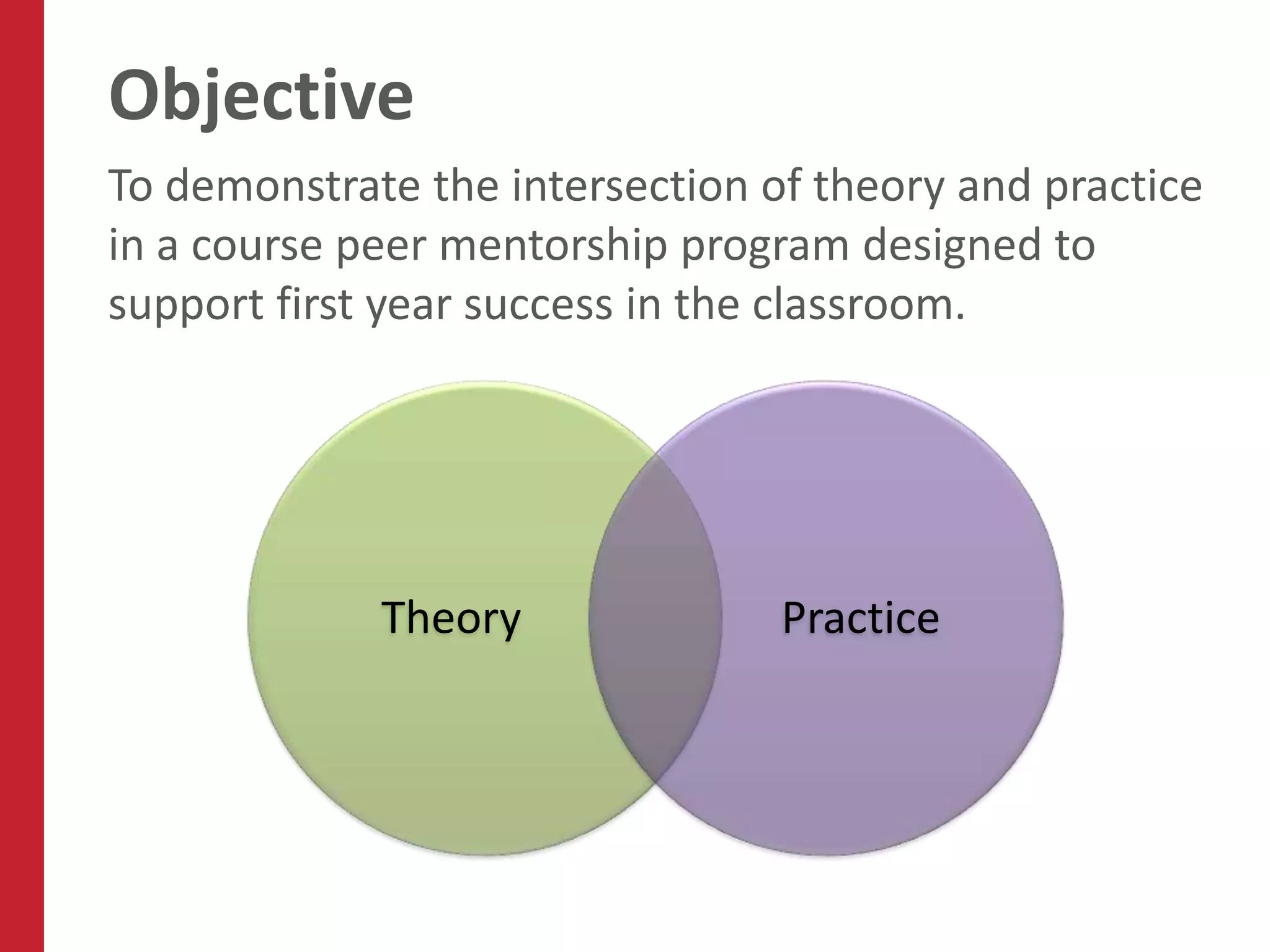
To demonstrate the intersection of theory and practice
in a course peer mentorship program designed to
support first year success in the classroom.


             Theory              Practice
It’s about YOU!
• Please feel free to interrupt us, REALLY!
• We want to hear from YOU!
• Just raise your hand and we’ll call on you.
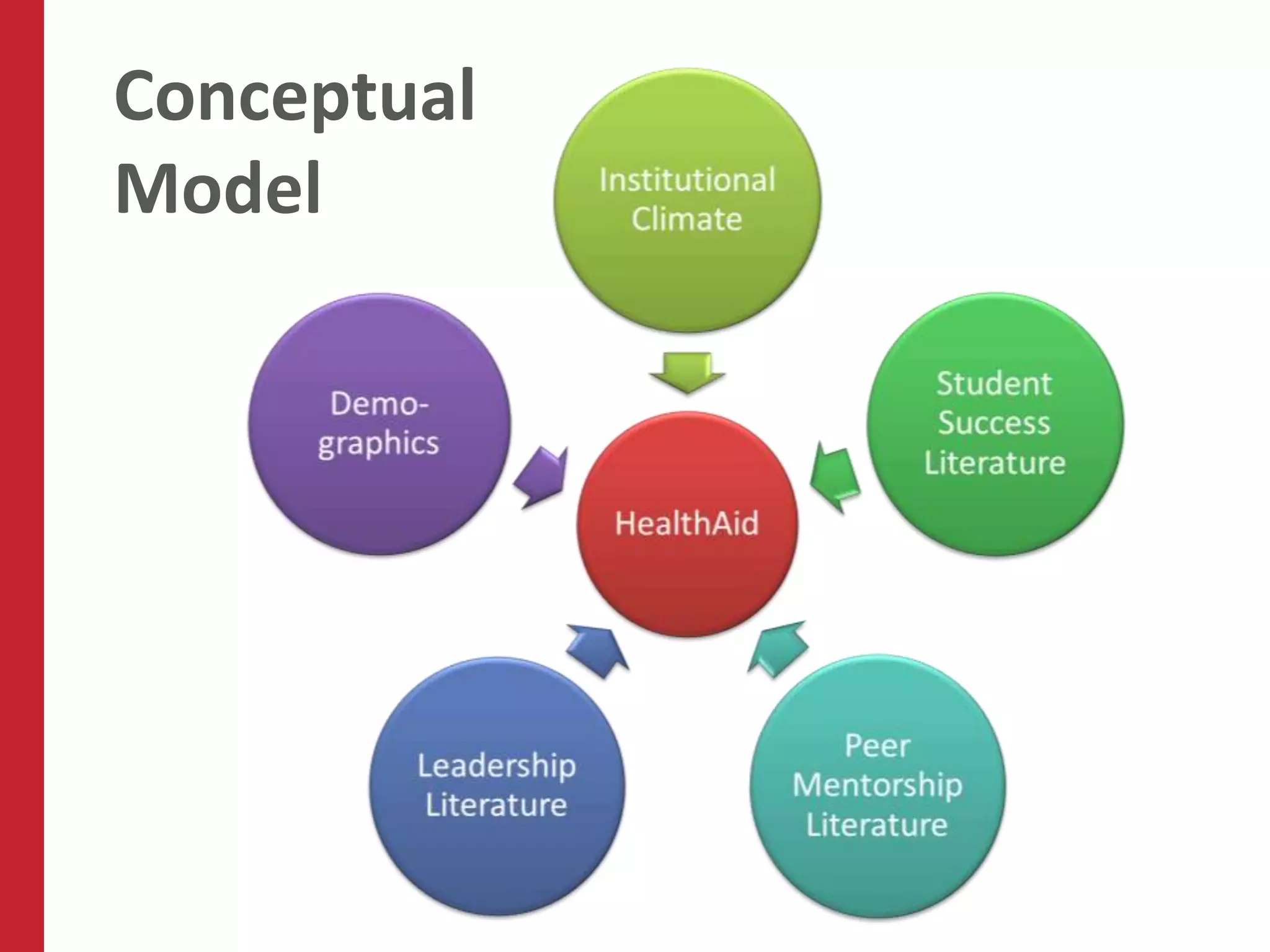
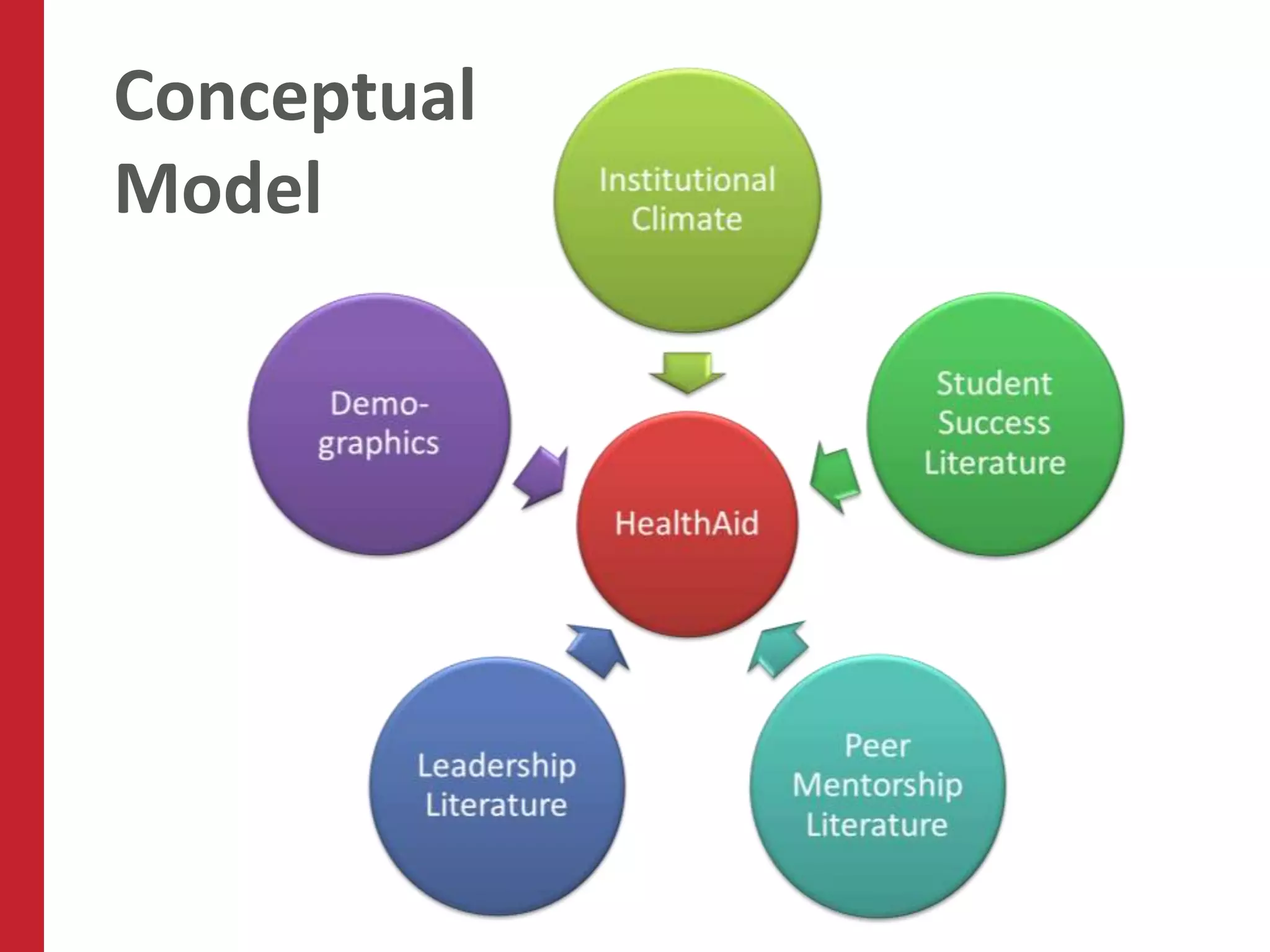
Conceptual
Model
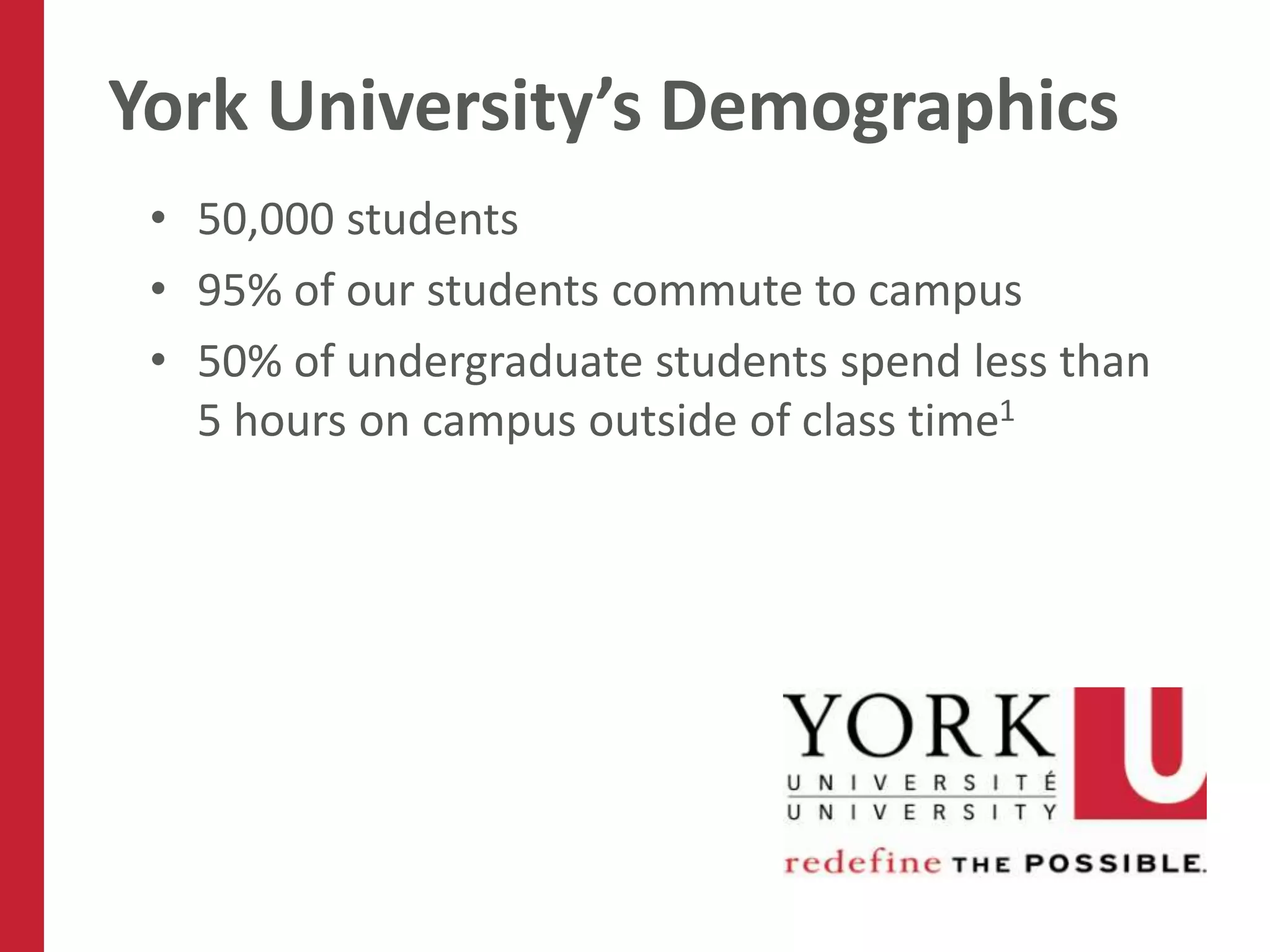
York University’s Demographics
 • 50,000 students
 • 95% of our students commute to campus
 • 50% of undergraduate students spend less than
   5 hours on campus outside of class time1
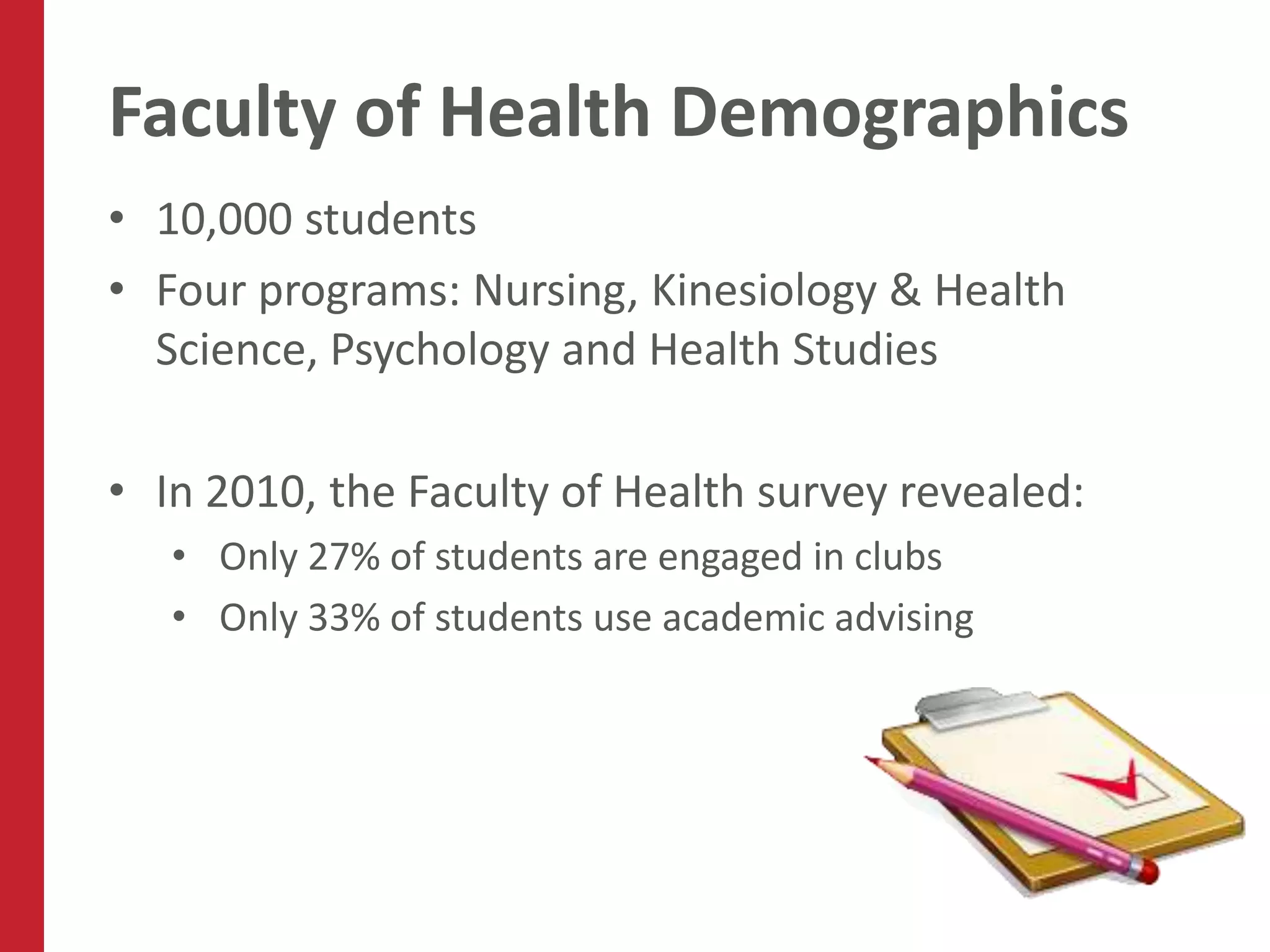
Faculty of Health Demographics
• 10,000 students
• Four programs: Nursing, Kinesiology & Health
  Science, Psychology and Health Studies

• In 2010, the Faculty of Health survey revealed:
   • Only 27% of students are engaged in clubs
   • Only 33% of students use academic advising
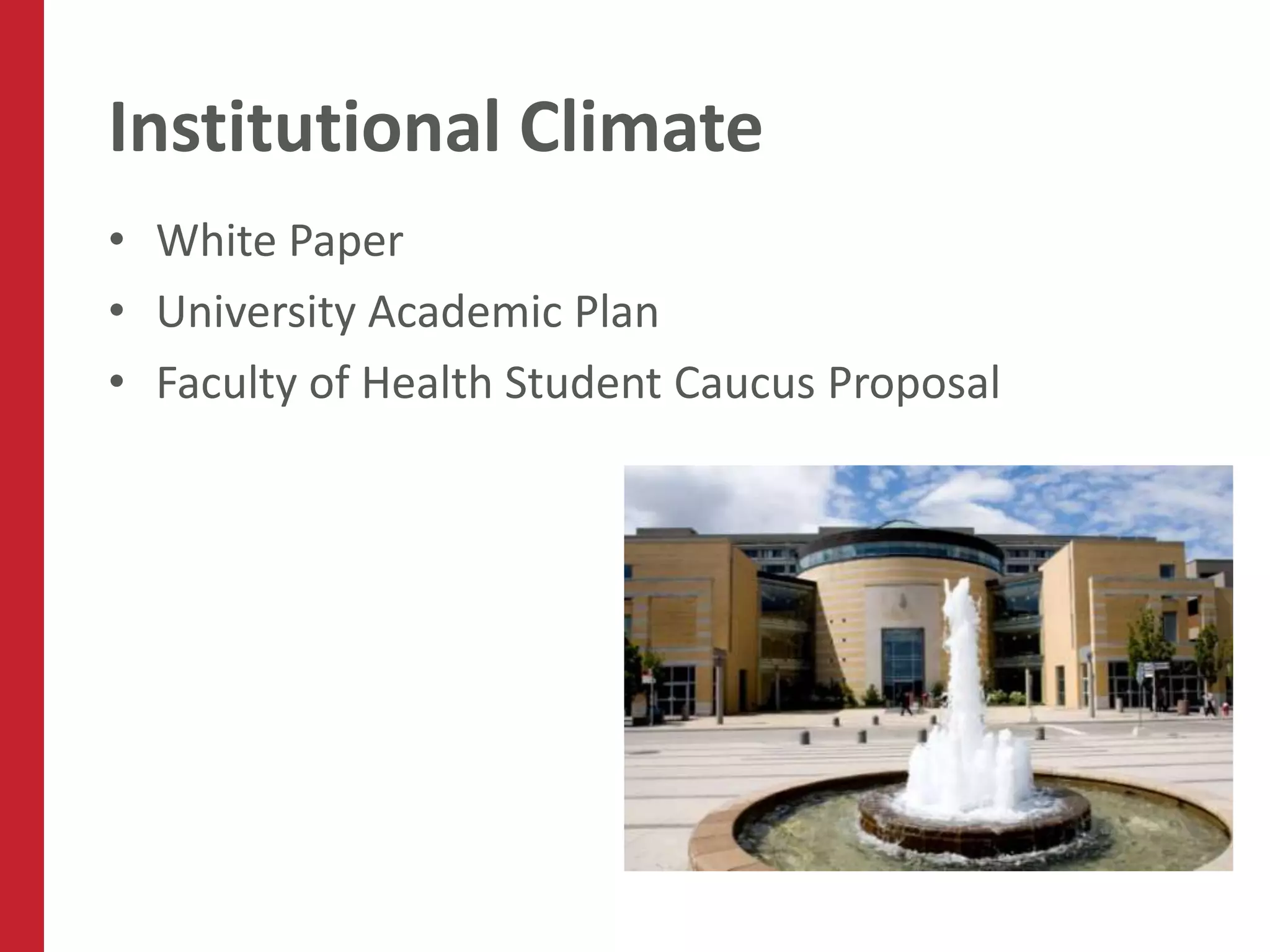
Institutional Climate
• White Paper
• University Academic Plan
• Faculty of Health Student Caucus Proposal
Design Decision
 Situate a first year success program in the classroom.
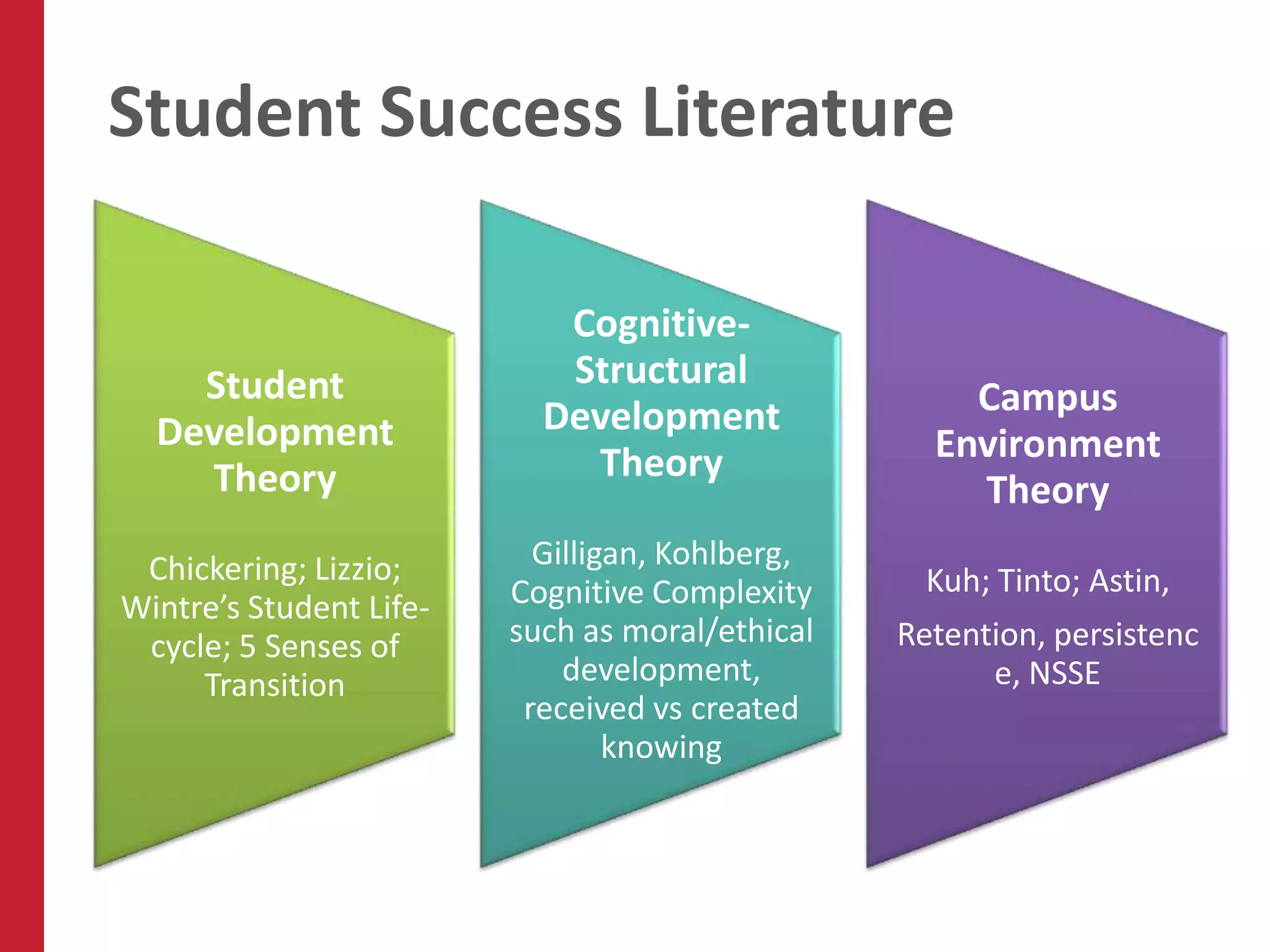
Student Success Literature

                            Cognitive-
    Student                 Structural
                           Development               Campus
  Development                                      Environment
    Theory                   Theory
                                                     Theory
 Chickering; Lizzio;       Gilligan, Kohlberg,
                         Cognitive Complexity      Kuh; Tinto; Astin,
Wintre’s Student Life-
 cycle; 5 Senses of      such as moral/ethical   Retention, persistenc
     Transition              development,              e, NSSE
                          received vs created
                                 knowing
Design Decision
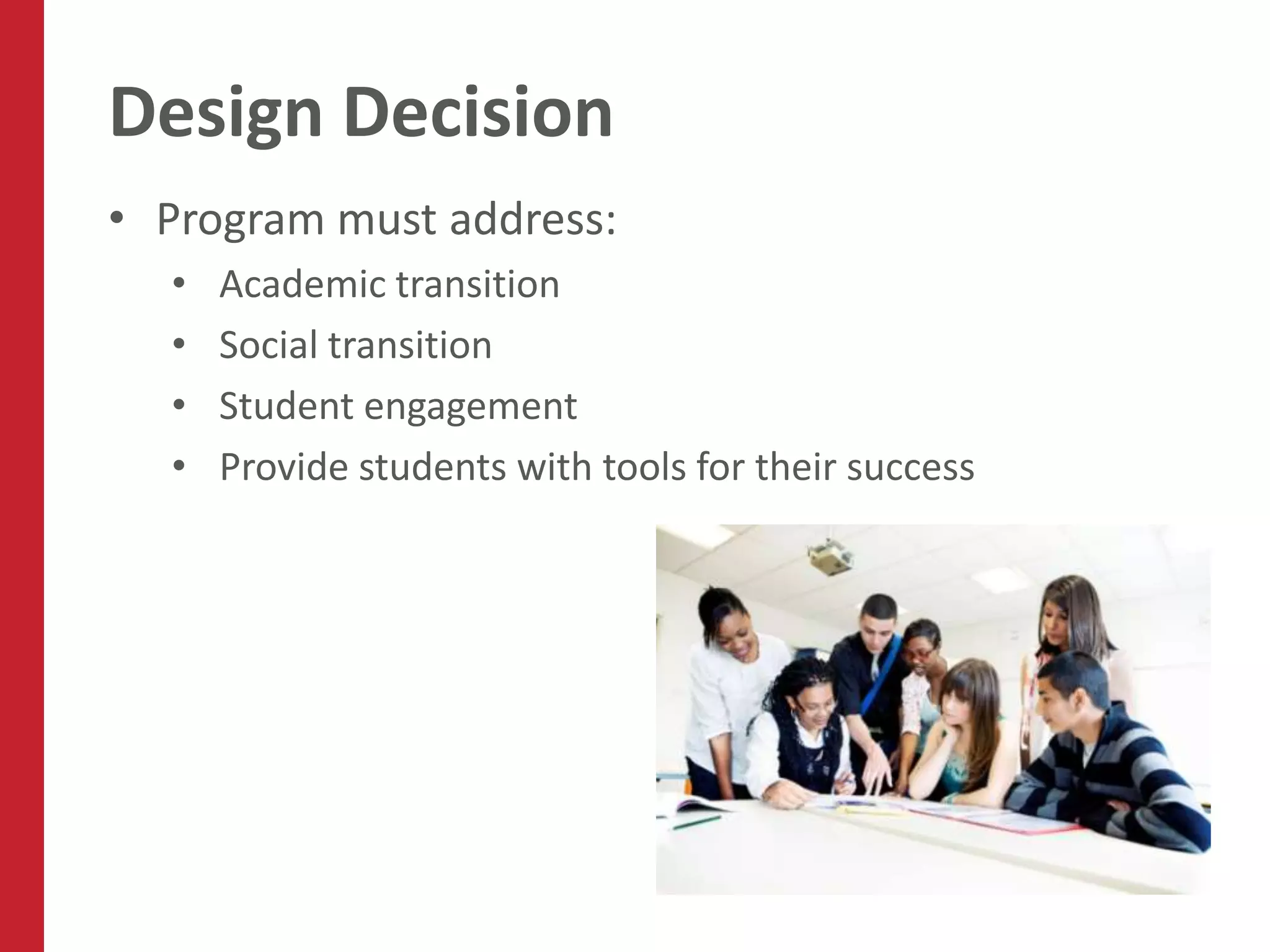
• Program must address:
  •   Academic transition
  •   Social transition
  •   Student engagement
  •   Provide students with tools for their success
BUT HOW?
What about peer
mentorship?
Raise your hand if you:
 • Know of a peer mentorship program at York

 • Believe that peer mentorship results in higher
   levels of student success

 • Have had a positive experience with
   peer mentoring
Peer Mentorship Literature
• Anecdotal findings are positive
• Empirical findings are equivocal

• 2 major criticisms
   1. Lack of clarity and consistency
   2. Without structure, the effect is minimal/non-existent
Successful Peer Mentorship Programs
•   Highly structured
•   Intentional Recruitment
•   High quality training
•   Systematic Evaluation Process
Design Decision
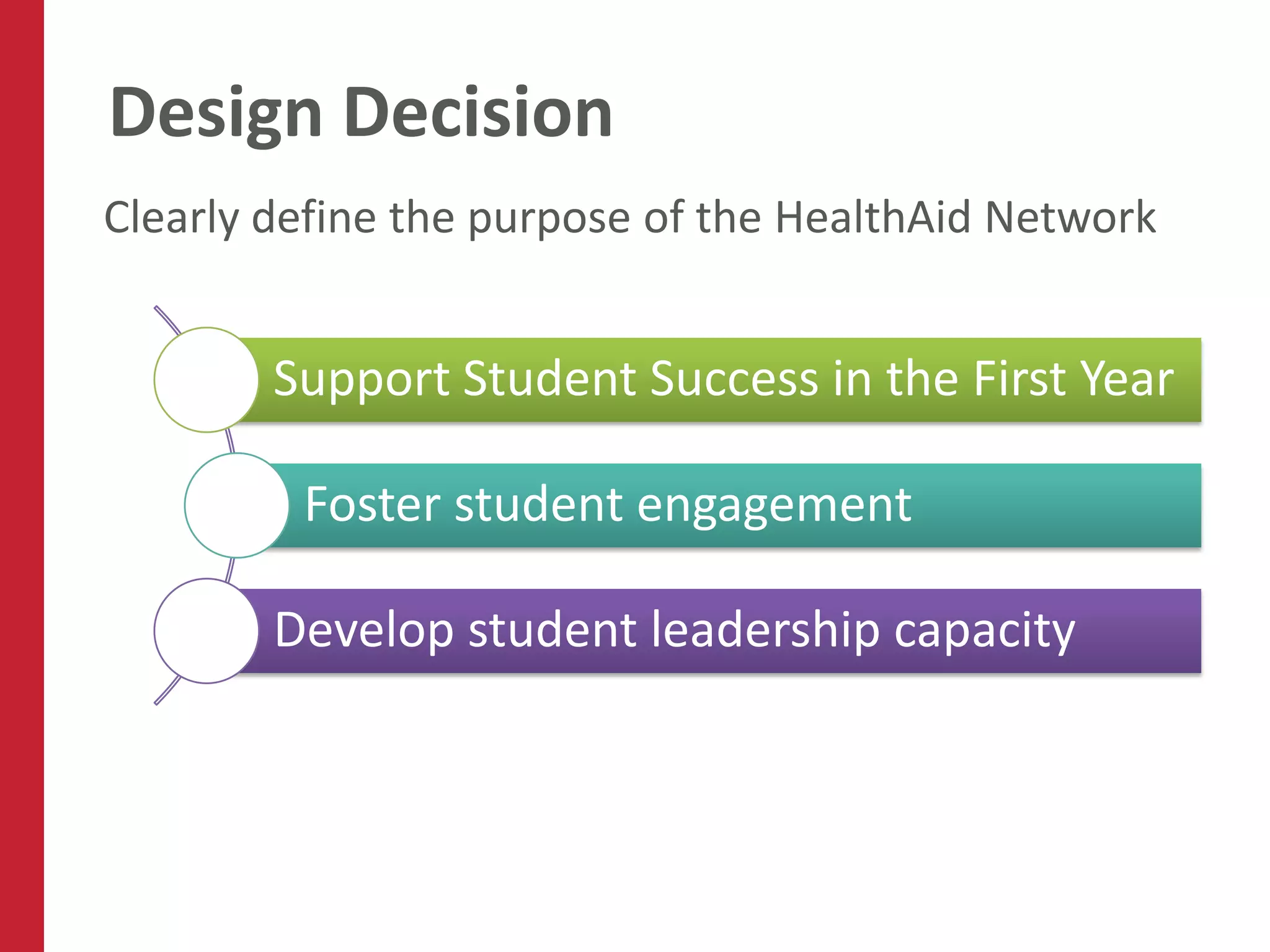
Clearly define the purpose of the HealthAid Network


        Support Student Success in the First Year

         Foster student engagement

        Develop student leadership capacity
Design Decision
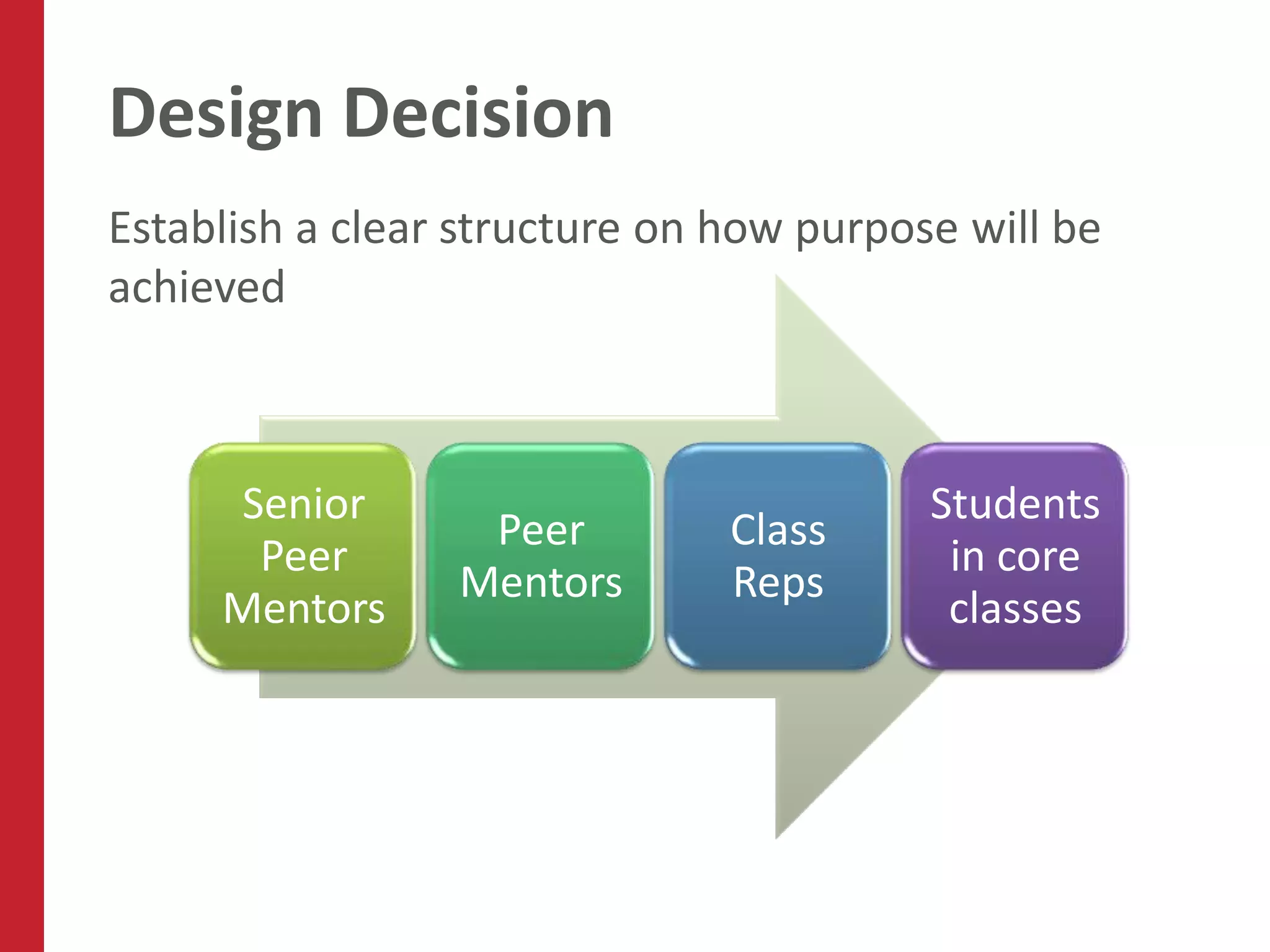
Establish a clear structure on how purpose will be
achieved


     Senior                              Students
                  Peer         Class
      Peer                                in core
                 Mentors       Reps
     Mentors                              classes
Design Decision
Establish nature and frequency of interaction:
   • Mentorship teams of 6
   • Biweekly meetings of 2 hours
   • Participate in leadership, student success and student
     engagement activities
   • Make announcements in large core classes once a week
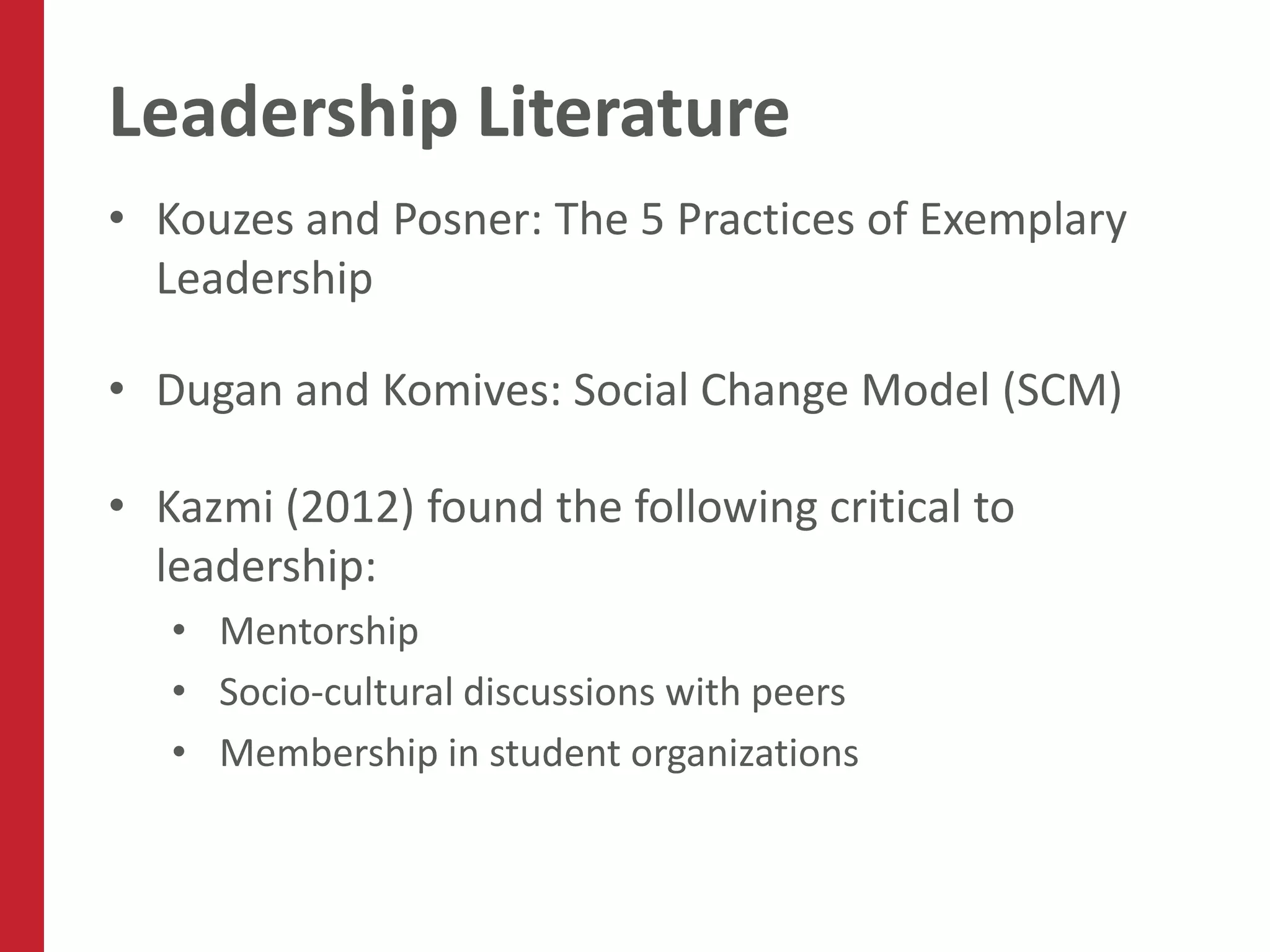
Leadership Literature
• Kouzes and Posner: The 5 Practices of Exemplary
  Leadership

• Dugan and Komives: Social Change Model (SCM)

• Kazmi (2012) found the following critical to
  leadership:
   • Mentorship
   • Socio-cultural discussions with peers
   • Membership in student organizations
Conceptual
Model
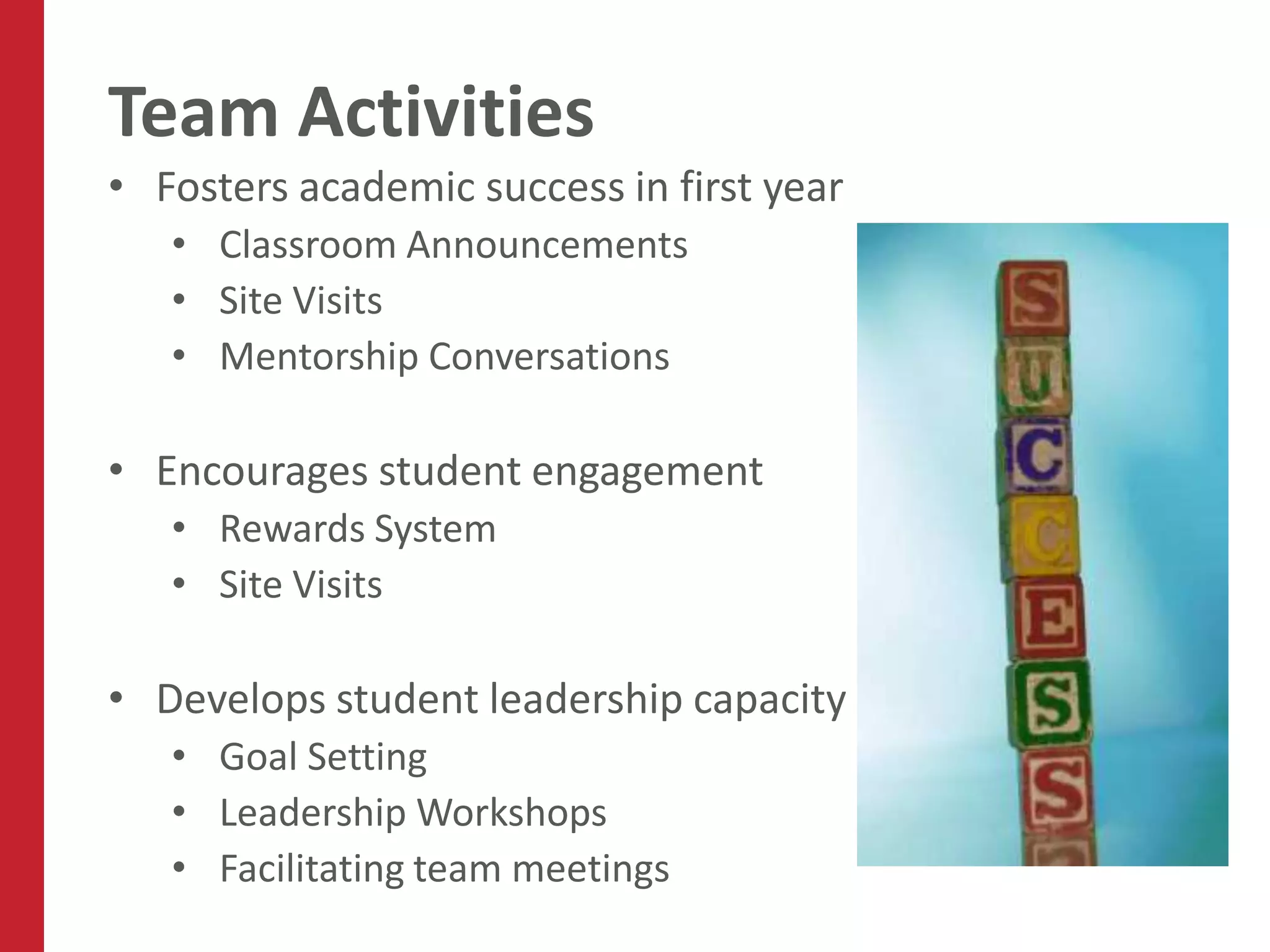
Team Activities
• Fosters academic success in first year
   • Classroom Announcements
   • Site Visits
   • Mentorship Conversations

• Encourages student engagement
   • Rewards System
   • Site Visits

• Develops student leadership capacity
   • Goal Setting
   • Leadership Workshops
   • Facilitating team meetings
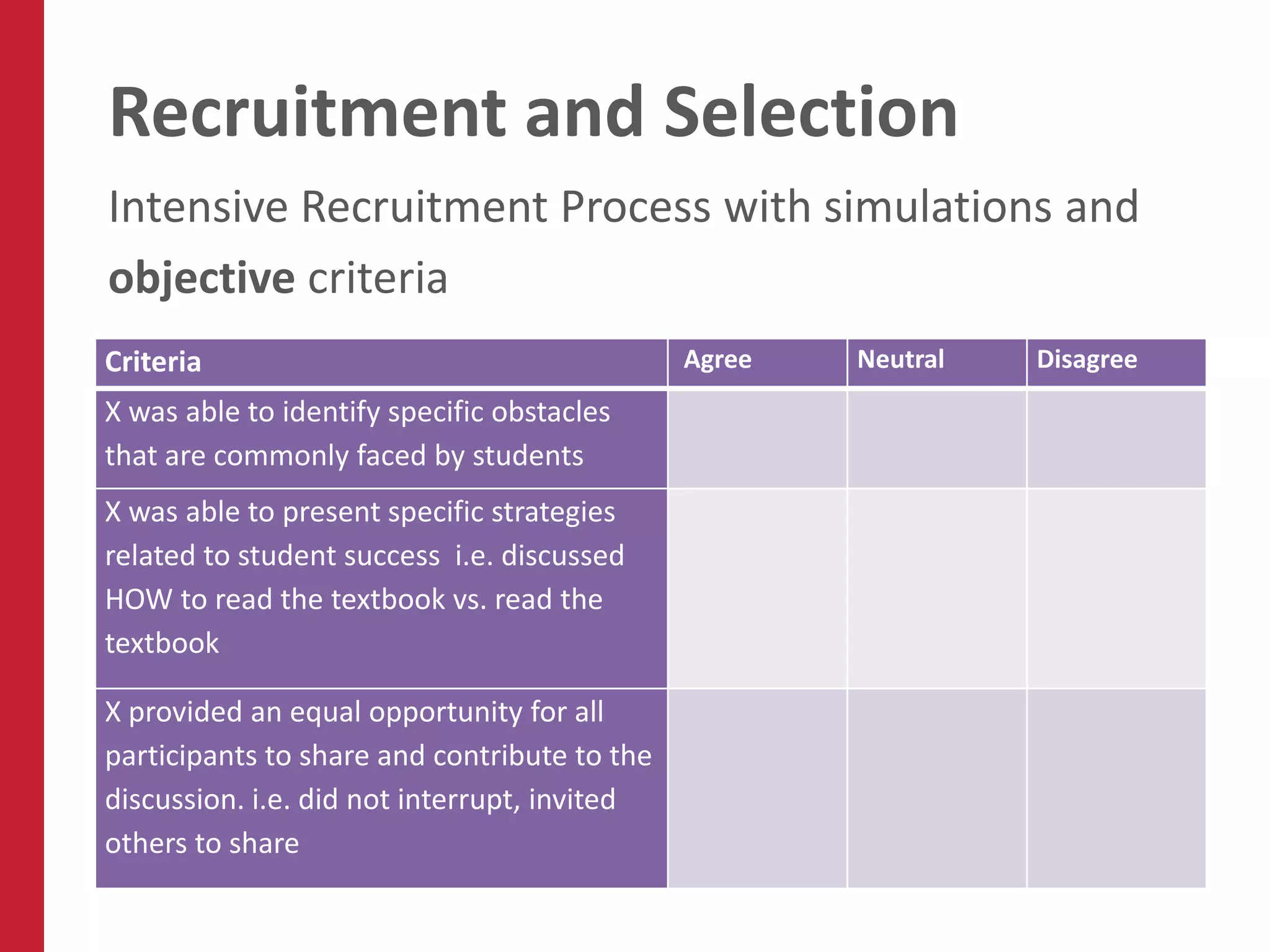
Recruitment and Selection
Intensive Recruitment Process with simulations and
objective criteria
Criteria                                      Agree   Neutral   Disagree
X was able to identify specific obstacles
that are commonly faced by students
X was able to present specific strategies
related to student success i.e. discussed
HOW to read the textbook vs. read the
textbook

X provided an equal opportunity for all
participants to share and contribute to the
discussion. i.e. did not interrupt, invited
others to share
Training and Development
Highly trained (20+ Hours) and ongoing development
that is participatory
Program Evaluation
2011/12: Comprehensive evaluation process
  • 950 surveys collected from students in core classes
  • 49 surveys collected from members
  • 800+ reflection forms collected from members
Students in Classes
• 67% reported improved awareness of campus
  resources

• 74% reported that class announcements helped
  them stay on track with important dates and
  deadlines

• 45% reported accessing one or more resources or
  having participated in a student life activity/event
Students in the Network –
Student Engagement & Academic
Success
80% to 90% of students reported:
  • Increased awareness of academic resources
  • Attainment of concrete skills
  • Interactions with new students
  • Feeling connected, supported and proud to be a
     part of the HealthAid Network
Students in the Network –
Leadership Development
80% to 90% of students felt that the following activities
contributed strongly to their leadership development:
   • Participating in and facilitating leadership workshops
   • Presenting and developing classroom
     announcements
   • Managing group morale and keeping team members
     motivated
   • Serving as a resource for peers
   • Interacting with staff and faculty
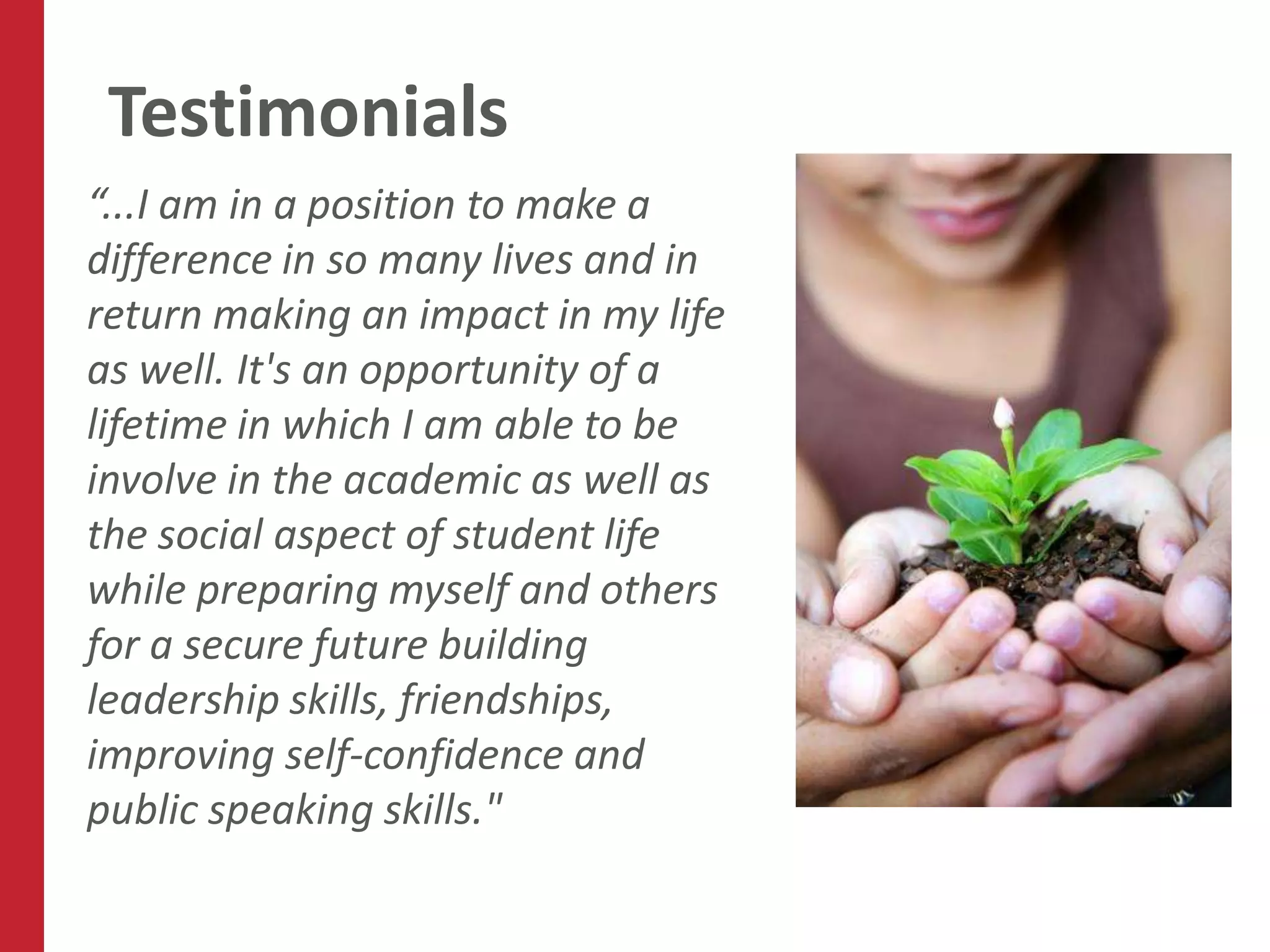
Testimonials
“...I am in a position to make a
difference in so many lives and in
return making an impact in my life
as well. It's an opportunity of a
lifetime in which I am able to be
involve in the academic as well as
the social aspect of student life
while preparing myself and others
for a secure future building
leadership skills, friendships,
improving self-confidence and
public speaking skills."
Sparking Innovation
• Peer Mentor access on Moodle
• Making Connections program
• YU START New Student Transition pilot
• Widespread use of Lizzio’s model of new student
  transition across the University
• Manual being developed for creating course-based
  peer mentorship programs
• International First Year Experience Conference
Summary
• Design decisions should be based on theory and
  practice
• PM programs are most successful when they are
  highly structured
• Evaluation is key for ensuring success
Now we want to hear from you!
• In a group of 3, please discuss and tell us:

   • What type of Peer Mentorship programs exist at your
     individual institutions?

   • What are the 3 most important lessons that you have
     learned from this presentation that you will take home
     with you?

   • What are some recommendations for our program based
     on your institutions’ approach to peer mentorship?
Selected References
Allen, T. and Eby, L. (2007). The Blackwell handbook of mentoring:A multiple perspectives
approach. Malden, MA:Blackwell Publ.

Cox, D. Hardy and Strange, C. (2010). Achieving student success: Effective student services in
Canadian higher education. Montreal & Kingston: McGill and Queen’s University Press.

Kazmi, A. (2012). Contextualizing Leadership: Where, When and How Do Leadership Values
Develop? University of Toronto, Qualifying Research Paper.

Kuh, G., Kinzie, J., Schuh, J., Whitt, E. and Associates (2005). Student success in college: Creating
conditions that matter. San Francisco, CA: John Wiley & Sons.

Lizzio, A. (2006). Five senses of success: Designing effective orientation and engagement
processes. Griffith University.

Nguyen, A. et al (2010). Faculty of Health: Comprehensive peer mentoring feasibility study.
Faculty of Health Student Caucus, York University, Toronto.
Selected References
Strange, C. & Craney, C. (2010). Theoretical foundations of student success. In D. Cox & C.
Strange (eds). Achieving Student Success: Effective student services in Canadian higher
education. Montral & Kingston:McGill-Queen’s University Press.

Tieu, T, Pancer, S, Pratt, M., Wintre, M., Birnie-Lefcovitch, Polivy, J. and Adams, G (2010) Helping
out or hanging out: the features of involvement and how it relates to university adjustment,
Higher Education 60(3), 343-355, DOI: 10.1007/s10734-009-9303-0

Wiggers, R. & Arnold, C. (2011). Defining, measuring and achieving “student success” in Ontario
colleges and universities. Toronto: Higher Education Quality Council of Ontario

Wintre, M. & Yaffe, M. (2000). First-Year students’ adjustment to university life as a function of
relationships with parents. Journal of Adolescent Research, 15 (1), 9-37.


Complete reference list available on request.
Thank You!
For more information, please contact:
Martha Rogers     mrogers@yorku.ca
Auroosa Kazmi     akazmi@yorku.ca

Or visit:
HealthAid Website http://healthaid.info.yorku.ca/

Supporting student success in first year symposium presentation

  • 1.
    Supporting Student Success in First Year Peer Mentorship in the Classroom Presented By: Martha Rogers and Auroosa Kazmi
  • 2.
    Objective To demonstrate theintersection of theory and practice in a course peer mentorship program designed to support first year success in the classroom. Theory Practice
  • 3.
    It’s about YOU! •Please feel free to interrupt us, REALLY! • We want to hear from YOU! • Just raise your hand and we’ll call on you.
  • 4.
  • 5.
    York University’s Demographics • 50,000 students • 95% of our students commute to campus • 50% of undergraduate students spend less than 5 hours on campus outside of class time1
  • 6.
    Faculty of HealthDemographics • 10,000 students • Four programs: Nursing, Kinesiology & Health Science, Psychology and Health Studies • In 2010, the Faculty of Health survey revealed: • Only 27% of students are engaged in clubs • Only 33% of students use academic advising
  • 7.
    Institutional Climate • WhitePaper • University Academic Plan • Faculty of Health Student Caucus Proposal
  • 8.
    Design Decision Situatea first year success program in the classroom.
  • 9.
    Student Success Literature Cognitive- Student Structural Development Campus Development Environment Theory Theory Theory Chickering; Lizzio; Gilligan, Kohlberg, Cognitive Complexity Kuh; Tinto; Astin, Wintre’s Student Life- cycle; 5 Senses of such as moral/ethical Retention, persistenc Transition development, e, NSSE received vs created knowing
  • 10.
    Design Decision • Programmust address: • Academic transition • Social transition • Student engagement • Provide students with tools for their success
  • 11.
    BUT HOW? What aboutpeer mentorship?
  • 12.
    Raise your handif you: • Know of a peer mentorship program at York • Believe that peer mentorship results in higher levels of student success • Have had a positive experience with peer mentoring
  • 13.
    Peer Mentorship Literature •Anecdotal findings are positive • Empirical findings are equivocal • 2 major criticisms 1. Lack of clarity and consistency 2. Without structure, the effect is minimal/non-existent
  • 14.
    Successful Peer MentorshipPrograms • Highly structured • Intentional Recruitment • High quality training • Systematic Evaluation Process
  • 15.
    Design Decision Clearly definethe purpose of the HealthAid Network Support Student Success in the First Year Foster student engagement Develop student leadership capacity
  • 16.
    Design Decision Establish aclear structure on how purpose will be achieved Senior Students Peer Class Peer in core Mentors Reps Mentors classes
  • 17.
    Design Decision Establish natureand frequency of interaction: • Mentorship teams of 6 • Biweekly meetings of 2 hours • Participate in leadership, student success and student engagement activities • Make announcements in large core classes once a week
  • 18.
    Leadership Literature • Kouzesand Posner: The 5 Practices of Exemplary Leadership • Dugan and Komives: Social Change Model (SCM) • Kazmi (2012) found the following critical to leadership: • Mentorship • Socio-cultural discussions with peers • Membership in student organizations
  • 19.
  • 20.
    Team Activities • Fostersacademic success in first year • Classroom Announcements • Site Visits • Mentorship Conversations • Encourages student engagement • Rewards System • Site Visits • Develops student leadership capacity • Goal Setting • Leadership Workshops • Facilitating team meetings
  • 21.
    Recruitment and Selection IntensiveRecruitment Process with simulations and objective criteria Criteria Agree Neutral Disagree X was able to identify specific obstacles that are commonly faced by students X was able to present specific strategies related to student success i.e. discussed HOW to read the textbook vs. read the textbook X provided an equal opportunity for all participants to share and contribute to the discussion. i.e. did not interrupt, invited others to share
  • 22.
    Training and Development Highlytrained (20+ Hours) and ongoing development that is participatory
  • 23.
    Program Evaluation 2011/12: Comprehensiveevaluation process • 950 surveys collected from students in core classes • 49 surveys collected from members • 800+ reflection forms collected from members
  • 24.
    Students in Classes •67% reported improved awareness of campus resources • 74% reported that class announcements helped them stay on track with important dates and deadlines • 45% reported accessing one or more resources or having participated in a student life activity/event
  • 25.
    Students in theNetwork – Student Engagement & Academic Success 80% to 90% of students reported: • Increased awareness of academic resources • Attainment of concrete skills • Interactions with new students • Feeling connected, supported and proud to be a part of the HealthAid Network
  • 26.
    Students in theNetwork – Leadership Development 80% to 90% of students felt that the following activities contributed strongly to their leadership development: • Participating in and facilitating leadership workshops • Presenting and developing classroom announcements • Managing group morale and keeping team members motivated • Serving as a resource for peers • Interacting with staff and faculty
  • 27.
    Testimonials “...I am ina position to make a difference in so many lives and in return making an impact in my life as well. It's an opportunity of a lifetime in which I am able to be involve in the academic as well as the social aspect of student life while preparing myself and others for a secure future building leadership skills, friendships, improving self-confidence and public speaking skills."
  • 28.
    Sparking Innovation • PeerMentor access on Moodle • Making Connections program • YU START New Student Transition pilot • Widespread use of Lizzio’s model of new student transition across the University • Manual being developed for creating course-based peer mentorship programs • International First Year Experience Conference
  • 29.
    Summary • Design decisionsshould be based on theory and practice • PM programs are most successful when they are highly structured • Evaluation is key for ensuring success
  • 30.
    Now we wantto hear from you! • In a group of 3, please discuss and tell us: • What type of Peer Mentorship programs exist at your individual institutions? • What are the 3 most important lessons that you have learned from this presentation that you will take home with you? • What are some recommendations for our program based on your institutions’ approach to peer mentorship?
  • 31.
    Selected References Allen, T.and Eby, L. (2007). The Blackwell handbook of mentoring:A multiple perspectives approach. Malden, MA:Blackwell Publ. Cox, D. Hardy and Strange, C. (2010). Achieving student success: Effective student services in Canadian higher education. Montreal & Kingston: McGill and Queen’s University Press. Kazmi, A. (2012). Contextualizing Leadership: Where, When and How Do Leadership Values Develop? University of Toronto, Qualifying Research Paper. Kuh, G., Kinzie, J., Schuh, J., Whitt, E. and Associates (2005). Student success in college: Creating conditions that matter. San Francisco, CA: John Wiley & Sons. Lizzio, A. (2006). Five senses of success: Designing effective orientation and engagement processes. Griffith University. Nguyen, A. et al (2010). Faculty of Health: Comprehensive peer mentoring feasibility study. Faculty of Health Student Caucus, York University, Toronto.
  • 32.
    Selected References Strange, C.& Craney, C. (2010). Theoretical foundations of student success. In D. Cox & C. Strange (eds). Achieving Student Success: Effective student services in Canadian higher education. Montral & Kingston:McGill-Queen’s University Press. Tieu, T, Pancer, S, Pratt, M., Wintre, M., Birnie-Lefcovitch, Polivy, J. and Adams, G (2010) Helping out or hanging out: the features of involvement and how it relates to university adjustment, Higher Education 60(3), 343-355, DOI: 10.1007/s10734-009-9303-0 Wiggers, R. & Arnold, C. (2011). Defining, measuring and achieving “student success” in Ontario colleges and universities. Toronto: Higher Education Quality Council of Ontario Wintre, M. & Yaffe, M. (2000). First-Year students’ adjustment to university life as a function of relationships with parents. Journal of Adolescent Research, 15 (1), 9-37. Complete reference list available on request.
  • 33.
    Thank You! For moreinformation, please contact: Martha Rogers mrogers@yorku.ca Auroosa Kazmi akazmi@yorku.ca Or visit: HealthAid Website http://healthaid.info.yorku.ca/

Editor's Notes

  • #2 Martha and AuroosaWe will introduce ourselves here as well.
  • #3 MarthaIllustrate the intersection of theory and practice as it relates to a course based PM program which we call the HealthAid Network. This program reached 2500 students in 2011-2012 and will reach over 4500 students in 2012-13. Our focus for today is how theory and practice informed the design, implementation and evaluation of the program.We look forward to engaging with you and having conversation and dialogue.
  • #4 Martha
  • #5 MarthaWe used the following factors when determining our conceptual model.
  • #6 MarthaImagine you are a first year student coming to university. The university you are attending is quite large, with over 80,000 people, 50,000 of which are other students. Work 15 hours a week on average, many work much more. More than 60% live at home.
  • #7 MarthaYou belong to the Faculty of Health a smaller but not small home with 10,000 students. You want to be engaged but it is still difficult with a Faculty of that size. As a survey pointed out, you’re not alone. Give stats.
  • #8 MarthaBut the university wants to help you… The University White Paper and Academic Plan have emphasized student experience as key and have explicitly supported innovations in student experience and learning through an innovation fund. The university climate is ripe to support change. The Faculty of Health Student Caucus recognized that students like you need better support particularly in the first year.
  • #9 MarthaMcElroy and Usher reported on the challenges faced by universities in Canada. They noted that in all student survey data, such as the NSSE, large universites struggle with perceptions of how supportive the environment in fostering student success. National surveys consistently report highest levels of engagement in small institutions. Being a large university where students commute and spend little time on campus is a real challenge. Consequently we decided, that you (students) need the information where and when you need it. So we put the HealthAid Network peer mentorship program in the classroom.
  • #10 MarthaDecades of research have shown that student success is complex and there is no one silver bullet that can create a panacea of student success so that means we need to examine the multiple lenses that make up student success.So Hardy and Cox cluster the lenses in this way. We examined theories and research that fall under each of these categories. <Elaborate>We have selected different theoretical models depending on what we’re working on, but for the purposes of the HealthAid Network, we tended to use the work of Tinto, Pascarella, Kuh who focus on social and academic transition, student engagement and the environment in which student success can be fostered.As you recall, our students tend to be disengaged and spend very few hours on campus. This is not unusual
  • #11 MarthaNote: Social transition: team based, help them make friends.Ending: “But the question is…”
  • #12 Auroosa
  • #13 AuroosaFollow up q: What lead to your positive experiences?
  • #14 Auroosa
  • #15 AuroosaHighly structuredClear program objectivesRole clarityNature and frequency of interactions
  • #16 Auroosa
  • #17 AuroosaDefine roles (Senior PMs, Peer Mentors, Class Reps)
  • #18 AuroosaSHOW ANNOUNCEMENT HERE
  • #19 AuroosaLike student success, the literature on leadership is vast. For the purpose of the HealthAid Network, the social change model and
  • #20 AuroosaLet’s recall our conceptual model…how did this help us decide what we were going to actually do?
  • #21 Auroosa
  • #22 AuroosaThe interview process simulates what they will actually be doing in the role.
  • #23 AuroosaEnding: “But how do we know if all of this is actually working?”
  • #24 Martha“We conduct an evaluation of the impact of the program on students in the core 1000 level courses in which HealthAid was offered as well as on those first year and upper year students who were active participants in the program either as Mentors or Class Reps. The evaluation focused on the 3 objectives of the program: to foster student success and engagement while building leadership skills. We depended on self-reported data for this evaluation. The response rate of students in the classes was far in excess of 50% with 90%????? Response rate among students who were direct participants. Given the data and response rates we are fairly confident with data.
  • #25 Wiggers and Arnold, 2011 in their study Defining, measuring and achieving student success in Ontario colleges and universities reported that even when students are aware of resources only 14% report having used them. Therefore, these findings are quite significant.
  • #26 MarthaTale of a Student – HumzaYou can quote if you like.Hi my name is Humza and I was a class rep in the HealthAid Network this past year. Being an active member in this organization provided me with the opportunity to interact with students, staff, and faculty members and enhance my leadership skills. For example one of the skills that I developed through this program was effective listening/communication skills. Since I was placed in diverse group, I had the opportunity to listen to a variety of perspectives, work collaboratively to come up with a common solution, and develop my critical thinking skills by exploring all options and not taking things for granted. With the exception of Kine 1000 and Social Science class, most of the prerequisite courses students take in their first year does not encourage critical thinking skills. However, through this program I was able to develop this particular skill, it really helped me understand the course concepts and succeed in my classes such as Kine 1000 and the Social Science! Our group had such a positive dynamic and we were able to relate to each other’s problems, and guide each other in right direction. I find I use this skill on a daily basis. The HealthAid really helped me with my time management and taught me how to set SMART goals, which I think is critical in order to be a successful university student. Managing time is especially difficult for first year students and the HealthAid meetings helped me to break down large tasks into small manageable goals/tasks. This really helped with my Kine 1000 interview analysis assignment where we had to go and conduct an interview with a practitioner in a Health related field. Although this assignment was due towards the end of February I was able to successfully finish this assignment within after a week it had been assigned. The main reason why I successfully finished this was because I managed my time effectively and as a result I was able to get A on this assignment which was the highest mark in my tutorial class. By joining HealthAid, I’ve also been exposed to and joined other organizations such as FHSC, GRASP, and York is U where I volunteer and am actively involved occasionally. This was important to me because it introduced me to new individuals, make connections, and on several occasion I personally met with Dr. Harvey Skinner as well. To conclude, I would like to thank HealthAid Network for making my first year remarkably successful and memorable, not only because it made a difference in my life by building leadership skills, long lasting friendships, public speaking and improved self confidence; but also in return I was able to share the “vision” of HealthAid; “student success” with my colleagues and was able to make a difference in their lives by encouraging them to be actively involved and take advantages of the programs the university offers! Thank you.
  • #27 MarthaTale of a Student: ShaganaPlease don’t quote her, but just use some of the ideas represented here.I feel that I have improved my public speaking and have less anxiety. In the beginning I remembered how uptight I was when speaking because I feared that I would make mistakes. I learned it really does not matter if you make mistakes when public speaking, because it happens and thats why its important to improvise. I really admired these skills from Shannon. Her improvisation was the best when she adds humour. Other than that, I am happy to have peer mentored our class reps through out the year. I have walked into one of their announcements and I felt their nervousness as a class representative. They had done a great job and I was happy to give tips and advice for their future announcements. During the announcement, Isabella stood out to me as a leader because the class was talking while Bryce and her were presenting and she had told the class to be quiet and said something along the lines of: "We have put effort to make this announcement to help you guys access resources that may benefit you, and there may be a few people here that would want to listen to this, so please be quiet".
  • #28 Summary statement of evaluation: We are confident that the HealthAid Network is achieving its objectives as is evident from the evaluation data. As we move forward we are hoping to begin tracking academic performance data to add another layer to the depth of the evaluation.
  • #29 Established effective partnerships across the university.
  • #30 To recap what theHealthAid Network is all about…<SHOW HEALTHAID VIDEO>
  • #31 Don’t actually do this slide but just tell listeners that we will be doing this at the conference.