Dependable Strengths Articulation:
Career Center Takes Career
Development to Departments
NCDA Global Conference – June 21, 2014
Kate Duttro, D.Ed.- Anthropology
Career Change for Academics, Seattle Career Trainer,
University of Washington Career Center (retired)
Master Trainer, Center for Dependable Strengths
Vic Snyder, M.Ed.
Associate Director
University of Washington Career Center
Master Trainer, Center for Dependable Strengths
Presentation Overview
• Change in career emphasis at R1 institution
• How it’s happening (DS + HE)
• The Dependable Strengths Articulation Process
• The Husky Experience initiative
• Dependable Strengths adviser training
• Advisers’ implementation of DS with students
• Initial results of DS use
• Future HE plans
• Additional DS trainings
1/7/20152
Change in career emphasis at a Research 1
institution
• Prior to Great Recession (2008)
– Little emphasis on career development
• Effects of Great Recession
– Perceptions change (especially students’ parents)
– Impacts university administration & faculty
1/7/20153
How it’s happening  DS plus HE
• History of DSAP benefits for students/alumni
– Alumni & Grad Student 2-day DS workshops
– Major Skills workshops, NCO career class
• Departmental advisers request DS training in late
summer 2013
• Husky Experience initiative introduced Fall 2013
to faculty and Spring 2014 to advisers
1/7/20154
Intro to Dependable Strengths
Articulation
• Strength: Capacity to do something
• Dependable Strength: Motivated
skill/ability/strength that is used repeatedly in
Good Experiences
• Good Experience: Something you have
done well, enjoyed doing and are proud of
• Let’s give it a try!
Benefits of Good Experiences
 Revives positive feelings...
• competence
• joy
• pride
 Counters negativity, reduces fear of change
 Taps into internal motivation and identity
 Reveals primary (Dependable) strengths
What is a Dependable Strength?
• Shows up repeatedly in top Good Experiences
• Used often in the past
• Enjoy using it now
• Strongly want to use in the future
• Inner motivated to use it
dependablestrengths.org/
Current DS Offerings
• Working with students to discover Dependable
Strengths
– Navigating Career Options Course
– Major Skills Workshops (academic Good Experiences)
– In-house and requested job search workshops
• http://careers.washington.edu/Workshops
• Grad Student/Ph.D. workshops
– http://careers.washington.edu/DSSforGrads
• Alumni workshops
– http://careers.washington.edu/DSSforAlumni
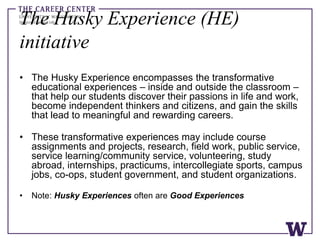
The Husky Experience (HE)
initiative
• The Husky Experience encompasses the transformative
educational experiences – inside and outside the classroom –
that help our students discover their passions in life and work,
become independent thinkers and citizens, and gain the skills
that lead to meaningful and rewarding careers.
• These transformative experiences may include course
assignments and projects, research, field work, public service,
service learning/community service, volunteering, study
abroad, internships, practicums, intercollegiate sports, campus
jobs, co-ops, student government, and student organizations.
• Note: Husky Experiences often are Good Experiences
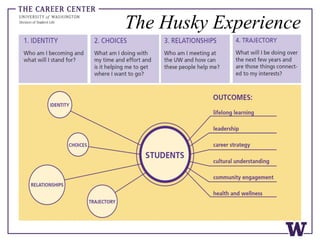
The Husky Experience
High level HE buy-in!
Washington State Futures Committee Recommendations
• Producing our next generation of leaders – August 2013
– Proficiency in what the American Association of Colleges and
Universities (AAC&U) calls “essential learning outcomes”— broad,
transferrable skills.
– Transformative, “high-impact” learning experiences that help students
develop skills through real life problem-solving in & out of the classroom.
– Introducing students early to career strategy skills.
UW Provost Report Series – Faculty Focus
• Helping UW Students Prepare for Life after Graduation: It Takes All of
Us – January 2014
• Innovators Among Us – May 2014
Introduction of Husky Experience at All Advisers Meeting
– Spring 2014
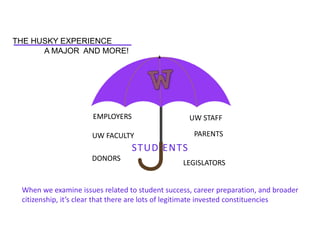
STUD ENTS
PARENTS
UW STAFFEMPLOYERS
LEGISLATORS
UW FACULTY
DONORS
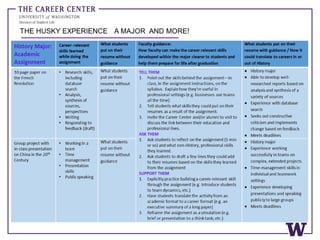
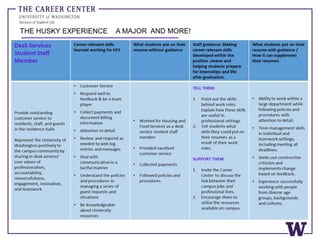
A MAJOR AND MORE!
THE HUSKY EXPERIENCE
When we examine issues related to student success, career preparation, and broader
citizenship, it’s clear that there are lots of legitimate invested constituencies
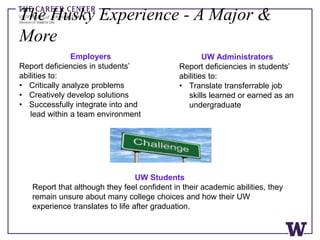
The Husky Experience - A Major &
More
Employers
Report deficiencies in students’
abilities to:
• Critically analyze problems
• Creatively develop solutions
• Successfully integrate into and
lead within a team environment
UW Administrators
Report deficiencies in students’
abilities to:
• Translate transferrable job
skills learned or earned as an
undergraduate
UW Students
Report that although they feel confident in their academic abilities, they
remain unsure about many college choices and how their UW
experience translates to life after graduation.
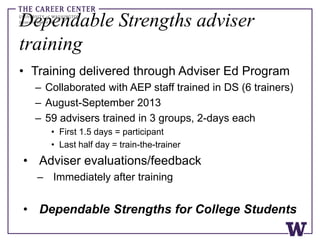
Dependable Strengths adviser
training
• Training delivered through Adviser Ed Program
– Collaborated with AEP staff trained in DS (6 trainers)
– August-September 2013
– 59 advisers trained in 3 groups, 2-days each
• First 1.5 days = participant
• Last half day = train-the-trainer
• Adviser evaluations/feedback
– Immediately after training
• Dependable Strengths for College Students
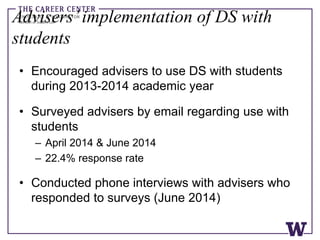
Advisers’implementation of DS with
students
• Encouraged advisers to use DS with students
during 2013-2014 academic year
• Surveyed advisers by email regarding use with
students
– April 2014 & June 2014
– 22.4% response rate
• Conducted phone interviews with advisers who
responded to surveys (June 2014)
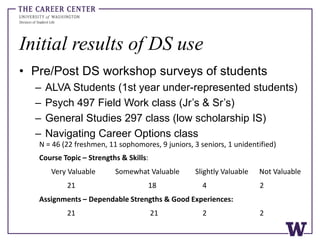
Initial results of DS use
• Pre/Post DS workshop surveys of students
– ALVA Students (1st year under-represented students)
– Psych 497 Field Work class (Jr’s & Sr’s)
– General Studies 297 class (low scholarship IS)
– Navigating Career Options class
N = 46 (22 freshmen, 11 sophomores, 9 juniors, 3 seniors, 1 unidentified)
Course Topic – Strengths & Skills:
Very Valuable Somewhat Valuable Slightly Valuable Not Valuable
21 18 4 2
Assignments – Dependable Strengths & Good Experiences:
21 21 2 2
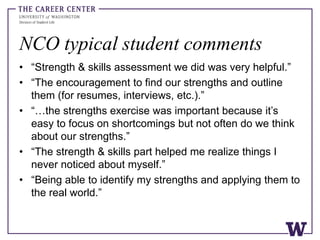
NCO typical student comments
• “Strength & skills assessment we did was very helpful.”
• “The encouragement to find our strengths and outline
them (for resumes, interviews, etc.).”
• “…the strengths exercise was important because it’s
easy to focus on shortcomings but not often do we think
about our strengths.”
• “The strength & skills part helped me realize things I
never noticed about myself.”
• “Being able to identify my strengths and applying them to
the real world.”
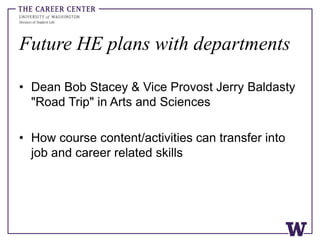
Future HE plans with departments
• Dean Bob Stacey & Vice Provost Jerry Baldasty
"Road Trip" in Arts and Sciences
• How course content/activities can transfer into
job and career related skills
Other plans with advisers…
• Undergraduate Academic Advising
– Incorporating HE language on their website
• First Year Programs – The Husky Experience:
Finding Your Learning Community
– Learn about how to enhance your undergraduate
experience - http://fyp.washington.edu/fyp-videos/
Additional DS trainings, etc.
• Future adviser trainings
• Future integration with HE
• Additional findings regarding DS use
Questions/Discussion
Dependable Strengths Articulation: Career Center Takes
Career Development to Departments
NCDA Global Conference – June 21, 2014
Thank You!
Kate Duttro, D.Ed.- Anthropology
206-923-8810
duttro@uw.edu
Vic Snyder, M.Ed.
vsnyder@uw.edu
206-616-5806
careers.uw.edu

NCDA DSAP-UW Depts-Jun-2014

  • 1.
    Dependable Strengths Articulation: CareerCenter Takes Career Development to Departments NCDA Global Conference – June 21, 2014 Kate Duttro, D.Ed.- Anthropology Career Change for Academics, Seattle Career Trainer, University of Washington Career Center (retired) Master Trainer, Center for Dependable Strengths Vic Snyder, M.Ed. Associate Director University of Washington Career Center Master Trainer, Center for Dependable Strengths
  • 2.
    Presentation Overview • Changein career emphasis at R1 institution • How it’s happening (DS + HE) • The Dependable Strengths Articulation Process • The Husky Experience initiative • Dependable Strengths adviser training • Advisers’ implementation of DS with students • Initial results of DS use • Future HE plans • Additional DS trainings 1/7/20152
  • 3.
    Change in careeremphasis at a Research 1 institution • Prior to Great Recession (2008) – Little emphasis on career development • Effects of Great Recession – Perceptions change (especially students’ parents) – Impacts university administration & faculty 1/7/20153
  • 4.
    How it’s happening DS plus HE • History of DSAP benefits for students/alumni – Alumni & Grad Student 2-day DS workshops – Major Skills workshops, NCO career class • Departmental advisers request DS training in late summer 2013 • Husky Experience initiative introduced Fall 2013 to faculty and Spring 2014 to advisers 1/7/20154
  • 5.
    Intro to DependableStrengths Articulation • Strength: Capacity to do something • Dependable Strength: Motivated skill/ability/strength that is used repeatedly in Good Experiences • Good Experience: Something you have done well, enjoyed doing and are proud of • Let’s give it a try!
  • 6.
    Benefits of GoodExperiences  Revives positive feelings... • competence • joy • pride  Counters negativity, reduces fear of change  Taps into internal motivation and identity  Reveals primary (Dependable) strengths
  • 7.
    What is aDependable Strength? • Shows up repeatedly in top Good Experiences • Used often in the past • Enjoy using it now • Strongly want to use in the future • Inner motivated to use it dependablestrengths.org/
  • 8.
    Current DS Offerings •Working with students to discover Dependable Strengths – Navigating Career Options Course – Major Skills Workshops (academic Good Experiences) – In-house and requested job search workshops • http://careers.washington.edu/Workshops • Grad Student/Ph.D. workshops – http://careers.washington.edu/DSSforGrads • Alumni workshops – http://careers.washington.edu/DSSforAlumni
  • 9.
    The Husky Experience(HE) initiative • The Husky Experience encompasses the transformative educational experiences – inside and outside the classroom – that help our students discover their passions in life and work, become independent thinkers and citizens, and gain the skills that lead to meaningful and rewarding careers. • These transformative experiences may include course assignments and projects, research, field work, public service, service learning/community service, volunteering, study abroad, internships, practicums, intercollegiate sports, campus jobs, co-ops, student government, and student organizations. • Note: Husky Experiences often are Good Experiences
  • 10.
  • 11.
    High level HEbuy-in! Washington State Futures Committee Recommendations • Producing our next generation of leaders – August 2013 – Proficiency in what the American Association of Colleges and Universities (AAC&U) calls “essential learning outcomes”— broad, transferrable skills. – Transformative, “high-impact” learning experiences that help students develop skills through real life problem-solving in & out of the classroom. – Introducing students early to career strategy skills. UW Provost Report Series – Faculty Focus • Helping UW Students Prepare for Life after Graduation: It Takes All of Us – January 2014 • Innovators Among Us – May 2014 Introduction of Husky Experience at All Advisers Meeting – Spring 2014
  • 12.
    STUD ENTS PARENTS UW STAFFEMPLOYERS LEGISLATORS UWFACULTY DONORS A MAJOR AND MORE! THE HUSKY EXPERIENCE When we examine issues related to student success, career preparation, and broader citizenship, it’s clear that there are lots of legitimate invested constituencies
  • 13.
    The Husky Experience- A Major & More Employers Report deficiencies in students’ abilities to: • Critically analyze problems • Creatively develop solutions • Successfully integrate into and lead within a team environment UW Administrators Report deficiencies in students’ abilities to: • Translate transferrable job skills learned or earned as an undergraduate UW Students Report that although they feel confident in their academic abilities, they remain unsure about many college choices and how their UW experience translates to life after graduation.
  • 14.
    Dependable Strengths adviser training •Training delivered through Adviser Ed Program – Collaborated with AEP staff trained in DS (6 trainers) – August-September 2013 – 59 advisers trained in 3 groups, 2-days each • First 1.5 days = participant • Last half day = train-the-trainer • Adviser evaluations/feedback – Immediately after training • Dependable Strengths for College Students
  • 15.
    Advisers’implementation of DSwith students • Encouraged advisers to use DS with students during 2013-2014 academic year • Surveyed advisers by email regarding use with students – April 2014 & June 2014 – 22.4% response rate • Conducted phone interviews with advisers who responded to surveys (June 2014)
  • 16.
    Initial results ofDS use • Pre/Post DS workshop surveys of students – ALVA Students (1st year under-represented students) – Psych 497 Field Work class (Jr’s & Sr’s) – General Studies 297 class (low scholarship IS) – Navigating Career Options class N = 46 (22 freshmen, 11 sophomores, 9 juniors, 3 seniors, 1 unidentified) Course Topic – Strengths & Skills: Very Valuable Somewhat Valuable Slightly Valuable Not Valuable 21 18 4 2 Assignments – Dependable Strengths & Good Experiences: 21 21 2 2
  • 17.
    NCO typical studentcomments • “Strength & skills assessment we did was very helpful.” • “The encouragement to find our strengths and outline them (for resumes, interviews, etc.).” • “…the strengths exercise was important because it’s easy to focus on shortcomings but not often do we think about our strengths.” • “The strength & skills part helped me realize things I never noticed about myself.” • “Being able to identify my strengths and applying them to the real world.”
  • 18.
    Future HE planswith departments • Dean Bob Stacey & Vice Provost Jerry Baldasty "Road Trip" in Arts and Sciences • How course content/activities can transfer into job and career related skills
  • 21.
    Other plans withadvisers… • Undergraduate Academic Advising – Incorporating HE language on their website • First Year Programs – The Husky Experience: Finding Your Learning Community – Learn about how to enhance your undergraduate experience - http://fyp.washington.edu/fyp-videos/
  • 22.
    Additional DS trainings,etc. • Future adviser trainings • Future integration with HE • Additional findings regarding DS use Questions/Discussion
  • 23.
    Dependable Strengths Articulation:Career Center Takes Career Development to Departments NCDA Global Conference – June 21, 2014 Thank You! Kate Duttro, D.Ed.- Anthropology 206-923-8810 duttro@uw.edu Vic Snyder, M.Ed. vsnyder@uw.edu 206-616-5806 careers.uw.edu

Editor's Notes

  • #10 Future’s Committee – In August 2013 a group of regional and national leaders in both the private and public sectors, The Futures Committee, issued a challenge to the University of Washington, legislators in Olympia, the philanthropic and business communities to do no less than “build an educated, innovative, diverse and prosperous citizenry that is a model to others worldwide.”
  • #12 Future’s Committee – In August 2013 a group of regional and national leaders in both the private and public sectors, The Futures Committee, issued a challenge to the University of Washington, legislators in Olympia, the philanthropic and business communities to do no less than “build an educated, innovative, diverse and prosperous citizenry that is a model to others worldwide.” UW President-Michael K. Young; Provost and Executive Vice President-Ana Mari Cauce; Senior Vice Provost for Academic and Student Affairs-Jerry Baldasty; Dean, Professor of History, Arts and Science-Bob Stacey; Associate Vice Provost, UW-IT Academic Services-Phillip Reid. http://www.washington.edu/president/2014/03/12/helping-uw-students-prepare-for-life-after-graduation/ - Michael Young’s comments 4-12-14. Innovators Among Us – May 2014 - Follow up conversations with faculty; developing resources for faculty.