
Clara Wong
CACUSS 2014: NAVIGATING CHANGE, Session 815
June 10, 2014
Measuring
Success
The Balanced Scorecard Approach
2
Division of Students
PARTNERS IN STUDENT SUCCESS
3
Division of Students
PARTNERS IN STUDENT SUCCESS
Are we there yet?
How far are we?
Are we on the right track?
4
Division of Students
PARTNERS IN STUDENT SUCCESS
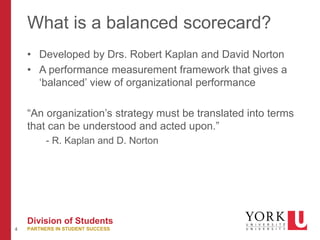
What is a balanced scorecard?
• Developed by Drs. Robert Kaplan and David Norton
• A performance measurement framework that gives a
‘balanced’ view of organizational performance
“An organization’s strategy must be translated into terms
that can be understood and acted upon.”
- R. Kaplan and D. Norton
5
Division of Students
PARTNERS IN STUDENT SUCCESS
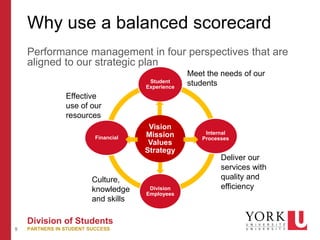
Why use a balanced scorecard
Performance management in four perspectives that are
aligned to our strategic plan
Vision
Mission
Values
Strategy
Student
Experience
Internal
Processes
Division
Employees
Financial
Meet the needs of our
students
Deliver our
services with
quality and
efficiency
Culture,
knowledge
and skills
Effective
use of our
resources
6
Division of Students
PARTNERS IN STUDENT SUCCESS
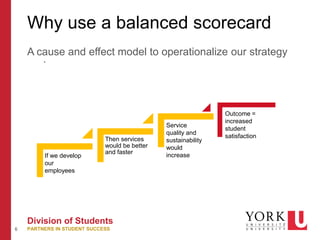
Why use a balanced scorecard
A cause and effect model to operationalize our strategy
`
Then services
would be better
and faster
If we develop
our
employees
Service
quality and
sustainability
would
increase
Outcome =
increased
student
satisfaction
7
Division of Students
PARTNERS IN STUDENT SUCCESS
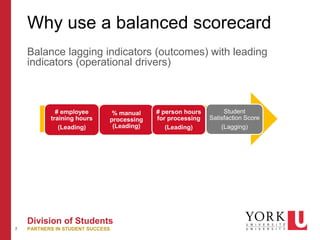
Why use a balanced scorecard
Balance lagging indicators (outcomes) with leading
indicators (operational drivers)
# employee
training hours
(Leading)
% manual
processing
(Leading)
# person hours
for processing
(Leading)
Student
Satisfaction Score
(Lagging)
8
Division of Students
PARTNERS IN STUDENT SUCCESS
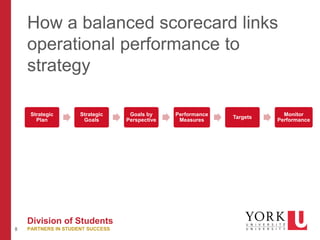
How a balanced scorecard links
operational performance to
strategy
Strategic
Plan
Strategic
Goals
Goals by
Perspective
Performance
Measures
Targets
Monitor
Performance
9
Division of Students
PARTNERS IN STUDENT SUCCESS
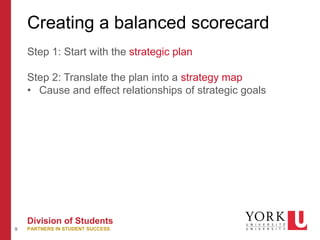
Creating a balanced scorecard
Step 1: Start with the strategic plan
Step 2: Translate the plan into a strategy map
• Cause and effect relationships of strategic goals
10
Division of Students
PARTNERS IN STUDENT SUCCESS
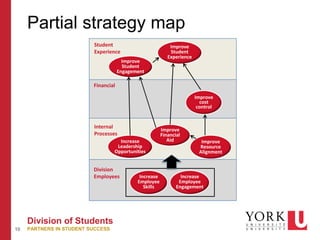
Partial strategy map
Student
Experience
Financial
Improve
Student
Engagement
Improve
Resource
Alignment
Improve
Student
Experience
Increase
Leadership
Opportunities
Improve
Financial
Aid
Increase
Employee
Engagement
Improve
cost
control
Increase
Employee
Skills
Internal
Processes
Division
Employees
11
Division of Students
PARTNERS IN STUDENT SUCCESS
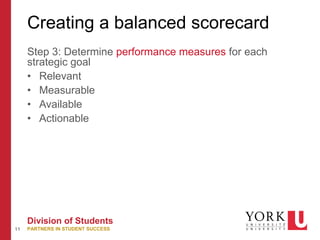
Creating a balanced scorecard
Step 3: Determine performance measures for each
strategic goal
• Relevant
• Measurable
• Available
• Actionable
12
Division of Students
PARTNERS IN STUDENT SUCCESS
Creating a balanced scorecard
Step 4: Set Targets
• Trend
• Benchmark
• Baseline
• Stated level
13
Division of Students
PARTNERS IN STUDENT SUCCESS
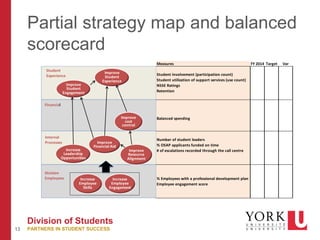
Partial strategy map and balanced
scorecard
Measures FY 2014 Target Var
Student involvement (participation count)
Student utilization of support services (use count)
NSSE Ratings
Retention
Balanced spending
Number of student leaders
% OSAP applicants funded on time
# of escalations recorded through the call centre
% Employees with a professional development plan
Employee engagement score
Student
Experience
Financial
Improve
Student
Engagement
Improve
Resource
Alignment
Improve
Student
Experience
Increase
Leadership
Opportunities
Improve
Financial Aid
Increase
Employee
Engagement
Improve
cost
control
Increase
Employee
Skills
Internal
Processes
Division
Employees
14
Division of Students
PARTNERS IN STUDENT SUCCESS
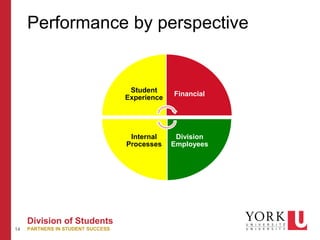
Performance by perspective
Student
Experience
Financial
Division
Employees
Internal
Processes
15
Division of Students
PARTNERS IN STUDENT SUCCESS
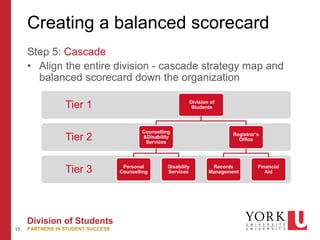
Creating a balanced scorecard
Step 5: Cascade
• Align the entire division - cascade strategy map and
balanced scorecard down the organization
Tier 3
Tier 2
Tier 1 Division of
Students
Counselling
&Disability
Services
Personal
Counselling
Disability
Services
Registrar’s
Office
Records
Management
Financial
Aid
16
Division of Students
PARTNERS IN STUDENT SUCCESS
Lessons learned for a successful
balanced scorecard implementation
• Executive support
• Engage the senior team in the selection of success
measures
• Assign an owner for each measure
• Update and review at least every 6 months
• Fine tune the measures used and their targets where
necessary - ongoing
• Cascade
Questions?
Contact Information
Clara Wong
Director, Business Performance
Reporting
Division of Students
cmwong@yorku.ca
416-736-2100 x20668

Measuring Success: The Balanced Scorecard Approach - Clara Wong - SASSY 2014

  • 1.
    Clara Wong CACUSS 2014:NAVIGATING CHANGE, Session 815 June 10, 2014 Measuring Success The Balanced Scorecard Approach
  • 2.
  • 3.
    3 Division of Students PARTNERSIN STUDENT SUCCESS Are we there yet? How far are we? Are we on the right track?
  • 4.
    4 Division of Students PARTNERSIN STUDENT SUCCESS What is a balanced scorecard? • Developed by Drs. Robert Kaplan and David Norton • A performance measurement framework that gives a ‘balanced’ view of organizational performance “An organization’s strategy must be translated into terms that can be understood and acted upon.” - R. Kaplan and D. Norton
  • 5.
    5 Division of Students PARTNERSIN STUDENT SUCCESS Why use a balanced scorecard Performance management in four perspectives that are aligned to our strategic plan Vision Mission Values Strategy Student Experience Internal Processes Division Employees Financial Meet the needs of our students Deliver our services with quality and efficiency Culture, knowledge and skills Effective use of our resources
  • 6.
    6 Division of Students PARTNERSIN STUDENT SUCCESS Why use a balanced scorecard A cause and effect model to operationalize our strategy ` Then services would be better and faster If we develop our employees Service quality and sustainability would increase Outcome = increased student satisfaction
  • 7.
    7 Division of Students PARTNERSIN STUDENT SUCCESS Why use a balanced scorecard Balance lagging indicators (outcomes) with leading indicators (operational drivers) # employee training hours (Leading) % manual processing (Leading) # person hours for processing (Leading) Student Satisfaction Score (Lagging)
  • 8.
    8 Division of Students PARTNERSIN STUDENT SUCCESS How a balanced scorecard links operational performance to strategy Strategic Plan Strategic Goals Goals by Perspective Performance Measures Targets Monitor Performance
  • 9.
    9 Division of Students PARTNERSIN STUDENT SUCCESS Creating a balanced scorecard Step 1: Start with the strategic plan Step 2: Translate the plan into a strategy map • Cause and effect relationships of strategic goals
  • 10.
    10 Division of Students PARTNERSIN STUDENT SUCCESS Partial strategy map Student Experience Financial Improve Student Engagement Improve Resource Alignment Improve Student Experience Increase Leadership Opportunities Improve Financial Aid Increase Employee Engagement Improve cost control Increase Employee Skills Internal Processes Division Employees
  • 11.
    11 Division of Students PARTNERSIN STUDENT SUCCESS Creating a balanced scorecard Step 3: Determine performance measures for each strategic goal • Relevant • Measurable • Available • Actionable
  • 12.
    12 Division of Students PARTNERSIN STUDENT SUCCESS Creating a balanced scorecard Step 4: Set Targets • Trend • Benchmark • Baseline • Stated level
  • 13.
    13 Division of Students PARTNERSIN STUDENT SUCCESS Partial strategy map and balanced scorecard Measures FY 2014 Target Var Student involvement (participation count) Student utilization of support services (use count) NSSE Ratings Retention Balanced spending Number of student leaders % OSAP applicants funded on time # of escalations recorded through the call centre % Employees with a professional development plan Employee engagement score Student Experience Financial Improve Student Engagement Improve Resource Alignment Improve Student Experience Increase Leadership Opportunities Improve Financial Aid Increase Employee Engagement Improve cost control Increase Employee Skills Internal Processes Division Employees
  • 14.
    14 Division of Students PARTNERSIN STUDENT SUCCESS Performance by perspective Student Experience Financial Division Employees Internal Processes
  • 15.
    15 Division of Students PARTNERSIN STUDENT SUCCESS Creating a balanced scorecard Step 5: Cascade • Align the entire division - cascade strategy map and balanced scorecard down the organization Tier 3 Tier 2 Tier 1 Division of Students Counselling &Disability Services Personal Counselling Disability Services Registrar’s Office Records Management Financial Aid
  • 16.
    16 Division of Students PARTNERSIN STUDENT SUCCESS Lessons learned for a successful balanced scorecard implementation • Executive support • Engage the senior team in the selection of success measures • Assign an owner for each measure • Update and review at least every 6 months • Fine tune the measures used and their targets where necessary - ongoing • Cascade
  • 17.
    Questions? Contact Information Clara Wong Director,Business Performance Reporting Division of Students cmwong@yorku.ca 416-736-2100 x20668

Editor's Notes

  • #4 everyone in the division must understand and align to our strategy need a strategy management system to help create this alignment and to monitor our progress - a map to support successful execution of our strategic plan
  • #5 AT&T Canada – 3 years after implementation, # of customers more than doubled and ARPU increased 36% UCSD – the first university to adopted the BSC approach in 1993, saved $6mil in the first 10 years, ranked as 7th best public university in USA in 2011 University of Leeds – implemented in 2004, within 3 years, jumped 50 places in world university rankings, goal is to be in the top 50 by 2015
  • #10 Strategic goals describe mid level results, not projects, that we intend to accomplish, example: ‘increase leadership development opportunities’
  • #12 - Strongest correlation with the strategic goal - example: for strategic goal ‘ increase leadership development opportunities’, use performance measure ‘count of student leaders’
  • #13 - Set thresholds also to alert when performance is below this level