Let’s Play!
Using an Interactive Board Game for Student Self Assessment
Agenda:
• Game Development
• Theoretical Foundations
• “Who Am I?”
• Game components
• Game play
• Challenges:
• The Students
• The Career Centre
• The Career Counsellors
• Student Feedback
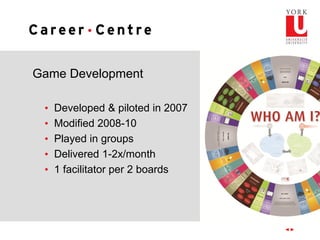
Game Development
• Developed & piloted in 2007
• Modified 2008-10
• Played in groups
• Delivered 1-2x/month
• 1 facilitator per 2 boards
Narrative Therapy
• We produce the meaning of our lives from the
stories we create about ourselves
• We select the evidence that support our stories
• We have multiple stories & influences
• Our stories are not neutral
• We change our stories from problematic to helpful
by externalizing them and “re-authoring” them
In essence, with a narrative therapy approach, the
focus is not on ‘experts’ solving problems, it is on
people discovering through conversations the
helpful, preferred, and previously unrecognized
and hidden possibilities contained within
themselves and unseen story lines.
Narrative Therapy Centre of Toronto
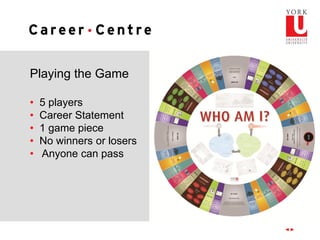
Playing the Game
• 5 players
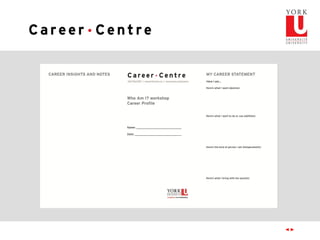
• Career Statement
• 1 game piece
• No winners or losers
• Anyone can pass
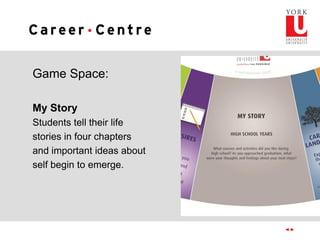
Game Space:
My Story
Students tell their life
stories in four chapters
and important ideas about
self begin to emerge.
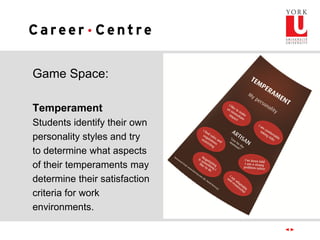
Game Space:
Temperament
Students identify their own
personality styles and try
to determine what aspects
of their temperaments may
determine their satisfaction
criteria for work
environments.
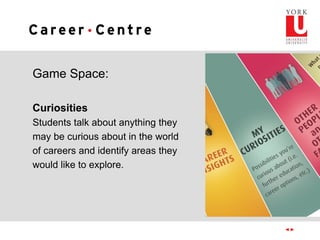
Game Space:
Curiosities
Students talk about anything they
may be curious about in the world
of careers and identify areas they
would like to explore.
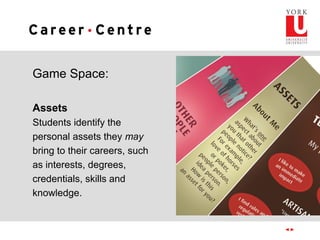
Game Space:
Assets
Students identify the
personal assets they may
bring to their careers, such
as interests, degrees,
credentials, skills and
knowledge.
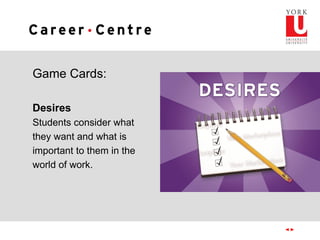
Game Cards:
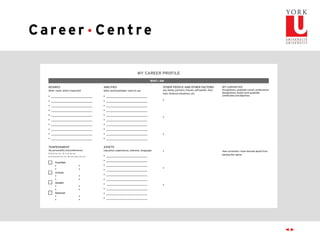
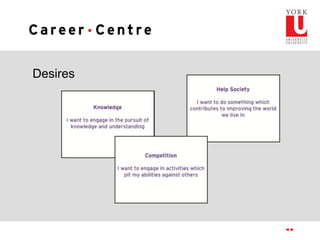
Desires
Students consider what
they want and what is
important to them in the
world of work.
Desires
Game Cards:
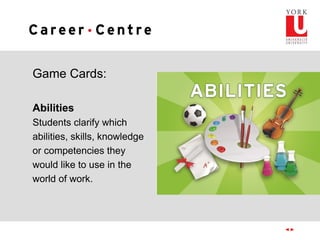
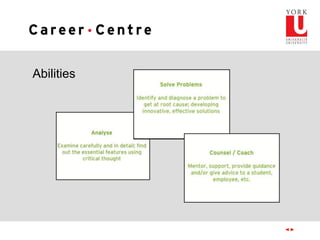
Abilities
Students clarify which
abilities, skills, knowledge
or competencies they
would like to use in the
world of work.
Abilities
Game Cards:
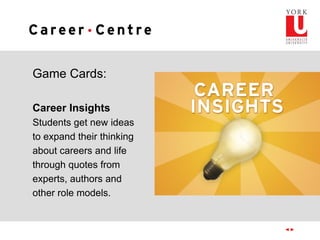
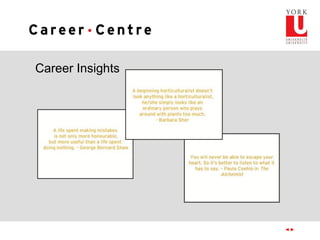
Career Insights
Students get new ideas
to expand their thinking
about careers and life
through quotes from
experts, authors and
other role models.
Career Insights
Game Cards:
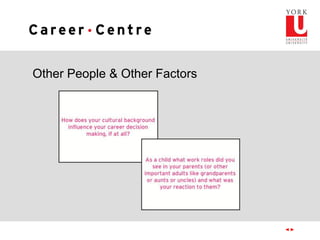
Other People &
Other Factors
Students become
mindful of the ways in
which other factors may
influence their career
decision making.
Other People & Other Factors
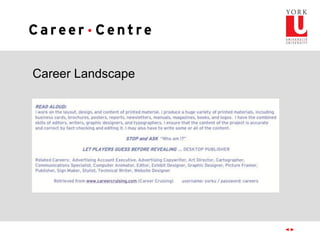
Game Card: Career Landscape
Students learn
more about
different career
possibilities.
Career Landscape
How can a game help the students re-author their
career stories to include the previously unrecognized
and hidden possibilities within themselves and thus
provide themselves with new avenues for
exploration?
• Students tell their stories and listen to the stories of
others while playing
• Students externalize and evaluate their “problem”
stories
• Students begin to make connections between stories
and career possibilities
How can we make career exploration less
overwhelming and anxiety-provoking and more fun,
educational and motivational?
• Game format
• Social experience
• Group support and inspiration
How can the Career Counsellors better prepare
students for career exploration in order to maximize
the effectiveness of individual appointments?
• Students are already familiar with the Career
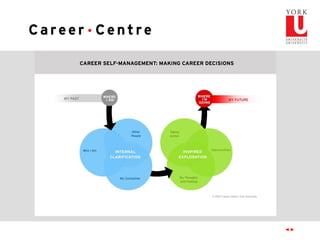
Decision Making Model
• Students begin career counselling with a better
understanding of themselves
• Students have already began thinking about their
career possibilities
How can the Career Counsellors assist students in
developing the skills to conduct their own self-
assessments as needed throughout their lives?
• Active process
• Translating stories and experiences into material
for career exploration
How can the Career Centre effectively serve more
students given our limited resources and high no-
show rate for individual appointments?
Up to 25 students per 3-hour game
Student Feedback
“It has had a tremendous impact. Although I know myself
somewhat, it made me realize my passions and what
my real interests are.”
“It has provided me with a better understanding of what's
important to me and has given me more confidence.”
“The game has more clearly defined my desires, abilities,
the type of person I am and what assets I have.”
“This workshop was a great way to strengthen my faith in
my decisions and justify my confidence.”
“Very detailed and helpful workshop. The social
interaction in small groups was nice. I can move
forward with a clearer view on what I value most in the
workplace.”
“This is important for me because I feel like I’m at a
crossroads in my life. It’s a start for me in making
career decisions. I’m glad I came!”
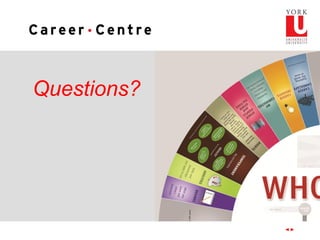
Questions?
Dianne Twombly, MSW
Manager, Career Development
Career Centre
York University
dtwombly@yorku.ca
416-736-2100 x33308

Let’s Play! Using an Interactive Board Game for Student Self-Assessment - Dianne Twombly - SASSY 2014

  • 1.
    Let’s Play! Using anInteractive Board Game for Student Self Assessment
  • 2.
    Agenda: • Game Development •Theoretical Foundations • “Who Am I?” • Game components • Game play
  • 3.
    • Challenges: • TheStudents • The Career Centre • The Career Counsellors • Student Feedback
  • 4.
    Game Development • Developed& piloted in 2007 • Modified 2008-10 • Played in groups • Delivered 1-2x/month • 1 facilitator per 2 boards
  • 6.
    Narrative Therapy • Weproduce the meaning of our lives from the stories we create about ourselves • We select the evidence that support our stories • We have multiple stories & influences • Our stories are not neutral • We change our stories from problematic to helpful by externalizing them and “re-authoring” them
  • 7.
    In essence, witha narrative therapy approach, the focus is not on ‘experts’ solving problems, it is on people discovering through conversations the helpful, preferred, and previously unrecognized and hidden possibilities contained within themselves and unseen story lines. Narrative Therapy Centre of Toronto
  • 8.
    Playing the Game •5 players • Career Statement • 1 game piece • No winners or losers • Anyone can pass
  • 11.
    Game Space: My Story Studentstell their life stories in four chapters and important ideas about self begin to emerge.
  • 12.
    Game Space: Temperament Students identifytheir own personality styles and try to determine what aspects of their temperaments may determine their satisfaction criteria for work environments.
  • 13.
    Game Space: Curiosities Students talkabout anything they may be curious about in the world of careers and identify areas they would like to explore.
  • 14.
    Game Space: Assets Students identifythe personal assets they may bring to their careers, such as interests, degrees, credentials, skills and knowledge.
  • 15.
    Game Cards: Desires Students considerwhat they want and what is important to them in the world of work.
  • 16.
  • 17.
    Game Cards: Abilities Students clarifywhich abilities, skills, knowledge or competencies they would like to use in the world of work.
  • 18.
  • 19.
    Game Cards: Career Insights Studentsget new ideas to expand their thinking about careers and life through quotes from experts, authors and other role models.
  • 20.
  • 21.
    Game Cards: Other People& Other Factors Students become mindful of the ways in which other factors may influence their career decision making.
  • 22.
    Other People &Other Factors
  • 23.
    Game Card: CareerLandscape Students learn more about different career possibilities.
  • 24.
  • 25.
    How can agame help the students re-author their career stories to include the previously unrecognized and hidden possibilities within themselves and thus provide themselves with new avenues for exploration? • Students tell their stories and listen to the stories of others while playing • Students externalize and evaluate their “problem” stories • Students begin to make connections between stories and career possibilities
  • 26.
    How can wemake career exploration less overwhelming and anxiety-provoking and more fun, educational and motivational? • Game format • Social experience • Group support and inspiration
  • 27.
    How can theCareer Counsellors better prepare students for career exploration in order to maximize the effectiveness of individual appointments? • Students are already familiar with the Career Decision Making Model • Students begin career counselling with a better understanding of themselves • Students have already began thinking about their career possibilities
  • 28.
    How can theCareer Counsellors assist students in developing the skills to conduct their own self- assessments as needed throughout their lives? • Active process • Translating stories and experiences into material for career exploration
  • 29.
    How can theCareer Centre effectively serve more students given our limited resources and high no- show rate for individual appointments? Up to 25 students per 3-hour game
  • 30.
    Student Feedback “It hashad a tremendous impact. Although I know myself somewhat, it made me realize my passions and what my real interests are.” “It has provided me with a better understanding of what's important to me and has given me more confidence.” “The game has more clearly defined my desires, abilities, the type of person I am and what assets I have.”
  • 31.
    “This workshop wasa great way to strengthen my faith in my decisions and justify my confidence.” “Very detailed and helpful workshop. The social interaction in small groups was nice. I can move forward with a clearer view on what I value most in the workplace.” “This is important for me because I feel like I’m at a crossroads in my life. It’s a start for me in making career decisions. I’m glad I came!”
  • 32.
  • 33.
    Dianne Twombly, MSW Manager,Career Development Career Centre York University dtwombly@yorku.ca 416-736-2100 x33308