

Support Vector Machines
Machine Learning - SVM
Support Vector Machines
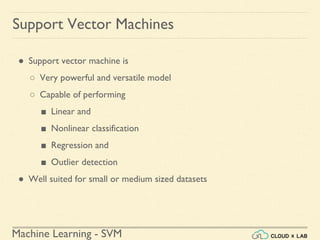
Divide dataset
into training and
test samples
Train the
model using
training dataset
Test using sample
training data
Performance
metrics (Finalize
the model)
Improve the
model using error
analysis
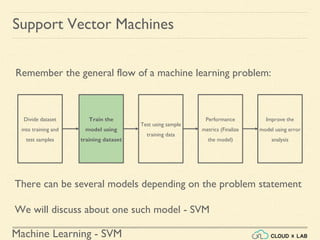
Remember the general flow of a machine learning problem:
There can be several models depending on the problem statement
We will discuss about one such model - SVM
Machine Learning - SVM
● Support vector machine is
○ Very powerful and versatile model
○ Capable of performing
■ Linear and
■ Nonlinear classification
■ Regression and
■ Outlier detection
● Well suited for small or medium sized datasets
Support Vector Machines
Machine Learning - SVM
Support Vector Machines
● In this session we will learn about
○ Linear SVM Classification
○ Nonlinear SVM Classification and
○ SVM Regression
Machine Learning - SVM
Support Vector Machines
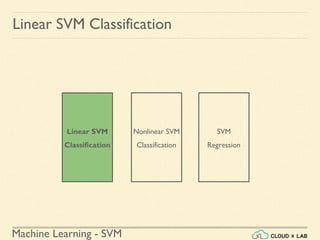
Linear SVM Classification
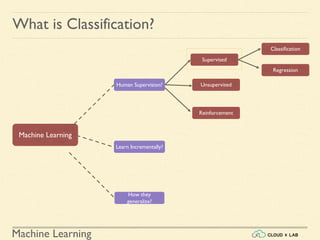
Machine Learning
Human Supervision?
Supervised
Machine Learning
Unsupervised
Reinforcement
Classification
Regression
How they
generalize?
Learn Incrementally?
What is Classification?
Machine Learning - SVM
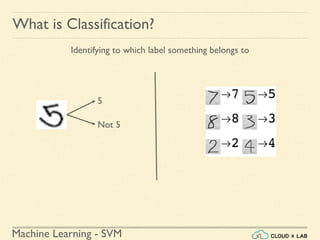
5
Not 5
What is Classification?
Identifying to which label something belongs to
Machine Learning - SVM
Examples of Classification
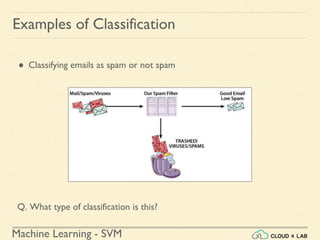
● Classifying emails as spam or not spam
Q. What type of classification is this?
Machine Learning - SVM
Examples of Classification
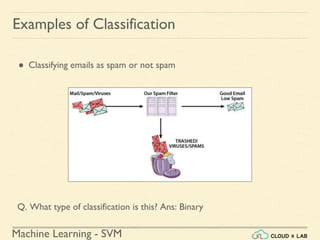
● Classifying emails as spam or not spam
Q. What type of classification is this? Ans: Binary
Machine Learning - SVM
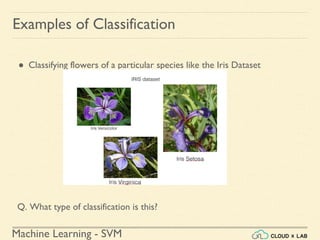
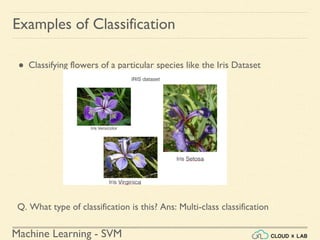
● Classifying flowers of a particular species like the Iris Dataset
Examples of Classification
Q. What type of classification is this?
Machine Learning - SVM
● Classifying flowers of a particular species like the Iris Dataset
Examples of Classification
Q. What type of classification is this? Ans: Multi-class classification
Machine Learning - SVM
● Classifying a credit card transaction as fraudulent or not
Examples of Classification
Machine Learning - SVM
Examples of Classification
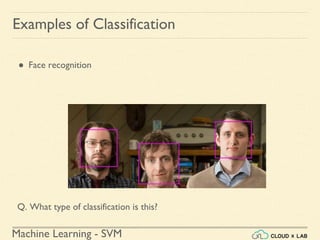
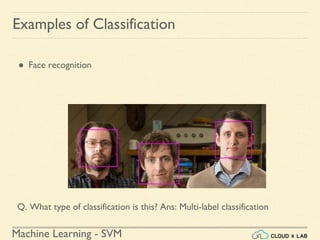
● Face recognition
Q. What type of classification is this?
Machine Learning - SVM
Examples of Classification
● Face recognition
Q. What type of classification is this? Ans: Multi-label classification
Machine Learning - SVM
5
Not 5
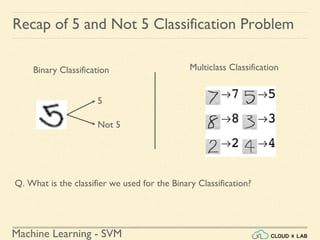
Recap of 5 and Not 5 Classification Problem
Binary Classification Multiclass Classification
Q. What is the classifier we used for the Binary Classification?
Machine Learning - SVM
5
Not 5
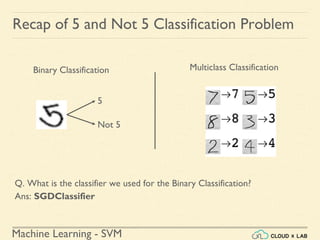
Recap of 5 and Not 5 Classification Problem
Binary Classification Multiclass Classification
Q. What is the classifier we used for the Binary Classification?
Ans: SGDClassifier
Machine Learning - SVM
5
Not 5
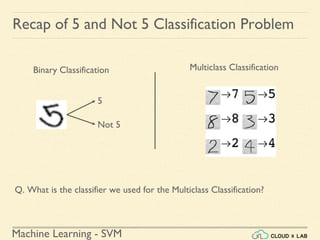
Recap of 5 and Not 5 Classification Problem
Binary Classification Multiclass Classification
Q. What is the classifier we used for the Multiclass Classification?
Machine Learning - SVM
5
Not 5
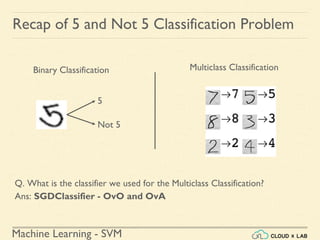
Recap of 5 and Not 5 Classification Problem
Binary Classification Multiclass Classification
Q. What is the classifier we used for the Multiclass Classification?
Ans: SGDClassifier - OvO and OvA
Machine Learning - SVM
What is Linear Classification?
Machine Learning - SVM
What is Linear Classification?
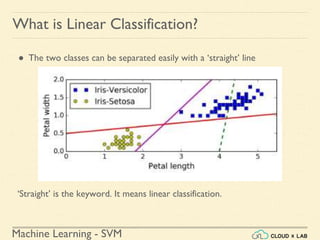
● The two classes can be separated easily with a ‘straight’ line
‘Straight’ is the keyword. It means linear classification.
Machine Learning - SVM
What is Linear Classification?
● For example: IRIS Dataset
○ Features: Sepal Length, Petal Length
○ Class: Iris Virginica OR Iris Versicolor OR Iris Setosa
Machine Learning - SVM
What is Linear Classification?
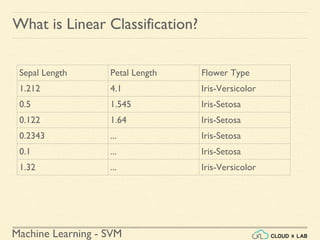
Sepal Length Petal Length Flower Type
1.212 4.1 Iris-Versicolor
0.5 1.545 Iris-Setosa
0.122 1.64 Iris-Setosa
0.2343 ... Iris-Setosa
0.1 ... Iris-Setosa
1.32 ... Iris-Versicolor
Machine Learning - SVM
What is Linear Classification?
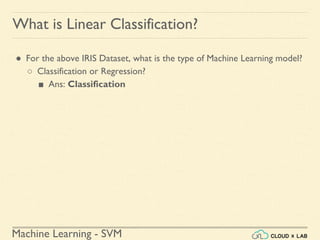
● For the above IRIS Dataset, what is the type of Machine Learning model?
○ Classification or Regression?
■ Ans:
Machine Learning - SVM
What is Linear Classification?
● For the above IRIS Dataset, what is the type of Machine Learning model?
○ Classification or Regression?
■ Ans: Classification
Machine Learning - SVM
What is Linear Classification?
● What is the type of Supervised Machine Learning model?
○ Classification or Regression?
■ Ans: Classification
○ What type of classification?
■ Binary Classification
■ Multi-label Classification
■ Multi-output Classification
■ Multi-class Classification
Machine Learning - SVM
What is Linear Classification?
● What is the type of Supervised Machine Learning model?
○ Classification or Regression?
■ Ans: Classification
○ What type of classification?
■ Binary Classification
■ Multi-label Classification
■ Multi-output Classification
■ Ans: Multi-class Classification
Machine Learning - SVM
What is Linear Classification?
● For the IRIS dataset above:
○ Number of features?
■ Ans:
○ Number of classes?
■ Ans:
Machine Learning - SVM
What is Linear Classification?
● For the IRIS dataset above:
○ Number of features?
■ Ans: 2
○ Number of classes?
■ Ans: 3
Machine Learning - SVM
What is Linear Classification?
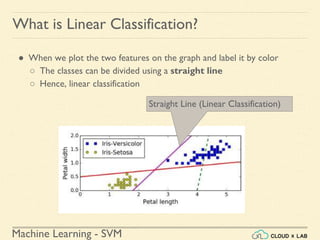
● When we plot the two features on the graph and label it by color
○ The classes can be divided using a straight line
○ Hence, linear classification
Straight Line (Linear Classification)
Machine Learning - SVM
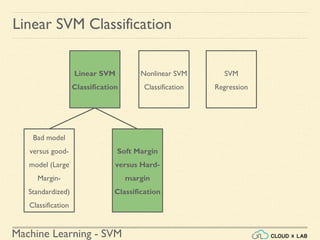
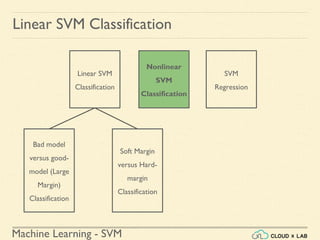
Linear SVM Classification
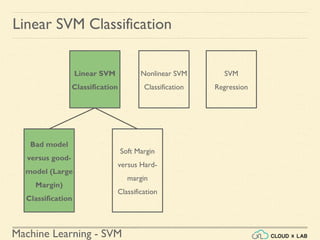
Linear SVM
Classification
Nonlinear SVM
Classification
SVM
Regression
Bad model
versus good-
model (Large
Margin)
Classification
Soft Margin
versus Hard-
margin
Classification
Machine Learning - SVM
Linear SVM Classification - Large Margin
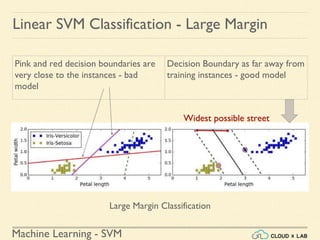
Pink and red decision boundaries are
very close to the instances - bad
model
Decision Boundary as far away from
training instances - good model
Large Margin Classification
Widest possible street
Machine Learning - SVM
Linear SVM Classification - Large Margin
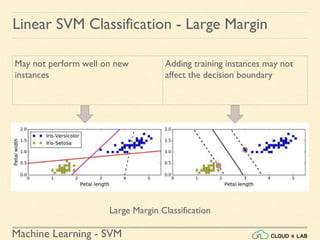
May not perform well on new
instances
Adding training instances may not
affect the decision boundary
Large Margin Classification
Machine Learning - SVM
Linear SVM Classification - Large Margin
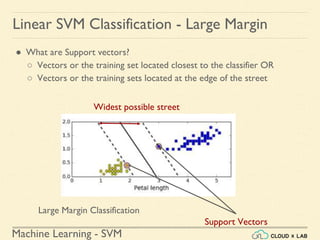
Large Margin Classification
Widest possible street
Support Vectors
● What are Support vectors?
○ Vectors or the training set located closest to the classifier OR
○ Vectors or the training sets located at the edge of the street
Machine Learning - SVM
Switch to Notebook
Machine Learning - SVM
Linear SVM Classification - Example 1
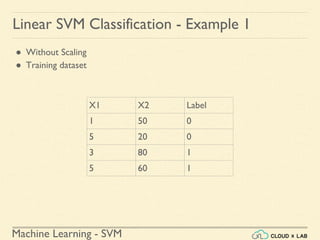
X1 X2 Label
1 50 0
5 20 0
3 80 1
5 60 1
● Without Scaling
● Training dataset
Machine Learning - SVM
Linear SVM Classification - Example 1
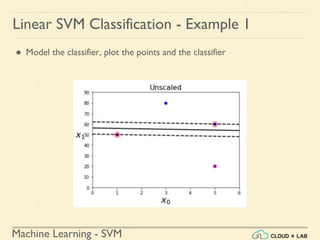
● Model the classifier, plot the points and the classifier
>>> Xs = np.array([[1, 50], [5, 20], [3, 80], [5,
60]]).astype(np.float64)
>>> ys = np.array([0, 0, 1, 1])
>>> svm_clf = SVC(kernel="linear", C=100)
>>> svm_clf.fit(Xs, ys)
>>> plt.plot(Xs[:, 0][ys==1], Xs[:, 1][ys==1], "bo")
>>> plt.plot(Xs[:, 0][ys==0], Xs[:, 1][ys==0], "ms")
>>> plot_svc_decision_boundary(svm_clf, 0, 6)
>>> plt.xlabel("$x_0$", fontsize=20)
>>> plt.ylabel("$x_1$ ", fontsize=20, rotation=0)
>>> plt.title("Unscaled", fontsize=16)
>>> plt.axis([0, 6, 0, 90])
Machine Learning - SVM
Linear SVM Classification - Example 1
● Model the classifier, plot the points and the classifier
Machine Learning - SVM
Linear SVM Classification - Example 1
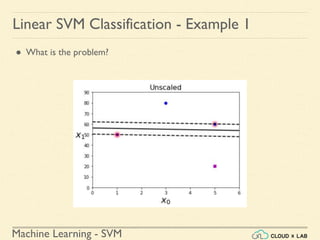
● What is the problem?
Machine Learning - SVM
Linear SVM Classification - Example 1
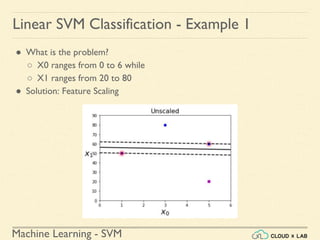
● What is the problem?
○ X0 ranges from 0 to 6 while
○ X1 ranges from 20 to 80
● Solution: Feature Scaling
Machine Learning Project
Feature Scaling
Feature Scaling
Quick Revision
from
Preparing the data for ML Algorithms in End-to-End Project
Machine Learning Project
Feature Scaling
● ML algorithms do not perform well
○ When the input numerical attributes have very different scales
● Feature Scaling is one of the most important
○ Transformation we need to apply to our data
● Two ways to make sure all attributes have same scale
○ Min-max scaling
○ Standardization
Machine Learning Project
Feature Scaling
Min-max Scaling
● Also known as Normalization
● Normalized values are in the range of [0, 1]
Machine Learning Project
Feature Scaling
Min-max Scaling
● Also known as Normalization
● Normalized values are in the range of [0, 1]
Original Value
Normalized Value
Machine Learning Project
Feature Scaling
Min-max Scaling - Example
# Creating DataFrame first
>>> import pandas as pd
>>> s1 = pd.Series([1, 2, 3, 4, 5, 6], index=(range(6)))
>>> s2 = pd.Series([10, 9, 8, 7, 6, 5], index=(range(6)))
>>> df = pd.DataFrame(s1, columns=['s1'])
>>> df['s2'] = s2
>>> df
Machine Learning Project
Feature Scaling
Min-max Scaling - Example
# Use Scikit-Learn minmax_scaling
>>> from mlxtend.preprocessing import minmax_scaling
>>> minmax_scaling(df, columns=['s1', 's2'])
Original Scaled (In range of
0 and 1)
Machine Learning Project
Feature Scaling
Standardization
● In Machine Learning, we handle various types of data like
○ Audio signals and
○ Pixel values for image data
○ And this data can include multiple dimensions
Machine Learning Project
Feature Scaling
Standardization
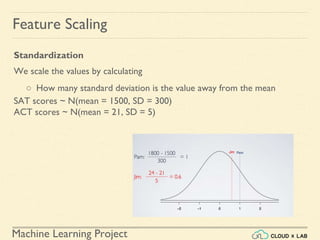
We scale the values by calculating
○ How many standard deviation is the value away from the mean
SAT scores ~ N(mean = 1500, SD = 300)
ACT scores ~ N(mean = 21, SD = 5)
Machine Learning Project
Feature Scaling
Standardization
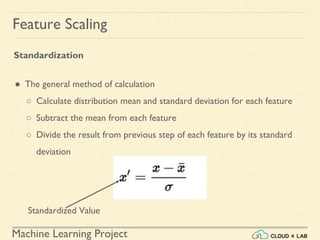
● The general method of calculation
○ Calculate distribution mean and standard deviation for each feature
○ Subtract the mean from each feature
○ Divide the result from previous step of each feature by its standard
deviation
Standardized Value
Machine Learning Project
Feature Scaling
Standardization
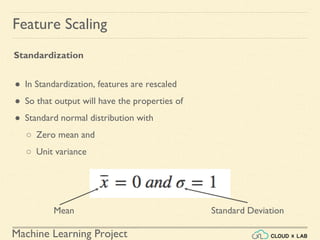
● In Standardization, features are rescaled
● So that output will have the properties of
● Standard normal distribution with
○ Zero mean and
○ Unit variance
Mean Standard Deviation
Machine Learning Project
Feature Scaling
Standardization
● Scikit-Learn provides
○ StandardScaler class for standardization
Machine Learning Project
Feature Scaling
Which One to Use?
● Min-max scales in the range of [0,1]
● Standardization does not bound values to a specific range
○ It may be problem for some algorithms
○ Example- Neural networks expect an input value ranging from 0 to 1
● We’ll learn more use cases as we proceed in the course
Machine Learning Project
Feature Scaling
Back to original Example 1
Machine Learning - SVM
Linear SVM Classification - Example 2
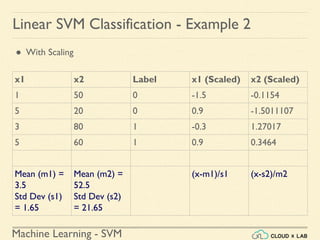
x1 x2 Label x1 (Scaled) x2 (Scaled)
1 50 0 -1.5 -0.1154
5 20 0 0.9 -1.5011107
3 80 1 -0.3 1.27017
5 60 1 0.9 0.3464
Mean (m1) =
3.5
Std Dev (s1)
= 1.65
Mean (m2) =
52.5
Std Dev (s2)
= 21.65
(x-m1)/s1 (x-s2)/m2
● With Scaling
Machine Learning - SVM
Linear SVM Classification - Example 2
● Scaling of features
X_new = (x-m1)/s1
● What kind of scaling is this?
○ Normalization
○ Standardization
Machine Learning - SVM
Linear SVM Classification - Example 2
● Scaling of features
X_new = (x-m1)/s1
● What kind of scaling is this?
○ Normalization
○ Standardization
Machine Learning - SVM
Linear SVM Classification - Example 2
● Scaling of features
X_new = (x-m1)/s1
● What kind of scaling is this?
○ Normalization
○ Standardization
● What is the module available in scikit_learn to perform standardization?
Machine Learning - SVM
Linear SVM Classification - Example 2
● Scaling of features
X_new = (x-m1)/s1
● What kind of scaling is this?
○ Normalization
○ Standardization
● What is the module available in scikit_learn to perform standardization?
○ Answer: StandardScalar
Machine Learning - SVM
Linear SVM Classification - Example 2
● Scaling the input training data
>>> from sklearn.preprocessing import StandardScaler
>>> scaler = StandardScaler()
>>> X_scaled = scaler.fit_transform(Xs)
>>> print(X_scaled)
[[-1.50755672 -0.11547005]
[ 0.90453403 -1.5011107 ]
[-0.30151134 1.27017059]
[ 0.90453403 0.34641016]]
Machine Learning - SVM
Linear SVM Classification - Example 2
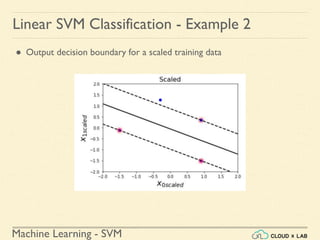
● Building the model, plotting the decision boundary and the training points
>>> svm_clf.fit(X_scaled, ys)
>>> plt.plot(X_scaled[:, 0][ys==1], X_scaled[:, 1][ys==1], "bo")
>>> plt.plot(X_scaled[:, 0][ys==0], X_scaled[:, 1][ys==0], "ms")
>>> plot_svc_decision_boundary(svm_clf, -2, 2)
>>> plt.ylabel("$x_{1scaled}$", fontsize=20)
>>> plt.xlabel("$x_{0scaled}$", fontsize=20)
>>> plt.title("Scaled", fontsize=16)
>>> plt.axis([-2, 2, -2, 2])
Machine Learning - SVM
Linear SVM Classification - Example 2
● Output decision boundary for a scaled training data
Machine Learning - SVM
Linear SVM Classification
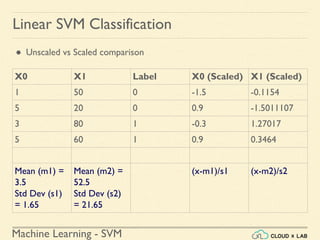
● Unscaled vs Scaled comparison
X0 X1 Label X0 (Scaled) X1 (Scaled)
1 50 0 -1.5 -0.1154
5 20 0 0.9 -1.5011107
3 80 1 -0.3 1.27017
5 60 1 0.9 0.3464
Mean (m1) =
3.5
Std Dev (s1)
= 1.65
Mean (m2) =
52.5
Std Dev (s2)
= 21.65
(x-m1)/s1 (x-m2)/s2
Machine Learning - SVM
Linear SVM Classification
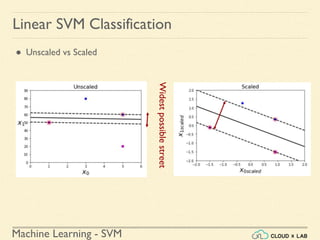
● Unscaled vs Scaled
Widestpossiblestreet
Machine Learning - SVM
Linear SVM Classification
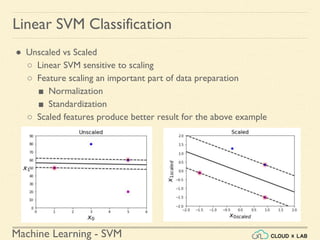
● Unscaled vs Scaled
○ Linear SVM sensitive to scaling
○ Feature scaling an important part of data preparation
■ Normalization
■ Standardization
○ Scaled features produce better result for the above example
Machine Learning - SVM
Switch to Notebook
Machine Learning - SVM
Linear SVM Classification
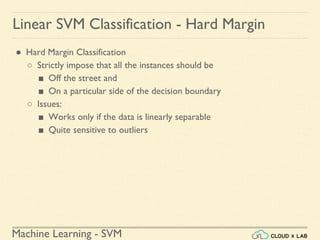
Linear SVM
Classification
Nonlinear SVM
Classification
SVM
Regression
Bad model
versus good-
model (Large
Margin-
Standardized)
Classification
Soft Margin
versus Hard-
margin
Classification
Machine Learning - SVM
Linear SVM Classification - Hard Margin
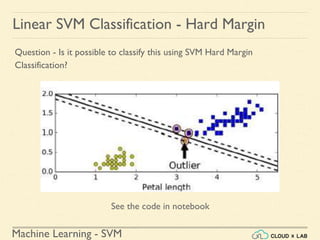
● Hard Margin Classification
○ Strictly impose that all the instances should be
■ Off the street and
■ On a particular side of the decision boundary
○ Issues:
■ Works only if the data is linearly separable
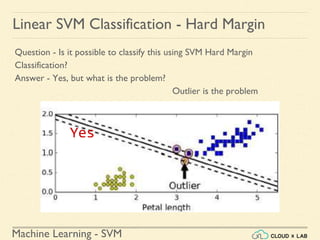
■ Quite sensitive to outliers
Machine Learning - SVM
Linear SVM Classification - Hard Margin
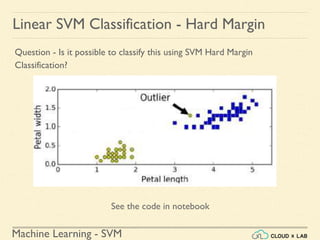
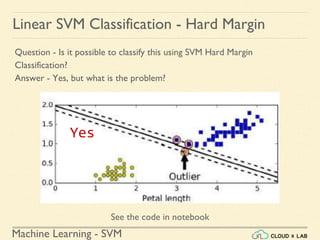
Question - Is it possible to classify this using SVM Hard Margin
Classification?
See the code in notebook
Machine Learning - SVM
Linear SVM Classification - Hard Margin
Question - Is it possible to classify this using SVM Hard Margin
Classification?
See the code in notebook
Machine Learning - SVM
Linear SVM Classification - Hard Margin
Question - Is it possible to classify this using SVM Hard Margin
Classification?
See the code in notebook
Machine Learning - SVM
Linear SVM Classification - Hard Margin
Question - Is it possible to classify this using SVM Hard Margin
Classification?
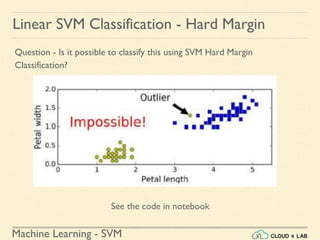
Answer - Yes, but what is the problem?
Yes
See the code in notebook
Machine Learning - SVM
Linear SVM Classification - Hard Margin
Yes
Question - Is it possible to classify this using SVM Hard Margin
Classification?
Answer - Yes, but what is the problem?
Outlier is the problem
Machine Learning - SVM
Linear SVM Classification - Soft Margin
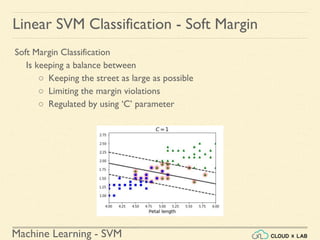
Soft Margin Classification
Is keeping a balance between
○ Keeping the street as large as possible
○ Limiting the margin violations
○ Regulated by using ‘C’ parameter
Machine Learning - SVM
Linear SVM Classification - Soft Margin
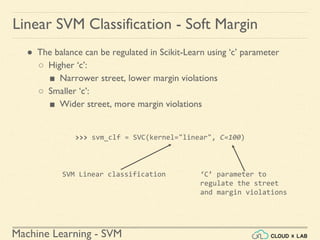
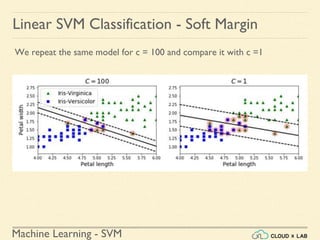
● The balance can be regulated in Scikit-Learn using ‘c’ parameter
○ Higher ‘c’:
■ Narrower street, lower margin violations
○ Smaller ‘c’:
■ Wider street, more margin violations
>>> svm_clf = SVC(kernel="linear", C=100)
SVM Linear classification ‘C’ parameter to
regulate the street
and margin violations
Machine Learning - SVM
Linear SVM Classification - Soft Margin
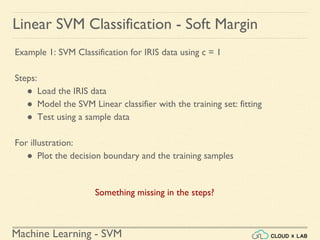
Example 1: SVM Classification for IRIS data using c = 1
Steps:
● Load the IRIS data
● Model the SVM Linear classifier with the training set: fitting
● Test using a sample data
For illustration:
● Plot the decision boundary and the training samples
Something missing in the steps?
Machine Learning - SVM
Linear SVM Classification - Soft Margin
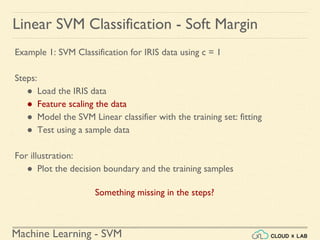
Example 1: SVM Classification for IRIS data using c = 1
Steps:
● Load the IRIS data
● Feature scaling the data
● Model the SVM Linear classifier with the training set: fitting
● Test using a sample data
For illustration:
● Plot the decision boundary and the training samples
Something missing in the steps?
Machine Learning - SVM
Switch to Notebook
Machine Learning - SVM
Linear SVM Classification - Soft Margin
Example 1: SVM Classification for IRIS data using c = 1
Steps:
● Load the IRIS data
>>> from sklearn import datasets
>>> from sklearn.pipeline import Pipeline
>>> from sklearn.preprocessing import StandardScaler
>>> from sklearn.svm import LinearSVC
>>> iris = datasets.load_iris()
>>> X = iris["data"][:, (2, 3)] # petal length, petal width
>>> y = (iris["target"] == 2).astype(np.float64) # Iris-Virginica
Machine Learning - SVM
Linear SVM Classification - Soft Margin
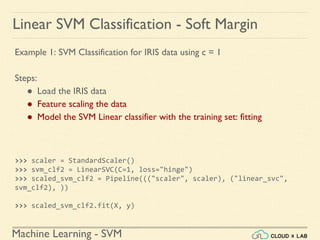
Example 1: SVM Classification for IRIS data using c = 1
Steps:
● Load the IRIS data
● Feature scaling the data
● Model the SVM Linear classifier with the training set: fitting
>>> scaler = StandardScaler()
>>> svm_clf2 = LinearSVC(C=1, loss="hinge")
>>> scaled_svm_clf2 = Pipeline((("scaler", scaler), ("linear_svc",
svm_clf2), ))
>>> scaled_svm_clf2.fit(X, y)
Machine Learning - SVM
Linear SVM Classification - Soft Margin
Example 1: SVM Classification for IRIS data using c = 1
Steps:
● Load the IRIS data
● Feature scaling the data
● Model the SVM Linear classifier with the training set: fitting
● Test using a sample data
>>> scaled_svm_clf1.predict([[5.5, 1.7]])
array([ 1.])
Machine Learning - SVM
Linear SVM Classification - Soft Margin
Example 1: SVM Classification for IRIS data using c = 1
Illustration:
● Plot the decision boundary along with the training data
○ Convert to unscaled parameters
■ Training data and decision boundary as calculated
○ Find support vectors
○ Plot it on the graph
Machine Learning - SVM
Linear SVM Classification - Soft Margin
Example 1: SVM Classification for IRIS data using c = 1
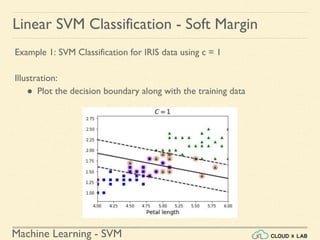
Illustration:
● Plot the decision boundary along with the training data
○ Convert to unscaled parameters
# Convert to unscaled parameters
>>> b2 = svm_clf1.decision_function([-scaler.mean_ / scaler.scale_])
>>> w2 = svm_clf1.coef_[0] / scaler.scale_
>>> svm_clf1.intercept_ = np.array([b2])
>>> svm_clf1.coef_ = np.array([w2])
Machine Learning - SVM
Linear SVM Classification - Soft Margin
Example 1: SVM Classification for IRIS data using c = 1
Illustration:
● Plot the decision boundary along with the training data
○ Find support vectors
# Find support vectors (LinearSVC does not do this automatically)
>>> t = y * 2 - 1
>>> support_vectors_idx2 = (t * (X.dot(w2) + b2) < 1).ravel()
>>> svm_clf1.support_vectors_ = X[support_vectors_idx2]
Machine Learning - SVM
Linear SVM Classification - Soft Margin
Example 1: SVM Classification for IRIS data using c = 1
Illustration:
● Plot the decision boundary along with the training data
○ Plot
>>> plt.plot(X[:, 0][y==1], X[:, 1][y==1], "g^")
>>> plt.plot(X[:, 0][y==0], X[:, 1][y==0], "bs")
>>> plot_svc_decision_boundary(svm_clf2, 4, 6)
>>> plt.xlabel("Petal length", fontsize=14)
>>> plt.title("$C = {}$".format(svm_clf2.C), fontsize=16)
>>> plt.axis([4, 6, 0.8, 2.8])
>>> plt.show()
Machine Learning - SVM
Linear SVM Classification - Soft Margin
Example 1: SVM Classification for IRIS data using c = 1
Illustration:
● Plot the decision boundary along with the training data
Machine Learning - SVM
Linear SVM Classification - Soft Margin
We repeat the same model for c = 100 and compare it with c =1
Machine Learning - SVM
Linear SVM Classification - Soft Margin
Question - What is the model we used here?
● SVC (kernel=’linear’, C=1)
● SGDClassifier(loss=’hinge’, alpha = 1/(m*c))
● LinearSVC
Machine Learning - SVM
Linear SVM Classification - Soft Margin
Question - What is the model we used here?
● SVC (kernel=’linear’, C=1)
● SGDClassifier(loss=’hinge’, alpha = 1/(m*c))
● Ans: LinearSVC
Machine Learning - SVM
Linear SVM Classification
Linear SVM
Classification
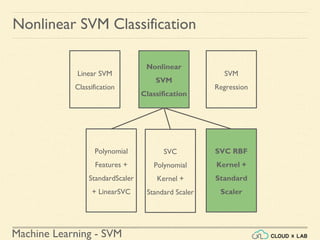
Nonlinear
SVM
Classification
SVM
Regression
Bad model
versus good-
model (Large
Margin)
Classification
Soft Margin
versus Hard-
margin
Classification
Machine Learning - SVM
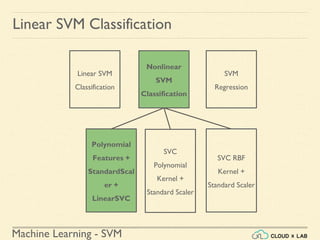
Linear SVM Classification
Linear SVM
Classification
Nonlinear
SVM
Classification
SVM
Regression
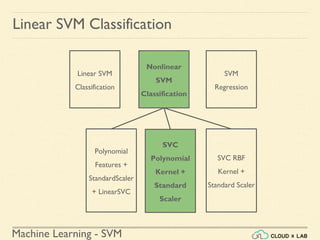
SVC
Polynomial
Kernel +
Standard Scaler
SVC RBF
Kernel +
Standard Scaler
Polynomial
Features +
StandardScal
er +
LinearSVC
Machine Learning - SVM
Nonlinear SVM Classification
● Many datasets cannot be linearly separable
○ Approach 1: Add more features as polynomial features
■ Can result in a linearly separable dataset
Machine Learning - SVM
Nonlinear SVM Classification
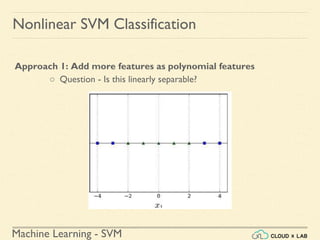
Approach 1: Add more features as polynomial features
○ Question - Is this linearly separable?
Machine Learning - SVM
Nonlinear SVM Classification
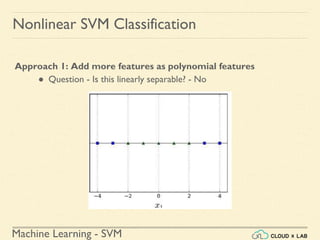
Approach 1: Add more features as polynomial features
● Question - Is this linearly separable? - No
Machine Learning - SVM
Nonlinear SVM Classification
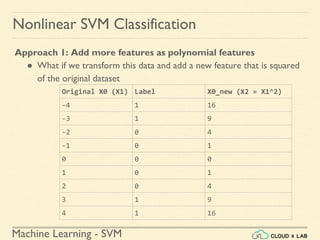
Approach 1: Add more features as polynomial features
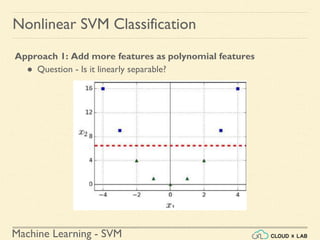
● What if we transform this data and add a new feature that is squared
of the original dataset
Original X0 (X1) Label X0_new (X2 = X1^2)
-4 1 16
-3 1 9
-2 0 4
-1 0 1
0 0 0
1 0 1
2 0 4
3 1 9
4 1 16
Machine Learning - SVM
Nonlinear SVM Classification
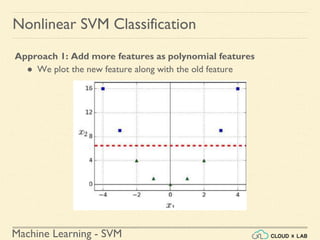
Approach 1: Add more features as polynomial features
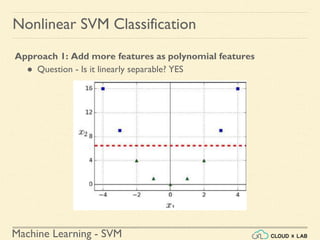
● We plot the new feature along with the old feature
Machine Learning - SVM
Nonlinear SVM Classification
Approach 1: Add more features as polynomial features
● Question - Is it linearly separable?
Machine Learning - SVM
Nonlinear SVM Classification
Approach 1: Add more features as polynomial features
● Question - Is it linearly separable? YES
Machine Learning - SVM
Switch to Notebook
Machine Learning - SVM
Nonlinear SVM Classification: Example
Approach 1: Add more features as polynomial features
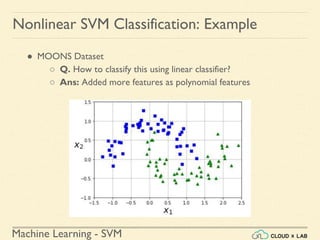
● MOONS Dataset
○ Random dataset generator provided by sklearn library
○ 2d or 2 features
○ Single Label
○ Binary Classification
Machine Learning - SVM
Nonlinear SVM Classification: Example
● MOONS Dataset
>>> from sklearn.datasets import make_moons
>>> X, y = make_moons(n_samples=5, noise=0.15, random_state=42)
Result:
[[-0.92892087 0.20526752]
[ 1.86247597 0.48137792]
[-0.30164443 0.42607949]
[ 1.05888696 -0.1393777 ]
[ 1.01197477 -0.52392748]]
[0 1 1 0 1]
No. of samples
seed
Machine Learning - SVM
Nonlinear SVM Classification: Example
● MOONS Dataset
Result:
[[-0.92892087 0.20526752]
[ 1.86247597 0.48137792]
[-0.30164443 0.42607949]
[ 1.05888696 -0.1393777 ]
[ 1.01197477 -0.52392748]]
[0 1 1 0 1]
Machine Learning - SVM
Nonlinear SVM Classification: Example
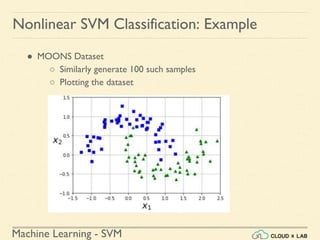
● MOONS Dataset
○ Similarly generate 100 such samples
>>> from sklearn.datasets import make_moons
>>> X, y = make_moons(n_samples=100, noise=0.15, random_state=42)
Machine Learning - SVM
Nonlinear SVM Classification: Example
● MOONS Dataset
○ Similarly generate 100 such samples
○ Plotting the dataset
>>> def plot_dataset(X, y, axes):
>>> plt.plot(X[:, 0][y==0], X[:, 1][y==0], "bs")
>>> plt.plot(X[:, 0][y==1], X[:, 1][y==1], "g^")
>>> plt.axis(axes)
>>> plt.grid(True, which='both')
>>> plt.xlabel(r"$x_1$", fontsize=20)
>>> plt.ylabel(r"$x_2$", fontsize=20, rotation=0)
>>> plot_dataset(X, y, [-1.5, 2.5, -1, 1.5])
>>> plt.show()
Machine Learning - SVM
Nonlinear SVM Classification: Example
● MOONS Dataset
○ Similarly generate 100 such samples
○ Plotting the dataset
Machine Learning - SVM
Nonlinear SVM Classification: Example
● MOONS Dataset
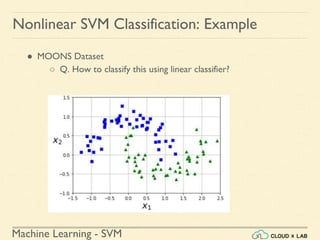
○ Q. How to classify this using linear classifier?
Machine Learning - SVM
Nonlinear SVM Classification: Example
● MOONS Dataset
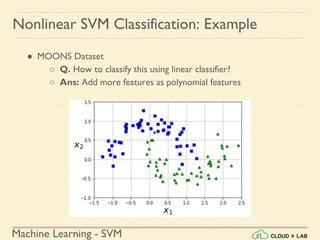
○ Q. How to classify this using linear classifier?
○ Ans: Add more features as polynomial features
Machine Learning - SVM
Nonlinear SVM Classification: Example
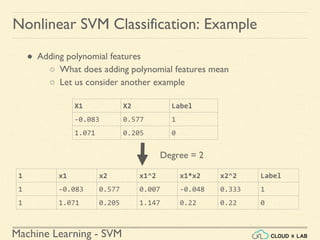
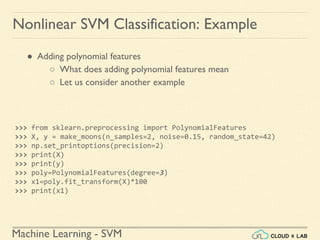
● Adding polynomial features
○ What does adding polynomial features mean
○ Let us consider another example
X1 X2 Label
-0.083 0.577 1
1.071 0.205 0
1 x1 x2 x1^2 x1*x2 x2^2 Label
1 -0.083 0.577 0.007 -0.048 0.333 1
1 1.071 0.205 1.147 0.22 0.22 0
Degree = 2
Machine Learning - SVM
Nonlinear SVM Classification: Example
● Adding polynomial features
○ What does adding polynomial features mean
○ Let us consider another example
>>> from sklearn.preprocessing import PolynomialFeatures
>>> X, y = make_moons(n_samples=2, noise=0.15, random_state=42)
>>> np.set_printoptions(precision=2)
>>> print(X)
>>> print(y)
>>> poly=PolynomialFeatures(degree=3)
>>> x1=poly.fit_transform(X)*100
>>> print(x1)
Machine Learning - SVM
Nonlinear SVM Classification: Example
● Adding polynomial features
○ What does adding polynomial features mean
○ Let us consider another example
X = [[-0.08 0.58]
[ 1.07 0.21]]
y = [1 0]
X1 =
[[ 1. -0.08 0.58 0.01 -0.05 0.33 -0. 0. -0.03 0.19]
[ 1. 1.07 0.21 1.15 0.22 0.04 1.23 0.24 0.05 0.01]]
Machine Learning - SVM
Nonlinear SVM Classification: Example
● MOONS Dataset
○ Q. How to classify this using linear classifier?
○ Ans: Added more features as polynomial features
Machine Learning - SVM
Nonlinear SVM Classification: Example
● MOONS Dataset
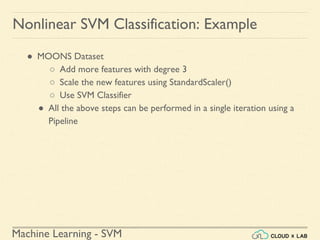
○ Add more features with degree 3
○ Scale the new features using StandardScaler()
○ Use SVM Classifier
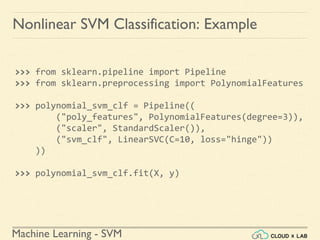
● All the above steps can be performed in a single iteration using a
Pipeline
Machine Learning - SVM
Nonlinear SVM Classification: Example
>>> from sklearn.pipeline import Pipeline
>>> from sklearn.preprocessing import PolynomialFeatures
>>> polynomial_svm_clf = Pipeline((
("poly_features", PolynomialFeatures(degree=3)),
("scaler", StandardScaler()),
("svm_clf", LinearSVC(C=10, loss="hinge"))
))
>>> polynomial_svm_clf.fit(X, y)
Machine Learning - SVM
Nonlinear SVM Classification: Example
● MOONS Dataset
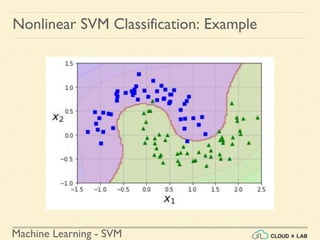
○ Plotting the dataset along with the classifier (decision boundary)
just modeled
Machine Learning - SVM
Nonlinear SVM Classification: Example
def plot_predictions(clf, axes):
x0s = np.linspace(axes[0], axes[1], 100)
x1s = np.linspace(axes[2], axes[3], 100)
x0, x1 = np.meshgrid(x0s, x1s)
X = np.c_[x0.ravel(), x1.ravel()]
y_pred = clf.predict(X).reshape(x0.shape)
y_decision = clf.decision_function(X).reshape(x0.shape)
plt.contourf(x0, x1, y_pred, cmap=plt.cm.brg, alpha=0.2)
plt.contourf(x0, x1, y_decision, cmap=plt.cm.brg, alpha=0.1)
plot_predictions(polynomial_svm_clf, [-1.5, 2.5, -1, 1.5])
plot_dataset(X, y, [-1.5, 2.5, -1, 1.5])
plt.show()
Machine Learning - SVM
Nonlinear SVM Classification: Example
Machine Learning - SVM
Switch to Notebook
Machine Learning - SVM
Linear SVM Classification
Linear SVM
Classification
Nonlinear
SVM
Classification
SVM
Regression
SVC
Polynomial
Kernel +
Standard
Scaler
SVC RBF
Kernel +
Standard Scaler
Polynomial
Features +
StandardScaler
+ LinearSVC
Machine Learning - SVM
Nonlinear SVM Classification
Polynomial Kernel
● Adding polynomial features works great
○ Low polynomial degree cannot deal with complex datasets
○ High polynomial degree makes the model slow due to huge
number of features
● How to overcome the slowness due to huge features?
● Ans: Polynomial Kernels or Kernel trick
Machine Learning - SVM
Nonlinear SVM Classification
Polynomial Kernel
● Adding polynomial features works great
○ Low polynomial degree cannot deal with complex datasets
○ High polynomial degree makes the model slow due to huge
number of features
● How to overcome the slowness due to huge features?
● Ans: Polynomial Kernels or Kernel trick
○ Makes it possible to get the same result as when using high
polynomial degree
○ Without having to add the features which makes the model slow
Machine Learning - SVM
Nonlinear SVM Classification
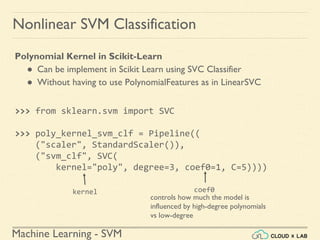
Polynomial Kernel in Scikit-Learn
● Can be implement in Scikit Learn using SVC Classifier
● Without having to use PolynomialFeatures as in LinearSVC
>>> from sklearn.svm import SVC
>>> poly_kernel_svm_clf = Pipeline((
("scaler", StandardScaler()),
("svm_clf", SVC(
kernel="poly", degree=3, coef0=1, C=5))))
kernel
controls how much the model is
influenced by high-degree polynomials
vs low-degree
coef0
Machine Learning - SVM
Nonlinear SVM Classification
Polynomial Kernel in Scikit-Learn
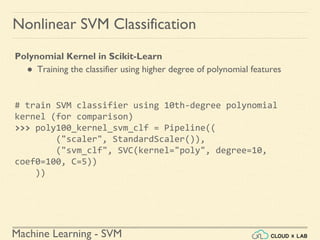
● Training the classifier using higher degree of polynomial features
# train SVM classifier using 10th-degree polynomial
kernel (for comparison)
>>> poly100_kernel_svm_clf = Pipeline((
("scaler", StandardScaler()),
("svm_clf", SVC(kernel="poly", degree=10,
coef0=100, C=5))
))
Machine Learning - SVM
Nonlinear SVM Classification
Polynomial Kernel in Scikit-Learn
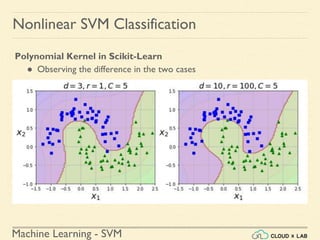
● Observing the difference in the two cases
Machine Learning - SVM
Switch to Notebook
Machine Learning - SVM
Nonlinear SVM Classification
Linear SVM
Classification
Nonlinear
SVM
Classification
SVM
Regression
SVC
Polynomial
Kernel +
Standard Scaler
SVC RBF
Kernel +
Standard
Scaler
Polynomial
Features +
StandardScaler
+ LinearSVC
Machine Learning - SVM
Nonlinear SVM Classification - SVC RBF
Adding similar features
● Another technique of solving nonlinear classifications
● Add features computed using a similarity function
● Similarity function measures how each instance resembles a particular
‘landmark’
Machine Learning - SVM
Nonlinear SVM Classification - SVC RBF
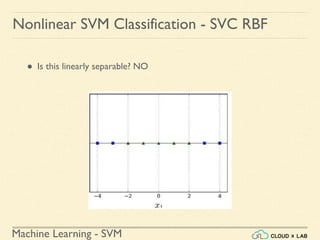
● Is this linearly separable? NO
Machine Learning - SVM
Nonlinear SVM Classification - SVC RBF
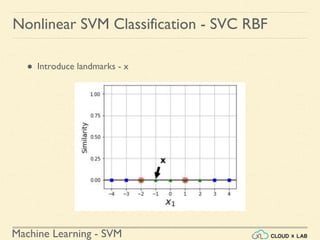
● Introduce landmarks - x
Machine Learning - SVM
Nonlinear SVM Classification - SVC RBF
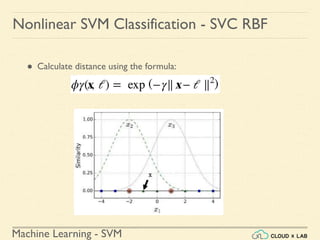
● Calculate distance using the formula:
Machine Learning - SVM
Nonlinear SVM Classification - SVC RBF
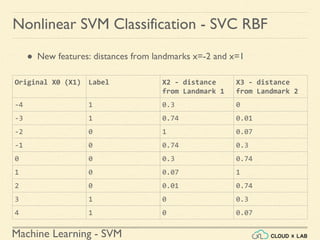
● New features: distances from landmarks x=-2 and x=1
Original X0 (X1) Label X2 - distance
from Landmark 1
X3 - distance
from Landmark 2
-4 1 0.3 0
-3 1 0.74 0.01
-2 0 1 0.07
-1 0 0.74 0.3
0 0 0.3 0.74
1 0 0.07 1
2 0 0.01 0.74
3 1 0 0.3
4 1 0 0.07
Machine Learning - SVM
Nonlinear SVM Classification - SVC RBF
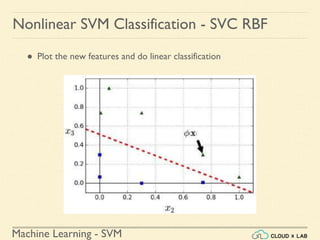
● Plot the new features and do linear classification
Machine Learning - SVM
Nonlinear SVM Classification - SVC RBF
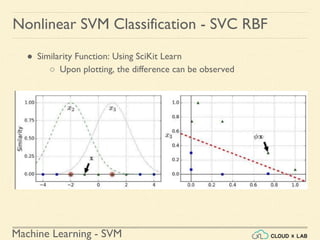
● Similarity Function: Using SciKit Learn
# define similarity function to be Gaussian Radial Basis Function
(RBF)
# equals 0 (far away) to 1 (at landmark)
>>> def gaussian_rbf(x, landmark, gamma):
return np.exp(-gamma * np.linalg.norm(x - landmark, axis=1)**2)
>>> gamma = 0.3
>>> x1s = np.linspace(-4.5, 4.5, 200).reshape(-1, 1)
>>> x2s = gaussian_rbf(x1s, -2, gamma)
>>> x3s = gaussian_rbf(x1s, 1, gamma)
>>> XK = np.c_[gaussian_rbf(X1D, -2, gamma), gaussian_rbf(X1D, 1,
gamma)]
>>> yk = np.array([0, 0, 1, 1, 1, 1, 1, 0, 0])
>>> print(XK)
Machine Learning - SVM
Nonlinear SVM Classification - SVC RBF
● Similarity Function: Using SciKit Learn
○ Upon plotting, the difference can be observed
Machine Learning - SVM
Switch to Notebook
Machine Learning - SVM
Nonlinear SVM Classification - SVC RBF
Similarity Function: How to select the landmarks?
● Create a landmark at each and every instance of the dataset
Drawback
● If training set is huge, number of new features added will be huge
Machine Learning - SVM
Nonlinear SVM Classification - SVC RBF
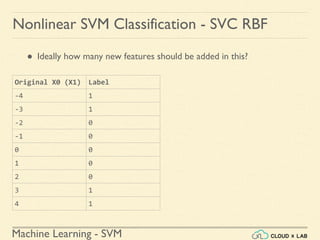
● Ideally how many new features should be added in this?
Original X0 (X1) Label
-4 1
-3 1
-2 0
-1 0
0 0
1 0
2 0
3 1
4 1
Machine Learning - SVM
Nonlinear SVM Classification
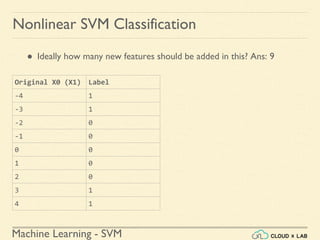
● Ideally how many new features should be added in this? Ans: 9
Original X0 (X1) Label
-4 1
-3 1
-2 0
-1 0
0 0
1 0
2 0
3 1
4 1
Machine Learning - SVM
Nonlinear SVM Classification - SVC RBF
● Ideally how many new features should be added in this? Ans: 9
● The training set converts into 9 instances with 9 features
● Imagine doing this with huge training datasets
Machine Learning - SVM
Nonlinear SVM Classification - SVC RBF
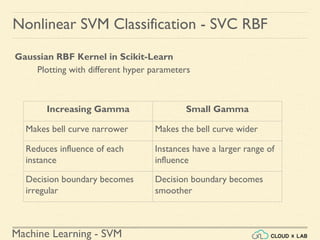
Gaussian RBF Kernel
● Polynomial Feature addition becomes slow with higher degrees
○ Kernel trick solves it
● Similarity function becomes slow with higher number of training
dataset
○ SVM kernel trick again solves the problem
Machine Learning - SVM
Nonlinear SVM Classification - SVC RBF
Gaussian RBF Kernel
● It lets us to get similar results as if
○ We had added many similarity features
○ Without actually having to add them
Machine Learning - SVM
Nonlinear SVM Classification - SVC RBF
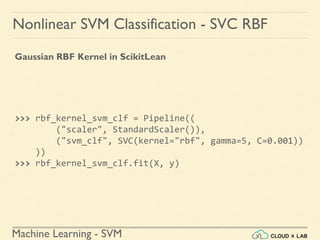
Gaussian RBF Kernel in ScikitLean
>>> rbf_kernel_svm_clf = Pipeline((
("scaler", StandardScaler()),
("svm_clf", SVC(kernel="rbf", gamma=5, C=0.001))
))
>>> rbf_kernel_svm_clf.fit(X, y)
Machine Learning - SVM
Nonlinear SVM Classification - SVC RBF
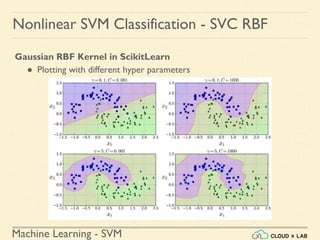
Gaussian RBF Kernel in ScikitLearn
● Plotting with different hyper parameters
Machine Learning - SVM
Nonlinear SVM Classification - SVC RBF
Gaussian RBF Kernel in Scikit-Learn
Plotting with different hyper parameters
Increasing Gamma Small Gamma
Makes bell curve narrower Makes the bell curve wider
Reduces influence of each
instance
Instances have a larger range of
influence
Decision boundary becomes
irregular
Decision boundary becomes
smoother
Machine Learning - SVM
Switch to Notebook
Machine Learning - SVM
Computational Complexity
Which kernel to use when?
1. Linear Kernel First
a. LinearSVC faster than SVC(kernel=’linear’) for large datasets with a
lot of features
1. Gaussian RBF kernel
1. Other kernels: Cross validation and grid search
Machine Learning - SVM
Computational Complexity
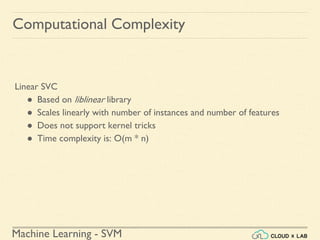
Linear SVC
● Based on liblinear library
● Scales linearly with number of instances and number of features
● Does not support kernel tricks
● Time complexity is: O(m * n)
Machine Learning - SVM
Computational Complexity
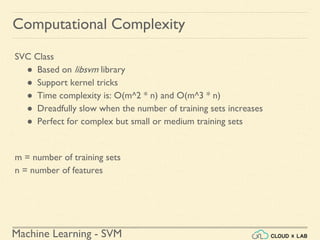
m = number of training sets
n = number of features
SVC Class
● Based on libsvm library
● Support kernel tricks
● Time complexity is: O(m^2 * n) and O(m^3 * n)
● Dreadfully slow when the number of training sets increases
● Perfect for complex but small or medium training sets
Machine Learning - SVM
SVM Classification - Comparison
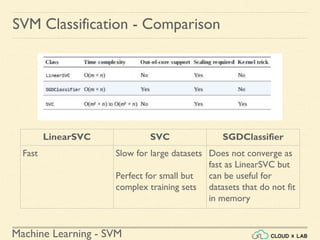
LinearSVC SVC SGDClassifier
Fast Slow for large datasets
Perfect for small but
complex training sets
Does not converge as
fast as LinearSVC but
can be useful for
datasets that do not fit
in memory
Machine Learning - SVM
Linear SVM Classification
Linear SVM
Classification
Nonlinear SVM
Classification
SVM
Regression
SVC
Polynomial
Kernel +
Standard Scaler
SVC RBF
Kernel +
Standard Scaler
Polynomial
Features +
StandardScaler
+ LinearSVC
Machine Learning - SVM
Linear SVM Classification
Linear SVM
Classification
Nonlinear SVM
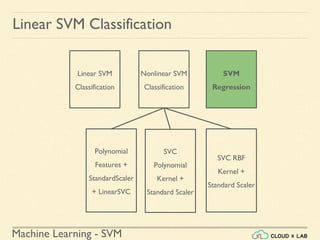
Classification
SVM
Regression
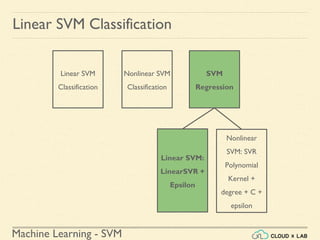
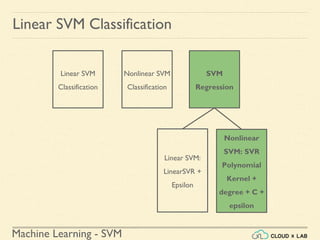
Nonlinear
SVM: SVR
Polynomial
Kernel +
degree + C +
epsilon
Linear SVM:
LinearSVR +
Epsilon
Machine Learning - SVM
SVM Regression
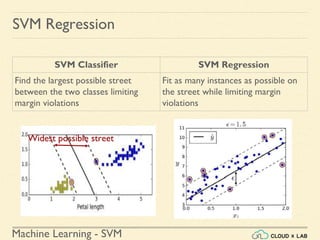
SVM Classifier SVM Regression
Find the largest possible street
between the two classes limiting
margin violations
Fit as many instances as possible on
the street while limiting margin
violations
Widest possible street
Machine Learning - SVM
SVM Regression - Linear
● Width of the SVM Regression model is controlled by a hyperparameter 𝜺
or epsilon.
● Adding training instances within the margin does not affect the model’s
predictions,
○ Hence model is said to be 𝜺-insensitive
Machine Learning - SVM
SVM Regression - Linear
Linear Regression in Scikit-Learn:
LinearSVR can be used
>>> from sklearn.svm import LinearSVR
>>> svm_reg = LinearSVR(epsilon=1.5)
>>> svm_reg.fit(X, y)
Machine Learning - SVM
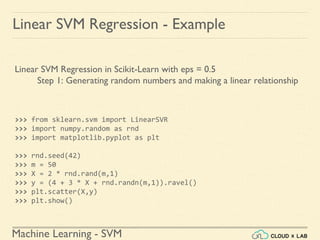
Linear SVM Regression - Example
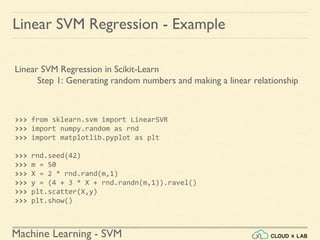
Linear SVM Regression in Scikit-Learn
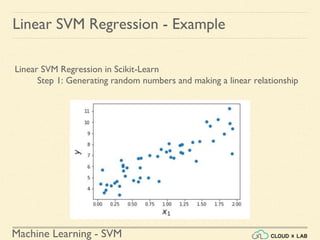
Step 1: Generating random numbers and making a linear relationship
>>> from sklearn.svm import LinearSVR
>>> import numpy.random as rnd
>>> import matplotlib.pyplot as plt
>>> rnd.seed(42)
>>> m = 50
>>> X = 2 * rnd.rand(m,1)
>>> y = (4 + 3 * X + rnd.randn(m,1)).ravel()
>>> plt.scatter(X,y)
>>> plt.show()
Machine Learning - SVM
Linear SVM Regression - Example
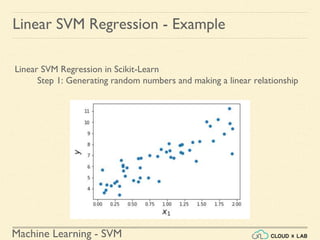
Linear SVM Regression in Scikit-Learn
Step 1: Generating random numbers and making a linear relationship
Machine Learning - SVM
Linear SVM Regression - Example
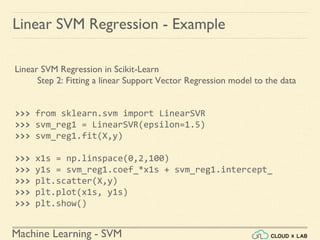
Linear SVM Regression in Scikit-Learn
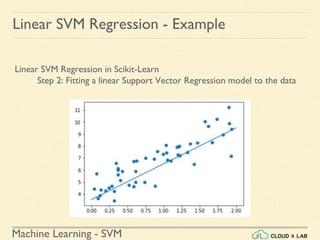
Step 2: Fitting a linear Support Vector Regression model to the data
>>> from sklearn.svm import LinearSVR
>>> svm_reg1 = LinearSVR(epsilon=1.5)
>>> svm_reg1.fit(X,y)
>>> x1s = np.linspace(0,2,100)
>>> y1s = svm_reg1.coef_*x1s + svm_reg1.intercept_
>>> plt.scatter(X,y)
>>> plt.plot(x1s, y1s)
>>> plt.show()
Machine Learning - SVM
Linear SVM Regression - Example
Linear SVM Regression in Scikit-Learn
Step 2: Fitting a linear Support Vector Regression model to the data
Machine Learning - SVM
Linear SVM Regression - Example
Linear SVM Regression in Scikit-Learn
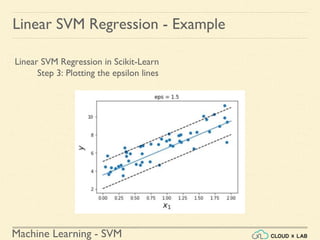
Step 3: Plotting the epsilon lines
>>> y1s_eps1 = y1s + 1.5
>>> y1s_eps2 = y1s - 1.5
>>> plt.scatter(X,y)
>>> plt.plot(x1s, y1s)
>>> plt.plot(x1s, y1s_eps1,'k--')
>>> plt.plot(x1s, y1s_eps2,'k--')
>>> plt.xlabel(r"$x_1$", fontsize=18)
>>> plt.ylabel(r"$y$", fontsize=18)
>>> plt.title('eps = 1.5')
>>> plt.show()
Machine Learning - SVM
Linear SVM Regression - Example
Linear SVM Regression in Scikit-Learn
Step 3: Plotting the epsilon lines
Machine Learning - SVM
Linear SVM Regression - Example
Linear SVM Regression in Scikit-Learn
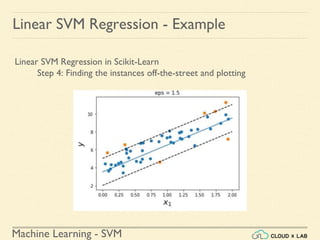
Step 4: Finding the instances off-the-street and plotting
>>> y_pred = svm_reg1.predict(X)
>>> supp_vec_X = X[np.abs(y-y_pred)>1.5]
>>> supp_vec_y = y[np.abs(y-y_pred)>1.5]
>>> plt.scatter(supp_vec_X,supp_vec_y)
>>> plt.show()
Machine Learning - SVM
Linear SVM Regression - Example
Linear SVM Regression in Scikit-Learn
Step 4: Finding the instances off-the-street and plotting
Machine Learning - SVM
Switch to Notebook
Machine Learning - SVM
Linear SVM Regression - Example
Linear SVM Regression in Scikit-Learn with eps = 0.5
Step 1: Generating random numbers and making a linear relationship
>>> from sklearn.svm import LinearSVR
>>> import numpy.random as rnd
>>> import matplotlib.pyplot as plt
>>> rnd.seed(42)
>>> m = 50
>>> X = 2 * rnd.rand(m,1)
>>> y = (4 + 3 * X + rnd.randn(m,1)).ravel()
>>> plt.scatter(X,y)
>>> plt.show()
Machine Learning - SVM
Linear SVM Regression - Example
Linear SVM Regression in Scikit-Learn
Step 1: Generating random numbers and making a linear relationship
Machine Learning - SVM
Linear SVM Regression - Example
Linear SVM Regression in Scikit-Learn
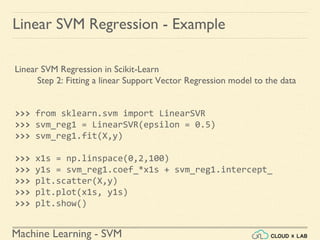
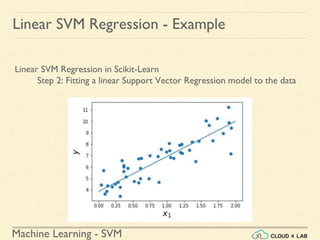
Step 2: Fitting a linear Support Vector Regression model to the data
>>> from sklearn.svm import LinearSVR
>>> svm_reg1 = LinearSVR(epsilon = 0.5)
>>> svm_reg1.fit(X,y)
>>> x1s = np.linspace(0,2,100)
>>> y1s = svm_reg1.coef_*x1s + svm_reg1.intercept_
>>> plt.scatter(X,y)
>>> plt.plot(x1s, y1s)
>>> plt.show()
Machine Learning - SVM
Linear SVM Regression - Example
Linear SVM Regression in Scikit-Learn
Step 2: Fitting a linear Support Vector Regression model to the data
Machine Learning - SVM
Linear SVM Regression - Example
Linear SVM Regression in Scikit-Learn
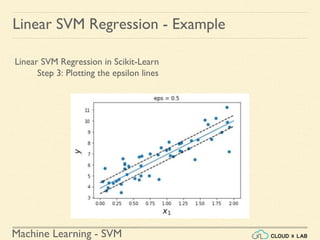
Step 3: Plotting the epsilon lines
>>> y1s_eps1 = y1s + 0.5
>>> y1s_eps2 = y1s - 0.5
>>> plt.scatter(X,y)
>>> plt.plot(x1s, y1s)
>>> plt.plot(x1s, y1s_eps1,'k--')
>>> plt.plot(x1s, y1s_eps2,'k--')
>>> plt.xlabel(r"$x_1$", fontsize=18)
>>> plt.ylabel(r"$y$", fontsize=18)
>>> plt.title('eps = 1.5')
>>> plt.show()
Machine Learning - SVM
Linear SVM Regression - Example
Linear SVM Regression in Scikit-Learn
Step 3: Plotting the epsilon lines
Machine Learning - SVM
Linear SVM Regression - Example
Linear SVM Regression in Scikit-Learn
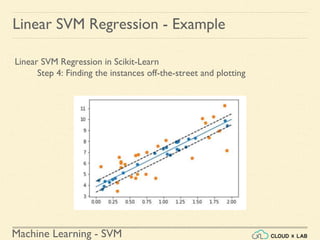
Step 4: Finding the instances off-the-street and plotting
>>> y_pred = svm_reg1.predict(X)
>>> supp_vec_X = X[np.abs(y-y_pred)>0.5]
>>> supp_vec_y = y[np.abs(y-y_pred)>0.5]
>>> plt.scatter(supp_vec_X,supp_vec_y)
>>> plt.show()
Machine Learning - SVM
Linear SVM Regression - Example
Linear SVM Regression in Scikit-Learn
Step 4: Finding the instances off-the-street and plotting
Machine Learning - SVM
Switch to Notebook
Machine Learning - SVM
Linear SVM Regression - Example
Linear SVM Regression in Scikit-Learn
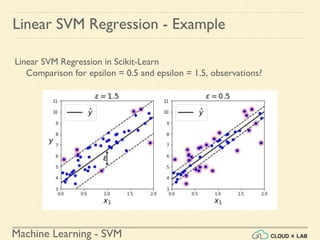
Comparison for epsilon = 0.5 and epsilon = 1.5, observations?
Machine Learning - SVM
Switch to Notebook
Machine Learning - SVM
Linear SVM Regression - Example
● Linear SVM Regression in Scikit-Learn
○ Comparison for eps = 0.5 and eps = 1.5, observations?
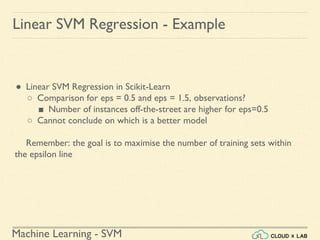
■ Number of instances off-the-street are higher for eps=0.5
○ Cannot conclude on which is a better model
Remember: the goal is to maximise the number of training sets within
the epsilon line
Machine Learning - SVM
Linear SVM Classification
Linear SVM
Classification
Nonlinear SVM
Classification
SVM
Regression
Nonlinear
SVM: SVR
Polynomial
Kernel +
degree + C +
epsilon
Linear SVM:
LinearSVR +
Epsilon
Machine Learning - SVM
SVM Nonlinear Regression
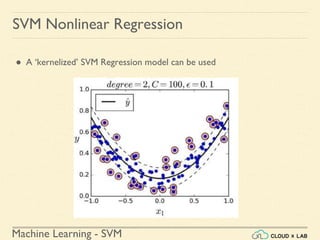
● A ‘kernelized’ SVM Regression model can be used
Machine Learning - SVM
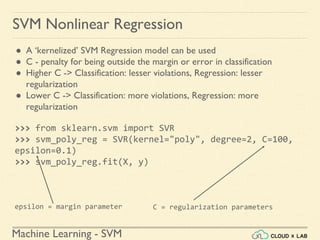
>>> from sklearn.svm import SVR
>>> svm_poly_reg = SVR(kernel="poly", degree=2, C=100,
epsilon=0.1)
>>> svm_poly_reg.fit(X, y)
SVM Nonlinear Regression
● A ‘kernelized’ SVM Regression model can be used
● C - penalty for being outside the margin or error in classification
● Higher C -> Classification: lesser violations, Regression: lesser
regularization
● Lower C -> Classification: more violations, Regression: more
regularization
epsilon = margin parameter C = regularization parameters
Machine Learning - SVM
SVM Nonlinear Regression - Example 1
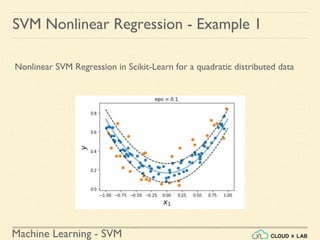
Nonlinear SVM Regression in Scikit-Learn for a quadratic distributed data
Machine Learning - SVM
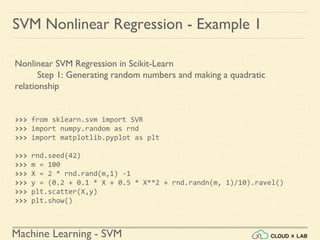
Nonlinear SVM Regression in Scikit-Learn
Step 1: Generating random numbers and making a quadratic
relationship
>>> from sklearn.svm import SVR
>>> import numpy.random as rnd
>>> import matplotlib.pyplot as plt
>>> rnd.seed(42)
>>> m = 100
>>> X = 2 * rnd.rand(m,1) -1
>>> y = (0.2 + 0.1 * X + 0.5 * X**2 + rnd.randn(m, 1)/10).ravel()
>>> plt.scatter(X,y)
>>> plt.show()
SVM Nonlinear Regression - Example 1
Machine Learning - SVM
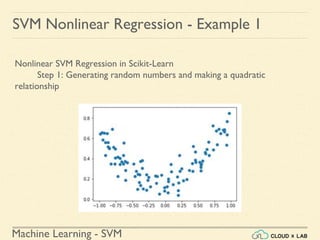
Nonlinear SVM Regression in Scikit-Learn
Step 1: Generating random numbers and making a quadratic
relationship
SVM Nonlinear Regression - Example 1
Machine Learning - SVM
Nonlinear SVM Regression in Scikit-Learn
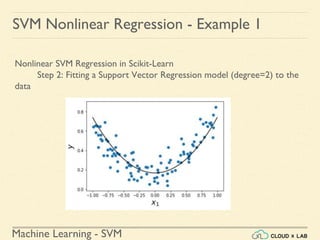
Step 2: Fitting a Support Vector Regression model (degree=2) to the
data
>>> from sklearn.svm import SVR
>>> svr_poly_reg1 = SVR(kernel="poly", degree=2, C =
100, epsilon = 0.1)
>>> svr_poly_reg1.fit(X,y)
>>> print(svr_poly_reg1.C)
>>> x1s = np.linspace(-1,1,200)
>>> plot_svm_regression(svr_poly_reg1, X, y, [-1, 1, 0,
1])
SVM Nonlinear Regression - Example 1
Machine Learning - SVM
Nonlinear SVM Regression in Scikit-Learn
Step 2: Fitting a Support Vector Regression model (degree=2) to the
data
SVM Nonlinear Regression - Example 1
Machine Learning - SVM
Nonlinear SVM Regression in Scikit-Learn
Step 3: Plotting the epsilon lines
>>> y1s_eps1 = y1s + 0.1
>>> y1s_eps2 = y1s - 0.1
>>> plt.scatter(X,y)
>>> plt.plot(x1s, y1s)
>>> plt.plot(x1s, y1s_eps1,'k--')
>>> plt.plot(x1s, y1s_eps2,'k--')
>>> plt.xlabel(r"$x_1$", fontsize=18)
>>> plt.ylabel(r"$y$", fontsize=18)
>>> plt.title('eps = 1.5')
>>> plt.show()
SVM Nonlinear Regression - Example 1
Machine Learning - SVM
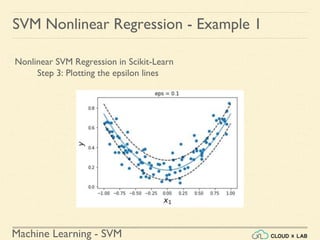
Nonlinear SVM Regression in Scikit-Learn
Step 3: Plotting the epsilon lines
SVM Nonlinear Regression - Example 1
Machine Learning - SVM
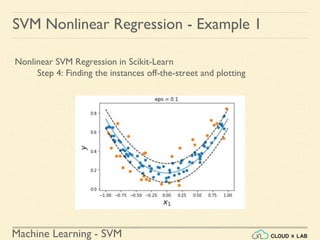
Nonlinear SVM Regression in Scikit-Learn
Step 4: Finding the instances off-the-street and plotting
>>> y1_predict = svr_poly_reg1.predict(X)
>>> supp_vectors_X = X[np.abs(y-y1_predict)>0.1]
>>> supp_vectors_y = y[np.abs(y-y1_predict)>0.1]
>>> plt.scatter(supp_vectors_X ,supp_vectors_y)
>>> plt.show()
SVM Nonlinear Regression - Example 1
Machine Learning - SVM
Nonlinear SVM Regression in Scikit-Learn
Step 4: Finding the instances off-the-street and plotting
SVM Nonlinear Regression - Example 1
Machine Learning - SVM
Switch to Notebook
Machine Learning - SVM
SVM Nonlinear Regression - Comparison
Machine Learning - SVM
Switch to Notebook
Machine Learning - SVM
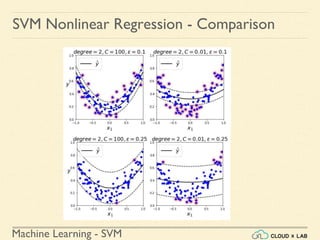
SVM Nonlinear Regression - Comparison
The model as calculated with different hyper-parameters can be observed
- Higher eps: Less number of instances off-the-street
- Higher C: Less number of instances off-the-street
However, higher eps and lesser number of violations does not always imply
a better model.
Similarly, higher C can lead to overfitting
Machine Learning - SVM
SVM Classification Summary
Linear Classification
- Bad-model versus good-model: large-margin classification
- SVM Sensitivity to feature scaling
- Hard margin versus Soft margin classification
Nonlinear SVM Classification
- Adding polynomial features and solving using kernel trick
- Adding similarity features - Gaussian RBF function and kernel trick
Computational comparison for SVC, SVCLinear and SGDClassifier
Machine Learning - SVM
SVM Regression Summary
SVM Regression (Linear and Non Linear)
- SVM Linear Regression using LinearSVR and controlling the width of the margin using
epsilon
- Using Kernel-ized SVM Regression model to model non-linear models - SVR with kernel,
StandardScaler
Machine Learning - SVM
How do SVMs work? - Under the Hood
Machine Learning - SVM
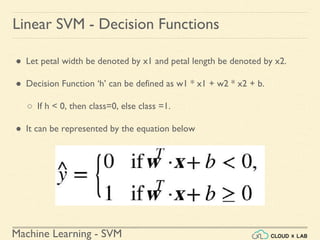
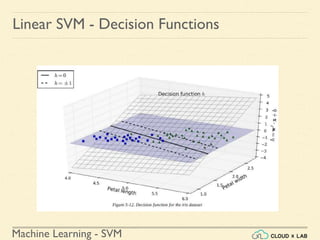
Linear SVM - Decision Functions
● Let petal width be denoted by x1 and petal length be denoted by x2.
● Decision Function ‘h’ can be defined as w1 * x1 + w2 * x2 + b.
○ If h < 0, then class=0, else class =1.
● It can be represented by the equation below
Machine Learning - SVM
Linear SVM - Decision Functions
Machine Learning - SVM
Linear SVM - Decision Functions
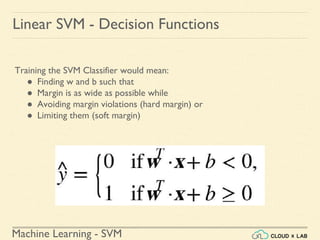
Training the SVM Classifier would mean:
● Finding w and b such that
● Margin is as wide as possible while
● Avoiding margin violations (hard margin) or
● Limiting them (soft margin)
Machine Learning - SVM
Linear SVM - Decision Functions
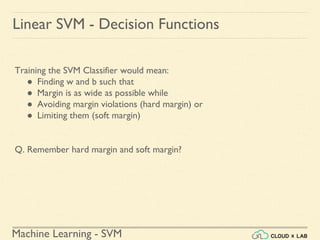
Training the SVM Classifier would mean:
● Finding w and b such that
● Margin is as wide as possible while
● Avoiding margin violations (hard margin) or
● Limiting them (soft margin)
Q. Remember hard margin and soft margin?
Machine Learning - SVM
Linear SVM - Decision Functions
Training the SVM Classifier would mean:
● Finding w and b such that
● Margin is as wide as possible while
● Avoiding margin violations (hard margin) or
● Limiting them (soft margin)
Q. How do we achieve the above?
Machine Learning - SVM
Linear SVM - Decision Functions
Training the SVM Classifier would mean:
● Finding w and b such that
● Margin is as wide as possible while
● Avoiding margin violations (hard margin) or
● Limiting them (soft margin)
Q. How do we achieve the above?
● Optimization
Machine Learning - SVM
Linear SVM - Decision Functions
What do we know?
- For a 2d dataset, the slope of the margin is equal to w = [w1, w2] and
the slope of the decision boundary is equal to w1^2 + w2^2
- For a n-dimensional dataset, w = [w1, w2, w3, ... , wn] and the slope of
the decision function is denoted by || w ||
Machine Learning - SVM
Linear SVM - Decision Functions
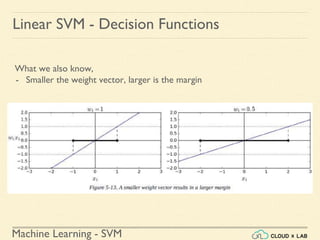
What we also know,
- Smaller the weight vector, larger is the margin
Machine Learning - SVM
Linear SVM - Decision Functions
- So, in order to achieve the best classifier
- we can minimize || w || to maximize the margin, can we?
Machine Learning - SVM
Linear SVM - Decision Functions
- So, in order to achieve the best classifier
- we can minimize || w || to maximize the margin, can we?
- No
- For hard margin, we need to ensure
- Decision function > 1 for all positive training instances
- Decision function < -1 for all negative training instances
Machine Learning - SVM
Linear SVM - Decision Functions
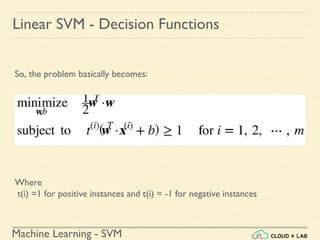
So, the problem basically becomes:
Where
t(i) =1 for positive instances and t(i) = -1 for negative instances
Machine Learning - SVM
Linear SVM - Decision Functions
- So, in order to achieve the best classifier
- we can minimize || w || to maximize the margin, can we?
- No
- For soft margin, we need to include a slack variable to the minimization
equation
- Two conflicting goals:
- Minimize the weights matrix to maximize the margin
- Minimize the slack variable to reduce margin violations
- C hyper-parameter allows us to define the trade-off between the two
Machine Learning - SVM
Linear SVM - Decision Functions
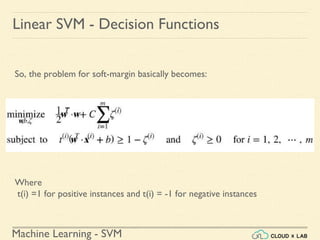
So, the problem for soft-margin basically becomes:
Where
t(i) =1 for positive instances and t(i) = -1 for negative instances
Machine Learning - SVM
Linear SVM - Decision Functions
Both hard-margin and soft-margin problems are
- Convex quadratic problems with
- Linear constraints
Such problems are known as Quadratic Programming (QP) problems
- Can be solved using off-the-shelf solvers
- Using variety of techniques
- We will not discuss this in the session
Machine Learning - SVM
Linear SVM - Decision Functions
So now we know that the hard-margin and soft-margin classifiers
- Is an optimization problem to
- minimize the cost
- given certain constraints
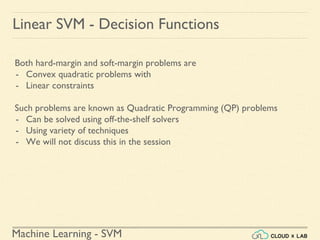
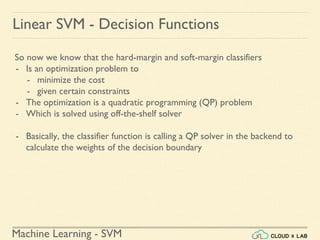
- The optimization is a quadratic programming (QP) problem
- Which is solved using off-the-shelf solver
- Basically, the classifier function is calling a QP solver in the backend to
calculate the weights of the decision boundary
Machine Learning - SVM
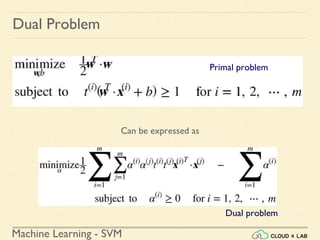
Dual Problem
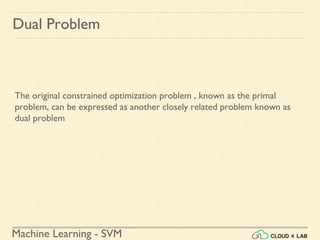
The original constrained optimization problem , known as the primal
problem, can be expressed as another closely related problem known as
dual problem
Machine Learning - SVM
Dual Problem
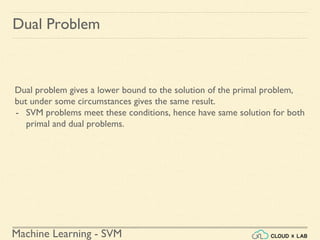
Dual problem gives a lower bound to the solution of the primal problem,
but under some circumstances gives the same result.
- SVM problems meet these conditions, hence have same solution for both
primal and dual problems.
Machine Learning - SVM
Dual Problem
Can be expressed as
Primal problem
Dual problem
Machine Learning - SVM
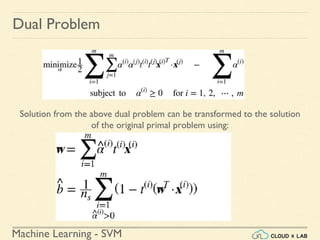
Dual Problem
Solution from the above dual problem can be transformed to the solution
of the original primal problem using:
Machine Learning - SVM
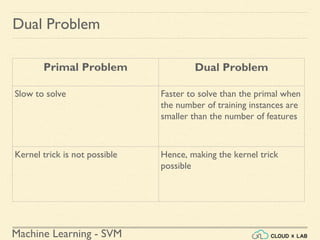
Dual Problem
Primal Problem Dual Problem
Slow to solve Faster to solve than the primal when
the number of training instances are
smaller than the number of features
Kernel trick is not possible Hence, making the kernel trick
possible
Machine Learning - SVM
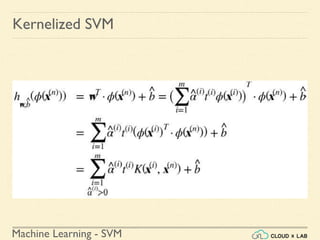
Kernelized SVM
- When did we use SVM Kernel?
- Review (Slides 91 to 125)
Machine Learning - SVM
Kernelized SVM
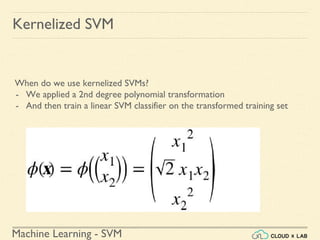
When do we use kernelized SVMs?
- We applied a 2nd degree polynomial transformation
- And then train a linear SVM classifier on the transformed training set
Machine Learning - SVM
Kernelized SVM
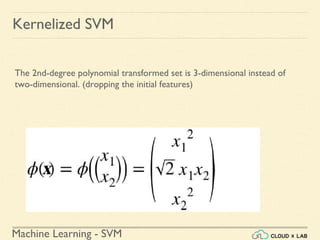
The 2nd-degree polynomial transformed set is 3-dimensional instead of
two-dimensional. (dropping the initial features)
Machine Learning - SVM
Kernelized SVM
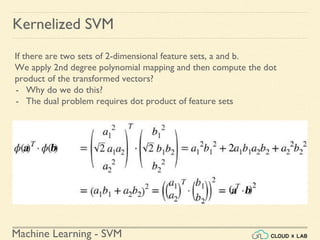
If there are two sets of 2-dimensional feature sets, a and b.
We apply 2nd degree polynomial mapping and then compute the dot
product of the transformed vectors?
- Why do we do this?
- The dual problem requires dot product of feature sets
Machine Learning - SVM
Kernelized SVM
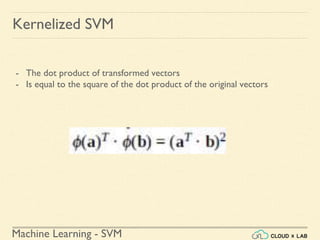
- The dot product of transformed vectors
- Is equal to the square of the dot product of the original vectors
Machine Learning - SVM
Kernelized SVM
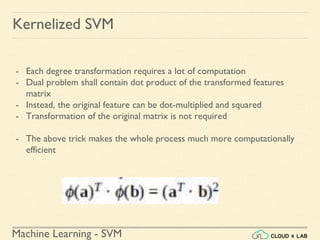
- Each degree transformation requires a lot of computation
- Dual problem shall contain dot product of the transformed features
matrix
- Instead, the original feature can be dot-multiplied and squared
- Transformation of the original matrix is not required
- The above trick makes the whole process much more computationally
efficient
Machine Learning - SVM
Kernelized SVM
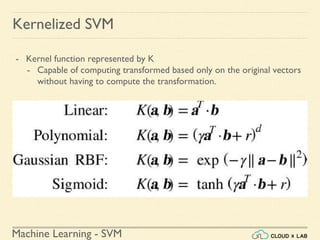
- Kernel function represented by K
- Capable of computing transformed based only on the original vectors
without having to compute the transformation.
Machine Learning - SVM
Online SVMs
What is Online Learning?
Recap: incremental learning of the model as data gathers more
datasets on the go
Machine Learning
Machine Learning - Online Learning
Machine Learning
Machine Learning - Online Learning
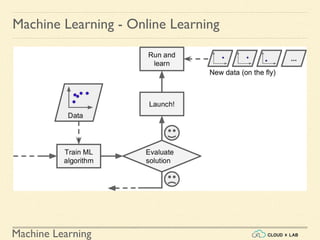
● Train system incrementally
○ By feeding new data sequentially
○ Or in batches
● System can learn from new data on the fly
● Good for systems where data is a continuous flow
○ Stock prices
Machine Learning
Machine Learning - Online Learning
Using online learning to handle huge datasets
Machine Learning
Machine Learning - Online Learning
Using online learning to handle huge datasets
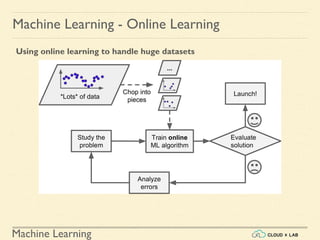
● Can be used to train huge datasets
○ That can not be fit in one machine
○ The training data gets divided into batches and
○ System gets trained on each batch incrementally
Machine Learning
Machine Learning - Online Learning
Challenges in online learning
● System’s performance gradually declines
○ If bad data is fed to the system
○ Bad data can come from
○ Malfunctioning sensor or robot
○ Someone spamming your system
Machine Learning
Machine Learning - Online Learning
Challenges in online learning
● Closely monitor the system
○ Turn off the learning if there is a performance drop
○ Or monitor the input data and remove anomalies
Machine Learning
Machine Learning - Online Learning
Challenges in online learning
● Closely monitor the system
○ Turn off the learning if there is a performance drop
○ Or monitor the input data and remove anomalies
Machine Learning
Machine Learning - Online Learning
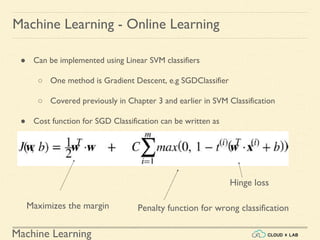
● Can be implemented using Linear SVM classifiers
○ One method is Gradient Descent, e.g SGDClassifier
○ Covered previously in Chapter 3 and earlier in SVM Classification
● Cost function for SGD Classification can be written as
Maximizes the margin Penalty function for wrong classification
Hinge loss
Machine Learning
Machine Learning - Online Learning
● Online Learning can also be implemented using Kernelized SVMs
○ Currently implemented in Matlab and CPP
○ For large scale nonlinear problems, we should also consider using neural
networks which will be covered in ANN course.
Archives
Machine Learning - SVM
Kernelized SVM
Machine Learning - SVM
Linear SVM Classification
Linear SVM
Classification
Nonlinear SVM
Classification
SVM
Regression

Support Vector Machines

  • 1.
  • 2.
    Machine Learning -SVM Support Vector Machines Divide dataset into training and test samples Train the model using training dataset Test using sample training data Performance metrics (Finalize the model) Improve the model using error analysis Remember the general flow of a machine learning problem: There can be several models depending on the problem statement We will discuss about one such model - SVM
  • 3.
    Machine Learning -SVM ● Support vector machine is ○ Very powerful and versatile model ○ Capable of performing ■ Linear and ■ Nonlinear classification ■ Regression and ■ Outlier detection ● Well suited for small or medium sized datasets Support Vector Machines
  • 4.
    Machine Learning -SVM Support Vector Machines ● In this session we will learn about ○ Linear SVM Classification ○ Nonlinear SVM Classification and ○ SVM Regression
  • 5.
    Machine Learning -SVM Support Vector Machines Linear SVM Classification
  • 6.
    Machine Learning Human Supervision? Supervised MachineLearning Unsupervised Reinforcement Classification Regression How they generalize? Learn Incrementally? What is Classification?
  • 7.
    Machine Learning -SVM 5 Not 5 What is Classification? Identifying to which label something belongs to
  • 8.
    Machine Learning -SVM Examples of Classification ● Classifying emails as spam or not spam Q. What type of classification is this?
  • 9.
    Machine Learning -SVM Examples of Classification ● Classifying emails as spam or not spam Q. What type of classification is this? Ans: Binary
  • 10.
    Machine Learning -SVM ● Classifying flowers of a particular species like the Iris Dataset Examples of Classification Q. What type of classification is this?
  • 11.
    Machine Learning -SVM ● Classifying flowers of a particular species like the Iris Dataset Examples of Classification Q. What type of classification is this? Ans: Multi-class classification
  • 12.
    Machine Learning -SVM ● Classifying a credit card transaction as fraudulent or not Examples of Classification
  • 13.
    Machine Learning -SVM Examples of Classification ● Face recognition Q. What type of classification is this?
  • 14.
    Machine Learning -SVM Examples of Classification ● Face recognition Q. What type of classification is this? Ans: Multi-label classification
  • 15.
    Machine Learning -SVM 5 Not 5 Recap of 5 and Not 5 Classification Problem Binary Classification Multiclass Classification Q. What is the classifier we used for the Binary Classification?
  • 16.
    Machine Learning -SVM 5 Not 5 Recap of 5 and Not 5 Classification Problem Binary Classification Multiclass Classification Q. What is the classifier we used for the Binary Classification? Ans: SGDClassifier
  • 17.
    Machine Learning -SVM 5 Not 5 Recap of 5 and Not 5 Classification Problem Binary Classification Multiclass Classification Q. What is the classifier we used for the Multiclass Classification?
  • 18.
    Machine Learning -SVM 5 Not 5 Recap of 5 and Not 5 Classification Problem Binary Classification Multiclass Classification Q. What is the classifier we used for the Multiclass Classification? Ans: SGDClassifier - OvO and OvA
  • 19.
    Machine Learning -SVM What is Linear Classification?
  • 20.
    Machine Learning -SVM What is Linear Classification? ● The two classes can be separated easily with a ‘straight’ line ‘Straight’ is the keyword. It means linear classification.
  • 21.
    Machine Learning -SVM What is Linear Classification? ● For example: IRIS Dataset ○ Features: Sepal Length, Petal Length ○ Class: Iris Virginica OR Iris Versicolor OR Iris Setosa
  • 22.
    Machine Learning -SVM What is Linear Classification? Sepal Length Petal Length Flower Type 1.212 4.1 Iris-Versicolor 0.5 1.545 Iris-Setosa 0.122 1.64 Iris-Setosa 0.2343 ... Iris-Setosa 0.1 ... Iris-Setosa 1.32 ... Iris-Versicolor
  • 23.
    Machine Learning -SVM What is Linear Classification? ● For the above IRIS Dataset, what is the type of Machine Learning model? ○ Classification or Regression? ■ Ans:
  • 24.
    Machine Learning -SVM What is Linear Classification? ● For the above IRIS Dataset, what is the type of Machine Learning model? ○ Classification or Regression? ■ Ans: Classification
  • 25.
    Machine Learning -SVM What is Linear Classification? ● What is the type of Supervised Machine Learning model? ○ Classification or Regression? ■ Ans: Classification ○ What type of classification? ■ Binary Classification ■ Multi-label Classification ■ Multi-output Classification ■ Multi-class Classification
  • 26.
    Machine Learning -SVM What is Linear Classification? ● What is the type of Supervised Machine Learning model? ○ Classification or Regression? ■ Ans: Classification ○ What type of classification? ■ Binary Classification ■ Multi-label Classification ■ Multi-output Classification ■ Ans: Multi-class Classification
  • 27.
    Machine Learning -SVM What is Linear Classification? ● For the IRIS dataset above: ○ Number of features? ■ Ans: ○ Number of classes? ■ Ans:
  • 28.
    Machine Learning -SVM What is Linear Classification? ● For the IRIS dataset above: ○ Number of features? ■ Ans: 2 ○ Number of classes? ■ Ans: 3
  • 29.
    Machine Learning -SVM What is Linear Classification? ● When we plot the two features on the graph and label it by color ○ The classes can be divided using a straight line ○ Hence, linear classification Straight Line (Linear Classification)
  • 30.
    Machine Learning -SVM Linear SVM Classification Linear SVM Classification Nonlinear SVM Classification SVM Regression Bad model versus good- model (Large Margin) Classification Soft Margin versus Hard- margin Classification
  • 31.
    Machine Learning -SVM Linear SVM Classification - Large Margin Pink and red decision boundaries are very close to the instances - bad model Decision Boundary as far away from training instances - good model Large Margin Classification Widest possible street
  • 32.
    Machine Learning -SVM Linear SVM Classification - Large Margin May not perform well on new instances Adding training instances may not affect the decision boundary Large Margin Classification
  • 33.
    Machine Learning -SVM Linear SVM Classification - Large Margin Large Margin Classification Widest possible street Support Vectors ● What are Support vectors? ○ Vectors or the training set located closest to the classifier OR ○ Vectors or the training sets located at the edge of the street
  • 34.
    Machine Learning -SVM Switch to Notebook
  • 35.
    Machine Learning -SVM Linear SVM Classification - Example 1 X1 X2 Label 1 50 0 5 20 0 3 80 1 5 60 1 ● Without Scaling ● Training dataset
  • 36.
    Machine Learning -SVM Linear SVM Classification - Example 1 ● Model the classifier, plot the points and the classifier >>> Xs = np.array([[1, 50], [5, 20], [3, 80], [5, 60]]).astype(np.float64) >>> ys = np.array([0, 0, 1, 1]) >>> svm_clf = SVC(kernel="linear", C=100) >>> svm_clf.fit(Xs, ys) >>> plt.plot(Xs[:, 0][ys==1], Xs[:, 1][ys==1], "bo") >>> plt.plot(Xs[:, 0][ys==0], Xs[:, 1][ys==0], "ms") >>> plot_svc_decision_boundary(svm_clf, 0, 6) >>> plt.xlabel("$x_0$", fontsize=20) >>> plt.ylabel("$x_1$ ", fontsize=20, rotation=0) >>> plt.title("Unscaled", fontsize=16) >>> plt.axis([0, 6, 0, 90])
  • 37.
    Machine Learning -SVM Linear SVM Classification - Example 1 ● Model the classifier, plot the points and the classifier
  • 38.
    Machine Learning -SVM Linear SVM Classification - Example 1 ● What is the problem?
  • 39.
    Machine Learning -SVM Linear SVM Classification - Example 1 ● What is the problem? ○ X0 ranges from 0 to 6 while ○ X1 ranges from 20 to 80 ● Solution: Feature Scaling
  • 40.
    Machine Learning Project FeatureScaling Feature Scaling Quick Revision from Preparing the data for ML Algorithms in End-to-End Project
  • 41.
    Machine Learning Project FeatureScaling ● ML algorithms do not perform well ○ When the input numerical attributes have very different scales ● Feature Scaling is one of the most important ○ Transformation we need to apply to our data ● Two ways to make sure all attributes have same scale ○ Min-max scaling ○ Standardization
  • 42.
    Machine Learning Project FeatureScaling Min-max Scaling ● Also known as Normalization ● Normalized values are in the range of [0, 1]
  • 43.
    Machine Learning Project FeatureScaling Min-max Scaling ● Also known as Normalization ● Normalized values are in the range of [0, 1] Original Value Normalized Value
  • 44.
    Machine Learning Project FeatureScaling Min-max Scaling - Example # Creating DataFrame first >>> import pandas as pd >>> s1 = pd.Series([1, 2, 3, 4, 5, 6], index=(range(6))) >>> s2 = pd.Series([10, 9, 8, 7, 6, 5], index=(range(6))) >>> df = pd.DataFrame(s1, columns=['s1']) >>> df['s2'] = s2 >>> df
  • 45.
    Machine Learning Project FeatureScaling Min-max Scaling - Example # Use Scikit-Learn minmax_scaling >>> from mlxtend.preprocessing import minmax_scaling >>> minmax_scaling(df, columns=['s1', 's2']) Original Scaled (In range of 0 and 1)
  • 46.
    Machine Learning Project FeatureScaling Standardization ● In Machine Learning, we handle various types of data like ○ Audio signals and ○ Pixel values for image data ○ And this data can include multiple dimensions
  • 47.
    Machine Learning Project FeatureScaling Standardization We scale the values by calculating ○ How many standard deviation is the value away from the mean SAT scores ~ N(mean = 1500, SD = 300) ACT scores ~ N(mean = 21, SD = 5)
  • 48.
    Machine Learning Project FeatureScaling Standardization ● The general method of calculation ○ Calculate distribution mean and standard deviation for each feature ○ Subtract the mean from each feature ○ Divide the result from previous step of each feature by its standard deviation Standardized Value
  • 49.
    Machine Learning Project FeatureScaling Standardization ● In Standardization, features are rescaled ● So that output will have the properties of ● Standard normal distribution with ○ Zero mean and ○ Unit variance Mean Standard Deviation
  • 50.
    Machine Learning Project FeatureScaling Standardization ● Scikit-Learn provides ○ StandardScaler class for standardization
  • 51.
    Machine Learning Project FeatureScaling Which One to Use? ● Min-max scales in the range of [0,1] ● Standardization does not bound values to a specific range ○ It may be problem for some algorithms ○ Example- Neural networks expect an input value ranging from 0 to 1 ● We’ll learn more use cases as we proceed in the course
  • 52.
    Machine Learning Project FeatureScaling Back to original Example 1
  • 53.
    Machine Learning -SVM Linear SVM Classification - Example 2 x1 x2 Label x1 (Scaled) x2 (Scaled) 1 50 0 -1.5 -0.1154 5 20 0 0.9 -1.5011107 3 80 1 -0.3 1.27017 5 60 1 0.9 0.3464 Mean (m1) = 3.5 Std Dev (s1) = 1.65 Mean (m2) = 52.5 Std Dev (s2) = 21.65 (x-m1)/s1 (x-s2)/m2 ● With Scaling
  • 54.
    Machine Learning -SVM Linear SVM Classification - Example 2 ● Scaling of features X_new = (x-m1)/s1 ● What kind of scaling is this? ○ Normalization ○ Standardization
  • 55.
    Machine Learning -SVM Linear SVM Classification - Example 2 ● Scaling of features X_new = (x-m1)/s1 ● What kind of scaling is this? ○ Normalization ○ Standardization
  • 56.
    Machine Learning -SVM Linear SVM Classification - Example 2 ● Scaling of features X_new = (x-m1)/s1 ● What kind of scaling is this? ○ Normalization ○ Standardization ● What is the module available in scikit_learn to perform standardization?
  • 57.
    Machine Learning -SVM Linear SVM Classification - Example 2 ● Scaling of features X_new = (x-m1)/s1 ● What kind of scaling is this? ○ Normalization ○ Standardization ● What is the module available in scikit_learn to perform standardization? ○ Answer: StandardScalar
  • 58.
    Machine Learning -SVM Linear SVM Classification - Example 2 ● Scaling the input training data >>> from sklearn.preprocessing import StandardScaler >>> scaler = StandardScaler() >>> X_scaled = scaler.fit_transform(Xs) >>> print(X_scaled) [[-1.50755672 -0.11547005] [ 0.90453403 -1.5011107 ] [-0.30151134 1.27017059] [ 0.90453403 0.34641016]]
  • 59.
    Machine Learning -SVM Linear SVM Classification - Example 2 ● Building the model, plotting the decision boundary and the training points >>> svm_clf.fit(X_scaled, ys) >>> plt.plot(X_scaled[:, 0][ys==1], X_scaled[:, 1][ys==1], "bo") >>> plt.plot(X_scaled[:, 0][ys==0], X_scaled[:, 1][ys==0], "ms") >>> plot_svc_decision_boundary(svm_clf, -2, 2) >>> plt.ylabel("$x_{1scaled}$", fontsize=20) >>> plt.xlabel("$x_{0scaled}$", fontsize=20) >>> plt.title("Scaled", fontsize=16) >>> plt.axis([-2, 2, -2, 2])
  • 60.
    Machine Learning -SVM Linear SVM Classification - Example 2 ● Output decision boundary for a scaled training data
  • 61.
    Machine Learning -SVM Linear SVM Classification ● Unscaled vs Scaled comparison X0 X1 Label X0 (Scaled) X1 (Scaled) 1 50 0 -1.5 -0.1154 5 20 0 0.9 -1.5011107 3 80 1 -0.3 1.27017 5 60 1 0.9 0.3464 Mean (m1) = 3.5 Std Dev (s1) = 1.65 Mean (m2) = 52.5 Std Dev (s2) = 21.65 (x-m1)/s1 (x-m2)/s2
  • 62.
    Machine Learning -SVM Linear SVM Classification ● Unscaled vs Scaled Widestpossiblestreet
  • 63.
    Machine Learning -SVM Linear SVM Classification ● Unscaled vs Scaled ○ Linear SVM sensitive to scaling ○ Feature scaling an important part of data preparation ■ Normalization ■ Standardization ○ Scaled features produce better result for the above example
  • 64.
    Machine Learning -SVM Switch to Notebook
  • 65.
    Machine Learning -SVM Linear SVM Classification Linear SVM Classification Nonlinear SVM Classification SVM Regression Bad model versus good- model (Large Margin- Standardized) Classification Soft Margin versus Hard- margin Classification
  • 66.
    Machine Learning -SVM Linear SVM Classification - Hard Margin ● Hard Margin Classification ○ Strictly impose that all the instances should be ■ Off the street and ■ On a particular side of the decision boundary ○ Issues: ■ Works only if the data is linearly separable ■ Quite sensitive to outliers
  • 67.
    Machine Learning -SVM Linear SVM Classification - Hard Margin Question - Is it possible to classify this using SVM Hard Margin Classification? See the code in notebook
  • 68.
    Machine Learning -SVM Linear SVM Classification - Hard Margin Question - Is it possible to classify this using SVM Hard Margin Classification? See the code in notebook
  • 69.
    Machine Learning -SVM Linear SVM Classification - Hard Margin Question - Is it possible to classify this using SVM Hard Margin Classification? See the code in notebook
  • 70.
    Machine Learning -SVM Linear SVM Classification - Hard Margin Question - Is it possible to classify this using SVM Hard Margin Classification? Answer - Yes, but what is the problem? Yes See the code in notebook
  • 71.
    Machine Learning -SVM Linear SVM Classification - Hard Margin Yes Question - Is it possible to classify this using SVM Hard Margin Classification? Answer - Yes, but what is the problem? Outlier is the problem
  • 72.
    Machine Learning -SVM Linear SVM Classification - Soft Margin Soft Margin Classification Is keeping a balance between ○ Keeping the street as large as possible ○ Limiting the margin violations ○ Regulated by using ‘C’ parameter
  • 73.
    Machine Learning -SVM Linear SVM Classification - Soft Margin ● The balance can be regulated in Scikit-Learn using ‘c’ parameter ○ Higher ‘c’: ■ Narrower street, lower margin violations ○ Smaller ‘c’: ■ Wider street, more margin violations >>> svm_clf = SVC(kernel="linear", C=100) SVM Linear classification ‘C’ parameter to regulate the street and margin violations
  • 74.
    Machine Learning -SVM Linear SVM Classification - Soft Margin Example 1: SVM Classification for IRIS data using c = 1 Steps: ● Load the IRIS data ● Model the SVM Linear classifier with the training set: fitting ● Test using a sample data For illustration: ● Plot the decision boundary and the training samples Something missing in the steps?
  • 75.
    Machine Learning -SVM Linear SVM Classification - Soft Margin Example 1: SVM Classification for IRIS data using c = 1 Steps: ● Load the IRIS data ● Feature scaling the data ● Model the SVM Linear classifier with the training set: fitting ● Test using a sample data For illustration: ● Plot the decision boundary and the training samples Something missing in the steps?
  • 76.
    Machine Learning -SVM Switch to Notebook
  • 77.
    Machine Learning -SVM Linear SVM Classification - Soft Margin Example 1: SVM Classification for IRIS data using c = 1 Steps: ● Load the IRIS data >>> from sklearn import datasets >>> from sklearn.pipeline import Pipeline >>> from sklearn.preprocessing import StandardScaler >>> from sklearn.svm import LinearSVC >>> iris = datasets.load_iris() >>> X = iris["data"][:, (2, 3)] # petal length, petal width >>> y = (iris["target"] == 2).astype(np.float64) # Iris-Virginica
  • 78.
    Machine Learning -SVM Linear SVM Classification - Soft Margin Example 1: SVM Classification for IRIS data using c = 1 Steps: ● Load the IRIS data ● Feature scaling the data ● Model the SVM Linear classifier with the training set: fitting >>> scaler = StandardScaler() >>> svm_clf2 = LinearSVC(C=1, loss="hinge") >>> scaled_svm_clf2 = Pipeline((("scaler", scaler), ("linear_svc", svm_clf2), )) >>> scaled_svm_clf2.fit(X, y)
  • 79.
    Machine Learning -SVM Linear SVM Classification - Soft Margin Example 1: SVM Classification for IRIS data using c = 1 Steps: ● Load the IRIS data ● Feature scaling the data ● Model the SVM Linear classifier with the training set: fitting ● Test using a sample data >>> scaled_svm_clf1.predict([[5.5, 1.7]]) array([ 1.])
  • 80.
    Machine Learning -SVM Linear SVM Classification - Soft Margin Example 1: SVM Classification for IRIS data using c = 1 Illustration: ● Plot the decision boundary along with the training data ○ Convert to unscaled parameters ■ Training data and decision boundary as calculated ○ Find support vectors ○ Plot it on the graph
  • 81.
    Machine Learning -SVM Linear SVM Classification - Soft Margin Example 1: SVM Classification for IRIS data using c = 1 Illustration: ● Plot the decision boundary along with the training data ○ Convert to unscaled parameters # Convert to unscaled parameters >>> b2 = svm_clf1.decision_function([-scaler.mean_ / scaler.scale_]) >>> w2 = svm_clf1.coef_[0] / scaler.scale_ >>> svm_clf1.intercept_ = np.array([b2]) >>> svm_clf1.coef_ = np.array([w2])
  • 82.
    Machine Learning -SVM Linear SVM Classification - Soft Margin Example 1: SVM Classification for IRIS data using c = 1 Illustration: ● Plot the decision boundary along with the training data ○ Find support vectors # Find support vectors (LinearSVC does not do this automatically) >>> t = y * 2 - 1 >>> support_vectors_idx2 = (t * (X.dot(w2) + b2) < 1).ravel() >>> svm_clf1.support_vectors_ = X[support_vectors_idx2]
  • 83.
    Machine Learning -SVM Linear SVM Classification - Soft Margin Example 1: SVM Classification for IRIS data using c = 1 Illustration: ● Plot the decision boundary along with the training data ○ Plot >>> plt.plot(X[:, 0][y==1], X[:, 1][y==1], "g^") >>> plt.plot(X[:, 0][y==0], X[:, 1][y==0], "bs") >>> plot_svc_decision_boundary(svm_clf2, 4, 6) >>> plt.xlabel("Petal length", fontsize=14) >>> plt.title("$C = {}$".format(svm_clf2.C), fontsize=16) >>> plt.axis([4, 6, 0.8, 2.8]) >>> plt.show()
  • 84.
    Machine Learning -SVM Linear SVM Classification - Soft Margin Example 1: SVM Classification for IRIS data using c = 1 Illustration: ● Plot the decision boundary along with the training data
  • 85.
    Machine Learning -SVM Linear SVM Classification - Soft Margin We repeat the same model for c = 100 and compare it with c =1
  • 86.
    Machine Learning -SVM Linear SVM Classification - Soft Margin Question - What is the model we used here? ● SVC (kernel=’linear’, C=1) ● SGDClassifier(loss=’hinge’, alpha = 1/(m*c)) ● LinearSVC
  • 87.
    Machine Learning -SVM Linear SVM Classification - Soft Margin Question - What is the model we used here? ● SVC (kernel=’linear’, C=1) ● SGDClassifier(loss=’hinge’, alpha = 1/(m*c)) ● Ans: LinearSVC
  • 88.
    Machine Learning -SVM Linear SVM Classification Linear SVM Classification Nonlinear SVM Classification SVM Regression Bad model versus good- model (Large Margin) Classification Soft Margin versus Hard- margin Classification
  • 89.
    Machine Learning -SVM Linear SVM Classification Linear SVM Classification Nonlinear SVM Classification SVM Regression SVC Polynomial Kernel + Standard Scaler SVC RBF Kernel + Standard Scaler Polynomial Features + StandardScal er + LinearSVC
  • 90.
    Machine Learning -SVM Nonlinear SVM Classification ● Many datasets cannot be linearly separable ○ Approach 1: Add more features as polynomial features ■ Can result in a linearly separable dataset
  • 91.
    Machine Learning -SVM Nonlinear SVM Classification Approach 1: Add more features as polynomial features ○ Question - Is this linearly separable?
  • 92.
    Machine Learning -SVM Nonlinear SVM Classification Approach 1: Add more features as polynomial features ● Question - Is this linearly separable? - No
  • 93.
    Machine Learning -SVM Nonlinear SVM Classification Approach 1: Add more features as polynomial features ● What if we transform this data and add a new feature that is squared of the original dataset Original X0 (X1) Label X0_new (X2 = X1^2) -4 1 16 -3 1 9 -2 0 4 -1 0 1 0 0 0 1 0 1 2 0 4 3 1 9 4 1 16
  • 94.
    Machine Learning -SVM Nonlinear SVM Classification Approach 1: Add more features as polynomial features ● We plot the new feature along with the old feature
  • 95.
    Machine Learning -SVM Nonlinear SVM Classification Approach 1: Add more features as polynomial features ● Question - Is it linearly separable?
  • 96.
    Machine Learning -SVM Nonlinear SVM Classification Approach 1: Add more features as polynomial features ● Question - Is it linearly separable? YES
  • 97.
    Machine Learning -SVM Switch to Notebook
  • 98.
    Machine Learning -SVM Nonlinear SVM Classification: Example Approach 1: Add more features as polynomial features ● MOONS Dataset ○ Random dataset generator provided by sklearn library ○ 2d or 2 features ○ Single Label ○ Binary Classification
  • 99.
    Machine Learning -SVM Nonlinear SVM Classification: Example ● MOONS Dataset >>> from sklearn.datasets import make_moons >>> X, y = make_moons(n_samples=5, noise=0.15, random_state=42) Result: [[-0.92892087 0.20526752] [ 1.86247597 0.48137792] [-0.30164443 0.42607949] [ 1.05888696 -0.1393777 ] [ 1.01197477 -0.52392748]] [0 1 1 0 1] No. of samples seed
  • 100.
    Machine Learning -SVM Nonlinear SVM Classification: Example ● MOONS Dataset Result: [[-0.92892087 0.20526752] [ 1.86247597 0.48137792] [-0.30164443 0.42607949] [ 1.05888696 -0.1393777 ] [ 1.01197477 -0.52392748]] [0 1 1 0 1]
  • 101.
    Machine Learning -SVM Nonlinear SVM Classification: Example ● MOONS Dataset ○ Similarly generate 100 such samples >>> from sklearn.datasets import make_moons >>> X, y = make_moons(n_samples=100, noise=0.15, random_state=42)
  • 102.
    Machine Learning -SVM Nonlinear SVM Classification: Example ● MOONS Dataset ○ Similarly generate 100 such samples ○ Plotting the dataset >>> def plot_dataset(X, y, axes): >>> plt.plot(X[:, 0][y==0], X[:, 1][y==0], "bs") >>> plt.plot(X[:, 0][y==1], X[:, 1][y==1], "g^") >>> plt.axis(axes) >>> plt.grid(True, which='both') >>> plt.xlabel(r"$x_1$", fontsize=20) >>> plt.ylabel(r"$x_2$", fontsize=20, rotation=0) >>> plot_dataset(X, y, [-1.5, 2.5, -1, 1.5]) >>> plt.show()
  • 103.
    Machine Learning -SVM Nonlinear SVM Classification: Example ● MOONS Dataset ○ Similarly generate 100 such samples ○ Plotting the dataset
  • 104.
    Machine Learning -SVM Nonlinear SVM Classification: Example ● MOONS Dataset ○ Q. How to classify this using linear classifier?
  • 105.
    Machine Learning -SVM Nonlinear SVM Classification: Example ● MOONS Dataset ○ Q. How to classify this using linear classifier? ○ Ans: Add more features as polynomial features
  • 106.
    Machine Learning -SVM Nonlinear SVM Classification: Example ● Adding polynomial features ○ What does adding polynomial features mean ○ Let us consider another example X1 X2 Label -0.083 0.577 1 1.071 0.205 0 1 x1 x2 x1^2 x1*x2 x2^2 Label 1 -0.083 0.577 0.007 -0.048 0.333 1 1 1.071 0.205 1.147 0.22 0.22 0 Degree = 2
  • 107.
    Machine Learning -SVM Nonlinear SVM Classification: Example ● Adding polynomial features ○ What does adding polynomial features mean ○ Let us consider another example >>> from sklearn.preprocessing import PolynomialFeatures >>> X, y = make_moons(n_samples=2, noise=0.15, random_state=42) >>> np.set_printoptions(precision=2) >>> print(X) >>> print(y) >>> poly=PolynomialFeatures(degree=3) >>> x1=poly.fit_transform(X)*100 >>> print(x1)
  • 108.
    Machine Learning -SVM Nonlinear SVM Classification: Example ● Adding polynomial features ○ What does adding polynomial features mean ○ Let us consider another example X = [[-0.08 0.58] [ 1.07 0.21]] y = [1 0] X1 = [[ 1. -0.08 0.58 0.01 -0.05 0.33 -0. 0. -0.03 0.19] [ 1. 1.07 0.21 1.15 0.22 0.04 1.23 0.24 0.05 0.01]]
  • 109.
    Machine Learning -SVM Nonlinear SVM Classification: Example ● MOONS Dataset ○ Q. How to classify this using linear classifier? ○ Ans: Added more features as polynomial features
  • 110.
    Machine Learning -SVM Nonlinear SVM Classification: Example ● MOONS Dataset ○ Add more features with degree 3 ○ Scale the new features using StandardScaler() ○ Use SVM Classifier ● All the above steps can be performed in a single iteration using a Pipeline
  • 111.
    Machine Learning -SVM Nonlinear SVM Classification: Example >>> from sklearn.pipeline import Pipeline >>> from sklearn.preprocessing import PolynomialFeatures >>> polynomial_svm_clf = Pipeline(( ("poly_features", PolynomialFeatures(degree=3)), ("scaler", StandardScaler()), ("svm_clf", LinearSVC(C=10, loss="hinge")) )) >>> polynomial_svm_clf.fit(X, y)
  • 112.
    Machine Learning -SVM Nonlinear SVM Classification: Example ● MOONS Dataset ○ Plotting the dataset along with the classifier (decision boundary) just modeled
  • 113.
    Machine Learning -SVM Nonlinear SVM Classification: Example def plot_predictions(clf, axes): x0s = np.linspace(axes[0], axes[1], 100) x1s = np.linspace(axes[2], axes[3], 100) x0, x1 = np.meshgrid(x0s, x1s) X = np.c_[x0.ravel(), x1.ravel()] y_pred = clf.predict(X).reshape(x0.shape) y_decision = clf.decision_function(X).reshape(x0.shape) plt.contourf(x0, x1, y_pred, cmap=plt.cm.brg, alpha=0.2) plt.contourf(x0, x1, y_decision, cmap=plt.cm.brg, alpha=0.1) plot_predictions(polynomial_svm_clf, [-1.5, 2.5, -1, 1.5]) plot_dataset(X, y, [-1.5, 2.5, -1, 1.5]) plt.show()
  • 114.
    Machine Learning -SVM Nonlinear SVM Classification: Example
  • 115.
    Machine Learning -SVM Switch to Notebook
  • 116.
    Machine Learning -SVM Linear SVM Classification Linear SVM Classification Nonlinear SVM Classification SVM Regression SVC Polynomial Kernel + Standard Scaler SVC RBF Kernel + Standard Scaler Polynomial Features + StandardScaler + LinearSVC
  • 117.
    Machine Learning -SVM Nonlinear SVM Classification Polynomial Kernel ● Adding polynomial features works great ○ Low polynomial degree cannot deal with complex datasets ○ High polynomial degree makes the model slow due to huge number of features ● How to overcome the slowness due to huge features? ● Ans: Polynomial Kernels or Kernel trick
  • 118.
    Machine Learning -SVM Nonlinear SVM Classification Polynomial Kernel ● Adding polynomial features works great ○ Low polynomial degree cannot deal with complex datasets ○ High polynomial degree makes the model slow due to huge number of features ● How to overcome the slowness due to huge features? ● Ans: Polynomial Kernels or Kernel trick ○ Makes it possible to get the same result as when using high polynomial degree ○ Without having to add the features which makes the model slow
  • 119.
    Machine Learning -SVM Nonlinear SVM Classification Polynomial Kernel in Scikit-Learn ● Can be implement in Scikit Learn using SVC Classifier ● Without having to use PolynomialFeatures as in LinearSVC >>> from sklearn.svm import SVC >>> poly_kernel_svm_clf = Pipeline(( ("scaler", StandardScaler()), ("svm_clf", SVC( kernel="poly", degree=3, coef0=1, C=5)))) kernel controls how much the model is influenced by high-degree polynomials vs low-degree coef0
  • 120.
    Machine Learning -SVM Nonlinear SVM Classification Polynomial Kernel in Scikit-Learn ● Training the classifier using higher degree of polynomial features # train SVM classifier using 10th-degree polynomial kernel (for comparison) >>> poly100_kernel_svm_clf = Pipeline(( ("scaler", StandardScaler()), ("svm_clf", SVC(kernel="poly", degree=10, coef0=100, C=5)) ))
  • 121.
    Machine Learning -SVM Nonlinear SVM Classification Polynomial Kernel in Scikit-Learn ● Observing the difference in the two cases
  • 122.
    Machine Learning -SVM Switch to Notebook
  • 123.
    Machine Learning -SVM Nonlinear SVM Classification Linear SVM Classification Nonlinear SVM Classification SVM Regression SVC Polynomial Kernel + Standard Scaler SVC RBF Kernel + Standard Scaler Polynomial Features + StandardScaler + LinearSVC
  • 124.
    Machine Learning -SVM Nonlinear SVM Classification - SVC RBF Adding similar features ● Another technique of solving nonlinear classifications ● Add features computed using a similarity function ● Similarity function measures how each instance resembles a particular ‘landmark’
  • 125.
    Machine Learning -SVM Nonlinear SVM Classification - SVC RBF ● Is this linearly separable? NO
  • 126.
    Machine Learning -SVM Nonlinear SVM Classification - SVC RBF ● Introduce landmarks - x
  • 127.
    Machine Learning -SVM Nonlinear SVM Classification - SVC RBF ● Calculate distance using the formula:
  • 128.
    Machine Learning -SVM Nonlinear SVM Classification - SVC RBF ● New features: distances from landmarks x=-2 and x=1 Original X0 (X1) Label X2 - distance from Landmark 1 X3 - distance from Landmark 2 -4 1 0.3 0 -3 1 0.74 0.01 -2 0 1 0.07 -1 0 0.74 0.3 0 0 0.3 0.74 1 0 0.07 1 2 0 0.01 0.74 3 1 0 0.3 4 1 0 0.07
  • 129.
    Machine Learning -SVM Nonlinear SVM Classification - SVC RBF ● Plot the new features and do linear classification
  • 130.
    Machine Learning -SVM Nonlinear SVM Classification - SVC RBF ● Similarity Function: Using SciKit Learn # define similarity function to be Gaussian Radial Basis Function (RBF) # equals 0 (far away) to 1 (at landmark) >>> def gaussian_rbf(x, landmark, gamma): return np.exp(-gamma * np.linalg.norm(x - landmark, axis=1)**2) >>> gamma = 0.3 >>> x1s = np.linspace(-4.5, 4.5, 200).reshape(-1, 1) >>> x2s = gaussian_rbf(x1s, -2, gamma) >>> x3s = gaussian_rbf(x1s, 1, gamma) >>> XK = np.c_[gaussian_rbf(X1D, -2, gamma), gaussian_rbf(X1D, 1, gamma)] >>> yk = np.array([0, 0, 1, 1, 1, 1, 1, 0, 0]) >>> print(XK)
  • 131.
    Machine Learning -SVM Nonlinear SVM Classification - SVC RBF ● Similarity Function: Using SciKit Learn ○ Upon plotting, the difference can be observed
  • 132.
    Machine Learning -SVM Switch to Notebook
  • 133.
    Machine Learning -SVM Nonlinear SVM Classification - SVC RBF Similarity Function: How to select the landmarks? ● Create a landmark at each and every instance of the dataset Drawback ● If training set is huge, number of new features added will be huge
  • 134.
    Machine Learning -SVM Nonlinear SVM Classification - SVC RBF ● Ideally how many new features should be added in this? Original X0 (X1) Label -4 1 -3 1 -2 0 -1 0 0 0 1 0 2 0 3 1 4 1
  • 135.
    Machine Learning -SVM Nonlinear SVM Classification ● Ideally how many new features should be added in this? Ans: 9 Original X0 (X1) Label -4 1 -3 1 -2 0 -1 0 0 0 1 0 2 0 3 1 4 1
  • 136.
    Machine Learning -SVM Nonlinear SVM Classification - SVC RBF ● Ideally how many new features should be added in this? Ans: 9 ● The training set converts into 9 instances with 9 features ● Imagine doing this with huge training datasets
  • 137.
    Machine Learning -SVM Nonlinear SVM Classification - SVC RBF Gaussian RBF Kernel ● Polynomial Feature addition becomes slow with higher degrees ○ Kernel trick solves it ● Similarity function becomes slow with higher number of training dataset ○ SVM kernel trick again solves the problem
  • 138.
    Machine Learning -SVM Nonlinear SVM Classification - SVC RBF Gaussian RBF Kernel ● It lets us to get similar results as if ○ We had added many similarity features ○ Without actually having to add them
  • 139.
    Machine Learning -SVM Nonlinear SVM Classification - SVC RBF Gaussian RBF Kernel in ScikitLean >>> rbf_kernel_svm_clf = Pipeline(( ("scaler", StandardScaler()), ("svm_clf", SVC(kernel="rbf", gamma=5, C=0.001)) )) >>> rbf_kernel_svm_clf.fit(X, y)
  • 140.
    Machine Learning -SVM Nonlinear SVM Classification - SVC RBF Gaussian RBF Kernel in ScikitLearn ● Plotting with different hyper parameters
  • 141.
    Machine Learning -SVM Nonlinear SVM Classification - SVC RBF Gaussian RBF Kernel in Scikit-Learn Plotting with different hyper parameters Increasing Gamma Small Gamma Makes bell curve narrower Makes the bell curve wider Reduces influence of each instance Instances have a larger range of influence Decision boundary becomes irregular Decision boundary becomes smoother
  • 142.
    Machine Learning -SVM Switch to Notebook
  • 143.
    Machine Learning -SVM Computational Complexity Which kernel to use when? 1. Linear Kernel First a. LinearSVC faster than SVC(kernel=’linear’) for large datasets with a lot of features 1. Gaussian RBF kernel 1. Other kernels: Cross validation and grid search
  • 144.
    Machine Learning -SVM Computational Complexity Linear SVC ● Based on liblinear library ● Scales linearly with number of instances and number of features ● Does not support kernel tricks ● Time complexity is: O(m * n)
  • 145.
    Machine Learning -SVM Computational Complexity m = number of training sets n = number of features SVC Class ● Based on libsvm library ● Support kernel tricks ● Time complexity is: O(m^2 * n) and O(m^3 * n) ● Dreadfully slow when the number of training sets increases ● Perfect for complex but small or medium training sets
  • 146.
    Machine Learning -SVM SVM Classification - Comparison LinearSVC SVC SGDClassifier Fast Slow for large datasets Perfect for small but complex training sets Does not converge as fast as LinearSVC but can be useful for datasets that do not fit in memory
  • 147.
    Machine Learning -SVM Linear SVM Classification Linear SVM Classification Nonlinear SVM Classification SVM Regression SVC Polynomial Kernel + Standard Scaler SVC RBF Kernel + Standard Scaler Polynomial Features + StandardScaler + LinearSVC
  • 148.
    Machine Learning -SVM Linear SVM Classification Linear SVM Classification Nonlinear SVM Classification SVM Regression Nonlinear SVM: SVR Polynomial Kernel + degree + C + epsilon Linear SVM: LinearSVR + Epsilon
  • 149.
    Machine Learning -SVM SVM Regression SVM Classifier SVM Regression Find the largest possible street between the two classes limiting margin violations Fit as many instances as possible on the street while limiting margin violations Widest possible street
  • 150.
    Machine Learning -SVM SVM Regression - Linear ● Width of the SVM Regression model is controlled by a hyperparameter 𝜺 or epsilon. ● Adding training instances within the margin does not affect the model’s predictions, ○ Hence model is said to be 𝜺-insensitive
  • 151.
    Machine Learning -SVM SVM Regression - Linear Linear Regression in Scikit-Learn: LinearSVR can be used >>> from sklearn.svm import LinearSVR >>> svm_reg = LinearSVR(epsilon=1.5) >>> svm_reg.fit(X, y)
  • 152.
    Machine Learning -SVM Linear SVM Regression - Example Linear SVM Regression in Scikit-Learn Step 1: Generating random numbers and making a linear relationship >>> from sklearn.svm import LinearSVR >>> import numpy.random as rnd >>> import matplotlib.pyplot as plt >>> rnd.seed(42) >>> m = 50 >>> X = 2 * rnd.rand(m,1) >>> y = (4 + 3 * X + rnd.randn(m,1)).ravel() >>> plt.scatter(X,y) >>> plt.show()
  • 153.
    Machine Learning -SVM Linear SVM Regression - Example Linear SVM Regression in Scikit-Learn Step 1: Generating random numbers and making a linear relationship
  • 154.
    Machine Learning -SVM Linear SVM Regression - Example Linear SVM Regression in Scikit-Learn Step 2: Fitting a linear Support Vector Regression model to the data >>> from sklearn.svm import LinearSVR >>> svm_reg1 = LinearSVR(epsilon=1.5) >>> svm_reg1.fit(X,y) >>> x1s = np.linspace(0,2,100) >>> y1s = svm_reg1.coef_*x1s + svm_reg1.intercept_ >>> plt.scatter(X,y) >>> plt.plot(x1s, y1s) >>> plt.show()
  • 155.
    Machine Learning -SVM Linear SVM Regression - Example Linear SVM Regression in Scikit-Learn Step 2: Fitting a linear Support Vector Regression model to the data
  • 156.
    Machine Learning -SVM Linear SVM Regression - Example Linear SVM Regression in Scikit-Learn Step 3: Plotting the epsilon lines >>> y1s_eps1 = y1s + 1.5 >>> y1s_eps2 = y1s - 1.5 >>> plt.scatter(X,y) >>> plt.plot(x1s, y1s) >>> plt.plot(x1s, y1s_eps1,'k--') >>> plt.plot(x1s, y1s_eps2,'k--') >>> plt.xlabel(r"$x_1$", fontsize=18) >>> plt.ylabel(r"$y$", fontsize=18) >>> plt.title('eps = 1.5') >>> plt.show()
  • 157.
    Machine Learning -SVM Linear SVM Regression - Example Linear SVM Regression in Scikit-Learn Step 3: Plotting the epsilon lines
  • 158.
    Machine Learning -SVM Linear SVM Regression - Example Linear SVM Regression in Scikit-Learn Step 4: Finding the instances off-the-street and plotting >>> y_pred = svm_reg1.predict(X) >>> supp_vec_X = X[np.abs(y-y_pred)>1.5] >>> supp_vec_y = y[np.abs(y-y_pred)>1.5] >>> plt.scatter(supp_vec_X,supp_vec_y) >>> plt.show()
  • 159.
    Machine Learning -SVM Linear SVM Regression - Example Linear SVM Regression in Scikit-Learn Step 4: Finding the instances off-the-street and plotting
  • 160.
    Machine Learning -SVM Switch to Notebook
  • 161.
    Machine Learning -SVM Linear SVM Regression - Example Linear SVM Regression in Scikit-Learn with eps = 0.5 Step 1: Generating random numbers and making a linear relationship >>> from sklearn.svm import LinearSVR >>> import numpy.random as rnd >>> import matplotlib.pyplot as plt >>> rnd.seed(42) >>> m = 50 >>> X = 2 * rnd.rand(m,1) >>> y = (4 + 3 * X + rnd.randn(m,1)).ravel() >>> plt.scatter(X,y) >>> plt.show()
  • 162.
    Machine Learning -SVM Linear SVM Regression - Example Linear SVM Regression in Scikit-Learn Step 1: Generating random numbers and making a linear relationship
  • 163.
    Machine Learning -SVM Linear SVM Regression - Example Linear SVM Regression in Scikit-Learn Step 2: Fitting a linear Support Vector Regression model to the data >>> from sklearn.svm import LinearSVR >>> svm_reg1 = LinearSVR(epsilon = 0.5) >>> svm_reg1.fit(X,y) >>> x1s = np.linspace(0,2,100) >>> y1s = svm_reg1.coef_*x1s + svm_reg1.intercept_ >>> plt.scatter(X,y) >>> plt.plot(x1s, y1s) >>> plt.show()
  • 164.
    Machine Learning -SVM Linear SVM Regression - Example Linear SVM Regression in Scikit-Learn Step 2: Fitting a linear Support Vector Regression model to the data
  • 165.
    Machine Learning -SVM Linear SVM Regression - Example Linear SVM Regression in Scikit-Learn Step 3: Plotting the epsilon lines >>> y1s_eps1 = y1s + 0.5 >>> y1s_eps2 = y1s - 0.5 >>> plt.scatter(X,y) >>> plt.plot(x1s, y1s) >>> plt.plot(x1s, y1s_eps1,'k--') >>> plt.plot(x1s, y1s_eps2,'k--') >>> plt.xlabel(r"$x_1$", fontsize=18) >>> plt.ylabel(r"$y$", fontsize=18) >>> plt.title('eps = 1.5') >>> plt.show()
  • 166.
    Machine Learning -SVM Linear SVM Regression - Example Linear SVM Regression in Scikit-Learn Step 3: Plotting the epsilon lines
  • 167.
    Machine Learning -SVM Linear SVM Regression - Example Linear SVM Regression in Scikit-Learn Step 4: Finding the instances off-the-street and plotting >>> y_pred = svm_reg1.predict(X) >>> supp_vec_X = X[np.abs(y-y_pred)>0.5] >>> supp_vec_y = y[np.abs(y-y_pred)>0.5] >>> plt.scatter(supp_vec_X,supp_vec_y) >>> plt.show()
  • 168.
    Machine Learning -SVM Linear SVM Regression - Example Linear SVM Regression in Scikit-Learn Step 4: Finding the instances off-the-street and plotting
  • 169.
    Machine Learning -SVM Switch to Notebook
  • 170.
    Machine Learning -SVM Linear SVM Regression - Example Linear SVM Regression in Scikit-Learn Comparison for epsilon = 0.5 and epsilon = 1.5, observations?
  • 171.
    Machine Learning -SVM Switch to Notebook
  • 172.
    Machine Learning -SVM Linear SVM Regression - Example ● Linear SVM Regression in Scikit-Learn ○ Comparison for eps = 0.5 and eps = 1.5, observations? ■ Number of instances off-the-street are higher for eps=0.5 ○ Cannot conclude on which is a better model Remember: the goal is to maximise the number of training sets within the epsilon line
  • 173.
    Machine Learning -SVM Linear SVM Classification Linear SVM Classification Nonlinear SVM Classification SVM Regression Nonlinear SVM: SVR Polynomial Kernel + degree + C + epsilon Linear SVM: LinearSVR + Epsilon
  • 174.
    Machine Learning -SVM SVM Nonlinear Regression ● A ‘kernelized’ SVM Regression model can be used
  • 175.
    Machine Learning -SVM >>> from sklearn.svm import SVR >>> svm_poly_reg = SVR(kernel="poly", degree=2, C=100, epsilon=0.1) >>> svm_poly_reg.fit(X, y) SVM Nonlinear Regression ● A ‘kernelized’ SVM Regression model can be used ● C - penalty for being outside the margin or error in classification ● Higher C -> Classification: lesser violations, Regression: lesser regularization ● Lower C -> Classification: more violations, Regression: more regularization epsilon = margin parameter C = regularization parameters
  • 176.
    Machine Learning -SVM SVM Nonlinear Regression - Example 1 Nonlinear SVM Regression in Scikit-Learn for a quadratic distributed data
  • 177.
    Machine Learning -SVM Nonlinear SVM Regression in Scikit-Learn Step 1: Generating random numbers and making a quadratic relationship >>> from sklearn.svm import SVR >>> import numpy.random as rnd >>> import matplotlib.pyplot as plt >>> rnd.seed(42) >>> m = 100 >>> X = 2 * rnd.rand(m,1) -1 >>> y = (0.2 + 0.1 * X + 0.5 * X**2 + rnd.randn(m, 1)/10).ravel() >>> plt.scatter(X,y) >>> plt.show() SVM Nonlinear Regression - Example 1
  • 178.
    Machine Learning -SVM Nonlinear SVM Regression in Scikit-Learn Step 1: Generating random numbers and making a quadratic relationship SVM Nonlinear Regression - Example 1
  • 179.
    Machine Learning -SVM Nonlinear SVM Regression in Scikit-Learn Step 2: Fitting a Support Vector Regression model (degree=2) to the data >>> from sklearn.svm import SVR >>> svr_poly_reg1 = SVR(kernel="poly", degree=2, C = 100, epsilon = 0.1) >>> svr_poly_reg1.fit(X,y) >>> print(svr_poly_reg1.C) >>> x1s = np.linspace(-1,1,200) >>> plot_svm_regression(svr_poly_reg1, X, y, [-1, 1, 0, 1]) SVM Nonlinear Regression - Example 1
  • 180.
    Machine Learning -SVM Nonlinear SVM Regression in Scikit-Learn Step 2: Fitting a Support Vector Regression model (degree=2) to the data SVM Nonlinear Regression - Example 1
  • 181.
    Machine Learning -SVM Nonlinear SVM Regression in Scikit-Learn Step 3: Plotting the epsilon lines >>> y1s_eps1 = y1s + 0.1 >>> y1s_eps2 = y1s - 0.1 >>> plt.scatter(X,y) >>> plt.plot(x1s, y1s) >>> plt.plot(x1s, y1s_eps1,'k--') >>> plt.plot(x1s, y1s_eps2,'k--') >>> plt.xlabel(r"$x_1$", fontsize=18) >>> plt.ylabel(r"$y$", fontsize=18) >>> plt.title('eps = 1.5') >>> plt.show() SVM Nonlinear Regression - Example 1
  • 182.
    Machine Learning -SVM Nonlinear SVM Regression in Scikit-Learn Step 3: Plotting the epsilon lines SVM Nonlinear Regression - Example 1
  • 183.
    Machine Learning -SVM Nonlinear SVM Regression in Scikit-Learn Step 4: Finding the instances off-the-street and plotting >>> y1_predict = svr_poly_reg1.predict(X) >>> supp_vectors_X = X[np.abs(y-y1_predict)>0.1] >>> supp_vectors_y = y[np.abs(y-y1_predict)>0.1] >>> plt.scatter(supp_vectors_X ,supp_vectors_y) >>> plt.show() SVM Nonlinear Regression - Example 1
  • 184.
    Machine Learning -SVM Nonlinear SVM Regression in Scikit-Learn Step 4: Finding the instances off-the-street and plotting SVM Nonlinear Regression - Example 1
  • 185.
    Machine Learning -SVM Switch to Notebook
  • 186.
    Machine Learning -SVM SVM Nonlinear Regression - Comparison
  • 187.
    Machine Learning -SVM Switch to Notebook
  • 188.
    Machine Learning -SVM SVM Nonlinear Regression - Comparison The model as calculated with different hyper-parameters can be observed - Higher eps: Less number of instances off-the-street - Higher C: Less number of instances off-the-street However, higher eps and lesser number of violations does not always imply a better model. Similarly, higher C can lead to overfitting
  • 189.
    Machine Learning -SVM SVM Classification Summary Linear Classification - Bad-model versus good-model: large-margin classification - SVM Sensitivity to feature scaling - Hard margin versus Soft margin classification Nonlinear SVM Classification - Adding polynomial features and solving using kernel trick - Adding similarity features - Gaussian RBF function and kernel trick Computational comparison for SVC, SVCLinear and SGDClassifier
  • 190.
    Machine Learning -SVM SVM Regression Summary SVM Regression (Linear and Non Linear) - SVM Linear Regression using LinearSVR and controlling the width of the margin using epsilon - Using Kernel-ized SVM Regression model to model non-linear models - SVR with kernel, StandardScaler
  • 191.
    Machine Learning -SVM How do SVMs work? - Under the Hood
  • 192.
    Machine Learning -SVM Linear SVM - Decision Functions ● Let petal width be denoted by x1 and petal length be denoted by x2. ● Decision Function ‘h’ can be defined as w1 * x1 + w2 * x2 + b. ○ If h < 0, then class=0, else class =1. ● It can be represented by the equation below
  • 193.
    Machine Learning -SVM Linear SVM - Decision Functions
  • 194.
    Machine Learning -SVM Linear SVM - Decision Functions Training the SVM Classifier would mean: ● Finding w and b such that ● Margin is as wide as possible while ● Avoiding margin violations (hard margin) or ● Limiting them (soft margin)
  • 195.
    Machine Learning -SVM Linear SVM - Decision Functions Training the SVM Classifier would mean: ● Finding w and b such that ● Margin is as wide as possible while ● Avoiding margin violations (hard margin) or ● Limiting them (soft margin) Q. Remember hard margin and soft margin?
  • 196.
    Machine Learning -SVM Linear SVM - Decision Functions Training the SVM Classifier would mean: ● Finding w and b such that ● Margin is as wide as possible while ● Avoiding margin violations (hard margin) or ● Limiting them (soft margin) Q. How do we achieve the above?
  • 197.
    Machine Learning -SVM Linear SVM - Decision Functions Training the SVM Classifier would mean: ● Finding w and b such that ● Margin is as wide as possible while ● Avoiding margin violations (hard margin) or ● Limiting them (soft margin) Q. How do we achieve the above? ● Optimization
  • 198.
    Machine Learning -SVM Linear SVM - Decision Functions What do we know? - For a 2d dataset, the slope of the margin is equal to w = [w1, w2] and the slope of the decision boundary is equal to w1^2 + w2^2 - For a n-dimensional dataset, w = [w1, w2, w3, ... , wn] and the slope of the decision function is denoted by || w ||
  • 199.
    Machine Learning -SVM Linear SVM - Decision Functions What we also know, - Smaller the weight vector, larger is the margin
  • 200.
    Machine Learning -SVM Linear SVM - Decision Functions - So, in order to achieve the best classifier - we can minimize || w || to maximize the margin, can we?
  • 201.
    Machine Learning -SVM Linear SVM - Decision Functions - So, in order to achieve the best classifier - we can minimize || w || to maximize the margin, can we? - No - For hard margin, we need to ensure - Decision function > 1 for all positive training instances - Decision function < -1 for all negative training instances
  • 202.
    Machine Learning -SVM Linear SVM - Decision Functions So, the problem basically becomes: Where t(i) =1 for positive instances and t(i) = -1 for negative instances
  • 203.
    Machine Learning -SVM Linear SVM - Decision Functions - So, in order to achieve the best classifier - we can minimize || w || to maximize the margin, can we? - No - For soft margin, we need to include a slack variable to the minimization equation - Two conflicting goals: - Minimize the weights matrix to maximize the margin - Minimize the slack variable to reduce margin violations - C hyper-parameter allows us to define the trade-off between the two
  • 204.
    Machine Learning -SVM Linear SVM - Decision Functions So, the problem for soft-margin basically becomes: Where t(i) =1 for positive instances and t(i) = -1 for negative instances
  • 205.
    Machine Learning -SVM Linear SVM - Decision Functions Both hard-margin and soft-margin problems are - Convex quadratic problems with - Linear constraints Such problems are known as Quadratic Programming (QP) problems - Can be solved using off-the-shelf solvers - Using variety of techniques - We will not discuss this in the session
  • 206.
    Machine Learning -SVM Linear SVM - Decision Functions So now we know that the hard-margin and soft-margin classifiers - Is an optimization problem to - minimize the cost - given certain constraints - The optimization is a quadratic programming (QP) problem - Which is solved using off-the-shelf solver - Basically, the classifier function is calling a QP solver in the backend to calculate the weights of the decision boundary
  • 207.
    Machine Learning -SVM Dual Problem The original constrained optimization problem , known as the primal problem, can be expressed as another closely related problem known as dual problem
  • 208.
    Machine Learning -SVM Dual Problem Dual problem gives a lower bound to the solution of the primal problem, but under some circumstances gives the same result. - SVM problems meet these conditions, hence have same solution for both primal and dual problems.
  • 209.
    Machine Learning -SVM Dual Problem Can be expressed as Primal problem Dual problem
  • 210.
    Machine Learning -SVM Dual Problem Solution from the above dual problem can be transformed to the solution of the original primal problem using:
  • 211.
    Machine Learning -SVM Dual Problem Primal Problem Dual Problem Slow to solve Faster to solve than the primal when the number of training instances are smaller than the number of features Kernel trick is not possible Hence, making the kernel trick possible
  • 212.
    Machine Learning -SVM Kernelized SVM - When did we use SVM Kernel? - Review (Slides 91 to 125)
  • 213.
    Machine Learning -SVM Kernelized SVM When do we use kernelized SVMs? - We applied a 2nd degree polynomial transformation - And then train a linear SVM classifier on the transformed training set
  • 214.
    Machine Learning -SVM Kernelized SVM The 2nd-degree polynomial transformed set is 3-dimensional instead of two-dimensional. (dropping the initial features)
  • 215.
    Machine Learning -SVM Kernelized SVM If there are two sets of 2-dimensional feature sets, a and b. We apply 2nd degree polynomial mapping and then compute the dot product of the transformed vectors? - Why do we do this? - The dual problem requires dot product of feature sets
  • 216.
    Machine Learning -SVM Kernelized SVM - The dot product of transformed vectors - Is equal to the square of the dot product of the original vectors
  • 217.
    Machine Learning -SVM Kernelized SVM - Each degree transformation requires a lot of computation - Dual problem shall contain dot product of the transformed features matrix - Instead, the original feature can be dot-multiplied and squared - Transformation of the original matrix is not required - The above trick makes the whole process much more computationally efficient
  • 218.
    Machine Learning -SVM Kernelized SVM - Kernel function represented by K - Capable of computing transformed based only on the original vectors without having to compute the transformation.
  • 219.
    Machine Learning -SVM Online SVMs What is Online Learning? Recap: incremental learning of the model as data gathers more datasets on the go
  • 220.
  • 221.
    Machine Learning Machine Learning- Online Learning ● Train system incrementally ○ By feeding new data sequentially ○ Or in batches ● System can learn from new data on the fly ● Good for systems where data is a continuous flow ○ Stock prices
  • 222.
    Machine Learning Machine Learning- Online Learning Using online learning to handle huge datasets
  • 223.
    Machine Learning Machine Learning- Online Learning Using online learning to handle huge datasets ● Can be used to train huge datasets ○ That can not be fit in one machine ○ The training data gets divided into batches and ○ System gets trained on each batch incrementally
  • 224.
    Machine Learning Machine Learning- Online Learning Challenges in online learning ● System’s performance gradually declines ○ If bad data is fed to the system ○ Bad data can come from ○ Malfunctioning sensor or robot ○ Someone spamming your system
  • 225.
    Machine Learning Machine Learning- Online Learning Challenges in online learning ● Closely monitor the system ○ Turn off the learning if there is a performance drop ○ Or monitor the input data and remove anomalies
  • 226.
    Machine Learning Machine Learning- Online Learning Challenges in online learning ● Closely monitor the system ○ Turn off the learning if there is a performance drop ○ Or monitor the input data and remove anomalies
  • 227.
    Machine Learning Machine Learning- Online Learning ● Can be implemented using Linear SVM classifiers ○ One method is Gradient Descent, e.g SGDClassifier ○ Covered previously in Chapter 3 and earlier in SVM Classification ● Cost function for SGD Classification can be written as Maximizes the margin Penalty function for wrong classification Hinge loss
  • 228.
    Machine Learning Machine Learning- Online Learning ● Online Learning can also be implemented using Kernelized SVMs ○ Currently implemented in Matlab and CPP ○ For large scale nonlinear problems, we should also consider using neural networks which will be covered in ANN course.
  • 229.
  • 230.
    Machine Learning -SVM Kernelized SVM
  • 231.
    Machine Learning -SVM Linear SVM Classification Linear SVM Classification Nonlinear SVM Classification SVM Regression