Supply Chain Risk The dark side of supply chain mangement Guest lecture, LOG 711, 15.09.2011 Jan Husdal Research   Geographer Møreforsking Molde
Jan Husdal Has been a researcher with the  transport economics  research group at Møreforsking Molde since 2005.  Is a member of  ISCRiM , the International Supply Chain Risk Management Network, 38 selected researchers and academics in supply chain risk Has been working with issues related to  risk assessment ,  business continuity planning  and  crisis management  since 1989, working for several regional government agencies. Holds an  MSc in Geographic Information Systems  from the University of Leicester, UK,  focusing on  transportation  and network analysis. Current research  is centered on supply chain risk  management transport  network  reliability  and  vulnerability cost-benefit analysis  of infrastructure projects
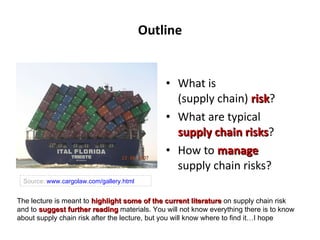
Outline What is  (supply chain)  risk ? What are typical  supply chain risks ? How to  manage   supply chain risks? Source:  www.cargolaw.com/gallery.html The lecture is meant to  highlight some of the current literature  on supply chain risk and to  suggest further reading  materials. You will not know everything there is to know about supply chain risk after the lecture, but you will know where to find it…I hope
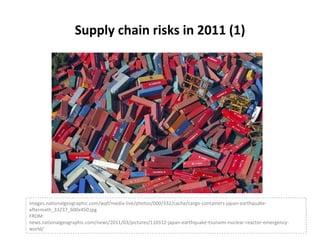
Supply chain risks in 2011 (1) images.nationalgeographic.com/wpf/media-live/photos/000/332/cache/cargo-containers-japan-earthquake-aftermath_33237_600x450.jpg FROM: news.nationalgeographic.com/news/2011/03/pictures/110312-japan-earthquake-tsunami-nuclear-reactor-emergency-world/
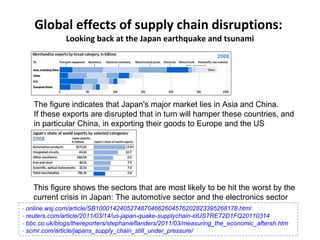
Global effects of supply chain disruptions:  Looking back at the Japan earthquake and tsunami The figure indicates that Japan's major market lies in Asia and China.  If these exports are disrupted that in turn will hamper these countries, and in particular China, in exporting their goods to Europe and the US -  online.wsj.com/article/SB10001424052748704662604576202823395268178.html -  reuters.com/article/2011/03/14/us-japan-quake-supplychain-idUSTRE72D1FQ20110314 -  bbc.co.uk/blogs/thereporters/stephanieflanders/2011/03/measuring_the_economic_aftersh.htm -  scmr.com/article/japans_supply_chain_still_under_pressure/ This figure shows the sectors that are most likely to be hit the worst by the current crisis in Japan: The automotive sector and the electronics sector 2008
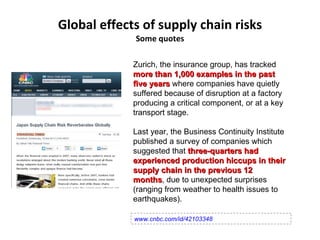
Global effects of supply chain risks Some quotes Zurich, the insurance group, has tracked  more than 1,000 examples in the past five years  where companies have quietly suffered because of disruption at a factory producing a critical component, or at a key transport stage. Last year, the Business Continuity Institute published a survey of companies which suggested that  three-quarters had experienced production hiccups in their supply chain in the previous 12 months , due to unexpected surprises (ranging from weather to health issues to earthquakes). www.cnbc.com/id/42103348
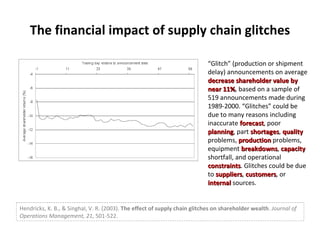
The financial impact of supply chain glitches Hendricks, K. B., & Singhal, V. R. (2003).  The effect of supply chain glitches on shareholder wealth .  Journal of Operations Management, 21 , 501-522. “ Glitch” (production or shipment delay) announcements on average  decrease shareholder value by near 11% , based on a sample of 519 announcements made during 1989-2000. “Glitches” could be due to many reasons including inaccurate  forecast , poor  planning , part  shortages ,  quality  problems,  production  problems, equipment  breakdowns ,  capacity  shortfall, and operational  constraints . Glitches could be due to  suppliers ,  customers , or  internal  sources.
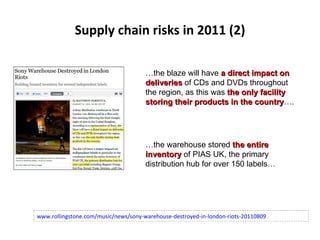
Supply chain risks in 2011 (2) www.rollingstone.com/music/news/sony-warehouse-destroyed-in-london-riots-20110809 … the blaze will have  a direct impact on deliveries  of CDs and DVDs throughout the region, as this was  the only facility storing their products in the country ….  … the warehouse stored  the entire inventory   of PIAS UK, the primary distribution hub for over 150 labels…
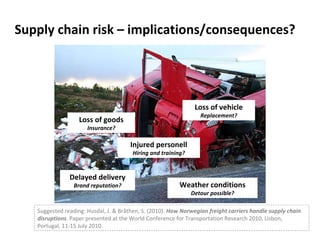
Supply chain risk – implications/consequences? Loss of goods Insurance? Loss of vehicle Replacement? Delayed delivery Brand reputation? Injured personell Hiring and training? Weather conditions Detour possible? Suggested reading: Husdal, J. & Bråthen, S. (2010).  How Norwegian freight carriers handle supply chain disruptions . Paper presented at the World Conference for Transportation Research 2010, Lisbon, Portugal, 11-15 July 2010.
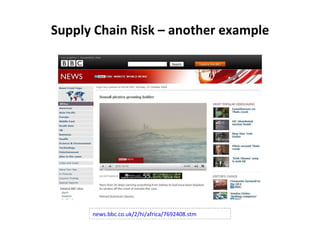
Supply Chain Risk – another example news.bbc.co.uk/2/hi/africa/7692408.stm
Why Supply Chain Risk? Supply chain risk research has grown in importance in the last 10 years and has resulted in many frameworks and concepts of risk categories and risk mitigation measures, but there is yet to be a consensus on which framework that best captures different types of supply chain risks. Oke, A., & Gopalakrishnan, M. (2009).  Managing disruptions in supply chains:  A case study of a retail supply chain .  International Journal of Production Economics,  118  (1), 168-174 .
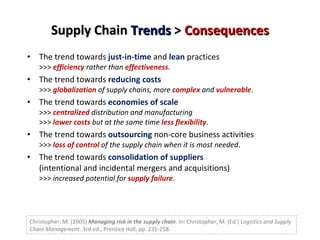
Supply Chain  Trends   >   Consequences The trend towards  just-in-time  and  lean  practices  >>>  efficiency   rather than  effectiveness . The trend towards  reducing costs   >>>  globalization   of supply chains, more  complex  and  vulnerable . The trend towards  economies of scale >>>  centralized   distribution and manufacturing >>>  lower costs  but at the same time  less flexibility . The trend towards  outsourcing  non-core business activities >>>  loss of control  of the supply chain when it is most needed . The trend towards  consolidation of suppliers (intentional and incidental mergers and acquisitions) >>>  increased potential for  supply failure .  Christopher, M. (2005)  Managing risk in the supply chain . In: Christopher, M. (Ed.)  Logistics and Supply Chain Management.  3rd ed., Prentice Hall, pp. 231-258.
Why is supply chain risk important? Even a relatively small supply chain disruption caused by a  localized event  may have  consequences across the global economic system . Globalization, offshoring and outsourcing leads to  >> “no” control over  causes  to events in the supply chain. >>  “only” control over  consequences   of events in the supply chain. World Economic Forum (2008)  Hyper-optimization and supply chain vulnerability: an invisible global risk?  In: Global Risks 2008 – A Global Risk Network Report, REF: 090108, World Economic Forum, Switzerland. http://www.weforum.org/pdf/globalrisk/report2008.pdf
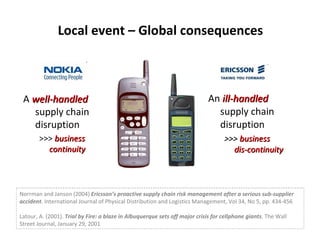
An  ill-handled   supply chain disruption >>>  business  dis-continuity A  well-handled   supply chain disruption >>>  business  continuity Norrman and Janson (2004)  Ericsson’s proactive supply chain risk management after a serious sub-supplier accident . International Journal of Physical Distribution and Logistics Management, Vol 34, No 5, pp. 434-456 Latour, A. (2001).  Trial by Fire: a blaze in Albuquerque sets off major crisis for cellphone giants . The Wall Street Journal, January 29, 2001 Local event – Global consequences
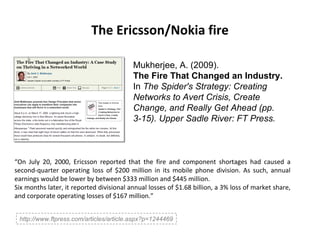
The Ericsson/Nokia fire Mukherjee, A. (2009).  The Fire That Changed an Industry.  In  The Spider's Strategy: Creating Networks to Avert Crisis, Create Change, and Really Get Ahead (pp. 3-15). Upper Sadle River: FT Press.  http://www.ftpress.com/articles/article.aspx?p=1244469 “ On July 20, 2000, Ericsson reported that the fire and component shortages had caused a second-quarter operating loss of $200 million in its mobile phone division. As such, annual earnings would be lower by between $333 million and $445 million.     Six months later, it reported divisional annual losses of $1.68 billion, a 3% loss of market share, and corporate operating losses of $167 million.”
What is risk? (1) Risk is an ambiguous  concept , and there are many  definitions  of risk, depending on their  specific application  and on their  situational context . AS/NZS 4360 Risk is the  possibility  of something happening that impacts on your  objectives . It is the chance to either make  a gain or a loss . It is measured in terms of  likelihood  and  consequence COSO ERM Risk is the  possibility  that an event will occur that  adversely affects  the achievement of  objectives . Risk is described by  likelihood  and  impact . ISO 31000 Risk is the effect of  uncertainty  on  objectives . An effect is a deviation from the expected ( positive or negative ). Risk is often expressed in terms of a combination of the  consequences  of an event and the associated  likelihood  of occurrence. Aven, E., & Aven, T. (2011).  On how to understand and express enterprise risk   International Journal of Business Continuity and Risk Management, 2  (1), 20-34
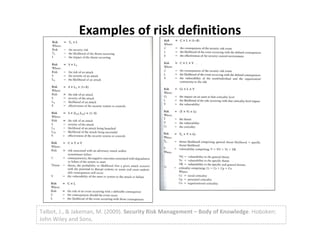
Examples of risk definitions Talbot, J., & Jakeman, M. (2009).  Security Risk Management – Body of Knowledge . Hoboken: John Wiley and Sons.
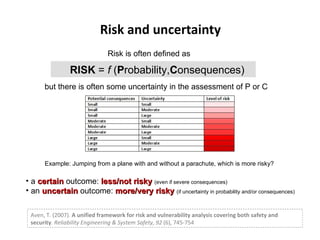
Risk and uncertainty RISK  =  f  ( P robability, C onsequences) but there is often some uncertainty in the assessment of P or C  Risk is often defined as Example: Jumping from a plane with and without a parachute, which is more risky? Aven, T. (2007).  A unified framework for risk and vulnerability analysis covering both safety and security .  Reliability Engineering & System Safety, 92  (6), 745-754 a  certain  outcome:  less/not risky  (even if severe consequences) an  uncertain  outcome:  more/very risky  (if uncertainty in probability and/or consequences)
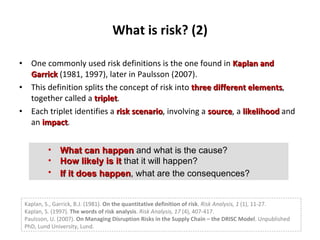
What is risk? (2) One commonly used risk definitions is the one found in  Kaplan   and Garrick   (1981, 1997), later in Paulsson (2007).  This definition splits the concept of risk into  three different   elements , together called a  triplet .  Each triplet identifies a  risk scenario , involving a  source , a  likelihood  and an  impact . What can happen   and what is the cause?  How likely is it   that it will happen?  If it does happen , what are the consequences?   Kaplan, S., Garrick, B.J. (1981).  On the quantitative definition of risk .  Risk Analysis, 1  (1), 11-27. Kaplan, S. (1997).  The words of risk analysis .  Risk Analysis, 17  (4), 407-417. Paulsson, U. (2007).  On Managing Disruption Risks in the Supply Chain   – the DRISC Model . Unpublished PhD, Lund University, Lund.
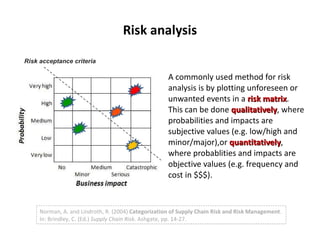
Risk analysis A commonly used method for risk analysis is by plotting unforeseen or unwanted events in a  risk matrix . This can be done  qualitatively , where probabilities and impacts are subjective values (e.g. low/high and minor/major),or  quantitatively , where probablities and impacts are objective values (e.g. frequency and cost in $$$). Norman, A. and Lindroth, R. (2004)  Categorization of Supply Chain Risk and Risk Management . In: Brindley, C. (Ed.)  Supply Chain Risk.  Ashgate, pp. 14-27. Risk acceptance criteria
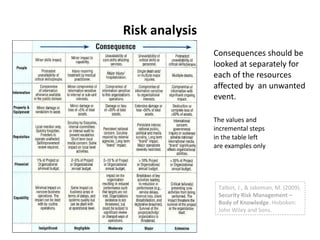
Risk analysis Consequences should be looked at separately for each of the resources affected by  an unwanted event. The values and  incremental steps  in the table left  are examples only Talbot, J., & Jakeman, M. (2009).  Security Risk Management – Body of Knowledge . Hoboken: John Wiley and Sons.
Risk categorization schemes Risk categorization varies in the literature, but broadly falls into three categories: High-impact Low-likelihood  - Low-impact High-likelihood e.g. Knemeyer, A., Zinn, W., & Eroglu, C. (2009).  Proactive planning for catastrophic events in supply chains .  Journal of Operations Management, 27  (2), 141-153 Supply – Demand  – Operational – External(Environmental) e.g. Christopher, M. (2005).  Managing risk in the supply chain . In  Logistics and Supply Chain Management  (3rd ed., pp. 231-258). Harlow: Prentice Hall. Organization – Network – Environment e.g. Jüttner, U., Peck, H., & Christopher, M. (2003).  Supply chain risk management: outlining an agenda for future research .  International Journal of Logistics, 6  (4), 197-210
High-Impact Low Likelihood HI-LL-events are rare, sudden and often totally unpredicted and unprecedented, and are also called “ Black Swan ” Events. Difficult to predict (proactive) but possible to prepare for (reactive)? A common problem with quantified risk management: We overestimate our abilities and underestimate what can go wrong. Taleb, N M, Goldstein D G & Spitznagel, M W (2009)  The Six Mistakes Executives Make in Risk Management .  Harvard Business Review, 87 (10), 78-81 Cohen, Morris A, & Kunreuther, Howard (2007).  Operations Risk Management: Overview of Paul Kleindorfer’s Contributions.  Production and Operations Management, 16 (5), 525-541
High-Impact Low Likelihood (2) www.youtube.com/watch?v=Zqo4MidIK28 Patrick Dixon, Futurist, www.globalchange.com
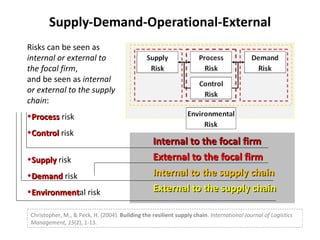
Supply-Demand-Operational-External Internal to the focal firm External to the focal firm Internal to the supply chain External to the supply chain Christopher, M., & Peck, H. (2004).  Building the resilient supply chain .  International Journal of Logistics Management, 15 (2), 1-13. Risks can be seen as  internal or external to the focal firm ,  and be seen as  internal or external to the supply chain : Process  risk Control  risk Supply  risk Demand  risk Environment al risk
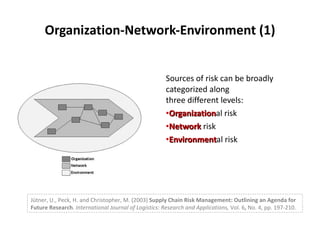
Organization-Network-Environment (1) Sources of risk can be broadly categorized along  three different levels:  Organization al risk Network  risk Environment al risk Jütner, U., Peck, H. and Christopher, M. (2003)  Supply Chain Risk Management: Outlining an Agenda for Future Research .  International Journal of Logistics: Research and Applications,  Vol. 6 ,  No. 4, pp. 197-210.
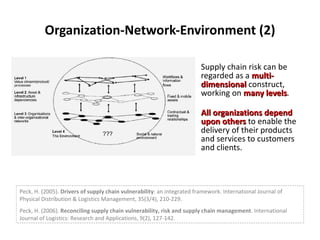
Organization-Network-Environment (2) Supply chain risk can be regarded as a  multi-dimensional  construct, working on  many levels . All organizations depend upon others   to enable the delivery of their products and services to customers and clients. Peck, H. (2005).  Drivers of supply chain vulnerability : an integrated framework. International Journal of Physical Distribution & Logistics Management, 35(3/4), 210-229. Peck, H. (2006).  Reconciling supply chain vulnerability, risk and supply chain management . International Journal of Logistics: Research and Applications, 9(2), 127-142.
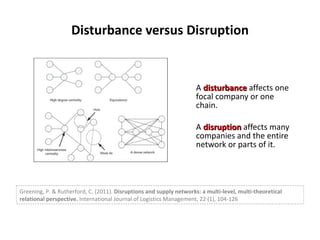
Disturbance versus Disruption A  disturbance  affects one focal company or one chain. A  disruption  affects many companies and the entire network or parts of it. Greening, P. & Rutherford, C. (2011).  Disruptions and supply networks: a multi-level, multi-theoretical relational perspective.  International Journal of Logistics Management, 22 (1), 104-126
Deviation versus Disruption versus Disaster A  deviation  is when  one or more performance parameters have strayed  from their mean or expected value, without changing the underlying supply chain structure (e.g. cost, demand, lead time). A  disruption  is when  the structure of the supply chain is radically transformed  by unexpected man-made or natural events. A  disaster  is when  the supply chain network is shut down irrecoverably  by an unforeseen and system-wide disruption. Viswanadham, N. & Gaonkar, R. S. (2008).  Risk Management in Global Supply Chain Networks . In: Tang, C.S., Teo, C.-T. & Wei, K-K. (eds.) Supply Chain Analysis. New York: Springer.
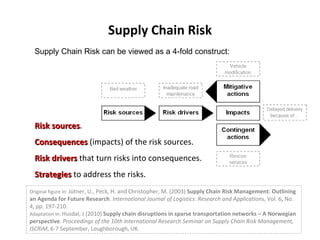
Supply Chain Risk Original figure in:  Jütner, U., Peck, H. and Christopher, M. (2003)  Supply Chain Risk Management: Outlining an Agenda for Future Research .  International Journal of Logistics: Research and Applications,  Vol. 6 ,  No. 4, pp. 197-210. Adaptation in:  Husdal, J (2010)  Supply chain disruptions in sparse transportation networks – A Norwegian perspective .  Proceedings of the 10th International Research Seminar on Supply Chain Risk Management, ISCRiM , 6-7 September, Loughborough, UK. Supply Chain Risk can be viewed as a 4-fold construct: Risk sources . Consequences  (impacts) of the risk sources. Risk drivers  that turn risks into consequences. Strategies   to address the risks.
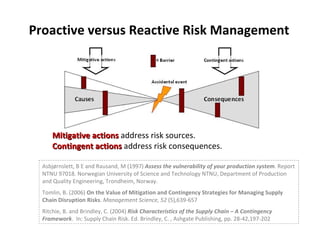
Proactive versus Reactive Risk Management Asbjørnslett, B E and Rausand, M (1997)  Assess the vulnerability of your production system . Report NTNU 97018. Norwegian University of Science and Technology NTNU, Department of Production and Quality Engineering, Trondheim, Norway. Tomlin, B. (2006)  On the Value of Mitigation and Contingency Strategies for Managing Supply Chain Disruption Risks .  Management Science, 52  (5),639-657 Ritchie, B. and Brindley, C. (2004)  Risk Characteristics of the Supply Chain – A Contingency Framework .  In: Supply Chain Risk. Ed. Brindley, C. , Ashgate Publishing, pp. 28-42,197-202 Mitigative actions  address risk sources. Contingent actions  address risk consequences.
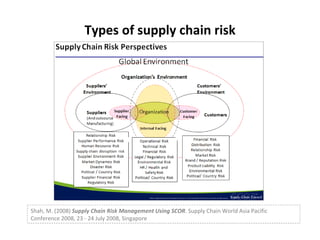
Types of supply chain risk Shah, M. (2008)  Supply Chain Risk Management Using SCOR . Supply Chain World Asia Pacific Conference 2008, 23 - 24 July 2008, Singapore
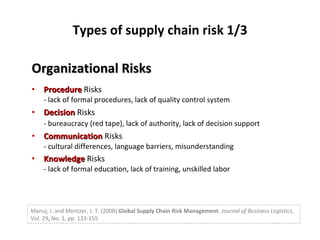
Types of supply chain risk 1/3 Organizational Risks Procedure  Risks - lack of formal procedures, lack of quality control system Decision  Risks - bureaucracy (red tape), lack of authority, lack of decision support   Communication  Risks - cultural differences, language barriers, misunderstanding Knowledge  Risks - lack of formal education, lack of training, unskilled labor Manuj, I. and Mentzer, J. T. (2008)  Global Supply Chain Risk Management .  Journal of Business Logistics,  Vol. 29 ,  No. 1, pp. 133-155
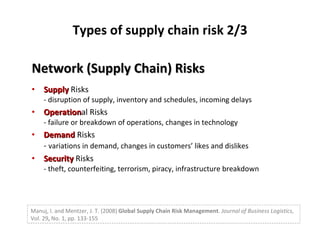
Types of supply chain risk 2/3 Network (Supply Chain) Risks Supply  Risks - disruption of supply, inventory and schedules, incoming delays Operation al Risks  - failure or breakdown of operations, changes in technology Demand  Risks -  variations in demand, changes in customers’ likes and dislikes Security  Risks - theft, counterfeiting, terrorism, piracy, infrastructure breakdown Manuj, I. and Mentzer, J. T. (2008)  Global Supply Chain Risk Management .  Journal of Business Logistics,  Vol. 29 ,  No. 1, pp. 133-155
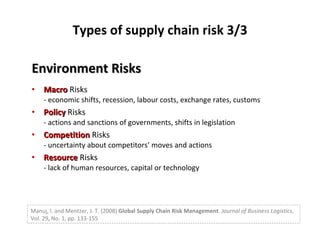
Environment Risks Macro  Risks - economic shifts, recession, labour costs, exchange rates, customs Policy  Risks - actions and sanctions of governments, shifts in legislation Competition  Risks - uncertainty about competitors’ moves and actions Resource  Risks  - lack of human resources, capital or technology Types of supply chain risk 3/3 Manuj, I. and Mentzer, J. T. (2008)  Global Supply Chain Risk Management .  Journal of Business Logistics,  Vol. 29 ,  No. 1, pp. 133-155
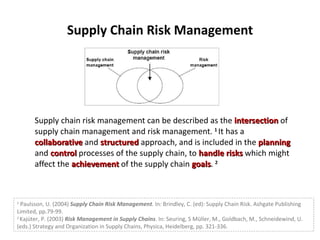
Supply Chain Risk Management Supply chain risk management can be described as the  intersection  of supply chain management and risk management.  1   It has a  collaborative  and  structured  approach, and is included in the  planning  and  control  processes of the supply chain, to  handle risks  which might affect the  achievement  of the supply chain  goals .  2 1  Paulsson, U. (2004)  Supply Chain Risk Management .  In :  Brindley, C. (ed): Supply Chain Risk. Ashgate  Publishing Limited, pp.79-99. 2  Kajüter, P. (2003)  Risk Management in Supply Chains . In: Seuring, S Müller, M.,  Goldbach, M., Schneidewind, U. (eds.) Strategy and Organization in  Supply Chains, Physica, Heidelberg, pp. 321-336.
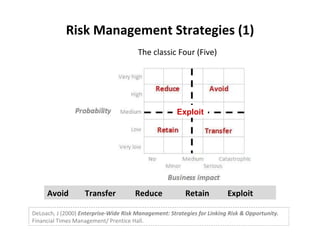
Risk Management Strategies (1) Avoid Transfer Reduce Retain  Exploit DeLoach, J (2000)  Enterprise-Wide Risk Management: Strategies for Linking Risk & Opportunity.  Financial Times Management/ Prentice Hall. The classic Four (Five) Exploit
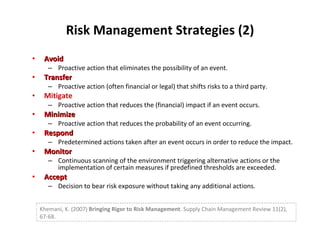
Risk Management Strategies (2) Avoid Proactive action that eliminates the possibility of an event. Transfer Proactive action (often financial or legal) that shifts risks to a third party. Mitigate Proactive action that reduces the (financial) impact if an event occurs. Minimize Proactive action that reduces the probability of an event occurring. Respond Predetermined actions taken after an event occurs in order to reduce the impact. Monitor Continuous scanning of the environment triggering alternative actions or the implementation of certain measures if predefined thresholds are exceeded. Accept Decision to bear risk exposure without taking any additional actions. Khemani, K. (2007)  Bringing Rigor to Risk Management . Supply Chain Management Review 11(2), 67-68.
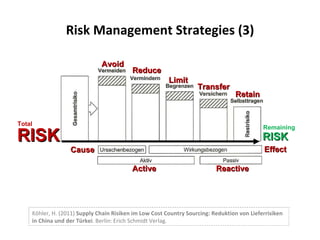
Risk Management Strategies (3) Köhler, H. (2011)  Supply Chain Risiken im Low Cost Country Sourcing: Reduktion von Lieferrisiken in China und der Türkei . Berlin: Erich Schmidt Verlag. RISK Avoid Limit Transfer Retain Active Effect Cause Reduce Reactive RISK Remaining Total
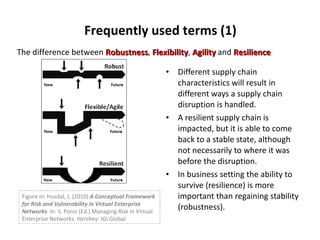
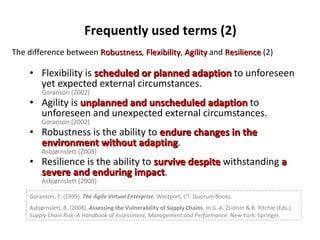
Different supply chain characteristics will result in different ways a supply chain disruption is handled. A resilient supply chain is impacted, but it is able to come back to a stable state, although not necessarily to where it was before the disruption. In business setting the ability to survive (resilience) is more important than regaining stability (robustness). The difference between  Robustness ,  Flexibility ,  Agility  and  Resilience Frequently used terms (1) Figure in: Husdal, J. (2010)  A Conceptual Framework for Risk and Vulnerability in Virtual Enterprise Networks . In: S. Ponis (Ed.) Managing Risk in Virtual Enterprise Networks. Hershey: IGI Global
Flexibility is  scheduled or planned adaption   to unforeseen yet expected external circumstances. Goranson (2002) Agility is  unplanned and unscheduled adaption   to unforeseen and unexpected external circumstances. Goranson (2002) Robustness is the ability to  endure changes in the environment without adapting . Asbjørnslett (2008) Resilience is the ability to  survive despite   withstanding  a severe and enduring impact . Asbjørnslett (2008) The difference between  Robustness ,  Flexibility ,  Agility  and  Resilience  (2) Frequently used terms (2) Goranson, T. (1999).  The Agile Virtual Enterprise . Westport, CT: Quorum Books. Asbjørnslett, B. (2008).  Assessing the Vulnerability of Supply Chains . In G. A. Zsidisin & B. Ritchie (Eds.),  Supply Chain Risk: A Handbook of Assessment, Management and Performance . New York: Springer.
Mitigating supply chain disruptions (1) Tang, C. (2006).  Robust strategies for mitigating supply chain disruptions.   International Journal of Logistics, 9  (1), 33-45 youtube.com/watch?v=K6XxcBTanZw
Mitigating supply chain disruptions (2) Three main strategies: Product   Nokia changed product configurations to meet customer demand during a supply disruption, the infamous Albuquerque Philips plant fire in 2000. Supply Hong-Kong based Li and Fung changed its supply plan in a flash to meet customer demand during a currency crisis, the 1997 Asian meltdown . Demand Dell changed its pricing strategy to satisfy customers during supply shortage, after the 1999 Taiwan earthquake. Tang, C. (2006).  Robust strategies for mitigating supply chain disruptions.   International Journal of Logistics, 9  (1), 33-45
Mitigating supply chain disruptions (3) Postponement  Nokia’s modular design allowed it to switch to other components after the supply shortage Strategic stock  Planned stockpiling of regular demand at central locations to serve areas in need or shortage Flexible supply base  If one supplier goes down, the other can take over, some for basic demand, some for high volume fluctuations Make and buy  Always keep some production in-house, outsource basic items, make high-end items in-house Tang, C. (2006).  Robust strategies for mitigating supply chain disruptions.   International Journal of Logistics, 9  (1), 33-45
Mitigating supply chain disruptions (4) Economic supply incentives  Commit to buying certain quantities from a certain supplier to keep the (backup) business running Flexible transportation  Multi-modal, multi-carrier, multi-routes in transportation, avoid chokepoints Dynamic pricing and promotion  Sell what you have, don’t delay or promise to supply what you don’t have Assortment planning  For retailers, displaying what’s in stock, influence customer choice and demand Silent product rollover  Do not market the introduction of new products or the end of old products Tang, C. (2006).  Robust strategies for mitigating supply chain disruptions.   International Journal of Logistics, 9  (1), 33-45
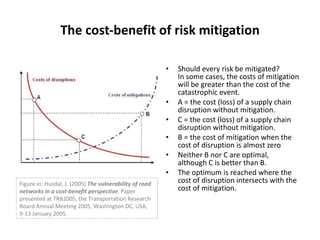
The cost-benefit of risk mitigation Should every risk be mitigated? In some cases, the costs of mitigation will be greater than the cost of the catastrophic event. A = the cost (loss) of a supply chain disruption without mitigation.  C = the cost (loss) of a supply chain disruption without mitigation. B = the cost of mitigation when the cost of disruption is almost zero Neither B nor C are optimal,  although C is better than B.  The optimum is reached where the cost of disruption intersects with the cost of mitigation. Figure in: Husdal, J. (2005)  The vulnerability of road networks in a cost-benefit perspective . Paper presented at TRB2005, the Transportation Research Board Annual Meeting 2005, Washington DC, USA, 9-13 January 2005.
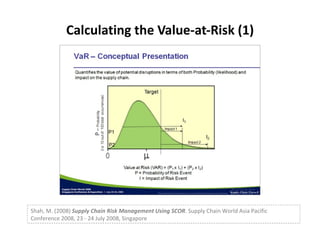
Calculating the Value-at-Risk (1) Shah, M. (2008)  Supply Chain Risk Management Using SCOR . Supply Chain World Asia Pacific Conference 2008, 23 - 24 July 2008, Singapore
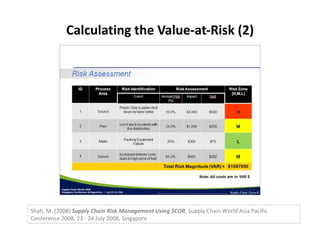
Calculating the Value-at-Risk (2) Shah, M. (2008)  Supply Chain Risk Management Using SCOR . Supply Chain World Asia Pacific Conference 2008, 23 - 24 July 2008, Singapore
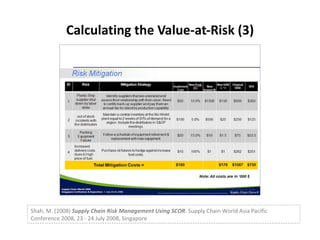
Calculating the Value-at-Risk (3) Shah, M. (2008)  Supply Chain Risk Management Using SCOR . Supply Chain World Asia Pacific Conference 2008, 23 - 24 July 2008, Singapore
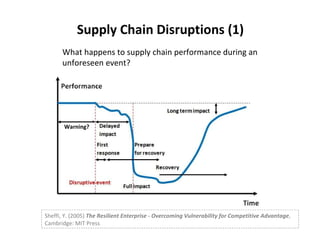
Supply Chain Disruptions (1) Sheffi, Y. (2005)  The Resilient Enterprise - Overcoming Vulnerability for Competitive Advantage , Cambridge: MIT Press Warning? What happens to supply chain performance during an unforeseen event?
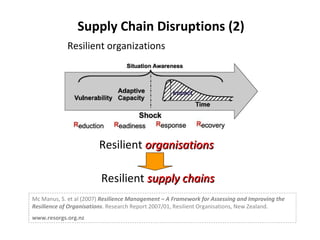
Supply Chain Disruptions (2) Resilient  organisations   Resilient  supply chains Mc Manus, S. et al (2007)  Resilience Management – A Framework for Assessing and Improving the Resilience of Organisations . Research Report 2007/01, Resilient Organisations, New Zealand.  www.resorgs.org.nz Resilient organizations
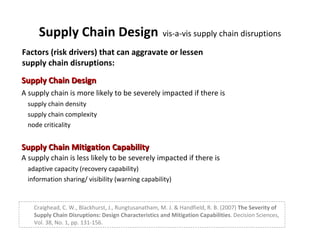
Supply Chain Design A supply chain is more likely to be severely impacted if there is supply chain density supply chain complexity node criticality Supply Chain Mitigation Capability A supply chain is less likely to be severely impacted if there is adaptive capacity (recovery capability) information sharing/ visibility (warning capability) Supply Chain Design   vis-a-vis supply chain disruptions Craighead, C. W., Blackhurst, J., Rungtusanatham, M. J. & Handfield, R. B. (2007)  The Severity of Supply Chain Disruptions: Design Characteristics and Mitigation Capabilities . Decision Sciences, Vol. 38, No. 1, pp. 131-156. Factors (risk drivers) that can aggravate or lessen  supply chain disruptions:
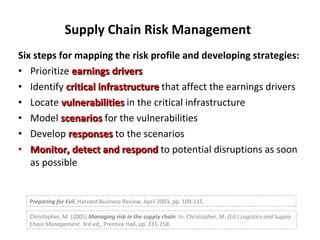
Supply Chain Risk Management Six steps for mapping the risk profile and developing strategies: Prioritize  earnings drivers Identify  critical infrastructure  that affect the earnings drivers Locate  vulnerabilities  in the critical infrastructure Model  scenarios  for the vulnerabilities Develop  responses  to the scenarios Monitor, detect and respond  to potential disruptions as soon as possible Preparing for Evil , Harvard Business Review, April 2003, pp. 109-115 Christopher, M. (2005)  Managing risk in the supply chain . In: Christopher, M. (Ed.)  Logistics and Supply Chain Management.  3rd ed., Prentice Hall, pp. 231-258.
Supply Chain Risk Management youtube.com/watch?v=QlZ6TyUaYpw
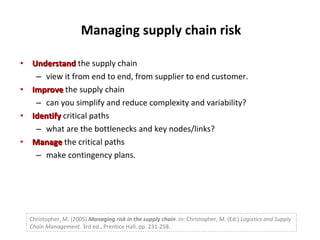
Managing supply chain risk Understand  the supply chain view it from end to end, from supplier to end customer. Improve  the supply chain can you simplify and reduce complexity and variability? Identify  critical paths what are the bottlenecks and key nodes/links? Manage  the critical paths make contingency plans. Christopher, M. (2005)  Managing risk in the supply chain . In: Christopher, M. (Ed.)  Logistics and Supply Chain Management.  3rd ed., Prentice Hall, pp. 231-258.
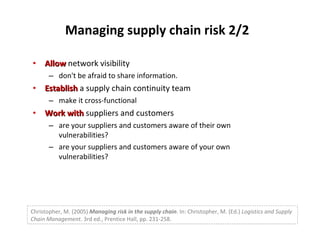
Managing supply chain risk 2/2 Allow  network visibility don't be afraid to share information. Establish  a supply chain continuity team make it cross-functional Work with  suppliers and customers are your suppliers and customers aware of their own vulnerabilities? are your suppliers and customers aware of your own vulnerabilities? Christopher, M. (2005)  Managing risk in the supply chain . In: Christopher, M. (Ed.)  Logistics and Supply Chain Management.  3rd ed., Prentice Hall, pp. 231-258.
Summary Supply Chains are exposed to  a variety of risks  that are unique to each supply chain. These risks are related to  actions  and  events  that are  inside  and  outside  of the supply chain. Supply Chain Risk Analysis seeks to  identify  these risks, their  sources  and  drivers , and their  impact  on the supply chain. Supply Chain Risk Management seeks to establish  mitigative  and  contingent  strategies for how to deal with the identified risks and their potential impact on the supply chain.
Want to know more? Visit my blog @  husdal . com - a gateway to journal articles, research reports and whitepapers, books, blogs and websites and other online and offline resources in Supply Chain Risk, Business Continuity and Transportation Vulnerability.

Supply chain-risk-2011

  • 1.
    Supply Chain RiskThe dark side of supply chain mangement Guest lecture, LOG 711, 15.09.2011 Jan Husdal Research Geographer Møreforsking Molde
  • 2.
    Jan Husdal Hasbeen a researcher with the transport economics research group at Møreforsking Molde since 2005. Is a member of ISCRiM , the International Supply Chain Risk Management Network, 38 selected researchers and academics in supply chain risk Has been working with issues related to risk assessment , business continuity planning and crisis management since 1989, working for several regional government agencies. Holds an MSc in Geographic Information Systems from the University of Leicester, UK, focusing on transportation and network analysis. Current research is centered on supply chain risk management transport network reliability and vulnerability cost-benefit analysis of infrastructure projects
  • 3.
    Outline What is (supply chain) risk ? What are typical supply chain risks ? How to manage supply chain risks? Source: www.cargolaw.com/gallery.html The lecture is meant to highlight some of the current literature on supply chain risk and to suggest further reading materials. You will not know everything there is to know about supply chain risk after the lecture, but you will know where to find it…I hope
  • 4.
    Supply chain risksin 2011 (1) images.nationalgeographic.com/wpf/media-live/photos/000/332/cache/cargo-containers-japan-earthquake-aftermath_33237_600x450.jpg FROM: news.nationalgeographic.com/news/2011/03/pictures/110312-japan-earthquake-tsunami-nuclear-reactor-emergency-world/
  • 5.
    Global effects ofsupply chain disruptions: Looking back at the Japan earthquake and tsunami The figure indicates that Japan's major market lies in Asia and China. If these exports are disrupted that in turn will hamper these countries, and in particular China, in exporting their goods to Europe and the US - online.wsj.com/article/SB10001424052748704662604576202823395268178.html - reuters.com/article/2011/03/14/us-japan-quake-supplychain-idUSTRE72D1FQ20110314 - bbc.co.uk/blogs/thereporters/stephanieflanders/2011/03/measuring_the_economic_aftersh.htm - scmr.com/article/japans_supply_chain_still_under_pressure/ This figure shows the sectors that are most likely to be hit the worst by the current crisis in Japan: The automotive sector and the electronics sector 2008
  • 6.
    Global effects ofsupply chain risks Some quotes Zurich, the insurance group, has tracked more than 1,000 examples in the past five years where companies have quietly suffered because of disruption at a factory producing a critical component, or at a key transport stage. Last year, the Business Continuity Institute published a survey of companies which suggested that three-quarters had experienced production hiccups in their supply chain in the previous 12 months , due to unexpected surprises (ranging from weather to health issues to earthquakes). www.cnbc.com/id/42103348
  • 7.
    The financial impactof supply chain glitches Hendricks, K. B., & Singhal, V. R. (2003). The effect of supply chain glitches on shareholder wealth . Journal of Operations Management, 21 , 501-522. “ Glitch” (production or shipment delay) announcements on average decrease shareholder value by near 11% , based on a sample of 519 announcements made during 1989-2000. “Glitches” could be due to many reasons including inaccurate forecast , poor planning , part shortages , quality problems, production problems, equipment breakdowns , capacity shortfall, and operational constraints . Glitches could be due to suppliers , customers , or internal sources.
  • 8.
    Supply chain risksin 2011 (2) www.rollingstone.com/music/news/sony-warehouse-destroyed-in-london-riots-20110809 … the blaze will have a direct impact on deliveries of CDs and DVDs throughout the region, as this was the only facility storing their products in the country …. … the warehouse stored the entire inventory of PIAS UK, the primary distribution hub for over 150 labels…
  • 9.
    Supply chain risk– implications/consequences? Loss of goods Insurance? Loss of vehicle Replacement? Delayed delivery Brand reputation? Injured personell Hiring and training? Weather conditions Detour possible? Suggested reading: Husdal, J. & Bråthen, S. (2010). How Norwegian freight carriers handle supply chain disruptions . Paper presented at the World Conference for Transportation Research 2010, Lisbon, Portugal, 11-15 July 2010.
  • 10.
    Supply Chain Risk– another example news.bbc.co.uk/2/hi/africa/7692408.stm
  • 11.
    Why Supply ChainRisk? Supply chain risk research has grown in importance in the last 10 years and has resulted in many frameworks and concepts of risk categories and risk mitigation measures, but there is yet to be a consensus on which framework that best captures different types of supply chain risks. Oke, A., & Gopalakrishnan, M. (2009). Managing disruptions in supply chains: A case study of a retail supply chain . International Journal of Production Economics, 118 (1), 168-174 .
  • 12.
    Supply Chain Trends > Consequences The trend towards just-in-time and lean practices >>> efficiency rather than effectiveness . The trend towards reducing costs >>> globalization of supply chains, more complex and vulnerable . The trend towards economies of scale >>> centralized distribution and manufacturing >>> lower costs but at the same time less flexibility . The trend towards outsourcing non-core business activities >>> loss of control of the supply chain when it is most needed . The trend towards consolidation of suppliers (intentional and incidental mergers and acquisitions) >>> increased potential for supply failure . Christopher, M. (2005) Managing risk in the supply chain . In: Christopher, M. (Ed.) Logistics and Supply Chain Management. 3rd ed., Prentice Hall, pp. 231-258.
  • 13.
    Why is supplychain risk important? Even a relatively small supply chain disruption caused by a localized event may have consequences across the global economic system . Globalization, offshoring and outsourcing leads to >> “no” control over causes to events in the supply chain. >> “only” control over consequences of events in the supply chain. World Economic Forum (2008) Hyper-optimization and supply chain vulnerability: an invisible global risk? In: Global Risks 2008 – A Global Risk Network Report, REF: 090108, World Economic Forum, Switzerland. http://www.weforum.org/pdf/globalrisk/report2008.pdf
  • 14.
    An ill-handled supply chain disruption >>> business dis-continuity A well-handled supply chain disruption >>> business continuity Norrman and Janson (2004) Ericsson’s proactive supply chain risk management after a serious sub-supplier accident . International Journal of Physical Distribution and Logistics Management, Vol 34, No 5, pp. 434-456 Latour, A. (2001). Trial by Fire: a blaze in Albuquerque sets off major crisis for cellphone giants . The Wall Street Journal, January 29, 2001 Local event – Global consequences
  • 15.
    The Ericsson/Nokia fireMukherjee, A. (2009). The Fire That Changed an Industry. In The Spider's Strategy: Creating Networks to Avert Crisis, Create Change, and Really Get Ahead (pp. 3-15). Upper Sadle River: FT Press. http://www.ftpress.com/articles/article.aspx?p=1244469 “ On July 20, 2000, Ericsson reported that the fire and component shortages had caused a second-quarter operating loss of $200 million in its mobile phone division. As such, annual earnings would be lower by between $333 million and $445 million.   Six months later, it reported divisional annual losses of $1.68 billion, a 3% loss of market share, and corporate operating losses of $167 million.”
  • 16.
    What is risk?(1) Risk is an ambiguous concept , and there are many definitions of risk, depending on their specific application and on their situational context . AS/NZS 4360 Risk is the possibility of something happening that impacts on your objectives . It is the chance to either make a gain or a loss . It is measured in terms of likelihood and consequence COSO ERM Risk is the possibility that an event will occur that adversely affects the achievement of objectives . Risk is described by likelihood and impact . ISO 31000 Risk is the effect of uncertainty on objectives . An effect is a deviation from the expected ( positive or negative ). Risk is often expressed in terms of a combination of the consequences of an event and the associated likelihood of occurrence. Aven, E., & Aven, T. (2011). On how to understand and express enterprise risk International Journal of Business Continuity and Risk Management, 2 (1), 20-34
  • 17.
    Examples of riskdefinitions Talbot, J., & Jakeman, M. (2009). Security Risk Management – Body of Knowledge . Hoboken: John Wiley and Sons.
  • 18.
    Risk and uncertaintyRISK = f ( P robability, C onsequences) but there is often some uncertainty in the assessment of P or C Risk is often defined as Example: Jumping from a plane with and without a parachute, which is more risky? Aven, T. (2007). A unified framework for risk and vulnerability analysis covering both safety and security . Reliability Engineering & System Safety, 92 (6), 745-754 a certain outcome: less/not risky (even if severe consequences) an uncertain outcome: more/very risky (if uncertainty in probability and/or consequences)
  • 19.
    What is risk?(2) One commonly used risk definitions is the one found in Kaplan and Garrick (1981, 1997), later in Paulsson (2007). This definition splits the concept of risk into three different elements , together called a triplet . Each triplet identifies a risk scenario , involving a source , a likelihood and an impact . What can happen and what is the cause? How likely is it that it will happen? If it does happen , what are the consequences? Kaplan, S., Garrick, B.J. (1981). On the quantitative definition of risk . Risk Analysis, 1 (1), 11-27. Kaplan, S. (1997). The words of risk analysis . Risk Analysis, 17 (4), 407-417. Paulsson, U. (2007). On Managing Disruption Risks in the Supply Chain – the DRISC Model . Unpublished PhD, Lund University, Lund.
  • 20.
    Risk analysis Acommonly used method for risk analysis is by plotting unforeseen or unwanted events in a risk matrix . This can be done qualitatively , where probabilities and impacts are subjective values (e.g. low/high and minor/major),or quantitatively , where probablities and impacts are objective values (e.g. frequency and cost in $$$). Norman, A. and Lindroth, R. (2004) Categorization of Supply Chain Risk and Risk Management . In: Brindley, C. (Ed.) Supply Chain Risk. Ashgate, pp. 14-27. Risk acceptance criteria
  • 21.
    Risk analysis Consequencesshould be looked at separately for each of the resources affected by an unwanted event. The values and incremental steps in the table left are examples only Talbot, J., & Jakeman, M. (2009). Security Risk Management – Body of Knowledge . Hoboken: John Wiley and Sons.
  • 22.
    Risk categorization schemesRisk categorization varies in the literature, but broadly falls into three categories: High-impact Low-likelihood - Low-impact High-likelihood e.g. Knemeyer, A., Zinn, W., & Eroglu, C. (2009). Proactive planning for catastrophic events in supply chains . Journal of Operations Management, 27 (2), 141-153 Supply – Demand – Operational – External(Environmental) e.g. Christopher, M. (2005). Managing risk in the supply chain . In Logistics and Supply Chain Management (3rd ed., pp. 231-258). Harlow: Prentice Hall. Organization – Network – Environment e.g. Jüttner, U., Peck, H., & Christopher, M. (2003). Supply chain risk management: outlining an agenda for future research . International Journal of Logistics, 6 (4), 197-210
  • 23.
    High-Impact Low LikelihoodHI-LL-events are rare, sudden and often totally unpredicted and unprecedented, and are also called “ Black Swan ” Events. Difficult to predict (proactive) but possible to prepare for (reactive)? A common problem with quantified risk management: We overestimate our abilities and underestimate what can go wrong. Taleb, N M, Goldstein D G & Spitznagel, M W (2009) The Six Mistakes Executives Make in Risk Management . Harvard Business Review, 87 (10), 78-81 Cohen, Morris A, & Kunreuther, Howard (2007). Operations Risk Management: Overview of Paul Kleindorfer’s Contributions. Production and Operations Management, 16 (5), 525-541
  • 24.
    High-Impact Low Likelihood(2) www.youtube.com/watch?v=Zqo4MidIK28 Patrick Dixon, Futurist, www.globalchange.com
  • 25.
    Supply-Demand-Operational-External Internal tothe focal firm External to the focal firm Internal to the supply chain External to the supply chain Christopher, M., & Peck, H. (2004). Building the resilient supply chain . International Journal of Logistics Management, 15 (2), 1-13. Risks can be seen as internal or external to the focal firm , and be seen as internal or external to the supply chain : Process risk Control risk Supply risk Demand risk Environment al risk
  • 26.
    Organization-Network-Environment (1) Sourcesof risk can be broadly categorized along three different levels: Organization al risk Network risk Environment al risk Jütner, U., Peck, H. and Christopher, M. (2003) Supply Chain Risk Management: Outlining an Agenda for Future Research . International Journal of Logistics: Research and Applications, Vol. 6 , No. 4, pp. 197-210.
  • 27.
    Organization-Network-Environment (2) Supplychain risk can be regarded as a multi-dimensional construct, working on many levels . All organizations depend upon others to enable the delivery of their products and services to customers and clients. Peck, H. (2005). Drivers of supply chain vulnerability : an integrated framework. International Journal of Physical Distribution & Logistics Management, 35(3/4), 210-229. Peck, H. (2006). Reconciling supply chain vulnerability, risk and supply chain management . International Journal of Logistics: Research and Applications, 9(2), 127-142.
  • 28.
    Disturbance versus DisruptionA disturbance affects one focal company or one chain. A disruption affects many companies and the entire network or parts of it. Greening, P. & Rutherford, C. (2011). Disruptions and supply networks: a multi-level, multi-theoretical relational perspective. International Journal of Logistics Management, 22 (1), 104-126
  • 29.
    Deviation versus Disruptionversus Disaster A deviation is when one or more performance parameters have strayed from their mean or expected value, without changing the underlying supply chain structure (e.g. cost, demand, lead time). A disruption is when the structure of the supply chain is radically transformed by unexpected man-made or natural events. A disaster is when the supply chain network is shut down irrecoverably by an unforeseen and system-wide disruption. Viswanadham, N. & Gaonkar, R. S. (2008). Risk Management in Global Supply Chain Networks . In: Tang, C.S., Teo, C.-T. & Wei, K-K. (eds.) Supply Chain Analysis. New York: Springer.
  • 30.
    Supply Chain RiskOriginal figure in: Jütner, U., Peck, H. and Christopher, M. (2003) Supply Chain Risk Management: Outlining an Agenda for Future Research . International Journal of Logistics: Research and Applications, Vol. 6 , No. 4, pp. 197-210. Adaptation in: Husdal, J (2010) Supply chain disruptions in sparse transportation networks – A Norwegian perspective . Proceedings of the 10th International Research Seminar on Supply Chain Risk Management, ISCRiM , 6-7 September, Loughborough, UK. Supply Chain Risk can be viewed as a 4-fold construct: Risk sources . Consequences (impacts) of the risk sources. Risk drivers that turn risks into consequences. Strategies to address the risks.
  • 31.
    Proactive versus ReactiveRisk Management Asbjørnslett, B E and Rausand, M (1997) Assess the vulnerability of your production system . Report NTNU 97018. Norwegian University of Science and Technology NTNU, Department of Production and Quality Engineering, Trondheim, Norway. Tomlin, B. (2006) On the Value of Mitigation and Contingency Strategies for Managing Supply Chain Disruption Risks . Management Science, 52 (5),639-657 Ritchie, B. and Brindley, C. (2004) Risk Characteristics of the Supply Chain – A Contingency Framework . In: Supply Chain Risk. Ed. Brindley, C. , Ashgate Publishing, pp. 28-42,197-202 Mitigative actions address risk sources. Contingent actions address risk consequences.
  • 32.
    Types of supplychain risk Shah, M. (2008) Supply Chain Risk Management Using SCOR . Supply Chain World Asia Pacific Conference 2008, 23 - 24 July 2008, Singapore
  • 33.
    Types of supplychain risk 1/3 Organizational Risks Procedure Risks - lack of formal procedures, lack of quality control system Decision Risks - bureaucracy (red tape), lack of authority, lack of decision support Communication Risks - cultural differences, language barriers, misunderstanding Knowledge Risks - lack of formal education, lack of training, unskilled labor Manuj, I. and Mentzer, J. T. (2008) Global Supply Chain Risk Management . Journal of Business Logistics, Vol. 29 , No. 1, pp. 133-155
  • 34.
    Types of supplychain risk 2/3 Network (Supply Chain) Risks Supply Risks - disruption of supply, inventory and schedules, incoming delays Operation al Risks - failure or breakdown of operations, changes in technology Demand Risks - variations in demand, changes in customers’ likes and dislikes Security Risks - theft, counterfeiting, terrorism, piracy, infrastructure breakdown Manuj, I. and Mentzer, J. T. (2008) Global Supply Chain Risk Management . Journal of Business Logistics, Vol. 29 , No. 1, pp. 133-155
  • 35.
    Environment Risks Macro Risks - economic shifts, recession, labour costs, exchange rates, customs Policy Risks - actions and sanctions of governments, shifts in legislation Competition Risks - uncertainty about competitors’ moves and actions Resource Risks - lack of human resources, capital or technology Types of supply chain risk 3/3 Manuj, I. and Mentzer, J. T. (2008) Global Supply Chain Risk Management . Journal of Business Logistics, Vol. 29 , No. 1, pp. 133-155
  • 36.
    Supply Chain RiskManagement Supply chain risk management can be described as the intersection of supply chain management and risk management. 1 It has a collaborative and structured approach, and is included in the planning and control processes of the supply chain, to handle risks which might affect the achievement of the supply chain goals . 2 1 Paulsson, U. (2004) Supply Chain Risk Management . In : Brindley, C. (ed): Supply Chain Risk. Ashgate Publishing Limited, pp.79-99. 2 Kajüter, P. (2003) Risk Management in Supply Chains . In: Seuring, S Müller, M., Goldbach, M., Schneidewind, U. (eds.) Strategy and Organization in Supply Chains, Physica, Heidelberg, pp. 321-336.
  • 37.
    Risk Management Strategies(1) Avoid Transfer Reduce Retain Exploit DeLoach, J (2000) Enterprise-Wide Risk Management: Strategies for Linking Risk & Opportunity. Financial Times Management/ Prentice Hall. The classic Four (Five) Exploit
  • 38.
    Risk Management Strategies(2) Avoid Proactive action that eliminates the possibility of an event. Transfer Proactive action (often financial or legal) that shifts risks to a third party. Mitigate Proactive action that reduces the (financial) impact if an event occurs. Minimize Proactive action that reduces the probability of an event occurring. Respond Predetermined actions taken after an event occurs in order to reduce the impact. Monitor Continuous scanning of the environment triggering alternative actions or the implementation of certain measures if predefined thresholds are exceeded. Accept Decision to bear risk exposure without taking any additional actions. Khemani, K. (2007) Bringing Rigor to Risk Management . Supply Chain Management Review 11(2), 67-68.
  • 39.
    Risk Management Strategies(3) Köhler, H. (2011) Supply Chain Risiken im Low Cost Country Sourcing: Reduktion von Lieferrisiken in China und der Türkei . Berlin: Erich Schmidt Verlag. RISK Avoid Limit Transfer Retain Active Effect Cause Reduce Reactive RISK Remaining Total
  • 40.
    Different supply chaincharacteristics will result in different ways a supply chain disruption is handled. A resilient supply chain is impacted, but it is able to come back to a stable state, although not necessarily to where it was before the disruption. In business setting the ability to survive (resilience) is more important than regaining stability (robustness). The difference between Robustness , Flexibility , Agility and Resilience Frequently used terms (1) Figure in: Husdal, J. (2010) A Conceptual Framework for Risk and Vulnerability in Virtual Enterprise Networks . In: S. Ponis (Ed.) Managing Risk in Virtual Enterprise Networks. Hershey: IGI Global
  • 41.
    Flexibility is scheduled or planned adaption to unforeseen yet expected external circumstances. Goranson (2002) Agility is unplanned and unscheduled adaption to unforeseen and unexpected external circumstances. Goranson (2002) Robustness is the ability to endure changes in the environment without adapting . Asbjørnslett (2008) Resilience is the ability to survive despite withstanding a severe and enduring impact . Asbjørnslett (2008) The difference between Robustness , Flexibility , Agility and Resilience (2) Frequently used terms (2) Goranson, T. (1999). The Agile Virtual Enterprise . Westport, CT: Quorum Books. Asbjørnslett, B. (2008). Assessing the Vulnerability of Supply Chains . In G. A. Zsidisin & B. Ritchie (Eds.), Supply Chain Risk: A Handbook of Assessment, Management and Performance . New York: Springer.
  • 42.
    Mitigating supply chaindisruptions (1) Tang, C. (2006). Robust strategies for mitigating supply chain disruptions. International Journal of Logistics, 9 (1), 33-45 youtube.com/watch?v=K6XxcBTanZw
  • 43.
    Mitigating supply chaindisruptions (2) Three main strategies: Product Nokia changed product configurations to meet customer demand during a supply disruption, the infamous Albuquerque Philips plant fire in 2000. Supply Hong-Kong based Li and Fung changed its supply plan in a flash to meet customer demand during a currency crisis, the 1997 Asian meltdown . Demand Dell changed its pricing strategy to satisfy customers during supply shortage, after the 1999 Taiwan earthquake. Tang, C. (2006). Robust strategies for mitigating supply chain disruptions. International Journal of Logistics, 9 (1), 33-45
  • 44.
    Mitigating supply chaindisruptions (3) Postponement Nokia’s modular design allowed it to switch to other components after the supply shortage Strategic stock Planned stockpiling of regular demand at central locations to serve areas in need or shortage Flexible supply base If one supplier goes down, the other can take over, some for basic demand, some for high volume fluctuations Make and buy Always keep some production in-house, outsource basic items, make high-end items in-house Tang, C. (2006). Robust strategies for mitigating supply chain disruptions. International Journal of Logistics, 9 (1), 33-45
  • 45.
    Mitigating supply chaindisruptions (4) Economic supply incentives Commit to buying certain quantities from a certain supplier to keep the (backup) business running Flexible transportation Multi-modal, multi-carrier, multi-routes in transportation, avoid chokepoints Dynamic pricing and promotion Sell what you have, don’t delay or promise to supply what you don’t have Assortment planning For retailers, displaying what’s in stock, influence customer choice and demand Silent product rollover Do not market the introduction of new products or the end of old products Tang, C. (2006). Robust strategies for mitigating supply chain disruptions. International Journal of Logistics, 9 (1), 33-45
  • 46.
    The cost-benefit ofrisk mitigation Should every risk be mitigated? In some cases, the costs of mitigation will be greater than the cost of the catastrophic event. A = the cost (loss) of a supply chain disruption without mitigation. C = the cost (loss) of a supply chain disruption without mitigation. B = the cost of mitigation when the cost of disruption is almost zero Neither B nor C are optimal, although C is better than B. The optimum is reached where the cost of disruption intersects with the cost of mitigation. Figure in: Husdal, J. (2005) The vulnerability of road networks in a cost-benefit perspective . Paper presented at TRB2005, the Transportation Research Board Annual Meeting 2005, Washington DC, USA, 9-13 January 2005.
  • 47.
    Calculating the Value-at-Risk(1) Shah, M. (2008) Supply Chain Risk Management Using SCOR . Supply Chain World Asia Pacific Conference 2008, 23 - 24 July 2008, Singapore
  • 48.
    Calculating the Value-at-Risk(2) Shah, M. (2008) Supply Chain Risk Management Using SCOR . Supply Chain World Asia Pacific Conference 2008, 23 - 24 July 2008, Singapore
  • 49.
    Calculating the Value-at-Risk(3) Shah, M. (2008) Supply Chain Risk Management Using SCOR . Supply Chain World Asia Pacific Conference 2008, 23 - 24 July 2008, Singapore
  • 50.
    Supply Chain Disruptions(1) Sheffi, Y. (2005) The Resilient Enterprise - Overcoming Vulnerability for Competitive Advantage , Cambridge: MIT Press Warning? What happens to supply chain performance during an unforeseen event?
  • 51.
    Supply Chain Disruptions(2) Resilient organisations Resilient supply chains Mc Manus, S. et al (2007) Resilience Management – A Framework for Assessing and Improving the Resilience of Organisations . Research Report 2007/01, Resilient Organisations, New Zealand. www.resorgs.org.nz Resilient organizations
  • 52.
    Supply Chain DesignA supply chain is more likely to be severely impacted if there is supply chain density supply chain complexity node criticality Supply Chain Mitigation Capability A supply chain is less likely to be severely impacted if there is adaptive capacity (recovery capability) information sharing/ visibility (warning capability) Supply Chain Design vis-a-vis supply chain disruptions Craighead, C. W., Blackhurst, J., Rungtusanatham, M. J. & Handfield, R. B. (2007) The Severity of Supply Chain Disruptions: Design Characteristics and Mitigation Capabilities . Decision Sciences, Vol. 38, No. 1, pp. 131-156. Factors (risk drivers) that can aggravate or lessen supply chain disruptions:
  • 53.
    Supply Chain RiskManagement Six steps for mapping the risk profile and developing strategies: Prioritize earnings drivers Identify critical infrastructure that affect the earnings drivers Locate vulnerabilities in the critical infrastructure Model scenarios for the vulnerabilities Develop responses to the scenarios Monitor, detect and respond to potential disruptions as soon as possible Preparing for Evil , Harvard Business Review, April 2003, pp. 109-115 Christopher, M. (2005) Managing risk in the supply chain . In: Christopher, M. (Ed.) Logistics and Supply Chain Management. 3rd ed., Prentice Hall, pp. 231-258.
  • 54.
    Supply Chain RiskManagement youtube.com/watch?v=QlZ6TyUaYpw
  • 55.
    Managing supply chainrisk Understand the supply chain view it from end to end, from supplier to end customer. Improve the supply chain can you simplify and reduce complexity and variability? Identify critical paths what are the bottlenecks and key nodes/links? Manage the critical paths make contingency plans. Christopher, M. (2005) Managing risk in the supply chain . In: Christopher, M. (Ed.) Logistics and Supply Chain Management. 3rd ed., Prentice Hall, pp. 231-258.
  • 56.
    Managing supply chainrisk 2/2 Allow network visibility don't be afraid to share information. Establish a supply chain continuity team make it cross-functional Work with suppliers and customers are your suppliers and customers aware of their own vulnerabilities? are your suppliers and customers aware of your own vulnerabilities? Christopher, M. (2005) Managing risk in the supply chain . In: Christopher, M. (Ed.) Logistics and Supply Chain Management. 3rd ed., Prentice Hall, pp. 231-258.
  • 57.
    Summary Supply Chainsare exposed to a variety of risks that are unique to each supply chain. These risks are related to actions and events that are inside and outside of the supply chain. Supply Chain Risk Analysis seeks to identify these risks, their sources and drivers , and their impact on the supply chain. Supply Chain Risk Management seeks to establish mitigative and contingent strategies for how to deal with the identified risks and their potential impact on the supply chain.
  • 58.
    Want to knowmore? Visit my blog @ husdal . com - a gateway to journal articles, research reports and whitepapers, books, blogs and websites and other online and offline resources in Supply Chain Risk, Business Continuity and Transportation Vulnerability.