Managing Risk in the 
Global Supply Chain 
A Report by the Supply Chain Management Faculty at the University of Tennessee 
Sponsored by UPS Capital Corporation 
By: J. Paul Dittman, PhD. 
Executive Director, The Global Supply Chain Institute at the University of Tennessee 
College of Business Administration 
Summer 2014
Introduction/Overview 
A preponderance of natural disasters and huge economic swings over the past decade have caused many companies to face extreme supply chain challenges that dramatically stretched their capabilities. Supply chains, which once functioned almost on autopilot, face many dangers today in both the global and domestic market. This report covers a wide range of risks and offers practical advice for risk mitigation strategies and tactics. 
Methodology 
This research examines how leading executives identify, prioritize and mitigate risk in their supply chains. A questionnaire was distributed to supply chain executives across a range of companies, including retailers, manufacturers and service providers. Results are based on 150 responses. In addition, six in-depth, face-to-face interviews were conducted with senior executives from six prominent companies. 
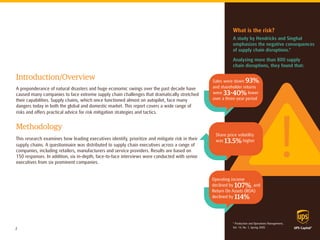
What is the risk? 
A study by Hendricks and Singhal emphasizes the negative consequences of supply chain disruptions.* 
Analyzing more than 800 supply 
chain disruptions, they found that: 
Sales were down 93%, and shareholder returns were 33-40% lower over a three-year period 
Share price volatility was 13.5% higher 
Operating income 
declined by 107%, and Return On Assets (ROA) 
declined by 114% 
* Production and Operations Management, 
Vol. 14, No. 1, Spring 2005 
2
Types of Risk 
Supply chain vulnerabilities are divided into two categories of risk: 
Day-to-Day Risks 
• Customer demand changes 
• Unexpected transit delays 
• Problems at suppliers that delay 
critically needed components 
• Theft (A much larger problem 
than most realize) 
• Production problems 
• Warehouse shortages that cause 
serious delays in customer shipments 
• Cyber security 
Catastrophic Risk 
• Significant disruptions that usually 
cannot be predicted - serious weather incidents (tsunamis, hurricane, 
tornado), terrorism, epidemics, etc. 
Insurance 
Companies can be key partners in working to minimize the financial 
effects of both daily 
supply chain risks and catastrophic disruptions. 
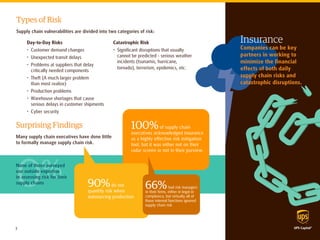
100% of supply chain executives acknowledged insurance as a highly effective risk mitigation tool, but it was either not on their radar screen or not in their purview. 
90% do not 
quantify risk when 
outsourcing production 
66% had risk managers 
in their firms, either in legal or 
compliance, but virtually all of 
those internal functions ignored 
supply chain risk 
Surprising Findings 
Many supply chain executives have done little 
to formally manage supply chain risk. 
None of those surveyed 
use outside expertise 
in assessing risk for their 
supply chains 
3
How risk is assessed 
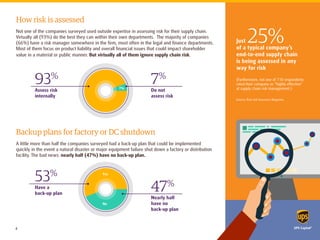
Not one of the companies surveyed used outside expertise in assessing risk for their supply chain. Virtually all (93%) do the best they can within their own departments. The majority of companies (66%) have a risk manager somewhere in the firm, most often in the legal and finance departments. Most of them focus on product liability and overall financial issues that could impact shareholder value in a material or public manner. But virtually all of them ignore supply chain risk. 
Just 25% 
of a typical company’s 
end-to-end supply chain 
is being assessed in any 
way for risk 
(Furthermore, not one of 110 respondents rated their company as “highly effective” 
at supply chain risk management.) 
7% 
7% 
Do not 
assess risk 
93% 
Assess risk 
internally 
Backup plans for factory or DC shutdown 
A little more than half the companies surveyed had a back-up plan that could be implemented quickly in the event a natural disaster or major equipment failure shut down a factory or distribution facility. The bad news: nearly half (47%) have no back-up plan. 
Yes 
No 
47% 
Nearly half 
have no 
back-up plan 
53% 
Have a 
back-up plan 
Source: Risk and Insurance Magazine. 
4
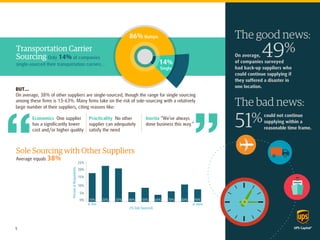
14% 
Single 
86% Multiple 
BUT… 
On average, 38% of other suppliers are single-sourced, though the range for single sourcing 
among these firms is 13-63%. Many firms take on the risk of sole-sourcing with a relatively 
large number of their suppliers, citing reasons like: 
Sole Sourcing with Other Suppliers 
Average equals 38% 
20% 
25% 
15% 
10% 
5% 
0% 10% 
or less 
20% 30% 40% 50% 60% 70% 80% 90% 
or more 
On average, 49% 
of companies surveyed 
had back-up suppliers who 
could continue supplying if 
they suffered a disaster in 
one location. 
The good news: 
The bad news: 
51% 
could not continue 
supplying within a 
reasonable time frame. 
Transportation Carrier 
Sourcing Only 14% of companies 
single-sourced their transportation carriers… 
Economics One supplier 
has a significantly lower 
cost and/or higher quality 
Practicality No other 
supplier can adequately 
satisfy the need 
Inertia “We’ve always 
done business this way.” 
(% Sole Sourced) 
Percent of Respondents 
5
Ranking the Risk 
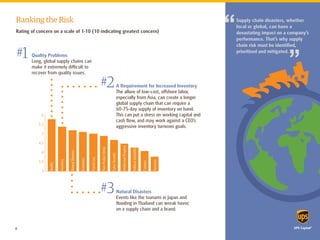
Rating of concern on a scale of 1-10 (10 indicating greatest concern) 
#1 
Quality Problems 
Long, global supply chains can make it extremely difficult to 
recover from quality issues. 
#2 
A Requirement for Increased Inventory 
The allure of low-cost, offshore labor, especially from Asia, can create a longer global supply chain that can require a 
60-75-day supply of inventory on hand. This can put a stress on working capital and cash flow, and may work against a CEO’s aggressive inventory turnover goals. 
#3 
Natural Disasters 
Events like the tsunami in Japan and flooding in Thailand can wreak havoc 
on a supply chain and a brand. 
6 
5.5 
5 
4.5 
4 
3.5 
3 
Quality 
Inventory 
Natural Disasters 
Economics 
Transit Loss 
New Product Delay 
Cyber Security 
Intellectual Property 
Political Instability 
Customs 
Terrorism 
6 
Supply chain disasters, whether local or global, can have a devastating impact on a company’s performance. That’s why supply chain risk must be identified, prioritized and mitigated.
An inexpensive insurance solution can mitigate a 
wide range of problems, from 
a port strike to 
lost cargo. 
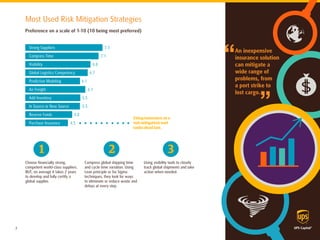
Most Used Risk Mitigation Strategies 
Preference on a scale of 1-10 (10 being most preferred) 
7.5 
7.1 
6.8 
6.7 
6.1 
Strong Suppliers 
Visibility 
Global Logistics Competency 
Predictive Modeling 
Compress Time 
Air Freight 
In Source or Near Source 
Reserve Funds 
Purchase Insurance 
Add Inventory 
6.1 
5.5 
5.5 
4.8 
4.5 
Using insurance as a risk mitigation tool ranks dead last. 
Choose financially strong, competent world-class suppliers. BUT, on average it takes 2 years to develop and fully certify a global supplier. 
Compress global shipping time and cycle time variation. Using Lean principle or Six Sigma techniques, they look for ways to eliminate or reduce waste and delays at every step. 
Using visibility tools to closely track global shipments and take action when needed. 
1 
2 
3 
7
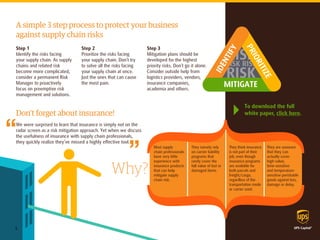
PRIORITIZE 
IDENTIFY 
MITIGATE 
Don’t forget about insurance! 
We were surprised to learn that insurance is simply not on the radar screen as a risk mitigation approach. Yet when we discuss the usefulness of insurance with supply chain professionals, 
they quickly realize they’ve missed a highly effective tool. 
Why? 
A simple 3 step process to protect your business 
against supply chain risks 
Step 1 
Identify the risks facing 
your supply chain. As supply chains and related risk become more complicated, consider a permanent Risk Manager to proactively focus on preemptive risk management and solutions. 
Step 2 
Prioritize the risks facing 
your supply chain. Don’t try 
to solve all the risks facing your supply chain at once. 
Just the ones that can cause the most pain. 
Step 3 
Mitigation plans should be developed for the highest priority risks. Don’t go it alone. Consider outside help from logistics providers, vendors, insurance companies, academia and others. 
Most supply 
chain professionals have very little experience with insurance products that can help mitigate supply chain risk. 
They naively rely on carrier liability programs that rarely cover the full value of lost or damaged items. 
They think insurance is not part of their job, even though insurance programs are available for both parcels and freight/cargo, regardless of the transportation mode or carrier used. 
They are unaware that they can actually cover high-value, time-sensitive and temperature- sensitive perishable goods against loss, damage or delay. 
8 
To download the full 
white paper, click here.
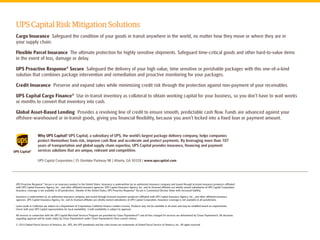
Why UPS Capital? UPS Capital, a subsidiary of UPS, the world’s largest package delivery company, helps companies protect themselves from risk, improve cash flow and accelerate and protect payments. By leveraging more than 107 years of transportation and global supply chain expertise, UPS Capital provides insurance, financing and payment services solutions that are unique, relevant and competitive. 
UPS Capital Risk Mitigation Solutions 
Cargo Insurance Safeguard the condition of your goods in transit anywhere in the world, no matter how they move or where they are in 
your supply chain. 
Flexible Parcel Insurance The ultimate protection for highly sensitive shipments. Safeguard time-critical goods and other hard-to-value items 
in the event of loss, damage or delay. 
UPS Proactive Response® Secure Safeguard the delivery of your high value, time sensitive or perishable packages with this one-of-a-kind solution that combines package intervention and remediation and proactive monitoring for your packages. 
Credit Insurance Preserve and expand sales while minimizing credit risk through the protection against non-payment of your receivables. 
UPS Capital Cargo Finance® Use in-transit inventory as collateral to obtain working capital for your business, so you don’t have to wait weeks 
or months to convert that inventory into cash. 
Global Asset-Based Lending Provides a revolving line of credit to ensure smooth, predictable cash flow. Funds are advanced against your offshore-warehoused or in-transit goods, giving you financial flexibility, because you aren’t locked into a fixed loan or payment amount. 
UPS Proactive Response® Secure is an insurance product in the United States. Insurance is underwritten by an authorized insurance company and issued through licensed insurance producers affiliated 
with UPS Capital Insurance Agency, Inc., and other affiliated insurance agencies. UPS Capital Insurance Agency, Inc. and its licensed affiliates are wholly owned subsidiaries of UPS Capital Corporation. Insurance coverage is not available in all jurisdictions. Outside of the United States, UPS Proactive Response® Secure is Customized Declare Value with increased liability. 
Insurance is underwritten by an authorized insurance company and issued through licensed insurance producers affiliated with UPS Capital Insurance Agency, Inc., and other affiliated insurance 
agencies. UPS Capital Insurance Agency, Inc. and its licensed affiliates are wholly owned subsidiaries of UPS Capital Corporation. Insurance coverage is not available in all jurisdictions. 
Loans made in California are subject to a Department of Corporations California Finance Lenders License. Products may not be available in all areas and may be modified based on requirements. 
Check with your UPS Capital representative for local availability. Credit availability is subject to approval. 
All services in connection with the UPS Capital Merchant Services Program are provided by Chase PaymentechTM and all fees charged for services are determined by Chase Paymentech. All decisions regarding approval will be made solely by Chase Paymentech under Chase Paymentech’s then current criteria. 
© 2014 United Parcel Service of America, Inc. UPS, the UPS brandmark and the color brown are trademarks of United Parcel Service of America, Inc. All rights reserved 
UPS Capital Corporation | 35 Glenlake Parkway NE | Atlanta, GA 30328 | www.upscapital.com

Managing risk

  • 1.
    Managing Risk inthe Global Supply Chain A Report by the Supply Chain Management Faculty at the University of Tennessee Sponsored by UPS Capital Corporation By: J. Paul Dittman, PhD. Executive Director, The Global Supply Chain Institute at the University of Tennessee College of Business Administration Summer 2014
  • 2.
    Introduction/Overview A preponderanceof natural disasters and huge economic swings over the past decade have caused many companies to face extreme supply chain challenges that dramatically stretched their capabilities. Supply chains, which once functioned almost on autopilot, face many dangers today in both the global and domestic market. This report covers a wide range of risks and offers practical advice for risk mitigation strategies and tactics. Methodology This research examines how leading executives identify, prioritize and mitigate risk in their supply chains. A questionnaire was distributed to supply chain executives across a range of companies, including retailers, manufacturers and service providers. Results are based on 150 responses. In addition, six in-depth, face-to-face interviews were conducted with senior executives from six prominent companies. What is the risk? A study by Hendricks and Singhal emphasizes the negative consequences of supply chain disruptions.* Analyzing more than 800 supply chain disruptions, they found that: Sales were down 93%, and shareholder returns were 33-40% lower over a three-year period Share price volatility was 13.5% higher Operating income declined by 107%, and Return On Assets (ROA) declined by 114% * Production and Operations Management, Vol. 14, No. 1, Spring 2005 2
  • 3.
    Types of Risk Supply chain vulnerabilities are divided into two categories of risk: Day-to-Day Risks • Customer demand changes • Unexpected transit delays • Problems at suppliers that delay critically needed components • Theft (A much larger problem than most realize) • Production problems • Warehouse shortages that cause serious delays in customer shipments • Cyber security Catastrophic Risk • Significant disruptions that usually cannot be predicted - serious weather incidents (tsunamis, hurricane, tornado), terrorism, epidemics, etc. Insurance Companies can be key partners in working to minimize the financial effects of both daily supply chain risks and catastrophic disruptions. 100% of supply chain executives acknowledged insurance as a highly effective risk mitigation tool, but it was either not on their radar screen or not in their purview. 90% do not quantify risk when outsourcing production 66% had risk managers in their firms, either in legal or compliance, but virtually all of those internal functions ignored supply chain risk Surprising Findings Many supply chain executives have done little to formally manage supply chain risk. None of those surveyed use outside expertise in assessing risk for their supply chains 3
  • 4.
    How risk isassessed Not one of the companies surveyed used outside expertise in assessing risk for their supply chain. Virtually all (93%) do the best they can within their own departments. The majority of companies (66%) have a risk manager somewhere in the firm, most often in the legal and finance departments. Most of them focus on product liability and overall financial issues that could impact shareholder value in a material or public manner. But virtually all of them ignore supply chain risk. Just 25% of a typical company’s end-to-end supply chain is being assessed in any way for risk (Furthermore, not one of 110 respondents rated their company as “highly effective” at supply chain risk management.) 7% 7% Do not assess risk 93% Assess risk internally Backup plans for factory or DC shutdown A little more than half the companies surveyed had a back-up plan that could be implemented quickly in the event a natural disaster or major equipment failure shut down a factory or distribution facility. The bad news: nearly half (47%) have no back-up plan. Yes No 47% Nearly half have no back-up plan 53% Have a back-up plan Source: Risk and Insurance Magazine. 4
  • 5.
    14% Single 86%Multiple BUT… On average, 38% of other suppliers are single-sourced, though the range for single sourcing among these firms is 13-63%. Many firms take on the risk of sole-sourcing with a relatively large number of their suppliers, citing reasons like: Sole Sourcing with Other Suppliers Average equals 38% 20% 25% 15% 10% 5% 0% 10% or less 20% 30% 40% 50% 60% 70% 80% 90% or more On average, 49% of companies surveyed had back-up suppliers who could continue supplying if they suffered a disaster in one location. The good news: The bad news: 51% could not continue supplying within a reasonable time frame. Transportation Carrier Sourcing Only 14% of companies single-sourced their transportation carriers… Economics One supplier has a significantly lower cost and/or higher quality Practicality No other supplier can adequately satisfy the need Inertia “We’ve always done business this way.” (% Sole Sourced) Percent of Respondents 5
  • 6.
    Ranking the Risk Rating of concern on a scale of 1-10 (10 indicating greatest concern) #1 Quality Problems Long, global supply chains can make it extremely difficult to recover from quality issues. #2 A Requirement for Increased Inventory The allure of low-cost, offshore labor, especially from Asia, can create a longer global supply chain that can require a 60-75-day supply of inventory on hand. This can put a stress on working capital and cash flow, and may work against a CEO’s aggressive inventory turnover goals. #3 Natural Disasters Events like the tsunami in Japan and flooding in Thailand can wreak havoc on a supply chain and a brand. 6 5.5 5 4.5 4 3.5 3 Quality Inventory Natural Disasters Economics Transit Loss New Product Delay Cyber Security Intellectual Property Political Instability Customs Terrorism 6 Supply chain disasters, whether local or global, can have a devastating impact on a company’s performance. That’s why supply chain risk must be identified, prioritized and mitigated.
  • 7.
    An inexpensive insurancesolution can mitigate a wide range of problems, from a port strike to lost cargo. Most Used Risk Mitigation Strategies Preference on a scale of 1-10 (10 being most preferred) 7.5 7.1 6.8 6.7 6.1 Strong Suppliers Visibility Global Logistics Competency Predictive Modeling Compress Time Air Freight In Source or Near Source Reserve Funds Purchase Insurance Add Inventory 6.1 5.5 5.5 4.8 4.5 Using insurance as a risk mitigation tool ranks dead last. Choose financially strong, competent world-class suppliers. BUT, on average it takes 2 years to develop and fully certify a global supplier. Compress global shipping time and cycle time variation. Using Lean principle or Six Sigma techniques, they look for ways to eliminate or reduce waste and delays at every step. Using visibility tools to closely track global shipments and take action when needed. 1 2 3 7
  • 8.
    PRIORITIZE IDENTIFY MITIGATE Don’t forget about insurance! We were surprised to learn that insurance is simply not on the radar screen as a risk mitigation approach. Yet when we discuss the usefulness of insurance with supply chain professionals, they quickly realize they’ve missed a highly effective tool. Why? A simple 3 step process to protect your business against supply chain risks Step 1 Identify the risks facing your supply chain. As supply chains and related risk become more complicated, consider a permanent Risk Manager to proactively focus on preemptive risk management and solutions. Step 2 Prioritize the risks facing your supply chain. Don’t try to solve all the risks facing your supply chain at once. Just the ones that can cause the most pain. Step 3 Mitigation plans should be developed for the highest priority risks. Don’t go it alone. Consider outside help from logistics providers, vendors, insurance companies, academia and others. Most supply chain professionals have very little experience with insurance products that can help mitigate supply chain risk. They naively rely on carrier liability programs that rarely cover the full value of lost or damaged items. They think insurance is not part of their job, even though insurance programs are available for both parcels and freight/cargo, regardless of the transportation mode or carrier used. They are unaware that they can actually cover high-value, time-sensitive and temperature- sensitive perishable goods against loss, damage or delay. 8 To download the full white paper, click here.
  • 9.
    Why UPS Capital?UPS Capital, a subsidiary of UPS, the world’s largest package delivery company, helps companies protect themselves from risk, improve cash flow and accelerate and protect payments. By leveraging more than 107 years of transportation and global supply chain expertise, UPS Capital provides insurance, financing and payment services solutions that are unique, relevant and competitive. UPS Capital Risk Mitigation Solutions Cargo Insurance Safeguard the condition of your goods in transit anywhere in the world, no matter how they move or where they are in your supply chain. Flexible Parcel Insurance The ultimate protection for highly sensitive shipments. Safeguard time-critical goods and other hard-to-value items in the event of loss, damage or delay. UPS Proactive Response® Secure Safeguard the delivery of your high value, time sensitive or perishable packages with this one-of-a-kind solution that combines package intervention and remediation and proactive monitoring for your packages. Credit Insurance Preserve and expand sales while minimizing credit risk through the protection against non-payment of your receivables. UPS Capital Cargo Finance® Use in-transit inventory as collateral to obtain working capital for your business, so you don’t have to wait weeks or months to convert that inventory into cash. Global Asset-Based Lending Provides a revolving line of credit to ensure smooth, predictable cash flow. Funds are advanced against your offshore-warehoused or in-transit goods, giving you financial flexibility, because you aren’t locked into a fixed loan or payment amount. UPS Proactive Response® Secure is an insurance product in the United States. Insurance is underwritten by an authorized insurance company and issued through licensed insurance producers affiliated with UPS Capital Insurance Agency, Inc., and other affiliated insurance agencies. UPS Capital Insurance Agency, Inc. and its licensed affiliates are wholly owned subsidiaries of UPS Capital Corporation. Insurance coverage is not available in all jurisdictions. Outside of the United States, UPS Proactive Response® Secure is Customized Declare Value with increased liability. Insurance is underwritten by an authorized insurance company and issued through licensed insurance producers affiliated with UPS Capital Insurance Agency, Inc., and other affiliated insurance agencies. UPS Capital Insurance Agency, Inc. and its licensed affiliates are wholly owned subsidiaries of UPS Capital Corporation. Insurance coverage is not available in all jurisdictions. Loans made in California are subject to a Department of Corporations California Finance Lenders License. Products may not be available in all areas and may be modified based on requirements. Check with your UPS Capital representative for local availability. Credit availability is subject to approval. All services in connection with the UPS Capital Merchant Services Program are provided by Chase PaymentechTM and all fees charged for services are determined by Chase Paymentech. All decisions regarding approval will be made solely by Chase Paymentech under Chase Paymentech’s then current criteria. © 2014 United Parcel Service of America, Inc. UPS, the UPS brandmark and the color brown are trademarks of United Parcel Service of America, Inc. All rights reserved UPS Capital Corporation | 35 Glenlake Parkway NE | Atlanta, GA 30328 | www.upscapital.com