Challenges in international
procurement
8 April 2018 1
Presented By
Priya Bambale
Introduction
Basically procurement is the process of
acquiring goods and services from outside the
external sources. Goods, services and works
supplied by external sources must meet the
standard requirement outline by the buyer. The
US Defense Acquisition University (DAU) defines
procurement as the act of buying goods and
services for the government.
International Procurement
In a global economy, international
procurement is a term used to describe the
process of allowing firms around the world to bid
on contracts for goods and services.
International Procurement
The concept has gained popularity as shipping
and transportation costs have decreased due to
an influx of cheap, readily available fuel. The
globalization of large corporations has allowed
them to reap the benefits of lower labor and
materials costs while still selling the same quality
and quantity of products.
Benefits of international procurement
Lower the costs
• In international procurement, industrialized
nations purchase goods from countries with a
lower dollar, gaining in the currency exchange.
• Product specialization - some items have a lower
cost of production, based on the natural or
human resources available in different locations.
Benefits of international procurement
Stimulation of a global economy
• Each nation must have some contribution or
basket of goods that they can offer to potential
customers.
• Country which have resources that could not be
produce by other country can benefit them, thus
vice versa to the other country
• For instance, A country with no natural oil can
build an oil drilling mechanism as to be supply to
country that have natural oil.
Challenges in international procurement
• Supplier-related issues
• Strategy selection
• Reducing costs and achieving savings
• Accurate data
• Managing stakeholders
• Risk mitigation
• Cultural understanding
• Language and communication difference
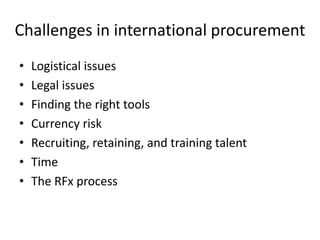
Challenges in international procurement
• Logistical issues
• Legal issues
• Finding the right tools
• Currency risk
• Recruiting, retaining, and training talent
• Time
• The RFx process
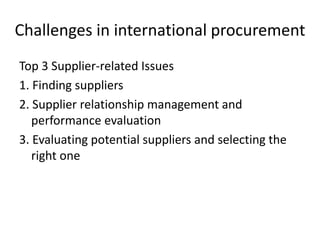
Challenges in international procurement
Top 3 Supplier-related Issues
1. Finding suppliers
2. Supplier relationship management and
performance evaluation
3. Evaluating potential suppliers and selecting the
right one
Thank you!

Challenges in international procurement

  • 1.
    Challenges in international procurement 8April 2018 1 Presented By Priya Bambale
  • 2.
    Introduction Basically procurement isthe process of acquiring goods and services from outside the external sources. Goods, services and works supplied by external sources must meet the standard requirement outline by the buyer. The US Defense Acquisition University (DAU) defines procurement as the act of buying goods and services for the government.
  • 3.
    International Procurement In aglobal economy, international procurement is a term used to describe the process of allowing firms around the world to bid on contracts for goods and services.
  • 4.
    International Procurement The concepthas gained popularity as shipping and transportation costs have decreased due to an influx of cheap, readily available fuel. The globalization of large corporations has allowed them to reap the benefits of lower labor and materials costs while still selling the same quality and quantity of products.
  • 5.
    Benefits of internationalprocurement Lower the costs • In international procurement, industrialized nations purchase goods from countries with a lower dollar, gaining in the currency exchange. • Product specialization - some items have a lower cost of production, based on the natural or human resources available in different locations.
  • 6.
    Benefits of internationalprocurement Stimulation of a global economy • Each nation must have some contribution or basket of goods that they can offer to potential customers. • Country which have resources that could not be produce by other country can benefit them, thus vice versa to the other country • For instance, A country with no natural oil can build an oil drilling mechanism as to be supply to country that have natural oil.
  • 7.
    Challenges in internationalprocurement • Supplier-related issues • Strategy selection • Reducing costs and achieving savings • Accurate data • Managing stakeholders • Risk mitigation • Cultural understanding • Language and communication difference
  • 8.
    Challenges in internationalprocurement • Logistical issues • Legal issues • Finding the right tools • Currency risk • Recruiting, retaining, and training talent • Time • The RFx process
  • 9.
    Challenges in internationalprocurement Top 3 Supplier-related Issues 1. Finding suppliers 2. Supplier relationship management and performance evaluation 3. Evaluating potential suppliers and selecting the right one
  • 10.