MBA Lecture:
A BETTER APPROACH to
Supply Chain Risk
Management

Paul Barsch
Marketing Director
Modern Day SCM Assumptions


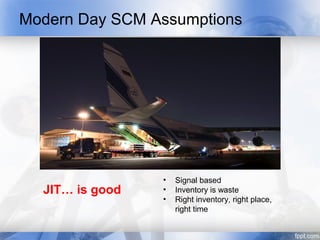
                 •   Signal based
  JIT… is good   •   Inventory is waste
                 •   Right inventory, right place,
                     right time
Modern Day SCM Assumptions


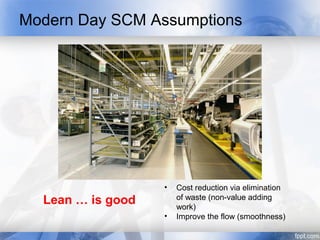
                   •   Cost reduction via elimination
  Lean … is good       of waste (non-value adding
                       work)
                   •   Improve the flow (smoothness)
Modern Day SCM Assumptions


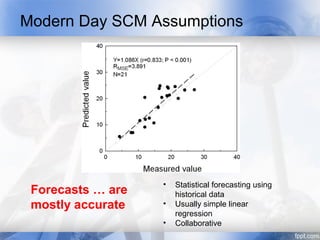
                   •   Statistical forecasting using
 Forecasts … are       historical data
 mostly accurate   •   Usually simple linear
                       regression
                   •   Collaborative
Problems with Predictions


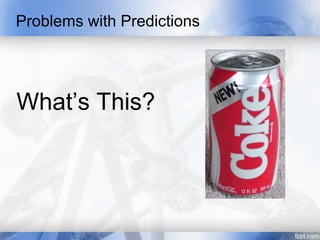
What’s This?
Problems with Predictions

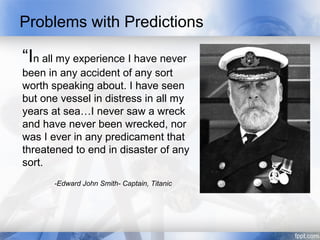
“In all my experience I have never
been in any accident of any sort
worth speaking about. I have seen
but one vessel in distress in all my
years at sea…I never saw a wreck
and have never been wrecked, nor
was I ever in any predicament that
threatened to end in disaster of any
sort.
      -Edward John Smith- Captain, Titanic
Problems with Predictions

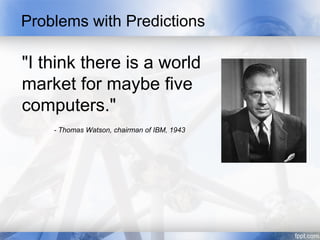
"I think there is a world
market for maybe five
computers."
    - Thomas Watson, chairman of IBM, 1943
Problems with Predictions

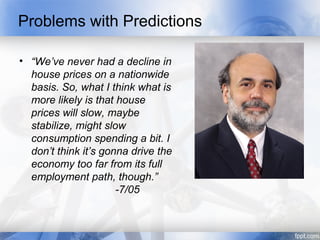
• “We’ve never had a decline in
  house prices on a nationwide
  basis. So, what I think what is
  more likely is that house
  prices will slow, maybe
  stabilize, might slow
  consumption spending a bit. I
  don’t think it’s gonna drive the
  economy too far from its full
  employment path, though.”
                      -7/05
More Problems with Predictions

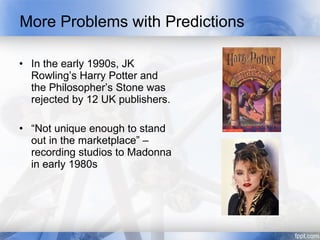
• In the early 1990s, JK
  Rowling’s Harry Potter and
  the Philosopher’s Stone was
  rejected by 12 UK publishers.

• “Not unique enough to stand
  out in the marketplace” –
  recording studios to Madonna
  in early 1980s
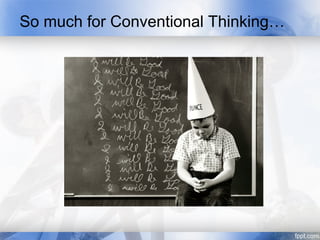
So much for Conventional Thinking…
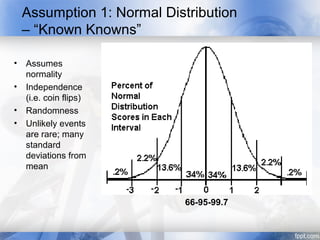
Assumption 1: Normal Distribution
  – “Known Knowns”

• Assumes
  normality
• Independence
  (i.e. coin flips)
• Randomness
• Unlikely events
  are rare; many
  standard
  deviations from
  mean


                           66-95-99.7
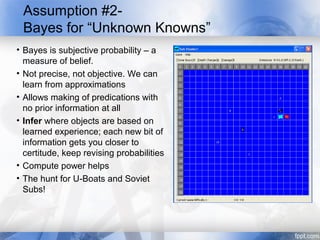
Assumption #2-
 Bayes for “Unknown Knowns”
• Bayes is subjective probability – a
  measure of belief.
• Not precise, not objective. We can
  learn from approximations
• Allows making of predications with
  no prior information at all
• Infer where objects are based on
  learned experience; each new bit of
  information gets you closer to
  certitude, keep revising probabilities
• Compute power helps
• The hunt for U-Boats and Soviet
  Subs!
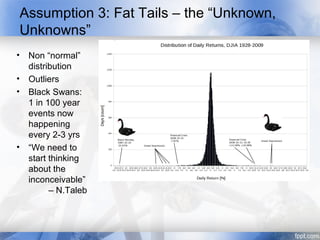
Assumption 3: Fat Tails – the “Unknown,
Unknowns”
• Non “normal”
  distribution
• Outliers
• Black Swans:
  1 in 100 year
  events now
  happening
  every 2-3 yrs
• “We need to
  start thinking
  about the
  inconceivable”
        – N.Taleb
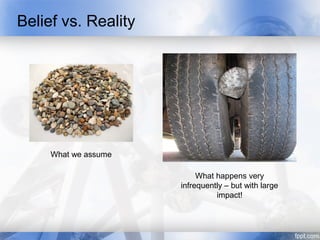
Belief vs. Reality


     What we assume

                           What happens very
                      infrequently – but with large
                                impact!
Beware Mickey Mouse Probabilities
                   • Before the -23% drop in the 1987
                     crash, the worst previous in
                     sample move was close to 10%

                   • “Not in a million years would we
                     have expected this gyration to be
                     as vicious and enduring as it has
                     been,”
                        – Steven Solmonson, head of Park Place Capital
                          Ltd.


                   • “A turkey cannot figure out what
                     is in store for it tomorrow based
                     on the events of today.”
                        – Nassim Nicholas Taleb
Fat Tails Happen!

• Watch the PBS Frontline video on
  Fukushima Daiichi nuclear disaster
• http://video.pbs.org/video/2202847024/
  (start at 1:25 til 8:25)
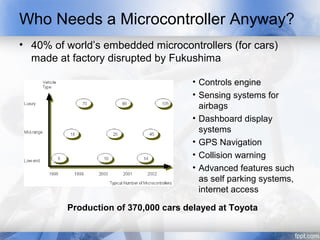
Who Needs a Microcontroller Anyway?
• 40% of world’s embedded microcontrollers (for cars)
  made at factory disrupted by Fukushima

                                     • Controls engine
                                     • Sensing systems for
                                       airbags
                                     • Dashboard display
                                       systems
                                     • GPS Navigation
                                     • Collision warning
                                     • Advanced features such
                                       as self parking systems,
                                       internet access

         Production of 370,000 cars delayed at Toyota
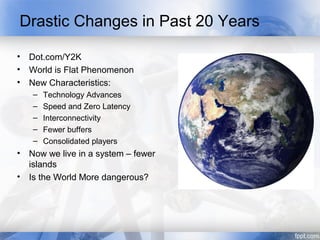
Drastic Changes in Past 20 Years

•   Dot.com/Y2K
•   World is Flat Phenomenon
•   New Characteristics:
    –   Technology Advances
    –   Speed and Zero Latency
    –   Interconnectivity
    –   Fewer buffers
    –   Consolidated players
•   Now we live in a system – fewer
    islands
•   Is the World More dangerous?
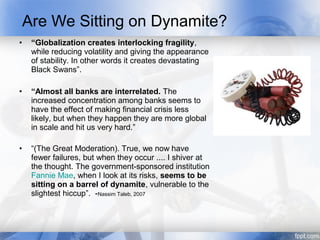
Are We Sitting on Dynamite?
•    “Globalization creates interlocking fragility,
     while reducing volatility and giving the appearance
     of stability. In other words it creates devastating
     Black Swans”.

•    “Almost all banks are interrelated. The
     increased concentration among banks seems to
     have the effect of making financial crisis less
     likely, but when they happen they are more global
     in scale and hit us very hard.”

•    “(The Great Moderation). True, we now have
     fewer failures, but when they occur .... I shiver at
     the thought. The government-sponsored institution
     Fannie Mae, when I look at its risks, seems to be
     sitting on a barrel of dynamite, vulnerable to the
     slightest hiccup”. -Nassim Taleb, 2007
Implications
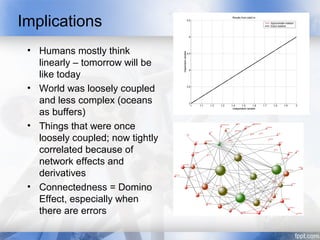
 • Humans mostly think
   linearly – tomorrow will be
   like today
 • World was loosely coupled
   and less complex (oceans
   as buffers)
 • Things that were once
   loosely coupled; now tightly
   correlated because of
   network effects and
   derivatives
 • Connectedness = Domino
   Effect, especially when
   there are errors
Solutions
• Near shoring – bringing work
  back home
• Examine risks up and down
  supply chain
   – Beyond Tier 1 suppliers
• Redundancy
• Disaster Planning for “known
  knowns” and “unknown
  knowns”
• Doing Nothing
   –   “It is difficult to motivate people in the
       prevention of Black Swans...
       Prevention is not easily perceived,
       measured, or rewarded; it is
       generally a silent and thankless
       activity. History books do not account
       for heroic preventive measures” –
       Taleb (2005)
Food for Thought

•   Remember – things that haven’t happened before will happen.
    Things that have happened, will happen again.
•   Your “worst case scenario” probably isn’t really the “worst case
    scenario” (think: Fukushima’s seawall).
•   With knowledge that things are fragile– better to be a little wrong
    (limited loss) than majorly wrong (out of business)
•   Don’t think of Black Swan’s as only negative (what I can avoid)
     – Think of them as “options”. Little investments with limited loss. Many
       have more upside than downside
     – Trial and error are options with small costs. There are huge pay-offs for
       being right such as big discoveries (positive Black Swan).

MBA Lecture: Supply Chain Risk Management

  • 1.
    MBA Lecture: A BETTERAPPROACH to Supply Chain Risk Management Paul Barsch Marketing Director
  • 2.
    Modern Day SCMAssumptions • Signal based JIT… is good • Inventory is waste • Right inventory, right place, right time
  • 3.
    Modern Day SCMAssumptions • Cost reduction via elimination Lean … is good of waste (non-value adding work) • Improve the flow (smoothness)
  • 4.
    Modern Day SCMAssumptions • Statistical forecasting using Forecasts … are historical data mostly accurate • Usually simple linear regression • Collaborative
  • 5.
  • 6.
    Problems with Predictions “Inall my experience I have never been in any accident of any sort worth speaking about. I have seen but one vessel in distress in all my years at sea…I never saw a wreck and have never been wrecked, nor was I ever in any predicament that threatened to end in disaster of any sort. -Edward John Smith- Captain, Titanic
  • 7.
    Problems with Predictions "Ithink there is a world market for maybe five computers." - Thomas Watson, chairman of IBM, 1943
  • 8.
    Problems with Predictions •“We’ve never had a decline in house prices on a nationwide basis. So, what I think what is more likely is that house prices will slow, maybe stabilize, might slow consumption spending a bit. I don’t think it’s gonna drive the economy too far from its full employment path, though.” -7/05
  • 9.
    More Problems withPredictions • In the early 1990s, JK Rowling’s Harry Potter and the Philosopher’s Stone was rejected by 12 UK publishers. • “Not unique enough to stand out in the marketplace” – recording studios to Madonna in early 1980s
  • 10.
    So much forConventional Thinking…
  • 11.
    Assumption 1: NormalDistribution – “Known Knowns” • Assumes normality • Independence (i.e. coin flips) • Randomness • Unlikely events are rare; many standard deviations from mean 66-95-99.7
  • 12.
    Assumption #2- Bayesfor “Unknown Knowns” • Bayes is subjective probability – a measure of belief. • Not precise, not objective. We can learn from approximations • Allows making of predications with no prior information at all • Infer where objects are based on learned experience; each new bit of information gets you closer to certitude, keep revising probabilities • Compute power helps • The hunt for U-Boats and Soviet Subs!
  • 13.
    Assumption 3: FatTails – the “Unknown, Unknowns” • Non “normal” distribution • Outliers • Black Swans: 1 in 100 year events now happening every 2-3 yrs • “We need to start thinking about the inconceivable” – N.Taleb
  • 14.
    Belief vs. Reality What we assume What happens very infrequently – but with large impact!
  • 15.
    Beware Mickey MouseProbabilities • Before the -23% drop in the 1987 crash, the worst previous in sample move was close to 10% • “Not in a million years would we have expected this gyration to be as vicious and enduring as it has been,” – Steven Solmonson, head of Park Place Capital Ltd. • “A turkey cannot figure out what is in store for it tomorrow based on the events of today.” – Nassim Nicholas Taleb
  • 16.
    Fat Tails Happen! •Watch the PBS Frontline video on Fukushima Daiichi nuclear disaster • http://video.pbs.org/video/2202847024/ (start at 1:25 til 8:25)
  • 17.
    Who Needs aMicrocontroller Anyway? • 40% of world’s embedded microcontrollers (for cars) made at factory disrupted by Fukushima • Controls engine • Sensing systems for airbags • Dashboard display systems • GPS Navigation • Collision warning • Advanced features such as self parking systems, internet access Production of 370,000 cars delayed at Toyota
  • 18.
    Drastic Changes inPast 20 Years • Dot.com/Y2K • World is Flat Phenomenon • New Characteristics: – Technology Advances – Speed and Zero Latency – Interconnectivity – Fewer buffers – Consolidated players • Now we live in a system – fewer islands • Is the World More dangerous?
  • 19.
    Are We Sittingon Dynamite? • “Globalization creates interlocking fragility, while reducing volatility and giving the appearance of stability. In other words it creates devastating Black Swans”. • “Almost all banks are interrelated. The increased concentration among banks seems to have the effect of making financial crisis less likely, but when they happen they are more global in scale and hit us very hard.” • “(The Great Moderation). True, we now have fewer failures, but when they occur .... I shiver at the thought. The government-sponsored institution Fannie Mae, when I look at its risks, seems to be sitting on a barrel of dynamite, vulnerable to the slightest hiccup”. -Nassim Taleb, 2007
  • 20.
    Implications • Humansmostly think linearly – tomorrow will be like today • World was loosely coupled and less complex (oceans as buffers) • Things that were once loosely coupled; now tightly correlated because of network effects and derivatives • Connectedness = Domino Effect, especially when there are errors
  • 21.
    Solutions • Near shoring– bringing work back home • Examine risks up and down supply chain – Beyond Tier 1 suppliers • Redundancy • Disaster Planning for “known knowns” and “unknown knowns” • Doing Nothing – “It is difficult to motivate people in the prevention of Black Swans... Prevention is not easily perceived, measured, or rewarded; it is generally a silent and thankless activity. History books do not account for heroic preventive measures” – Taleb (2005)
  • 22.
    Food for Thought • Remember – things that haven’t happened before will happen. Things that have happened, will happen again. • Your “worst case scenario” probably isn’t really the “worst case scenario” (think: Fukushima’s seawall). • With knowledge that things are fragile– better to be a little wrong (limited loss) than majorly wrong (out of business) • Don’t think of Black Swan’s as only negative (what I can avoid) – Think of them as “options”. Little investments with limited loss. Many have more upside than downside – Trial and error are options with small costs. There are huge pay-offs for being right such as big discoveries (positive Black Swan).