THE SUPPLY CHAIN MANAGER’S HANDBOOK A PRACTICAL GUIDE TO THE MANAGEMENT OF HEALTH COMMODITIES THE SUPPLY CHAIN MANAGER’S HANDBOOK A PRACTICAL GUIDE TO THE MANAGEMENT OF HEALTH COMMODITIES
SUPPLY CHAIN RISK
MANAGEMENT
WHAT A SUPPLY CHAIN
MANAGER NEEDSTO KNOW:
As detailed in this handbook, making health commodities available at the point of service delivery
requires successful completion of numerous tasks. For developing country public health supply
chains, there are many potential opportunities for the flow of commodities to be interrupted
before they reach users and patients. Some of these potential failure points may be in direct
control of the supply chain manager, while others may not be. However, active consideration and
management of these risks to performance can help decrease the likelihood or impact
of occurrence.
To effectively manage risks to supply chain performance, a public health supply chain manager
should understand the following:
• The basic components of supply chain risk and why it’s important to actively manage
• The benefits of supply chain risk management
• How to identify, evaluate, and prioritize risks to your supply chain performance
• How to identify approaches to manage, monitor, and respond to risk events
• Other strategic applications of risk management
CHAPTER 12
12 12
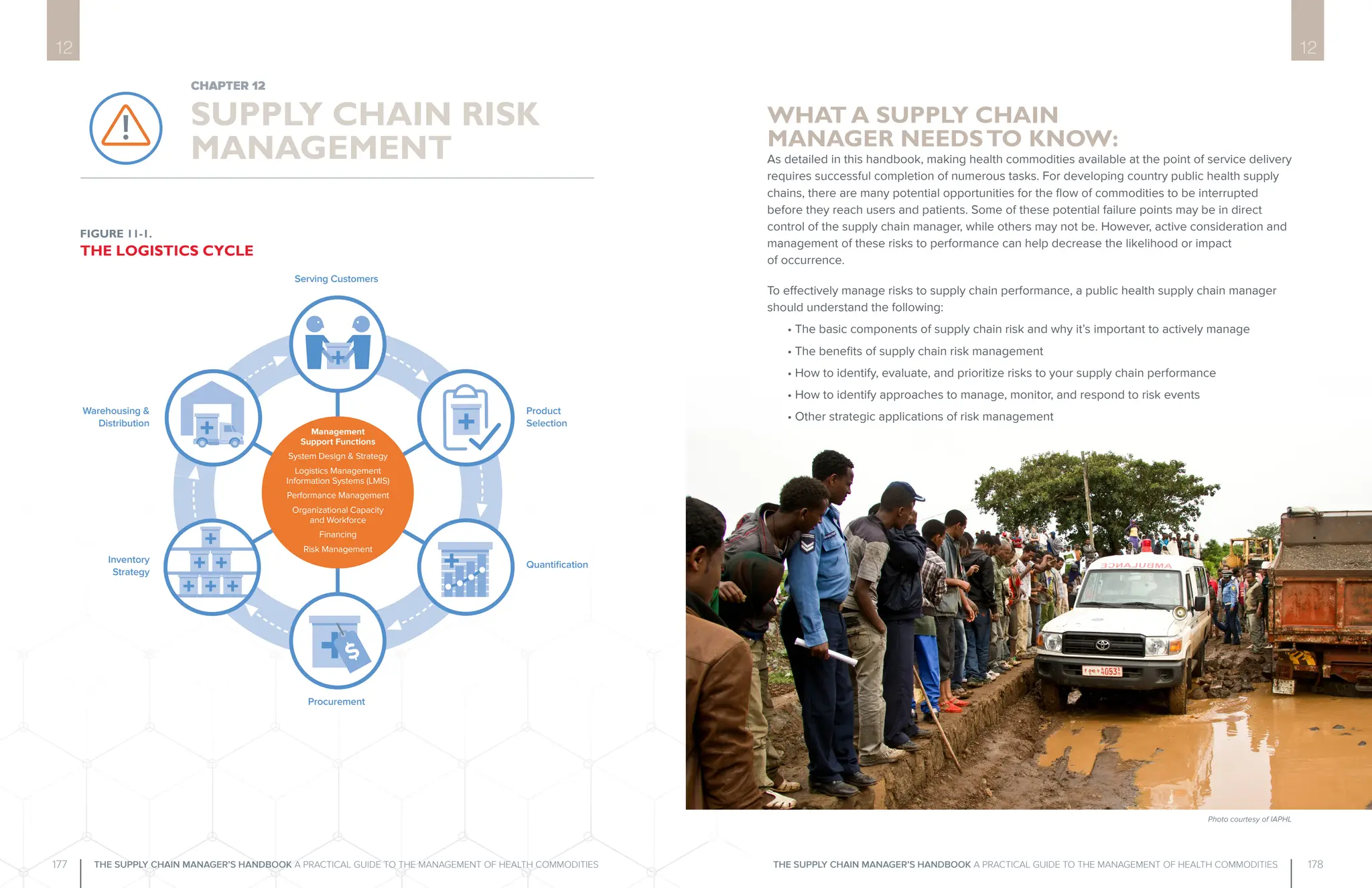
FIGURE 11-1.
THE LOGISTICS CYCLE
Serving Customers
Inventory
Strategy
Quantification
Warehousing &
Distribution
Procurement
THE LOGISTICS CYCLE
Product
Selection
Management
Support Functions
System Design & Strategy
Logistics Management
Information Systems (LMIS)
Performance Management
Organizational Capacity
and Workforce
Financing
Risk Management
Photo courtesy of IAPHL
177 178
THE SUPPLY CHAIN MANAGER’S HANDBOOK A PRACTICAL GUIDE TO THE MANAGEMENT OF HEALTH COMMODITIES THE SUPPLY CHAIN MANAGER’S HANDBOOK A PRACTICAL GUIDE TO THE MANAGEMENT OF HEALTH COMMODITIES
12 12
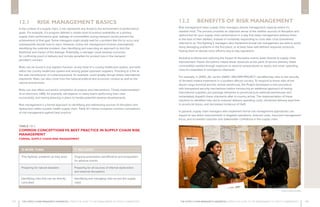
IS MORE THAN: IT INCLUDES:
‘Fire-fighting’ problems as they arise Ongoing preemptive identification and preparation
for adverse events
Preparing for natural disasters Preparing for all sources of internal dysfunction
and external disruptions
Identifying risks that can be directly
controlled
Identifying and managing risks across the supply
chain
12.1 RISK MANAGEMENT BASICS
TABLE 12-1.
COMMON CONCEPTIONSVS. BEST PRACTICE IN SUPPLY CHAIN RISK
MANAGEMENT
FORMAL SUPPLY CHAIN RISK MANAGEMENT
In the context of a supply chain, a risk represents any threat to the achievement of performance
goals. For example, if a program defined a certain level of product availability as a primary
supply chain performance goal, leakage of commodities during transport would prevent the
achievement of that goal. Some managers might simply wait for a problem like this to occur and
subsequently decide how to react. However, active risk management involves preemptively
identifying the potential problem, then identifying and executing an approach to limit the
likelihood and impact of the leakage. Potentially, a manager could develop a process
for confirming proof of delivery and include penalties for product loss in the transport
provider’s contract.
Risks can be found in any logistics function, at any level of a country healthcare system, and both
within the country healthcare system and among global upstream suppliers. Flooding or a fire at
the sole manufacturer of a pharmaceutical, for example, could greatly disrupt timely international
shipments. Risks can also come from the national political and economic context as well as the
natural environment.
Risks can also affect successful completion of projects and interventions. Timely implementation
of an electronic LMIS, for example, will depend on many teams performing their roles
successfully, and having planning in place to handle potential adverse developments.
Risk management is a formal approach to identifying and addressing sources of disruption and
dysfunction within a public health supply chain. Table 12-1 below compares common conceptions
of risk management against best practice:
12.2 BENEFITS OF RISK MANAGEMENT
Risk management helps supply chain managers devote management capacity where it’s
needed most. The process provides an objective sense of the relative sources of disruption and
dysfunction for your supply chain performance in a way that helps management address them
to the best of their abilities. Instead of constantly responding to crisis after crisis (sometimes
referred to as “fire-fighting”), managers who implement formal risk management are able to avoid
many damaging problems in the first place, or at least have well-defined response protocols,
freeing them to devote more effort to day-to-day operations.
Avoiding incidents and reducing the impact of disruptive events leads directly to supply chain
improvement. Fewer disruptions means fewer stockouts at the point of service delivery, fewer
commodities wasted through exposure to adverse temperatures or expiry, and lower operating
costs for expedited or emergency shipments.
For example, in 2009, JSI, via the USAID | DELIVER PROJECT, identified key risks to the security
of donated malaria treatments in a southern African country. To respond to these risks at the
airport cargo terminal and the central warehouse, the Project developed a new procedure
with transparent security mechanisms before introducing an additional approach of having
international suppliers pre-package deliveries to provincial (sub-national) warehouses and
immediately dispatch these shipments after in-country arrival. The implementation of these
solutions to identified risks led to reduced delivery operating costs, shortened delivery lead time
to provincial stores, and decreased incidence of theft.
In general, supply chain managers who implement formal risk management approaches can
expect to see direct improvements in targeted operations, reduced costs, improved management
focus, and increased customer and stakeholder confidence in the supply chain.
Photo courtesy of IAPHL
179 180
THE SUPPLY CHAIN MANAGER’S HANDBOOK A PRACTICAL GUIDE TO THE MANAGEMENT OF HEALTH COMMODITIES THE SUPPLY CHAIN MANAGER’S HANDBOOK A PRACTICAL GUIDE TO THE MANAGEMENT OF HEALTH COMMODITIES
12.3 
RISK MANAGEMENT AS A FORMAL
PROCESS FOR PUBLIC HEALTH
SUPPLY CHAIN MANAGERS
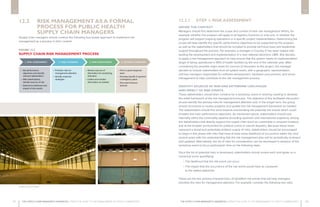
Supply chain managers should conduct the following four-phase approach to implement risk
management as a process in their context:
FIGURE 12-2.
SUPPLY CHAIN RISK MANAGEMENT PROCESS
1. RISK ASSESSMENT 2. RISK PLANNING 3. RISK MONITORING 4. INCIDENT HANDLING
• Set performance
objectives and identify
relevant stakeholders
• With stakeholders,
identify sources of risk
• Determine likelihood and
impact of risk events
• Prioritize risks for
management attention
• Identify response
strategies
• Review sources of
information for monitoring
indicators
• Collect and monitor
information as needed
• Form a quick-response
team
• Develop specific  general
contingency plans
• Document lessons
learned
DEFINE THE CONTEXT
Managers should first determine the scope and context of their risk management efforts, for
example: whether the program will apply to all logistics functions or only one, or whether the
program will support ongoing operations or a specific project implementation. Determining the
scope will help identify the specific performance objectives to be supported by the program
as well as the stakeholders that should be included to provide technical input and leadership
support throughout the process. For example, a manager in Country X has been tasked with
leading the development and implementation of a new national electronic LMIS. She decides
to apply a risk management approach to help ensure that the system meets its implementation
target of being operational in 95% of health facilities by the end of the calendar year. After
considering the possible major areas for sources of disruption to the project, the manager
decides to include stakeholders from all system levels, with a geographic representation,
and key managers responsible for software development, hardware procurement, and server
management to help contribute to the risk management process.
IDENTIFY SOURCES OF RISK AND DETERMINE LIKELIHOOD
AND IMPACT OF RISK EVENTS
These stakeholders should then convene for a workshop event or working meeting to develop
the initial framework of the risk management process. The objective of this facilitated discussion
should identify the primary risks for management attention and, in the longer term, the group
should reconvene to review progress and update the risk management framework as needed.
The stakeholders should first work towards enumerating the potential risk events which could
threaten the main performance objectives. As mentioned above, stakeholders should look
internally within the commodity pipeline (including upstream and international suppliers), among
the stakeholders that directly support the supply chain (such as commodity or program funders),
and at the broader environment for political unrest or natural disasters. Because these areas
represent a broad and potentially limitless supply of risks, stakeholders should be encouraged
to begin in this phase with risks that have at least some likelihood of occurrence within the next
several years with the understanding that the risk management plan will be periodically reviewed
and updated. Alternatively, the list of risks for consideration can be developed in advance of the
workshop event to focus participants’ time on the following tasks.
Once the list of potential risks is developed, stakeholders should review each and agree on a
numerical score quantifying:
• The likelihood that the risk event can occur
• 
The impact that the occurrence of the risk event would have as compared
to the stated objectives
These are the two primary characteristics of identified risk events that will help managers
prioritize the risks for management attention. For example, consider the following two risks:
12.3.1 STEP 1: RISK ASSESSMENT
12 12
Photos courtesy of IAPHL
181 182
THE SUPPLY CHAIN MANAGER’S HANDBOOK A PRACTICAL GUIDE TO THE MANAGEMENT OF HEALTH COMMODITIES THE SUPPLY CHAIN MANAGER’S HANDBOOK A PRACTICAL GUIDE TO THE MANAGEMENT OF HEALTH COMMODITIES
• A server or network connectivity outage occurs
• A major theft of commodities occurs within the national pipeline
After discussion, stakeholders might consider server outage to have a high likelihood and high
impact on their system, while they might consider theft to have a low to moderate likelihood of
occurrence and high impact. In this instance, supply chain managers would have guidance to
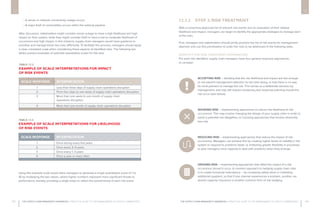
prioritize and manage these two risks differently. To facilitate this process, managers should apply
a clear, consistent scale when considering these aspects of identified risks. The following two
tables present examples of potential quantitative scales for this task:
TABLE 12-2.
EXAMPLE OF SCALE INTERPRETATIONS FOR IMPACT
OF RISK EVENTS
SCALE RESPONSE INTERPRETATION
1 Less than three days of supply chain operations disruption
2 From four days to one week of supply chain operations disruption
3 More than one week to one month of supply chain
operations disruption
4 More than one month of supply chain operations disruption
TABLE 12-3.
EXAMPLE OF SCALE INTERPRETATIONS FOR LIKELIHOOD
OF RISK EVENTS
SCALE RESPONSE INTERPRETATION
1 Once during every five years
2 Once every 3–5 years
3 Once every 1–3 years
4 Once a year or more often
Using this example scale would allow managers to generate a single quantitative score of 1 to
16 by multiplying the two values, where higher numbers represent more significant threats to
performance, thereby providing a single index to reflect the overall threat of each risk event.
12.3.2 STEP 2: RISKTREATMENT
With a consensus-approved list of relevant risk events and an evaluation of their relative
likelihood and impact, managers can begin to identify the appropriate strategies to manage each
of the risks.
First, managers and stakeholders should jointly prioritize the list of risk events for management
attention and use this prioritization to order the risks to be addressed in the following tasks.
IDENTIFYTHE RISKTREATMENT APPROACHES
For each risk identified, supply chain managers have four general response approaches
to consider:
ACCEPTING RISK – deciding that the risk likelihood and impact are low enough
to not warrant management attention for the time being, or that there is no way
for local partners to manage the risk. This serves as a deliberate decision by
management, and may still require monitoring and response planning should the
risk occur (see below).
		
AVOIDING RISK – implementing approaches to reduce the likelihood of risk
occurrence. This may involve changing the design of your supply chain in order to
avoid a potential risk altogether, or choosing approaches that involve inherently
less risk.
		
REDUCING RISK – implementing approaches that reduce the impact of risk
occurrence. Managers can achieve this by creating higher levels of visibility in the
system to respond to problems faster, or instituting greater flexibility in processes
to give managers more capacity to deal with problems when they emerge.
		
HEDGING RISK – implementing approaches that offset the impact of a risk
occurrence should it occur. A common approach to hedging supply chain risks
is to create functional redundancy – by increasing safety stock or instituting
additional suppliers, so that if one channel experiences a problem, another can
absorb capacity. Insurance is another common form of risk hedging.
12 12
183 184
THE SUPPLY CHAIN MANAGER’S HANDBOOK A PRACTICAL GUIDE TO THE MANAGEMENT OF HEALTH COMMODITIES THE SUPPLY CHAIN MANAGER’S HANDBOOK A PRACTICAL GUIDE TO THE MANAGEMENT OF HEALTH COMMODITIES
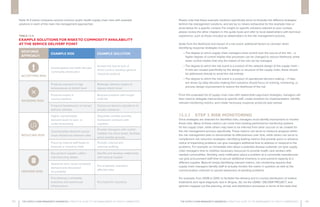
TABLE 12-4.
EXAMPLE SOLUTIONS FOR RISKSTO COMMODITY AVAILABILITY
ATTHE SERVICE DELIVERY POINT
RESPONSE
APPROACH
EXAMPLE RISK EXAMPLE SOLUTION
ACCEPTING RISK
Unanticipated civil strife disrupts
commodity distribution
Accept risk due to lack of
direct control, develop general
response protocol
AVOIDING RISK
Products exposed to high
temperatures at district level
Redesign delivery system to
bypass district level
Products expire in
country pipeline
Request products with longer
shelf life
Frequent breakdowns of owned
delivery vehicles
Outsource delivery operations to
private contractor
REDUCING RISK
Highly unpredictable
demand leads to over- or
under-forecasting
Negotiate variable-quantity
framework contracts with
suppliers
Unpredictable demand causes
stock imbalances between sites
Provide managers with central
visibility into stock levels, facilitate
stock transfer process
Fraud by internal staff leads to
financial or inventory theft
Periodic internal and
external auditing
HEDGING RISK
Key product supplier suffers
manufacturing delays
Identify and develop relationship
with backup supplier
Seasonal rains cause increased
demand and decreased
accessibility
Pre-emptively overstock
affected sites
Fire destroys commodity
inventory and warehouse
infrastructure
Purchase fire insurance
Table 12-4 below compares several common public health supply chain risks with example
solutions in each of the main risk management approaches:
Aside from the likelihood and impact of a risk event, additional factors to consider when
identifying response strategies include:
• 
The degree to which supply chain managers have control over the source of the risk – a
higher degree of control implies that processes can be changed to reduce likelihood, while
lower control implies that only the impact of the risk can be managed
• 
The degree to which the risk event is a product of the network design of the supply chain –
if risks are caused specifically by the design or structure of the supply chain, these should
be addressed directly to avoid the risk entirely
• 
The degree to which the risk event is a product of operational decision-making – if risks
are driven by daily decision-making then solutions should focus on training, monitoring, or
process design improvement to reduce the likelihood of the risk
From this evaluated list of supply chain risks with stakeholder-approved strategies, managers will
then need to delegate interventions to specific staff, create timelines for implementation, identify
relevant monitoring metrics, and create necessary response protocols (see below).
12.3.3 STEP 3. RISK MONITORING
Once strategies are selected for identified risks, managers must identify mechanisms to monitor
those risks. Many of these metrics can come from existing performance monitoring systems
for the supply chain, while others may have to be inferred from other sources or be created for
the risk management process specifically. These metrics can serve to measure progress within
the risk management plan to demonstrate its effectiveness over time, while others can serve to
complement risk reduction strategies: identifying leading metrics that provide quick or advance
notice of impending problems can give managers additional time to address or respond to the
problems. For example, an immediate alert about a potential disease outbreak can give supply
chain managers time to mobilize necessary resources to provide health care workers with
needed commodities. Similarly, early notification about a problem at a commodity manufacturer
can give procurement staff time to secure additional inventory or procurement capacity at a
different supplier. Beyond simply identifying relevant metrics, risk monitoring requires that
supply chain managers identify staff to actually monitor the metric in question as well as the
communication channels to spread awareness of pending problems.
For example, from 2008 to 2015, to facilitate the delivery and in-country distribution of malaria
treatments and rapid diagnostic test in Angola, JSI, via the USAID | DELIVER PROJECT, and
partners mapped out the planning, arrival, and distribution processes in terms of the tasks that
Please note that these example solutions specifically serve to illustrate the different strategies
behind risk management solutions, and are by no means exhaustive for the example risks or
proscriptive for a specific context. For insight on specific solutions relevant to your context,
please review the other chapters in this guide book and refer to local stakeholders with technical
experience, such as those included as stakeholders to the risk management process.
12 12
185 186
THE SUPPLY CHAIN MANAGER’S HANDBOOK A PRACTICAL GUIDE TO THE MANAGEMENT OF HEALTH COMMODITIES THE SUPPLY CHAIN MANAGER’S HANDBOOK A PRACTICAL GUIDE TO THE MANAGEMENT OF HEALTH COMMODITIES
needed to be completed and the potential disruptions to any of those tasks. This mapping
process identified key activities for staff to monitor and notifications to share, such as alerting
donor partners when the cargo arrived and providing proofs of delivery, delivery quantity
verifications, and discrepancy reports once the commodities reached state headquarters.
12.3.4 4. INCIDENT HANDLING
A core aspect of successful risk management requires process development for handling risk
incidents as they occur. As mentioned above, supply chain managers cannot address all risks
due to resource limitations, or may not have the level of control required to address the source
of certain risks. Instead, managers should develop and implement processes for identifying,
responding to, and learning from risk events as they occur.
Some events may be predictable enough that they require specific response plans. In these
instances, managers can work with their teams to map out a relevant response approach in
terms of who is responsible for which actions, and how the response is triggered initially.
Other events which may not have been foreseen in the risk management could benefit from
general emergency response plans. For these incidents, management may not be able to craft
responses in advance, but can at least document actions that will help staff mobilize required
resources as quickly as possible. In both instances managers should institute a learning agenda
by reviewing results after each incident, documenting outcomes, and adjusting response
protocols as needed.
Incident handling plays a key role in response to disease outbreaks, where the health system
(and subsequently the supply chain) is tasked with rapid delivery of services to recipients in
variable and challenging contexts. The unpredictable nature of these outbreaks implies that the
response cannot be handled by the routine supply chain alone, but that special planning and
response approaches are needed to meet specific demands.
In Liberia, following the 2013 Ebola outbreak which completely disrupted existing supply
channels, healthcare partners including the MOH, developed a standard kit to be pushed to
healthcare facilities in absence of consumption data. These kits were assembled and distributed
through a dedicated channel that required close coordination among partners to ensure no
facilities were missed by distributions, and close interaction with local authorities to facilitate
delivery and storage in resource-limited environments. Successful delivery of commodities to
health care workers confronting the Ebola outbreak required unique coordination and delivery
capacity developed in response to the onset of the outbreak.
ADDITIONAL STRATEGIC CONSIDERATIONS FOR RISK MANAGEMENT
Beyond formal risk management as outlined above, supply chain managers can incorporate risk
management principles into other aspects of process design and execution. When designing
an LMIS or regulating the roles of logistics service providers, for example, consideration of risk
management approaches to limit the likelihood or reduce the impact of adverse events can help
performance in the long run.
In the context of integrating or merging parallel distribution streams within a country setting,
healthcare supply chains can also consider the concept of multiplicity, or a state of helpful
redundancy. Multiplicity can help supply chains weather short and medium-term distribution
challenges by utilizing parallel distribution capacity: when one country system experiences
performance problems, a parallel system might help maintain commodity availability by absorbing
required capacity. These parallel systems may exist in a given context due to specific response to
an under-resourced distribution system, advancement of a priority health program, or deliberate
pursuit of efficiency through options-building. In any of these cases, local managers should be
aware of parallel capacity and the potentially helpful role it can play in emergencies.
12 12
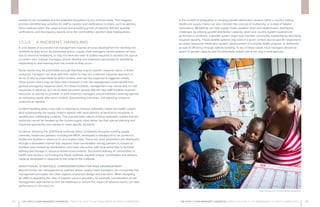
Photos courtesy of R. Hammond/Panos, Madagascar
187 188

JSI_Supply_Chain_Manager's_Handbook_Chpt.12_Final.pdf

  • 1.
    THE SUPPLY CHAINMANAGER’S HANDBOOK A PRACTICAL GUIDE TO THE MANAGEMENT OF HEALTH COMMODITIES THE SUPPLY CHAIN MANAGER’S HANDBOOK A PRACTICAL GUIDE TO THE MANAGEMENT OF HEALTH COMMODITIES SUPPLY CHAIN RISK MANAGEMENT WHAT A SUPPLY CHAIN MANAGER NEEDSTO KNOW: As detailed in this handbook, making health commodities available at the point of service delivery requires successful completion of numerous tasks. For developing country public health supply chains, there are many potential opportunities for the flow of commodities to be interrupted before they reach users and patients. Some of these potential failure points may be in direct control of the supply chain manager, while others may not be. However, active consideration and management of these risks to performance can help decrease the likelihood or impact of occurrence. To effectively manage risks to supply chain performance, a public health supply chain manager should understand the following: • The basic components of supply chain risk and why it’s important to actively manage • The benefits of supply chain risk management • How to identify, evaluate, and prioritize risks to your supply chain performance • How to identify approaches to manage, monitor, and respond to risk events • Other strategic applications of risk management CHAPTER 12 12 12 FIGURE 11-1. THE LOGISTICS CYCLE Serving Customers Inventory Strategy Quantification Warehousing & Distribution Procurement THE LOGISTICS CYCLE Product Selection Management Support Functions System Design & Strategy Logistics Management Information Systems (LMIS) Performance Management Organizational Capacity and Workforce Financing Risk Management Photo courtesy of IAPHL 177 178
  • 2.
    THE SUPPLY CHAINMANAGER’S HANDBOOK A PRACTICAL GUIDE TO THE MANAGEMENT OF HEALTH COMMODITIES THE SUPPLY CHAIN MANAGER’S HANDBOOK A PRACTICAL GUIDE TO THE MANAGEMENT OF HEALTH COMMODITIES 12 12 IS MORE THAN: IT INCLUDES: ‘Fire-fighting’ problems as they arise Ongoing preemptive identification and preparation for adverse events Preparing for natural disasters Preparing for all sources of internal dysfunction and external disruptions Identifying risks that can be directly controlled Identifying and managing risks across the supply chain 12.1 RISK MANAGEMENT BASICS TABLE 12-1. COMMON CONCEPTIONSVS. BEST PRACTICE IN SUPPLY CHAIN RISK MANAGEMENT FORMAL SUPPLY CHAIN RISK MANAGEMENT In the context of a supply chain, a risk represents any threat to the achievement of performance goals. For example, if a program defined a certain level of product availability as a primary supply chain performance goal, leakage of commodities during transport would prevent the achievement of that goal. Some managers might simply wait for a problem like this to occur and subsequently decide how to react. However, active risk management involves preemptively identifying the potential problem, then identifying and executing an approach to limit the likelihood and impact of the leakage. Potentially, a manager could develop a process for confirming proof of delivery and include penalties for product loss in the transport provider’s contract. Risks can be found in any logistics function, at any level of a country healthcare system, and both within the country healthcare system and among global upstream suppliers. Flooding or a fire at the sole manufacturer of a pharmaceutical, for example, could greatly disrupt timely international shipments. Risks can also come from the national political and economic context as well as the natural environment. Risks can also affect successful completion of projects and interventions. Timely implementation of an electronic LMIS, for example, will depend on many teams performing their roles successfully, and having planning in place to handle potential adverse developments. Risk management is a formal approach to identifying and addressing sources of disruption and dysfunction within a public health supply chain. Table 12-1 below compares common conceptions of risk management against best practice: 12.2 BENEFITS OF RISK MANAGEMENT Risk management helps supply chain managers devote management capacity where it’s needed most. The process provides an objective sense of the relative sources of disruption and dysfunction for your supply chain performance in a way that helps management address them to the best of their abilities. Instead of constantly responding to crisis after crisis (sometimes referred to as “fire-fighting”), managers who implement formal risk management are able to avoid many damaging problems in the first place, or at least have well-defined response protocols, freeing them to devote more effort to day-to-day operations. Avoiding incidents and reducing the impact of disruptive events leads directly to supply chain improvement. Fewer disruptions means fewer stockouts at the point of service delivery, fewer commodities wasted through exposure to adverse temperatures or expiry, and lower operating costs for expedited or emergency shipments. For example, in 2009, JSI, via the USAID | DELIVER PROJECT, identified key risks to the security of donated malaria treatments in a southern African country. To respond to these risks at the airport cargo terminal and the central warehouse, the Project developed a new procedure with transparent security mechanisms before introducing an additional approach of having international suppliers pre-package deliveries to provincial (sub-national) warehouses and immediately dispatch these shipments after in-country arrival. The implementation of these solutions to identified risks led to reduced delivery operating costs, shortened delivery lead time to provincial stores, and decreased incidence of theft. In general, supply chain managers who implement formal risk management approaches can expect to see direct improvements in targeted operations, reduced costs, improved management focus, and increased customer and stakeholder confidence in the supply chain. Photo courtesy of IAPHL 179 180
  • 3.
    THE SUPPLY CHAINMANAGER’S HANDBOOK A PRACTICAL GUIDE TO THE MANAGEMENT OF HEALTH COMMODITIES THE SUPPLY CHAIN MANAGER’S HANDBOOK A PRACTICAL GUIDE TO THE MANAGEMENT OF HEALTH COMMODITIES 12.3 RISK MANAGEMENT AS A FORMAL PROCESS FOR PUBLIC HEALTH SUPPLY CHAIN MANAGERS Supply chain managers should conduct the following four-phase approach to implement risk management as a process in their context: FIGURE 12-2. SUPPLY CHAIN RISK MANAGEMENT PROCESS SUPPLY CHAIN RISK MANAGEMENT PROCESS 1. RISK ASSESSMENT 2. RISK PLANNING 3. RISK MONITORING 4. INCIDENT HANDLING • Set performance objectives and identify relevant stakeholders • With stakeholders, identify sources of risk • Determine likelihood and impact of risk events • Prioritize risks for management attention • Identify response strategies • Review sources of information for monitoring indicators • Collect and monitor information as needed • Form a quick-response team • Develop specific general contingency plans • Document lessons learned DEFINE THE CONTEXT Managers should first determine the scope and context of their risk management efforts, for example: whether the program will apply to all logistics functions or only one, or whether the program will support ongoing operations or a specific project implementation. Determining the scope will help identify the specific performance objectives to be supported by the program as well as the stakeholders that should be included to provide technical input and leadership support throughout the process. For example, a manager in Country X has been tasked with leading the development and implementation of a new national electronic LMIS. She decides to apply a risk management approach to help ensure that the system meets its implementation target of being operational in 95% of health facilities by the end of the calendar year. After considering the possible major areas for sources of disruption to the project, the manager decides to include stakeholders from all system levels, with a geographic representation, and key managers responsible for software development, hardware procurement, and server management to help contribute to the risk management process. IDENTIFY SOURCES OF RISK AND DETERMINE LIKELIHOOD AND IMPACT OF RISK EVENTS These stakeholders should then convene for a workshop event or working meeting to develop the initial framework of the risk management process. The objective of this facilitated discussion should identify the primary risks for management attention and, in the longer term, the group should reconvene to review progress and update the risk management framework as needed. The stakeholders should first work towards enumerating the potential risk events which could threaten the main performance objectives. As mentioned above, stakeholders should look internally within the commodity pipeline (including upstream and international suppliers), among the stakeholders that directly support the supply chain (such as commodity or program funders), and at the broader environment for political unrest or natural disasters. Because these areas represent a broad and potentially limitless supply of risks, stakeholders should be encouraged to begin in this phase with risks that have at least some likelihood of occurrence within the next several years with the understanding that the risk management plan will be periodically reviewed and updated. Alternatively, the list of risks for consideration can be developed in advance of the workshop event to focus participants’ time on the following tasks. Once the list of potential risks is developed, stakeholders should review each and agree on a numerical score quantifying: • The likelihood that the risk event can occur • The impact that the occurrence of the risk event would have as compared to the stated objectives These are the two primary characteristics of identified risk events that will help managers prioritize the risks for management attention. For example, consider the following two risks: 12.3.1 STEP 1: RISK ASSESSMENT 12 12 Photos courtesy of IAPHL 181 182
  • 4.
    THE SUPPLY CHAINMANAGER’S HANDBOOK A PRACTICAL GUIDE TO THE MANAGEMENT OF HEALTH COMMODITIES THE SUPPLY CHAIN MANAGER’S HANDBOOK A PRACTICAL GUIDE TO THE MANAGEMENT OF HEALTH COMMODITIES • A server or network connectivity outage occurs • A major theft of commodities occurs within the national pipeline After discussion, stakeholders might consider server outage to have a high likelihood and high impact on their system, while they might consider theft to have a low to moderate likelihood of occurrence and high impact. In this instance, supply chain managers would have guidance to prioritize and manage these two risks differently. To facilitate this process, managers should apply a clear, consistent scale when considering these aspects of identified risks. The following two tables present examples of potential quantitative scales for this task: TABLE 12-2. EXAMPLE OF SCALE INTERPRETATIONS FOR IMPACT OF RISK EVENTS SCALE RESPONSE INTERPRETATION 1 Less than three days of supply chain operations disruption 2 From four days to one week of supply chain operations disruption 3 More than one week to one month of supply chain operations disruption 4 More than one month of supply chain operations disruption TABLE 12-3. EXAMPLE OF SCALE INTERPRETATIONS FOR LIKELIHOOD OF RISK EVENTS SCALE RESPONSE INTERPRETATION 1 Once during every five years 2 Once every 3–5 years 3 Once every 1–3 years 4 Once a year or more often Using this example scale would allow managers to generate a single quantitative score of 1 to 16 by multiplying the two values, where higher numbers represent more significant threats to performance, thereby providing a single index to reflect the overall threat of each risk event. 12.3.2 STEP 2: RISKTREATMENT With a consensus-approved list of relevant risk events and an evaluation of their relative likelihood and impact, managers can begin to identify the appropriate strategies to manage each of the risks. First, managers and stakeholders should jointly prioritize the list of risk events for management attention and use this prioritization to order the risks to be addressed in the following tasks. IDENTIFYTHE RISKTREATMENT APPROACHES For each risk identified, supply chain managers have four general response approaches to consider: ACCEPTING RISK – deciding that the risk likelihood and impact are low enough to not warrant management attention for the time being, or that there is no way for local partners to manage the risk. This serves as a deliberate decision by management, and may still require monitoring and response planning should the risk occur (see below). AVOIDING RISK – implementing approaches to reduce the likelihood of risk occurrence. This may involve changing the design of your supply chain in order to avoid a potential risk altogether, or choosing approaches that involve inherently less risk. REDUCING RISK – implementing approaches that reduce the impact of risk occurrence. Managers can achieve this by creating higher levels of visibility in the system to respond to problems faster, or instituting greater flexibility in processes to give managers more capacity to deal with problems when they emerge. HEDGING RISK – implementing approaches that offset the impact of a risk occurrence should it occur. A common approach to hedging supply chain risks is to create functional redundancy – by increasing safety stock or instituting additional suppliers, so that if one channel experiences a problem, another can absorb capacity. Insurance is another common form of risk hedging. 12 12 183 184
  • 5.
    THE SUPPLY CHAINMANAGER’S HANDBOOK A PRACTICAL GUIDE TO THE MANAGEMENT OF HEALTH COMMODITIES THE SUPPLY CHAIN MANAGER’S HANDBOOK A PRACTICAL GUIDE TO THE MANAGEMENT OF HEALTH COMMODITIES TABLE 12-4. EXAMPLE SOLUTIONS FOR RISKSTO COMMODITY AVAILABILITY ATTHE SERVICE DELIVERY POINT RESPONSE APPROACH EXAMPLE RISK EXAMPLE SOLUTION ACCEPTING RISK Unanticipated civil strife disrupts commodity distribution Accept risk due to lack of direct control, develop general response protocol AVOIDING RISK Products exposed to high temperatures at district level Redesign delivery system to bypass district level Products expire in country pipeline Request products with longer shelf life Frequent breakdowns of owned delivery vehicles Outsource delivery operations to private contractor REDUCING RISK Highly unpredictable demand leads to over- or under-forecasting Negotiate variable-quantity framework contracts with suppliers Unpredictable demand causes stock imbalances between sites Provide managers with central visibility into stock levels, facilitate stock transfer process Fraud by internal staff leads to financial or inventory theft Periodic internal and external auditing HEDGING RISK Key product supplier suffers manufacturing delays Identify and develop relationship with backup supplier Seasonal rains cause increased demand and decreased accessibility Pre-emptively overstock affected sites Fire destroys commodity inventory and warehouse infrastructure Purchase fire insurance Table 12-4 below compares several common public health supply chain risks with example solutions in each of the main risk management approaches: Aside from the likelihood and impact of a risk event, additional factors to consider when identifying response strategies include: • The degree to which supply chain managers have control over the source of the risk – a higher degree of control implies that processes can be changed to reduce likelihood, while lower control implies that only the impact of the risk can be managed • The degree to which the risk event is a product of the network design of the supply chain – if risks are caused specifically by the design or structure of the supply chain, these should be addressed directly to avoid the risk entirely • The degree to which the risk event is a product of operational decision-making – if risks are driven by daily decision-making then solutions should focus on training, monitoring, or process design improvement to reduce the likelihood of the risk From this evaluated list of supply chain risks with stakeholder-approved strategies, managers will then need to delegate interventions to specific staff, create timelines for implementation, identify relevant monitoring metrics, and create necessary response protocols (see below). 12.3.3 STEP 3. RISK MONITORING Once strategies are selected for identified risks, managers must identify mechanisms to monitor those risks. Many of these metrics can come from existing performance monitoring systems for the supply chain, while others may have to be inferred from other sources or be created for the risk management process specifically. These metrics can serve to measure progress within the risk management plan to demonstrate its effectiveness over time, while others can serve to complement risk reduction strategies: identifying leading metrics that provide quick or advance notice of impending problems can give managers additional time to address or respond to the problems. For example, an immediate alert about a potential disease outbreak can give supply chain managers time to mobilize necessary resources to provide health care workers with needed commodities. Similarly, early notification about a problem at a commodity manufacturer can give procurement staff time to secure additional inventory or procurement capacity at a different supplier. Beyond simply identifying relevant metrics, risk monitoring requires that supply chain managers identify staff to actually monitor the metric in question as well as the communication channels to spread awareness of pending problems. For example, from 2008 to 2015, to facilitate the delivery and in-country distribution of malaria treatments and rapid diagnostic test in Angola, JSI, via the USAID | DELIVER PROJECT, and partners mapped out the planning, arrival, and distribution processes in terms of the tasks that Please note that these example solutions specifically serve to illustrate the different strategies behind risk management solutions, and are by no means exhaustive for the example risks or proscriptive for a specific context. For insight on specific solutions relevant to your context, please review the other chapters in this guide book and refer to local stakeholders with technical experience, such as those included as stakeholders to the risk management process. 12 12 185 186
  • 6.
    THE SUPPLY CHAINMANAGER’S HANDBOOK A PRACTICAL GUIDE TO THE MANAGEMENT OF HEALTH COMMODITIES THE SUPPLY CHAIN MANAGER’S HANDBOOK A PRACTICAL GUIDE TO THE MANAGEMENT OF HEALTH COMMODITIES needed to be completed and the potential disruptions to any of those tasks. This mapping process identified key activities for staff to monitor and notifications to share, such as alerting donor partners when the cargo arrived and providing proofs of delivery, delivery quantity verifications, and discrepancy reports once the commodities reached state headquarters. 12.3.4 4. INCIDENT HANDLING A core aspect of successful risk management requires process development for handling risk incidents as they occur. As mentioned above, supply chain managers cannot address all risks due to resource limitations, or may not have the level of control required to address the source of certain risks. Instead, managers should develop and implement processes for identifying, responding to, and learning from risk events as they occur. Some events may be predictable enough that they require specific response plans. In these instances, managers can work with their teams to map out a relevant response approach in terms of who is responsible for which actions, and how the response is triggered initially. Other events which may not have been foreseen in the risk management could benefit from general emergency response plans. For these incidents, management may not be able to craft responses in advance, but can at least document actions that will help staff mobilize required resources as quickly as possible. In both instances managers should institute a learning agenda by reviewing results after each incident, documenting outcomes, and adjusting response protocols as needed. Incident handling plays a key role in response to disease outbreaks, where the health system (and subsequently the supply chain) is tasked with rapid delivery of services to recipients in variable and challenging contexts. The unpredictable nature of these outbreaks implies that the response cannot be handled by the routine supply chain alone, but that special planning and response approaches are needed to meet specific demands. In Liberia, following the 2013 Ebola outbreak which completely disrupted existing supply channels, healthcare partners including the MOH, developed a standard kit to be pushed to healthcare facilities in absence of consumption data. These kits were assembled and distributed through a dedicated channel that required close coordination among partners to ensure no facilities were missed by distributions, and close interaction with local authorities to facilitate delivery and storage in resource-limited environments. Successful delivery of commodities to health care workers confronting the Ebola outbreak required unique coordination and delivery capacity developed in response to the onset of the outbreak. ADDITIONAL STRATEGIC CONSIDERATIONS FOR RISK MANAGEMENT Beyond formal risk management as outlined above, supply chain managers can incorporate risk management principles into other aspects of process design and execution. When designing an LMIS or regulating the roles of logistics service providers, for example, consideration of risk management approaches to limit the likelihood or reduce the impact of adverse events can help performance in the long run. In the context of integrating or merging parallel distribution streams within a country setting, healthcare supply chains can also consider the concept of multiplicity, or a state of helpful redundancy. Multiplicity can help supply chains weather short and medium-term distribution challenges by utilizing parallel distribution capacity: when one country system experiences performance problems, a parallel system might help maintain commodity availability by absorbing required capacity. These parallel systems may exist in a given context due to specific response to an under-resourced distribution system, advancement of a priority health program, or deliberate pursuit of efficiency through options-building. In any of these cases, local managers should be aware of parallel capacity and the potentially helpful role it can play in emergencies. 12 12 Photos courtesy of R. Hammond/Panos, Madagascar 187 188