MODULE 11
CONTROL AND CONTROL SYSTEMS
“What gets measured happens”
• What is important to know
about the control process?
•What are some organizational
control systems and techniques?
CONTROL AND CONTROL SYSTEMS
Control Systems
Controlling is one of the four management
functions.
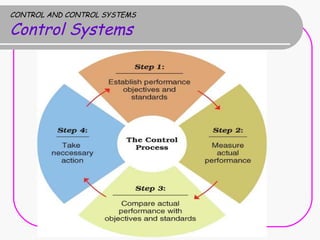
Control begins with objectives and standards.
Control measures actual performance.
Control compares results with objectives and
standards.
Control takes corrective action as needed.
Control focuses on work inputs, throughputs, and
outputs.
CONTROL AND CONTROL SYSTEMS
Control Systems
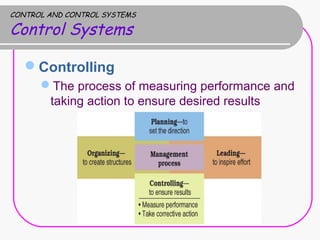
Controlling
The process of measuring performance and
taking action to ensure desired results
CONTROL AND CONTROL SYSTEMS
Control Systems
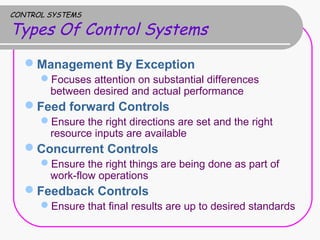
CONTROL SYSTEMS
Types Of Control Systems
Management By Exception
Focuses attention on substantial differences
between desired and actual performance
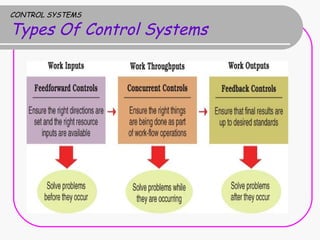
Feed forward Controls
Ensure the right directions are set and the right
resource inputs are available
Concurrent Controls
Ensure the right things are being done as part of
work-flow operations
Feedback Controls
Ensure that final results are up to desired standards
CONTROL SYSTEMS
Types Of Control Systems
ORGANIZATIONAL CONTROL SYSTEMS AND TECHNIQUES
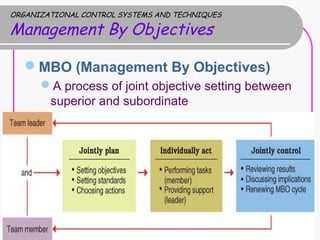
Management By Objectives
MBO (Management By Objectives)
A process of joint objective setting between
superior and subordinate
ORGANIZATIONAL CONTROL SYSTEMS AND TECHNIQUES
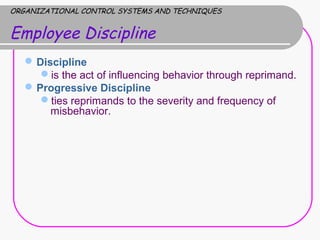
Employee Discipline
Discipline
is the act of influencing behavior through reprimand.
Progressive Discipline
ties reprimands to the severity and frequency of
misbehavior.
ORGANIZATIONAL CONTROL SYSTEMS AND TECHNIQUES
Quality Control
Total Quality Management (TQM)
commits to quality objectives, continuous
improvement, and doing things right the first time.
Quality Circle
is a small group that meets regularly to discuss
ways of improving work quality.
ORGANIZATIONAL CONTROL SYSTEMS AND TECHNIQUES
Purchasing And Inventory Controls
Purchasing Control
buying what is needed at right quality, price, and on-time.
Supply Chain Management
uses information technology to link suppliers and
purchasers in cost efficient ways.
Inventory Control
ensures that inventory is only big enough to meet
immediate needs.
Economic Order Quantity
places new orders when inventory levels fall to
predetermined points.
Just-in-time Scheduling
routes materials to workstations just in time for use.
ORGANIZATIONAL CONTROL SYSTEMS AND TECHNIQUES
Breakeven Analysis
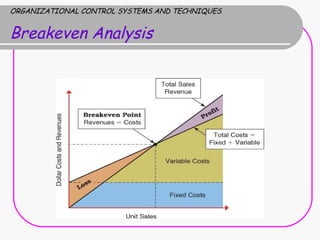
Breakeven Point
is the point at which revenues equal costs
Breakeven Analysis
calculates the point at which sales revenues
cover costs.
How to Calculate a Breakeven Point
Breakeven Point = Fixed Costs / (Price - Variable Costs)
ORGANIZATIONAL CONTROL SYSTEMS AND TECHNIQUES
Breakeven Analysis

Controlling, types, techniques, process as a Management Function

  • 1.
    MODULE 11 CONTROL ANDCONTROL SYSTEMS “What gets measured happens” • What is important to know about the control process? •What are some organizational control systems and techniques?
  • 2.
    CONTROL AND CONTROLSYSTEMS Control Systems Controlling is one of the four management functions. Control begins with objectives and standards. Control measures actual performance. Control compares results with objectives and standards. Control takes corrective action as needed. Control focuses on work inputs, throughputs, and outputs.
  • 3.
    CONTROL AND CONTROLSYSTEMS Control Systems Controlling The process of measuring performance and taking action to ensure desired results
  • 4.
    CONTROL AND CONTROLSYSTEMS Control Systems
  • 5.
    CONTROL SYSTEMS Types OfControl Systems Management By Exception Focuses attention on substantial differences between desired and actual performance Feed forward Controls Ensure the right directions are set and the right resource inputs are available Concurrent Controls Ensure the right things are being done as part of work-flow operations Feedback Controls Ensure that final results are up to desired standards
  • 6.
    CONTROL SYSTEMS Types OfControl Systems
  • 7.
    ORGANIZATIONAL CONTROL SYSTEMSAND TECHNIQUES Management By Objectives MBO (Management By Objectives) A process of joint objective setting between superior and subordinate
  • 8.
    ORGANIZATIONAL CONTROL SYSTEMSAND TECHNIQUES Employee Discipline Discipline is the act of influencing behavior through reprimand. Progressive Discipline ties reprimands to the severity and frequency of misbehavior.
  • 9.
    ORGANIZATIONAL CONTROL SYSTEMSAND TECHNIQUES Quality Control Total Quality Management (TQM) commits to quality objectives, continuous improvement, and doing things right the first time. Quality Circle is a small group that meets regularly to discuss ways of improving work quality.
  • 10.
    ORGANIZATIONAL CONTROL SYSTEMSAND TECHNIQUES Purchasing And Inventory Controls Purchasing Control buying what is needed at right quality, price, and on-time. Supply Chain Management uses information technology to link suppliers and purchasers in cost efficient ways. Inventory Control ensures that inventory is only big enough to meet immediate needs. Economic Order Quantity places new orders when inventory levels fall to predetermined points. Just-in-time Scheduling routes materials to workstations just in time for use.
  • 11.
    ORGANIZATIONAL CONTROL SYSTEMSAND TECHNIQUES Breakeven Analysis Breakeven Point is the point at which revenues equal costs Breakeven Analysis calculates the point at which sales revenues cover costs. How to Calculate a Breakeven Point Breakeven Point = Fixed Costs / (Price - Variable Costs)
  • 12.
    ORGANIZATIONAL CONTROL SYSTEMSAND TECHNIQUES Breakeven Analysis

Editor's Notes

  • #2 Another similar common expression is “People will behave the way you measure them.”
  • #3 Controlling is the last of the four management functions. It is intended to allow management to see if things are going according to plan.
  • #4 The sooner you can take corrective action, the easier it will be to correct the problem.
  • #5 Input standards include material, labor and overhead in the form of administrative and operating costs.
  • #6 There is also the principal of Management By Sufficiency. It focuses on large important items even if they are on track.
  • #7 As previously mentioned, it is usually a whole lot less expensive to solve problems before they occur.
  • #8 It is important to have regular (monthly) reviews. Once or twice a year is not enough to stay on track.
  • #9 Discipline is necessary but it has to be done properly to avoid legal problems. If you have any doubts about how to do it, have an HR person with you.
  • #10 TQM applies to the entire organization. It is not limited to manufacturing.
  • #11 These are all tools used by operations managers to run efficient and effective production lines.
  • #12 Fixed costs include all costs that do not normally vary with the amount of product being produced.
  • #13 It is important to include one time “start up” costs in the calculation. These are costs that occur once at the beginning of operations. They are not fixed or variable costs.