Hospital Pharmacy
Prepared By:
Mr. Pankaj U. Valvi,
Lecturer
Smt. S.S. Patil Institute of Technology (D.Pharmacy), Chopda
1
Outline:
 Definition of Hospital pharmacy
 Functions of Hospital pharmacy
 Objectives of Hospital pharmacy
 Location and layout of Hospital pharmacy
 Flow chart of materials and men
 Personnel and floor space requirements
 Requirement and Abilities required for Hospital
Pharmacist
2
Definition:
 Department of hospital which deals with
procurement, storage, compounding, dispensing,
manufacturing, testing, packaging and distribution
of drugs.
 It is also concerned with education and research in
pharmaceutical services.
 Hospital Pharmacy is controlled by a professionally
competent and a qualified pharmacist.
3
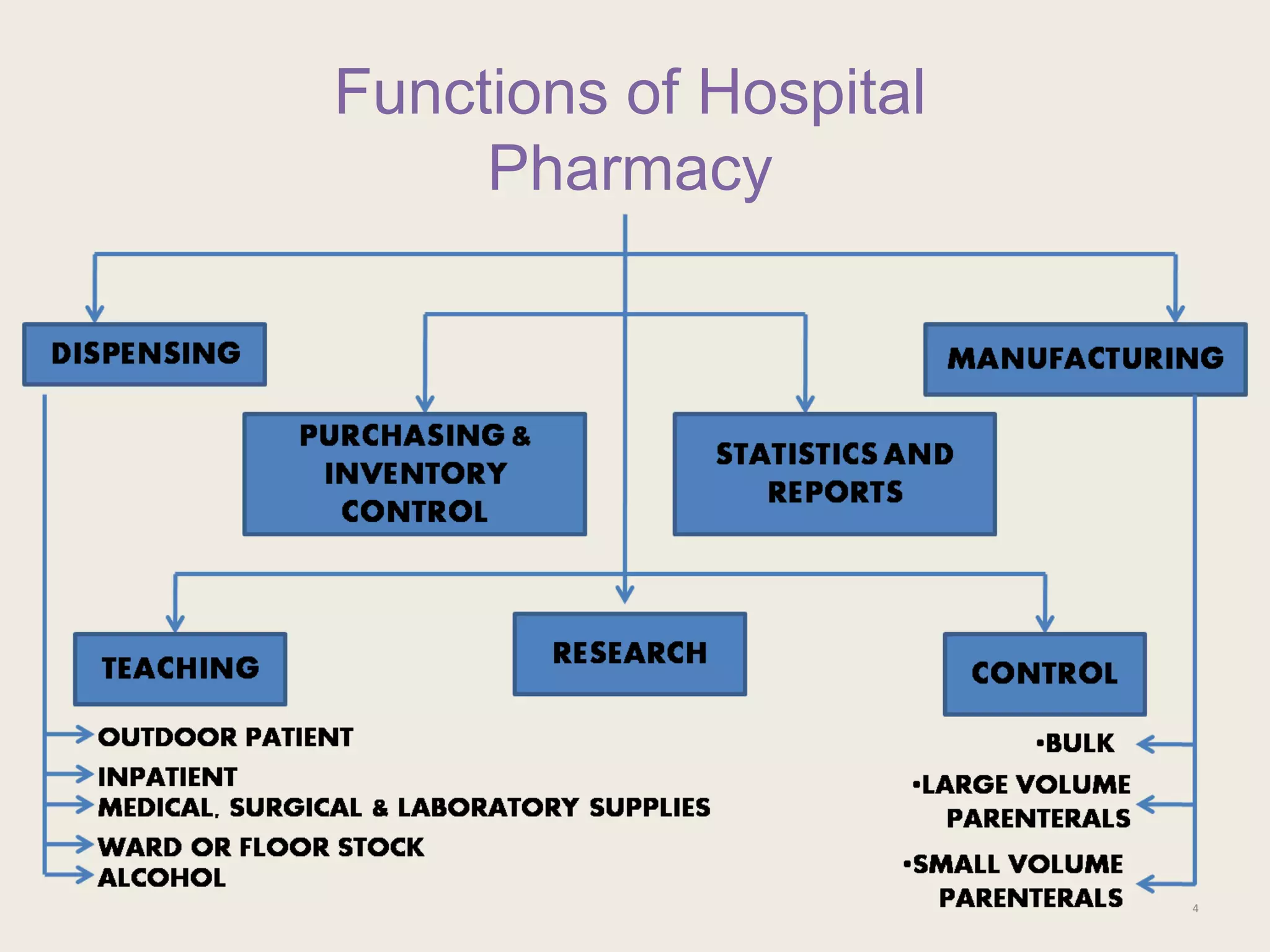
Functions of Hospital
Pharmacy
4
Functions of Hospital Pharmacy:
1. Provide specifications for the purchase of drugs,
chemicals, biological etc.
2. Proper storing of drugs.
3. Manufacturing and distribution of medicaments
such as transfusion fluids, parenteral products,
tablets, capsules, ointments, and stock mixtures.
4. Dispensing and sterilizing parenteral preparations
which are manufactured in hospital.
5. Dispensing of drugs as per the prescriptions of the
medical staff of the hospital.
5
6. Filling and labelling of all drug containers from
which medicines are to be administered.
7. Management of stores which includes purchase of
drugs, proper storage conditions, and maintenance
of records.
8. Establishment and maintenance of “Drug
Information Centre”.
9. Providing co-operation in teaching and research
programmes.
10. Discarding the expired drugs and containers worn
and missing labels.
6
Objectives of Hospital Pharmacy:
1. To ensure the availability of right medication, at
right time, in the right dose at the minimum possible
cost.
2. To professionalize the functioning of pharmaceutical
services in a hospital.
3. To act as a counseling department for medical staff,
nurses and for patient.
4. To act as a data bank on drug utilization.
5. To participate in research projects.
7
6. To implement decisions of the pharmacy and
therapeutics committee.
7. To co-ordinate and co-operate with other
departments of a hospital.
8. To plan, organize and implement pharmacy policy
procedures in keeping with established policies of
the hospitals.
8
Location of Hospital Pharmacy:
1. Located in hospital premises so that patients and
staff can easily approach it.
2. In multi-storeyed building of a hospital, the
pharmacy should be preferably located on ground
floor especially the dispensing unit.
3. It should be laid in such a way that there is a
continuous flow of men and materials.
9
10
Floor Space Requirements
1. [Refer table on previous slide]
2. Floors of pharmacy should be smooth, easily
washable and acid resistant.
3. In manufacturing sections, drains should be
provided, walls should be smooth, painted in light
color.
4. Wooden cabinets should be laminated.
5. Fluorescent lamps should be placed above
prescription counter.
6. Counter for Bunsen burner are also required.
11
12
Flow Charts for
Materials and Men
13
14
General Flow Chart for Materials
General Flow Chart for Outpatients
General Flow Chart for Inpatients
17
General Flow Chart for Men
Requirements for personnel in a
Hospital Pharmacy:
1. Director of pharmacy should be a graduate in
pharmacy or bachelor of science with at least 1 yr
experience in hospital pharmacy
2. He should have adequate number of assistants who
are licensed pharmacists to supply highest quality of
p’ceutical services.
18
Personnel Required for Hospital
Pharmacy:
1. Director of pharmacy
2. One or more assistant directors of pharmacy
3. Staff pharmacists
4. Residents
5. Personnel trained in non-professional function and
clerical help
19
Director of pharmacy should have-
–Completed 3 yrs course
–If he does not B.S. degree then should have 5 yrs exp. in
hospital pharmacy
–If he is D. Pharm and does not have B.S. degree then he
should have 10 yrs exp. in hospital pharmacy
The director of pharmacy recommends the selection
and discharge of employees in the pharmacy
He is also responsible for preparing the rules for
employees and their enforcement
Licensed pharmacist should be present in pharmacy
24x7
20
Facilities Required In Hospital
Pharmacy:
1. In smaller hospitals, with one pharmacist only, one
room is required for pharmacy, having a combination
of dispensing, manufacturing, administrative and all
other sections of complete pharmaceutical service.
2. For sterile products there should be a separate room
or area.
3. In large hospitals, with 200 or more beds,
departmentalization of pharmacy activities is
required.
21
4. A separate area is required for :-
 Inpatient services and unit dose dispensing
 Outpatient service
 An office for the chief pharmacist
 A compounding room
 Prepacking and labelling room
 A store room
 Sterile products room
5. A separate area for drug information services and
space assigned on various nursing units for unit dose
drug administration.
6. A modern pharmaceutical library should be
maintained with official books , journals, text and
reference books.
22
7. Adequate locking arrangement for storage of
narcotics, alcohol
8. Proper lighting and ventilation
9. Refrigerator for thermolabile products
23
Equipments Required In Hospital
Pharmacy:
1. Prescription case
2. Drug stock cabinets with proper shelves and drawers.
3. Sectional drawer cabinets with cupboards bases.
4. Work tables and counters for routine dispensing.
5. Cabinet to store mortar and pestles.
6. Cabinet for glass utensils, flasks, funnels and beakers.
7. Refrigerator of suitable capacity.
8. Narcotics safe with individually locked drawers.
9. Office desk with telephone connection and file cabinet.
10. Dispensing window for nurses and outpatients.
24
• Generally, equipments required are of two types:
1.Fixed equipment:
– Can not be moved
– Require installation
– Fixed to building
– Ex. Cabinets, counters, elevators and sinks
2.Movable equipment:
– Can be moved
– Not permanently fixed to building
– Ex. Desks, carts etc.
25
26
27
Qualifications of Hospital Pharmacist:
 Graduate or PG in pharmacy with license or
 Should have completed hospital pharmacy training
program
28
29
30
Pharmacist Requirement on the Basis
of Bed Strength
Bed Strength
No. of Pharmacist
Required
Upto 50 Beds 3
Upto 100 Beds 5
Upto 200 Beds 8
Upto 300 Beds 10
Upto 500 Beds 15
Responsibilities of Hospital Pharmacist:
A.Inpatient Pharmacy Department:
I.Dispensing Area:
1. Policies
2. Accuracy
3. Maintenance of records
4. Storage
5. Working
6. Co-ordination
7. Drug information
31
32
II. Patient Care Area:
1. Co-ordination
2. Communication
3. Technical
4. Supervisory
III.Direct Patient Care:
1. Patient Medication History
2. Drugs Identification
3. Patient Monitoring
4. Patient Counseling
5. Selection Of Drug
IV.General Responsibilities
33
B. Outpatient Pharmacy Department:
I.In Dispensing Area:
1. Maintenance of Records
2. Co-ordination
3. Assures Proper Personnel
4. Neatly Maintenance
5. Professional Competence Maintenance
II. Inpatient Care Area:
1. Inspection
2. Patient monitoring and counseling
3. Selection of drug therapy, dose regimen and schedule
4. Medication history and drug identification
III.General Responsibilities:
1. Co-ordination
2. Drug information
3. Control
4. Education
Abilities Required of Hospital
Pharmacist:
1.Administrative & Managerial Ability:
– Co-ordinating pharmacy activities
– Preparing pharmacy policies
– Budgeting, stock control and maintenance of records
– Communication with other staff
– training and development of pharmacy personnel
– Keeping records of pharmacy funds
2.Manufacturing Ability:
– Develop and conduct p’ceutical mfg. program
– Provide drugs at low cost by mfg in bulk quantities
34
3.Perfect Knowledge of:
a) Drugs and its actions
b) Control of Drugs
 Quality control of drugs
 Control on distribution of drugs
4.Research Ability: Perform p’ceutical research on drugs-
– To improve its usefulness
– To develop methods for preservation and stability
– To improve therapeutic effectiveness and taste
– To develop the various bases and vehicles for improving, the
absorption of active ingredients from internal and external
preparations
35
5.Teaching Ability:
Deliver lectures and demonstrations for the nursing staff on-
– Methods of storage of drugs
– Drug usage
– Various dosage form
– Mathematical calculations involving percentage solutions
and dose calculation
– Prescription writing
– Drug stability and incompatibilities
He must carry out training program for trainee and staff
pharmacists
36
The End
37

hospital-pharmacy (1).pdf

  • 1.
    Hospital Pharmacy Prepared By: Mr.Pankaj U. Valvi, Lecturer Smt. S.S. Patil Institute of Technology (D.Pharmacy), Chopda 1
  • 2.
    Outline:  Definition ofHospital pharmacy  Functions of Hospital pharmacy  Objectives of Hospital pharmacy  Location and layout of Hospital pharmacy  Flow chart of materials and men  Personnel and floor space requirements  Requirement and Abilities required for Hospital Pharmacist 2
  • 3.
    Definition:  Department ofhospital which deals with procurement, storage, compounding, dispensing, manufacturing, testing, packaging and distribution of drugs.  It is also concerned with education and research in pharmaceutical services.  Hospital Pharmacy is controlled by a professionally competent and a qualified pharmacist. 3
  • 4.
  • 5.
    Functions of HospitalPharmacy: 1. Provide specifications for the purchase of drugs, chemicals, biological etc. 2. Proper storing of drugs. 3. Manufacturing and distribution of medicaments such as transfusion fluids, parenteral products, tablets, capsules, ointments, and stock mixtures. 4. Dispensing and sterilizing parenteral preparations which are manufactured in hospital. 5. Dispensing of drugs as per the prescriptions of the medical staff of the hospital. 5
  • 6.
    6. Filling andlabelling of all drug containers from which medicines are to be administered. 7. Management of stores which includes purchase of drugs, proper storage conditions, and maintenance of records. 8. Establishment and maintenance of “Drug Information Centre”. 9. Providing co-operation in teaching and research programmes. 10. Discarding the expired drugs and containers worn and missing labels. 6
  • 7.
    Objectives of HospitalPharmacy: 1. To ensure the availability of right medication, at right time, in the right dose at the minimum possible cost. 2. To professionalize the functioning of pharmaceutical services in a hospital. 3. To act as a counseling department for medical staff, nurses and for patient. 4. To act as a data bank on drug utilization. 5. To participate in research projects. 7
  • 8.
    6. To implementdecisions of the pharmacy and therapeutics committee. 7. To co-ordinate and co-operate with other departments of a hospital. 8. To plan, organize and implement pharmacy policy procedures in keeping with established policies of the hospitals. 8
  • 9.
    Location of HospitalPharmacy: 1. Located in hospital premises so that patients and staff can easily approach it. 2. In multi-storeyed building of a hospital, the pharmacy should be preferably located on ground floor especially the dispensing unit. 3. It should be laid in such a way that there is a continuous flow of men and materials. 9
  • 10.
  • 11.
    Floor Space Requirements 1.[Refer table on previous slide] 2. Floors of pharmacy should be smooth, easily washable and acid resistant. 3. In manufacturing sections, drains should be provided, walls should be smooth, painted in light color. 4. Wooden cabinets should be laminated. 5. Fluorescent lamps should be placed above prescription counter. 6. Counter for Bunsen burner are also required. 11
  • 12.
  • 13.
  • 14.
    14 General Flow Chartfor Materials
  • 15.
    General Flow Chartfor Outpatients
  • 16.
    General Flow Chartfor Inpatients
  • 17.
  • 18.
    Requirements for personnelin a Hospital Pharmacy: 1. Director of pharmacy should be a graduate in pharmacy or bachelor of science with at least 1 yr experience in hospital pharmacy 2. He should have adequate number of assistants who are licensed pharmacists to supply highest quality of p’ceutical services. 18
  • 19.
    Personnel Required forHospital Pharmacy: 1. Director of pharmacy 2. One or more assistant directors of pharmacy 3. Staff pharmacists 4. Residents 5. Personnel trained in non-professional function and clerical help 19
  • 20.
    Director of pharmacyshould have- –Completed 3 yrs course –If he does not B.S. degree then should have 5 yrs exp. in hospital pharmacy –If he is D. Pharm and does not have B.S. degree then he should have 10 yrs exp. in hospital pharmacy The director of pharmacy recommends the selection and discharge of employees in the pharmacy He is also responsible for preparing the rules for employees and their enforcement Licensed pharmacist should be present in pharmacy 24x7 20
  • 21.
    Facilities Required InHospital Pharmacy: 1. In smaller hospitals, with one pharmacist only, one room is required for pharmacy, having a combination of dispensing, manufacturing, administrative and all other sections of complete pharmaceutical service. 2. For sterile products there should be a separate room or area. 3. In large hospitals, with 200 or more beds, departmentalization of pharmacy activities is required. 21
  • 22.
    4. A separatearea is required for :-  Inpatient services and unit dose dispensing  Outpatient service  An office for the chief pharmacist  A compounding room  Prepacking and labelling room  A store room  Sterile products room 5. A separate area for drug information services and space assigned on various nursing units for unit dose drug administration. 6. A modern pharmaceutical library should be maintained with official books , journals, text and reference books. 22
  • 23.
    7. Adequate lockingarrangement for storage of narcotics, alcohol 8. Proper lighting and ventilation 9. Refrigerator for thermolabile products 23
  • 24.
    Equipments Required InHospital Pharmacy: 1. Prescription case 2. Drug stock cabinets with proper shelves and drawers. 3. Sectional drawer cabinets with cupboards bases. 4. Work tables and counters for routine dispensing. 5. Cabinet to store mortar and pestles. 6. Cabinet for glass utensils, flasks, funnels and beakers. 7. Refrigerator of suitable capacity. 8. Narcotics safe with individually locked drawers. 9. Office desk with telephone connection and file cabinet. 10. Dispensing window for nurses and outpatients. 24
  • 25.
    • Generally, equipmentsrequired are of two types: 1.Fixed equipment: – Can not be moved – Require installation – Fixed to building – Ex. Cabinets, counters, elevators and sinks 2.Movable equipment: – Can be moved – Not permanently fixed to building – Ex. Desks, carts etc. 25
  • 26.
  • 27.
  • 28.
    Qualifications of HospitalPharmacist:  Graduate or PG in pharmacy with license or  Should have completed hospital pharmacy training program 28
  • 29.
  • 30.
    30 Pharmacist Requirement onthe Basis of Bed Strength Bed Strength No. of Pharmacist Required Upto 50 Beds 3 Upto 100 Beds 5 Upto 200 Beds 8 Upto 300 Beds 10 Upto 500 Beds 15
  • 31.
    Responsibilities of HospitalPharmacist: A.Inpatient Pharmacy Department: I.Dispensing Area: 1. Policies 2. Accuracy 3. Maintenance of records 4. Storage 5. Working 6. Co-ordination 7. Drug information 31
  • 32.
    32 II. Patient CareArea: 1. Co-ordination 2. Communication 3. Technical 4. Supervisory III.Direct Patient Care: 1. Patient Medication History 2. Drugs Identification 3. Patient Monitoring 4. Patient Counseling 5. Selection Of Drug IV.General Responsibilities
  • 33.
    33 B. Outpatient PharmacyDepartment: I.In Dispensing Area: 1. Maintenance of Records 2. Co-ordination 3. Assures Proper Personnel 4. Neatly Maintenance 5. Professional Competence Maintenance II. Inpatient Care Area: 1. Inspection 2. Patient monitoring and counseling 3. Selection of drug therapy, dose regimen and schedule 4. Medication history and drug identification III.General Responsibilities: 1. Co-ordination 2. Drug information 3. Control 4. Education
  • 34.
    Abilities Required ofHospital Pharmacist: 1.Administrative & Managerial Ability: – Co-ordinating pharmacy activities – Preparing pharmacy policies – Budgeting, stock control and maintenance of records – Communication with other staff – training and development of pharmacy personnel – Keeping records of pharmacy funds 2.Manufacturing Ability: – Develop and conduct p’ceutical mfg. program – Provide drugs at low cost by mfg in bulk quantities 34
  • 35.
    3.Perfect Knowledge of: a)Drugs and its actions b) Control of Drugs  Quality control of drugs  Control on distribution of drugs 4.Research Ability: Perform p’ceutical research on drugs- – To improve its usefulness – To develop methods for preservation and stability – To improve therapeutic effectiveness and taste – To develop the various bases and vehicles for improving, the absorption of active ingredients from internal and external preparations 35
  • 36.
    5.Teaching Ability: Deliver lecturesand demonstrations for the nursing staff on- – Methods of storage of drugs – Drug usage – Various dosage form – Mathematical calculations involving percentage solutions and dose calculation – Prescription writing – Drug stability and incompatibilities He must carry out training program for trainee and staff pharmacists 36
  • 37.