Community Pharmacy
DEFINITION
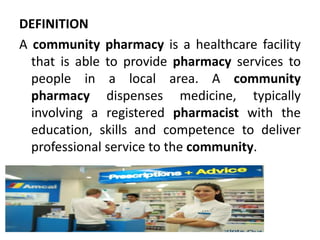
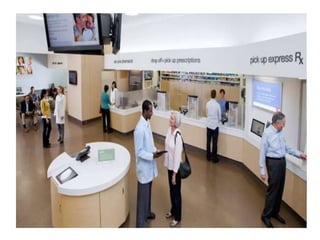
A community pharmacy is a healthcare facility
that is able to provide pharmacy services to
people in a local area. A community
pharmacy dispenses medicine, typically
involving a registered pharmacist with the
education, skills and competence to deliver
professional service to the community.
• Community pharmacists are the health professionals
most accessible to the public.
• They supply medicines in accordance with a prescription
or, when legally permitted, sell them without a
prescription.
• In addition to ensuring an accurate supply of
appropriate products, their professional activities also
cover
 counseling of patients at the time of dispensing of
prescription and non-prescription drugs,
 drug information to health professionals, patients and
the general public, and
 participation in health-promotion programmes.
• They maintain links with other health professionals in
primary health care.
SCOPE OF COMMUNITY PHARMACY
• steep rise in the field of medical and health
services due to introduction of various latest
techniques and globalization of medical profession
• Population of whole world is rising tremendously
day by day,
• medical and health services are insufficient for
overall improvement of health status
• there is a requirement of equal participation of all
health professionals to obtain a common goal of
disease prevention and health promotion
• Community pharmacist strives for most effective,
appropriate, safe and economic treatment of the
patient.
• Nowdays the scope of community pharmacy is
expanding to the following areas:
Informing health care professionals and the public
• Community Pharmacy compile and maintain
information on all medicines, and particularly on
newly introduced medicines, provide this
information as necessary to other health care
professionals and to patients.
Care of patients or Clinical pharmacy
The pharmacist seeks to
• collect and integrate information about the
patient’s drug history,
• clarify the patient’s understanding of the
intended dosage regimen and method of
administration, and
• advises the patient of drug-related
precautions, and in some countries, monitors
and evaluates the therapeutic response.
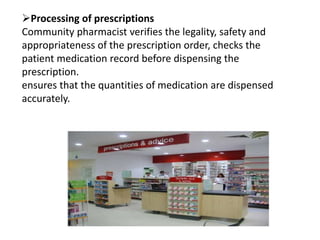
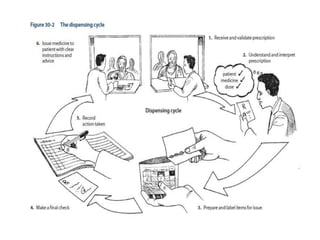
Processing of prescriptions
Community pharmacist verifies the legality, safety and
appropriateness of the prescription order, checks the
patient medication record before dispensing the
prescription.
ensures that the quantities of medication are dispensed
accurately.
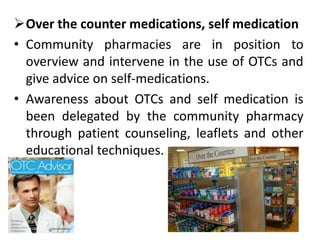
Over the counter medications, self medication
• Community pharmacies are in position to
overview and intervene in the use of OTCs and
give advice on self-medications.
• Awareness about OTCs and self medication is
been delegated by the community pharmacy
through patient counseling, leaflets and other
educational techniques.
Increasing demand in chronic care
• Chronic diseases such as asthma, diabetes,
cardiovascular diseases such as hypertension,
Chronic obstructive pulmonary disease (COPD)
needs long term medical and pharmaceutical
care.
• Community pharmacies can run various health
care programs, patients' disease / medication
education programs for its clients where in
patients will be benefited for their health.
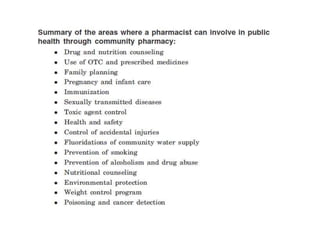
Health promotion
• Community pharmacist can take part in health
promotion campaigns, locally and nationally, on
a wide range of health-related topics, and
particularly on drug-related topics (e.g., rational
use of drugs, alcohol abuse, tobacco use,
discouragement of drug use during pregnancy,
organic solvent abuse, poison prevention) or
topics concerned with other health problems
(diarrheal diseases, tuberculosis, leprosy, HIV-
infection/AIDS) and family planning.
Drug selection
• Community pharmacy plays an important role
for appropriate selection of drugs which will
be given to patients to encounter disease. It
involves various type of activities:
• Adoption of essential drug concept
• Training of health professionals
• Maintenance of data based on clinical
guidelines
• Consumer education and regulatory
strategies.
 Lifestyle changes and pharmaceutical demands
• Economic growth and socio-structural changes in modern
Indian community have rapidly changed the life-style of
the community.
• Along with drugs for disease ailments, there is changing
trend in the population for use of life style drugs.
• There is increasing demands for therapies such as anti-
obesity drugs, anti-ageing cosmetic interventions,
erectile dysfunction disorders, anti-oxidants etc.
• increasing trend towards consumption of specialized
nutraceuticals such as isolated protein supplements and
dietary supplements.
• There needs special input from the community pharmacy
and pharmacist towards appropriate use of these
medications.
 Medical tourism
• Medical Tourism India, also known as Health Tourism India is
a developing concept whereby people from world over visit
India for their medical and related needs.
• India is encashing this opportunity by providing high level
medical services at as low as one tenth of price in developed
countries.
• An estimate suggests that the medical tourism could bring
between $1 billion and $2 billion US into the country by
2012 at a growth rate of 30 per cent a year.
• Considering this fact, there is extreme need for development
of community pharmacy and community pharmacy practices
in urban developments.
• Community pharmacy in India includes various systems of
the medicines such as allopathy, ayurveda, homeopathy and
other herbal therapies. Medical tourists may seek services
from these sectors in community pharmacy.
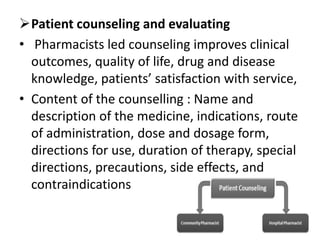
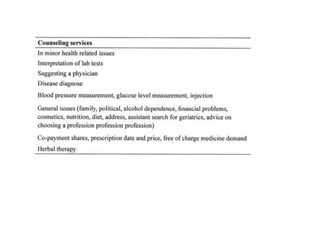
Patient counseling and evaluating
• Pharmacists led counseling improves clinical
outcomes, quality of life, drug and disease
knowledge, patients’ satisfaction with service,
• Content of the counselling : Name and
description of the medicine, indications, route
of administration, dose and dosage form,
directions for use, duration of therapy, special
directions, precautions, side effects, and
contraindications
Domiciliary services
In a number of countries, the pharmacist
provides an advisory as well as a supply
service to residential homes for the elderly,
and other long-term patients.
In some countries, policies are being developed
under which pharmacists will visit certain
categories of house-bound patients to provide
the counselling service that the patients
would have received had they been able to
visit the pharmacy.
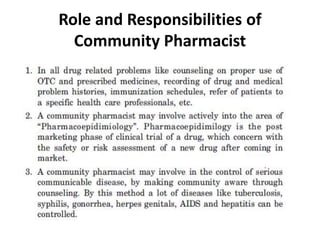
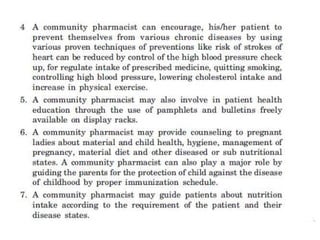
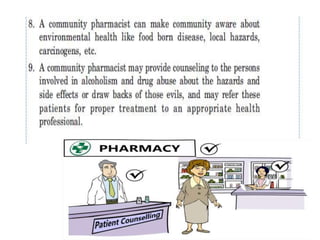
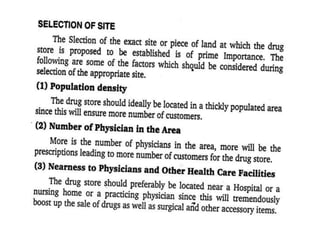
Role and Responsibilities of
Community Pharmacist
Legal Requirements for Pharmacy
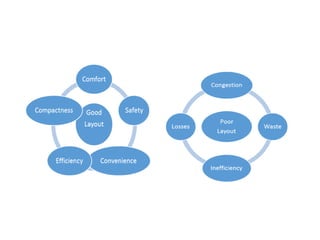
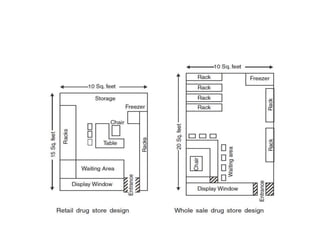
Layout
• A Pharmacy should fulfill all the requirements in Schedule N (Drug and
cosmetics Act 1940, Rules 1945) “List of minimum equipment for the
efficient running of Pharmacy’’.
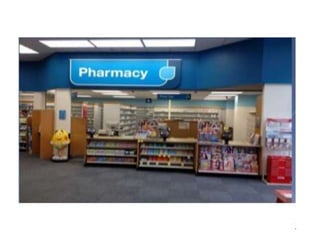
• The front of a pharmacy shall bear an inscription “Pharmacy” in front.
• The premises shall be well built, dry, well lit and ventilated and, of
sufficient dimensions.
• The areas of the dispensing department shall be not less than 6 square
meters for one pharmacist working therein with additional 2 square
meters for each additional pharmacist.
• The height of the premises shall be at least 2.5 meters.
• A Pharmacy shall be provided with apparatus and books necessary for
making of official preparations and prescriptions
• A pharmacy shall be conducted under the continuous personal
supervision of a Registered Pharmacist.
Functional Areas of Community
Pharmacy
• Space for incoming goods
• Reserve stock
• Office
• Counter for customers
• Resting rooms and toilets
• Telephone
• Flap door entrance for personnel
• Refrigerator
• Shelves for keeping medicines
• Waiting area
• Dispensing area
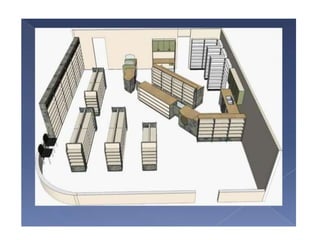
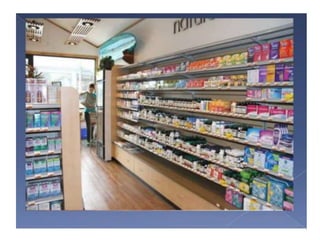
DESIGN FEATURES OF COMMUNITY PHARMACY
1. A community Pharmacy should be painted purely
white or with special light colors to reflect noble
nature of Pharmacy.
2. Illuminated by using tube lights
(neon/fluorescent).Lighting of bulbs should be
avoided.
3. All parts of store should be effective. There should
be no L shapes or hidden corners within.
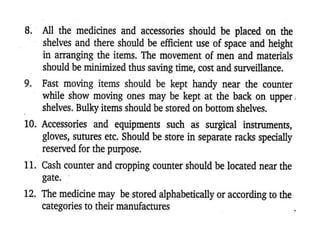
4. Cash counters and wrapping counter should be
near the gate.
5. Placement of nationally advertised non-
prescription/ OTC products near customer counter.
6. Prescription product should be arranged as
industry wise, disease wise or alphabetically
to facilitate their identification.
7. Provision of adequate number of bin and
shelves (wooden or steel)
8. Provision of fire extinguisher, generator,
computer, telephone
9. Heavy and bulky items should be stored as
low as possible.
STAFFING IN COMMUNITY
PHARMACY
• The process of hiring and developing the
required personnel
• to fill in various positions in the organization.
• It involves the
• scientific and systemic procurement, allocation,
utilization, conversation and development of
human resources.
• A registered pharmacist is eligible to establish
and run a community pharmacy.
• To become a registered pharmacist, the
individual must have passed Diploma in
pharmacy from recognized institution along
with 500 hrs training in a govt. hospital or B.
Pharm from a recognized institution.
• For starting whole sale pharmacy the
individual must be a diploma holder or B
Pharm or matriculation + 4 year experience in
handling the drugs.
• Manpower required for community pharmacy
• Registered pharmacist may be owner or
manager.
• Pharmacy technician and two counter
salesmen
• One clerk
• Two delivery boys
• One part time or full time accountant
• Driver of vehicle if any
MATERIAL CODING
• Coding is define as
• process of assigning a code number or code
symbol to a particular material for easy
identification.
• According to another definition “ codification
is a system of symbols designed to be applied
to a classified set of items”
Advantages of Coding
1. The long names and description of items need not
to be repeated every time.
2. Systematic grouping for correct identification of
similar items.
3.Avoids duplicate stocks of drugs
4.It helps in quick identification of items
5. The storing of materials, sorting and documentation
becomes easier.
6. It helps in inspection of materials
7. It helps in physical counting
8. It helps in accounting and costing
Methods of Codification
Alphabetical system:
• Alphabetical symbols or letters are used as
symbols or codes to identify an item.
• first alphabet of each name of the material is
the starting point of coding and subsequently
sub alphabets are also used.
• For tablet Code T and for capsule, code C is
used. For tablet Thiamine hydrochloride code
T-TH-HC and for raw material of Thiamine
hydrochloride TH-HC is used.
• This method is generally used for coding the
rack.
• Simple method
• It is not always easy to remember codes
• Lacks flexibility and expansion
• Chances of duplication
• Coding mistakes may occur due to repetition
of alphabets
Numerical system
• uses only numbers as codes of various materials
kept in the stores.
• items are divided into a number of groups and
each group is given a specific code.
• Further sub grouping is done on the basis of
classification of items falling in any group
according to its shape, size and function
• complete code of the item is written by
combining the main group code with the sub
code of that item.
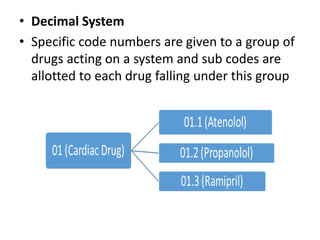
• Decimal System
• Specific code numbers are given to a group of
drugs acting on a system and sub codes are
allotted to each drug falling under this group
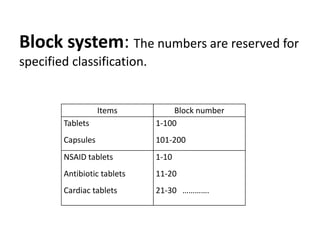
Block system: The numbers are reserved for
specified classification.
Items Block number
Tablets
Capsules
1-100
101-200
NSAID tablets
Antibiotic tablets
Cardiac tablets
1-10
11-20
21-30 ………….
• Alpha-numerical system/ Combination: In this
method, both alphabets and numerals are used
in the combined form to allot a code to different
items of the store.
• This method is used where store items are quite
large.
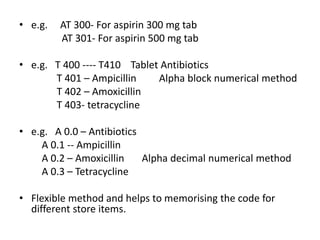
• e.g. AT 300- For aspirin 300 mg tab
AT 301- For aspirin 500 mg tab
• e.g. T 400 ---- T410 Tablet Antibiotics
T 401 – Ampicillin Alpha block numerical method
T 402 – Amoxicillin
T 403- tetracycline
• e.g. A 0.0 – Antibiotics
A 0.1 -- Ampicillin
A 0.2 – Amoxicillin Alpha decimal numerical method
A 0.3 – Tetracycline
• Flexible method and helps to memorising the code for
different store items.
• Location coding: In a large organization, there
are a large number of stores and each store
may be quite large in size.
• So the store room is divided into blocks.
Within each block every row is divided
vertically in columns and horizontally in
shelves.
• Each and every shelf is given a particular
number. The location of item can be identified
from block number; row number; column
number.
A. Fixed location: Each group of item is allotted a fixed
place inside store according to either
a) Supplier wise b) Item wise c) Utility
of item
B. Random location: Items are placed according to
availability of space in store at the time of receiving the
items. This method can be used when number of items
is less and store keeper is efficient in remembering the
location of each item.
C. Zonal location: Generally the whole inventory is
divided into 3 zones, namely
a) Bulk zone b) Reserve stock C) Consumable items
d) spare
Legal Requirements
• To run a Pharmacy the specific laws imposed
are:
1. Drug & Cosmetics act & rules (1940 & 1945)
2. Poison Act, 1919
3. Pharmacy Act 1948
4. Shop & establishment act (1948)
5. Dangerous drug act 1930
6. Prohibition and excise rules
• To establish a pharmacy following legal
requirements should be fulfilled:
Minimum academic qualification:
Registered Pharmacist
Should have attained at least 18 yrs of age
Should possess a degree/ diploma in pharmacy
Completed a training of 500 hrs in a medical
store, hospital pharmacy.
Minimum space
Minimum area of 10m2 for running a retail
store
Equipped with proper storage facility for
preserving properties of drug
Sufficient number of storage racks
areas of the dispensing department shall be
not less than 6 square meters for one
pharmacist working therein with additional 2
square meters for each additional pharmacist.
Application for grant of License
License for running a shop according to shop &
establishment act from labour office situated
at district place.
For the purpose of Sale
General License
Restricted License
• General license- are granted to person who
have premises for the business and who
engage the services of a qualified person to
supervise sale of drugs and do the
compounding and dispensing.
• Restricted License- granted to dealers/
persons in respect of drugs whose sale does
not require the supervision of a qualified
person.
• Any person desirous of getting a license to sell,
stock, exhibit or offer to sale/distribute drugs
should apply to Licensing authority along with
following:
 Application form 19/ 19B/19C (duly filled;
duplicate)
Additional information form, Identification forms
Original Challan receipt for required amount of fees
deposited
Attested copy of Pharmacy registration certificate,
Qualification certificate , training certificate,
Matriculation certificate(Proof of DOB)
Hand written declaration of Pharmacist
Bill of refrigerator
Partnership deed, Affidavit of Partners
Rent deed of proposed firm (If applicable)
Layout plan of Pharmacy duly signed by
proprietor
Legal documents of ownership
• Central sales tax, Income tax numbers can be
obtained from respective offices
• After scrutinizing application form & all
documents---- If satisfied----- Drug control
authority may issue license
• For wholesale- 20B/ 21B/20G
Condition of license
 shall be displayed at prominent place in part of
premises open to public
Licensee should comply with provisions of D &
C act.
No Physician’s sample or expired drugs will be
stocked on sale premises
Compounding of prescription would be done
under personal supervision of registered
pharmacist
Drugs should be purchased only from a duly
licensed dealer/ manufacturer
Any change in qualified staff in charge should
be reported by licensee to LA within 3 month
• Duration of license- An original license or a
renewed license to sell drugs, unless sooner
suspended or cancelled, shall be valid for a
period of five years on and from the date on
which it is granted or renewed.
• Renewal of license- application for renewal
may be put up before the expiry or within 6
months of expiry
MAINTENANCE OF VARIOUS REGISTERS IN
COMMUNITY PHARMACY
The various types of records in CP may be
classified as-
• Records regarding the acquisition and
disposition of drugs
• Records regarding patient utilization of drugs
• Records regarding the past and present
financial status of CP
• In Community Pharmacy, the community
pharmacist is responsible to maintain the
following types of records-
• Records related to sales and purchase of
drugs
• Patients records
• Financial records
Records related to sales and purchase
of drugs
1. Legal records
The pharmacy owner or manager is charged
with maintaining accurate & up to date records
on specific class of drugs and poisons.
acquisition and disposition of certain drugs that
are deemed to be subjected to possible misuse
or abuse.
maintain the proper records of poisons and
other hazards substances.
2. Records of purchase of drugs
Records related to purchase of all drugs whether
intended to be sold in retail or by whole sale
should maintained under the following
headings:
• Date of purchase
• Name, address, and license no of stockiest from
which drugs were purchased
• Name, quantities, and lot no. of drugs
• Name of manufacturer of drugs
• The owner of pharmacy is advised to kept
purchase bill in records
3. Records of sales of drugs
(a) Records of sales of drugs specified in schedule X
• The following particular should be mentioned in
the register:-
1. Date of purchase
2. Name and quantity of drug supplied
3. Manufacturer name and batch no or lot no
4. Name and address of the purchaser
5. Reference no of prescription against which the
supply of drug is made
6. Bill no etc.
• Schedule X is a class of prescription drugs in India
appearing as an appendix to the Drugs and
Cosmetics Rules introduced in 1945.
• These are drugs which cannot be purchased over
the counter without the prescription of a
qualified doctor.
• The retailer has to preserve the prescription for
a period of two years.
• Records of sales of drugs specified other than
schedule X
1. Serial no of entry
2. Date of supply
3. Name and address of the patient or in case of
veterinary use, the name of animal and name
& address of owner of animal
4. Name and quantities of the drugs supplied
5. The signature of the pharmacist under whose
supervision medicine was supplied etc
Patient records
• maintain the proper records of patient drug
history.
• This type of records are helpful to pharmacist in
following situations: -
1. to monitor the total drug usage by the patient
and his family
2. To reduce the problems associated with the
drugs interactions.
3. To find out the individual idiosyncrasies to the
drugs
Financial records
• Properly collected and organized accounting data
help the owner of pharmacy in the following
way: -
1. Making sound decision regarding the future cash
need, inventory requirements etc.
2. Evaluating the past operations, controlling the
current operations, and providing the
information regarding planning and forecasting.
3. Analyzing revenues and expenses.
4. Measuring the return on investment.
5. Helping to ensure a profitable operation.
OTC MEDICATIONS
• Drugs are substances intended for use in the
diagnosis, cure, mitigation, treatment or
prevention of disease. Drugs may be
Prescription and OTC drugs.
• OTC drugs also known as Non-Prescription
drugs (NPDs) are those medications which can
be obtained without a prescription of
Registered Medical Practitioner (RMP) and can
be easily purchased from pharmacies, grocery
stores, and convenience stores.
Criteria for OTC Designation
• Benefits of these drugs outweigh then risk
• Low toxicity and low risk of serious adverse
reactions
• Not to increase resistance
• Correct self-assessment of the condition
• No known incorrect use
• Risk to public health limited in case of misuse
• Drugs are usually approved as prescription
only first and just after they prove safe in
clinical use they are re-categorized as OTC
Merits of OTC
• Rapid access
• Fewer physician visits, lower healthcare
system costs
• Self reliant of patients
• No third party involvement i.e.
doctor/pharmacist
• Usually cheaper
Risks associated with OTC
• Poor patient compliance
• Misdiagnosis
• Difficult to study the drug’s effect
• Delay in obtaining needed therapy
• Drug resistance
• Increase cost due to side effects, adverse effects
• Failure to follow label instructions
• under dose / overdose
• Increased risk of drug-drug/drug-food/ herbal interactions
• Potential for misuse/ drug abuse/ addiction/ dependency
Reasons for consumptions of OTC
• Lack of time
• Self medication
• Lack of finance (poor socio-economic status)
• Used for short term illness
• Easily available
• Belief in self care practice
• Lack of accessibility of healthcare
• Advertisement and marketing
• fear of lab investigations
• lack of resources like availability of physician
• feeling that disease is simple enough to treat with
OTC medications
Labeling of OTC drugs
• Name of product’s active ingredients including the
amount in each dosage unit
• Purpose of the product
• Uses of the product
• Specific warning including when the product should not
be used under any circumstances and when it is
appropriate to consult the doctor.
• Dosage instructions- when, How, and how often to take
the product
• Product inactive ingredients, important information to
help the consumers avoid the ingredients that causes an
allergic reaction
• Directions
• Special precautions
• Other information’s like storage conditions
Guidelines for choosing & using OTC
• Make sure self diagnosis is accurate as possible.
• Do not assume
• Choose a product because ingredient are
appropriate for condition not because product
has a familiar brand name.
• Read label carefully to determine- correct
dose/direction/precautions
• Do not take more than recommended dose
• Keep the drug out of reach of Children
• Don’t use for long time.
Role of pharmacist
• Enquire whether the patient knows the correct use of medicine
• Get into conversation so that you can ask the patient to tell you the
symptoms for which he/ she wants the particular OTC medicines
• Enquire whether client is taking other medicines
• Enquire whether client is suffering from another illness/ conditions
• Assist the patient in selecting OTC medicine suitable to his/her
symptoms and also check that it is not contraindicated for his illness.
• Also check drug – drug interaction/ drug- food interaction
• Pharmacist can recommended ayruvedic medications or other
recognized system of medicine
• Can give the following information to patients
a. how to take the medicines
b. how much to take
c. for how long to take
d. any side effect/ adverse effect likely to occur
e. any other precautions
Patient counselling
• Evaluation: Pharmacist should evaluate, through the interview and
observation, the patient's physical complaint and/or symptoms
alongside medical condition
• Differentiation: Pharmacist must differentiate between self-treatable
conditions from those requiring the attention of the patient's health
care provider (i.e. a doctor).
• Obligation: Pharmacist’s obligation is to provide adequate advice and
counsel the patient on the proper course of action to be taken
• Assistance: Pharmacist can assist in product selection, taking into
account the prescription medicines the patient is already taking,
evaluate potential risk factors (i.e. contraindications, warnings,
precautions, age, organ function).
• Counsel the patient: Pharmacist can counsel the patient about proper
drug use (i.e. dosage, administration technique, monitoring parameters,
storage). A proper OTC pharmacist-patient encounter should be carried
out in four steps:
Step 1: Introduction
1. Every pharmacist should begin the OTC
counselling session by introducing
himself/herself by name and designation.
2. Pharmacist should try to relax the patient by
beginning the session with good oculesics (or
eye contact), a friendly smile and a handshake
3. The pharmacist should also explain that he/she
can provide assistance with OTC product
selection and explain how to use such
medication
Step 2: Collection of relevant information’s from
the patient:
Patient’s demographic (e.g. sex, age, pregnant,
nursing, weight, allergies, social history etc),
disease (e.g. history of present illness, current
symptoms, course of illness, past history, other
underlying medical conditions) and drug (e.g.
current medication, medication taking history,
OTC history etc.)
Step 3: Counselling: using suitable verbal and
written communication techniques, the
pharmacist should inform, educate, and counsel
patients.
Pharmacist can tell to patient-
• Drug name (generic and/or brand name);
• Route, dosage form.
• Dose and administration schedule
• Special directions for preparation and
administration as well as precautions to be taken
during the process
• Techniques for self-monitoring of drug therapy
• Storage conditions if any
• Potential drug-drug or drug-food interactions
• Other therapeutic contraindications and
accordingly other information particular to the
specific patient or drug
• Demonstrate to patients how to use
medications in various forms such as inhalers,
patches, drops, ointments, lozenges, gargles
• About side effect and adverse effect
• Step 4: Closing the counselling: Before closing
the pharmacist should ask the patient about
any doubt regarding therapy. If the session is
clear to patient or not. Pharmacist should
close the session with a smile.

Community pharmacy

  • 1.
  • 2.
    DEFINITION A community pharmacyis a healthcare facility that is able to provide pharmacy services to people in a local area. A community pharmacy dispenses medicine, typically involving a registered pharmacist with the education, skills and competence to deliver professional service to the community.
  • 4.
    • Community pharmacistsare the health professionals most accessible to the public. • They supply medicines in accordance with a prescription or, when legally permitted, sell them without a prescription. • In addition to ensuring an accurate supply of appropriate products, their professional activities also cover  counseling of patients at the time of dispensing of prescription and non-prescription drugs,  drug information to health professionals, patients and the general public, and  participation in health-promotion programmes. • They maintain links with other health professionals in primary health care.
  • 5.
    SCOPE OF COMMUNITYPHARMACY • steep rise in the field of medical and health services due to introduction of various latest techniques and globalization of medical profession • Population of whole world is rising tremendously day by day, • medical and health services are insufficient for overall improvement of health status • there is a requirement of equal participation of all health professionals to obtain a common goal of disease prevention and health promotion
  • 6.
    • Community pharmaciststrives for most effective, appropriate, safe and economic treatment of the patient. • Nowdays the scope of community pharmacy is expanding to the following areas: Informing health care professionals and the public • Community Pharmacy compile and maintain information on all medicines, and particularly on newly introduced medicines, provide this information as necessary to other health care professionals and to patients.
  • 7.
    Care of patientsor Clinical pharmacy The pharmacist seeks to • collect and integrate information about the patient’s drug history, • clarify the patient’s understanding of the intended dosage regimen and method of administration, and • advises the patient of drug-related precautions, and in some countries, monitors and evaluates the therapeutic response.
  • 8.
    Processing of prescriptions Communitypharmacist verifies the legality, safety and appropriateness of the prescription order, checks the patient medication record before dispensing the prescription. ensures that the quantities of medication are dispensed accurately.
  • 10.
    Over the countermedications, self medication • Community pharmacies are in position to overview and intervene in the use of OTCs and give advice on self-medications. • Awareness about OTCs and self medication is been delegated by the community pharmacy through patient counseling, leaflets and other educational techniques.
  • 11.
    Increasing demand inchronic care • Chronic diseases such as asthma, diabetes, cardiovascular diseases such as hypertension, Chronic obstructive pulmonary disease (COPD) needs long term medical and pharmaceutical care. • Community pharmacies can run various health care programs, patients' disease / medication education programs for its clients where in patients will be benefited for their health.
  • 12.
    Health promotion • Communitypharmacist can take part in health promotion campaigns, locally and nationally, on a wide range of health-related topics, and particularly on drug-related topics (e.g., rational use of drugs, alcohol abuse, tobacco use, discouragement of drug use during pregnancy, organic solvent abuse, poison prevention) or topics concerned with other health problems (diarrheal diseases, tuberculosis, leprosy, HIV- infection/AIDS) and family planning.
  • 13.
    Drug selection • Communitypharmacy plays an important role for appropriate selection of drugs which will be given to patients to encounter disease. It involves various type of activities: • Adoption of essential drug concept • Training of health professionals • Maintenance of data based on clinical guidelines • Consumer education and regulatory strategies.
  • 14.
     Lifestyle changesand pharmaceutical demands • Economic growth and socio-structural changes in modern Indian community have rapidly changed the life-style of the community. • Along with drugs for disease ailments, there is changing trend in the population for use of life style drugs. • There is increasing demands for therapies such as anti- obesity drugs, anti-ageing cosmetic interventions, erectile dysfunction disorders, anti-oxidants etc. • increasing trend towards consumption of specialized nutraceuticals such as isolated protein supplements and dietary supplements. • There needs special input from the community pharmacy and pharmacist towards appropriate use of these medications.
  • 15.
     Medical tourism •Medical Tourism India, also known as Health Tourism India is a developing concept whereby people from world over visit India for their medical and related needs. • India is encashing this opportunity by providing high level medical services at as low as one tenth of price in developed countries. • An estimate suggests that the medical tourism could bring between $1 billion and $2 billion US into the country by 2012 at a growth rate of 30 per cent a year. • Considering this fact, there is extreme need for development of community pharmacy and community pharmacy practices in urban developments. • Community pharmacy in India includes various systems of the medicines such as allopathy, ayurveda, homeopathy and other herbal therapies. Medical tourists may seek services from these sectors in community pharmacy.
  • 16.
    Patient counseling andevaluating • Pharmacists led counseling improves clinical outcomes, quality of life, drug and disease knowledge, patients’ satisfaction with service, • Content of the counselling : Name and description of the medicine, indications, route of administration, dose and dosage form, directions for use, duration of therapy, special directions, precautions, side effects, and contraindications
  • 18.
    Domiciliary services In anumber of countries, the pharmacist provides an advisory as well as a supply service to residential homes for the elderly, and other long-term patients. In some countries, policies are being developed under which pharmacists will visit certain categories of house-bound patients to provide the counselling service that the patients would have received had they been able to visit the pharmacy.
  • 20.
    Role and Responsibilitiesof Community Pharmacist
  • 29.
    Legal Requirements forPharmacy Layout • A Pharmacy should fulfill all the requirements in Schedule N (Drug and cosmetics Act 1940, Rules 1945) “List of minimum equipment for the efficient running of Pharmacy’’. • The front of a pharmacy shall bear an inscription “Pharmacy” in front. • The premises shall be well built, dry, well lit and ventilated and, of sufficient dimensions. • The areas of the dispensing department shall be not less than 6 square meters for one pharmacist working therein with additional 2 square meters for each additional pharmacist. • The height of the premises shall be at least 2.5 meters. • A Pharmacy shall be provided with apparatus and books necessary for making of official preparations and prescriptions • A pharmacy shall be conducted under the continuous personal supervision of a Registered Pharmacist.
  • 32.
    Functional Areas ofCommunity Pharmacy • Space for incoming goods • Reserve stock • Office • Counter for customers • Resting rooms and toilets • Telephone • Flap door entrance for personnel • Refrigerator • Shelves for keeping medicines • Waiting area • Dispensing area
  • 39.
    DESIGN FEATURES OFCOMMUNITY PHARMACY 1. A community Pharmacy should be painted purely white or with special light colors to reflect noble nature of Pharmacy. 2. Illuminated by using tube lights (neon/fluorescent).Lighting of bulbs should be avoided. 3. All parts of store should be effective. There should be no L shapes or hidden corners within. 4. Cash counters and wrapping counter should be near the gate. 5. Placement of nationally advertised non- prescription/ OTC products near customer counter.
  • 40.
    6. Prescription productshould be arranged as industry wise, disease wise or alphabetically to facilitate their identification. 7. Provision of adequate number of bin and shelves (wooden or steel) 8. Provision of fire extinguisher, generator, computer, telephone 9. Heavy and bulky items should be stored as low as possible.
  • 41.
    STAFFING IN COMMUNITY PHARMACY •The process of hiring and developing the required personnel • to fill in various positions in the organization. • It involves the • scientific and systemic procurement, allocation, utilization, conversation and development of human resources.
  • 42.
    • A registeredpharmacist is eligible to establish and run a community pharmacy. • To become a registered pharmacist, the individual must have passed Diploma in pharmacy from recognized institution along with 500 hrs training in a govt. hospital or B. Pharm from a recognized institution. • For starting whole sale pharmacy the individual must be a diploma holder or B Pharm or matriculation + 4 year experience in handling the drugs.
  • 43.
    • Manpower requiredfor community pharmacy • Registered pharmacist may be owner or manager. • Pharmacy technician and two counter salesmen • One clerk • Two delivery boys • One part time or full time accountant • Driver of vehicle if any
  • 44.
    MATERIAL CODING • Codingis define as • process of assigning a code number or code symbol to a particular material for easy identification. • According to another definition “ codification is a system of symbols designed to be applied to a classified set of items”
  • 45.
    Advantages of Coding 1.The long names and description of items need not to be repeated every time. 2. Systematic grouping for correct identification of similar items. 3.Avoids duplicate stocks of drugs 4.It helps in quick identification of items 5. The storing of materials, sorting and documentation becomes easier. 6. It helps in inspection of materials 7. It helps in physical counting 8. It helps in accounting and costing
  • 46.
    Methods of Codification Alphabeticalsystem: • Alphabetical symbols or letters are used as symbols or codes to identify an item. • first alphabet of each name of the material is the starting point of coding and subsequently sub alphabets are also used. • For tablet Code T and for capsule, code C is used. For tablet Thiamine hydrochloride code T-TH-HC and for raw material of Thiamine hydrochloride TH-HC is used.
  • 47.
    • This methodis generally used for coding the rack. • Simple method • It is not always easy to remember codes • Lacks flexibility and expansion • Chances of duplication • Coding mistakes may occur due to repetition of alphabets
  • 48.
    Numerical system • usesonly numbers as codes of various materials kept in the stores. • items are divided into a number of groups and each group is given a specific code. • Further sub grouping is done on the basis of classification of items falling in any group according to its shape, size and function • complete code of the item is written by combining the main group code with the sub code of that item.
  • 49.
    • Decimal System •Specific code numbers are given to a group of drugs acting on a system and sub codes are allotted to each drug falling under this group
  • 50.
    Block system: Thenumbers are reserved for specified classification. Items Block number Tablets Capsules 1-100 101-200 NSAID tablets Antibiotic tablets Cardiac tablets 1-10 11-20 21-30 ………….
  • 51.
    • Alpha-numerical system/Combination: In this method, both alphabets and numerals are used in the combined form to allot a code to different items of the store. • This method is used where store items are quite large.
  • 52.
    • e.g. AT300- For aspirin 300 mg tab AT 301- For aspirin 500 mg tab • e.g. T 400 ---- T410 Tablet Antibiotics T 401 – Ampicillin Alpha block numerical method T 402 – Amoxicillin T 403- tetracycline • e.g. A 0.0 – Antibiotics A 0.1 -- Ampicillin A 0.2 – Amoxicillin Alpha decimal numerical method A 0.3 – Tetracycline • Flexible method and helps to memorising the code for different store items.
  • 53.
    • Location coding:In a large organization, there are a large number of stores and each store may be quite large in size. • So the store room is divided into blocks. Within each block every row is divided vertically in columns and horizontally in shelves. • Each and every shelf is given a particular number. The location of item can be identified from block number; row number; column number.
  • 54.
    A. Fixed location:Each group of item is allotted a fixed place inside store according to either a) Supplier wise b) Item wise c) Utility of item B. Random location: Items are placed according to availability of space in store at the time of receiving the items. This method can be used when number of items is less and store keeper is efficient in remembering the location of each item. C. Zonal location: Generally the whole inventory is divided into 3 zones, namely a) Bulk zone b) Reserve stock C) Consumable items d) spare
  • 55.
    Legal Requirements • Torun a Pharmacy the specific laws imposed are: 1. Drug & Cosmetics act & rules (1940 & 1945) 2. Poison Act, 1919 3. Pharmacy Act 1948 4. Shop & establishment act (1948) 5. Dangerous drug act 1930 6. Prohibition and excise rules
  • 56.
    • To establisha pharmacy following legal requirements should be fulfilled: Minimum academic qualification: Registered Pharmacist Should have attained at least 18 yrs of age Should possess a degree/ diploma in pharmacy Completed a training of 500 hrs in a medical store, hospital pharmacy.
  • 57.
    Minimum space Minimum areaof 10m2 for running a retail store Equipped with proper storage facility for preserving properties of drug Sufficient number of storage racks areas of the dispensing department shall be not less than 6 square meters for one pharmacist working therein with additional 2 square meters for each additional pharmacist.
  • 58.
    Application for grantof License License for running a shop according to shop & establishment act from labour office situated at district place. For the purpose of Sale General License Restricted License
  • 59.
    • General license-are granted to person who have premises for the business and who engage the services of a qualified person to supervise sale of drugs and do the compounding and dispensing. • Restricted License- granted to dealers/ persons in respect of drugs whose sale does not require the supervision of a qualified person.
  • 60.
    • Any persondesirous of getting a license to sell, stock, exhibit or offer to sale/distribute drugs should apply to Licensing authority along with following:  Application form 19/ 19B/19C (duly filled; duplicate) Additional information form, Identification forms Original Challan receipt for required amount of fees deposited Attested copy of Pharmacy registration certificate, Qualification certificate , training certificate, Matriculation certificate(Proof of DOB)
  • 61.
    Hand written declarationof Pharmacist Bill of refrigerator Partnership deed, Affidavit of Partners Rent deed of proposed firm (If applicable) Layout plan of Pharmacy duly signed by proprietor Legal documents of ownership • Central sales tax, Income tax numbers can be obtained from respective offices
  • 62.
    • After scrutinizingapplication form & all documents---- If satisfied----- Drug control authority may issue license • For wholesale- 20B/ 21B/20G Condition of license  shall be displayed at prominent place in part of premises open to public Licensee should comply with provisions of D & C act.
  • 63.
    No Physician’s sampleor expired drugs will be stocked on sale premises Compounding of prescription would be done under personal supervision of registered pharmacist Drugs should be purchased only from a duly licensed dealer/ manufacturer Any change in qualified staff in charge should be reported by licensee to LA within 3 month
  • 64.
    • Duration oflicense- An original license or a renewed license to sell drugs, unless sooner suspended or cancelled, shall be valid for a period of five years on and from the date on which it is granted or renewed. • Renewal of license- application for renewal may be put up before the expiry or within 6 months of expiry
  • 65.
    MAINTENANCE OF VARIOUSREGISTERS IN COMMUNITY PHARMACY The various types of records in CP may be classified as- • Records regarding the acquisition and disposition of drugs • Records regarding patient utilization of drugs • Records regarding the past and present financial status of CP
  • 66.
    • In CommunityPharmacy, the community pharmacist is responsible to maintain the following types of records- • Records related to sales and purchase of drugs • Patients records • Financial records
  • 67.
    Records related tosales and purchase of drugs 1. Legal records The pharmacy owner or manager is charged with maintaining accurate & up to date records on specific class of drugs and poisons. acquisition and disposition of certain drugs that are deemed to be subjected to possible misuse or abuse. maintain the proper records of poisons and other hazards substances.
  • 68.
    2. Records ofpurchase of drugs Records related to purchase of all drugs whether intended to be sold in retail or by whole sale should maintained under the following headings: • Date of purchase • Name, address, and license no of stockiest from which drugs were purchased • Name, quantities, and lot no. of drugs • Name of manufacturer of drugs • The owner of pharmacy is advised to kept purchase bill in records
  • 69.
    3. Records ofsales of drugs (a) Records of sales of drugs specified in schedule X • The following particular should be mentioned in the register:- 1. Date of purchase 2. Name and quantity of drug supplied 3. Manufacturer name and batch no or lot no 4. Name and address of the purchaser 5. Reference no of prescription against which the supply of drug is made 6. Bill no etc.
  • 70.
    • Schedule Xis a class of prescription drugs in India appearing as an appendix to the Drugs and Cosmetics Rules introduced in 1945. • These are drugs which cannot be purchased over the counter without the prescription of a qualified doctor. • The retailer has to preserve the prescription for a period of two years.
  • 71.
    • Records ofsales of drugs specified other than schedule X 1. Serial no of entry 2. Date of supply 3. Name and address of the patient or in case of veterinary use, the name of animal and name & address of owner of animal 4. Name and quantities of the drugs supplied 5. The signature of the pharmacist under whose supervision medicine was supplied etc
  • 72.
    Patient records • maintainthe proper records of patient drug history. • This type of records are helpful to pharmacist in following situations: - 1. to monitor the total drug usage by the patient and his family 2. To reduce the problems associated with the drugs interactions. 3. To find out the individual idiosyncrasies to the drugs
  • 73.
    Financial records • Properlycollected and organized accounting data help the owner of pharmacy in the following way: - 1. Making sound decision regarding the future cash need, inventory requirements etc. 2. Evaluating the past operations, controlling the current operations, and providing the information regarding planning and forecasting. 3. Analyzing revenues and expenses. 4. Measuring the return on investment. 5. Helping to ensure a profitable operation.
  • 74.
    OTC MEDICATIONS • Drugsare substances intended for use in the diagnosis, cure, mitigation, treatment or prevention of disease. Drugs may be Prescription and OTC drugs. • OTC drugs also known as Non-Prescription drugs (NPDs) are those medications which can be obtained without a prescription of Registered Medical Practitioner (RMP) and can be easily purchased from pharmacies, grocery stores, and convenience stores.
  • 75.
    Criteria for OTCDesignation • Benefits of these drugs outweigh then risk • Low toxicity and low risk of serious adverse reactions • Not to increase resistance • Correct self-assessment of the condition • No known incorrect use • Risk to public health limited in case of misuse • Drugs are usually approved as prescription only first and just after they prove safe in clinical use they are re-categorized as OTC
  • 76.
    Merits of OTC •Rapid access • Fewer physician visits, lower healthcare system costs • Self reliant of patients • No third party involvement i.e. doctor/pharmacist • Usually cheaper
  • 77.
    Risks associated withOTC • Poor patient compliance • Misdiagnosis • Difficult to study the drug’s effect • Delay in obtaining needed therapy • Drug resistance • Increase cost due to side effects, adverse effects • Failure to follow label instructions • under dose / overdose • Increased risk of drug-drug/drug-food/ herbal interactions • Potential for misuse/ drug abuse/ addiction/ dependency
  • 78.
    Reasons for consumptionsof OTC • Lack of time • Self medication • Lack of finance (poor socio-economic status) • Used for short term illness • Easily available • Belief in self care practice • Lack of accessibility of healthcare • Advertisement and marketing • fear of lab investigations • lack of resources like availability of physician • feeling that disease is simple enough to treat with OTC medications
  • 79.
    Labeling of OTCdrugs • Name of product’s active ingredients including the amount in each dosage unit • Purpose of the product • Uses of the product • Specific warning including when the product should not be used under any circumstances and when it is appropriate to consult the doctor. • Dosage instructions- when, How, and how often to take the product • Product inactive ingredients, important information to help the consumers avoid the ingredients that causes an allergic reaction • Directions • Special precautions • Other information’s like storage conditions
  • 80.
    Guidelines for choosing& using OTC • Make sure self diagnosis is accurate as possible. • Do not assume • Choose a product because ingredient are appropriate for condition not because product has a familiar brand name. • Read label carefully to determine- correct dose/direction/precautions • Do not take more than recommended dose • Keep the drug out of reach of Children • Don’t use for long time.
  • 81.
    Role of pharmacist •Enquire whether the patient knows the correct use of medicine • Get into conversation so that you can ask the patient to tell you the symptoms for which he/ she wants the particular OTC medicines • Enquire whether client is taking other medicines • Enquire whether client is suffering from another illness/ conditions • Assist the patient in selecting OTC medicine suitable to his/her symptoms and also check that it is not contraindicated for his illness. • Also check drug – drug interaction/ drug- food interaction • Pharmacist can recommended ayruvedic medications or other recognized system of medicine • Can give the following information to patients a. how to take the medicines b. how much to take c. for how long to take d. any side effect/ adverse effect likely to occur e. any other precautions
  • 82.
    Patient counselling • Evaluation:Pharmacist should evaluate, through the interview and observation, the patient's physical complaint and/or symptoms alongside medical condition • Differentiation: Pharmacist must differentiate between self-treatable conditions from those requiring the attention of the patient's health care provider (i.e. a doctor). • Obligation: Pharmacist’s obligation is to provide adequate advice and counsel the patient on the proper course of action to be taken • Assistance: Pharmacist can assist in product selection, taking into account the prescription medicines the patient is already taking, evaluate potential risk factors (i.e. contraindications, warnings, precautions, age, organ function). • Counsel the patient: Pharmacist can counsel the patient about proper drug use (i.e. dosage, administration technique, monitoring parameters, storage). A proper OTC pharmacist-patient encounter should be carried out in four steps:
  • 83.
    Step 1: Introduction 1.Every pharmacist should begin the OTC counselling session by introducing himself/herself by name and designation. 2. Pharmacist should try to relax the patient by beginning the session with good oculesics (or eye contact), a friendly smile and a handshake 3. The pharmacist should also explain that he/she can provide assistance with OTC product selection and explain how to use such medication
  • 84.
    Step 2: Collectionof relevant information’s from the patient: Patient’s demographic (e.g. sex, age, pregnant, nursing, weight, allergies, social history etc), disease (e.g. history of present illness, current symptoms, course of illness, past history, other underlying medical conditions) and drug (e.g. current medication, medication taking history, OTC history etc.)
  • 85.
    Step 3: Counselling:using suitable verbal and written communication techniques, the pharmacist should inform, educate, and counsel patients. Pharmacist can tell to patient- • Drug name (generic and/or brand name); • Route, dosage form. • Dose and administration schedule • Special directions for preparation and administration as well as precautions to be taken during the process • Techniques for self-monitoring of drug therapy • Storage conditions if any • Potential drug-drug or drug-food interactions
  • 86.
    • Other therapeuticcontraindications and accordingly other information particular to the specific patient or drug • Demonstrate to patients how to use medications in various forms such as inhalers, patches, drops, ointments, lozenges, gargles • About side effect and adverse effect
  • 87.
    • Step 4:Closing the counselling: Before closing the pharmacist should ask the patient about any doubt regarding therapy. If the session is clear to patient or not. Pharmacist should close the session with a smile.