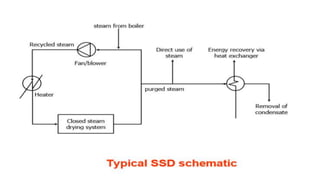
SUPERHEATED STEAM DRYING (SSD)
DEPARTMENT OF AGRICULTURE AND FOOD ENGINEERING
NAME- DEVESH KUMAR (19AG63R15)
M.TECH (FOOD PROCESS ENGINEERING)
OUTLINE
• Introduction to Superheated Steam Drying (SSD)
• Basic principles
• Classification and selection of SSD
• Selected applications of SSD and case studies
• Closure
SUPERHEATED STEAM DRYING (SSD)
Proposed over 100 years ago; received serious attention only during
the past 20-30 years
Uses superheated steam instead of hot air or combustion/flue gases
in a direct (convection) dryer
More complex equipment than hot-air drying system; leak proofing
needed; feed/discharge can be difficult
Lower net energy consumption (if exhausted steam can be used
elsewhere in the process and not charged to dryer)
Better product quality (in most cases);Safe operation, no
fire/explosion hazard; no oxidation
SUPERHEATED STEAM DRYER (Contd)
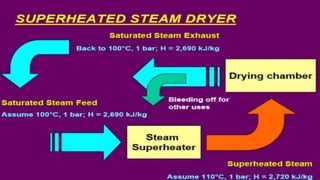
If steam pressure is kept constant and more energy is added, its
temperature increases and saturated steam becomes superheated
steam (SHS)
If extra heat can be transferred to an available heat sink, SHS returns
to saturated conditions
Any convection dryer can be made into SHSD e.g. fluidized bed, flash,
rotary, conveyor type, spray, impinging jet; opposing jets (impinging
streams) etc. Additional heat sources e.g. radiation, conduction, MW
etc. can also be added
Low, near-atmospheric or high pressure operation possible
SOME ADVANTAGES OF SSD
Dryer exhaust is steam so it is possible to recover all latent heat
supplied to SSD-some cost involved in equipment and operation
No oxidative reactions possible due to lack of O2 Color and some
nutrients are better preserved in food
Higher drying rates possible in both CRP and FRP depending on steam
temperature (above the so-called inversion temperature SSD is faster
than air drying)not a decisive factor for selection
Toxic or organic liquids can be recovered easily-by condensation
SOME ADVANTAGES OF SSD
Casehardened skin is unlikely to form in SSD mechanism not known-
product dependent
SSD yields higher product porosity due to evolution of steam within
the product ; boiling in interior opens up elastic wet solid-bulk density
is thus lower and rehydration behavior is better; also affects color
Sterilization, deodorization or other heat treatments (e.g. blanching,
boiling, cooking) can be performed simultaneously with drying
SOME DISADVANTAGES OF SSD
• SSD system is more complex than its hot-air counterpart
•Initial condensation is inevitable -more time may be required
to dry the product –if feed comes below saturation
temperature
•Products that may melt, undergo glass transition or be
damaged at saturation temperature of steam cannot be dried
in SSD (hence can be dried in a low pressure SHSD)
•Limited industrial experience with SSD
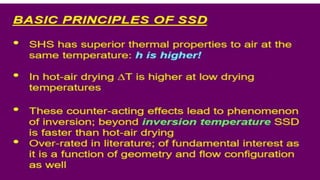
BASIC PRINCIPLES OF SSD
FRP drying rate of SSD is sometimes higher than that of hot air -
mechanisms responsible are different, however, Vapor transfer is
faster than liquid diffusion
FRP drying rate of SSD is sometimes higher than air drying rate since
product temperature is higher. Casehardening is unlikely to form and
product is likely to be more porous as well
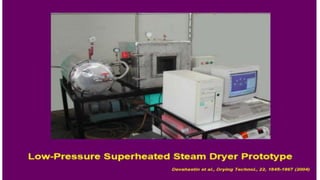
LOW-PRESSURE SSD (LPSSD)
• Combines the ability to dry product at low
temperature with some advantages of SSD
•Dryer is operated at reduced pressure (5-10 kPa)
•Steam becomes saturated (and superheated) at lower
temperature
•Suitable for highly heat-sensitive products e.g. herbs,
fruits and vegetables and other bio-active materials
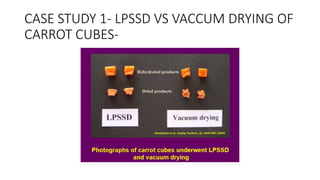
CASE STUDY 1- LPSSD VS VACCUM DRYING OF
CARROT CUBES-
CASE STUDY 2- BEET PULP
Drying of pressed beet pulp after extraction of
sugar
•Operates at pressure ~ 5 bar
•Consumes 50% less energy than conventional air
dryer
•Product quality i.e. appearance, texture,
digestability by cattle is better than air drying
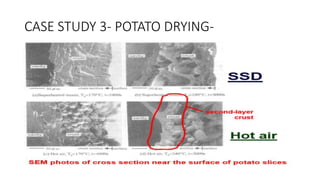
CASE STUDY 3- POTATO DRYING-
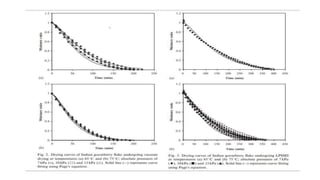
INDIAN GOOSEBERRY BY LPSSD-
MANGO
CUBES
LPSSD
DRYING
Physical Properties of Edible Chitosan Films BY
LPSSD VS VD
• LPSSD dried film was less darker and less yellower than the
VD film.
• the maximum value for tensile strength was observed in the
case of LPSSD at 70°C and storage condition of 53% RH. This
might be due to the effects of higher degree of crystallinity
and thermal cross-linkage that occurred more at this
condition.
• Film dried by LPSSD at 70°C and storage condition of 53% RH
was 11% lighter than VD.
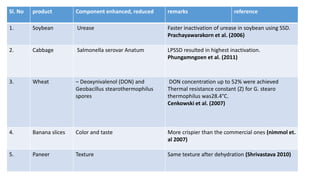
Sl. No product Component enhanced, reduced remarks reference
1. Soybean Urease Faster inactivation of urease in soybean using SSD.
Prachayawarakorn et al. (2006)
2. Cabbage Salmonella serovar Anatum LPSSD resulted in highest inactivation.
Phungamngoen et al. (2011)
3. Wheat – Deoxynivalenol (DON) and
Geobacillus stearothermophilus
spores
DON concentration up to 52% were achieved
Thermal resistance constant (Z) for G. stearo
thermophilus was28.4°C.
Cenkowski et al. (2007)
4. Banana slices Color and taste More crispier than the commercial ones (nimmol et.
al 2007)
5. Paneer Texture Same texture after dehydration (Shrivastava 2010)
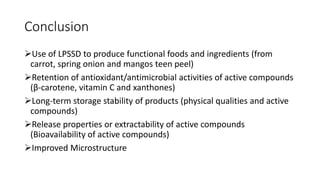
Conclusion
Use of LPSSD to produce functional foods and ingredients (from
carrot, spring onion and mangos teen peel)
Retention of antioxidant/antimicrobial activities of active compounds
(β-carotene, vitamin C and xanthones)
Long-term storage stability of products (physical qualities and active
compounds)
Release properties or extractability of active compounds
(Bioavailability of active compounds)
Improved Microstructure
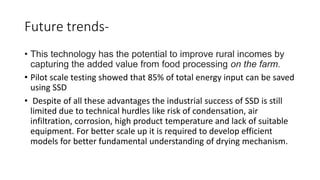
Future trends-
• This technology has the potential to improve rural incomes by
capturing the added value from food processing on the farm.
• Pilot scale testing showed that 85% of total energy input can be saved
using SSD
• Despite of all these advantages the industrial success of SSD is still
limited due to technical hurdles like risk of condensation, air
infiltration, corrosion, high product temperature and lack of suitable
equipment. For better scale up it is required to develop efficient
models for better fundamental understanding of drying mechanism.
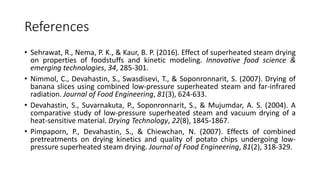
References
• Sehrawat, R., Nema, P. K., & Kaur, B. P. (2016). Effect of superheated steam drying
on properties of foodstuffs and kinetic modeling. Innovative food science &
emerging technologies, 34, 285-301.
• Nimmol, C., Devahastin, S., Swasdisevi, T., & Soponronnarit, S. (2007). Drying of
banana slices using combined low-pressure superheated steam and far-infrared
radiation. Journal of Food Engineering, 81(3), 624-633.
• Devahastin, S., Suvarnakuta, P., Soponronnarit, S., & Mujumdar, A. S. (2004). A
comparative study of low-pressure superheated steam and vacuum drying of a
heat-sensitive material. Drying Technology, 22(8), 1845-1867.
• Pimpaporn, P., Devahastin, S., & Chiewchan, N. (2007). Effects of combined
pretreatments on drying kinetics and quality of potato chips undergoing low-
pressure superheated steam drying. Journal of Food Engineering, 81(2), 318-329.

Superheated steam drying an emerging drying technology

  • 1.
    SUPERHEATED STEAM DRYING(SSD) DEPARTMENT OF AGRICULTURE AND FOOD ENGINEERING NAME- DEVESH KUMAR (19AG63R15) M.TECH (FOOD PROCESS ENGINEERING)
  • 2.
    OUTLINE • Introduction toSuperheated Steam Drying (SSD) • Basic principles • Classification and selection of SSD • Selected applications of SSD and case studies • Closure
  • 3.
    SUPERHEATED STEAM DRYING(SSD) Proposed over 100 years ago; received serious attention only during the past 20-30 years Uses superheated steam instead of hot air or combustion/flue gases in a direct (convection) dryer More complex equipment than hot-air drying system; leak proofing needed; feed/discharge can be difficult Lower net energy consumption (if exhausted steam can be used elsewhere in the process and not charged to dryer) Better product quality (in most cases);Safe operation, no fire/explosion hazard; no oxidation
  • 4.
    SUPERHEATED STEAM DRYER(Contd) If steam pressure is kept constant and more energy is added, its temperature increases and saturated steam becomes superheated steam (SHS) If extra heat can be transferred to an available heat sink, SHS returns to saturated conditions Any convection dryer can be made into SHSD e.g. fluidized bed, flash, rotary, conveyor type, spray, impinging jet; opposing jets (impinging streams) etc. Additional heat sources e.g. radiation, conduction, MW etc. can also be added Low, near-atmospheric or high pressure operation possible
  • 7.
    SOME ADVANTAGES OFSSD Dryer exhaust is steam so it is possible to recover all latent heat supplied to SSD-some cost involved in equipment and operation No oxidative reactions possible due to lack of O2 Color and some nutrients are better preserved in food Higher drying rates possible in both CRP and FRP depending on steam temperature (above the so-called inversion temperature SSD is faster than air drying)not a decisive factor for selection Toxic or organic liquids can be recovered easily-by condensation
  • 8.
    SOME ADVANTAGES OFSSD Casehardened skin is unlikely to form in SSD mechanism not known- product dependent SSD yields higher product porosity due to evolution of steam within the product ; boiling in interior opens up elastic wet solid-bulk density is thus lower and rehydration behavior is better; also affects color Sterilization, deodorization or other heat treatments (e.g. blanching, boiling, cooking) can be performed simultaneously with drying
  • 9.
    SOME DISADVANTAGES OFSSD • SSD system is more complex than its hot-air counterpart •Initial condensation is inevitable -more time may be required to dry the product –if feed comes below saturation temperature •Products that may melt, undergo glass transition or be damaged at saturation temperature of steam cannot be dried in SSD (hence can be dried in a low pressure SHSD) •Limited industrial experience with SSD
  • 12.
    BASIC PRINCIPLES OFSSD FRP drying rate of SSD is sometimes higher than that of hot air - mechanisms responsible are different, however, Vapor transfer is faster than liquid diffusion FRP drying rate of SSD is sometimes higher than air drying rate since product temperature is higher. Casehardening is unlikely to form and product is likely to be more porous as well
  • 13.
    LOW-PRESSURE SSD (LPSSD) •Combines the ability to dry product at low temperature with some advantages of SSD •Dryer is operated at reduced pressure (5-10 kPa) •Steam becomes saturated (and superheated) at lower temperature •Suitable for highly heat-sensitive products e.g. herbs, fruits and vegetables and other bio-active materials
  • 16.
    CASE STUDY 1-LPSSD VS VACCUM DRYING OF CARROT CUBES-
  • 17.
    CASE STUDY 2-BEET PULP Drying of pressed beet pulp after extraction of sugar •Operates at pressure ~ 5 bar •Consumes 50% less energy than conventional air dryer •Product quality i.e. appearance, texture, digestability by cattle is better than air drying
  • 18.
    CASE STUDY 3-POTATO DRYING-
  • 19.
  • 23.
  • 25.
    Physical Properties ofEdible Chitosan Films BY LPSSD VS VD • LPSSD dried film was less darker and less yellower than the VD film. • the maximum value for tensile strength was observed in the case of LPSSD at 70°C and storage condition of 53% RH. This might be due to the effects of higher degree of crystallinity and thermal cross-linkage that occurred more at this condition. • Film dried by LPSSD at 70°C and storage condition of 53% RH was 11% lighter than VD.
  • 26.
    Sl. No productComponent enhanced, reduced remarks reference 1. Soybean Urease Faster inactivation of urease in soybean using SSD. Prachayawarakorn et al. (2006) 2. Cabbage Salmonella serovar Anatum LPSSD resulted in highest inactivation. Phungamngoen et al. (2011) 3. Wheat – Deoxynivalenol (DON) and Geobacillus stearothermophilus spores DON concentration up to 52% were achieved Thermal resistance constant (Z) for G. stearo thermophilus was28.4°C. Cenkowski et al. (2007) 4. Banana slices Color and taste More crispier than the commercial ones (nimmol et. al 2007) 5. Paneer Texture Same texture after dehydration (Shrivastava 2010)
  • 28.
    Conclusion Use of LPSSDto produce functional foods and ingredients (from carrot, spring onion and mangos teen peel) Retention of antioxidant/antimicrobial activities of active compounds (β-carotene, vitamin C and xanthones) Long-term storage stability of products (physical qualities and active compounds) Release properties or extractability of active compounds (Bioavailability of active compounds) Improved Microstructure
  • 29.
    Future trends- • Thistechnology has the potential to improve rural incomes by capturing the added value from food processing on the farm. • Pilot scale testing showed that 85% of total energy input can be saved using SSD • Despite of all these advantages the industrial success of SSD is still limited due to technical hurdles like risk of condensation, air infiltration, corrosion, high product temperature and lack of suitable equipment. For better scale up it is required to develop efficient models for better fundamental understanding of drying mechanism.
  • 30.
    References • Sehrawat, R.,Nema, P. K., & Kaur, B. P. (2016). Effect of superheated steam drying on properties of foodstuffs and kinetic modeling. Innovative food science & emerging technologies, 34, 285-301. • Nimmol, C., Devahastin, S., Swasdisevi, T., & Soponronnarit, S. (2007). Drying of banana slices using combined low-pressure superheated steam and far-infrared radiation. Journal of Food Engineering, 81(3), 624-633. • Devahastin, S., Suvarnakuta, P., Soponronnarit, S., & Mujumdar, A. S. (2004). A comparative study of low-pressure superheated steam and vacuum drying of a heat-sensitive material. Drying Technology, 22(8), 1845-1867. • Pimpaporn, P., Devahastin, S., & Chiewchan, N. (2007). Effects of combined pretreatments on drying kinetics and quality of potato chips undergoing low- pressure superheated steam drying. Journal of Food Engineering, 81(2), 318-329.