KITTUR RANI CHANNAMMA COLLEGE OF HORTICULTURE, ARABHAVI
Seminar-II
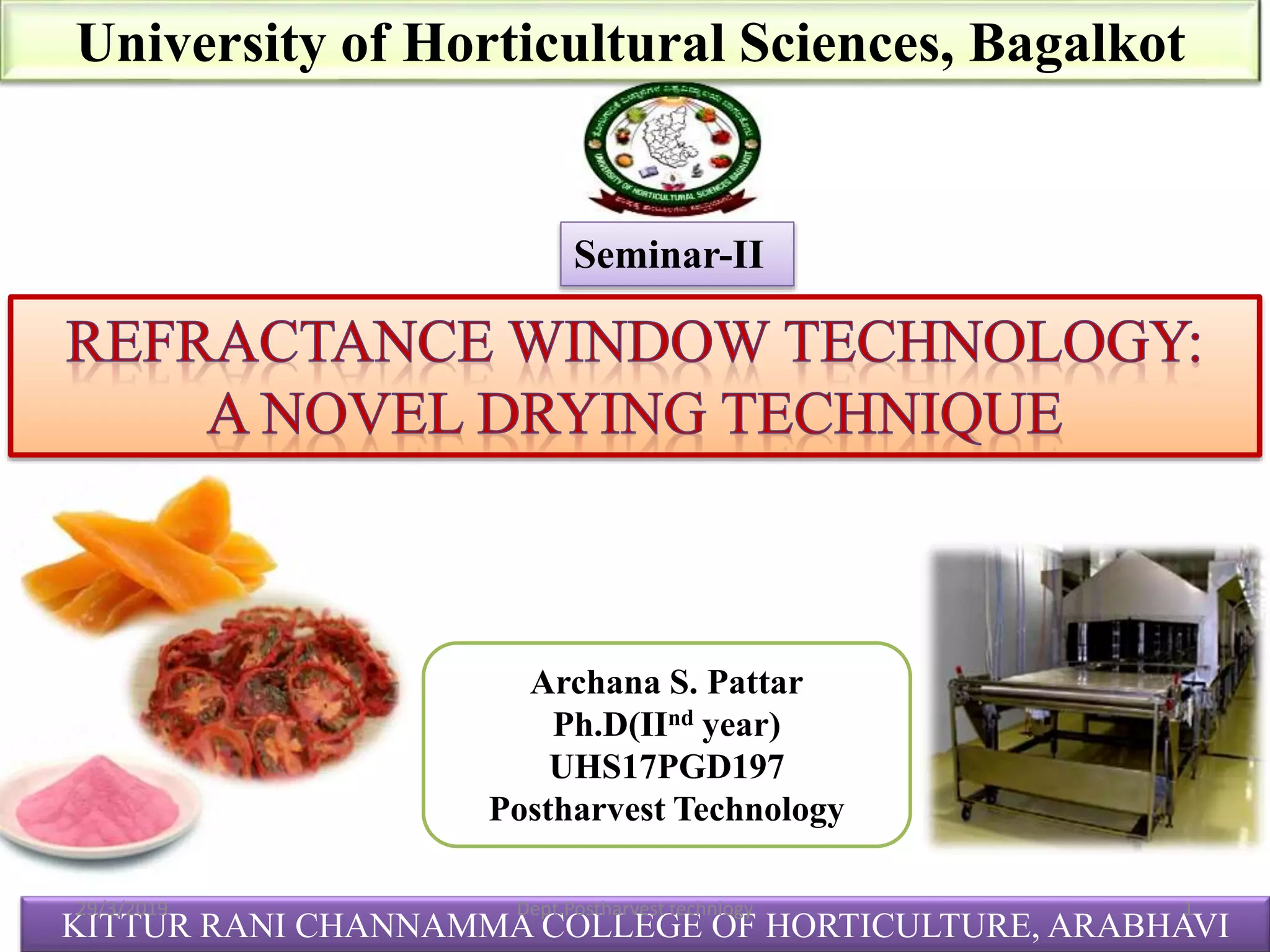
Archana S. Pattar
Ph.D(IInd year)
UHS17PGD197
Postharvest Technology
University of Horticultural Sciences, Bagalkot
29/3/2019 1Dept.Postharvest technlogy
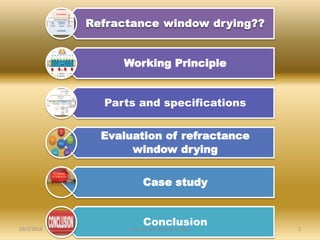
Refractance window drying??
Working Principle
Parts and specifications
Evaluation of refractance
window drying
Case study
Conclusion29/3/2019 2Dept.Postharvest technlogy
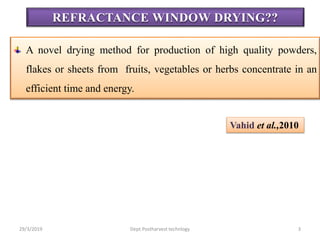
A novel drying method for production of high quality powders,
flakes or sheets from fruits, vegetables or herbs concentrate in an
efficient time and energy.
REFRACTANCE WINDOW DRYING??
Vahid et al.,2010
29/3/2019 3Dept.Postharvest technlogy
MCD technologies,(Tacoma,Washington) designed the Refractive
Window dryer which was patented by Richard Magoon in 1989
RW drying process uses 50–70 % less cost and more than 50 %
less energy than the freeze-drying
Short drying time (2-6 minutes)
ORIGIN OF RW DRYING METHOD
Deepika and Ashis, 2018
29/3/2019 4Dept.Postharvest technlogy
Pureed fruit and vegetable
Herbal formulations
Egg mixtures
Meat powder
Pharmaceutical
Nutraceutical
Cosmetics
Applications of RW
Deepika and Ashis, 2018
29/3/2019 5Dept.Postharvest technlogy
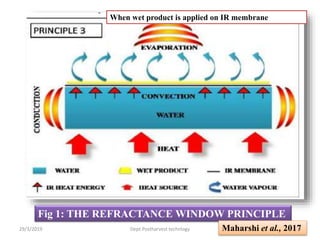
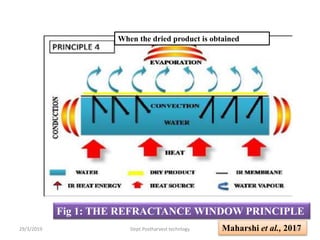
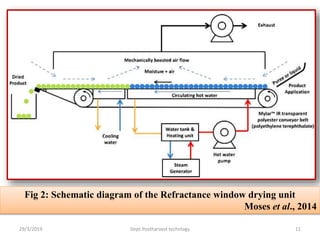
Working of RW dryer
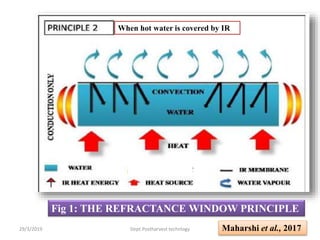
RW drying technique uses hot water as the source of heat
Mylar sheet as a medium which transmit IR radiation as well as
conduct heat to the product to be dried
Deepika and Ashis, 2018
29/3/2019 6Dept.Postharvest technlogy
When water is heated
Fig 1: THE REFRACTANCE WINDOW PRINCIPLE
Maharshi et al.,201729/3/2019 7Dept.Postharvest technlogy
When hot water is covered by IR
Fig 1: THE REFRACTANCE WINDOW PRINCIPLE
Maharshi et al., 201729/3/2019 8Dept.Postharvest technlogy
When wet product is applied on IR membrane
Fig 1: THE REFRACTANCE WINDOW PRINCIPLE
Maharshi et al., 201729/3/2019 9Dept.Postharvest technlogy
When the dried product is obtained
Fig 1: THE REFRACTANCE WINDOW PRINCIPLE
Maharshi et al., 201729/3/2019 10Dept.Postharvest technlogy
Fig 2: Schematic diagram of the Refractance window drying unit
Moses et al., 2014
29/3/2019 11Dept.Postharvest technlogy
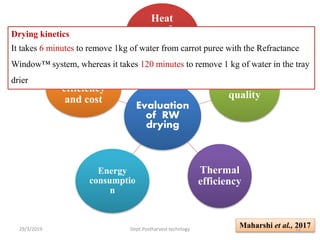
Evaluation
of RW
drying
Heat
transfer
and drying
kinetics
Product
quality
Thermal
efficiency
Energy
consumptio
n
Drying
efficiency
and cost
Drying kinetics
It takes 6 minutes to remove 1kg of water from carrot puree with the Refractance
Window™ system, whereas it takes 120 minutes to remove 1 kg of water in the tray
drier
Maharshi et al., 201729/3/2019 12Dept.Postharvest technlogy
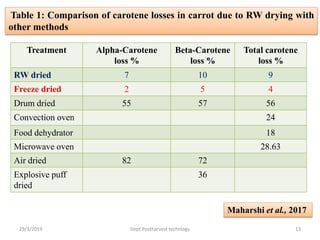
Table 1: Comparison of carotene losses in carrot due to RW drying with
other methods
Treatment Alpha-Carotene
loss %
Beta-Carotene
loss %
Total carotene
loss %
RW dried 7 10 9
Freeze dried 2 5 4
Drum dried 55 57 56
Convection oven 24
Food dehydrator 18
Microwave oven 28.63
Air dried 82 72
Explosive puff
dried
36
Maharshi et al., 2017
29/3/2019 13Dept.Postharvest technlogy
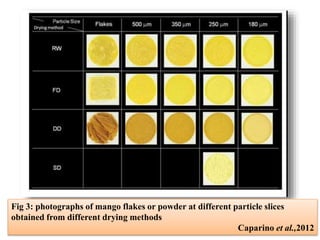
Fig 3: photographs of mango flakes or powder at different particle slices
obtained from different drying methods
Caparino et al.,2012
29/3/2019 Dept.Postharvest technlogy 15
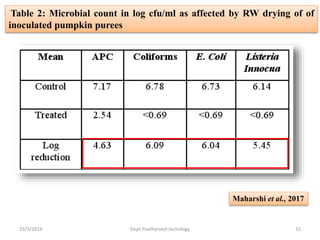
Table 2: Microbial count in log cfu/ml as affected by RW drying of of
inoculated pumpkin purees
Maharshi et al., 2017
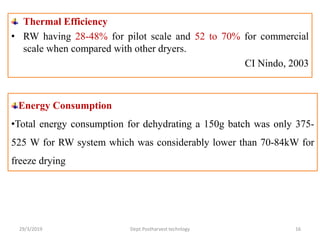
Thermal Efficiency
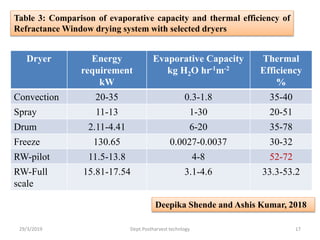
• RW having 28-48% for pilot scale and 52 to 70% for commercial
scale when compared with other dryers.
CI Nindo, 2003
Energy Consumption
•Total energy consumption for dehydrating a 150g batch was only 375-
525 W for RW system which was considerably lower than 70-84kW for
freeze drying
29/3/2019 16Dept.Postharvest technlogy
Table 3: Comparison of evaporative capacity and thermal efficiency of
Refractance Window drying system with selected dryers
Deepika Shende and Ashis Kumar, 2018
Dryer Energy
requirement
kW
Evaporative Capacity
kg H2O hr-1m-2
Thermal
Efficiency
%
Convection 20-35 0.3-1.8 35-40
Spray 11-13 1-30 20-51
Drum 2.11-4.41 6-20 35-78
Freeze 130.65 0.0027-0.0037 30-32
RW-pilot 11.5-13.8 4-8 52-72
RW-Full
scale
15.81-17.54 3.1-4.6 33.3-53.2
29/3/2019 17Dept.Postharvest technlogy
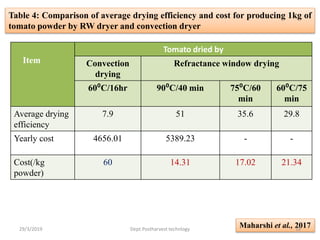
Table 4: Comparison of average drying efficiency and cost for producing 1kg of
tomato powder by RW dryer and convection dryer
Maharshi et al., 2017
Item
Tomato dried by
Convection
drying
Refractance window drying
60⁰C/16hr 90⁰C/40 min 75⁰C/60
min
60⁰C/75
min
Average drying
efficiency
7.9 51 35.6 29.8
Yearly cost 4656.01 5389.23 - -
Cost(/kg
powder)
60 14.31 17.02 21.34
29/3/2019 18Dept.Postharvest technlogy
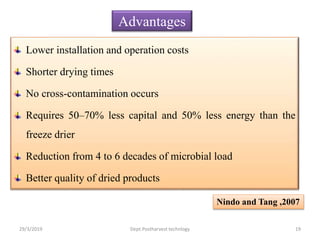
Lower installation and operation costs
Shorter drying times
No cross-contamination occurs
Requires 50–70% less capital and 50% less energy than the
freeze drier
Reduction from 4 to 6 decades of microbial load
Better quality of dried products
Advantages
Nindo and Tang ,2007
29/3/2019 19Dept.Postharvest technlogy
29/3/2019 20Dept.Postharvest technlogy
Objective: To compare the RW and tray drying
techniques with regard to the kinetics of drying, and
water activity of mango slices
Drying characteristics of mango slices using
the Refractance Window technique
Journal of Food Engineering 109 (2012) 69–75
C.I. Ochoa-Martínez , P.T. Quintero, A.A. Ayala, M.J. Ortiz
School of Food Engineering, Colombia
29/3/2019 21Dept.Postharvest technlogy
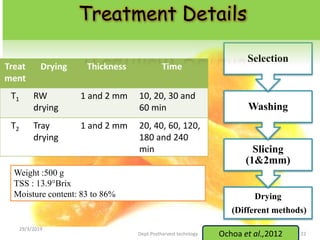
Treat
ment
Drying Thickness Time
T1 RW
drying
1 and 2 mm 10, 20, 30 and
60 min
T2 Tray
drying
1 and 2 mm 20, 40, 60, 120,
180 and 240
min
Drying
(Different methods)
Slicing
(1&2mm)
Washing
Selection
Ochoa et al.,2012
Treatment Details
Weight :500 g
TSS : 13.9°Brix
Moisture content: 83 to 86%
29/3/2019
22Dept.Postharvest technlogy
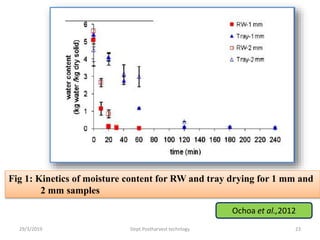
Fig 1: Kinetics of moisture content for RW and tray drying for 1 mm and
2 mm samples
29/3/2019 23Dept.Postharvest technlogy
Ochoa et al.,2012
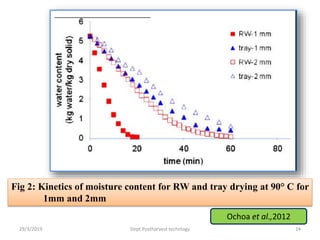
Fig 2: Kinetics of moisture content for RW and tray drying at 90° C for
1mm and 2mm
29/3/2019 24Dept.Postharvest technlogy
Ochoa et al.,2012
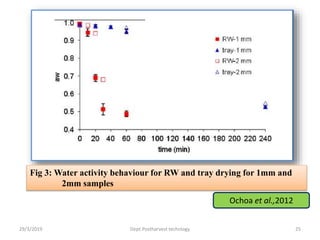
Fig 3: Water activity behaviour for RW and tray drying for 1mm and
2mm samples
29/3/2019 25Dept.Postharvest technlogy
Ochoa et al.,2012
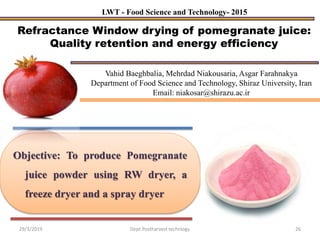
Objective: To produce Pomegranate
juice powder using RW dryer, a
freeze dryer and a spray dryer
Refractance Window drying of pomegranate juice:
Quality retention and energy efficiency
LWT - Food Science and Technology- 2015
Vahid Baeghbalia, Mehrdad Niakousaria, Asgar Farahnakya
Department of Food Science and Technology, Shiraz University, Iran
Email: niakosar@shirazu.ac.ir
29/3/2019 26Dept.Postharvest technlogy
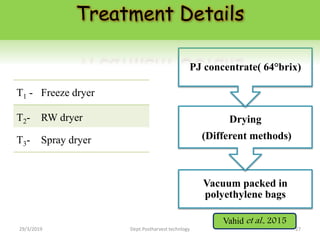
T1 - Freeze dryer
T2- RW dryer
T3- Spray dryer
Vacuum packed in
polyethylene bags
Drying
(Different methods)
PJ concentrate( 64°brix)
Treatment Details
Vahid et al., 2015
29/3/2019 27Dept.Postharvest technlogy
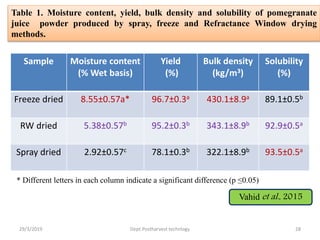
Sample Moisture content
(% Wet basis)
Yield
(%)
Bulk density
(kg/m3)
Solubility
(%)
Freeze dried 8.55±0.57a* 96.7±0.3a 430.1±8.9a 89.1±0.5b
RW dried 5.38±0.57b 95.2±0.3b 343.1±8.9b 92.9±0.5a
Spray dried 2.92±0.57c 78.1±0.3b 322.1±8.9b 93.5±0.5a
Table 1. Moisture content, yield, bulk density and solubility of pomegranate
juice powder produced by spray, freeze and Refractance Window drying
methods.
* Different letters in each column indicate a significant difference (p ≤0.05)
29/3/2019 28Dept.Postharvest technlogy
Vahid et al., 2015
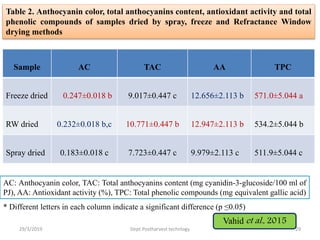
Sample AC TAC AA TPC
Freeze dried 0.247±0.018 b 9.017±0.447 c 12.656±2.113 b 571.0±5.044 a
RW dried 0.232±0.018 b,c 10.771±0.447 b 12.947±2.113 b 534.2±5.044 b
Spray dried 0.183±0.018 c 7.723±0.447 c 9.979±2.113 c 511.9±5.044 c
Table 2. Anthocyanin color, total anthocyanins content, antioxidant activity and total
phenolic compounds of samples dried by spray, freeze and Refractance Window
drying methods
AC: Anthocyanin color, TAC: Total anthocyanins content (mg cyanidin-3-glucoside/100 ml of
PJ), AA: Antioxidant activity (%), TPC: Total phenolic compounds (mg equivalent gallic acid)
* Different letters in each column indicate a significant difference (p ≤0.05)
29/3/2019 29Dept.Postharvest technlogy
Vahid et al., 2015
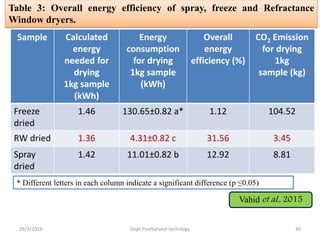
Sample Calculated
energy
needed for
drying
1kg sample
(kWh)
Energy
consumption
for drying
1kg sample
(kWh)
Overall
energy
efficiency (%)
CO2 Emission
for drying
1kg
sample (kg)
Freeze
dried
1.46 130.65±0.82 a* 1.12 104.52
RW dried 1.36 4.31±0.82 c 31.56 3.45
Spray
dried
1.42 11.01±0.82 b 12.92 8.81
Table 3: Overall energy efficiency of spray, freeze and Refractance
Window dryers.
* Different letters in each column indicate a significant difference (p ≤0.05)
29/3/2019 30Dept.Postharvest technlogy
Vahid et al., 2015
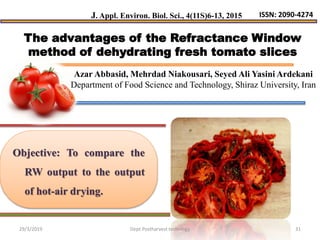
Objective: To compare the
RW output to the output
of hot-air drying.
The advantages of the Refractance Window
method of dehydrating fresh tomato slices
J. Appl. Environ. Biol. Sci., 4(11S)6-13, 2015 ISSN: 2090-4274
Azar Abbasid, Mehrdad Niakousari, Seyed Ali Yasini Ardekani
Department of Food Science and Technology, Shiraz University, Iran
29/3/2019 31Dept.Postharvest technlogy
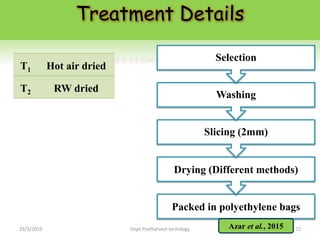
Treatment Details
Packed in polyethylene bags
Drying (Different methods)
Slicing (2mm)
Washing
Selection
T1 Hot air dried
T2 RW dried
Azar et al., 201529/3/2019 32Dept.Postharvest technlogy
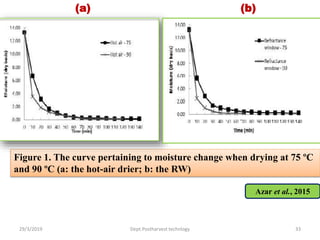
Figure 1. The curve pertaining to moisture change when drying at 75 ºC
and 90 ºC (a: the hot-air drier; b: the RW)
(a) (b)
29/3/2019 33Dept.Postharvest technlogy
Azar et al., 2015
0
10
20
30
40
50
60
Fresh Hot air
75
Hot air
90
RW 75 RW 90
0
10
20
30
40
50
60
70
Fresh Hot air
75
Hot air
90
RW 75 RW 90
0
10
20
30
40
50
60
Fresh Hot
air 75
Hot
air 90
RW
75
RW90
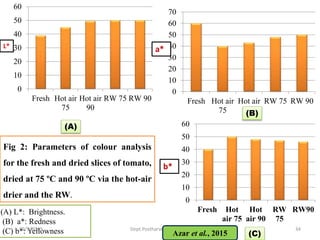
Fig 2: Parameters of colour analysis
for the fresh and dried slices of tomato,
dried at 75 ºC and 90 ºC via the hot-air
drier and the RW.
L*
a*
b*
(A) L*: Brightness.
(B) a*: Redness
(C) b*: Yellowness
(A)
(B)
(C)
29/3/2019 34Dept.Postharvest technlogy
Azar et al., 2015
0 5 10 15 20 25
Hot air 75
Hot air 90
RW 75
RW 90
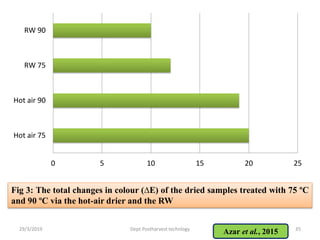
Fig 3: The total changes in colour (∆E) of the dried samples treated with 75 ºC
and 90 ºC via the hot-air drier and the RW
29/3/2019 35Dept.Postharvest technlogy
Azar et al., 2015
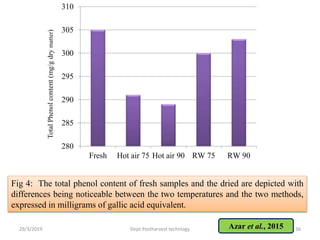
Fig 4: The total phenol content of fresh samples and the dried are depicted with
differences being noticeable between the two temperatures and the two methods,
expressed in milligrams of gallic acid equivalent.
280
285
290
295
300
305
310
Fresh Hot air 75 Hot air 90 RW 75 RW 90
TotalPhenolcontent(mg/gdrymatter)
29/3/2019 36Dept.Postharvest technlogy Azar et al., 2015
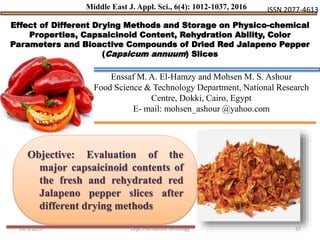
Objective: Evaluation of the
major capsaicinoid contents of
the fresh and rehydrated red
Jalapeno pepper slices after
different drying methods
Effect of Different Drying Methods and Storage on Physico-chemical
Properties, Capsaicinoid Content, Rehydration Ability, Color
Parameters and Bioactive Compounds of Dried Red Jalapeno Pepper
(Capsicum annuum) Slices
Middle East J. Appl. Sci., 6(4): 1012-1037, 2016
Enssaf M. A. El-Hamzy and Mohsen M. S. Ashour
Food Science & Technology Department, National Research
Centre, Dokki, Cairo, Egypt
E- mail: mohsen_ashour @yahoo.com
ISSN 2077-4613
29/3/2019 37Dept.Postharvest technlogy
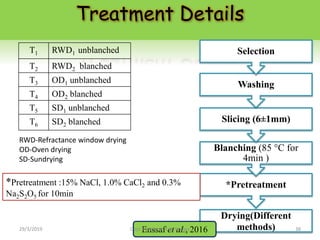
Treatment Details
Drying(Different
methods)
*Pretreatment
Blanching (85 °C for
4min )
Slicing (6±1mm)
Washing
Selection
Enssaf et al., 2016
*Pretreatment :15% NaCl, 1.0% CaCl2 and 0.3%
Na2S2O5 for 10min
T1 RWD1 unblanched
T2 RWD2 blanched
T3 OD1 unblanched
T4 OD2 blanched
T5 SD1 unblanched
T6 SD2 blanched
29/3/2019 38Dept.Postharvest technlogy
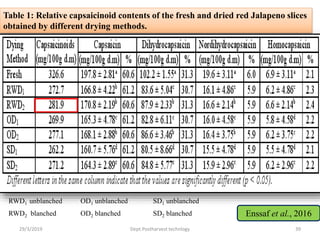
RWD-Refractance window drying
OD-Oven drying
SD-Sundrying
Table 1: Relative capsaicinoid contents of the fresh and dried red Jalapeno slices
obtained by different drying methods.
29/3/2019 39Dept.Postharvest technlogy
Enssaf et al., 2016
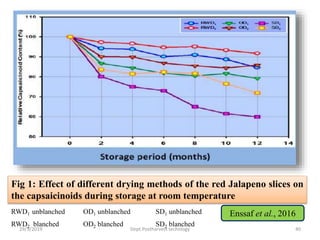
RWD1 unblanched OD1 unblanched SD1 unblanched
RWD2 blanched OD2 blanched SD2 blanched
Fig 1: Effect of different drying methods of the red Jalapeno slices on
the capsaicinoids during storage at room temperature
29/3/2019 40Dept.Postharvest technlogy
Enssaf et al., 2016RWD1 unblanched OD1 unblanched SD1 unblanched
RWD2 blanched OD2 blanched SD2 blanched
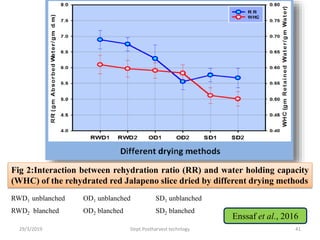
Fig 2:Interaction between rehydration ratio (RR) and water holding capacity
(WHC) of the rehydrated red Jalapeno slice dried by different drying methods
29/3/2019 41Dept.Postharvest technlogy
Enssaf et al., 2016
RWD1 unblanched OD1 unblanched SD1 unblanched
RWD2 blanched OD2 blanched SD2 blanched
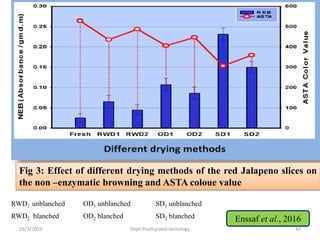
Fig 3: Effect of different drying methods of the red Jalapeno slices on
the non –enzymatic browning and ASTA coloue value
29/3/2019 42Dept.Postharvest technlogy
Enssaf et al., 2016
RWD1 unblanched OD1 unblanched SD1 unblanched
RWD2 blanched OD2 blanched SD2 blanched
Objective: To evaluate the main changes
in physico-chemical properties of
dehydrated Aloe vera gel obtained by
different drying procedures
Effect of different drying procedures on
physicochemical properties and flow behavior of
Aloe vera (Aloe Barbadensis Miller) gel
LWT - Food Science and Technology-2016
R. Minjares-Fuentes, A. Femenia, F. Comas-Serra, C. Rossello, V.M.
Rodríguez-Gonzalez, R.F. Gonzalez-Laredo, J.A. Gallegos-Infante, L.
Medina-Torres
Department of Chemistry, University of the Balearic Islands, Spain
Email:antoni.femenia@uib.es
29/3/2019 43Dept.Postharvest technlogy
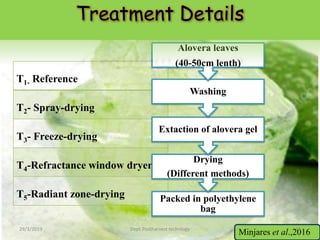
T1- Reference
T2- Spray-drying
T3- Freeze-drying
T4-Refractance window dryer
T5-Radiant zone-drying Packed in polyethylene
bag
Drying
(Different methods)
Extaction of alovera gel
Washing
Alovera leaves
(40-50cm lenth)
Treatment Details
Minjares et al.,201629/3/2019 44Dept.Postharvest technlogy
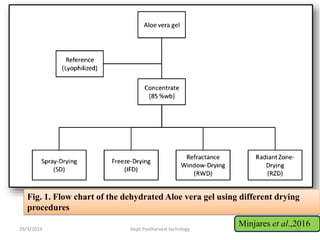
Fig. 1. Flow chart of the dehydrated Aloe vera gel using different drying
procedures
Minjares et al.,201629/3/2019 45Dept.Postharvest technlogy
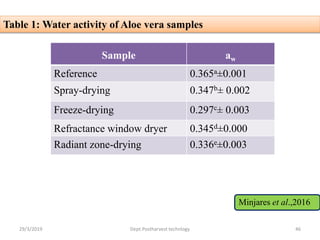
Table 1: Water activity of Aloe vera samples
Sample aw
Reference 0.365a±0.001
Spray-drying 0.347b± 0.002
Freeze-drying 0.297c± 0.003
Refractance window dryer 0.345d±0.000
Radiant zone-drying 0.336e±0.003
Minjares et al.,2016
29/3/2019 46Dept.Postharvest technlogy
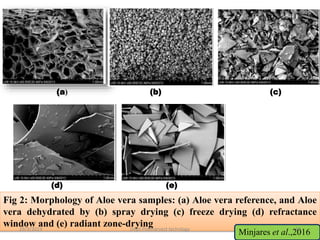
Fig 2: Morphology of Aloe vera samples: (a) Aloe vera reference, and Aloe
vera dehydrated by (b) spray drying (c) freeze drying (d) refractance
window and (e) radiant zone-drying
(a) (b) (c)
(d) (e)
Minjares et al.,201629/3/2019 47Dept.Postharvest technlogy
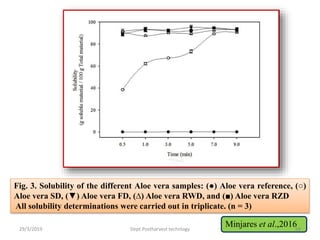
Fig. 3. Solubility of the different Aloe vera samples: (●) Aloe vera reference, (○)
Aloe vera SD, (▼) Aloe vera FD, (∆) Aloe vera RWD, and (■) Aloe vera RZD
All solubility determinations were carried out in triplicate. (n = 3)
Minjares et al.,201629/3/2019 48Dept.Postharvest technlogy
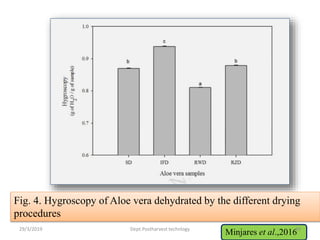
Fig. 4. Hygroscopy of Aloe vera dehydrated by the different drying
procedures
Minjares et al.,201629/3/2019 49Dept.Postharvest technlogy
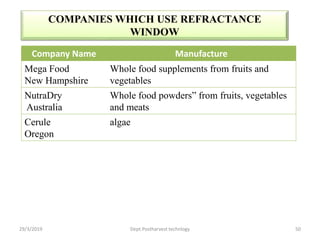
COMPANIES WHICH USE REFRACTANCE
WINDOW
Company Name Manufacture
Mega Food
New Hampshire
Whole food supplements from fruits and
vegetables
NutraDry
Australia
Whole food powders” from fruits, vegetables
and meats
Cerule
Oregon
algae
29/3/2019 50Dept.Postharvest technlogy
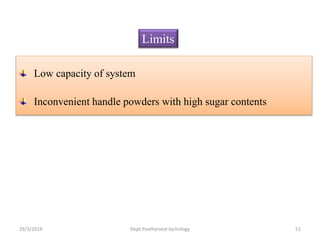
Low capacity of system
Inconvenient handle powders with high sugar contents
Limits
29/3/2019 51Dept.Postharvest technlogy
CONCLUSION
29/3/2019 52Dept.Postharvest technlogy
29/3/2019 53Dept.Postharvest technlogy

REFRACTANCE WINDOW DRYING

  • 1.
    KITTUR RANI CHANNAMMACOLLEGE OF HORTICULTURE, ARABHAVI Seminar-II Archana S. Pattar Ph.D(IInd year) UHS17PGD197 Postharvest Technology University of Horticultural Sciences, Bagalkot 29/3/2019 1Dept.Postharvest technlogy
  • 2.
    Refractance window drying?? WorkingPrinciple Parts and specifications Evaluation of refractance window drying Case study Conclusion29/3/2019 2Dept.Postharvest technlogy
  • 3.
    A novel dryingmethod for production of high quality powders, flakes or sheets from fruits, vegetables or herbs concentrate in an efficient time and energy. REFRACTANCE WINDOW DRYING?? Vahid et al.,2010 29/3/2019 3Dept.Postharvest technlogy
  • 4.
    MCD technologies,(Tacoma,Washington) designedthe Refractive Window dryer which was patented by Richard Magoon in 1989 RW drying process uses 50–70 % less cost and more than 50 % less energy than the freeze-drying Short drying time (2-6 minutes) ORIGIN OF RW DRYING METHOD Deepika and Ashis, 2018 29/3/2019 4Dept.Postharvest technlogy
  • 5.
    Pureed fruit andvegetable Herbal formulations Egg mixtures Meat powder Pharmaceutical Nutraceutical Cosmetics Applications of RW Deepika and Ashis, 2018 29/3/2019 5Dept.Postharvest technlogy
  • 6.
    Working of RWdryer RW drying technique uses hot water as the source of heat Mylar sheet as a medium which transmit IR radiation as well as conduct heat to the product to be dried Deepika and Ashis, 2018 29/3/2019 6Dept.Postharvest technlogy
  • 7.
    When water isheated Fig 1: THE REFRACTANCE WINDOW PRINCIPLE Maharshi et al.,201729/3/2019 7Dept.Postharvest technlogy
  • 8.
    When hot wateris covered by IR Fig 1: THE REFRACTANCE WINDOW PRINCIPLE Maharshi et al., 201729/3/2019 8Dept.Postharvest technlogy
  • 9.
    When wet productis applied on IR membrane Fig 1: THE REFRACTANCE WINDOW PRINCIPLE Maharshi et al., 201729/3/2019 9Dept.Postharvest technlogy
  • 10.
    When the driedproduct is obtained Fig 1: THE REFRACTANCE WINDOW PRINCIPLE Maharshi et al., 201729/3/2019 10Dept.Postharvest technlogy
  • 11.
    Fig 2: Schematicdiagram of the Refractance window drying unit Moses et al., 2014 29/3/2019 11Dept.Postharvest technlogy
  • 12.
    Evaluation of RW drying Heat transfer and drying kinetics Product quality Thermal efficiency Energy consumptio n Drying efficiency andcost Drying kinetics It takes 6 minutes to remove 1kg of water from carrot puree with the Refractance Window™ system, whereas it takes 120 minutes to remove 1 kg of water in the tray drier Maharshi et al., 201729/3/2019 12Dept.Postharvest technlogy
  • 13.
    Table 1: Comparisonof carotene losses in carrot due to RW drying with other methods Treatment Alpha-Carotene loss % Beta-Carotene loss % Total carotene loss % RW dried 7 10 9 Freeze dried 2 5 4 Drum dried 55 57 56 Convection oven 24 Food dehydrator 18 Microwave oven 28.63 Air dried 82 72 Explosive puff dried 36 Maharshi et al., 2017 29/3/2019 13Dept.Postharvest technlogy
  • 14.
    Fig 3: photographsof mango flakes or powder at different particle slices obtained from different drying methods Caparino et al.,2012
  • 15.
    29/3/2019 Dept.Postharvest technlogy15 Table 2: Microbial count in log cfu/ml as affected by RW drying of of inoculated pumpkin purees Maharshi et al., 2017
  • 16.
    Thermal Efficiency • RWhaving 28-48% for pilot scale and 52 to 70% for commercial scale when compared with other dryers. CI Nindo, 2003 Energy Consumption •Total energy consumption for dehydrating a 150g batch was only 375- 525 W for RW system which was considerably lower than 70-84kW for freeze drying 29/3/2019 16Dept.Postharvest technlogy
  • 17.
    Table 3: Comparisonof evaporative capacity and thermal efficiency of Refractance Window drying system with selected dryers Deepika Shende and Ashis Kumar, 2018 Dryer Energy requirement kW Evaporative Capacity kg H2O hr-1m-2 Thermal Efficiency % Convection 20-35 0.3-1.8 35-40 Spray 11-13 1-30 20-51 Drum 2.11-4.41 6-20 35-78 Freeze 130.65 0.0027-0.0037 30-32 RW-pilot 11.5-13.8 4-8 52-72 RW-Full scale 15.81-17.54 3.1-4.6 33.3-53.2 29/3/2019 17Dept.Postharvest technlogy
  • 18.
    Table 4: Comparisonof average drying efficiency and cost for producing 1kg of tomato powder by RW dryer and convection dryer Maharshi et al., 2017 Item Tomato dried by Convection drying Refractance window drying 60⁰C/16hr 90⁰C/40 min 75⁰C/60 min 60⁰C/75 min Average drying efficiency 7.9 51 35.6 29.8 Yearly cost 4656.01 5389.23 - - Cost(/kg powder) 60 14.31 17.02 21.34 29/3/2019 18Dept.Postharvest technlogy
  • 19.
    Lower installation andoperation costs Shorter drying times No cross-contamination occurs Requires 50–70% less capital and 50% less energy than the freeze drier Reduction from 4 to 6 decades of microbial load Better quality of dried products Advantages Nindo and Tang ,2007 29/3/2019 19Dept.Postharvest technlogy
  • 20.
  • 21.
    Objective: To comparethe RW and tray drying techniques with regard to the kinetics of drying, and water activity of mango slices Drying characteristics of mango slices using the Refractance Window technique Journal of Food Engineering 109 (2012) 69–75 C.I. Ochoa-Martínez , P.T. Quintero, A.A. Ayala, M.J. Ortiz School of Food Engineering, Colombia 29/3/2019 21Dept.Postharvest technlogy
  • 22.
    Treat ment Drying Thickness Time T1RW drying 1 and 2 mm 10, 20, 30 and 60 min T2 Tray drying 1 and 2 mm 20, 40, 60, 120, 180 and 240 min Drying (Different methods) Slicing (1&2mm) Washing Selection Ochoa et al.,2012 Treatment Details Weight :500 g TSS : 13.9°Brix Moisture content: 83 to 86% 29/3/2019 22Dept.Postharvest technlogy
  • 23.
    Fig 1: Kineticsof moisture content for RW and tray drying for 1 mm and 2 mm samples 29/3/2019 23Dept.Postharvest technlogy Ochoa et al.,2012
  • 24.
    Fig 2: Kineticsof moisture content for RW and tray drying at 90° C for 1mm and 2mm 29/3/2019 24Dept.Postharvest technlogy Ochoa et al.,2012
  • 25.
    Fig 3: Wateractivity behaviour for RW and tray drying for 1mm and 2mm samples 29/3/2019 25Dept.Postharvest technlogy Ochoa et al.,2012
  • 26.
    Objective: To producePomegranate juice powder using RW dryer, a freeze dryer and a spray dryer Refractance Window drying of pomegranate juice: Quality retention and energy efficiency LWT - Food Science and Technology- 2015 Vahid Baeghbalia, Mehrdad Niakousaria, Asgar Farahnakya Department of Food Science and Technology, Shiraz University, Iran Email: niakosar@shirazu.ac.ir 29/3/2019 26Dept.Postharvest technlogy
  • 27.
    T1 - Freezedryer T2- RW dryer T3- Spray dryer Vacuum packed in polyethylene bags Drying (Different methods) PJ concentrate( 64°brix) Treatment Details Vahid et al., 2015 29/3/2019 27Dept.Postharvest technlogy
  • 28.
    Sample Moisture content (%Wet basis) Yield (%) Bulk density (kg/m3) Solubility (%) Freeze dried 8.55±0.57a* 96.7±0.3a 430.1±8.9a 89.1±0.5b RW dried 5.38±0.57b 95.2±0.3b 343.1±8.9b 92.9±0.5a Spray dried 2.92±0.57c 78.1±0.3b 322.1±8.9b 93.5±0.5a Table 1. Moisture content, yield, bulk density and solubility of pomegranate juice powder produced by spray, freeze and Refractance Window drying methods. * Different letters in each column indicate a significant difference (p ≤0.05) 29/3/2019 28Dept.Postharvest technlogy Vahid et al., 2015
  • 29.
    Sample AC TACAA TPC Freeze dried 0.247±0.018 b 9.017±0.447 c 12.656±2.113 b 571.0±5.044 a RW dried 0.232±0.018 b,c 10.771±0.447 b 12.947±2.113 b 534.2±5.044 b Spray dried 0.183±0.018 c 7.723±0.447 c 9.979±2.113 c 511.9±5.044 c Table 2. Anthocyanin color, total anthocyanins content, antioxidant activity and total phenolic compounds of samples dried by spray, freeze and Refractance Window drying methods AC: Anthocyanin color, TAC: Total anthocyanins content (mg cyanidin-3-glucoside/100 ml of PJ), AA: Antioxidant activity (%), TPC: Total phenolic compounds (mg equivalent gallic acid) * Different letters in each column indicate a significant difference (p ≤0.05) 29/3/2019 29Dept.Postharvest technlogy Vahid et al., 2015
  • 30.
    Sample Calculated energy needed for drying 1kgsample (kWh) Energy consumption for drying 1kg sample (kWh) Overall energy efficiency (%) CO2 Emission for drying 1kg sample (kg) Freeze dried 1.46 130.65±0.82 a* 1.12 104.52 RW dried 1.36 4.31±0.82 c 31.56 3.45 Spray dried 1.42 11.01±0.82 b 12.92 8.81 Table 3: Overall energy efficiency of spray, freeze and Refractance Window dryers. * Different letters in each column indicate a significant difference (p ≤0.05) 29/3/2019 30Dept.Postharvest technlogy Vahid et al., 2015
  • 31.
    Objective: To comparethe RW output to the output of hot-air drying. The advantages of the Refractance Window method of dehydrating fresh tomato slices J. Appl. Environ. Biol. Sci., 4(11S)6-13, 2015 ISSN: 2090-4274 Azar Abbasid, Mehrdad Niakousari, Seyed Ali Yasini Ardekani Department of Food Science and Technology, Shiraz University, Iran 29/3/2019 31Dept.Postharvest technlogy
  • 32.
    Treatment Details Packed inpolyethylene bags Drying (Different methods) Slicing (2mm) Washing Selection T1 Hot air dried T2 RW dried Azar et al., 201529/3/2019 32Dept.Postharvest technlogy
  • 33.
    Figure 1. Thecurve pertaining to moisture change when drying at 75 ºC and 90 ºC (a: the hot-air drier; b: the RW) (a) (b) 29/3/2019 33Dept.Postharvest technlogy Azar et al., 2015
  • 34.
    0 10 20 30 40 50 60 Fresh Hot air 75 Hotair 90 RW 75 RW 90 0 10 20 30 40 50 60 70 Fresh Hot air 75 Hot air 90 RW 75 RW 90 0 10 20 30 40 50 60 Fresh Hot air 75 Hot air 90 RW 75 RW90 Fig 2: Parameters of colour analysis for the fresh and dried slices of tomato, dried at 75 ºC and 90 ºC via the hot-air drier and the RW. L* a* b* (A) L*: Brightness. (B) a*: Redness (C) b*: Yellowness (A) (B) (C) 29/3/2019 34Dept.Postharvest technlogy Azar et al., 2015
  • 35.
    0 5 1015 20 25 Hot air 75 Hot air 90 RW 75 RW 90 Fig 3: The total changes in colour (∆E) of the dried samples treated with 75 ºC and 90 ºC via the hot-air drier and the RW 29/3/2019 35Dept.Postharvest technlogy Azar et al., 2015
  • 36.
    Fig 4: Thetotal phenol content of fresh samples and the dried are depicted with differences being noticeable between the two temperatures and the two methods, expressed in milligrams of gallic acid equivalent. 280 285 290 295 300 305 310 Fresh Hot air 75 Hot air 90 RW 75 RW 90 TotalPhenolcontent(mg/gdrymatter) 29/3/2019 36Dept.Postharvest technlogy Azar et al., 2015
  • 37.
    Objective: Evaluation ofthe major capsaicinoid contents of the fresh and rehydrated red Jalapeno pepper slices after different drying methods Effect of Different Drying Methods and Storage on Physico-chemical Properties, Capsaicinoid Content, Rehydration Ability, Color Parameters and Bioactive Compounds of Dried Red Jalapeno Pepper (Capsicum annuum) Slices Middle East J. Appl. Sci., 6(4): 1012-1037, 2016 Enssaf M. A. El-Hamzy and Mohsen M. S. Ashour Food Science & Technology Department, National Research Centre, Dokki, Cairo, Egypt E- mail: mohsen_ashour @yahoo.com ISSN 2077-4613 29/3/2019 37Dept.Postharvest technlogy
  • 38.
    Treatment Details Drying(Different methods) *Pretreatment Blanching (85°C for 4min ) Slicing (6±1mm) Washing Selection Enssaf et al., 2016 *Pretreatment :15% NaCl, 1.0% CaCl2 and 0.3% Na2S2O5 for 10min T1 RWD1 unblanched T2 RWD2 blanched T3 OD1 unblanched T4 OD2 blanched T5 SD1 unblanched T6 SD2 blanched 29/3/2019 38Dept.Postharvest technlogy RWD-Refractance window drying OD-Oven drying SD-Sundrying
  • 39.
    Table 1: Relativecapsaicinoid contents of the fresh and dried red Jalapeno slices obtained by different drying methods. 29/3/2019 39Dept.Postharvest technlogy Enssaf et al., 2016 RWD1 unblanched OD1 unblanched SD1 unblanched RWD2 blanched OD2 blanched SD2 blanched
  • 40.
    Fig 1: Effectof different drying methods of the red Jalapeno slices on the capsaicinoids during storage at room temperature 29/3/2019 40Dept.Postharvest technlogy Enssaf et al., 2016RWD1 unblanched OD1 unblanched SD1 unblanched RWD2 blanched OD2 blanched SD2 blanched
  • 41.
    Fig 2:Interaction betweenrehydration ratio (RR) and water holding capacity (WHC) of the rehydrated red Jalapeno slice dried by different drying methods 29/3/2019 41Dept.Postharvest technlogy Enssaf et al., 2016 RWD1 unblanched OD1 unblanched SD1 unblanched RWD2 blanched OD2 blanched SD2 blanched
  • 42.
    Fig 3: Effectof different drying methods of the red Jalapeno slices on the non –enzymatic browning and ASTA coloue value 29/3/2019 42Dept.Postharvest technlogy Enssaf et al., 2016 RWD1 unblanched OD1 unblanched SD1 unblanched RWD2 blanched OD2 blanched SD2 blanched
  • 43.
    Objective: To evaluatethe main changes in physico-chemical properties of dehydrated Aloe vera gel obtained by different drying procedures Effect of different drying procedures on physicochemical properties and flow behavior of Aloe vera (Aloe Barbadensis Miller) gel LWT - Food Science and Technology-2016 R. Minjares-Fuentes, A. Femenia, F. Comas-Serra, C. Rossello, V.M. Rodríguez-Gonzalez, R.F. Gonzalez-Laredo, J.A. Gallegos-Infante, L. Medina-Torres Department of Chemistry, University of the Balearic Islands, Spain Email:antoni.femenia@uib.es 29/3/2019 43Dept.Postharvest technlogy
  • 44.
    T1- Reference T2- Spray-drying T3-Freeze-drying T4-Refractance window dryer T5-Radiant zone-drying Packed in polyethylene bag Drying (Different methods) Extaction of alovera gel Washing Alovera leaves (40-50cm lenth) Treatment Details Minjares et al.,201629/3/2019 44Dept.Postharvest technlogy
  • 45.
    Fig. 1. Flowchart of the dehydrated Aloe vera gel using different drying procedures Minjares et al.,201629/3/2019 45Dept.Postharvest technlogy
  • 46.
    Table 1: Wateractivity of Aloe vera samples Sample aw Reference 0.365a±0.001 Spray-drying 0.347b± 0.002 Freeze-drying 0.297c± 0.003 Refractance window dryer 0.345d±0.000 Radiant zone-drying 0.336e±0.003 Minjares et al.,2016 29/3/2019 46Dept.Postharvest technlogy
  • 47.
    Fig 2: Morphologyof Aloe vera samples: (a) Aloe vera reference, and Aloe vera dehydrated by (b) spray drying (c) freeze drying (d) refractance window and (e) radiant zone-drying (a) (b) (c) (d) (e) Minjares et al.,201629/3/2019 47Dept.Postharvest technlogy
  • 48.
    Fig. 3. Solubilityof the different Aloe vera samples: (●) Aloe vera reference, (○) Aloe vera SD, (▼) Aloe vera FD, (∆) Aloe vera RWD, and (■) Aloe vera RZD All solubility determinations were carried out in triplicate. (n = 3) Minjares et al.,201629/3/2019 48Dept.Postharvest technlogy
  • 49.
    Fig. 4. Hygroscopyof Aloe vera dehydrated by the different drying procedures Minjares et al.,201629/3/2019 49Dept.Postharvest technlogy
  • 50.
    COMPANIES WHICH USEREFRACTANCE WINDOW Company Name Manufacture Mega Food New Hampshire Whole food supplements from fruits and vegetables NutraDry Australia Whole food powders” from fruits, vegetables and meats Cerule Oregon algae 29/3/2019 50Dept.Postharvest technlogy
  • 51.
    Low capacity ofsystem Inconvenient handle powders with high sugar contents Limits 29/3/2019 51Dept.Postharvest technlogy
  • 52.
  • 53.