Vasantrao Naik Marathwada Krishi Vidyapeeth
College of food technology
FST - 519
MASTER SEMINAR
RECENT ADVANCES IN FOOD ENGINEERING
Presented by
Guruju Nookaratnam
2021T07M
Submitted to
Dr. B. S. Agarkar
Ass. Professor
Dept. of Food Engineering
 Recent advances in drying
 Pulsed electric field assisted extraction
 Radiofrequency pasteurization
 Cold plasma technology
 Hyperspectral imaging for safety and quality evaluation
Content
Introduction
 Engineering is the application of scientific principles to design and build
machines, equipment, buildings etc. for human use
 Food engineering is the application of engineering principles to food
processing and related issues.
 Advancements in food engineering are nothing but renovation or
improvement of already existing methods.
 For food processing and other activities, even now we are using conventional
methods which are based on heat or chemical treatments. These methods
consume more time and energy and show adverse affects on food quality,
nutritional and health aspects
 So, in order to overcome these problems, recently certain advancements are
made such as HPP, PEF, ultrasound, EOW, cold plasma, HSI etc.
Recent Advances In Drying
 Drying is a method of food preservation that removes enough moisture from the
food so bacteria, yeast and molds cannot grow. It enhances shelflife quality, ease
of handling, organoleptic properties of food etc.
 There are many drying techniques like air drying, spray drying, fluidized bed
drying, vacuum drying, osmotic drying etc. for different types of wet feedstock
Needs of new developments in drying
 To improve control of product quality
To increase capacity than existing drying systems
To achieve Sustainability in overall process
To dry new products such as functional foods
To Reduce the risk of fire, explosion and toxic hazards
To get better control of dryer and drying systems
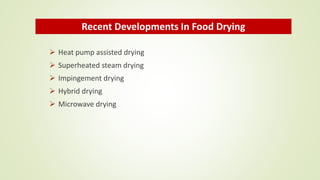
 Heat pump assisted drying
 Superheated steam drying
 Impingement drying
 Hybrid drying
 Microwave drying
Recent Developments In Food Drying
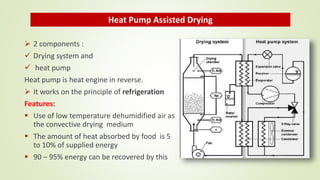
 2 components :
 Drying system and
 heat pump
Heat pump is heat engine in reverse.
 It works on the principle of refrigeration
Features:
 Use of low temperature dehumidified air as
the convective drying medium
 The amount of heat absorbed by food is 5
to 10% of supplied energy
 90 – 95% energy can be recovered by this
Heat Pump Assisted Drying
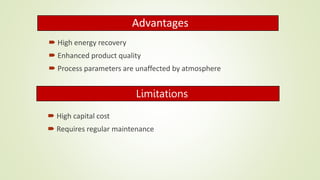
Advantages
 High energy recovery
 Enhanced product quality
 Process parameters are unaffected by atmosphere
Limitations
 High capital cost
 Requires regular maintenance
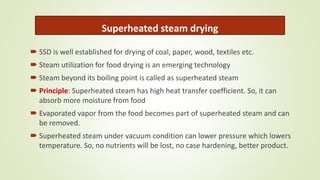
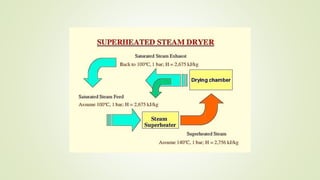
Superheated steam drying
 SSD is well established for drying of coal, paper, wood, textiles etc.
 Steam utilization for food drying is an emerging technology
 Steam beyond its boiling point is called as superheated steam
 Principle: Superheated steam has high heat transfer coefficient. So, it can
absorb more moisture from food
 Evaporated vapor from the food becomes part of superheated steam and can
be removed.
 Superheated steam under vacuum condition can lower pressure which lowers
temperature. So, no nutrients will be lost, no case hardening, better product.
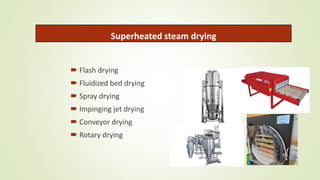
Superheated steam drying
 Flash drying
 Fluidized bed drying
 Spray drying
 Impinging jet drying
 Conveyor drying
 Rotary drying
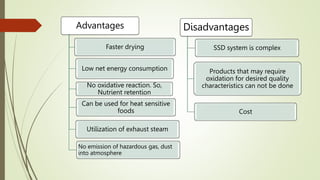
Advantages
Faster drying
Low net energy consumption
No oxidative reaction. So,
Nutrient retention
Can be used for heat sensitive
foods
No emission of hazardous gas, dust
into atmosphere
Utilization of exhaust steam
Disadvantages
SSD system is complex
Products that may require
oxidation for desired quality
characteristics can not be done
Cost
 Impingement drying is a very efficient way of drying the food that
blows hot and high velocity air onto the food to be dried.
 Impinging jets are largely employed to increase the performance of
air drying
 It increases heat transfer coefficient of air and thus reduces the
drying time
 This drying is highly accurate and uniform
 It is widely used in paper drying process
Impingment drying
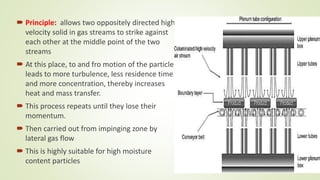
 Principle: allows two oppositely directed high
velocity solid in gas streams to strike against
each other at the middle point of the two
streams
 At this place, to and fro motion of the particle
leads to more turbulence, less residence time
and more concentration, thereby increases
heat and mass transfer.
 This process repeats until they lose their
momentum.
 Then carried out from impinging zone by
lateral gas flow
 This is highly suitable for high moisture
content particles
Advantages
 Reduces drying time
 Higher yield
 High quality product
 High capital cost
 10 -14% shrinkage
Disadvantages
Pulsed Electric Field Assisted Extraction
 Extraction is the separation of the desired natural products from the
raw materials.
 Extraction methods include solvent extraction, distillation method,
pressing and sublimation
 Limitations of traditional extraction methods include Poor
performance, Low yields, Long processing time, More solvent use,
thermal degradation of product
 PEF is a non thermal technology that uses high intensity short pulses of
electric field to inactivate microorganisms and thereby preserving the
food.
PEF uses moderate to high electric field strength
In batch mode: 100-300 KV/cm
In continuous mode: 10-80 KV/cm
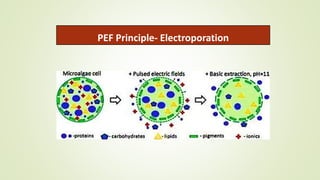
PEF Principle- Electroporation
Degree Of Electroporation Depends Upon
 Electric field strength: proportional to damage of the membrane
 Type of electric field
 No. of pulses
 Treatment time: nanoseconds to milliseconds
 Targeted plant material: plant cells, seeds, microorganisms
 For plant cells:- 0.1 to 10KV/cm
 For tough cells:- 10 to 20KV/cm
 Geometry and distance of electrodes
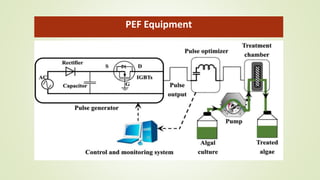
PEF Equipment
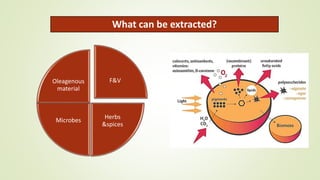
What can be extracted?
F&V
Herbs
&spices
Microbes
Oleagenous
material
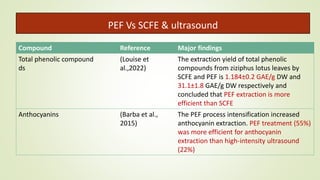
PEF Vs SCFE & ultrasound
Compound Reference Major findings
Total phenolic compound
ds
(Louise et
al.,2022)
The extraction yield of total phenolic
compounds from ziziphus lotus leaves by
SCFE and PEF is 1.184±0.2 GAE/g DW and
31.1±1.8 GAE/g DW respectively and
concluded that PEF extraction is more
efficient than SCFE
Anthocyanins (Barba et al.,
2015)
The PEF process intensification increased
anthocyanin extraction. PEF treatment (55%)
was more efficient for anthocyanin
extraction than high-intensity ultrasound
(22%)
Advantages
It is the best solution to extract phytoconstituents because
 it is efficient
 less time &solvent consumption
 Improved yield : 55-59% more with PEF than traditional extraction methods
 Heat sensitive components can be extracted without any losses
 high initial investment but less operating costs and higher yield justify it
 cooling coils requirement
Disadvantages
 Radiofrequency has been utilized in food industry since 1960s
 Radiofrequency heating involves utilizing electromagnetic energy at a
frequency range of 3KHz to 300 MHz
 Frequencies permitted for industrial, scientific, medicinal applications are
13.56MHz, 27.12MHz and 40.68MHz
 Radiofrequency is first utilized for blanching, cooking, drying, thawing and now
pasteurization/sterilization
Radiofrequency pasteurization
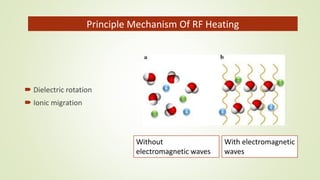
Principle Mechanism Of RF Heating
 Dielectric rotation
 Ionic migration
Without
electromagnetic waves
With electromagnetic
waves
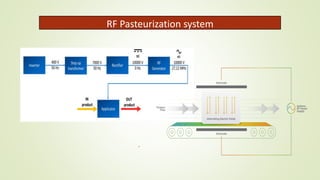
RF Pasteurization system
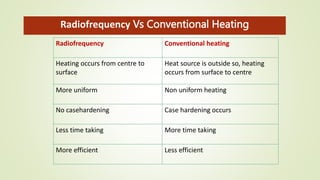
Radiofrequency Vs Conventional Heating
Radiofrequency Conventional heating
Heating occurs from centre to
surface
Heat source is outside so, heating
occurs from surface to centre
More uniform Non uniform heating
No casehardening Case hardening occurs
Less time taking More time taking
More efficient Less efficient
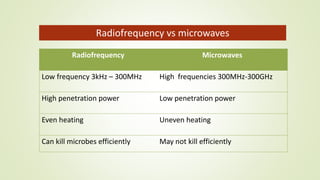
Radiofrequency Microwaves
Low frequency 3kHz – 300MHz High frequencies 300MHz-300GHz
High penetration power Low penetration power
Even heating Uneven heating
Can kill microbes efficiently May not kill efficiently
Radiofrequency vs microwaves
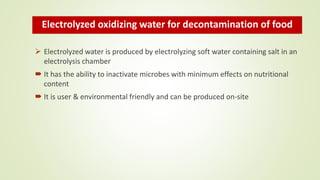
Electrolyzed oxidizing water for decontamination of food
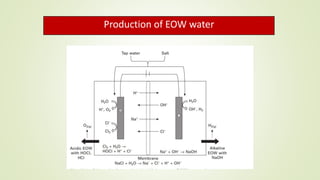
 Electrolyzed water is produced by electrolyzing soft water containing salt in an
electrolysis chamber
 It has the ability to inactivate microbes with minimum effects on nutritional
content
 It is user & environmental friendly and can be produced on-site
Production of EOW water
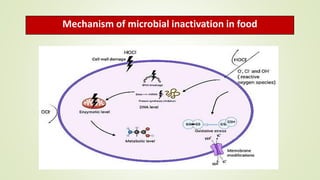
Mechanism of microbial inactivation in food
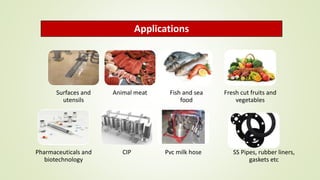
Applications
Surfaces and
utensils
Animal meat Fish and sea
food
Fresh cut fruits and
vegetables
Pharmaceuticals and
biotechnology
CIP Pvc milk hose SS Pipes, rubber liners,
gaskets etc
Advantages
 good sanitizing effect
 Non corrosive to skin: safe to use
 Low cost
 Environmental friendly
 Becomes ordinary water when diluted
Disadvantages
 Needs monitoring if auto adjustment control is not applicable
 Needs good ventilation as it produces hydrogen gas
 Low pH and chloride ions may lead to pitting if low quality SS is used
 Should be stored in closed container
 Electrolysis machine is costly as it is not widely used at present
Hyperspectral Imaging Technology: A Non Destructive Tool For
Food Safety And Quality Evaluation
 Food analysis is generally carried out by visual inspection at CCPS, chemical,
biological evaluation.
 But, they are tedious ,Time consuming, laborious, inconsistent, needs sample
preparation
 HPLC, mass spectrometry are expensive, destructive, time consuming
 Therefore, there is a need for accurate, rapid, reliable methods are necessary for
automatic quality evaluation.
 HSI is one such method, it analyses the food samples rapidly without any sample
preparation.
What is hyperspectral imaging?
 Imaging means visual representation of an object
 Spectral imaging is a branch of spectroscopy in which stack of
images of the same object at different wavelength in the
electromagnetic spectrum is collected
 Hyperspectral imaging is a sub category of spectral imaging
which involves collection and processing of information of an
object across the electromagnetic spectrum.
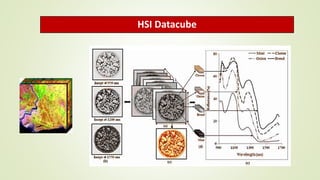
 The goal of hyperspectral imaging is to obtain the spectrum for
each pixel in the image of a scene, with the purpose of finding
objects, identifying materials, or detecting processes
HSI Datacube
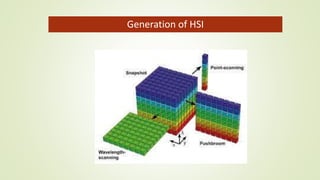
Generation of HSI
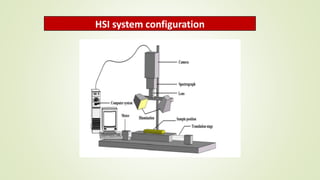
HSI system configuration
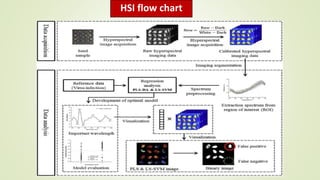
HSI flow chart
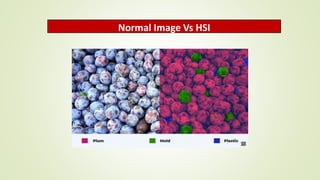
Normal Image Vs HSI
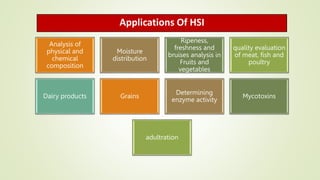
Applications Of HSI
Analysis of
physical and
chemical
composition
Moisture
distribution
Ripeness,
freshness and
bruises analysis in
Fruits and
vegetables
quality evaluation
of meat, fish and
poultry
Dairy products Grains
Determining
enzyme activity
Mycotoxins
adultration
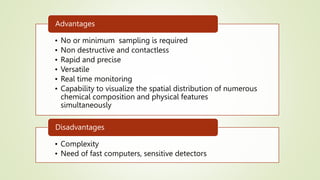
• No or minimum sampling is required
• Non destructive and contactless
• Rapid and precise
• Versatile
• Real time monitoring
• Capability to visualize the spatial distribution of numerous
chemical composition and physical features
simultaneously
Advantages
• Complexity
• Need of fast computers, sensitive detectors
Disadvantages
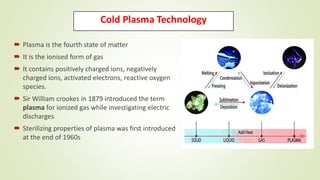
Cold Plasma Technology
 Plasma is the fourth state of matter
 It is the ionised form of gas
 It contains positively charged ions, negatively
charged ions, activated electrons, reactive oxygen
species.
 Sir William crookes in 1879 introduced the term
plasma for ionized gas while investigating electric
discharges
 Sterilizing properties of plasma was first introduced
at the end of 1960s
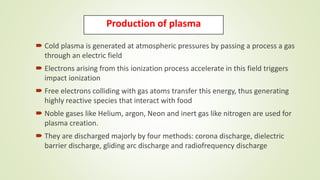
Production of plasma
 Cold plasma is generated at atmospheric pressures by passing a process a gas
through an electric field
 Electrons arising from this ionization process accelerate in this field triggers
impact ionization
 Free electrons colliding with gas atoms transfer this energy, thus generating
highly reactive species that interact with food
 Noble gases like Helium, argon, Neon and inert gas like nitrogen are used for
plasma creation.
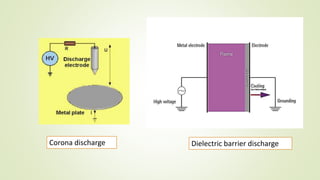
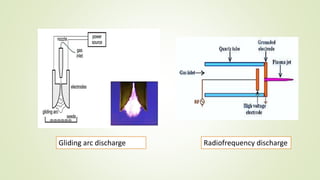
 They are discharged majorly by four methods: corona discharge, dielectric
barrier discharge, gliding arc discharge and radiofrequency discharge
Corona discharge Dielectric barrier discharge
Gliding arc discharge Radiofrequency discharge
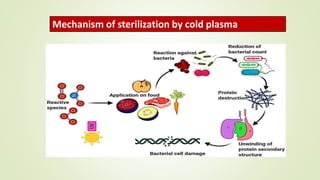
Mechanism of sterilization by cold plasma
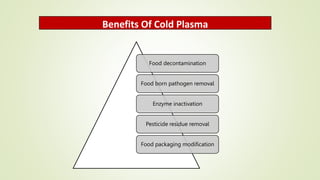
Benefits Of Cold Plasma
Food decontamination
Food born pathogen removal
Enzyme inactivation
Pesticide residue removal
Food packaging modification
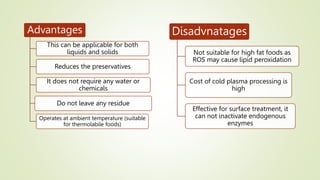
Advantages
This can be applicable for both
liquids and solids
Reduces the preservatives
It does not require any water or
chemicals
Do not leave any residue
Operates at ambient temperature (suitable
for thermolabile foods)
Disadvnatages
Not suitable for high fat foods as
ROS may cause lipid peroxidation
Cost of cold plasma processing is
high
Effective for surface treatment, it
can not inactivate endogenous
enzymes
References
 Manoj K. Dubey, John Janowiak, Ron Mack, Peggy Elder & Kelli Hoover (2016)
Comparative study of radio-frequency and microwave heating for phytosanitary
treatment of wood
 Ramon Bocker, Eric Keven Silva Pulsed electric field assisted extraction of natural
food pigments and colorings from plant matrices, journal of food chemistry
 Muhammad Modassar A. N. Ranjha 1 , Rabia Kanwal 1 , Bakhtawar Shafique 1 , Rai
Naveed Arshad(2021) A Critical Review on Pulsed Electric Field: A Novel Technology
for the Extraction of Phytoconstituents, molecles
 Jun-Hu Chenga and Da-Wen Suna (2014),Hyperspectral imaging as an effective
tool for quality analysis and control of fish and other seafoods: Current research
and potential applications, trends in food science & technology (2014)1-14
 Teresa Antequera 1 , Daniel Caballero 1,2τ, Silvia Grassi 3 , Bethany Uttaro 4 ,
Trinidad Perez-Palacios (2019) Use of Non-destructive Techniques for the Quality
Evaluation of Fresh Meat: A review
Thank you….

Recent advances in food engineering

  • 1.
    Vasantrao Naik MarathwadaKrishi Vidyapeeth College of food technology FST - 519 MASTER SEMINAR RECENT ADVANCES IN FOOD ENGINEERING Presented by Guruju Nookaratnam 2021T07M Submitted to Dr. B. S. Agarkar Ass. Professor Dept. of Food Engineering
  • 2.
     Recent advancesin drying  Pulsed electric field assisted extraction  Radiofrequency pasteurization  Cold plasma technology  Hyperspectral imaging for safety and quality evaluation Content
  • 3.
    Introduction  Engineering isthe application of scientific principles to design and build machines, equipment, buildings etc. for human use  Food engineering is the application of engineering principles to food processing and related issues.  Advancements in food engineering are nothing but renovation or improvement of already existing methods.  For food processing and other activities, even now we are using conventional methods which are based on heat or chemical treatments. These methods consume more time and energy and show adverse affects on food quality, nutritional and health aspects  So, in order to overcome these problems, recently certain advancements are made such as HPP, PEF, ultrasound, EOW, cold plasma, HSI etc.
  • 4.
    Recent Advances InDrying  Drying is a method of food preservation that removes enough moisture from the food so bacteria, yeast and molds cannot grow. It enhances shelflife quality, ease of handling, organoleptic properties of food etc.  There are many drying techniques like air drying, spray drying, fluidized bed drying, vacuum drying, osmotic drying etc. for different types of wet feedstock Needs of new developments in drying  To improve control of product quality To increase capacity than existing drying systems To achieve Sustainability in overall process To dry new products such as functional foods To Reduce the risk of fire, explosion and toxic hazards To get better control of dryer and drying systems
  • 5.
     Heat pumpassisted drying  Superheated steam drying  Impingement drying  Hybrid drying  Microwave drying Recent Developments In Food Drying
  • 6.
     2 components:  Drying system and  heat pump Heat pump is heat engine in reverse.  It works on the principle of refrigeration Features:  Use of low temperature dehumidified air as the convective drying medium  The amount of heat absorbed by food is 5 to 10% of supplied energy  90 – 95% energy can be recovered by this Heat Pump Assisted Drying
  • 7.
    Advantages  High energyrecovery  Enhanced product quality  Process parameters are unaffected by atmosphere Limitations  High capital cost  Requires regular maintenance
  • 8.
    Superheated steam drying SSD is well established for drying of coal, paper, wood, textiles etc.  Steam utilization for food drying is an emerging technology  Steam beyond its boiling point is called as superheated steam  Principle: Superheated steam has high heat transfer coefficient. So, it can absorb more moisture from food  Evaporated vapor from the food becomes part of superheated steam and can be removed.  Superheated steam under vacuum condition can lower pressure which lowers temperature. So, no nutrients will be lost, no case hardening, better product.
  • 10.
    Superheated steam drying Flash drying  Fluidized bed drying  Spray drying  Impinging jet drying  Conveyor drying  Rotary drying
  • 11.
    Advantages Faster drying Low netenergy consumption No oxidative reaction. So, Nutrient retention Can be used for heat sensitive foods No emission of hazardous gas, dust into atmosphere Utilization of exhaust steam Disadvantages SSD system is complex Products that may require oxidation for desired quality characteristics can not be done Cost
  • 12.
     Impingement dryingis a very efficient way of drying the food that blows hot and high velocity air onto the food to be dried.  Impinging jets are largely employed to increase the performance of air drying  It increases heat transfer coefficient of air and thus reduces the drying time  This drying is highly accurate and uniform  It is widely used in paper drying process Impingment drying
  • 13.
     Principle: allowstwo oppositely directed high velocity solid in gas streams to strike against each other at the middle point of the two streams  At this place, to and fro motion of the particle leads to more turbulence, less residence time and more concentration, thereby increases heat and mass transfer.  This process repeats until they lose their momentum.  Then carried out from impinging zone by lateral gas flow  This is highly suitable for high moisture content particles
  • 14.
    Advantages  Reduces dryingtime  Higher yield  High quality product  High capital cost  10 -14% shrinkage Disadvantages
  • 15.
    Pulsed Electric FieldAssisted Extraction  Extraction is the separation of the desired natural products from the raw materials.  Extraction methods include solvent extraction, distillation method, pressing and sublimation  Limitations of traditional extraction methods include Poor performance, Low yields, Long processing time, More solvent use, thermal degradation of product  PEF is a non thermal technology that uses high intensity short pulses of electric field to inactivate microorganisms and thereby preserving the food. PEF uses moderate to high electric field strength In batch mode: 100-300 KV/cm In continuous mode: 10-80 KV/cm
  • 16.
  • 17.
    Degree Of ElectroporationDepends Upon  Electric field strength: proportional to damage of the membrane  Type of electric field  No. of pulses  Treatment time: nanoseconds to milliseconds  Targeted plant material: plant cells, seeds, microorganisms  For plant cells:- 0.1 to 10KV/cm  For tough cells:- 10 to 20KV/cm  Geometry and distance of electrodes
  • 18.
  • 19.
    What can beextracted? F&V Herbs &spices Microbes Oleagenous material
  • 20.
    PEF Vs SCFE& ultrasound Compound Reference Major findings Total phenolic compound ds (Louise et al.,2022) The extraction yield of total phenolic compounds from ziziphus lotus leaves by SCFE and PEF is 1.184±0.2 GAE/g DW and 31.1±1.8 GAE/g DW respectively and concluded that PEF extraction is more efficient than SCFE Anthocyanins (Barba et al., 2015) The PEF process intensification increased anthocyanin extraction. PEF treatment (55%) was more efficient for anthocyanin extraction than high-intensity ultrasound (22%)
  • 21.
    Advantages It is thebest solution to extract phytoconstituents because  it is efficient  less time &solvent consumption  Improved yield : 55-59% more with PEF than traditional extraction methods  Heat sensitive components can be extracted without any losses  high initial investment but less operating costs and higher yield justify it  cooling coils requirement Disadvantages
  • 22.
     Radiofrequency hasbeen utilized in food industry since 1960s  Radiofrequency heating involves utilizing electromagnetic energy at a frequency range of 3KHz to 300 MHz  Frequencies permitted for industrial, scientific, medicinal applications are 13.56MHz, 27.12MHz and 40.68MHz  Radiofrequency is first utilized for blanching, cooking, drying, thawing and now pasteurization/sterilization Radiofrequency pasteurization
  • 23.
    Principle Mechanism OfRF Heating  Dielectric rotation  Ionic migration Without electromagnetic waves With electromagnetic waves
  • 24.
  • 25.
    Radiofrequency Vs ConventionalHeating Radiofrequency Conventional heating Heating occurs from centre to surface Heat source is outside so, heating occurs from surface to centre More uniform Non uniform heating No casehardening Case hardening occurs Less time taking More time taking More efficient Less efficient
  • 26.
    Radiofrequency Microwaves Low frequency3kHz – 300MHz High frequencies 300MHz-300GHz High penetration power Low penetration power Even heating Uneven heating Can kill microbes efficiently May not kill efficiently Radiofrequency vs microwaves
  • 27.
    Electrolyzed oxidizing waterfor decontamination of food  Electrolyzed water is produced by electrolyzing soft water containing salt in an electrolysis chamber  It has the ability to inactivate microbes with minimum effects on nutritional content  It is user & environmental friendly and can be produced on-site
  • 28.
  • 29.
    Mechanism of microbialinactivation in food
  • 30.
    Applications Surfaces and utensils Animal meatFish and sea food Fresh cut fruits and vegetables Pharmaceuticals and biotechnology CIP Pvc milk hose SS Pipes, rubber liners, gaskets etc
  • 31.
    Advantages  good sanitizingeffect  Non corrosive to skin: safe to use  Low cost  Environmental friendly  Becomes ordinary water when diluted
  • 32.
    Disadvantages  Needs monitoringif auto adjustment control is not applicable  Needs good ventilation as it produces hydrogen gas  Low pH and chloride ions may lead to pitting if low quality SS is used  Should be stored in closed container  Electrolysis machine is costly as it is not widely used at present
  • 33.
    Hyperspectral Imaging Technology:A Non Destructive Tool For Food Safety And Quality Evaluation  Food analysis is generally carried out by visual inspection at CCPS, chemical, biological evaluation.  But, they are tedious ,Time consuming, laborious, inconsistent, needs sample preparation  HPLC, mass spectrometry are expensive, destructive, time consuming  Therefore, there is a need for accurate, rapid, reliable methods are necessary for automatic quality evaluation.  HSI is one such method, it analyses the food samples rapidly without any sample preparation.
  • 34.
    What is hyperspectralimaging?  Imaging means visual representation of an object  Spectral imaging is a branch of spectroscopy in which stack of images of the same object at different wavelength in the electromagnetic spectrum is collected  Hyperspectral imaging is a sub category of spectral imaging which involves collection and processing of information of an object across the electromagnetic spectrum.  The goal of hyperspectral imaging is to obtain the spectrum for each pixel in the image of a scene, with the purpose of finding objects, identifying materials, or detecting processes
  • 35.
  • 36.
  • 37.
  • 38.
  • 39.
  • 40.
    Applications Of HSI Analysisof physical and chemical composition Moisture distribution Ripeness, freshness and bruises analysis in Fruits and vegetables quality evaluation of meat, fish and poultry Dairy products Grains Determining enzyme activity Mycotoxins adultration
  • 41.
    • No orminimum sampling is required • Non destructive and contactless • Rapid and precise • Versatile • Real time monitoring • Capability to visualize the spatial distribution of numerous chemical composition and physical features simultaneously Advantages • Complexity • Need of fast computers, sensitive detectors Disadvantages
  • 42.
    Cold Plasma Technology Plasma is the fourth state of matter  It is the ionised form of gas  It contains positively charged ions, negatively charged ions, activated electrons, reactive oxygen species.  Sir William crookes in 1879 introduced the term plasma for ionized gas while investigating electric discharges  Sterilizing properties of plasma was first introduced at the end of 1960s
  • 43.
    Production of plasma Cold plasma is generated at atmospheric pressures by passing a process a gas through an electric field  Electrons arising from this ionization process accelerate in this field triggers impact ionization  Free electrons colliding with gas atoms transfer this energy, thus generating highly reactive species that interact with food  Noble gases like Helium, argon, Neon and inert gas like nitrogen are used for plasma creation.  They are discharged majorly by four methods: corona discharge, dielectric barrier discharge, gliding arc discharge and radiofrequency discharge
  • 44.
    Corona discharge Dielectricbarrier discharge
  • 45.
    Gliding arc dischargeRadiofrequency discharge
  • 46.
  • 47.
    Benefits Of ColdPlasma Food decontamination Food born pathogen removal Enzyme inactivation Pesticide residue removal Food packaging modification
  • 48.
    Advantages This can beapplicable for both liquids and solids Reduces the preservatives It does not require any water or chemicals Do not leave any residue Operates at ambient temperature (suitable for thermolabile foods) Disadvnatages Not suitable for high fat foods as ROS may cause lipid peroxidation Cost of cold plasma processing is high Effective for surface treatment, it can not inactivate endogenous enzymes
  • 49.
    References  Manoj K.Dubey, John Janowiak, Ron Mack, Peggy Elder & Kelli Hoover (2016) Comparative study of radio-frequency and microwave heating for phytosanitary treatment of wood  Ramon Bocker, Eric Keven Silva Pulsed electric field assisted extraction of natural food pigments and colorings from plant matrices, journal of food chemistry  Muhammad Modassar A. N. Ranjha 1 , Rabia Kanwal 1 , Bakhtawar Shafique 1 , Rai Naveed Arshad(2021) A Critical Review on Pulsed Electric Field: A Novel Technology for the Extraction of Phytoconstituents, molecles  Jun-Hu Chenga and Da-Wen Suna (2014),Hyperspectral imaging as an effective tool for quality analysis and control of fish and other seafoods: Current research and potential applications, trends in food science & technology (2014)1-14  Teresa Antequera 1 , Daniel Caballero 1,2τ, Silvia Grassi 3 , Bethany Uttaro 4 , Trinidad Perez-Palacios (2019) Use of Non-destructive Techniques for the Quality Evaluation of Fresh Meat: A review
  • 50.