Supercritical Fluids
Pharmaceutical department 2019/2020 Dr.Ahmad Abdulhusiaan Yosef
Overview
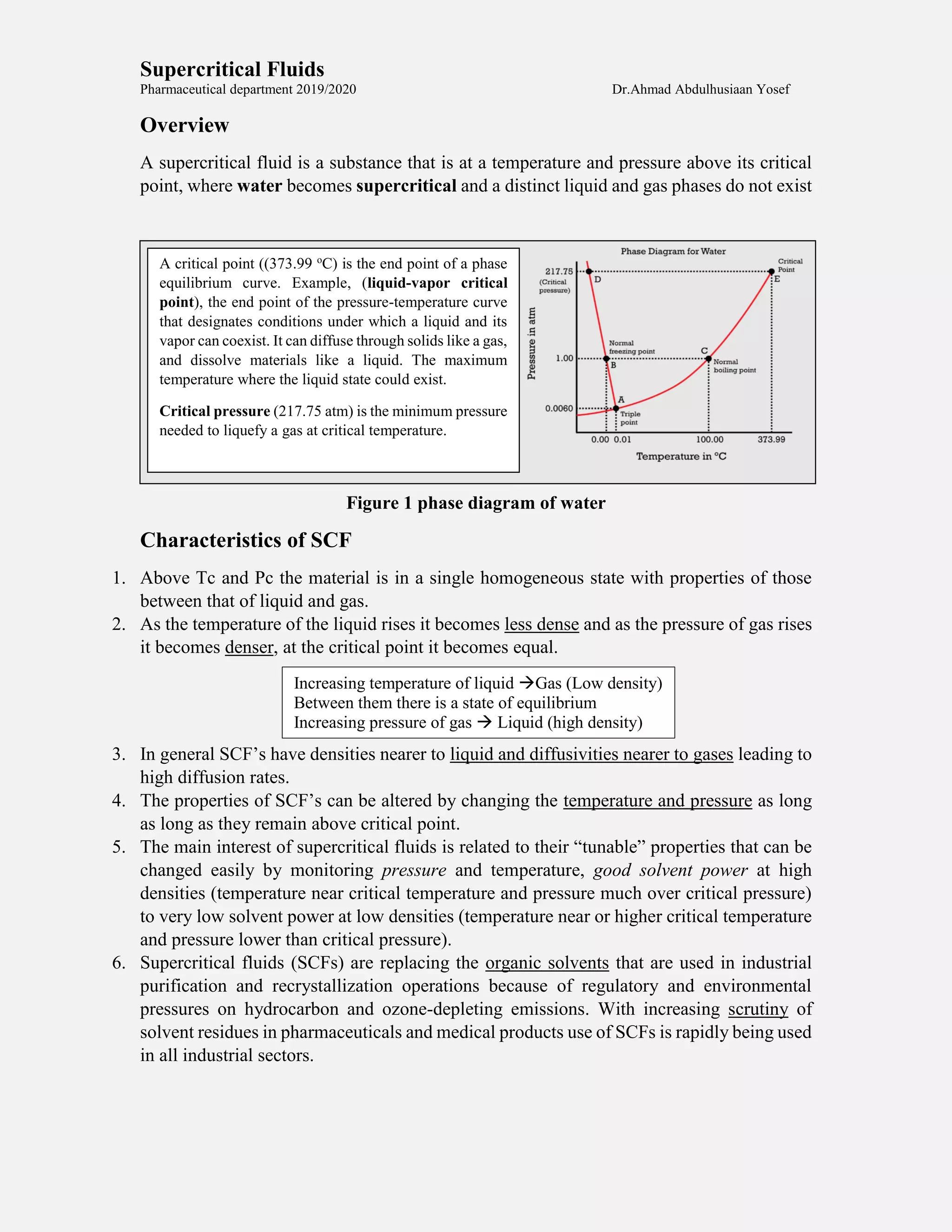
A supercritical fluid is a substance that is at a temperature and pressure above its critical
point, where water becomes supercritical and a distinct liquid and gas phases do not exist
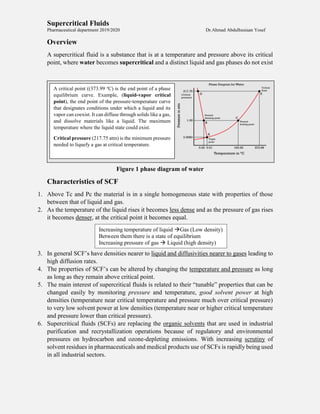
Figure 1 phase diagram of water
Characteristics of SCF
1. Above Tc and Pc the material is in a single homogeneous state with properties of those
between that of liquid and gas.
2. As the temperature of the liquid rises it becomes less dense and as the pressure of gas rises
it becomes denser, at the critical point it becomes equal.
3. In general SCF’s have densities nearer to liquid and diffusivities nearer to gases leading to
high diffusion rates.
4. The properties of SCF’s can be altered by changing the temperature and pressure as long
as long as they remain above critical point.
5. The main interest of supercritical fluids is related to their “tunable” properties that can be
changed easily by monitoring pressure and temperature, good solvent power at high
densities (temperature near critical temperature and pressure much over critical pressure)
to very low solvent power at low densities (temperature near or higher critical temperature
and pressure lower than critical pressure).
6. Supercritical fluids (SCFs) are replacing the organic solvents that are used in industrial
purification and recrystallization operations because of regulatory and environmental
pressures on hydrocarbon and ozone-depleting emissions. With increasing scrutiny of
solvent residues in pharmaceuticals and medical products use of SCFs is rapidly being used
in all industrial sectors.
A critical point ((373.99 o
C) is the end point of a phase
equilibrium curve. Example, (liquid-vapor critical
point), the end point of the pressure-temperature curve
that designates conditions under which a liquid and its
vapor can coexist. It can diffuse through solids like a gas,
and dissolve materials like a liquid. The maximum
temperature where the liquid state could exist.
Critical pressure (217.75 atm) is the minimum pressure
needed to liquefy a gas at critical temperature.
Increasing temperature of liquid Gas (Low density)
Between them there is a state of equilibrium
Increasing pressure of gas  Liquid (high density)
Supercritical Fluids
Pharmaceutical department 2019/2020 Dr.Ahmad Abdulhusiaan Yosef
Phase behavior of supercritical fluids
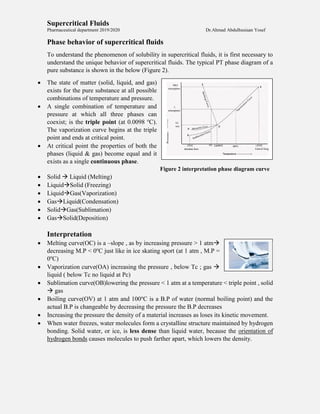
To understand the phenomenon of solubility in supercritical fluids, it is first necessary to
understand the unique behavior of supercritical fluids. The typical PT phase diagram of a
pure substance is shown in the below (Figure 2).
 The state of matter (solid, liquid, and gas)
exists for the pure substance at all possible
combinations of temperature and pressure.
 A single combination of temperature and
pressure at which all three phases can
coexist; is the triple point (at 0.0098 o
C).
The vaporization curve begins at the triple
point and ends at critical point.
 At critical point the properties of both the
phases (liquid & gas) become equal and it
exists as a single continuous phase.
Figure 2 interpretation phase diagram curve
 Solid  Liquid (Melting)
 LiquidSolid (Freezing)
 LiquidGas(Vaporization)
 GasLiquid(Condensation)
 SolidGas(Sublimation)
 GasSolid(Deposition)
Interpretation
 Melting curve(OC) is a –slope , as by increasing pressure > 1 atm
decreasing M.P < 0o
C just like in ice skating sport (at 1 atm , M.P =
0o
C)
 Vaporization curve(OA) increasing the pressure , below Tc ; gas 
liquid ( below Tc no liquid at Pc)
 Sublimation curve(OB)lowering the pressure < 1 atm at a temperature < triple point , solid
 gas
 Boiling curve(OV) at 1 atm and 100o
C is a B.P of water (normal boiling point) and the
actual B.P is changeable by decreasing the pressure the B.P decreases
 Increasing the pressure the density of a material increases as loses its kinetic movement.
 When water freezes, water molecules form a crystalline structure maintained by hydrogen
bonding. Solid water, or ice, is less dense than liquid water, because the orientation of
hydrogen bonds causes molecules to push farther apart, which lowers the density.
Supercritical Fluids
Pharmaceutical department 2019/2020 Dr.Ahmad Abdulhusiaan Yosef
Properties of SCF
 Density
Could be tuned by changing the pressure and temperature
Tunable solubility of a solute
 Gas like viscosity
Accelerate the chemical reaction kinetics.
 Zero surface tension ,
Good wetting of the surface to allow chemical reaction happen on the surface
Facilitates a better penetration of the reactants into a porous structure.
 SCf is good substitution for organic solvent
Application of SCF
SFE (Supercritical fluid extraction) is a separation process where solid or liquid matter is
processed with SCF in order to obtain soluble compounds from the mixtures. SCF offers a
variety of applications by changing pressure and temperature. A fluid above critical
temperature has gas-like viscosity, liquid-like density, and its diffusion magnitude of order
is between the two states. An important factor that has to be considered is the mass transfer
of the solute in the supercritical solvent. Mass transfer depends on the solubility of the
solute in the given solvent. Different compounds have different degrees of solubility under
various operating conditions.
The most common solvent used as a SCF is carbon dioxide (CO2). When polar components
are extracted and supercritical CO2 (SC–CO2) is used as a solvent, a polar modifier or co-
solvent is mixed with SC–CO2 to enhance solubility. Examples of such a modifier are
methanol, ethanol, etc. When a modifier is added, it is not only solubility, but also viscosity
and density that are increased.
One of the commonest application of (CO2) in the extracting of caffeine from raw coffee,
roast coffee and tea. Super-critical carbon dioxide is used as extracting agent, and ion-
exchangers are used to absorb the caffeine.
Supercritical Fluids
Pharmaceutical department 2019/2020 Dr.Ahmad Abdulhusiaan Yosef
Supercritical water
1. Supercritical Water Oxidation
The destruction of toxic organic wastewaters from complex industries becomes an
overwhelming problem if we use conventional treatment processes.
Incineration and supercritical water oxidation (SCWO), exist for the complete destruction
of toxic organic wastewaters. Incinerator has problems such as very high cost and public
resentment; on the other hand, SCWO has proved to be a very promising method for the
treatment of many different waste waters with extremely efficient organic waste
destruction 99.99% with none of the emissions associated with incineration.
2. Supercritical water reactor
There are basically two types of reactors used in nuclear power plants i.e. pressurized water
reactor (PWR) and boiling water reactor (BWR). Both use steam generated from the
nuclear fission reactions (nuclear reaction in which the nucleus of an atom splits into
smaller parts (lighter nuclei) of uranium which generate up to 1MeV (Mega Electron volt)
of energy which converts the cooling water to steam and rotates the turbine to produce
electrical energy. The major difference between them is in BWR, which is 1st generation,
only one cycle is used while in PWR two cycles are used. Here care is taken to ensure no
boiling takes place and the water is kept at high pressure.
3. Supercritical Fluid Extraction
Often the analysis of complex materials requires as a preliminary step separation of the
analyte form a sample matrix. Ideally, an analytical separation method should be rapid,
simple and inexpensive; should give quantitative recovery of analytes without loss or
degradation; should yield a solution of the analyte this is sufficiently concentrated to permit
the final measurement to be made without the need for concentration; and should generate
little or no laboratory wastes that have to be disposed of.
-steady state extraction)
.
Extraction modes
-line extraction.
-line extraction.
Common Industrial Applications includes:
pharmaceutical and biochemical industry.
Supercritical Fluids
Pharmaceutical department 2019/2020 Dr.Ahmad Abdulhusiaan Yosef
Materials Analyzed in Environmental Applications:
Alkanes,
Classification of SCF technology
Depending on the way SCF-CO2 is being used.
-solvent for the precipitation of active substances in organic solvents)
Conclusion
SCF address many challenges facing drug delivery
1. Particle generation and processing
2. Products range from dry powder to micro and nano drug carriers
3. Could retain the biological activity of heat labile pharmaceuticals
(Proteins and antibiotics)
References
1. http://en.wikipedia.org/wiki/Supercritical_fluid, 15/01/15, 18.30
2. C:Usershp-pcDesktopPROPERTIES FLUIDS.html,15/01/15, 18.30
3. Author: Michel PERRUT – SEPAREX, What is a Supercritical Fluid, 1999
4. C:Usershp-pcDesktopCharacteristics of Supercritical Fluids.html,15/01/15 19, 45
5. C:Usershp-pcDesktopSupercritical Fluid Applications Supercritical Fluid Extraction
Phasex Corporation.html,15/01/15 19, 45
6. Mike Lancaster, Introduction to Green Chemistry, 5th edition, 120-154
7. Veriyansyah, Bambang, Kim Jae duck, Supercritical water oxidation for the destruction
of toxic organic wastewaters, received 16 June 2006, revised 28 September
8. www.power.alstom.com, 27/1/15, 20.30
9. C:Usershp-pcDocumentsPatent US4644060 - Cellulose hydrolysis to
monosaccharide’s; livestock feed from agricultural wastes - Google Patents.html, 15/2/15,
20.55
10. Supercritical Fluid Extraction (SCFE) Technologies from IIT Bombay

Supercritical Fluid

  • 1.
    Supercritical Fluids Pharmaceutical department2019/2020 Dr.Ahmad Abdulhusiaan Yosef Overview A supercritical fluid is a substance that is at a temperature and pressure above its critical point, where water becomes supercritical and a distinct liquid and gas phases do not exist Figure 1 phase diagram of water Characteristics of SCF 1. Above Tc and Pc the material is in a single homogeneous state with properties of those between that of liquid and gas. 2. As the temperature of the liquid rises it becomes less dense and as the pressure of gas rises it becomes denser, at the critical point it becomes equal. 3. In general SCF’s have densities nearer to liquid and diffusivities nearer to gases leading to high diffusion rates. 4. The properties of SCF’s can be altered by changing the temperature and pressure as long as long as they remain above critical point. 5. The main interest of supercritical fluids is related to their “tunable” properties that can be changed easily by monitoring pressure and temperature, good solvent power at high densities (temperature near critical temperature and pressure much over critical pressure) to very low solvent power at low densities (temperature near or higher critical temperature and pressure lower than critical pressure). 6. Supercritical fluids (SCFs) are replacing the organic solvents that are used in industrial purification and recrystallization operations because of regulatory and environmental pressures on hydrocarbon and ozone-depleting emissions. With increasing scrutiny of solvent residues in pharmaceuticals and medical products use of SCFs is rapidly being used in all industrial sectors. A critical point ((373.99 o C) is the end point of a phase equilibrium curve. Example, (liquid-vapor critical point), the end point of the pressure-temperature curve that designates conditions under which a liquid and its vapor can coexist. It can diffuse through solids like a gas, and dissolve materials like a liquid. The maximum temperature where the liquid state could exist. Critical pressure (217.75 atm) is the minimum pressure needed to liquefy a gas at critical temperature. Increasing temperature of liquid Gas (Low density) Between them there is a state of equilibrium Increasing pressure of gas  Liquid (high density)
  • 2.
    Supercritical Fluids Pharmaceutical department2019/2020 Dr.Ahmad Abdulhusiaan Yosef Phase behavior of supercritical fluids To understand the phenomenon of solubility in supercritical fluids, it is first necessary to understand the unique behavior of supercritical fluids. The typical PT phase diagram of a pure substance is shown in the below (Figure 2).  The state of matter (solid, liquid, and gas) exists for the pure substance at all possible combinations of temperature and pressure.  A single combination of temperature and pressure at which all three phases can coexist; is the triple point (at 0.0098 o C). The vaporization curve begins at the triple point and ends at critical point.  At critical point the properties of both the phases (liquid & gas) become equal and it exists as a single continuous phase. Figure 2 interpretation phase diagram curve  Solid  Liquid (Melting)  LiquidSolid (Freezing)  LiquidGas(Vaporization)  GasLiquid(Condensation)  SolidGas(Sublimation)  GasSolid(Deposition) Interpretation  Melting curve(OC) is a –slope , as by increasing pressure > 1 atm decreasing M.P < 0o C just like in ice skating sport (at 1 atm , M.P = 0o C)  Vaporization curve(OA) increasing the pressure , below Tc ; gas  liquid ( below Tc no liquid at Pc)  Sublimation curve(OB)lowering the pressure < 1 atm at a temperature < triple point , solid  gas  Boiling curve(OV) at 1 atm and 100o C is a B.P of water (normal boiling point) and the actual B.P is changeable by decreasing the pressure the B.P decreases  Increasing the pressure the density of a material increases as loses its kinetic movement.  When water freezes, water molecules form a crystalline structure maintained by hydrogen bonding. Solid water, or ice, is less dense than liquid water, because the orientation of hydrogen bonds causes molecules to push farther apart, which lowers the density.
  • 3.
    Supercritical Fluids Pharmaceutical department2019/2020 Dr.Ahmad Abdulhusiaan Yosef Properties of SCF  Density Could be tuned by changing the pressure and temperature Tunable solubility of a solute  Gas like viscosity Accelerate the chemical reaction kinetics.  Zero surface tension , Good wetting of the surface to allow chemical reaction happen on the surface Facilitates a better penetration of the reactants into a porous structure.  SCf is good substitution for organic solvent Application of SCF SFE (Supercritical fluid extraction) is a separation process where solid or liquid matter is processed with SCF in order to obtain soluble compounds from the mixtures. SCF offers a variety of applications by changing pressure and temperature. A fluid above critical temperature has gas-like viscosity, liquid-like density, and its diffusion magnitude of order is between the two states. An important factor that has to be considered is the mass transfer of the solute in the supercritical solvent. Mass transfer depends on the solubility of the solute in the given solvent. Different compounds have different degrees of solubility under various operating conditions. The most common solvent used as a SCF is carbon dioxide (CO2). When polar components are extracted and supercritical CO2 (SC–CO2) is used as a solvent, a polar modifier or co- solvent is mixed with SC–CO2 to enhance solubility. Examples of such a modifier are methanol, ethanol, etc. When a modifier is added, it is not only solubility, but also viscosity and density that are increased. One of the commonest application of (CO2) in the extracting of caffeine from raw coffee, roast coffee and tea. Super-critical carbon dioxide is used as extracting agent, and ion- exchangers are used to absorb the caffeine.
  • 4.
    Supercritical Fluids Pharmaceutical department2019/2020 Dr.Ahmad Abdulhusiaan Yosef Supercritical water 1. Supercritical Water Oxidation The destruction of toxic organic wastewaters from complex industries becomes an overwhelming problem if we use conventional treatment processes. Incineration and supercritical water oxidation (SCWO), exist for the complete destruction of toxic organic wastewaters. Incinerator has problems such as very high cost and public resentment; on the other hand, SCWO has proved to be a very promising method for the treatment of many different waste waters with extremely efficient organic waste destruction 99.99% with none of the emissions associated with incineration. 2. Supercritical water reactor There are basically two types of reactors used in nuclear power plants i.e. pressurized water reactor (PWR) and boiling water reactor (BWR). Both use steam generated from the nuclear fission reactions (nuclear reaction in which the nucleus of an atom splits into smaller parts (lighter nuclei) of uranium which generate up to 1MeV (Mega Electron volt) of energy which converts the cooling water to steam and rotates the turbine to produce electrical energy. The major difference between them is in BWR, which is 1st generation, only one cycle is used while in PWR two cycles are used. Here care is taken to ensure no boiling takes place and the water is kept at high pressure. 3. Supercritical Fluid Extraction Often the analysis of complex materials requires as a preliminary step separation of the analyte form a sample matrix. Ideally, an analytical separation method should be rapid, simple and inexpensive; should give quantitative recovery of analytes without loss or degradation; should yield a solution of the analyte this is sufficiently concentrated to permit the final measurement to be made without the need for concentration; and should generate little or no laboratory wastes that have to be disposed of. -steady state extraction) . Extraction modes -line extraction. -line extraction. Common Industrial Applications includes: pharmaceutical and biochemical industry.
  • 5.
    Supercritical Fluids Pharmaceutical department2019/2020 Dr.Ahmad Abdulhusiaan Yosef Materials Analyzed in Environmental Applications: Alkanes, Classification of SCF technology Depending on the way SCF-CO2 is being used. -solvent for the precipitation of active substances in organic solvents) Conclusion SCF address many challenges facing drug delivery 1. Particle generation and processing 2. Products range from dry powder to micro and nano drug carriers 3. Could retain the biological activity of heat labile pharmaceuticals (Proteins and antibiotics) References 1. http://en.wikipedia.org/wiki/Supercritical_fluid, 15/01/15, 18.30 2. C:Usershp-pcDesktopPROPERTIES FLUIDS.html,15/01/15, 18.30 3. Author: Michel PERRUT – SEPAREX, What is a Supercritical Fluid, 1999 4. C:Usershp-pcDesktopCharacteristics of Supercritical Fluids.html,15/01/15 19, 45 5. C:Usershp-pcDesktopSupercritical Fluid Applications Supercritical Fluid Extraction Phasex Corporation.html,15/01/15 19, 45 6. Mike Lancaster, Introduction to Green Chemistry, 5th edition, 120-154 7. Veriyansyah, Bambang, Kim Jae duck, Supercritical water oxidation for the destruction of toxic organic wastewaters, received 16 June 2006, revised 28 September 8. www.power.alstom.com, 27/1/15, 20.30 9. C:Usershp-pcDocumentsPatent US4644060 - Cellulose hydrolysis to monosaccharide’s; livestock feed from agricultural wastes - Google Patents.html, 15/2/15, 20.55 10. Supercritical Fluid Extraction (SCFE) Technologies from IIT Bombay