Supercomputers and Supernetworks  are Transforming Research Invited Talk  Computing Research that Changed the World: Reflections and Perspectives Washington, DC March 25, 2009 Dr. Larry Smarr Director, California Institute for Telecommunications and Information Technology Harry E. Gruber Professor,  Dept. of Computer Science and Engineering Jacobs School of Engineering, UCSD
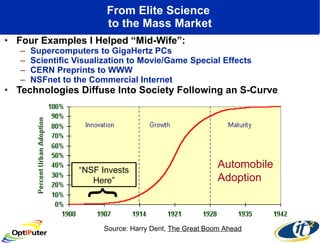
From Elite Science  to the Mass Market Four Examples I Helped “Mid-Wife”: Supercomputers to GigaHertz PCs Scientific Visualization to Movie/Game Special Effects CERN Preprints to WWW NSFnet to the Commercial Internet Technologies Diffuse Into Society Following an S-Curve Automobile  Adoption  Source: Harry Dent,  The Great Boom Ahead “ NSF Invests Here” {
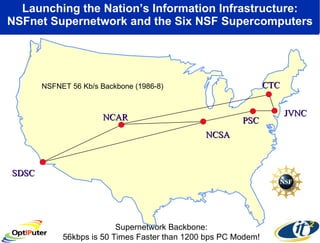
Launching the Nation’s Information Infrastructure: NSFnet Supernetwork and the Six NSF Supercomputers NCSA NSFNET 56 Kb/s Backbone (1986-8) PSC NCAR CTC JVNC SDSC Supernetwork Backbone: 56kbps is 50 Times Faster than 1200 bps PC Modem!
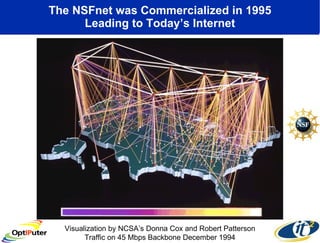
The NSFnet was Commercialized in 1995 Leading to Today’s Internet Visualization by NCSA’s Donna Cox and Robert Patterson Traffic on 45 Mbps Backbone December 1994
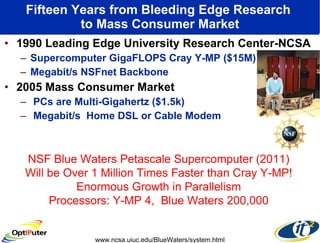
Fifteen Years from Bleeding Edge Research  to Mass Consumer Market 1990 Leading Edge University Research Center-NCSA Supercomputer GigaFLOPS Cray Y-MP ($15M) Megabit/s NSFnet Backbone 2005 Mass Consumer Market PCs are Multi-Gigahertz ($1.5k) Megabit/s  Home DSL or Cable Modem NSF Blue Waters Petascale Supercomputer (2011) Will be Over 1 Million Times Faster than Cray Y-MP! Enormous Growth in Parallelism Processors: Y-MP 4,  Blue Waters 200,000 www.ncsa.uiuc.edu/BlueWaters/system.html
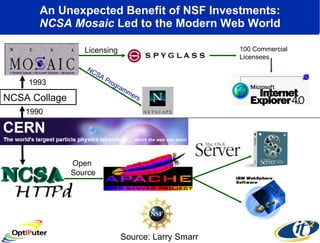
An Unexpected Benefit of NSF Investments: NCSA Mosaic  Led to the Modern Web World 1990 Source: Larry Smarr NCSA Collage 100 Commercial Licensees NCSA Programmers Open  Source Licensing 1993
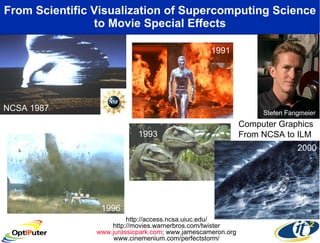
From Scientific Visualization of Supercomputing Science to Movie Special Effects http://access.ncsa.uiuc.edu/ http://movies.warnerbros.com/twister www.jurassicpark.com ; www.jamescameron.org www.cinemenium.com/perfectstorm/ NCSA 1987 1993 1996 2000 Computer Graphics From NCSA to ILM 1991 Stefen Fangmeier  
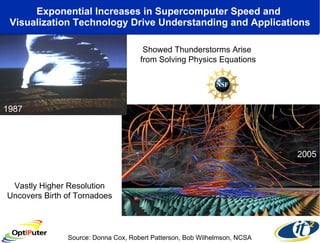
Exponential Increases in Supercomputer Speed and  Visualization Technology Drive Understanding and Applications Source: Donna Cox, Robert Patterson, Bob Wilhelmson, NCSA 1987 2005 Showed Thunderstorms Arise  from Solving Physics Equations Vastly Higher Resolution Uncovers Birth of Tornadoes
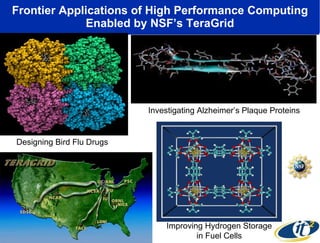
Frontier Applications of High Performance Computing Enabled by NSF’s TeraGrid Designing Bird Flu Drugs Investigating Alzheimer’s Plaque Proteins Improving Hydrogen Storage in Fuel Cells
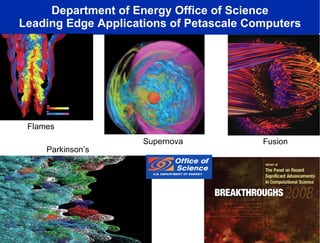
Department of Energy Office of Science Leading Edge Applications of Petascale Computers Flames Supernova Parkinson’s Fusion
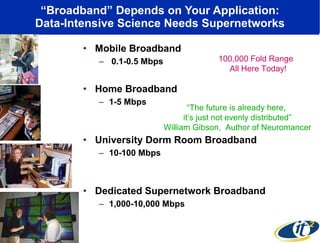
“ Broadband” Depends on Your Application: Data-Intensive Science Needs Supernetworks Mobile Broadband 0.1-0.5 Mbps Home Broadband 1-5 Mbps University Dorm Room Broadband 10-100 Mbps Dedicated Supernetwork Broadband 1,000-10,000 Mbps 100,000 Fold Range  All Here Today! “ The future is already here,  it’s just not evenly distributed” William Gibson,  Author of Neuromancer
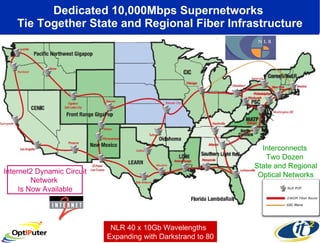
Dedicated 10,000Mbps Supernetworks  Tie Together State and Regional Fiber Infrastructure NLR 40 x 10Gb Wavelengths  Expanding with Darkstrand to 80 Interconnects  Two Dozen  State and Regional Optical Networks Internet2 Dynamic Circuit Network  Is Now Available
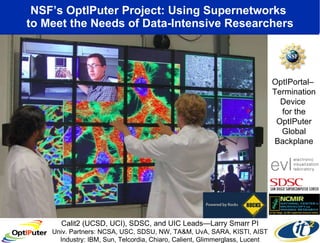
NSF’s OptIPuter Project: Using Supernetworks  to Meet the Needs of Data-Intensive Researchers OptIPortal–  Termination Device  for the OptIPuter Global Backplane Calit2 (UCSD, UCI), SDSC, and UIC Leads—Larry Smarr PI Univ. Partners: NCSA, USC, SDSU, NW, TA&M, UvA, SARA, KISTI, AIST Industry: IBM, Sun, Telcordia, Chiaro, Calient, Glimmerglass, Lucent
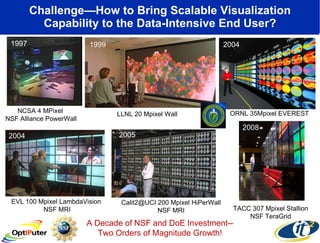
Challenge—How to Bring Scalable Visualization Capability to the Data-Intensive End User? ORNL 35Mpixel EVEREST 2004 1999 LLNL 20 Mpixel Wall NCSA 4 MPixel  NSF Alliance PowerWall TACC 307 Mpixel Stallion NSF TeraGrid 1997 1999 2004 2005 Calit2@UCI 200 Mpixel HiPerWall NSF MRI EVL 100 Mpixel LambdaVision  NSF MRI 2008 A Decade of NSF and DoE Investment-- Two Orders of Magnitude Growth!
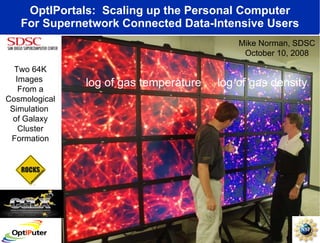
OptIPortals:  Scaling up the Personal Computer For Supernetwork Connected Data-Intensive Users Two 64K Images  From a Cosmological Simulation  of Galaxy Cluster Formation Mike Norman, SDSC October 10, 2008 log of gas temperature  log of gas density
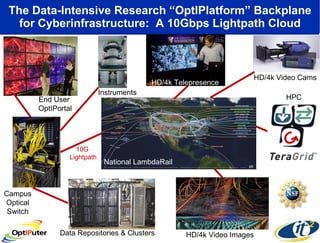
The Data-Intensive Research “OptIPlatform” Backplane for Cyberinfrastructure:  A 10Gbps Lightpath Cloud National LambdaRail Campus Optical Switch Data Repositories & Clusters HPC HD/4k Video Images HD/4k Video Cams End User  OptIPortal 10G  Lightpath HD/4k Telepresence Instruments

Supercomputers and Supernetworks are Transforming Research

  • 1.
    Supercomputers and Supernetworks are Transforming Research Invited Talk Computing Research that Changed the World: Reflections and Perspectives Washington, DC March 25, 2009 Dr. Larry Smarr Director, California Institute for Telecommunications and Information Technology Harry E. Gruber Professor, Dept. of Computer Science and Engineering Jacobs School of Engineering, UCSD
  • 2.
    From Elite Science to the Mass Market Four Examples I Helped “Mid-Wife”: Supercomputers to GigaHertz PCs Scientific Visualization to Movie/Game Special Effects CERN Preprints to WWW NSFnet to the Commercial Internet Technologies Diffuse Into Society Following an S-Curve Automobile Adoption Source: Harry Dent, The Great Boom Ahead “ NSF Invests Here” {
  • 3.
    Launching the Nation’sInformation Infrastructure: NSFnet Supernetwork and the Six NSF Supercomputers NCSA NSFNET 56 Kb/s Backbone (1986-8) PSC NCAR CTC JVNC SDSC Supernetwork Backbone: 56kbps is 50 Times Faster than 1200 bps PC Modem!
  • 4.
    The NSFnet wasCommercialized in 1995 Leading to Today’s Internet Visualization by NCSA’s Donna Cox and Robert Patterson Traffic on 45 Mbps Backbone December 1994
  • 5.
    Fifteen Years fromBleeding Edge Research to Mass Consumer Market 1990 Leading Edge University Research Center-NCSA Supercomputer GigaFLOPS Cray Y-MP ($15M) Megabit/s NSFnet Backbone 2005 Mass Consumer Market PCs are Multi-Gigahertz ($1.5k) Megabit/s Home DSL or Cable Modem NSF Blue Waters Petascale Supercomputer (2011) Will be Over 1 Million Times Faster than Cray Y-MP! Enormous Growth in Parallelism Processors: Y-MP 4, Blue Waters 200,000 www.ncsa.uiuc.edu/BlueWaters/system.html
  • 6.
    An Unexpected Benefitof NSF Investments: NCSA Mosaic Led to the Modern Web World 1990 Source: Larry Smarr NCSA Collage 100 Commercial Licensees NCSA Programmers Open Source Licensing 1993
  • 7.
    From Scientific Visualizationof Supercomputing Science to Movie Special Effects http://access.ncsa.uiuc.edu/ http://movies.warnerbros.com/twister www.jurassicpark.com ; www.jamescameron.org www.cinemenium.com/perfectstorm/ NCSA 1987 1993 1996 2000 Computer Graphics From NCSA to ILM 1991 Stefen Fangmeier  
  • 8.
    Exponential Increases inSupercomputer Speed and Visualization Technology Drive Understanding and Applications Source: Donna Cox, Robert Patterson, Bob Wilhelmson, NCSA 1987 2005 Showed Thunderstorms Arise from Solving Physics Equations Vastly Higher Resolution Uncovers Birth of Tornadoes
  • 9.
    Frontier Applications ofHigh Performance Computing Enabled by NSF’s TeraGrid Designing Bird Flu Drugs Investigating Alzheimer’s Plaque Proteins Improving Hydrogen Storage in Fuel Cells
  • 10.
    Department of EnergyOffice of Science Leading Edge Applications of Petascale Computers Flames Supernova Parkinson’s Fusion
  • 11.
    “ Broadband” Dependson Your Application: Data-Intensive Science Needs Supernetworks Mobile Broadband 0.1-0.5 Mbps Home Broadband 1-5 Mbps University Dorm Room Broadband 10-100 Mbps Dedicated Supernetwork Broadband 1,000-10,000 Mbps 100,000 Fold Range All Here Today! “ The future is already here, it’s just not evenly distributed” William Gibson, Author of Neuromancer
  • 12.
    Dedicated 10,000Mbps Supernetworks Tie Together State and Regional Fiber Infrastructure NLR 40 x 10Gb Wavelengths Expanding with Darkstrand to 80 Interconnects Two Dozen State and Regional Optical Networks Internet2 Dynamic Circuit Network Is Now Available
  • 13.
    NSF’s OptIPuter Project:Using Supernetworks to Meet the Needs of Data-Intensive Researchers OptIPortal– Termination Device for the OptIPuter Global Backplane Calit2 (UCSD, UCI), SDSC, and UIC Leads—Larry Smarr PI Univ. Partners: NCSA, USC, SDSU, NW, TA&M, UvA, SARA, KISTI, AIST Industry: IBM, Sun, Telcordia, Chiaro, Calient, Glimmerglass, Lucent
  • 14.
    Challenge—How to BringScalable Visualization Capability to the Data-Intensive End User? ORNL 35Mpixel EVEREST 2004 1999 LLNL 20 Mpixel Wall NCSA 4 MPixel NSF Alliance PowerWall TACC 307 Mpixel Stallion NSF TeraGrid 1997 1999 2004 2005 Calit2@UCI 200 Mpixel HiPerWall NSF MRI EVL 100 Mpixel LambdaVision NSF MRI 2008 A Decade of NSF and DoE Investment-- Two Orders of Magnitude Growth!
  • 15.
    OptIPortals: Scalingup the Personal Computer For Supernetwork Connected Data-Intensive Users Two 64K Images From a Cosmological Simulation of Galaxy Cluster Formation Mike Norman, SDSC October 10, 2008 log of gas temperature log of gas density
  • 16.
    The Data-Intensive Research“OptIPlatform” Backplane for Cyberinfrastructure: A 10Gbps Lightpath Cloud National LambdaRail Campus Optical Switch Data Repositories & Clusters HPC HD/4k Video Images HD/4k Video Cams End User OptIPortal 10G Lightpath HD/4k Telepresence Instruments