PROPULSION SYSTEM
1
 A marine propulsion system may be defined as
the mechanism by which a thrust force is
produced to propel the ship/boat across water.
 The vessel moves forward when the produced
thrust overcomes the drag or resistance of the
hull form in water.
 Today ship propulsion is not just about
successful movement of the ship in the water. It
also includes using the best mode of propulsion
to ensure a better safety standard for the marine
ecosystem along with cost efficiency.
2
TYPES OF PROPULSION SYSTEM
 Diesel Propulsion
 Diesel-electric Propulsion
 Nuclear Propulsion
 Gas Turbine Propulsion
 Steam Turbine Propulsion
 Water-Jet Propulsion
 Solar Propulsion
3
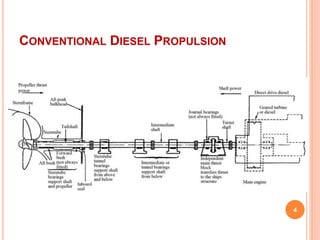
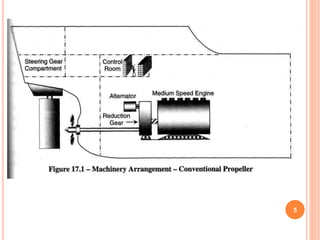
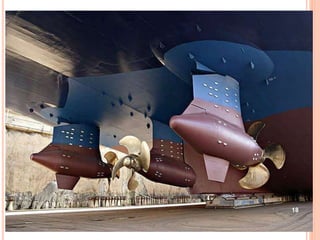
CONVENTIONAL DIESEL PROPULSION
4
5
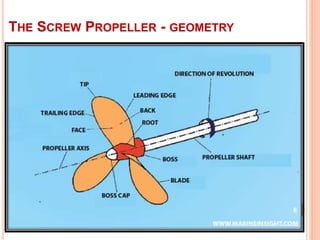
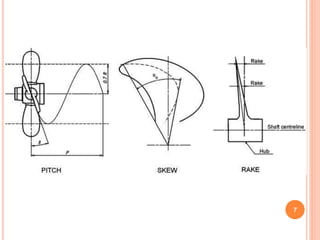
THE SCREW PROPELLER - GEOMETRY
6
7
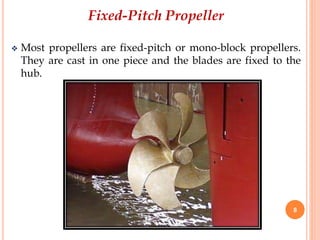
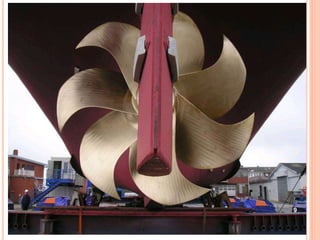
Fixed-Pitch Propeller
 Most propellers are fixed-pitch or mono-block propellers.
They are cast in one piece and the blades are fixed to the
hub.
8
9
Controllable-Pitch Propeller
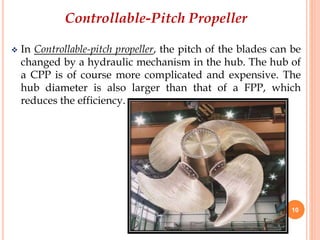
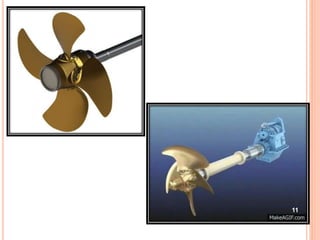
 In Controllable-pitch propeller, the pitch of the blades can be
changed by a hydraulic mechanism in the hub. The hub of
a CPP is of course more complicated and expensive. The
hub diameter is also larger than that of a FPP, which
reduces the efficiency.
10
11
Ducted Propeller
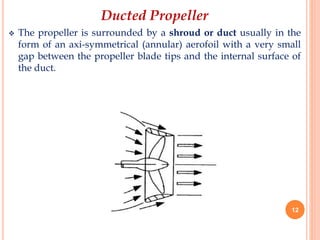
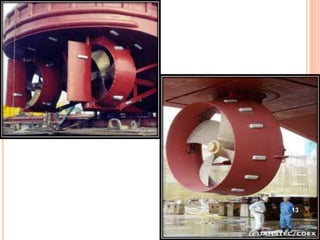
 The propeller is surrounded by a shroud or duct usually in the
form of an axi-symmetrical (annular) aerofoil with a very small
gap between the propeller blade tips and the internal surface of
the duct.
12
13
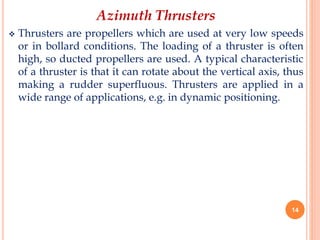
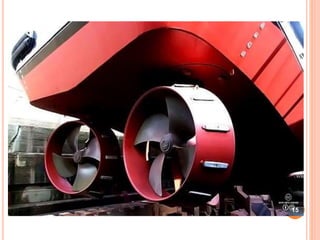
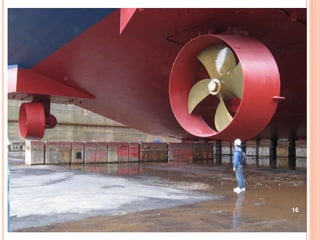
Azimuth Thrusters
 Thrusters are propellers which are used at very low speeds
or in bollard conditions. The loading of a thruster is often
high, so ducted propellers are used. A typical characteristic
of a thruster is that it can rotate about the vertical axis, thus
making a rudder superfluous. Thrusters are applied in a
wide range of applications, e.g. in dynamic positioning.
14
15
16
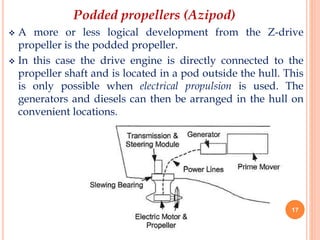
Podded propellers (Azipod)
 A more or less logical development from the Z-drive
propeller is the podded propeller.
 In this case the drive engine is directly connected to the
propeller shaft and is located in a pod outside the hull. This
is only possible when electrical propulsion is used. The
generators and diesels can then be arranged in the hull on
convenient locations.
17
18
Pump Jets (Water Jets)
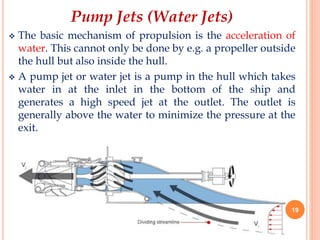
 The basic mechanism of propulsion is the acceleration of
water. This cannot only be done by e.g. a propeller outside
the hull but also inside the hull.
 A pump jet or water jet is a pump in the hull which takes
water in at the inlet in the bottom of the ship and
generates a high speed jet at the outlet. The outlet is
generally above the water to minimize the pressure at the
exit.
19
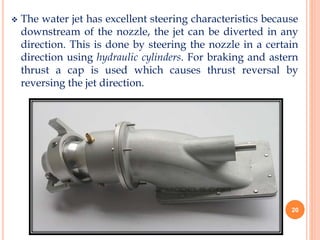
 The water jet has excellent steering characteristics because
downstream of the nozzle, the jet can be diverted in any
direction. This is done by steering the nozzle in a certain
direction using hydraulic cylinders. For braking and astern
thrust a cap is used which causes thrust reversal by
reversing the jet direction.
20
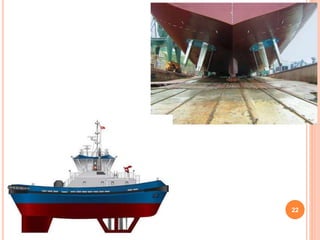
Voith Schneider Propeller
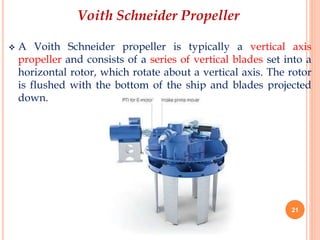
 A Voith Schneider propeller is typically a vertical axis
propeller and consists of a series of vertical blades set into a
horizontal rotor, which rotate about a vertical axis. The rotor
is flushed with the bottom of the ship and blades projected
down.
21
22
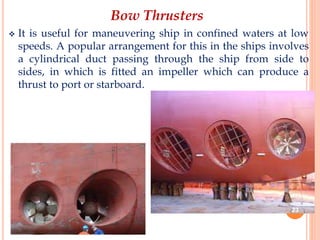
Bow Thrusters
 It is useful for maneuvering ship in confined waters at low
speeds. A popular arrangement for this in the ships involves
a cylindrical duct passing through the ship from side to
sides, in which is fitted an impeller which can produce a
thrust to port or starboard.
23