Naval Architecture
Faculty of Maritime Studies – Marine Engineering Department
Lecture 9:
Ship Propellers
3
SHIP PROPELLERS
Introduction
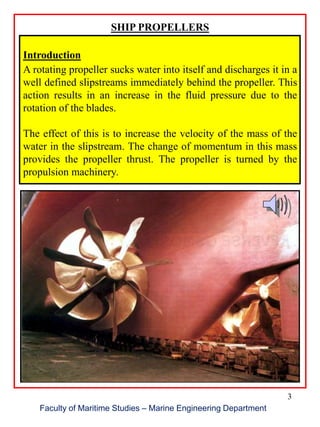
A rotating propeller sucks water into itself and discharges it in a
well defined slipstreams immediately behind the propeller. This
action results in an increase in the fluid pressure due to the
rotation of the blades.
The effect of this is to increase the velocity of the mass of the
water in the slipstream. The change of momentum in this mass
provides the propeller thrust. The propeller is turned by the
propulsion machinery.
Faculty of Maritime Studies – Marine Engineering Department
4
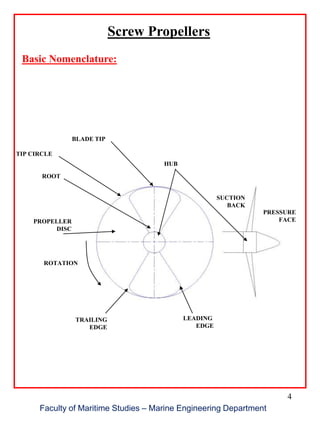
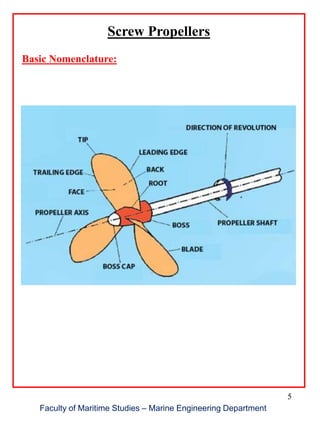
Screw Propellers
Basic Nomenclature:
Faculty of Maritime Studies – Marine Engineering Department
HUB
ROOT
BLADE TIP
TIP CIRCLE
ROTATION
LEADING
EDGE
TRAILING
EDGE
PRESSURE
FACE
SUCTION
BACK
PROPELLER
DISC
5
Screw Propellers
Basic Nomenclature:
Faculty of Maritime Studies – Marine Engineering Department
6
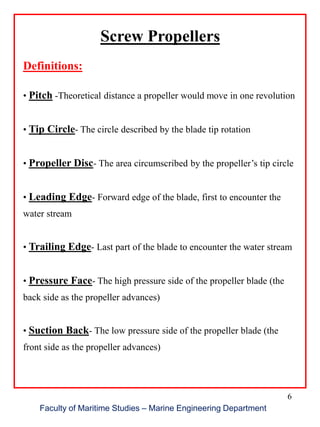
Screw Propellers
Definitions:
• Pitch -Theoretical distance a propeller would move in one revolution
• Tip Circle- The circle described by the blade tip rotation
• Propeller Disc- The area circumscribed by the propeller’s tip circle
• Leading Edge- Forward edge of the blade, first to encounter the
water stream
• Trailing Edge- Last part of the blade to encounter the water stream
• Pressure Face- The high pressure side of the propeller blade (the
back side as the propeller advances)
• Suction Back- The low pressure side of the propeller blade (the
front side as the propeller advances)
Faculty of Maritime Studies – Marine Engineering Department
7
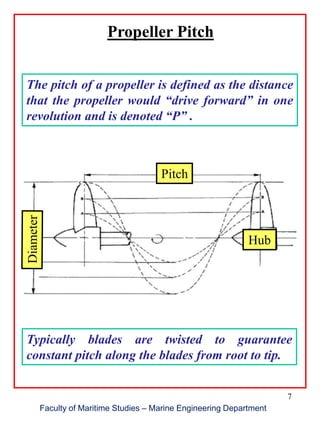
Propeller Pitch
Faculty of Maritime Studies – Marine Engineering Department
The pitch of a propeller is defined as the distance
that the propeller would “drive forward” in one
revolution and is denoted “P” .
Pitch
Hub
Typically blades are twisted to guarantee
constant pitch along the blades from root to tip.
8
Faculty of Maritime Studies – Marine Engineering Department
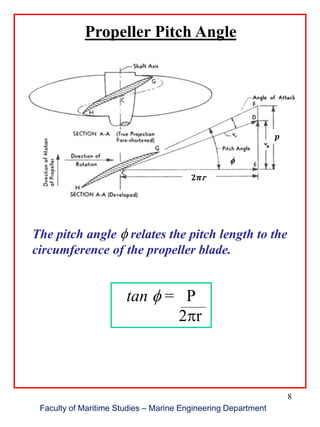
Propeller Pitch Angle
The pitch angle f relates the pitch length to the
circumference of the propeller blade.
tan f = P
2pr
f
𝟐𝝅r
𝒑
9
Faculty of Maritime Studies – Marine Engineering Department
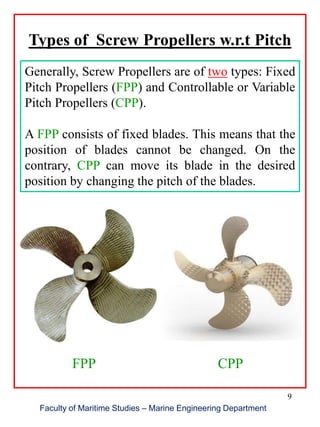
Types of Screw Propellers w.r.t Pitch
Generally, Screw Propellers are of two types: Fixed
Pitch Propellers (FPP) and Controllable or Variable
Pitch Propellers (CPP).
A FPP consists of fixed blades. This means that the
position of blades cannot be changed. On the
contrary, CPP can move its blade in the desired
position by changing the pitch of the blades.
FPP CPP
10
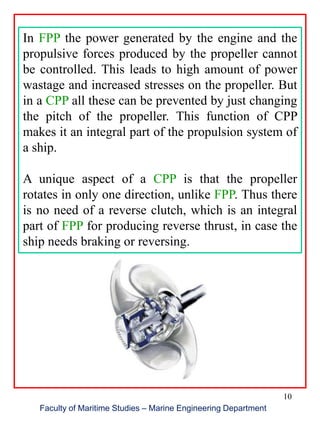
In FPP the power generated by the engine and the
propulsive forces produced by the propeller cannot
be controlled. This leads to high amount of power
wastage and increased stresses on the propeller. But
in a CPP all these can be prevented by just changing
the pitch of the propeller. This function of CPP
makes it an integral part of the propulsion system of
a ship.
A unique aspect of a CPP is that the propeller
rotates in only one direction, unlike FPP. Thus there
is no need of a reverse clutch, which is an integral
part of FPP for producing reverse thrust, in case the
ship needs braking or reversing.
Faculty of Maritime Studies – Marine Engineering Department
11
Faculty of Maritime Studies – Marine Engineering Department
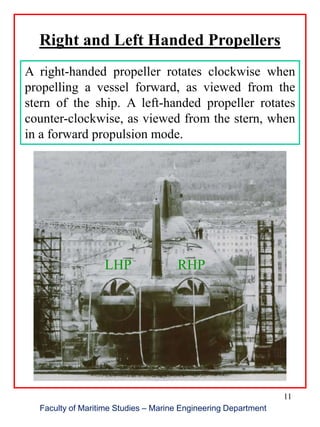
Right and Left Handed Propellers
A right-handed propeller rotates clockwise when
propelling a vessel forward, as viewed from the
stern of the ship. A left-handed propeller rotates
counter-clockwise, as viewed from the stern, when
in a forward propulsion mode.
LHP RHP
12
Faculty of Maritime Studies – Marine Engineering Department
Right and Left Handed Propellers
When viewing a propeller from astern, the leading
edges of the blades will always be farther away
from you than the trailing edges. The propeller
rotates clockwise, and is right-handed, if the
leading edges are on the right. A propeller’s
handedness is fixed. A right-handed propeller can
never be exchanged with a left handed propeller,
and vice versa.
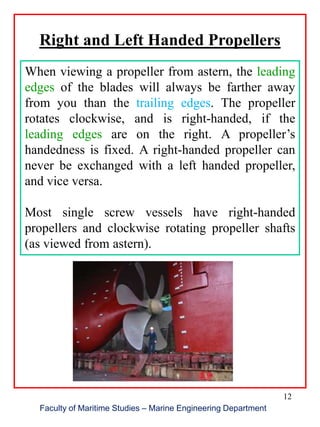
Most single screw vessels have right-handed
propellers and clockwise rotating propeller shafts
(as viewed from astern).
13
Faculty of Maritime Studies – Marine Engineering Department
Right and Left Handed Propellers
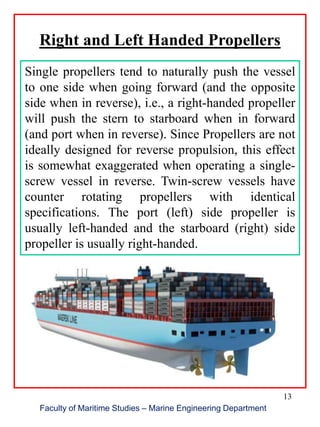
Single propellers tend to naturally push the vessel
to one side when going forward (and the opposite
side when in reverse), i.e., a right-handed propeller
will push the stern to starboard when in forward
(and port when in reverse). Since Propellers are not
ideally designed for reverse propulsion, this effect
is somewhat exaggerated when operating a single-
screw vessel in reverse. Twin-screw vessels have
counter rotating propellers with identical
specifications. The port (left) side propeller is
usually left-handed and the starboard (right) side
propeller is usually right-handed.
14
Faculty of Maritime Studies – Marine Engineering Department
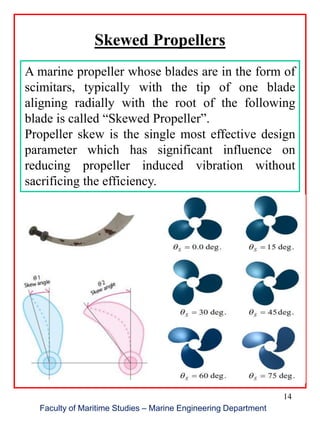
Skewed Propellers
A marine propeller whose blades are in the form of
scimitars, typically with the tip of one blade
aligning radially with the root of the following
blade is called “Skewed Propeller”.
Propeller skew is the single most effective design
parameter which has significant influence on
reducing propeller induced vibration without
sacrificing the efficiency.
15
Faculty of Maritime Studies – Marine Engineering Department
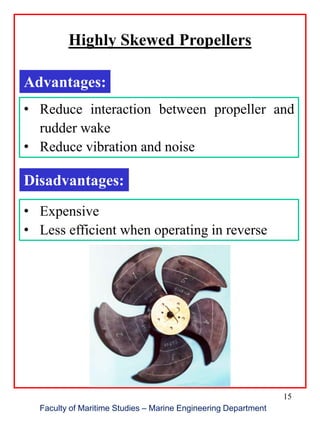
Highly Skewed Propellers
• Reduce interaction between propeller and
rudder wake
• Reduce vibration and noise
Advantages:
Disadvantages:
• Expensive
• Less efficient when operating in reverse
16
Faculty of Maritime Studies – Marine Engineering Department
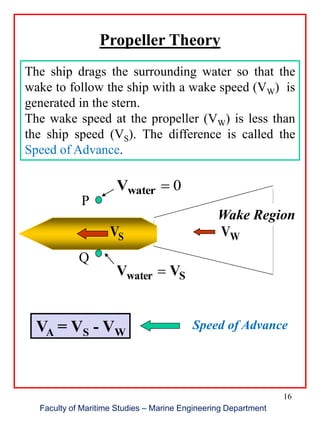
Propeller Theory
The ship drags the surrounding water so that the
wake to follow the ship with a wake speed (VW) is
generated in the stern.
The wake speed at the propeller (VW) is less than
the ship speed (VS). The difference is called the
Speed of Advance.
Q
P
Wake Region
SV WV
0waterV
Swater VV 
VA = VS - VW
Speed of Advance
17
Faculty of Maritime Studies – Marine Engineering Department
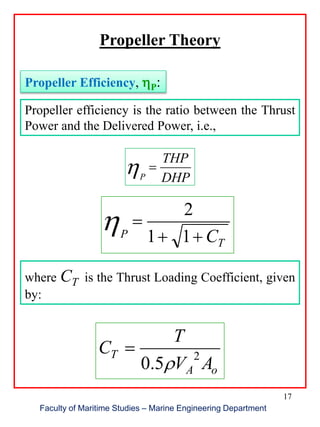
Propeller Theory
Propeller efficiency is the ratio between the Thrust
Power and the Delivered Power, i.e.,
Propeller Efficiency, hP:
DHP
THP
P
h
T
P C

11
2
h
where CT is the Thrust Loading Coefficient, given
by:
oA
T
AV
T
C 2
5.0 

18
Faculty of Maritime Studies – Marine Engineering Department
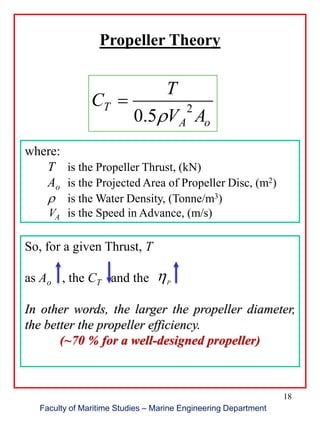
Propeller Theory
oA
T
AV
T
C 2
5.0 

where:
T is the Propeller Thrust, (kN)
Ao is the Projected Area of Propeller Disc, (m2)
 is the Water Density, (Tonne/m3)
VA is the Speed in Advance, (m/s)
So, for a given Thrust, T
as Ao , the CT and the
In other words, the larger the propeller diameter,
the better the propeller efficiency.
(~70 % for a well-designed propeller)
hP
19
Faculty of Maritime Studies – Marine Engineering Department
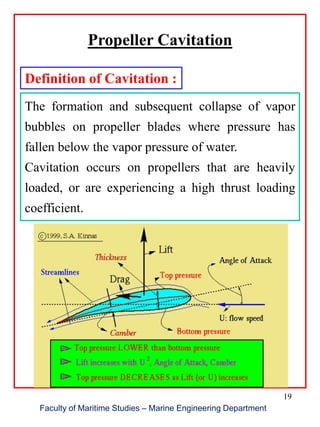
Propeller Cavitation
The formation and subsequent collapse of vapor
bubbles on propeller blades where pressure has
fallen below the vapor pressure of water.
Cavitation occurs on propellers that are heavily
loaded, or are experiencing a high thrust loading
coefficient.
Definition of Cavitation :
20
Faculty of Maritime Studies – Marine Engineering Department
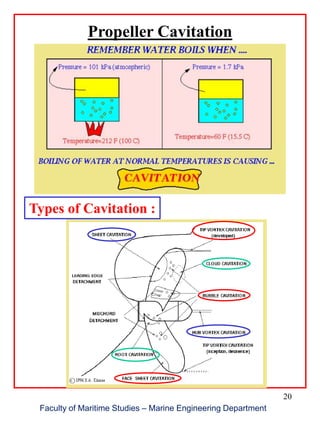
Propeller Cavitation
Types of Cavitation :
21
Faculty of Maritime Studies – Marine Engineering Department
Propeller Cavitation
Types of Cavitation :
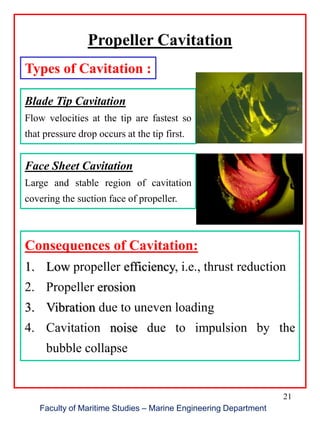
Blade Tip Cavitation
Flow velocities at the tip are fastest so
that pressure drop occurs at the tip first.
Face Sheet Cavitation
Large and stable region of cavitation
covering the suction face of propeller.
Consequences of Cavitation:
1. Low propeller efficiency, i.e., thrust reduction
2. Propeller erosion
3. Vibration due to uneven loading
4. Cavitation noise due to impulsion by the
bubble collapse

Lect 9 ship propellers (new)

  • 1.
    Naval Architecture Faculty ofMaritime Studies – Marine Engineering Department
  • 2.
    Faculty of MaritimeStudies – Marine Engineering Department Lecture 9: Ship Propellers
  • 3.
    3 SHIP PROPELLERS Introduction A rotatingpropeller sucks water into itself and discharges it in a well defined slipstreams immediately behind the propeller. This action results in an increase in the fluid pressure due to the rotation of the blades. The effect of this is to increase the velocity of the mass of the water in the slipstream. The change of momentum in this mass provides the propeller thrust. The propeller is turned by the propulsion machinery. Faculty of Maritime Studies – Marine Engineering Department
  • 4.
    4 Screw Propellers Basic Nomenclature: Facultyof Maritime Studies – Marine Engineering Department HUB ROOT BLADE TIP TIP CIRCLE ROTATION LEADING EDGE TRAILING EDGE PRESSURE FACE SUCTION BACK PROPELLER DISC
  • 5.
    5 Screw Propellers Basic Nomenclature: Facultyof Maritime Studies – Marine Engineering Department
  • 6.
    6 Screw Propellers Definitions: • Pitch-Theoretical distance a propeller would move in one revolution • Tip Circle- The circle described by the blade tip rotation • Propeller Disc- The area circumscribed by the propeller’s tip circle • Leading Edge- Forward edge of the blade, first to encounter the water stream • Trailing Edge- Last part of the blade to encounter the water stream • Pressure Face- The high pressure side of the propeller blade (the back side as the propeller advances) • Suction Back- The low pressure side of the propeller blade (the front side as the propeller advances) Faculty of Maritime Studies – Marine Engineering Department
  • 7.
    7 Propeller Pitch Faculty ofMaritime Studies – Marine Engineering Department The pitch of a propeller is defined as the distance that the propeller would “drive forward” in one revolution and is denoted “P” . Pitch Hub Typically blades are twisted to guarantee constant pitch along the blades from root to tip.
  • 8.
    8 Faculty of MaritimeStudies – Marine Engineering Department Propeller Pitch Angle The pitch angle f relates the pitch length to the circumference of the propeller blade. tan f = P 2pr f 𝟐𝝅r 𝒑
  • 9.
    9 Faculty of MaritimeStudies – Marine Engineering Department Types of Screw Propellers w.r.t Pitch Generally, Screw Propellers are of two types: Fixed Pitch Propellers (FPP) and Controllable or Variable Pitch Propellers (CPP). A FPP consists of fixed blades. This means that the position of blades cannot be changed. On the contrary, CPP can move its blade in the desired position by changing the pitch of the blades. FPP CPP
  • 10.
    10 In FPP thepower generated by the engine and the propulsive forces produced by the propeller cannot be controlled. This leads to high amount of power wastage and increased stresses on the propeller. But in a CPP all these can be prevented by just changing the pitch of the propeller. This function of CPP makes it an integral part of the propulsion system of a ship. A unique aspect of a CPP is that the propeller rotates in only one direction, unlike FPP. Thus there is no need of a reverse clutch, which is an integral part of FPP for producing reverse thrust, in case the ship needs braking or reversing. Faculty of Maritime Studies – Marine Engineering Department
  • 11.
    11 Faculty of MaritimeStudies – Marine Engineering Department Right and Left Handed Propellers A right-handed propeller rotates clockwise when propelling a vessel forward, as viewed from the stern of the ship. A left-handed propeller rotates counter-clockwise, as viewed from the stern, when in a forward propulsion mode. LHP RHP
  • 12.
    12 Faculty of MaritimeStudies – Marine Engineering Department Right and Left Handed Propellers When viewing a propeller from astern, the leading edges of the blades will always be farther away from you than the trailing edges. The propeller rotates clockwise, and is right-handed, if the leading edges are on the right. A propeller’s handedness is fixed. A right-handed propeller can never be exchanged with a left handed propeller, and vice versa. Most single screw vessels have right-handed propellers and clockwise rotating propeller shafts (as viewed from astern).
  • 13.
    13 Faculty of MaritimeStudies – Marine Engineering Department Right and Left Handed Propellers Single propellers tend to naturally push the vessel to one side when going forward (and the opposite side when in reverse), i.e., a right-handed propeller will push the stern to starboard when in forward (and port when in reverse). Since Propellers are not ideally designed for reverse propulsion, this effect is somewhat exaggerated when operating a single- screw vessel in reverse. Twin-screw vessels have counter rotating propellers with identical specifications. The port (left) side propeller is usually left-handed and the starboard (right) side propeller is usually right-handed.
  • 14.
    14 Faculty of MaritimeStudies – Marine Engineering Department Skewed Propellers A marine propeller whose blades are in the form of scimitars, typically with the tip of one blade aligning radially with the root of the following blade is called “Skewed Propeller”. Propeller skew is the single most effective design parameter which has significant influence on reducing propeller induced vibration without sacrificing the efficiency.
  • 15.
    15 Faculty of MaritimeStudies – Marine Engineering Department Highly Skewed Propellers • Reduce interaction between propeller and rudder wake • Reduce vibration and noise Advantages: Disadvantages: • Expensive • Less efficient when operating in reverse
  • 16.
    16 Faculty of MaritimeStudies – Marine Engineering Department Propeller Theory The ship drags the surrounding water so that the wake to follow the ship with a wake speed (VW) is generated in the stern. The wake speed at the propeller (VW) is less than the ship speed (VS). The difference is called the Speed of Advance. Q P Wake Region SV WV 0waterV Swater VV  VA = VS - VW Speed of Advance
  • 17.
    17 Faculty of MaritimeStudies – Marine Engineering Department Propeller Theory Propeller efficiency is the ratio between the Thrust Power and the Delivered Power, i.e., Propeller Efficiency, hP: DHP THP P h T P C  11 2 h where CT is the Thrust Loading Coefficient, given by: oA T AV T C 2 5.0  
  • 18.
    18 Faculty of MaritimeStudies – Marine Engineering Department Propeller Theory oA T AV T C 2 5.0   where: T is the Propeller Thrust, (kN) Ao is the Projected Area of Propeller Disc, (m2)  is the Water Density, (Tonne/m3) VA is the Speed in Advance, (m/s) So, for a given Thrust, T as Ao , the CT and the In other words, the larger the propeller diameter, the better the propeller efficiency. (~70 % for a well-designed propeller) hP
  • 19.
    19 Faculty of MaritimeStudies – Marine Engineering Department Propeller Cavitation The formation and subsequent collapse of vapor bubbles on propeller blades where pressure has fallen below the vapor pressure of water. Cavitation occurs on propellers that are heavily loaded, or are experiencing a high thrust loading coefficient. Definition of Cavitation :
  • 20.
    20 Faculty of MaritimeStudies – Marine Engineering Department Propeller Cavitation Types of Cavitation :
  • 21.
    21 Faculty of MaritimeStudies – Marine Engineering Department Propeller Cavitation Types of Cavitation : Blade Tip Cavitation Flow velocities at the tip are fastest so that pressure drop occurs at the tip first. Face Sheet Cavitation Large and stable region of cavitation covering the suction face of propeller. Consequences of Cavitation: 1. Low propeller efficiency, i.e., thrust reduction 2. Propeller erosion 3. Vibration due to uneven loading 4. Cavitation noise due to impulsion by the bubble collapse