MODULE 5.1
EXPERIENCING ART


   Art 100
   Understanding Visual Culture
M 5.1 overview

 key things to remember in your initial
  approach to art
   it is a personal process
   knowledge can assist, but cannot substitute for,
    your connection with the work
   find your favorites and keep an open mind
 experiencing art: a suggested course of action
   experiencing effects
   accounting for those effects
Each of us has his or her own taste in visual art. We
find different things appealing, at different times in
our lives.
Brandywine River Museum
Chadds Ford, PA


This is a small regional museum where I spent a lot of time as a kid.
Interior
galleries

Part of the museum is located inside an old
mill building along the Brandywine River. Local
artists are featured, with a special emphasis on
the Wyeth family.
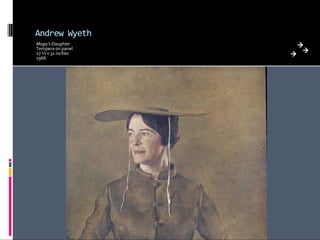
Andrew Wyeth
Maga’s Daughter
Tempera on panel
27 ½ x 31 inches
1966
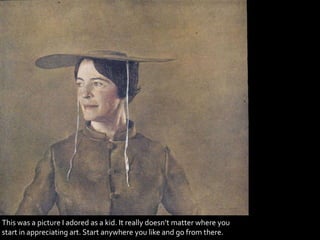
This was a picture I adored as a kid. It really doesn’t matter where you
start in appreciating art. Start anywhere you like and go from there.
Finding out more about
artworks you like is a
great thing to do.

But no amount of
information will answer all
of your questions.
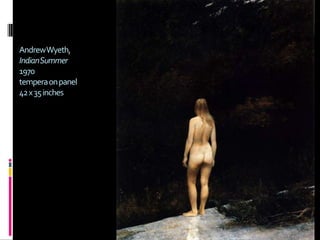
Andrew Wyeth,
Indian Summer
1970
tempera on panel
42 x 35 inches
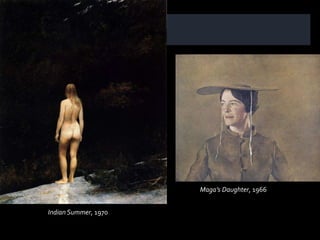
Maga’s Daughter, 1966


Indian Summer, 1970
Andrew Wyeth's life

             For more information
               http://www.askart.com/AskART/artists/
                biography.aspx?artist=24079
               Scroll down to second biography, by
                Frank E. Fowler

             His brother Nathaniel Wyeth was an
              important 20th century figure too:
               http://query.nytimes.com/gst/fullpage.
                html?res=9C0CEEDE163EF934A35754C
                0A966958260
There are as many flavors
of art as there are people
who make it.

New flavors are being
created all the time.

You get to pick your
favorites.
The point is to give it a try and see
which kinds you think are especially
great. Then experience to the fullest
and enjoy.


                       Hint: You might like them all.
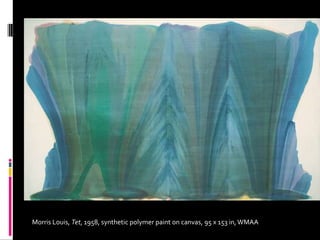
Morris Louis, Tet, 1958, synthetic polymer paint on canvas, 95 x 153 in, WMAA
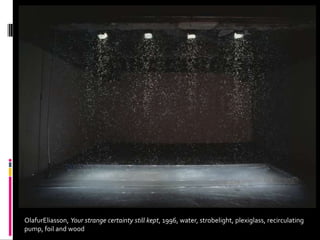
OlafurEliasson, Your strange certainty still kept, 1996, water, strobelight, plexiglass, recirculating
pump, foil and wood
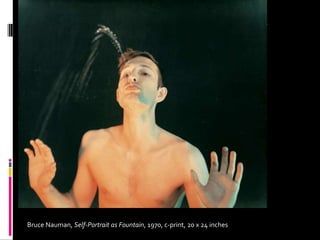
Bruce Nauman, Self-Portrait as Fountain, 1970, c-print, 20 x 24 inches
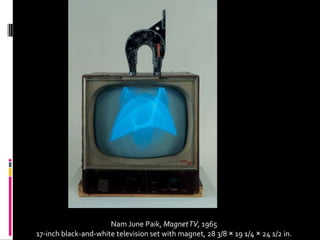
Nam June Paik, Magnet TV, 1965
17-inch black-and-white television set with magnet, 28 3/8 × 19 1/4 × 24 1/2 in.
Duane Hanson, Woman with Dog, 1977
cast polyvinyl polychromed in synthetic polymer, with cloth and hair
46 × 48 × 51 ½ in
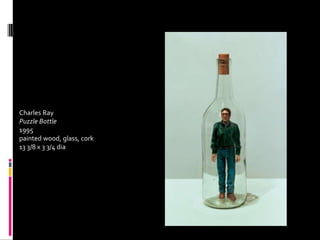
Charles Ray
Puzzle Bottle
1995
painted wood, glass, cork
13 3/8 x 3 3/4 dia
Joseph Kosuth, Five Words in Green Neon, 1965,
neon tubing, 62 x 80 x 6 in
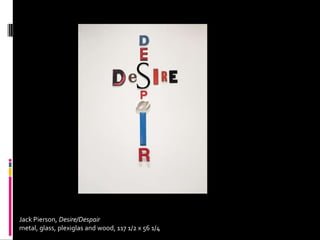
Jack Pierson, Desire/Despair
metal, glass, plexiglas and wood, 117 1/2 x 56 1/4
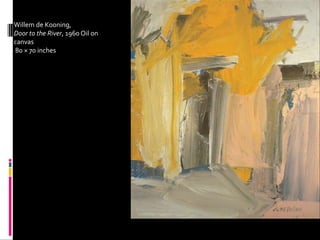
Willem de Kooning,
Door to the River, 1960 Oil on
canvas
80 × 70 inches
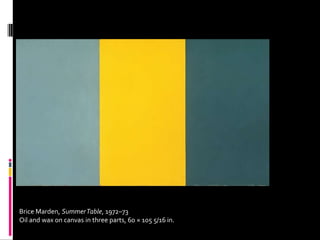
Brice Marden, Summer Table, 1972–73
Oil and wax on canvas in three parts, 60 × 105 5/16 in.
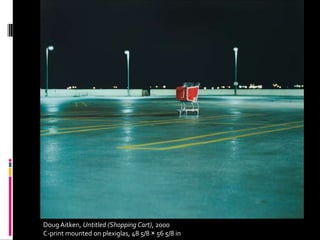
Doug Aitken, Untitled (Shopping Cart), 2000
C-print mounted on plexiglas, 48 5/8 × 56 5/8 in
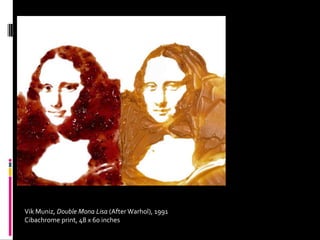
Vik Muniz, Double Mona Lisa (After Warhol), 1991
Cibachrome print, 48 x 60 inches
Jean-Michel Basquiat,LNAPRK, 1982.
Synthetic polymer and oil stick on canvas, 73 1/2 × 72 1/4 in
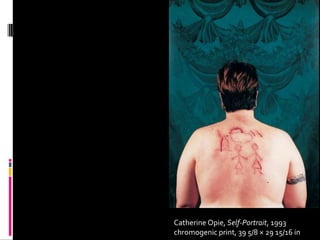
Catherine Opie, Self-Portrait, 1993
chromogenic print, 39 5/8 × 29 15/16 in
quick review
You’re allowed to—
supposed to!—respond
personally to artwork.
    The artist wants you to have an experience—an emotional,
    physical, spiritual, intellectual, moral (some combination
    of these or all of them) experience of the work.
If you like a work of art,
you’ll often want to find
out more about it.


That’s great, find out more, it will enrich your experience of the work, no
doubt about it. But there is no “final correct answer” to the meaning of a
given work. There are more and less satisfying interpretations, more and
less sensitive readings, but no single reading is ultimately correct.
Like your parents probably told
  you, “How do you know you don’t
  like it if you won’t even try it?


             This class gives you a chance to try out different kinds of art.

    There’s no obligation to like the things that I, or your classmates, like.

                                            Pick your own likes and dislikes.

However, you can learn from—even come to appreciate—works you don’t
                                                 particularly care for.
With all this in mind., how do we…

EXPERIENCE ART TO THE
FULLEST?
 One way we try to experience art more fully is
  by understanding how it creates the effects it
  has on us.
Experience, with your eyes, mind, feelings,
  memories, body. What does this piece do to
  me?
   Examples: Does it make me happy?
    Uncomfortable? Sad? Upset? Does it turn my
    stomach? Does it make me shiver? Worry? Sweat?
EXPERIENCING THE EFFECTS

 1. Experience comes first. What do you SEE
  and how does it make you FEEL in your
  bones.
EXPERIENCING THE EFFECTS


 At this point, it doesn’t matter who made it,
  when, or why. The point is to try to figure out,
  as completely as possible, the effect the work
  is having on you.
EXPERIENCING THE EFFECTS


 So let’s sum this up as “experiencing the
  effects” of the work. This process can take a
  while. It is not necessarily simple. In fact, one
  definition of art could be work that takes the
  viewer some time and trouble to experience.
Accounting for the Effects

 2. Now that you have a handle on what you’ve
  experienced, you want to know how the piece
  made you feel that way. Cf. driving a car to
  looking under the hood.
 This is where formal analysis can be helpful.
 How did this piece make me feel (x, y, and z)
  way? How is it structured to achieve those
  specific effects?
 This is where purely personal, idiosyncratic
  responses can be weeded out if you are writing
  to share with an audience.
Accounting for the Effects

2. Now that you have a handle on what you’ve
   experienced, you want to know how the piece
   made you feel that way. Cf. driving a car to
   looking under the hood.
Accounting for the Effects

This is where formal analysis can be helpful.

How did this piece make me feel this way?

How is it structured to achieve those specific
  effects?

NOTE: This is where your purely personal,
 idiosyncratic responses can be weeded out if you
 are writing to share with an audience.
Let’s try out this process
with a few different
examples.
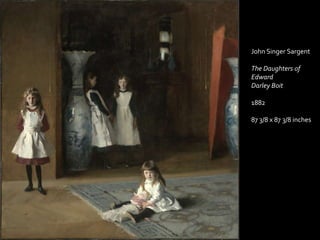
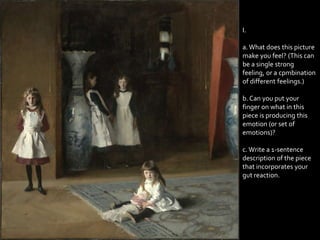
John Singer Sargent

The Daughters of
Edward
Darley Boit

1882

87 3/8 x 87 3/8 inches
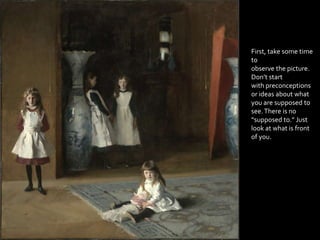
First, take some time
to
observe the picture.
Don’t start
with preconceptions
or ideas about what
you are supposed to
see. There is no
“supposed to.” Just
look at what is front
of you.
I.

a. What does this picture
make you feel? (This can
be a single strong
feeling, or a cpmbination
of different feelings.)

b. Can you put your
finger on what in this
piece is producing this
emotion (or set of
emotions)?

c. Write a 1-sentence
description of the piece
that incorporates your
gut reaction.
Effects 1


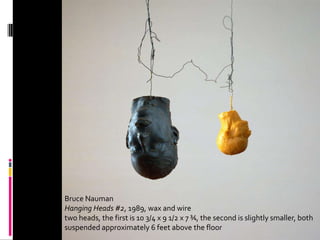
Bruce Nauman
Hanging Heads #2, 1989, wax and wire
two heads, the first is 10 3/4 x 9 1/2 x 7 ¾, the second is slightly smaller, both
suspended approximately 6 feet above the floor
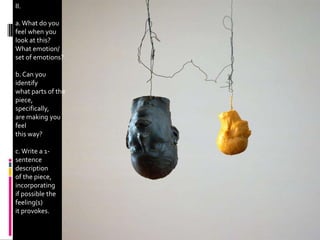
II.

a. What do you
                    Effects 1
feel when you
look at this?
What emotion/
set of emotions?

b. Can you
identify
what parts of the
piece,
specifically,
are making you
feel
this way?

c. Write a 1-
sentence
description
of the piece,
incorporating
if possible the
feeling(s)
it provokes.
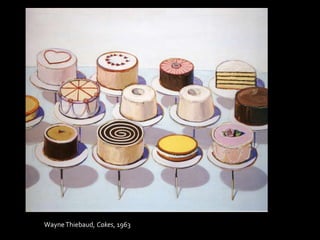
Wayne Thiebaud, Cakes, 1963

Art100Su12Module05.1

  • 1.
    MODULE 5.1 EXPERIENCING ART Art 100 Understanding Visual Culture
  • 2.
    M 5.1 overview key things to remember in your initial approach to art  it is a personal process  knowledge can assist, but cannot substitute for, your connection with the work  find your favorites and keep an open mind  experiencing art: a suggested course of action  experiencing effects  accounting for those effects
  • 3.
    Each of ushas his or her own taste in visual art. We find different things appealing, at different times in our lives.
  • 4.
    Brandywine River Museum ChaddsFord, PA This is a small regional museum where I spent a lot of time as a kid.
  • 5.
    Interior galleries Part of themuseum is located inside an old mill building along the Brandywine River. Local artists are featured, with a special emphasis on the Wyeth family.
  • 6.
    Andrew Wyeth Maga’s Daughter Temperaon panel 27 ½ x 31 inches 1966
  • 7.
    This was apicture I adored as a kid. It really doesn’t matter where you start in appreciating art. Start anywhere you like and go from there.
  • 8.
    Finding out moreabout artworks you like is a great thing to do. But no amount of information will answer all of your questions.
  • 9.
  • 10.
  • 11.
    Andrew Wyeth's life  For more information  http://www.askart.com/AskART/artists/ biography.aspx?artist=24079  Scroll down to second biography, by Frank E. Fowler  His brother Nathaniel Wyeth was an important 20th century figure too:  http://query.nytimes.com/gst/fullpage. html?res=9C0CEEDE163EF934A35754C 0A966958260
  • 12.
    There are asmany flavors of art as there are people who make it. New flavors are being created all the time. You get to pick your favorites.
  • 13.
    The point isto give it a try and see which kinds you think are especially great. Then experience to the fullest and enjoy. Hint: You might like them all.
  • 14.
    Morris Louis, Tet,1958, synthetic polymer paint on canvas, 95 x 153 in, WMAA
  • 15.
    OlafurEliasson, Your strangecertainty still kept, 1996, water, strobelight, plexiglass, recirculating pump, foil and wood
  • 16.
    Bruce Nauman, Self-Portraitas Fountain, 1970, c-print, 20 x 24 inches
  • 17.
    Nam June Paik,Magnet TV, 1965 17-inch black-and-white television set with magnet, 28 3/8 × 19 1/4 × 24 1/2 in.
  • 18.
    Duane Hanson, Womanwith Dog, 1977 cast polyvinyl polychromed in synthetic polymer, with cloth and hair 46 × 48 × 51 ½ in
  • 19.
    Charles Ray Puzzle Bottle 1995 paintedwood, glass, cork 13 3/8 x 3 3/4 dia
  • 20.
    Joseph Kosuth, FiveWords in Green Neon, 1965, neon tubing, 62 x 80 x 6 in
  • 21.
    Jack Pierson, Desire/Despair metal,glass, plexiglas and wood, 117 1/2 x 56 1/4
  • 22.
    Willem de Kooning, Doorto the River, 1960 Oil on canvas 80 × 70 inches
  • 23.
    Brice Marden, SummerTable, 1972–73 Oil and wax on canvas in three parts, 60 × 105 5/16 in.
  • 24.
    Doug Aitken, Untitled(Shopping Cart), 2000 C-print mounted on plexiglas, 48 5/8 × 56 5/8 in
  • 25.
    Vik Muniz, DoubleMona Lisa (After Warhol), 1991 Cibachrome print, 48 x 60 inches
  • 26.
    Jean-Michel Basquiat,LNAPRK, 1982. Syntheticpolymer and oil stick on canvas, 73 1/2 × 72 1/4 in
  • 27.
    Catherine Opie, Self-Portrait,1993 chromogenic print, 39 5/8 × 29 15/16 in
  • 28.
  • 29.
    You’re allowed to— supposedto!—respond personally to artwork. The artist wants you to have an experience—an emotional, physical, spiritual, intellectual, moral (some combination of these or all of them) experience of the work.
  • 30.
    If you likea work of art, you’ll often want to find out more about it. That’s great, find out more, it will enrich your experience of the work, no doubt about it. But there is no “final correct answer” to the meaning of a given work. There are more and less satisfying interpretations, more and less sensitive readings, but no single reading is ultimately correct.
  • 31.
    Like your parentsprobably told you, “How do you know you don’t like it if you won’t even try it? This class gives you a chance to try out different kinds of art. There’s no obligation to like the things that I, or your classmates, like. Pick your own likes and dislikes. However, you can learn from—even come to appreciate—works you don’t particularly care for.
  • 32.
    With all thisin mind., how do we… EXPERIENCE ART TO THE FULLEST?
  • 33.
     One waywe try to experience art more fully is by understanding how it creates the effects it has on us.
  • 34.
    Experience, with youreyes, mind, feelings, memories, body. What does this piece do to me?  Examples: Does it make me happy? Uncomfortable? Sad? Upset? Does it turn my stomach? Does it make me shiver? Worry? Sweat?
  • 35.
    EXPERIENCING THE EFFECTS 1. Experience comes first. What do you SEE and how does it make you FEEL in your bones.
  • 36.
    EXPERIENCING THE EFFECTS At this point, it doesn’t matter who made it, when, or why. The point is to try to figure out, as completely as possible, the effect the work is having on you.
  • 37.
    EXPERIENCING THE EFFECTS So let’s sum this up as “experiencing the effects” of the work. This process can take a while. It is not necessarily simple. In fact, one definition of art could be work that takes the viewer some time and trouble to experience.
  • 38.
    Accounting for theEffects  2. Now that you have a handle on what you’ve experienced, you want to know how the piece made you feel that way. Cf. driving a car to looking under the hood.  This is where formal analysis can be helpful.  How did this piece make me feel (x, y, and z) way? How is it structured to achieve those specific effects?  This is where purely personal, idiosyncratic responses can be weeded out if you are writing to share with an audience.
  • 39.
    Accounting for theEffects 2. Now that you have a handle on what you’ve experienced, you want to know how the piece made you feel that way. Cf. driving a car to looking under the hood.
  • 40.
    Accounting for theEffects This is where formal analysis can be helpful. How did this piece make me feel this way? How is it structured to achieve those specific effects? NOTE: This is where your purely personal, idiosyncratic responses can be weeded out if you are writing to share with an audience.
  • 41.
    Let’s try outthis process with a few different examples.
  • 42.
    John Singer Sargent TheDaughters of Edward Darley Boit 1882 87 3/8 x 87 3/8 inches
  • 43.
    First, take sometime to observe the picture. Don’t start with preconceptions or ideas about what you are supposed to see. There is no “supposed to.” Just look at what is front of you.
  • 44.
    I. a. What doesthis picture make you feel? (This can be a single strong feeling, or a cpmbination of different feelings.) b. Can you put your finger on what in this piece is producing this emotion (or set of emotions)? c. Write a 1-sentence description of the piece that incorporates your gut reaction.
  • 45.
    Effects 1 Bruce Nauman HangingHeads #2, 1989, wax and wire two heads, the first is 10 3/4 x 9 1/2 x 7 ¾, the second is slightly smaller, both suspended approximately 6 feet above the floor
  • 46.
    II. a. What doyou Effects 1 feel when you look at this? What emotion/ set of emotions? b. Can you identify what parts of the piece, specifically, are making you feel this way? c. Write a 1- sentence description of the piece, incorporating if possible the feeling(s) it provokes.
  • 47.

Editor's Notes

  • #4 Find some things you like, and enjoy them.
  • #13 Seriously. There’s art made out of chocolate, art made out of steel, art made out of cardboard boxes, ribbons, toy airplanes; if you can imagine it, an artist has probably used it in their work.
  • #30 Find some things you like, and enjoy them.
  • #32 Seriously. There’s art made out of chocolate, art made out of steel, art made out of cardboard boxes, ribbons, toy airplanes; if you can imagine it, an artist has probably used it in their work.