
PRESENTED BY:
VISHNU.R.NAIR,
SONIYA T V,
SANDRA MERIN SAJI.
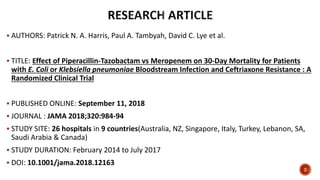
 AUTHORS: Patrick N. A. Harris, Paul A. Tambyah, David C. Lye et al.
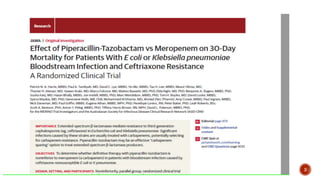
 TITLE: Effect of Piperacillin-Tazobactam vs Meropenem on 30-Day Mortality for Patients
with E. Coli or Klebsiella pneumoniae Bloodstream Infection and Ceftriaxone Resistance : A
Randomized Clinical Trial
 PUBLISHED ONLINE: September 11, 2018
 JOURNAL : JAMA 2018;320:984-94
 STUDY SITE: 26 hospitals in 9 countries(Australia, NZ, Singapore, Italy, Turkey, Lebanon, SA,
Saudi Arabia & Canada)
 STUDY DURATION: February 2014 to July 2017
 DOI: 10.1001/jama.2018.12163
2
3
 Gram (-ve) bacteria  produce ESBL enzymes
Contribute to significant health concern globally!
 According to US CDC estimates from 2011
ESBL-producing organisms
Contributed to 26,000 infections & 1,700 deaths annually!
1. Pitout JD, Laupland KB. Extended-spectrum beta-lactamase-producing Enterobacteriaceae: an emerging public-health concern. Lancet Infect Dis. 2008;8(3):159-166. [Crossref]
2. Centers for Disease Control and Prevention. Antibiotic Resistance Threats in the United States. Washington, DC: US Department of Health and Human Services; 2013. [Crossref] 4
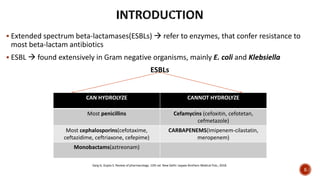
 Extended spectrum beta-lactamases(ESBLs)  refer to enzymes, that confer resistance to
most beta-lactam antibiotics
 ESBL  found extensively in Gram negative organisms, mainly E. coli and Klebsiella
ESBLs
CAN HYDROLYZE CANNOT HYDROLYZE
Most penicillins Cefamycins (cefoxitin, cefotetan,
cefmetazole)
Most cephalosporins(cefotaxime,
ceftazidime, ceftriaxone, cefepime)
CARBAPENEMS(Imipenem-cilastatin,
meropenem)
Monobactams(aztreonam)
Garg G, Gupta S. Review of pharmacology. 12th ed. New Delhi: Jaypee Brothers Medical Pub.; 2018.
5
 ESBL-producers  alarmingly prevalent in both community & health-care settings
Although carbapenems are DOC* for ESBL infections
Increased use of former
Can result in
Ineffectuality in G(-ve) bacilli!
 In such situations  usage of alternative carbapenem-sparing agents (eg. Piperacillin-
tazobactam)
Might be an effective option to reduce global burden on carbapenems
*Drug of choice
1. Doi Y, Park YS, Rivera JI, et al. Communityassociated extended-spectrum β-lactamase producing Escherichia coli infection in the United States. Clin Infect Dis. 2013;56(5):641-648[Crossref]
2. Paterson DL, Bonomo RA. Extended-spectrum beta-lactamases: a clinical update. Clin Microbiol Rev. 2005;18(4):657-686[Crossref]
3. Chang H-J, Hsu P-C, Yang C-C, et al. Risk factors and outcomes of carbapenem-non susceptible Escherichia coli bacteremia: a matched case-control study. J Microbiol Immunol Infect. 2011;44(2):125-130[Crossref]
6
Although BLBLIs* are documented to be effective in ESBL infections
Results are rather controversial!
Thus
This study aims to hypothesize if usage of a carbapenem-sparing agent(piperacillin-tazobactam)
Would
Prove to be non-inferior to a carbapenem(meropenem) for ESBL infections.
*Beta-lactam-beta-lactamase inhibitor
1. Harris PN, Tambyah PA, Paterson DL. β-lactam and β-lactamase inhibitor combinations in the treatment of extended-spectrum β-lactamase producing Enterobacteriaceae: time for a reappraisal in the era of few antibiotic
options? Lancet Infect Dis. 2015;15(4):475-485 [Crossref]
2. Tamma PD, Rodriguez-Bano J. The use of noncarbapenem β-lactams for the treatment of extended-spectrum β-lactamase infections. Clin Infect Dis. 2017;64(7):972-980 [Crossref]
3. Tamma PD, Han JH, Rock C, et al; Antibacterial Resistance Leadership Group. Carbapenem therapy is associated with improved survival compared with piperacillin-tazobactam for patients with extended-spectrum β-lactamase
bacteremia Clin Infect Dis. 2015;60(9):1319-1325. [Crossref]
7
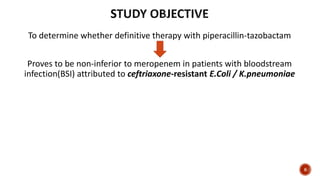
To determine whether definitive therapy with piperacillin-tazobactam
Proves to be non-inferior to meropenem in patients with bloodstream
infection(BSI) attributed to ceftriaxone-resistant E.Coli / K.pneumoniae
8
STUDY METHODOLOGY
9
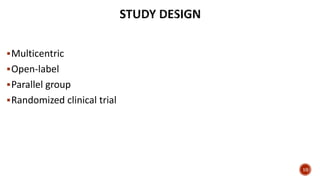
Multicentric
Open-label
Parallel group
Randomized clinical trial
10
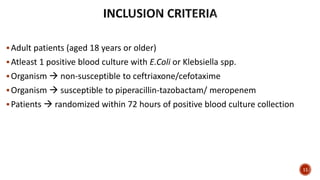
Adult patients (aged 18 years or older)
Atleast 1 positive blood culture with E.Coli or Klebsiella spp.
Organism  non-susceptible to ceftriaxone/cefotaxime
Organism  susceptible to piperacillin-tazobactam/ meropenem
Patients  randomized within 72 hours of positive blood culture collection
11
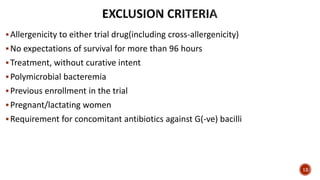
Allergenicity to either trial drug(including cross-allergenicity)
No expectations of survival for more than 96 hours
Treatment, without curative intent
Polymicrobial bacteremia
Previous enrollment in the trial
Pregnant/lactating women
Requirement for concomitant antibiotics against G(-ve) bacilli
12
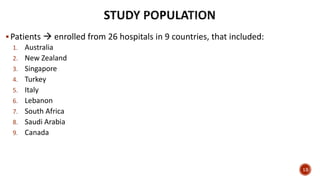
Patients  enrolled from 26 hospitals in 9 countries, that included:
1. Australia
2. New Zealand
3. Singapore
4. Turkey
5. Italy
6. Lebanon
7. South Africa
8. Saudi Arabia
9. Canada
13
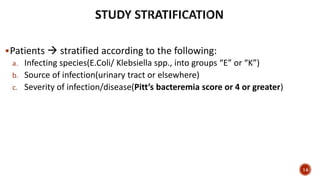
Patients  stratified according to the following:
a. Infecting species(E.Coli/ Klebsiella spp., into groups “E” or “K”)
b. Source of infection(urinary tract or elsewhere)
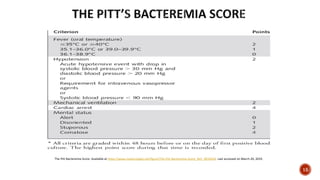
c. Severity of infection/disease(Pitt’s bacteremia score or 4 or greater)
14
15
The Pitt Bacteremia Score. Available at https://www.researchgate.net/figure/The-Pitt-Bacteremia-Score_tbl1_8933024. Last accessed on March 20, 2019.
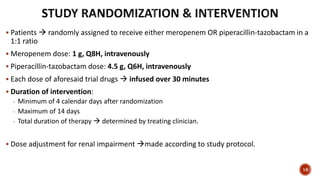
 Patients  randomly assigned to receive either meropenem OR piperacillin-tazobactam in a
1:1 ratio
 Meropenem dose: 1 g, Q8H, intravenously
 Piperacillin-tazobactam dose: 4.5 g, Q6H, intravenously
 Each dose of aforesaid trial drugs  infused over 30 minutes
 Duration of intervention:
- Minimum of 4 calendar days after randomization
- Maximum of 14 days
- Total duration of therapy  determined by treating clinician.
 Dose adjustment for renal impairment made according to study protocol.
16
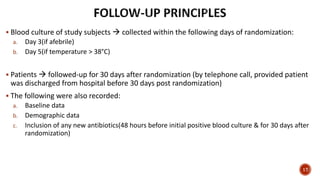
 Blood culture of study subjects  collected within the following days of randomization:
a. Day 3(if afebrile)
b. Day 5(if temperature > 38°C)
 Patients  followed-up for 30 days after randomization (by telephone call, provided patient
was discharged from hospital before 30 days post randomization)
 The following were also recorded:
a. Baseline data
b. Demographic data
c. Inclusion of any new antibiotics(48 hours before initial positive blood culture & for 30 days after
randomization)
17
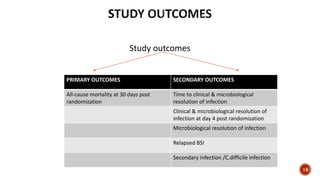
Study outcomes
PRIMARY OUTCOMES SECONDARY OUTCOMES
All-cause mortality at 30 days post
randomization
Time to clinical & microbiological
resolution of infection
Clinical & microbiological resolution of
infection at day 4 post randomization
Microbiological resolution of infection
Relapsed BSI
Secondary infection /C.difficile infection
18
STUDY RESULTS
19
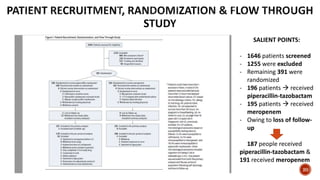
SALIENT POINTS:
- 1646 patients screened
- 1255 were excluded
- Remaining 391 were
randomized
- 196 patients  received
piperacillin-tazobactam
- 195 patients  received
meropenem
- Owing to loss of follow-
up
187 people received
piperacillin-tazobactam &
191 received meropenem
20
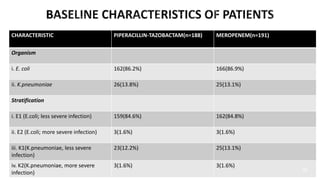
CHARACTERISTIC PIPERACILLIN-TAZOBACTAM(n=188) MEROPENEM(n=191)
Organism
i. E. coli 162(86.2%) 166(86.9%)
ii. K.pneumoniae 26(13.8%) 25(13.1%)
Stratification
i. E1 (E.coli; less severe infection) 159(84.6%) 162(84.8%)
ii. E2 (E.coli; more severe infection) 3(1.6%) 3(1.6%)
iii. K1(K.pneumoniae, less severe
infection)
23(12.2%) 25(13.1%)
iv. K2(K.pneumoniae, more severe
infection)
3(1.6%) 3(1.6%)
21
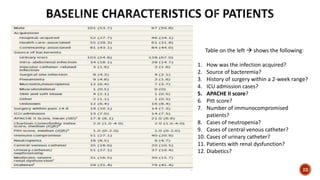
Table on the left  shows the following:
1. How was the infection acquired?
2. Source of bacteremia?
3. History of surgery within a 2-week range?
4. ICU admission cases?
5. APACHE II score?
6. Pitt score?
7. Number of immunocompromised
patients?
8. Cases of neutropenia?
9. Cases of central venous catheter?
10. Cases of urinary catheter?
11. Patients with renal dysfunction?
12. Diabetics?
22
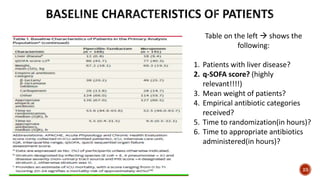
Table on the left  shows the
following:
1. Patients with liver disease?
2. q-SOFA score? (highly
relevant!!!!)
3. Mean weight of patients?
4. Empirical antibiotic categories
received?
5. Time to randomization(in hours)?
6. Time to appropriate antibiotics
administered(in hours)?
23
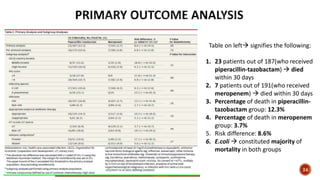
Table on left signifies the following:
1. 23 patients out of 187(who received
piperacillin-tazobactam)  died
within 30 days
2. 7 patients out of 191(who received
meropenem)  died within 30 days
3. Percentage of death in piperacillin-
tazobactam group: 12.3%
4. Percentage of death in meropenem
group: 3.7%
5. Risk difference: 8.6%
6. E.coli  constituted majority of
mortality in both groups
24
Table on the left signifies the
following:
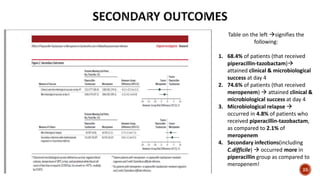
1. 68.4% of patients (that received
piperacillin-tazobactam)
attained clinical & microbiological
success at day 4
2. 74.6% of patients (that received
meropenem)  attained clinical &
microbiological success at day 4
3. Microbiological relapse 
occurred in 4.8% of patients who
received piperacillin-tazobactam,
as compared to 2.1% of
meropenem
4. Secondary infections(including
C.difficile)  occurred more in
piperacillin group as compared to
meropenem!
25
 Overall mortality in this study(8.0%)  was lower than expected
 Lower mortality rate  may have happened due to:
a. Restrictions in selection of patients with severe infections
b. Exclusion of patients, who seemed unlikely to survive beyond 96 hours(very poor prognosis)
 According to a recent trial of meropenem-vaborbactam vs piperacillin-tazobactam for
complicated UTI  meropenem-vaborbactam was found superior over the latter (even in
presence of some carbapenemase-producing strains!)
 Whether piperacillin-tazobactam is effective for UTI caused by ESBL producers in patients
without BSI/ low mortality risk  remains uncertain!!
1. Kaye KS, Bhowmick T, Metallidis S, et al. Effect of meropenem-vaborbactam vs piperacillin-tazobactam on clinical cure or improvement and microbial eradication in complicated urinary tract infection: the TANGO I
randomized clinical trial. JAMA. 2018;319(8):788-799.
26
This study  signifies the fact that piperacillin-tazobactam is not as efficacious
as that of meropenem in the treatment of ESBL infections
This study  shows the alarming fact that “piperacillin-tazobactam is
associated with C.difficile infection, which can culminate in significant
morbidity & mortality in a healthcare setting”!
27
 Inherent delays in sampling of blood cultures & susceptibility testing  empirical therapy
wasn’t in the control of the trial team!
 50 patients who were randomized to meropenem
Received a BLBLI empirically!
 26 patients who were randomized to piperacillin-tazobactam
Received a carbapenem empirically!
 Step-down therapy (allowed on day 5 after randomization) with a carbapenem  occurred in
76 of total number of trial subjects  even if randomized to piperacillin-tazobactam!!!
28
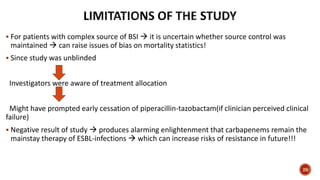
 For patients with complex source of BSI  it is uncertain whether source control was
maintained  can raise issues of bias on mortality statistics!
 Since study was unblinded
Investigators were aware of treatment allocation
Might have prompted early cessation of piperacillin-tazobactam(if clinician perceived clinical
failure)
 Negative result of study  produces alarming enlightenment that carbapenems remain the
mainstay therapy of ESBL-infections  which can increase risks of resistance in future!!!
29
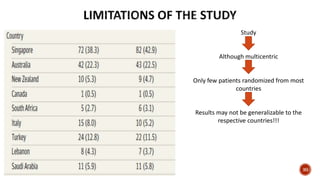
Study
Although multicentric
Only few patients randomized from most
countries
Results may not be generalizable to the
respective countries!!!
30
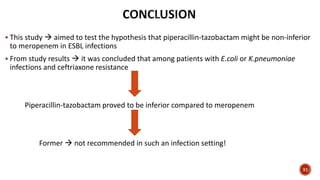
 This study  aimed to test the hypothesis that piperacillin-tazobactam might be non-inferior
to meropenem in ESBL infections
 From study results  it was concluded that among patients with E.coli or K.pneumoniae
infections and ceftriaxone resistance
Piperacillin-tazobactam proved to be inferior compared to meropenem
Former  not recommended in such an infection setting!
31
32
ANY QUERIES?
THANK YOU!!!!
33

Journal club presentation: by RxVichuZ!! ;)

  • 1.
  • 2.
     AUTHORS: PatrickN. A. Harris, Paul A. Tambyah, David C. Lye et al.  TITLE: Effect of Piperacillin-Tazobactam vs Meropenem on 30-Day Mortality for Patients with E. Coli or Klebsiella pneumoniae Bloodstream Infection and Ceftriaxone Resistance : A Randomized Clinical Trial  PUBLISHED ONLINE: September 11, 2018  JOURNAL : JAMA 2018;320:984-94  STUDY SITE: 26 hospitals in 9 countries(Australia, NZ, Singapore, Italy, Turkey, Lebanon, SA, Saudi Arabia & Canada)  STUDY DURATION: February 2014 to July 2017  DOI: 10.1001/jama.2018.12163 2
  • 3.
  • 4.
     Gram (-ve)bacteria  produce ESBL enzymes Contribute to significant health concern globally!  According to US CDC estimates from 2011 ESBL-producing organisms Contributed to 26,000 infections & 1,700 deaths annually! 1. Pitout JD, Laupland KB. Extended-spectrum beta-lactamase-producing Enterobacteriaceae: an emerging public-health concern. Lancet Infect Dis. 2008;8(3):159-166. [Crossref] 2. Centers for Disease Control and Prevention. Antibiotic Resistance Threats in the United States. Washington, DC: US Department of Health and Human Services; 2013. [Crossref] 4
  • 5.
     Extended spectrumbeta-lactamases(ESBLs)  refer to enzymes, that confer resistance to most beta-lactam antibiotics  ESBL  found extensively in Gram negative organisms, mainly E. coli and Klebsiella ESBLs CAN HYDROLYZE CANNOT HYDROLYZE Most penicillins Cefamycins (cefoxitin, cefotetan, cefmetazole) Most cephalosporins(cefotaxime, ceftazidime, ceftriaxone, cefepime) CARBAPENEMS(Imipenem-cilastatin, meropenem) Monobactams(aztreonam) Garg G, Gupta S. Review of pharmacology. 12th ed. New Delhi: Jaypee Brothers Medical Pub.; 2018. 5
  • 6.
     ESBL-producers alarmingly prevalent in both community & health-care settings Although carbapenems are DOC* for ESBL infections Increased use of former Can result in Ineffectuality in G(-ve) bacilli!  In such situations  usage of alternative carbapenem-sparing agents (eg. Piperacillin- tazobactam) Might be an effective option to reduce global burden on carbapenems *Drug of choice 1. Doi Y, Park YS, Rivera JI, et al. Communityassociated extended-spectrum β-lactamase producing Escherichia coli infection in the United States. Clin Infect Dis. 2013;56(5):641-648[Crossref] 2. Paterson DL, Bonomo RA. Extended-spectrum beta-lactamases: a clinical update. Clin Microbiol Rev. 2005;18(4):657-686[Crossref] 3. Chang H-J, Hsu P-C, Yang C-C, et al. Risk factors and outcomes of carbapenem-non susceptible Escherichia coli bacteremia: a matched case-control study. J Microbiol Immunol Infect. 2011;44(2):125-130[Crossref] 6
  • 7.
    Although BLBLIs* aredocumented to be effective in ESBL infections Results are rather controversial! Thus This study aims to hypothesize if usage of a carbapenem-sparing agent(piperacillin-tazobactam) Would Prove to be non-inferior to a carbapenem(meropenem) for ESBL infections. *Beta-lactam-beta-lactamase inhibitor 1. Harris PN, Tambyah PA, Paterson DL. β-lactam and β-lactamase inhibitor combinations in the treatment of extended-spectrum β-lactamase producing Enterobacteriaceae: time for a reappraisal in the era of few antibiotic options? Lancet Infect Dis. 2015;15(4):475-485 [Crossref] 2. Tamma PD, Rodriguez-Bano J. The use of noncarbapenem β-lactams for the treatment of extended-spectrum β-lactamase infections. Clin Infect Dis. 2017;64(7):972-980 [Crossref] 3. Tamma PD, Han JH, Rock C, et al; Antibacterial Resistance Leadership Group. Carbapenem therapy is associated with improved survival compared with piperacillin-tazobactam for patients with extended-spectrum β-lactamase bacteremia Clin Infect Dis. 2015;60(9):1319-1325. [Crossref] 7
  • 8.
    To determine whetherdefinitive therapy with piperacillin-tazobactam Proves to be non-inferior to meropenem in patients with bloodstream infection(BSI) attributed to ceftriaxone-resistant E.Coli / K.pneumoniae 8
  • 9.
  • 10.
  • 11.
    Adult patients (aged18 years or older) Atleast 1 positive blood culture with E.Coli or Klebsiella spp. Organism  non-susceptible to ceftriaxone/cefotaxime Organism  susceptible to piperacillin-tazobactam/ meropenem Patients  randomized within 72 hours of positive blood culture collection 11
  • 12.
    Allergenicity to eithertrial drug(including cross-allergenicity) No expectations of survival for more than 96 hours Treatment, without curative intent Polymicrobial bacteremia Previous enrollment in the trial Pregnant/lactating women Requirement for concomitant antibiotics against G(-ve) bacilli 12
  • 13.
    Patients  enrolledfrom 26 hospitals in 9 countries, that included: 1. Australia 2. New Zealand 3. Singapore 4. Turkey 5. Italy 6. Lebanon 7. South Africa 8. Saudi Arabia 9. Canada 13
  • 14.
    Patients  stratifiedaccording to the following: a. Infecting species(E.Coli/ Klebsiella spp., into groups “E” or “K”) b. Source of infection(urinary tract or elsewhere) c. Severity of infection/disease(Pitt’s bacteremia score or 4 or greater) 14
  • 15.
    15 The Pitt BacteremiaScore. Available at https://www.researchgate.net/figure/The-Pitt-Bacteremia-Score_tbl1_8933024. Last accessed on March 20, 2019.
  • 16.
     Patients randomly assigned to receive either meropenem OR piperacillin-tazobactam in a 1:1 ratio  Meropenem dose: 1 g, Q8H, intravenously  Piperacillin-tazobactam dose: 4.5 g, Q6H, intravenously  Each dose of aforesaid trial drugs  infused over 30 minutes  Duration of intervention: - Minimum of 4 calendar days after randomization - Maximum of 14 days - Total duration of therapy  determined by treating clinician.  Dose adjustment for renal impairment made according to study protocol. 16
  • 17.
     Blood cultureof study subjects  collected within the following days of randomization: a. Day 3(if afebrile) b. Day 5(if temperature > 38°C)  Patients  followed-up for 30 days after randomization (by telephone call, provided patient was discharged from hospital before 30 days post randomization)  The following were also recorded: a. Baseline data b. Demographic data c. Inclusion of any new antibiotics(48 hours before initial positive blood culture & for 30 days after randomization) 17
  • 18.
    Study outcomes PRIMARY OUTCOMESSECONDARY OUTCOMES All-cause mortality at 30 days post randomization Time to clinical & microbiological resolution of infection Clinical & microbiological resolution of infection at day 4 post randomization Microbiological resolution of infection Relapsed BSI Secondary infection /C.difficile infection 18
  • 19.
  • 20.
    SALIENT POINTS: - 1646patients screened - 1255 were excluded - Remaining 391 were randomized - 196 patients  received piperacillin-tazobactam - 195 patients  received meropenem - Owing to loss of follow- up 187 people received piperacillin-tazobactam & 191 received meropenem 20
  • 21.
    CHARACTERISTIC PIPERACILLIN-TAZOBACTAM(n=188) MEROPENEM(n=191) Organism i.E. coli 162(86.2%) 166(86.9%) ii. K.pneumoniae 26(13.8%) 25(13.1%) Stratification i. E1 (E.coli; less severe infection) 159(84.6%) 162(84.8%) ii. E2 (E.coli; more severe infection) 3(1.6%) 3(1.6%) iii. K1(K.pneumoniae, less severe infection) 23(12.2%) 25(13.1%) iv. K2(K.pneumoniae, more severe infection) 3(1.6%) 3(1.6%) 21
  • 22.
    Table on theleft  shows the following: 1. How was the infection acquired? 2. Source of bacteremia? 3. History of surgery within a 2-week range? 4. ICU admission cases? 5. APACHE II score? 6. Pitt score? 7. Number of immunocompromised patients? 8. Cases of neutropenia? 9. Cases of central venous catheter? 10. Cases of urinary catheter? 11. Patients with renal dysfunction? 12. Diabetics? 22
  • 23.
    Table on theleft  shows the following: 1. Patients with liver disease? 2. q-SOFA score? (highly relevant!!!!) 3. Mean weight of patients? 4. Empirical antibiotic categories received? 5. Time to randomization(in hours)? 6. Time to appropriate antibiotics administered(in hours)? 23
  • 24.
    Table on leftsignifies the following: 1. 23 patients out of 187(who received piperacillin-tazobactam)  died within 30 days 2. 7 patients out of 191(who received meropenem)  died within 30 days 3. Percentage of death in piperacillin- tazobactam group: 12.3% 4. Percentage of death in meropenem group: 3.7% 5. Risk difference: 8.6% 6. E.coli  constituted majority of mortality in both groups 24
  • 25.
    Table on theleft signifies the following: 1. 68.4% of patients (that received piperacillin-tazobactam) attained clinical & microbiological success at day 4 2. 74.6% of patients (that received meropenem)  attained clinical & microbiological success at day 4 3. Microbiological relapse  occurred in 4.8% of patients who received piperacillin-tazobactam, as compared to 2.1% of meropenem 4. Secondary infections(including C.difficile)  occurred more in piperacillin group as compared to meropenem! 25
  • 26.
     Overall mortalityin this study(8.0%)  was lower than expected  Lower mortality rate  may have happened due to: a. Restrictions in selection of patients with severe infections b. Exclusion of patients, who seemed unlikely to survive beyond 96 hours(very poor prognosis)  According to a recent trial of meropenem-vaborbactam vs piperacillin-tazobactam for complicated UTI  meropenem-vaborbactam was found superior over the latter (even in presence of some carbapenemase-producing strains!)  Whether piperacillin-tazobactam is effective for UTI caused by ESBL producers in patients without BSI/ low mortality risk  remains uncertain!! 1. Kaye KS, Bhowmick T, Metallidis S, et al. Effect of meropenem-vaborbactam vs piperacillin-tazobactam on clinical cure or improvement and microbial eradication in complicated urinary tract infection: the TANGO I randomized clinical trial. JAMA. 2018;319(8):788-799. 26
  • 27.
    This study signifies the fact that piperacillin-tazobactam is not as efficacious as that of meropenem in the treatment of ESBL infections This study  shows the alarming fact that “piperacillin-tazobactam is associated with C.difficile infection, which can culminate in significant morbidity & mortality in a healthcare setting”! 27
  • 28.
     Inherent delaysin sampling of blood cultures & susceptibility testing  empirical therapy wasn’t in the control of the trial team!  50 patients who were randomized to meropenem Received a BLBLI empirically!  26 patients who were randomized to piperacillin-tazobactam Received a carbapenem empirically!  Step-down therapy (allowed on day 5 after randomization) with a carbapenem  occurred in 76 of total number of trial subjects  even if randomized to piperacillin-tazobactam!!! 28
  • 29.
     For patientswith complex source of BSI  it is uncertain whether source control was maintained  can raise issues of bias on mortality statistics!  Since study was unblinded Investigators were aware of treatment allocation Might have prompted early cessation of piperacillin-tazobactam(if clinician perceived clinical failure)  Negative result of study  produces alarming enlightenment that carbapenems remain the mainstay therapy of ESBL-infections  which can increase risks of resistance in future!!! 29
  • 30.
    Study Although multicentric Only fewpatients randomized from most countries Results may not be generalizable to the respective countries!!! 30
  • 31.
     This study aimed to test the hypothesis that piperacillin-tazobactam might be non-inferior to meropenem in ESBL infections  From study results  it was concluded that among patients with E.coli or K.pneumoniae infections and ceftriaxone resistance Piperacillin-tazobactam proved to be inferior compared to meropenem Former  not recommended in such an infection setting! 31
  • 32.
  • 33.