SUGAR PROCESSING
FROM SUGAR BEET
Presented by: Ayaz Ahmad
Class no: 258
Subject: Sugar Technology
Teacher: Dr. Ihsan Mabood Qazi
Sugar beet
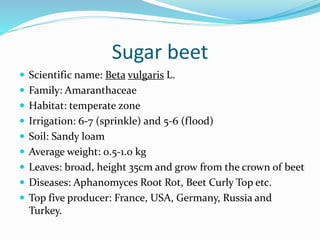
 Scientific name: Beta vulgaris L.
 Family: Amaranthaceae
 Habitat: temperate zone
 Irrigation: 6-7 (sprinkle) and 5-6 (flood)
 Soil: Sandy loam
 Average weight: 0.5-1.0 kg
 Leaves: broad, height 35cm and grow from the crown of beet
 Diseases: Aphanomyces Root Rot, Beet Curly Top etc.
 Top five producer: France, USA, Germany, Russia and
Turkey.
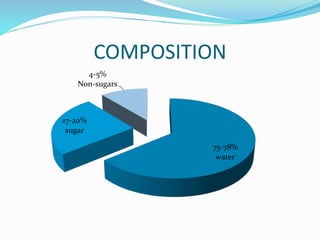
COMPOSITION
75-78%
water
17-20%
sugar
4-5%
Non-sugars
FROM FIELD TO FACTORY
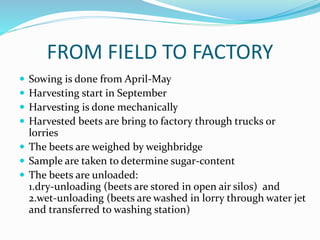
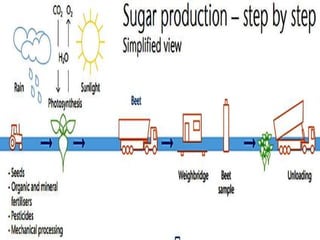
 Sowing is done from April-May
 Harvesting start in September
 Harvesting is done mechanically
 Harvested beets are bring to factory through trucks or
lorries
 The beets are weighed by weighbridge
 Sample are taken to determine sugar-content
 The beets are unloaded:
1.dry-unloading (beets are stored in open air silos) and
2.wet-unloading (beets are washed in lorry through water jet
and transferred to washing station)
CLEANING OF BEETS
 Beets from silos or wet-unloading are passed to the washing
station through conveyer belt
 In route to the production process, stones and grass are
removed in a series of stone and grass catchers
 First they enter into the revolving drum where under a
shower of water the beets rubbed against each other
dislodging the soil
 The water flow, floats the beets which exit the drum
 The stones remain behind and collected in separate bucket
along the edge
 A screw conveyer moves the beets to the transfer system
which brings them into the slicing machine
SLICING
 The sugar beets are bring into the slicing machines where
very sharp knives cut them into long noodle-like pieces
called cossettes
 This makes more surface area for extraction of sugar
 Emerging from the slicing machines, the cossettes fall onto
a conveyor belt to be weighed and fed into the diffusion
system
DIFFUSION
 Sugar is extracted from the beet by diffusing it out with hot
water up to 70oC
 The beets are fed into the bottom of the diffuser and water is
entered from the top of diffuser
 Through the process of osmosis sugar is extracted from beet
slices into hot water called raw juice (contain 14% sugar)
 The remaining slices are called pulp ( up to 2% sugar) and are
send for further processing
PULP DRYER
 The wet pulp (90-92% water) from the diffuser is sent to pulp
presses
 The pulp presses squeeze the pulp in order to remove as much
water as possible
 then it is called pressed pulp (72-78% water) and is either sold
as livestock feed or sent to the dryer for further processing
 The water pressed out of the pulp is sent back to the diffuser to
recover the sugar in it
 The pulp dryers are direct fired by oil, gas or coal and dry the
pulp to 12% moisture
 Pressed pulp is sold for short term use while pellets store for
longer periods, but both are used for livestock feed
LIME KILN
 In sugar factory the lime kiln supplies the burned lime and
carbon dioxide for the purification processes
 Limestone (calcium carbonate) is heated to 1093OC in a
lime kiln using hard coal or natural gas
 The heating process releases carbon dioxide from the
limestone reducing the calcium carbonate to calcium oxide
 The calcium oxide (burned lime) is then mixed with sweet
water to form milk of lime in a lime slacker
PURIFICATION AND FILTERATION
PROCESSES
 Before sugar can be produced in a white crystalline form it
is necessary to remove non-sugars present in the juice
 lime and CO2 are added to the juice causing non-sugars to
be precipitated out of the solution
 Lime and CO2 are added in the following ways
 Raw juice having pH 5.5-6.0
 Pre heated and then slack lime and CO2 is added to it
raising pH between 8.8-9.0 and temperature between
75-80OC
 First carbonation is done and lime is added to raise the pH
between 11.0-11.5 and temperature between 85-88OC
 The resulting juice flows to a clarifier where the
precipitated calcium carbonate formed in first carbonation
is settled out
 The clear juice is filtered, heated and send for second
carbonation while the defecation lime left behind in the
bottom
 The defecation removed and fed to vacuum drum filters
where it is washed to recover the sugar left in it
 The washed defecat has about 1% of the sugar from the
beets in it and is sent to a lime pond
 The washed water with the recovered sugar is called
"sweet water" and is sent to the lime house to be mixed
with the burned lime
 In the second carbonation system CO2 is used to form
calcium carbonate precipitate
( pH 8.7-8.8 & temp 95-100OC)
 Juice is stored in collection tank, then filtered and again
heated
( pH 8.5-9.0 & temp 74-80OC)
 Sulfitation is done along with the addition of slack lime
( pH 7.0-7.5 & temp 90-100OC) and resulting thin juice is
send to evaporators
EVAPORATION PROCESS
 The thin juice is a sugar solution containing
approximately 14% sugar and 1% non-sugars
 The juice is concentrated boiling off water from the
solution in large vessels known as evaporators
 The evaporation station consists of 4 to 6 evaporator
bodies that contain tubes
 Steam is fed to the outside of the tubes and the juice is
on the inside of the tubes
 The heat transfers from the steam to the juice
 The water evaporated in one evaporator becomes the steam
feeding the next evaporator while the juice travels from one
effect to the next
 The thin juice enters the evaporators at 13 to 15% solids and
leaves the station at 60% solids and is called thick juice
CRYSTALLIZATION AND
SEPARATION
 Thick juice is send to high melting machine where high and low
sugars are dissolved in it through heating and agitation
 The juice is then heated, filtered and further concentrated
through the "concentrator" to 70 to 75% solids
 This is then called standard liquor and is fed to the white pan
where white sugar is crystallized from solution
 Finely ground sugar is used to "seed" the pan
 More and more water is evaporated forcing more sugar to
crystallize
 The solution is concentrated to 92% solids and consists of sugar
crystal surrounded by syrup of sugar-water and this is call white
massecuite.
 The massecuite is dropped into a mixer that then feeds the
white centrifugals
 The white centrifugals separate the sugar crystals from the
syrup in the massecuite by spinning the sugar against a
screen while the syrup spins through the screen
 Hot water is used to wash the residual syrup from the
crystal
 The white sugar is then conveyed to the granulator for
further drying and cooling
 The finished sugar is then shifted to the bulk sugar bins for
storage
HIGH RAW SYSTEM
 White centrifugal produce two type of syrup: 1.the high wash
is higher purity syrup that is recycled to the high melter 2.the
high green is the lower purity syrup
 It is sent to the high raw vacuum pan for processing
 Here again, seed crystals and evaporation are used to remove
sugar from the syrup solution
 The high raw massecuite is sent to a mixer and then to
another set of centrifugals to separate the sugar crystal from
the syrup
 The sugar crystals made here are not a good enough quality so
they are sent to the high melter to be re-dissolved and re-
processed in the white pan
LOW RAW SYSTEM
 The syrup leaving the high raw centrifugals is called machine
syrup
 Lower in purity than high green syrup
 The machine syrup is sent to the low raw system that contains
one additional piece of equipment as compared to the high
raw system
 The low raw vacuum pan is used to crystallize sugar
 The low raw massecuite sent to a crystallizer where cold
water is used to continue the crystallization process for an
additional 48 hours
 The low raw massecuite send to the low raw mixer and
centrifugals where sugar crystals are separated from the
syrup called molasses
 The sugar crystals are sent to the high melter for re-
processing
MOLASSES DESUGARIZATION
 The molasses is about 50% sugar by weight
 About 10-15% of the sugar from the beets leaves the sugar
factory in molasses
 The molasses is sent to the molasses desugarization system
 This operation removes about 80% of the sugar in the
molasses
 The molasses is treated to remove some non-sugars (Ca, Mg
and suspended solids) that will cause processing problems in
the separation process
 The molasses is softened by replacing non-sugars with
sodium and filtering the precipitates formed in the
reaction
 The pre-treatment process consists of dilution, heating,
soda ash addition (sodium source) and filtering
 The filtering process uses plate and frame filters to
squeeze the softened molasses through filter leaves, while
the precipitated non-sugars remain behind
SOFTENED MOLASSES SEPARATION
 The softened molasses is sent to the separation (ion
exclusion) process
 The columns are loaded with a resin that attracts certain
chemicals while letting other chemicals pass through
quickly
 This difference in travel time is used to separate the
molasses into a sugar fraction, a betaine fraction and a
residual molasses fraction
PACKAGING AND STORAGE OF
PRODUCT
 Dry sugar is stored in sugar silo which has air conditioning
 For the expedition sugar is packed in 50, 25 kg bags
 It can also be delivered unpacked in tanks
 Before packing, it is important that all sugar be cooled
below 45° C
 At higher temperatures it hardens in the bag or silo
Sugar processing
Sugar processing
Sugar processing

Sugar processing

  • 2.
    SUGAR PROCESSING FROM SUGARBEET Presented by: Ayaz Ahmad Class no: 258 Subject: Sugar Technology Teacher: Dr. Ihsan Mabood Qazi
  • 3.
    Sugar beet  Scientificname: Beta vulgaris L.  Family: Amaranthaceae  Habitat: temperate zone  Irrigation: 6-7 (sprinkle) and 5-6 (flood)  Soil: Sandy loam  Average weight: 0.5-1.0 kg  Leaves: broad, height 35cm and grow from the crown of beet  Diseases: Aphanomyces Root Rot, Beet Curly Top etc.  Top five producer: France, USA, Germany, Russia and Turkey.
  • 4.
  • 5.
    FROM FIELD TOFACTORY  Sowing is done from April-May  Harvesting start in September  Harvesting is done mechanically  Harvested beets are bring to factory through trucks or lorries  The beets are weighed by weighbridge  Sample are taken to determine sugar-content  The beets are unloaded: 1.dry-unloading (beets are stored in open air silos) and 2.wet-unloading (beets are washed in lorry through water jet and transferred to washing station)
  • 7.
    CLEANING OF BEETS Beets from silos or wet-unloading are passed to the washing station through conveyer belt  In route to the production process, stones and grass are removed in a series of stone and grass catchers  First they enter into the revolving drum where under a shower of water the beets rubbed against each other dislodging the soil  The water flow, floats the beets which exit the drum  The stones remain behind and collected in separate bucket along the edge  A screw conveyer moves the beets to the transfer system which brings them into the slicing machine
  • 8.
    SLICING  The sugarbeets are bring into the slicing machines where very sharp knives cut them into long noodle-like pieces called cossettes  This makes more surface area for extraction of sugar  Emerging from the slicing machines, the cossettes fall onto a conveyor belt to be weighed and fed into the diffusion system
  • 9.
    DIFFUSION  Sugar isextracted from the beet by diffusing it out with hot water up to 70oC  The beets are fed into the bottom of the diffuser and water is entered from the top of diffuser  Through the process of osmosis sugar is extracted from beet slices into hot water called raw juice (contain 14% sugar)  The remaining slices are called pulp ( up to 2% sugar) and are send for further processing
  • 10.
    PULP DRYER  Thewet pulp (90-92% water) from the diffuser is sent to pulp presses  The pulp presses squeeze the pulp in order to remove as much water as possible  then it is called pressed pulp (72-78% water) and is either sold as livestock feed or sent to the dryer for further processing  The water pressed out of the pulp is sent back to the diffuser to recover the sugar in it  The pulp dryers are direct fired by oil, gas or coal and dry the pulp to 12% moisture  Pressed pulp is sold for short term use while pellets store for longer periods, but both are used for livestock feed
  • 12.
    LIME KILN  Insugar factory the lime kiln supplies the burned lime and carbon dioxide for the purification processes  Limestone (calcium carbonate) is heated to 1093OC in a lime kiln using hard coal or natural gas  The heating process releases carbon dioxide from the limestone reducing the calcium carbonate to calcium oxide  The calcium oxide (burned lime) is then mixed with sweet water to form milk of lime in a lime slacker
  • 13.
    PURIFICATION AND FILTERATION PROCESSES Before sugar can be produced in a white crystalline form it is necessary to remove non-sugars present in the juice  lime and CO2 are added to the juice causing non-sugars to be precipitated out of the solution  Lime and CO2 are added in the following ways
  • 14.
     Raw juicehaving pH 5.5-6.0  Pre heated and then slack lime and CO2 is added to it raising pH between 8.8-9.0 and temperature between 75-80OC  First carbonation is done and lime is added to raise the pH between 11.0-11.5 and temperature between 85-88OC  The resulting juice flows to a clarifier where the precipitated calcium carbonate formed in first carbonation is settled out  The clear juice is filtered, heated and send for second carbonation while the defecation lime left behind in the bottom
  • 15.
     The defecationremoved and fed to vacuum drum filters where it is washed to recover the sugar left in it  The washed defecat has about 1% of the sugar from the beets in it and is sent to a lime pond  The washed water with the recovered sugar is called "sweet water" and is sent to the lime house to be mixed with the burned lime
  • 16.
     In thesecond carbonation system CO2 is used to form calcium carbonate precipitate ( pH 8.7-8.8 & temp 95-100OC)  Juice is stored in collection tank, then filtered and again heated ( pH 8.5-9.0 & temp 74-80OC)  Sulfitation is done along with the addition of slack lime ( pH 7.0-7.5 & temp 90-100OC) and resulting thin juice is send to evaporators
  • 17.
    EVAPORATION PROCESS  Thethin juice is a sugar solution containing approximately 14% sugar and 1% non-sugars  The juice is concentrated boiling off water from the solution in large vessels known as evaporators  The evaporation station consists of 4 to 6 evaporator bodies that contain tubes  Steam is fed to the outside of the tubes and the juice is on the inside of the tubes
  • 18.
     The heattransfers from the steam to the juice  The water evaporated in one evaporator becomes the steam feeding the next evaporator while the juice travels from one effect to the next  The thin juice enters the evaporators at 13 to 15% solids and leaves the station at 60% solids and is called thick juice
  • 19.
    CRYSTALLIZATION AND SEPARATION  Thickjuice is send to high melting machine where high and low sugars are dissolved in it through heating and agitation  The juice is then heated, filtered and further concentrated through the "concentrator" to 70 to 75% solids  This is then called standard liquor and is fed to the white pan where white sugar is crystallized from solution  Finely ground sugar is used to "seed" the pan  More and more water is evaporated forcing more sugar to crystallize  The solution is concentrated to 92% solids and consists of sugar crystal surrounded by syrup of sugar-water and this is call white massecuite.
  • 20.
     The massecuiteis dropped into a mixer that then feeds the white centrifugals  The white centrifugals separate the sugar crystals from the syrup in the massecuite by spinning the sugar against a screen while the syrup spins through the screen  Hot water is used to wash the residual syrup from the crystal  The white sugar is then conveyed to the granulator for further drying and cooling  The finished sugar is then shifted to the bulk sugar bins for storage
  • 21.
    HIGH RAW SYSTEM White centrifugal produce two type of syrup: 1.the high wash is higher purity syrup that is recycled to the high melter 2.the high green is the lower purity syrup  It is sent to the high raw vacuum pan for processing  Here again, seed crystals and evaporation are used to remove sugar from the syrup solution  The high raw massecuite is sent to a mixer and then to another set of centrifugals to separate the sugar crystal from the syrup  The sugar crystals made here are not a good enough quality so they are sent to the high melter to be re-dissolved and re- processed in the white pan
  • 22.
    LOW RAW SYSTEM The syrup leaving the high raw centrifugals is called machine syrup  Lower in purity than high green syrup  The machine syrup is sent to the low raw system that contains one additional piece of equipment as compared to the high raw system  The low raw vacuum pan is used to crystallize sugar
  • 23.
     The lowraw massecuite sent to a crystallizer where cold water is used to continue the crystallization process for an additional 48 hours  The low raw massecuite send to the low raw mixer and centrifugals where sugar crystals are separated from the syrup called molasses  The sugar crystals are sent to the high melter for re- processing
  • 24.
    MOLASSES DESUGARIZATION  Themolasses is about 50% sugar by weight  About 10-15% of the sugar from the beets leaves the sugar factory in molasses  The molasses is sent to the molasses desugarization system  This operation removes about 80% of the sugar in the molasses  The molasses is treated to remove some non-sugars (Ca, Mg and suspended solids) that will cause processing problems in the separation process
  • 25.
     The molassesis softened by replacing non-sugars with sodium and filtering the precipitates formed in the reaction  The pre-treatment process consists of dilution, heating, soda ash addition (sodium source) and filtering  The filtering process uses plate and frame filters to squeeze the softened molasses through filter leaves, while the precipitated non-sugars remain behind
  • 26.
    SOFTENED MOLASSES SEPARATION The softened molasses is sent to the separation (ion exclusion) process  The columns are loaded with a resin that attracts certain chemicals while letting other chemicals pass through quickly  This difference in travel time is used to separate the molasses into a sugar fraction, a betaine fraction and a residual molasses fraction
  • 27.
    PACKAGING AND STORAGEOF PRODUCT  Dry sugar is stored in sugar silo which has air conditioning  For the expedition sugar is packed in 50, 25 kg bags  It can also be delivered unpacked in tanks  Before packing, it is important that all sugar be cooled below 45° C  At higher temperatures it hardens in the bag or silo