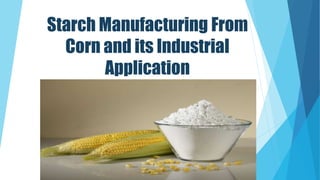
Starch Manufacturing From
Corn and its Industrial
Application
ABDUL RAOUF
Contents….
 Starch
 Introduction
 History
 Corn Properties
 Corn Types
 Dry Milling Process
 Wet Milling Process
 Application in Industory
Starch
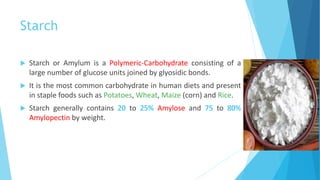
 Starch or Amylum is a Polymeric-Carbohydrate consisting of a
large number of glucose units joined by glyosidic bonds.
 It is the most common carbohydrate in human diets and present
in staple foods such as Potatoes, Wheat, Maize (corn) and Rice.
 Starch generally contains 20 to 25% Amylose and 75 to 80%
Amylopectin by weight.
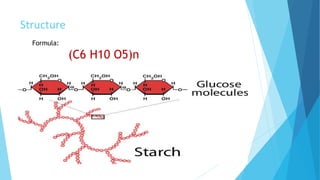
Structure
Formula:
(C6 H10 O5)n
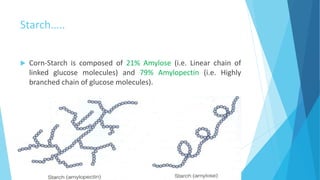
Starch…..
 Corn-Starch is composed of 21% Amylose (i.e. Linear chain of
linked glucose molecules) and 79% Amylopectin (i.e. Highly
branched chain of glucose molecules).
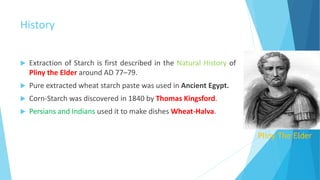
History
 Extraction of Starch is first described in the Natural History of
Pliny the Elder around AD 77–79.
 Pure extracted wheat starch paste was used in Ancient Egypt.
 Corn-Starch was discovered in 1840 by Thomas Kingsford.
 Persians and Indians used it to make dishes Wheat-Halva.
Pliny The Elder
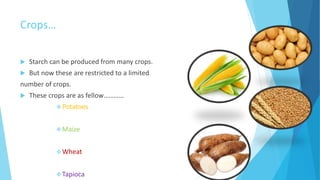
Crops…
 Starch can be produced from many crops.
 But now these are restricted to a limited
number of crops.
 These crops are as fellow…………
Potatoes
Maize
Wheat
Tapioca
Corn Properties
 Approximately 20% of the Annual Corn Harvest is used to
produce products such as Sweeteners, Starches, Oils, Ethanol
and Animal Feeds.
 The remainder quantity is fed to Livestock, Poultry & Fish.
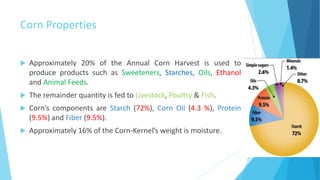
 Corn’s components are Starch (72%), Corn Oil (4.3 %), Protein
(9.5%) and Fiber (9.5%).
 Approximately 16% of the Corn-Kernel’s weight is moisture.
Types of Corn
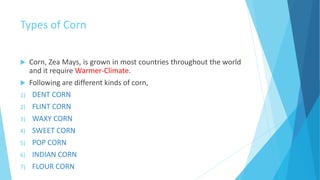
 Corn, Zea Mays, is grown in most countries throughout the world
and it require Warmer-Climate.
 Following are different kinds of corn,
1) DENT CORN
2) FLINT CORN
3) WAXY CORN
4) SWEET CORN
5) POP CORN
6) INDIAN CORN
7) FLOUR CORN
Types…..
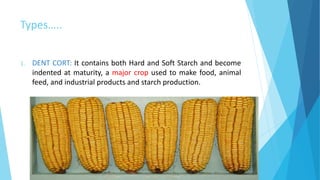
1. DENT CORT: It contains both Hard and Soft Starch and become
indented at maturity, a major crop used to make food, animal
feed, and industrial products and starch production.
Types…..
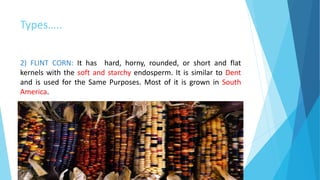
2) FLINT CORN: It has hard, horny, rounded, or short and flat
kernels with the soft and starchy endosperm. It is similar to Dent
and is used for the Same Purposes. Most of it is grown in South
America.
Types…..
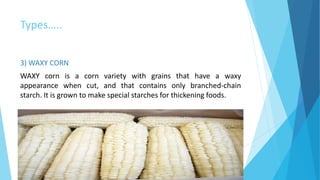
3) WAXY CORN
WAXY corn is a corn variety with grains that have a waxy
appearance when cut, and that contains only branched-chain
starch. It is grown to make special starches for thickening foods.
Types…..
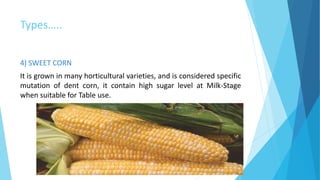
4) SWEET CORN
It is grown in many horticultural varieties, and is considered specific
mutation of dent corn, it contain high sugar level at Milk-Stage
when suitable for Table use.
Types…..
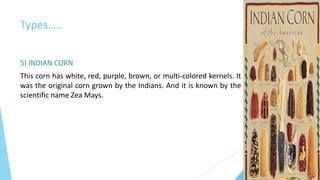
5) INDIAN CORN
This corn has white, red, purple, brown, or multi-colored kernels. It
was the original corn grown by the Indians. And it is known by the
scientific name Zea Mays.
Types…..
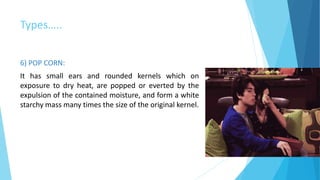
6) POP CORN:
It has small ears and rounded kernels which on
exposure to dry heat, are popped or everted by the
expulsion of the contained moisture, and form a white
starchy mass many times the size of the original kernel.
Types…..
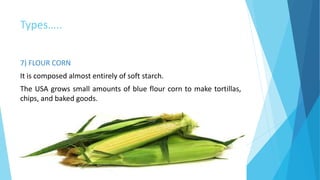
7) FLOUR CORN
It is composed almost entirely of soft starch.
The USA grows small amounts of blue flour corn to make tortillas,
chips, and baked goods.
Starch Processing
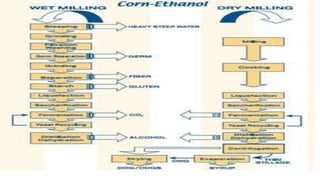
 The basis of the maize milling process is the separation of the
maize kernel into its different parts.
 Starch has been produced from corn for many years by two
general procedures, namely
1. Dry milling
2. Wet milling
Both dry and wet milling procedures accomplish separation of
the germ from which corn oil is obtained and removal of the hull
which constitutes the majority of the high fiber portion.
Starch Processing……
 Dry Milling
 Dry milling refining processes provide less highly refined
starches.
 dry-milled products find use in many applications, such as in
cereals, snack foods, pancake mixes, cookies, biscuits and in the
brewing industry.
 It is a major object of this invention to provide a process for
producing high purity starch from corn which eliminates the long
steeping times normally required for wet milling production of
starch.
Starch Processing……
 The corn dry milling process is a less versatile, less capital
intensive process that focuses
primarily on the production of grain ethanol.
 The products of a traditional dry grind ethanol facility are fuel
mainly ethanol and Dried Distillers
Grains (DDG), a lowvalue animal feed product.
Starch Processing……
Wet-Milling Process……
This process is expensive as compare to Dry-
Milling, and it requires more time, space, energy
and waste treatment.
It is designed to extract highest use and value of
product low water consumption.
The Corn-Wet Milling process is the industry
standard, implemented in more than 170 plants
around the world.
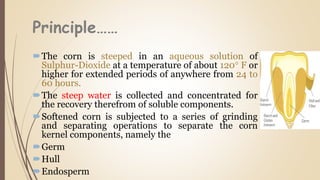
Principle……
The corn is steeped in an aqueous solution of
Sulphur-Dioxide at a temperature of about 120° F or
higher for extended periods of anywhere from 24 to
60 hours.
The steep water is collected and concentrated for
the recovery therefrom of soluble components.
Softened corn is subjected to a series of grinding
and separating operations to separate the corn
kernel components, namely the
Germ
Hull
Endosperm
Principle……
The mixture contain starch granules imbedded
in a Proteinaceous matrix (gluten).
For highly refined starch, additional separating
procedures are necessary to separate the starch
from Protein (Gluten).
The remaining components then screened to
remove fibre.
In Centrifugation the mixture is separated to
lighter Gluten and Heavier Starch.
Steps……
Following are the steps
1) CLEANING
2) STEEPING & SO2 ADDITION
3) GERM SEPARATION
4) FINE GRINDING AND SCREENING
5) FIBRE DRYING
Steps……
6) GLUTEN DRYING
7) STARCH REFINING
8) STARCH DRYING
9) MODIFICATION
Cleaning……
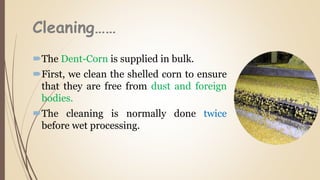
The Dent-Corn is supplied in bulk.
First, we clean the shelled corn to ensure
that they are free from dust and foreign
bodies.
The cleaning is normally done twice
before wet processing.
Steeping……
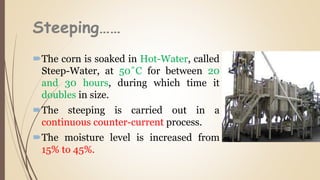
The corn is soaked in Hot-Water, called
Steep-Water, at 50˚C for between 20
and 30 hours, during which time it
doubles in size.
The steeping is carried out in a
continuous counter-current process.
The moisture level is increased from
15% to 45%.
SO2……
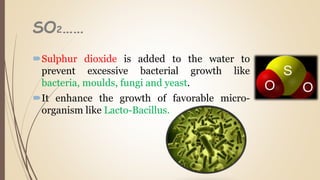
Sulphur dioxide is added to the water to
prevent excessive bacterial growth like
bacteria, moulds, fungi and yeast.
It enhance the growth of favorable micro-
organism like Lacto-Bacillus.
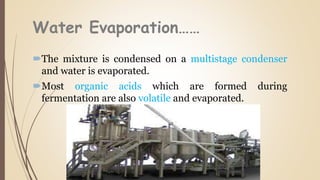
Water Evaporation……
The mixture is condensed on a multistage condenser
and water is evaporated.
Most organic acids which are formed during
fermentation are also volatile and evaporated.
Wet-Milling Process……
The Steep-Water is not wasted. We concentrate
it in an evaporator to capture nutrients, which
are used for animal feed and fermentation.
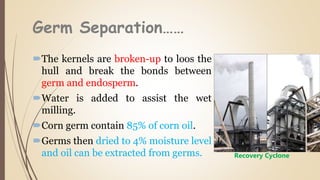
Germ Separation……
The kernels are broken-up to loos the
hull and break the bonds between
germ and endosperm.
Water is added to assist the wet
milling.
Corn germ contain 85% of corn oil.
Germs then dried to 4% moisture level
and oil can be extracted from germs. Recovery Cyclone
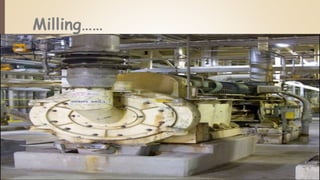
Milling……
Fine Grinding……
The remaining slurry is then subjected to fine
grinding.
This process release Starch and Gluten from
fibre.
The slurry flows over fixed concave screens
which catch the fibre.
But allow the starch and gluten to pass through.
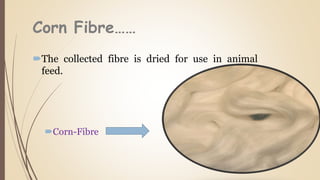
Corn Fibre……
The collected fibre is dried for use in animal
feed.
Corn-Fibre
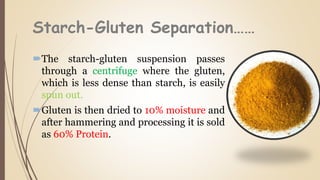
Starch-Gluten Separation……
The starch-gluten suspension passes
through a centrifuge where the gluten,
which is less dense than starch, is easily
spun out.
Gluten is then dried to 10% moisture and
after hammering and processing it is sold
as 60% Protein.
Starch Refining……
The purified starch milk is discharged to a peeler
centrifuge for dewatering.
The starch, which still has a small percentage of
protein remaining, is washed to remove the last
traces of protein and leave a 99.5% pure starch.
Starch is among the purest of all agricultural
products and purity makes it competitive.
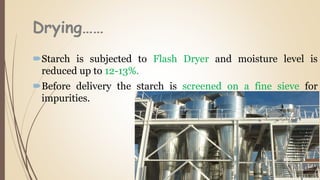
Drying……
Starch is subjected to Flash Dryer and moisture level is
reduced up to 12-13%.
Before delivery the starch is screened on a fine sieve for
impurities.
Modification……
 The starch can either be dried and sold as corn
starch, or it can be modified to turn into other
products, such as corn sweeteners, corn syrups,
dextrose and fructose.
Many techniques are applies for modification for
example
1. ph
2. Temperature
3. Additives addition
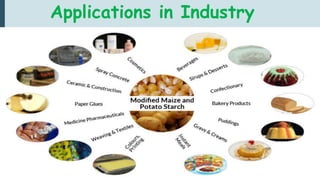
Applications in Industry
Applications……
 Being a pure renewable natural polymer, starch
has a multitude of applications.
Starch finds uses in fast food, sweets, sausages,
tablets, and paper industry.
Maize starch forms viscous, relatively short and
opaque paste which stiffen the gel.
Applications……
In 2004 more than fifty percent of starch was
converted to High Fructose Syrups (HFS).
In textile industry, starch is used in sizing to
strengthen fabric after it is bleached, dyed or
printed.
Now some By-Products of Maize-Processing are
given below
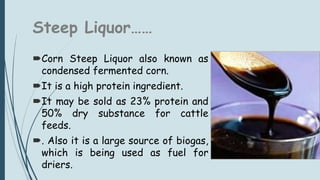
Steep Liquor……
Corn Steep Liquor also known as
condensed fermented corn.
It is a high protein ingredient.
It may be sold as 23% protein and
50% dry substance for cattle
feeds.
. Also it is a large source of biogas,
which is being used as fuel for
driers.
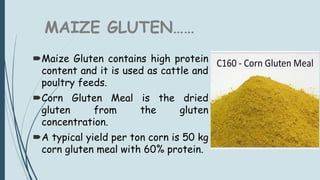
MAIZE GLUTEN……
Maize Gluten contains high protein
content and it is used as cattle and
poultry feeds.
Corn Gluten Meal is the dried
gluten from the gluten
concentration.
A typical yield per ton corn is 50 kg
corn gluten meal with 60% protein.
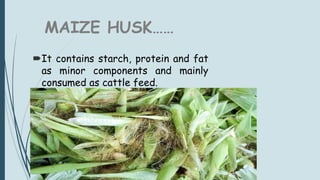
MAIZE HUSK……
It contains starch, protein and fat
as minor components and mainly
consumed as cattle feed.
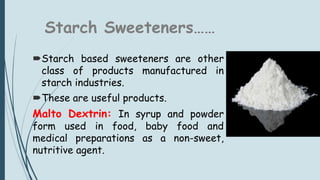
Starch Sweeteners……
Starch based sweeteners are other
class of products manufactured in
starch industries.
These are useful products.
Malto Dextrin: In syrup and powder
form used in food, baby food and
medical preparations as a non-sweet,
nutritive agent.
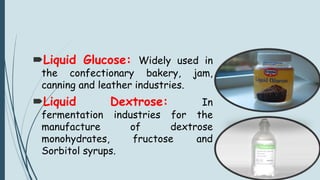
Liquid Glucose: Widely used in
the confectionary bakery, jam,
canning and leather industries.
Liquid Dextrose: In
fermentation industries for the
manufacture of dextrose
monohydrates, fructose and
Sorbitol syrups.
Applications……
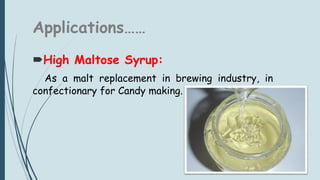
High Maltose Syrup:
As a malt replacement in brewing industry, in
confectionary for Candy making.
Applications……
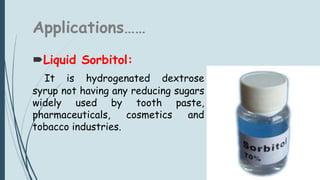
Liquid Sorbitol:
It is hydrogenated dextrose
syrup not having any reducing sugars
widely used by tooth paste,
pharmaceuticals, cosmetics and
tobacco industries.
Starch manufacturing from Corn and Industrial Application

Starch manufacturing from Corn and Industrial Application

  • 2.
    Starch Manufacturing From Cornand its Industrial Application
  • 3.
  • 4.
    Contents….  Starch  Introduction History  Corn Properties  Corn Types  Dry Milling Process  Wet Milling Process  Application in Industory
  • 5.
    Starch  Starch orAmylum is a Polymeric-Carbohydrate consisting of a large number of glucose units joined by glyosidic bonds.  It is the most common carbohydrate in human diets and present in staple foods such as Potatoes, Wheat, Maize (corn) and Rice.  Starch generally contains 20 to 25% Amylose and 75 to 80% Amylopectin by weight.
  • 6.
  • 7.
    Starch…..  Corn-Starch iscomposed of 21% Amylose (i.e. Linear chain of linked glucose molecules) and 79% Amylopectin (i.e. Highly branched chain of glucose molecules).
  • 8.
    History  Extraction ofStarch is first described in the Natural History of Pliny the Elder around AD 77–79.  Pure extracted wheat starch paste was used in Ancient Egypt.  Corn-Starch was discovered in 1840 by Thomas Kingsford.  Persians and Indians used it to make dishes Wheat-Halva. Pliny The Elder
  • 9.
    Crops…  Starch canbe produced from many crops.  But now these are restricted to a limited number of crops.  These crops are as fellow………… Potatoes Maize Wheat Tapioca
  • 10.
    Corn Properties  Approximately20% of the Annual Corn Harvest is used to produce products such as Sweeteners, Starches, Oils, Ethanol and Animal Feeds.  The remainder quantity is fed to Livestock, Poultry & Fish.  Corn’s components are Starch (72%), Corn Oil (4.3 %), Protein (9.5%) and Fiber (9.5%).  Approximately 16% of the Corn-Kernel’s weight is moisture.
  • 11.
    Types of Corn Corn, Zea Mays, is grown in most countries throughout the world and it require Warmer-Climate.  Following are different kinds of corn, 1) DENT CORN 2) FLINT CORN 3) WAXY CORN 4) SWEET CORN 5) POP CORN 6) INDIAN CORN 7) FLOUR CORN
  • 12.
    Types….. 1. DENT CORT:It contains both Hard and Soft Starch and become indented at maturity, a major crop used to make food, animal feed, and industrial products and starch production.
  • 13.
    Types….. 2) FLINT CORN:It has hard, horny, rounded, or short and flat kernels with the soft and starchy endosperm. It is similar to Dent and is used for the Same Purposes. Most of it is grown in South America.
  • 14.
    Types….. 3) WAXY CORN WAXYcorn is a corn variety with grains that have a waxy appearance when cut, and that contains only branched-chain starch. It is grown to make special starches for thickening foods.
  • 15.
    Types….. 4) SWEET CORN Itis grown in many horticultural varieties, and is considered specific mutation of dent corn, it contain high sugar level at Milk-Stage when suitable for Table use.
  • 16.
    Types….. 5) INDIAN CORN Thiscorn has white, red, purple, brown, or multi-colored kernels. It was the original corn grown by the Indians. And it is known by the scientific name Zea Mays.
  • 17.
    Types….. 6) POP CORN: Ithas small ears and rounded kernels which on exposure to dry heat, are popped or everted by the expulsion of the contained moisture, and form a white starchy mass many times the size of the original kernel.
  • 18.
    Types….. 7) FLOUR CORN Itis composed almost entirely of soft starch. The USA grows small amounts of blue flour corn to make tortillas, chips, and baked goods.
  • 19.
    Starch Processing  Thebasis of the maize milling process is the separation of the maize kernel into its different parts.  Starch has been produced from corn for many years by two general procedures, namely 1. Dry milling 2. Wet milling Both dry and wet milling procedures accomplish separation of the germ from which corn oil is obtained and removal of the hull which constitutes the majority of the high fiber portion.
  • 20.
    Starch Processing……  DryMilling  Dry milling refining processes provide less highly refined starches.  dry-milled products find use in many applications, such as in cereals, snack foods, pancake mixes, cookies, biscuits and in the brewing industry.  It is a major object of this invention to provide a process for producing high purity starch from corn which eliminates the long steeping times normally required for wet milling production of starch.
  • 21.
    Starch Processing……  Thecorn dry milling process is a less versatile, less capital intensive process that focuses primarily on the production of grain ethanol.  The products of a traditional dry grind ethanol facility are fuel mainly ethanol and Dried Distillers Grains (DDG), a lowvalue animal feed product.
  • 22.
  • 23.
    Wet-Milling Process…… This processis expensive as compare to Dry- Milling, and it requires more time, space, energy and waste treatment. It is designed to extract highest use and value of product low water consumption. The Corn-Wet Milling process is the industry standard, implemented in more than 170 plants around the world.
  • 24.
    Principle…… The corn issteeped in an aqueous solution of Sulphur-Dioxide at a temperature of about 120° F or higher for extended periods of anywhere from 24 to 60 hours. The steep water is collected and concentrated for the recovery therefrom of soluble components. Softened corn is subjected to a series of grinding and separating operations to separate the corn kernel components, namely the Germ Hull Endosperm
  • 25.
    Principle…… The mixture containstarch granules imbedded in a Proteinaceous matrix (gluten). For highly refined starch, additional separating procedures are necessary to separate the starch from Protein (Gluten). The remaining components then screened to remove fibre. In Centrifugation the mixture is separated to lighter Gluten and Heavier Starch.
  • 26.
    Steps…… Following are thesteps 1) CLEANING 2) STEEPING & SO2 ADDITION 3) GERM SEPARATION 4) FINE GRINDING AND SCREENING 5) FIBRE DRYING
  • 27.
    Steps…… 6) GLUTEN DRYING 7)STARCH REFINING 8) STARCH DRYING 9) MODIFICATION
  • 28.
    Cleaning…… The Dent-Corn issupplied in bulk. First, we clean the shelled corn to ensure that they are free from dust and foreign bodies. The cleaning is normally done twice before wet processing.
  • 29.
    Steeping…… The corn issoaked in Hot-Water, called Steep-Water, at 50˚C for between 20 and 30 hours, during which time it doubles in size. The steeping is carried out in a continuous counter-current process. The moisture level is increased from 15% to 45%.
  • 30.
    SO2…… Sulphur dioxide isadded to the water to prevent excessive bacterial growth like bacteria, moulds, fungi and yeast. It enhance the growth of favorable micro- organism like Lacto-Bacillus.
  • 31.
    Water Evaporation…… The mixtureis condensed on a multistage condenser and water is evaporated. Most organic acids which are formed during fermentation are also volatile and evaporated.
  • 32.
    Wet-Milling Process…… The Steep-Wateris not wasted. We concentrate it in an evaporator to capture nutrients, which are used for animal feed and fermentation.
  • 33.
    Germ Separation…… The kernelsare broken-up to loos the hull and break the bonds between germ and endosperm. Water is added to assist the wet milling. Corn germ contain 85% of corn oil. Germs then dried to 4% moisture level and oil can be extracted from germs. Recovery Cyclone
  • 34.
  • 35.
    Fine Grinding…… The remainingslurry is then subjected to fine grinding. This process release Starch and Gluten from fibre. The slurry flows over fixed concave screens which catch the fibre. But allow the starch and gluten to pass through.
  • 36.
    Corn Fibre…… The collectedfibre is dried for use in animal feed. Corn-Fibre
  • 37.
    Starch-Gluten Separation…… The starch-glutensuspension passes through a centrifuge where the gluten, which is less dense than starch, is easily spun out. Gluten is then dried to 10% moisture and after hammering and processing it is sold as 60% Protein.
  • 38.
    Starch Refining…… The purifiedstarch milk is discharged to a peeler centrifuge for dewatering. The starch, which still has a small percentage of protein remaining, is washed to remove the last traces of protein and leave a 99.5% pure starch. Starch is among the purest of all agricultural products and purity makes it competitive.
  • 39.
    Drying…… Starch is subjectedto Flash Dryer and moisture level is reduced up to 12-13%. Before delivery the starch is screened on a fine sieve for impurities.
  • 40.
    Modification……  The starchcan either be dried and sold as corn starch, or it can be modified to turn into other products, such as corn sweeteners, corn syrups, dextrose and fructose. Many techniques are applies for modification for example 1. ph 2. Temperature 3. Additives addition
  • 41.
  • 42.
    Applications……  Being apure renewable natural polymer, starch has a multitude of applications. Starch finds uses in fast food, sweets, sausages, tablets, and paper industry. Maize starch forms viscous, relatively short and opaque paste which stiffen the gel.
  • 43.
    Applications…… In 2004 morethan fifty percent of starch was converted to High Fructose Syrups (HFS). In textile industry, starch is used in sizing to strengthen fabric after it is bleached, dyed or printed. Now some By-Products of Maize-Processing are given below
  • 44.
    Steep Liquor…… Corn SteepLiquor also known as condensed fermented corn. It is a high protein ingredient. It may be sold as 23% protein and 50% dry substance for cattle feeds. . Also it is a large source of biogas, which is being used as fuel for driers.
  • 45.
    MAIZE GLUTEN…… Maize Glutencontains high protein content and it is used as cattle and poultry feeds. Corn Gluten Meal is the dried gluten from the gluten concentration. A typical yield per ton corn is 50 kg corn gluten meal with 60% protein.
  • 46.
    MAIZE HUSK…… It containsstarch, protein and fat as minor components and mainly consumed as cattle feed.
  • 47.
    Starch Sweeteners…… Starch basedsweeteners are other class of products manufactured in starch industries. These are useful products. Malto Dextrin: In syrup and powder form used in food, baby food and medical preparations as a non-sweet, nutritive agent.
  • 48.
    Liquid Glucose: Widelyused in the confectionary bakery, jam, canning and leather industries. Liquid Dextrose: In fermentation industries for the manufacture of dextrose monohydrates, fructose and Sorbitol syrups.
  • 49.
    Applications…… High Maltose Syrup: Asa malt replacement in brewing industry, in confectionary for Candy making.
  • 50.
    Applications…… Liquid Sorbitol: It ishydrogenated dextrose syrup not having any reducing sugars widely used by tooth paste, pharmaceuticals, cosmetics and tobacco industries.