Overview
• Definition ofSugar
• History of Sugar
• Classification of Sugar According to Chemical
Forms
• Classification of Sugar According to Market
Forms
• Classification of Sugar According to Sources
• Classifications of Syrups
• Properties and Characteristics of Sugar
• Functions of Sugar
• Storage of Sugar
5.
Learning Objectives
At theend of every chapter the students should be able to:
1. Identify the classification of sugar according to chemical
forms, market forms and source.
2. Describe the classification of syrups according to source.
3. Discuss the properties and characteristics of sugar.
4. Discuss the functions of Sugar in food preparation.
5. Store and handle sugar properly.
6.
WHAT IS SUGAR?
Sugarsare nutritive carbohydrates
used by the baking industry to add
sweetness, flavor, fermentable solids.
Sugar is a sweet, crystalline substance,
C12H22O11 (composed of 12 atoms of
carbon, 22 atoms of hydrogen, and 11
atoms of oxygen), obtained chiefly from
the juice of the sugarcane and the
sugar beet, consisting essentially of
sucrose, and used as a sweetener in
food and drink.
7.
HISTORY OF SUGAR
Sinceancient times, India has produced sugar, which was first used to
sweeten food with honey.
The native of tropical South and Southeast Asia, sugarcane was chewed
to extract the sugar.
In the first century of its discovery, sugar was utilized as an imported
medication in Europe.
During the fifth century, Indians figured out how to make sugarcane
juice into granulated crystals.
Throughout the 15th
century, Venice emerged as the main center for the
distribution and refinement of sugar.
8.
HISTORY OF SUGAR
●Inthe 17th
century, China started its first sugarcane plantations.
●Chinese records at least two trips to India in AD 647 to acquire
technology for sugar refining.
●Arab armies invaded the area, bringing with them their knowledge
of sugar production and their love of it as food, condiment, and
remedy.
●Early in the 17th century, Islamic armies had taken control of most of
Spain, bringing with them the sugar industry.
●Changes in the economy and society occurred when sugar became
more widely available and regarded as a necessity in the 19th
century.
MONOSACCHARIDES
The monosaccharides (mono=
one, saccharide = sugar)
simplest form and are
composed of a single molecule
or subunit.
Example: glucose, fructose,
galactose, ribose, and
deoxyribose.
11.
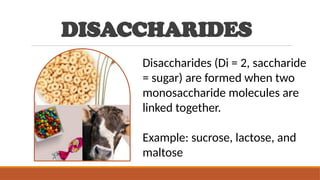
DISACCHARIDES
Disaccharides (Di =2, saccharide
= sugar) are formed when two
monosaccharide molecules are
linked together.
Example: sucrose, lactose, and
maltose
White Sugar
also knownas granulated or table sugar,
is produced by refining sugar cane or
sugar beets. It is used in baking,
sweetening beverages, and savory
dishes.
16.
“Regular” or WhiteGranulated Sugar
This is what you typically find in your
sugar bowl.
Granulated sugar is the most
common sugar called for in recipes
when cooking and baking.
• “Regular” sugar granules are fine
because small crystals are ideal for
bulk handling and not susceptible
to caking.
17.
Confectioners’ or PowderedSugar
Powdered sugar is simply granulated
sugar ground to a smooth powder and
then sifted.
Commercially available powdered sugar
is mixed with a small amount of
cornstarch (3%) to prevent caking.
• It is often used in icings, confections
and whipping cream.
18.
Fruit Sugar
Fruit sugaris smaller and more uniform in
crystal size than regular sugar.
It is used in dry mixes, such as gelatin and
pudding desserts or powdered drinks.
• The uniformity of crystal size prevents
settling of the sugar crystals to the
bottom of the box, an important quality
in dry mixes.
19.
Baker’s Special Sugar
Thecrystal size of baker’s special sugar
is finer than that of fruit sugar.
As its name suggests, it was developed
especially for the baking industry.
• This sugar is used for sugaring donuts
and cookies, and it’s used in some
cake recipes to create a fine crumb
texture.
20.
Superfine Sugar
Also knownas caster or bar sugar, this
sugar has the smallest crystal size of
white granulated sugars.
It is generally used in making delicate
or smooth desserts, such as mousse or
puddings.
• Because the crystals are so fine,
they dissolve easily, even in cold
drinks.
21.
Coarse Sugar
Coarse sugarhas a larger crystal size than
regular sugar.
It results from the crystallization of molasses-
rich sugar syrups that are high in sucrose.
• The large crystal size makes it highly
resistant to color change or inversion
(natural breakdown to fructose and glucose)
at cooking and baking temperatures,
important characteristics for use in making
fondants, confections and liquors.
22.
Sanding Sugar
Sanding sugarcan have large or
fine crystals—both types reflect
light and give the product a
sparkling appearance.
• It is used mainly in baking and
confectionery as a sprinkle on
top of baked goods (often in fun
colors!).
23.
Brown Sugar
are eithermade by directly boiling
a brown sugar syrup or mixing
white sugar with various amounts
of molasses.
24.
Light and DarkSugar
• Light brown sugar is often used in
sauces and most baked goods.
• Dark brown sugar has a deeper color
and stronger molasses flavor than
light brown sugar—the rich, full
flavor makes it ideal for gingerbread,
baked beans, barbecuing and other
full-flavored foods.
25.
Turbinado Sugar
• Turbinadosugar is a partially
processed sugar which retains more
of the naturally present molasses. It
is sometimes called Demerara Sugar
or Raw Cane Sugar.
• It has a blond color, mild brown
sugar flavor and larger crystals than
brown sugars used in baking.
26.
Muscovado Sugar
Also knownas Barbados sugar, muscovado
sugar is an unrefined cane sugar in which the
molasses has not been removed.
It is very dark brown and has a particularly
strong molasses flavor.
• The crystals are slightly coarser and
stickier than regular brown sugar, giving
this sugar a sandy texture.
27.
Free-Flowing Brown Sugar
•Also known as granulated brown sugar,
this powder-like brown sugar is less
moist than regular brown sugar.
• Since it is less moist, it does not clump
and is free flowing, like white sugar.
• As it is so easy to measure and
sprinkle, free-flowing brown sugar is
great for topping on cereals and
oatmeal.
28.
Liquid Sugar
• Liquidsugar is white granulated sugar
that has been dissolved in water.
• Simple syrup is liquid sugar with a 1:1
ratio of sugar and water.
• Liquid sugar is often used in drinks.
29.
Invert Sugar
Inversion isthe process in which sugar is split into
its two component sugars, glucose and fructose,
and the resulting product is invert sugar, a liquid
sugar with equal parts glucose and fructose.
Because fructose is sweeter than sucrose or
glucose, invert sugar is sweeter than white sugar.
• 50% invert sugar is ½ sucrose, ¼ glucose and
¼ fructose, because only half of the sucrose
has been inverted.
Sugar
Beets
• Growing incooler climates with rich soil and a five-month growing
season, sugar beets are a root crop that thrive. When harvested, they
weighed an incredible 3–5 pounds, making them far larger than the
beets you might find in the produce section of the grocery store or
those grown in backyard gardens. California, Colorado, Idaho, Michigan,
Minnesota, Montana, Nebraska, North Dakota, Oregon, Washington,
and Wyoming are among the states with sugar beet farms.
32.
Sugar
Cane
• Perennial grasseslike sugar cane are grown in more tropical areas. It
doesn’t require annual replanting because it is perennial. Sugar cane is
collected by cutting it just above the root level, allowing new sprouts to
grow and allow for another harvest in ten to twelve months. The cane
plants reach a height of ten to twenty feet. America grows sugar cane in
three states: Texas, Florida, and Louisiana.
33.
Root vegetable
Cool countries
■Since 250 years ago
Now Grown in UK
Sugar in Root
Very short
A plant
Sugar made in Factory
Grass
Hot countries
Thousands of years
Was rare and costly in UK
Sugar in Stem
Very tall
A plant
Sugar Made in Factory
SUGAR CANE SUGAR BEETS
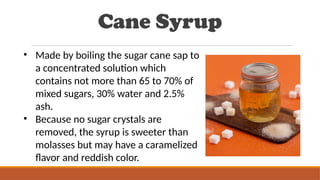
Cane Syrup
• Madeby boiling the sugar cane sap to
a concentrated solution which
contains not more than 65 to 70% of
mixed sugars, 30% water and 2.5%
ash.
• Because no sugar crystals are
removed, the syrup is sweeter than
molasses but may have a caramelized
flavor and reddish color.
36.
Molasses Syrup
• Theresidue that remains
after sucrose crystal have
been removed from the
concentrated juice of the
sugar cane or beet.
37.
Refiner’s Syrup
• Theliquor that remains after the
crystallization of sucrose during
the refining process. It is lighter in
color and milder in flavor than
either cane syrup or molasses.
• It has not more than 25% water
and has the characteristics flavor
of brown sugar.
38.
Sorghum Syrup
• Madefrom sorghum, a grass plant
that grows easily in the temperature
climates. Sorghum syrup is
produced from the juice of sorghum
without extracting sugar from the
juice. It is similar to cane syrup in
the total sugar content but is more
like molasses in appearance.
39.
Maple Syrup
• Madeby evaporating the asap of sugar
maple tree to a concentration
containing no more than 35% water.
• It is used for culinary and table
purposes.
• Maple syrup of the highest grade is
light in color without cloudiness and
off-flavor.
• Darker, stronger maple syrup of lower
quality is made from the last run of sap.
40.
Corn Syrup
• Usuallyprepared by partial hydrolysis
of cornstarch with acid.
• A method often employed is to heat
the starch with hydrochloric acid or
Sulphur acid under pressure.
• The process is stopped before
hydrolysis is complete.
41.
Two Types ofCorn Syrup
• Dark Corn Syrup which is a mixture of corn
syrup and refiner's syrup; it is used as table
syrup and in candies, baked goods, etc. where
its peculiar flavor and color are called for.
• Light Corn Syrup which is clarified, decolorized
dark corn syrup; it is used to prevent or control
crystallization in candies, frosting and other
sugar concentrated products.
Honey Syrup
• Comesfrom the nectar of
flowers that is collected,
modified and concentrated
by the honeybees.
44.
Properties and Characteristicsof Sugar
1. Sweetness
2. Texture
3. Color and Flavor Formation
4. Amorphous and Glass formation
5. Preservation
6. Fermentation
45.
Sweetness
The sweetness ofsucrose is seen as the
principal standard of sweetness. The sugars
each have a different sweetness intensity
and sweetness quality.
46.
Texture
Sugars also providetexture to foods e.g. in
confectionery where the crystalline texture
is provided by small sucrose crystals. Sugars
also interact with other ingredients e.g.
proteins and carbohydrates to provide
structure and texture.
47.
Color & Flavorformation
Sugars play a major role in the
development of characteristic colors and
flavors in food products. There are two
principal reactions where sugars deliver
flavor and color. These are caramelisation
and the Maillard reaction.
48.
Amorphous and Glassformation
Sugars are highly soluble and when they reach
saturation point they will crystallise. In
relatively pure solutions the concentration at
which crystallisation occurs is governed by the
solubility product and saturation point of the
specific sugar.
49.
Preservation
Sugars are highlysoluble and thus
influence the water activity aw in many
systems. The ability to retain water and
in some cases even attract water
(hygroscopicity) can also influence the
texture of many foods.
50.
Fermentation
Sugars are readilybroken down by yeasts,
bacteria and molds. In some products the
fermentation of sugars is essential to deliver
the desired characteristics.
51.
Function of Sugar
1.Flavor Balance
2. Preservation
3. Texture and Mouthfeel
4. Volume
5. Color
6. Taste
52.
Flavor Balance
Sugar addssweetness, and balances
acidic and bitter flavours in tomato and
vinegar-based sauces, dressings and
brines.
Storage of Sugar
Keepit Dry
Store it in a Cool Place:
Avoid Strong Odors
Keep it Sealed
Consider Temperature Fluctuations
Don’t Freeze It
Rotate Your Stock
1. Avoid Excessive Handling
59.
Keep it Dry
Ensurethat your sugar is stored in a dry
environment away from sources of humidity,
such as the sink or dishwasher. If your pantry
tends to be humid, consider using moisture-
absorbing packets or silica gel packs in the
storage container to keep the sugar dry.
60.
Store it ina Cool Place
Sugar is best stored in a cool location, away
from direct sunlight and heat sources. Heat
can cause the sugar to melt or clump
together. Aim for a temperature-controlled
area, such as a pantry or cupboard, where
the temperature remains consistently cool.
61.
Avoid Strong Odors
Sugarreadily absorbs odors from its
surroundings. Store it away from strongly
scented foods, spices, or cleaning products to
prevent the sugar from taking on unwanted
flavors. If using containers, ensure they are
odor-free and clean before storing the sugar.
62.
Keep it Sealed
Whetheryou are using jars, containers, or
bags, make sure they are tightly sealed to
prevent any air or moisture from getting
in. Airtight seals will help maintain the
sugar’s freshness and prevent clumping.
63.
Consider Temperature Fluctuations
Avoidplacing sugar containers near
appliances that generate heat, such as ovens
or stovetops. Fluctuating temperatures can
cause the sugar to harden or absorb moisture
from condensation, leading to clumping or
quality deterioration.
64.
Don’t Freeze It
Unlikesome other food items, freezing sugar
is not recommended. Freezing can cause the
sugar to absorb moisture when thawed,
leading to clumping and loss of quality. It is
best to store sugar in a cool, dry storage area
instead.
65.
Rotate Your Stock
Ifyou buy sugar in bulk, it’s a good
practice to use the oldest stock first
(first in, first out). This ensures that the
sugar is consumed before it loses its
freshness or quality.
66.
Avoid Excessive Handling
Tominimize the risk of introducing
moisture or contaminants, try to scoop
the sugar with clean, dry utensils instead
of using your hands. Avoid touching the
sugar directly with wet or dirty hands.
67.
FLOWER ROYAL ICING
Ingredients:
•4 cups of powdered sugar
• 3 tablespoons of meringue powder
• 6-9 tablespoons of room-temperature water
• Wilton gel coloring
Procedure:
1. Sift the powdered sugar in a large mixing bowl to remove any lumps.
2. Add the meringue powder and water to the bowl and mix until combined.
3. Using the stand mixer with the whisk attachment, beat the mixture on high speed for about 7-8 minutes
or until the icing holds stiff peaks.
4. Divide the icing into separate bowls, one for each color you’ll be using.
5. Use the Wilton gel food coloring to tint each bowl of icing to the desired shade.
6. Spoon the icing into separate piping bags and attach the desired tips.