Submersion Injuries


   David A. Caro, MD FACEP
Department of Emergency Medicine
Submersion Injuries

s Drowning
s Near-Drowning
    – Wet drowning
    – Dry drowning
s Secondary Drowning
s Immersion Syndrome
Drowning
s 8000 deaths per year in US
s 4th most common cause of death in adults
s 3rd most common cause in children
s Males have 5 times greater death rate
s Blacks have 3 times higher death rate
s 40% of deaths are < 4 yrs old
s 50% of those who die in swimming pools
  are < 10 yrs old
Risk Factors
s Age
s Location
s Gender
s Race
s Ability to Swim
s Drugs and Alcohol
s Underlying Disease
Submersion Injuries:
      Pathophysiology

s Asphyxia: Anoxic and ischemic injury
s Fluid Overload
s Pulmonary Injury
s Hypothermia/Diving Reflex
Asphyxia/Hypoxia
s Breath holding +/- laryngospasm
s PAO2 falls rapidly in 1st minute

s   PACO2 rises and pH falls less rapidly
s   Hyperventilation - PACO2 rises less while
    PAO2 falls at about the same rate
Pulmonary                    CNS
1. 2' Apnea -                1. Anoxic Damage
    aspiration               2. Cerebral edema
2. Hypercapnia               3. Defective
                                  autoregulation
                             4. Increased ICP


GI
1. Mucosal                    Hematologic
2. Liver inury    ASPHYXIA    1. DIC


                              Renal
Cardiac                       1. ATN
1. Ischemia                   2. Acute cortical
2. Fibrillation                  necrosis
Fluid Overload

Swallowing large amounts of water:
  – Gastric distention
  – Vomiting
  – Aspiration
Response to Submersion
s   Stage I (0-2 min)
    – Aspiration and laryngospasm
s   Stage II (1-2 min)
    – Swallows water
s   Stage III (variable)
    – Laryngospasm aborted (85-90%) and
      aspiration of water
s   Stage III (variable)
    – Laryngospasm reoccurs with anoxia, sz,death
Fresh Water Drowning

s   Hypotonic
    – Hemodilution
      s   Decreased electrolytes, Hct, Hgb
    – Hemolysis
      s Hyperkalemia
      s Increased CVP
Salt Water Drowning

s   Hypertonic
    – Draws water into respiratory tract
    – Hemoconcentration
      s Increase electrolytes, Hct, Hgb
      s Decreases CVP
Fluid Aspiration
s Animal studies found that 22 ml/kg
  needs to be aspirated before serum
  electrolytes change
s Usual aspiration into lungs < 3-4 ml/kg,
   however swallowed water can be
  aspirated later
s In most series: serum electrolyte
  changes are mild, non-life threatening
Pulmonary Injury
s   Aspirated fluid decreased PaO2 due to reflex
    contraction of terminal airways leading to V/Q
    mismatch
s   Fresh water destroys surfactant leading to alveolar
    collapse and retards transudation of fluid causing
    intrapulmonary shunt and hypoxemia
s   Salt water leads to fluid filled but perfused alveoli
    leading to intrapulmonary shunt and hypoxemia
s   Aspiration of fluid leads to increased pulmonary
    resistance and decreased compliance
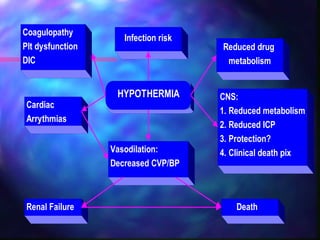
Coagulopathy
                     Infection risk
Plt dysfunction                       Reduced drug
DIC                                    metabolism


                   HYPOTHERMIA        CNS:
 Cardiac
                                      1. Reduced metabolism
 Arrythmias
                                      2. Reduced ICP
                                      3. Protection?
                  Vasodilation:       4. Clinical death pix
                  Decreased CVP/BP


 Renal Failure                            Death
Hypothermia
s   Exerts protective effects through
    reducing cerebral metabolism
    – decreases to 50% at temp of 28o C
    – below 22o C, cerebral activity abolished
s   Diving Reflex:
    – Neurogenic reflex which shunts blood away
      from nonessential organs
    – Associated with bradycardia
    – Triggered by submersion of the face, fear,
      and cold water
Hypothermia
s   May cause the following:
    – Compromised neutrophil migration and release
    – Decreased drug metabolism
    – Abnormal platelet number, morphology, function
    – Decrease cardiac contractility and arrhythmias
    – Vasodilation, hypotension, renal failure, death
Clinical Presentation
s   Variable presentation:
    – Awake and alert
    – Awake, lethargic
    – Children may have had brief apnea
    – Hx of choking, coughing or vomiting
    – Comatose
    – Cardiac arrest
Clinical Exam

s   Pulmonary
    – Resp distress, rhonchi, rales, wheezing
s   Cardiovascular
    – Arrythmias, ischemia
s   GI
    – Abd distention, vomiting, aspiration
s   Neurological
    – Signs of cerebral hypoxia
s   Hypothermia
s   Associated Injuries: C-spine
Prehospital Care
s Safety of rescue workers
s Pull victim out of water
s Mouth to mouth resuscitation
s Suspect head/neck injuries - backboard
s BCLS/ACLS as needed
s Administer oxygen
s Avoid heimlich maneuver/lung drainage
s Transport all patients
Emergency Department
          Assessment

s ABC’s
s Vital signs - including rectal temp, pulse ox
s Oxygen
Asymptomatic Patient

s   Hx - incident, submersion time, temp of water,
    trauma involved, drug/alcohol, past health, current
    complaints
s   PE - also assess for other injuries
s   Lab - ABG, CXR, CBC, Chem-7, U/A, think C-spine
s   Tx - Oxygen at 8-10 liters, IV, Monitor, Observe for
    4-12 hours
Symptomatic Patient
s HX/PE - same as for asymptomatic pt
s Lab - consider PT/PTT, LFT’s, CPK’s
s Tx
    – open airway, remove emesis particles, NGT
    – oxygenate at 10 l/min
    – consider CPAP or intubate with PEEP
    – Warm patient
    – Hospitalize in monitored environment
CPR
s Airway and intubation
s ACLS protocol with attention to acidosis
s C-spine protection
s Mechanical ventilation with PEEP
s No steroids or prophylactic antibiotics
s Maintain urine output at 50 cc/hr
Respiratory Assessment

s Clear the airway, achieve ventilation
s ABG
s CXR
s Assess gag and cough reflexes, ability
  to protect airway
Intubation

s   If pCO2 > 50
s   If pt requires > 40% FiO2 to maintain
    adequate paO2
s Gross pulmonary edema
s Poor or absent cough and gag reflexes
Ventilation
s CPAP - spontaneously breathing with
  hypoxia
s PEEP - decreases intrapulmonary
  shunting, reduces V/Q mismatch, and
  increases the functional residual
  capacity resulting in increased PaO2
s PEEP may also prevent secondary
  drowning from RDS
s PEEP disadvantage - may worsen
  cerebral edema
Ventilation

s Persistent hypoxia may be result of
  aspirated foreign material - aggressive
  suctioning or bronchoscopy may help
s ECMO - consider in patients unresponsive
  to 100% oxygen and PEEP
Pulmonary

s Bronchospasm can be treated with
  beta-agonists
s Steroid administration has not shown
  survival benefit
s Prophylactic antibiotics have not
  demonstrated improved survival
Cardiovascular

s   Monitor HR, rhythm, BP, cap refill, UO
s   Consider CVP/PAWP monitoring
s   Adequate fluid resuscitate before using pressors
s   Monitor volume status
s   Treat metabolic acidosis with bicarb
Neurologic Assessment
s Primary importance for prognosis
s Assess level of consciousness - AVPU
s Assess GCS
s Level of consciousness in ED:
    – A - Awake
    – B - Blunted
    – C - Comatose
      s C1 - decorticate
      s C2 - decerebrate

      s C3 - flaccid
Cerebral Resuscitation
s Goal is to keep ICP below 20 mm Hg and
     CPP above 50 mm Hg
s Primarily depends on rapid stabilization,
  correction of hypoxia and acidosis
s Treat agitation, seizures
s Treat increased ICP:
    – elevate head, hyperventilate
    – osmotic and loop diuretics
    – barbiturates
Cerebral Resuscitation

s Unproven   therapies:
 – therapeutic dehydration
 – induced hypothermia
 – barbiturate coma
 – paralysis
 – Ca channel blockers
 – oxygen radical scavengers
GI

s NG drainage
s Control gastric pH
Hypothermia Management
s Below 28’ C - arrhythmias occur
s Below 25’ C - hypotension
s Management:
    – Remove wet clothes
    – Internal rewarming techniques
       s   NG irrigation, enemas, Foley, lavage
s   If pt sustained prolonged hypoxia/asphyxia
    consider maintaining core temp near 30’ C
Prognostic Variables
s   At the Scene:
    – Length of submersion
       s   > 5 minutes associated with poor outcome
    – Water temperature
    – CPR initiated
    – First gasp within 5 minutes of CPR
Prognostic Variables
s   In the ED:
    – CPR still required
    – pH < 7.0 - 7.1
    – Submersion hypothermia
    – Mechanical ventilation
    – Level of consciousness
    – Pupils
Pediatric Survival
s   Unfavorable outcome if
    – comatose state
    – lack of pupillary reflex
    – male sex
    – initial blood glucose concentration

s   In 194 children, rule was 100% specific with
    65% sensitivity
                         Graf, Ann Emerg Med, 1995
Secondary Drowning
    (Post immersion syndrome)

s Onset delayed from 1 to 72 hours
s Occurs in 2-15% of near drowning cases
s Respiratory deterioration and possible death
s Mechanism:
    – loss of surfactant from chemical, anoxic or
      osmotic damage to the pneumatocytes
Immersion Syndrome

s Sudden death after immersion in very
  cold water
s Cause thought to be vagally-mediated
  bradyasystolic cardiac arrest or
  ventricular fibrillation
Drowning Prevention

s Environmental
s Parent-related
s Factors related to children
Drowning Prevention
s Public education
s Legislation
s Proper supervision
s Mandatory CPR for pool owners
s Mandatory swimming lessons for children
s Proper use of life preservers

Submersion Injuries

  • 1.
    Submersion Injuries David A. Caro, MD FACEP Department of Emergency Medicine
  • 2.
    Submersion Injuries s Drowning sNear-Drowning – Wet drowning – Dry drowning s Secondary Drowning s Immersion Syndrome
  • 3.
    Drowning s 8000 deathsper year in US s 4th most common cause of death in adults s 3rd most common cause in children s Males have 5 times greater death rate s Blacks have 3 times higher death rate s 40% of deaths are < 4 yrs old s 50% of those who die in swimming pools are < 10 yrs old
  • 4.
    Risk Factors s Age sLocation s Gender s Race s Ability to Swim s Drugs and Alcohol s Underlying Disease
  • 6.
    Submersion Injuries: Pathophysiology s Asphyxia: Anoxic and ischemic injury s Fluid Overload s Pulmonary Injury s Hypothermia/Diving Reflex
  • 7.
    Asphyxia/Hypoxia s Breath holding+/- laryngospasm s PAO2 falls rapidly in 1st minute s PACO2 rises and pH falls less rapidly s Hyperventilation - PACO2 rises less while PAO2 falls at about the same rate
  • 8.
    Pulmonary CNS 1. 2' Apnea - 1. Anoxic Damage aspiration 2. Cerebral edema 2. Hypercapnia 3. Defective autoregulation 4. Increased ICP GI 1. Mucosal Hematologic 2. Liver inury ASPHYXIA 1. DIC Renal Cardiac 1. ATN 1. Ischemia 2. Acute cortical 2. Fibrillation necrosis
  • 9.
    Fluid Overload Swallowing largeamounts of water: – Gastric distention – Vomiting – Aspiration
  • 10.
    Response to Submersion s Stage I (0-2 min) – Aspiration and laryngospasm s Stage II (1-2 min) – Swallows water s Stage III (variable) – Laryngospasm aborted (85-90%) and aspiration of water s Stage III (variable) – Laryngospasm reoccurs with anoxia, sz,death
  • 11.
    Fresh Water Drowning s Hypotonic – Hemodilution s Decreased electrolytes, Hct, Hgb – Hemolysis s Hyperkalemia s Increased CVP
  • 12.
    Salt Water Drowning s Hypertonic – Draws water into respiratory tract – Hemoconcentration s Increase electrolytes, Hct, Hgb s Decreases CVP
  • 13.
    Fluid Aspiration s Animalstudies found that 22 ml/kg needs to be aspirated before serum electrolytes change s Usual aspiration into lungs < 3-4 ml/kg, however swallowed water can be aspirated later s In most series: serum electrolyte changes are mild, non-life threatening
  • 14.
    Pulmonary Injury s Aspirated fluid decreased PaO2 due to reflex contraction of terminal airways leading to V/Q mismatch s Fresh water destroys surfactant leading to alveolar collapse and retards transudation of fluid causing intrapulmonary shunt and hypoxemia s Salt water leads to fluid filled but perfused alveoli leading to intrapulmonary shunt and hypoxemia s Aspiration of fluid leads to increased pulmonary resistance and decreased compliance
  • 15.
    Coagulopathy Infection risk Plt dysfunction Reduced drug DIC metabolism HYPOTHERMIA CNS: Cardiac 1. Reduced metabolism Arrythmias 2. Reduced ICP 3. Protection? Vasodilation: 4. Clinical death pix Decreased CVP/BP Renal Failure Death
  • 16.
    Hypothermia s Exerts protective effects through reducing cerebral metabolism – decreases to 50% at temp of 28o C – below 22o C, cerebral activity abolished s Diving Reflex: – Neurogenic reflex which shunts blood away from nonessential organs – Associated with bradycardia – Triggered by submersion of the face, fear, and cold water
  • 17.
    Hypothermia s May cause the following: – Compromised neutrophil migration and release – Decreased drug metabolism – Abnormal platelet number, morphology, function – Decrease cardiac contractility and arrhythmias – Vasodilation, hypotension, renal failure, death
  • 18.
    Clinical Presentation s Variable presentation: – Awake and alert – Awake, lethargic – Children may have had brief apnea – Hx of choking, coughing or vomiting – Comatose – Cardiac arrest
  • 19.
    Clinical Exam s Pulmonary – Resp distress, rhonchi, rales, wheezing s Cardiovascular – Arrythmias, ischemia s GI – Abd distention, vomiting, aspiration s Neurological – Signs of cerebral hypoxia s Hypothermia s Associated Injuries: C-spine
  • 20.
    Prehospital Care s Safetyof rescue workers s Pull victim out of water s Mouth to mouth resuscitation s Suspect head/neck injuries - backboard s BCLS/ACLS as needed s Administer oxygen s Avoid heimlich maneuver/lung drainage s Transport all patients
  • 21.
    Emergency Department Assessment s ABC’s s Vital signs - including rectal temp, pulse ox s Oxygen
  • 22.
    Asymptomatic Patient s Hx - incident, submersion time, temp of water, trauma involved, drug/alcohol, past health, current complaints s PE - also assess for other injuries s Lab - ABG, CXR, CBC, Chem-7, U/A, think C-spine s Tx - Oxygen at 8-10 liters, IV, Monitor, Observe for 4-12 hours
  • 23.
    Symptomatic Patient s HX/PE- same as for asymptomatic pt s Lab - consider PT/PTT, LFT’s, CPK’s s Tx – open airway, remove emesis particles, NGT – oxygenate at 10 l/min – consider CPAP or intubate with PEEP – Warm patient – Hospitalize in monitored environment
  • 24.
    CPR s Airway andintubation s ACLS protocol with attention to acidosis s C-spine protection s Mechanical ventilation with PEEP s No steroids or prophylactic antibiotics s Maintain urine output at 50 cc/hr
  • 25.
    Respiratory Assessment s Clearthe airway, achieve ventilation s ABG s CXR s Assess gag and cough reflexes, ability to protect airway
  • 26.
    Intubation s If pCO2 > 50 s If pt requires > 40% FiO2 to maintain adequate paO2 s Gross pulmonary edema s Poor or absent cough and gag reflexes
  • 27.
    Ventilation s CPAP -spontaneously breathing with hypoxia s PEEP - decreases intrapulmonary shunting, reduces V/Q mismatch, and increases the functional residual capacity resulting in increased PaO2 s PEEP may also prevent secondary drowning from RDS s PEEP disadvantage - may worsen cerebral edema
  • 28.
    Ventilation s Persistent hypoxiamay be result of aspirated foreign material - aggressive suctioning or bronchoscopy may help s ECMO - consider in patients unresponsive to 100% oxygen and PEEP
  • 29.
    Pulmonary s Bronchospasm canbe treated with beta-agonists s Steroid administration has not shown survival benefit s Prophylactic antibiotics have not demonstrated improved survival
  • 30.
    Cardiovascular s Monitor HR, rhythm, BP, cap refill, UO s Consider CVP/PAWP monitoring s Adequate fluid resuscitate before using pressors s Monitor volume status s Treat metabolic acidosis with bicarb
  • 31.
    Neurologic Assessment s Primaryimportance for prognosis s Assess level of consciousness - AVPU s Assess GCS s Level of consciousness in ED: – A - Awake – B - Blunted – C - Comatose s C1 - decorticate s C2 - decerebrate s C3 - flaccid
  • 32.
    Cerebral Resuscitation s Goalis to keep ICP below 20 mm Hg and CPP above 50 mm Hg s Primarily depends on rapid stabilization, correction of hypoxia and acidosis s Treat agitation, seizures s Treat increased ICP: – elevate head, hyperventilate – osmotic and loop diuretics – barbiturates
  • 33.
    Cerebral Resuscitation s Unproven therapies: – therapeutic dehydration – induced hypothermia – barbiturate coma – paralysis – Ca channel blockers – oxygen radical scavengers
  • 34.
    GI s NG drainage sControl gastric pH
  • 35.
    Hypothermia Management s Below28’ C - arrhythmias occur s Below 25’ C - hypotension s Management: – Remove wet clothes – Internal rewarming techniques s NG irrigation, enemas, Foley, lavage s If pt sustained prolonged hypoxia/asphyxia consider maintaining core temp near 30’ C
  • 36.
    Prognostic Variables s At the Scene: – Length of submersion s > 5 minutes associated with poor outcome – Water temperature – CPR initiated – First gasp within 5 minutes of CPR
  • 37.
    Prognostic Variables s In the ED: – CPR still required – pH < 7.0 - 7.1 – Submersion hypothermia – Mechanical ventilation – Level of consciousness – Pupils
  • 38.
    Pediatric Survival s Unfavorable outcome if – comatose state – lack of pupillary reflex – male sex – initial blood glucose concentration s In 194 children, rule was 100% specific with 65% sensitivity Graf, Ann Emerg Med, 1995
  • 39.
    Secondary Drowning (Post immersion syndrome) s Onset delayed from 1 to 72 hours s Occurs in 2-15% of near drowning cases s Respiratory deterioration and possible death s Mechanism: – loss of surfactant from chemical, anoxic or osmotic damage to the pneumatocytes
  • 40.
    Immersion Syndrome s Suddendeath after immersion in very cold water s Cause thought to be vagally-mediated bradyasystolic cardiac arrest or ventricular fibrillation
  • 41.
    Drowning Prevention s Environmental sParent-related s Factors related to children
  • 42.
    Drowning Prevention s Publiceducation s Legislation s Proper supervision s Mandatory CPR for pool owners s Mandatory swimming lessons for children s Proper use of life preservers