Hypovolemic Shock
Ivan De Paz MD
WRH
SHOCK
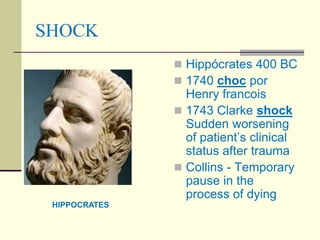
 Hippócrates 400 BC
 1740 choc por
Henry francois
 1743 Clarke shock
Sudden worsening
of patient’s clinical
status after trauma
 Collins - Temporary
pause in the
process of dying
HIPPOCRATES
SHOCK
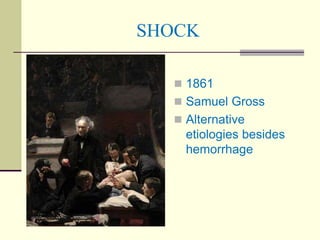
 1861
 Samuel Gross
 Alternative
etiologies besides
hemorrhage
FACTS
 Shock is a life-threatening condition of
circulatory failure.
 The effects of shock are initially reversible,
but rapidly become irreversible, resulting in
multiorgan failure (MOF) and death
DEFINITION
A state of cellular and tissue hypoxia due to
reduced oxygen delivery and/or increased
oxygen consumption or inadequate oxygen
utilization
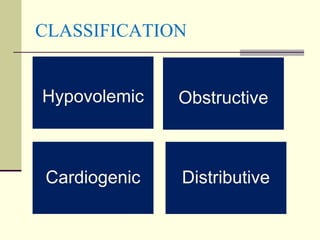
CLASSIFICATION
Hypovolemic
DistributiveCardiogenic
Obstructive
CHARACTERISTICS OF SHOCK
 Hypotension
 Altered mental status
 Oliguria
 Tachypnea
 Cool clammy skin
 Delayed capillary refill
 Metabolic acidosis
HIPOVOLEMIC SHOCK
Hypovolemic shock
 Decrease in venous return due to a loss of
circulating volume (internal or external)
 Early recognition of the condition is vital, if
subsequent tissue injuries are to be avoided
Hypovolemic Shock
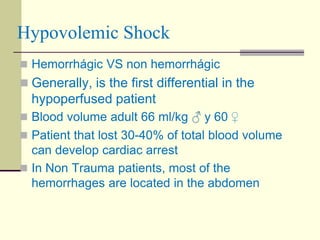
 Hemorrhágic VS non hemorrhágic
 Generally, is the first differential in the
hypoperfused patient
 Blood volume adult 66 ml/kg ♂ y 60 ♀
 Patient that lost 30-40% of total blood volume
can develop cardiac arrest
 In Non Trauma patients, most of the
hemorrhages are located in the abdomen
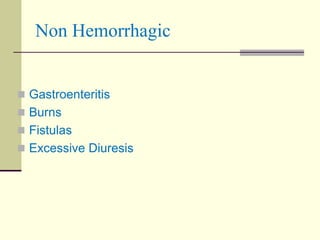
Non Hemorrhagic
 Gastroenteritis
 Burns
 Fistulas
 Excessive Diuresis
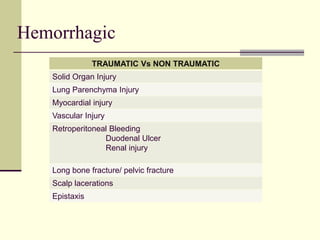
Hemorrhagic
TRAUMATIC Vs NON TRAUMATIC
Solid Organ Injury
Lung Parenchyma Injury
Myocardial injury
Vascular Injury
Retroperitoneal Bleeding
Duodenal Ulcer
Renal injury
Long bone fracture/ pelvic fracture
Scalp lacerations
Epistaxis
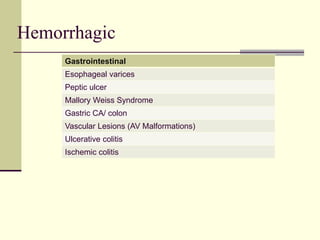
Hemorrhagic
Gastrointestinal
Esophageal varices
Peptic ulcer
Mallory Weiss Syndrome
Gastric CA/ colon
Vascular Lesions (AV Malformations)
Ulcerative colitis
Ischemic colitis
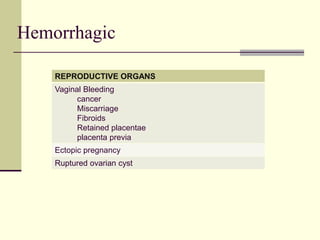
Hemorrhagic
REPRODUCTIVE ORGANS
Vaginal Bleeding
cancer
Miscarriage
Fibroids
Retained placentae
placenta previa
Ectopic pregnancy
Ruptured ovarian cyst
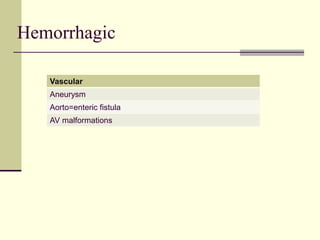
Hemorrhagic
Vascular
Aneurysm
Aorto=enteric fistula
AV malformations
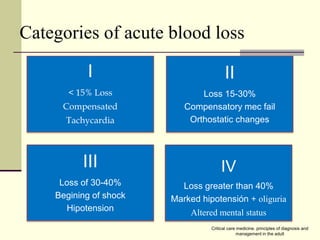
Categories of acute blood loss
I
< 15% Loss
Compensated
Tachycardia
II
Loss 15-30%
Compensatory mec fail
Orthostatic changes
III
Loss of 30-40%
Begining of shock
Hipotension
IV
Loss greater than 40%
Marked hipotensión + oliguria
Altered mental status
Critical care medicine. principles of diagnosis and
management in the adult
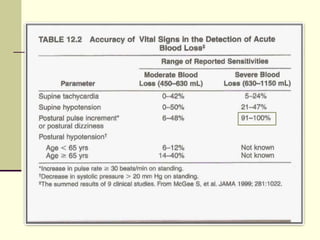
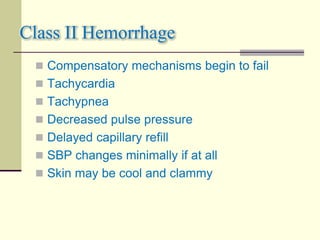
Class II Hemorrhage
 Compensatory mechanisms begin to fail
 Tachycardia
 Tachypnea
 Decreased pulse pressure
 Delayed capillary refill
 SBP changes minimally if at all
 Skin may be cool and clammy
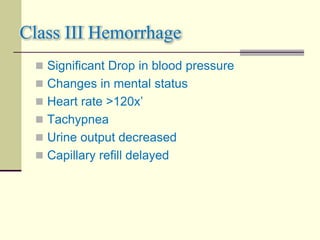
Class III Hemorrhage
 Significant Drop in blood pressure
 Changes in mental status
 Heart rate >120x’
 Tachypnea
 Urine output decreased
 Capillary refill delayed
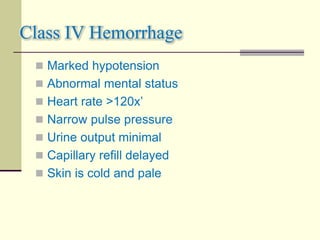
Class IV Hemorrhage
 Marked hypotension
 Abnormal mental status
 Heart rate >120x’
 Narrow pulse pressure
 Urine output minimal
 Capillary refill delayed
 Skin is cold and pale
Management
• Crystalloid Solutions
• at least 1-2 liters
• Delayed therapy can lead to
ischemic injury and possibly to
irreversible shock
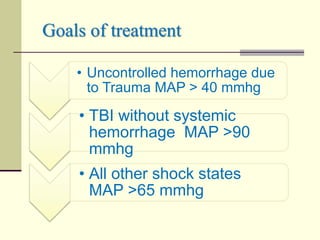
Goals of treatment
• Uncontrolled hemorrhage due
to Trauma MAP > 40 mmhg
• TBI without systemic
hemorrhage MAP >90
mmhg
• All other shock states
MAP >65 mmhg
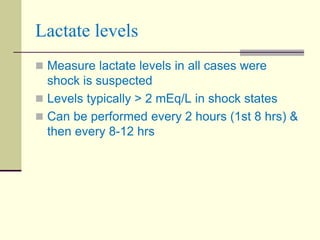
Lactate levels
 Measure lactate levels in all cases were
shock is suspected
 Levels typically > 2 mEq/L in shock states
 Can be performed every 2 hours (1st 8 hrs) &
then every 8-12 hrs
Challenges
 Docs no longer touch patients, they order tests
 A good history and detailed PE are needed
 A high index of suspicion
 Identify your patient’s basal status and work
towards specific goals
Learn from the mountain goat
Mumtaz mahal
Thank you

Hypovolemic shock

Editor's Notes

  • #4 Hipocrates en el 400 BC realiza una descripción del choque refiriéndose a un paciente con nariz afilada, ojos ahuecados, sienes sumidas, orejas frias y contraídas, con la piel de la cara seca, tensa y con perdida de la coloración del rostro. Choc- which was used by the French army surgeon Henri Francois Le Dran to describe the collapse of vital functions culminating in death that he observed in soldiers who had been struck by missiles An innapropiate translation used by the English physician Clarke in 1743 introduced the word shock Jhon Collins indica que el shock es una pausa momentánea en el acto de la muerte
  • #5 Excessive pallor of the countenance, the weakened or absent pulse, the confused state of mind, the nausea or vomiting and the excessive bodily postration
  • #8 Soap 2 trial septic shock was the most frequent cause of shock for 62% of patients, followed by cardiogenic in 17% and hypovolemia in 16%
  • #9 Oliguria (less than 0.5 ml/kg/hr)
  • #19 Class I generally well tolerated. Tachycardia the most obvious sign Compensatory mechanisms begin to fail with a loss of 20-25 %
  • #27 Average doctor treats full blown disease Good doctor finds disease early Superior doctor prevents disease