INDIAN DENTAL ACADEMY
Leader in continuing dental education
www.indiandentalacademy.com

www.indiandentalacademy.com
TRANSPOSITION
OF TEETH AND
ITS
MANAGEMENT
www.indiandentalacademy.com
CONTENTS
 

1. INTRODUCTION
2. HISTORY
3. DEFINITION
4. CLASSIFICATION
5. TRANSPOSITION VS ECTOPIC ERUPTION
6. TRANSPOSITION VS TRANSMIGRATION
7. PSEUDO TRANSPOSITION
8. ETIOLOGY
a
MIGRATION / DRIFT THEORY
b
INTERCHANGE IN POSITION OF
TOOTH BUDS
c
TRAUMA
d
GENETIC
9. CONTROVERSIES REGARDING ETIOLOGY OF
TRANSPOSITION
www.indiandentalacademy.com
10. CLINICAL FEATURES
11. WHY GREATEST INCIDENCE OF
MAXILLARY CANINE TRANSPOSITION
12. MANAGEMENT
a.     INTERCEPTIVE
b.     DEFINITIVE
 i.  CANINE – FIRST PREMOLAR
 
ii.  CANINE – LATERAL INCISOR
iii.  CANINE – FIRST MOLAR
iv.  LATERAL INCISOR – CENTRAL
INCISOR
 
v.   CANINE - CENTRAL INCISOR
13. CLINICAL CONSIDERATIONS
14. CONCLUSION
15. BIBLIOGRAPHY
www.indiandentalacademy.com
INTRODUCTION

:


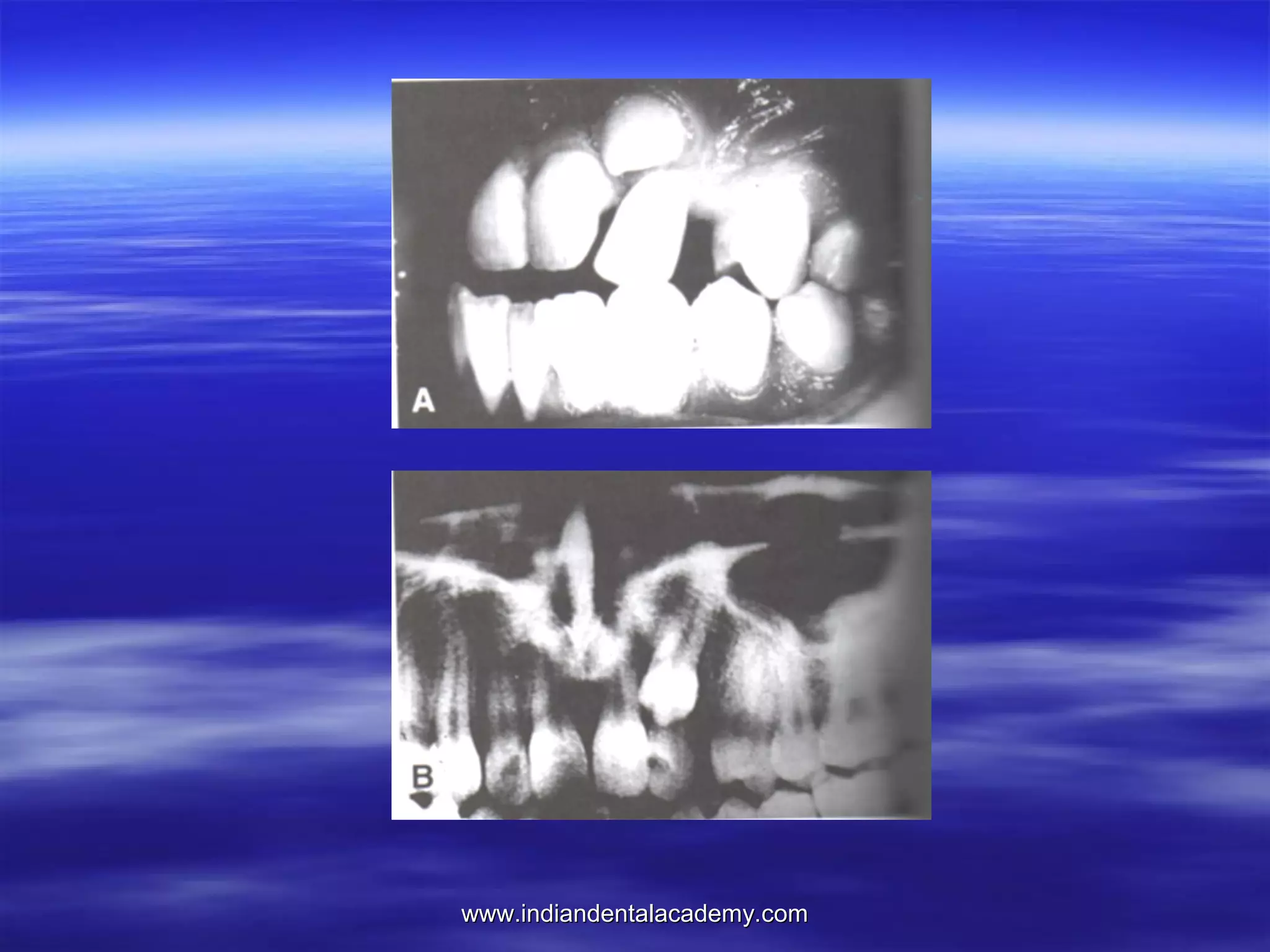
Transposition of a tooth is a relatively
rare dental anomaly of unknown origin.

It can be basically said as a
phenomenon in which two teeth
in dental arch are in exchanged
position and is a disturbance of
eruptive position
www.indiandentalacademy.com
. Orthodontists are usually forced with a
dilemma regarding the diagnosis and
treatment of patient with transposition
with the occurrence of transposition is
approximately 1 out of 300 orthodontic
cases.

www.indiandentalacademy.com
  Its  correction  involves  treatment  risk  and 
requires  a  great  deal  of  control  and 
carefully applied mechanics.

www.indiandentalacademy.com
HISTORY
 

Transposition of teeth has been
observed and reported since the early
19th century.
 
In 1849 Harris in his first edition
of “A Dictionary of Dental Sciences,
Biography, Bibliography and Medical
Terminology” described transposition
as an aberration in the position of
www.indiandentalacademy.com
teeth.
  A  French  dentist,  E.M.Miel  wrote  in  1817 
what  is  perhaps  the  earliest  scientific 
report  of  maxillary  central  and  first 
premolar  transposition.    He  gives  a  detail 
description  of  bilateral  occurrence  of  this 
dental positional anomaly in a 16 year old 
girl.    He  noted  that  her  father  presented 
with  a  unilateral  left  maxillary  central 
incisor and first premolar transposition. 
www.indiandentalacademy.com
DEFINITION
According  to  Mader and Joseph
L.Konzelman  (JADA,  1979  :  98).    It  may 
be defined as an interchange of position of 
two teeth.  

According  to  Sheldon Peck  (AJO. 
1995  :  107).    Tooth  transposition  is  the 
positional  interchange  of  two  adjacent 
teeth,  especially  their  roots,  or  the 
development  or  eruption  of  a  tooth  in  a 
position  occupied  normally  by  a 
nonadjacent tooth. 


www.indiandentalacademy.com
According 
to 
Y.Shapira
and
M.M.Kuftinec  (AJO,  2001  :  119).    They 
stated  it  as  an  interchange  in  the  position 
of two adjacent permanent teeth within the 
same quadrant of the dental arch. 

According to Elizabeth C.Weeks (BDJ, 
1996:  181).    It  may  be  defined  as  the 
migration  of  a  tooth  from  its  normal 
developmental  position,  such  that  the 
order of the teeth is changed. 


www.indiandentalacademy.com
CLASSIFICATION
Teeth transposition can be classified in a variety of ways.
I. Given by Pertz B. and Arad A.
Int. 1992 : 23)

(Quintessence

Complete : In complete transposition both crowns and
entire roots of the involved teeth are found in their
transposed position.
Incomplete : In this crowns of the involved teeth may be
transposed but the root apices still remain in their relatively
normal position.
www.indiandentalacademy.com
II. Given by Elizabeth C.Weeks (BDJ. 1996 : 181).

Transposition
True
Unilateral

False

Bilateral

www.indiandentalacademy.com
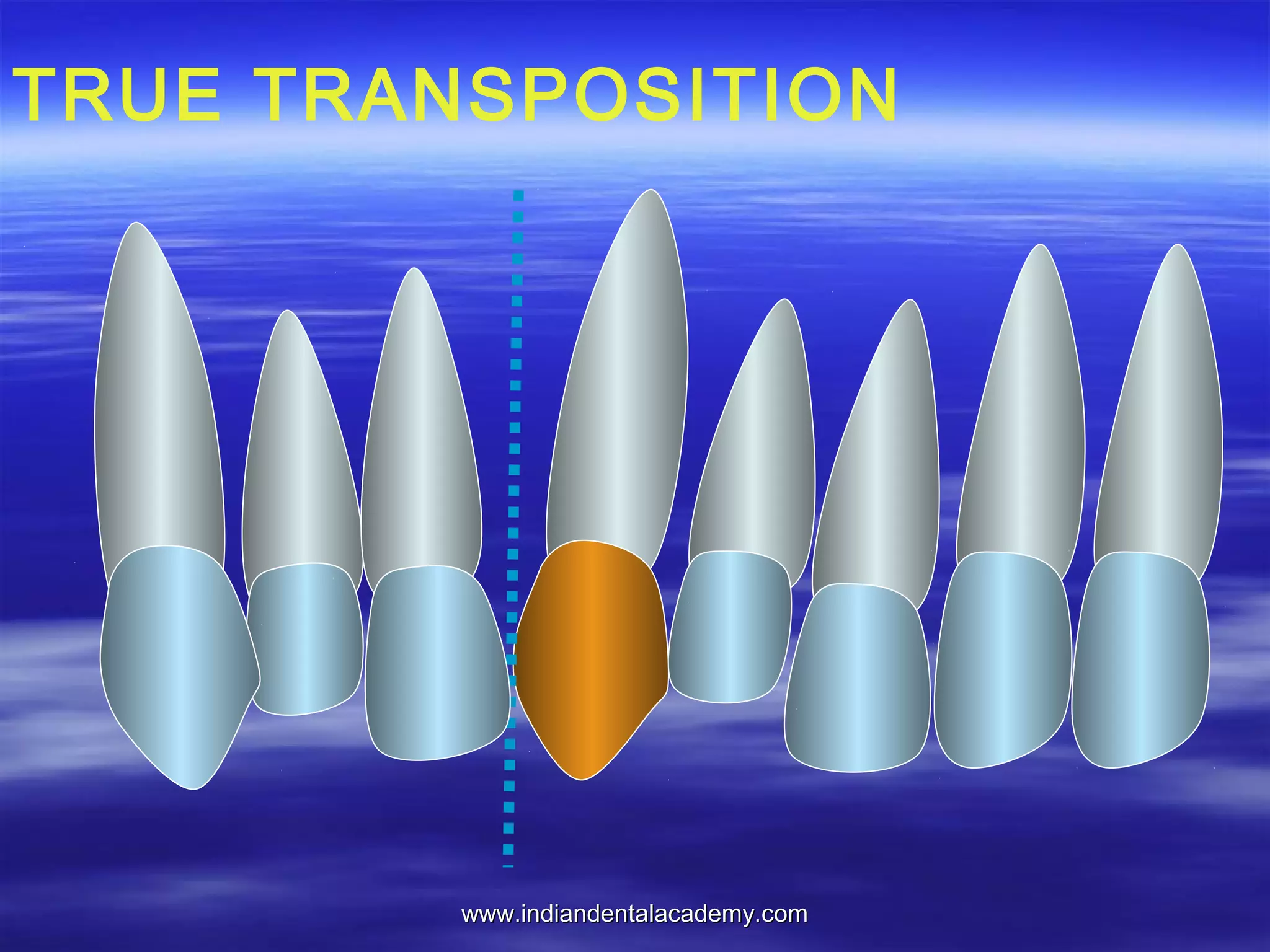
 True transposition : In true transposition the 
both involved teeth ex. Central incisor and 
canine do occupy each others respective 
positions. 
This again sub divided into ; 

 


Unilateral : Transposition taking place 
on one quadrant of the respective 
arch.
Bilateral : Transposition taking place 
on  both sides of a arch. 
www.indiandentalacademy.com
TRUE TRANSPOSITION

www.indiandentalacademy.com
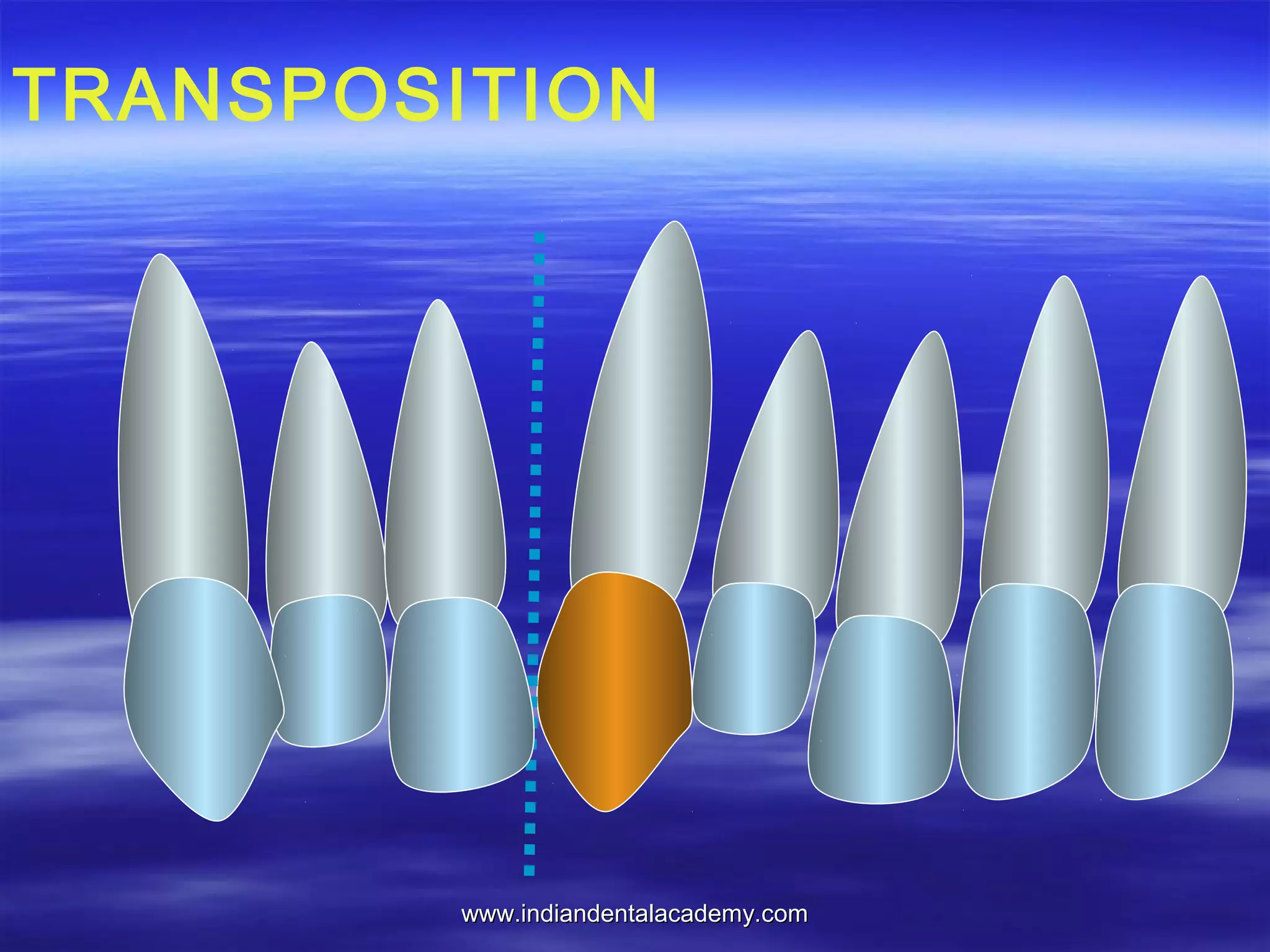
 False Transposition:  In this the involved 
teeth do not occupy each others normal 
respective position. 
For example in case of canine and central 
incisors transposition, the canine has 
taken the position of central incisor by 
migrating mesially and central incisor and 
lateral incisor which are in normal 
sequence have simply migrated or been 
forced distally.
www.indiandentalacademy.com
FALSE TRANSPOSITION

www.indiandentalacademy.com
TRANSPOSITION VS ECTOPIC
ERUPTION
Ectopic Eruption

it is a broad category
referring to any abnormal or aberrant eruptive position
taken by a tooth. For example buccally placed maxillary
canines.
In Transposition the teeth exchange their places
thereby reversing their sequence in the mouth.
Thus transposition must be considered a subdivision
of ectopic eruption.
 

All transpositions are examples of
ectopic eruption, but few ectopic
eruptions are transpositions.
www.indiandentalacademy.com
ECTOPIC ERUPTION

www.indiandentalacademy.com
TRANSPOSITION

www.indiandentalacademy.com
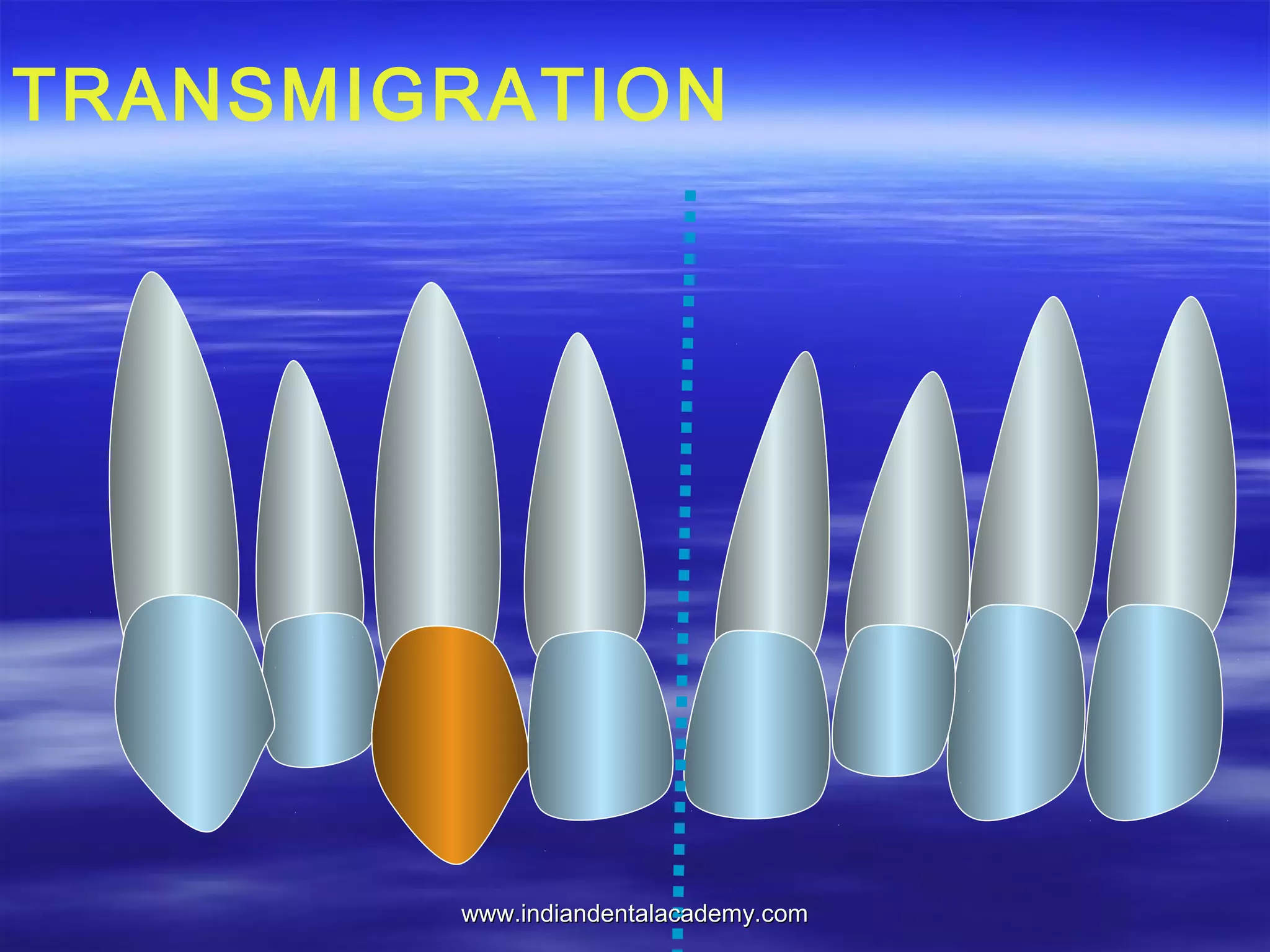
Transposition Vs Transmigration
Transposition by definition is an interchange
in the
position of two adjacent permanent
teeth within the
same quadrant of the dental
arch.
 
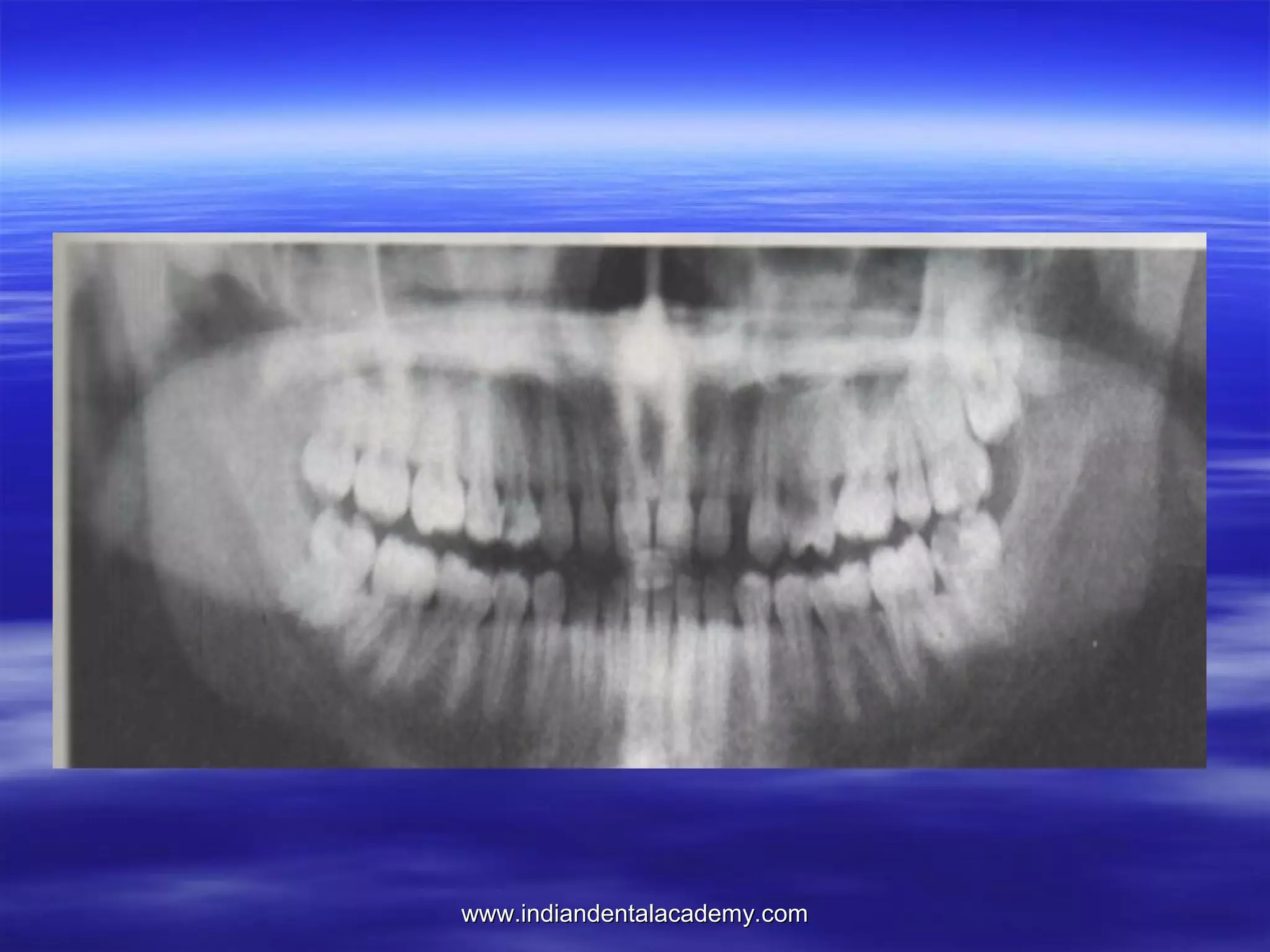
Transmigration It is referred as displacement
of
teeth from one quadrant across the midline
to the
other quadrant.
Thus transmigration teeth should be
considered
ectopically erupted teeth not
transposed teeth. www.indiandentalacademy.com
TRANSPOSITION

www.indiandentalacademy.com
TRANSMIGRATION

www.indiandentalacademy.com
Pseudo Transposition :
(Peck et al AJO, 1995)
Some reported variations of
tooth sequence that mimic
transpositions yet technically do
not
fit
the
definition
of
transposition. This category is
known as pseudo transposition.
www.indiandentalacademy.com
One type of pseudotransposition is in form 
of  hyperdontia  best  called  supernumerary 
distal  maxillary  premolars.    Clinically  it  is 
characterized  by  a  premolar  like  extra 
tooth  developing  or  erupted  between  the 
maxillary  permanent  first  and  second 
molars.  
 
The  cause  of  this  condition  is  probably 
genetically  related,  like  most  types  of 
hyperdontia. 
www.indiandentalacademy.com
ETIOLOGY

www.indiandentalacademy.com
 1) Migration / Deflection / Drift theory

This  theory  stated  that  over  retained 
deciduous teeth obstruct the eruption 
path  of  permanent  canine  which 
therefore  gets  deflected,  it  then 
migrates  and  erupts  in  a  transposed 
position. 

www.indiandentalacademy.com
The tooth most commonly
transposed is the maxillary canine,
starts its long pre eruptive migration
high above the premolars. It has
been suggested that it may change
its usual nearly straight downward
direction and migrate mesially to be
transposed with the lateral incisor
or distally to be transposed with the
first premolar.  
 

www.indiandentalacademy.com
2) Interchange in Position of
Tooth
Buds :
This theory put forward by Stafne 
and Gibilsco stated interchange in 
position  of  tooth  buds  during  the 
very  early  stages  of  tooth 
development  is  responsible  for 
the anomaly. 
www.indiandentalacademy.com
3) Trauma :
The
third
possible
explanation of etiology of
transposition is that of
trauma which presumably
causes an exchange of germs
imposed by an external force
on the teeth.
www.indiandentalacademy.com
4) Genetic :
Lastly genetic etiology has
been strongly supported by
“Nelson” from his study of
prehistoric
material
from
Santa Cruz Island, Calif, and
also supported by Peck et al.
www.indiandentalacademy.com
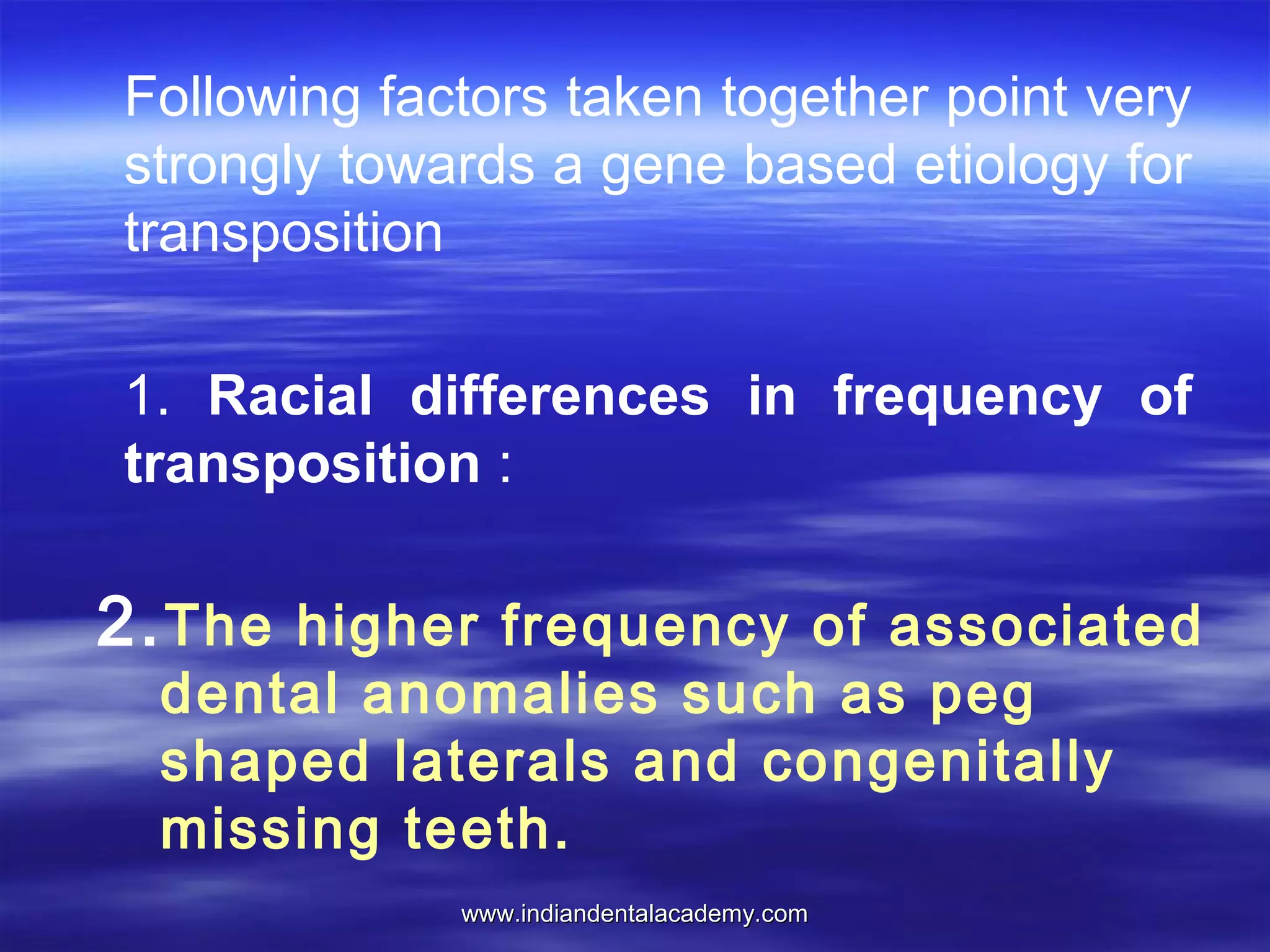
Following factors taken together point very 
strongly towards a gene based etiology for 
transposition
1.  Racial differences in frequency of
transposition :

2. The higher frequency of associated
dental anomalies such as peg
shaped laterals and congenitally
missing teeth.
www.indiandentalacademy.com
3. Frequent bilateral occurrence
4. Involvement of same type of teeth in
bilateral cases on both sides.

www.indiandentalacademy.com
. 
 
These 
observations 
further 
strengthen  considering  a  genetic 
component  in  a  pre  eminent  position 
in the etiology of transposition. 

www.indiandentalacademy.com
CONTROVERSIES
REGARDING ETIOLOGY OF
TRANSPOSITION

www.indiandentalacademy.com
 

1. Against Mesial Drift Theory:
Peck et al clearly assert that an
over retained deciduous canine is a
direct outcome of failure of
permanent canine to erupt below it
and not the
cause
of the
transposition. Over retention is

the effect rather than
cause of transposition.
 

www.indiandentalacademy.com

the
    This  theory  sounds  plausible, 
regarding  transposition  of  the 
canine  and  premolar  as  eruption 
time  of  canine  and  premolar  are 
close to each other but theory fail 
to  explain  the  position  of  canine 
with  the  early  eruption  of  lateral 
incisor. 
www.indiandentalacademy.com
  Normally eruption patterns of teeth are 

generally constant 61245378 in upper 
arch.    The  lateral  incisor  eruption 
precedes the canine, by 2 to 3 years.  
If  the  transposition  of  the  canine  with 
lateral  incisor  is  to  explained  through 
migrating  /  drift  theory  then  what 
condition  or  situation  makes  the 
earlier  erupting  lateral  incisor  occupy 
the canines position. 
www.indiandentalacademy.com
At  the  same  time  mesio  distal  width  of 
lateral  incisor  is  smaller  than  canine.  If 
canine  has  to  force  its  way  between 
central  incisor  and  lateral  incisor,  pushing 
lateral incisor distally with an over retained 
deciduous  canine  present  distally,  it  is 
bound  to  find  very  little  space  for  precise 
eruption  in  lateral  incisor  space.    This 
would lead to impaction or palatal eruption 
of canine rather than transposition. 
www.indiandentalacademy.com
.Thus  this  provides  the  antithesis  for  the 
migration  and  deflection  theory  of 
transposition. 

www.indiandentalacademy.com
2) Against inter change of tooth buds
It is important to remember that
transpositions affect the permanent
teeth but leave the deciduous teeth
normal. Since the deciduous germ and
its permanent successor are in same
bony crypt it is obvious that precise
exchange of germs of the permanent
teeth would not occur when the
deciduous teeth have not erupted.
www.indiandentalacademy.com
    In  the  phase  following  the  eruption  of 
deciduous  teeth,  such  precise  exchanges 
would  be  precluded  due  to  obvious 
anatomical, morphological  
and 
physiological reasons. 
 
. 

www.indiandentalacademy.com
3) Against the trauma:If  trauma  were  to  play  a  role  one 
would except displacement of the 
dental  elements  rather  than 
precise  exchanged  position  as  in 
transposition. 

www.indiandentalacademy.com
Thus Peck et al suggested a polygenic,
multifactorial
inheritance
for
transposition of teeth. However detailed
mechanism of origin of transposition is
matter for further research.

www.indiandentalacademy.com
CLINICAL FEATURES

www.indiandentalacademy.com
 

SSex :
Usually both males and females are affected.
However some studies show higher male
predilection. According to study conducted at
Dharwad in 1993 showed higher male
predilection and Peck et al also cited higher
male predilection.
According to recent
studies done by Y.Shapira et al cited higher
female predilection.
 
-    

www.indiandentalacademy.com
Site :
Most  transposition  appear  in  maxillary 
arch. 
The five maxillary transposition types are 
arranged  in  descending  order  according 
to prevalence (AJO. 1995 : 107).  
1. Canine to first premolar
2. Canine to lateral incisor
3. Canine to first molar 
4. Lateral incisor to central incisor
5. Canine to lateral incisor
www.indiandentalacademy.com
Unilateral
transposition
are
more
prevalent then bilateral ones.
-     _      In mandible it is found to occur in the
site off lateral incisor to canine.
-   _       Among unilateral left side is more
frequently involved then right side in ratio of
2:1.
-    _       The preponderance of left sided
expression
of
transposition
remains
unexplained at present.
-    _     

www.indiandentalacademy.com
 

Other dental anomalies associated with
tooth transposition are :
1)     Developmentally missing or peg shaped,
upper lateral incisor.
2)    Retention of deciduous teeth.
3)    Malpositioned adjacent teeth.
4)    Rotation of transposed teeth.
-

www.indiandentalacademy.com
      Transposition has never been reported in 
deciduous dentition. 
 In a recent study of individuals with Down 
syndrome a tooth transposition prevalence 
of 15% was found. (ANGLE 0 2000,70)

www.indiandentalacademy.com
WHY GREATEST INCIDENCE
OF MAXILLARY CANINE
TRANSPOSITION

www.indiandentalacademy.com
The
maxillary
canines
are
important key stone in the dental arch
both for good esthetics and normal
masticatory function.
 

The maxillary canine is the most
common tooth to get transposed. In
case of canines, the preeruptive position
of the permanent maxillary canines
increases its potential for ectopic
eruption.
www.indiandentalacademy.com
The maxillary permanent canine has the
longest period of development and the
longest way to travel from the point of
its early formational stage, just under
the orbit to its complete eruption.

It

starts to calcify at about four to five
months after parturition and erupts into
the mouth at the age of approximately
12-13 years.  
www.indiandentalacademy.com
Any bony obstruction, insufficient
bone development and crowding for
other reasons, or resistance of the
neighbouring teeth such as a
retained deciduous canine may
deflect the permanent canine from
its normal eruptive path. It may be
displaced mesially and become
transposed with lateral incisor or
distally to become transposed with
first premolar.
www.indiandentalacademy.com
MANAGEMENT

www.indiandentalacademy.com
TREATMENT

INTERCEPTIVE
DEFINITIVE
www.indiandentalacademy.com
Interceptive :
This is carried out before the
complete transposition have occurred.
When incipient transposition is detected
early enough interceptive modality of
orthodontic treatment can be initiated.
This is made possible by changing
eruptive path of permanent tooth by
removal of retained primary tooth.
www.indiandentalacademy.com
For example in mandibular arch the
retained deciduous lateral incisor and
canines are removed and the ectopically
erupted lateral incisor are uprighted and
aligned in their normal positions in the
arch before the eruption of permanent
canine

which

has

prevented

transposition process from continuing.
www.indiandentalacademy.com

the
Here is another example; A case with severe
distal angulation of the lateral incisor. Uprighting
of 41, 42, 31, 32 with a sectional fixed appliance
was done, before the eruption of permanent
mandibular canine which has prevented the
transposition process from continuing.

www.indiandentalacademy.com
DDefinitive :

BBefore
deciding
any
definitive
treatment strategy, certain factors need
to be considered ;
11)  Position and condition of root
apices.
Whether it is complete or
incomplete transposition.
22)  Dental and facial esthetics.
33)  Occlusion (both static and dynamic)

www.indiandentalacademy.com
4) The underlying malocclusion and
degree of crowding.
5) Clinical crown height and shape
should be evaluate in case of
reshaping the transposed teeth.
6) Patient motivation

www.indiandentalacademy.com
vVarious treatment options are :
11)    Alignment in the transposed
position
followed by recontouring
and
reshaping
of
transposed teeth.
22)  Extraction of the transposed tooth
33) Orthodontic
movement
of
transposed
teeth into the normal
arch positions.

www.indiandentalacademy.com
In
case
of
incomplete
transposition where the crowns are
transposed but the root apices are
in their relatively normal positions,
uprighting and rotating the involved
teeth is the procedure to place them
in their normal position, provided
enough space is available in the
arch.
 
www.indiandentalacademy.com
In cases of complete transposition,
with root apices in their transposed
positions, repositioning the teeth to
their normal relationship in the arch is
complex and may be damaging to the
teeth and supporting structures. So
one should align them in the
transposed position and then go for
reshaping and recontouring of them
www.indiandentalacademy.com
Or otherwise treatment option
include the attempt to move
transposed teeth to their normal
positions in the arch providing
alignment in the transposed
positions would be esthetically
and functionally unacceptable.

www.indiandentalacademy.com
TREATMENT OPTIONS FOR
DIFFERENT TYPES OF
MAXILLARY TOOTH
TRANSPOSITION

www.indiandentalacademy.com
11)   Maxillary canine to First

premolar
MMaxillary canine and first premolar
transposition appears to be the most
commonest transposition in man.

www.indiandentalacademy.com
1. Retained deciduous canines.
2. The permanent canine, which is positioned
between the adjacent first and second
premolars, is usually blocked out bucally, and is
often mesiolabially rotated.
3. The transposed first premolar is nearly always
rotated mesiopalatally upto 90o ; occasionally
also blocked palatally.
4. Transitional crowding is present in
transposition area, especially when
deciduous canine been retained.
www.indiandentalacademy.com

the
the
www.indiandentalacademy.com
In cases of crowding or need for
overjet reduction correction of
transposition and malocclusion is
carried by extraction of the first
premolars.
 
. 

www.indiandentalacademy.com
 In non-extraction cases, transposition can
be accepted with reasonable esthetic
result by restorative camouflage
procedures. The roots of upper first
premolars are usually acceptable for
canine guidance. Partial reduction of the
palatal cups may assist in providing a
smoothly cuspally guided occlusion

www.indiandentalacademy.com
Orthodontic correction of transposed
teeth
involves
complex
fixed
appliance
mechanics.
The
transposed
teeth
are
moved
simultaneously, one buccally and
other palatally while also being
moved distally or mesially as
required. Palatal as well as buccal
archwires may be required in order to
control the tooth movements.
www.indiandentalacademy.com
22)Maxillary

canine to lateral incisor
transposition :
1.Retained deciduous canines.
22.Labially blocked out and often rotated canine
and lateral incisor.
33.  Small lateral incisors and missing second
premolars.
44.Impaction of the canine or central incisor most often on
the transposition side.

www.indiandentalacademy.com
In this situation there are two
problems
a) Ability of the lateral incisor to
function as canine.
b) The ability to disguise the canine
and lateral incisor as each other.
www.indiandentalacademy.com
 The upper lateral incisor is less favourable
for canine guidance since its roots is
usually thin and small in length.
 If the color, shape or bulbosity of the
upper canine be infavourable for
restorative camouflage, consideration
should be given to extraction of lateral
incisor. The upper canine can then be
retracted into its correct position and the
lateral incisor can be replaced by a
cantilever adhesive bridge or an implant.
www.indiandentalacademy.com
Last
option
is
to
correct
transposition orthodontically..
The correction may be achieved by
moving lateral incisor palatally by
bodily
movement.Then
canine
retraction is carried avoiding any
major root interferences . After
canine retraction the lateral
incisor is moved labially to its
normal position in the arch,
aligned next to central incisor.
www.indiandentalacademy.com
3) Canine to First molar site :
This transposition is characterized by
presence of maxillary canine in the
space of the same side permanent first
molar which had been lost earlier. The
canine usually is observed rotated
mesiopalataly
with
slight
palatal
displacement.

www.indiandentalacademy.com
No remedial treatment for this anoamly but
other than extraction of transposed canine

www.indiandentalacademy.com
4) Maxillary lateral to central
incisor
transposition :
In this type of transposition esthetically
symmetry is the main difficulty since the
gingival contour of the lateral incisor is
lower and narrower than that of central
incisor. Aesthetics can be improved with
restorative procedures using veneers and
crowns.
But then residual gingival
triangular space may look cosmetically
poor for patients with high smile line.  
www.indiandentalacademy.com
Other alternative is to selectively
extract the lateral incisor, followed
by alignment of the central incisor
into its correct position followed
with prosthetic replacement of the
lateral incisor. This procedure
would provide a more aesthetic
results.
www.indiandentalacademy.com
5) Maxillary canine to central incisor
transposition :
In this type of transposition, it is often decided
to retain the canine in the central incisor site and to
keep central incisor into canine position.
The
brackets on the 11,13 are inverted in order to assist
palatal root torque on 13 and labial root torque on
11. The upper central incisor root is adequate to
withstand cuspid guidance, however aesthetics will
not be ideal.

www.indiandentalacademy.com
 Then considerable restorative camouflage
to canine and central incisor will be carried
will reduction of the incisal corner

www.indiandentalacademy.com
CLINICAL CONSIDERATIONS

www.indiandentalacademy.com
1)
Bracket
placement
:
Regarding the bracket placement
one has too first decide whether
one is aligning the transposed
teeth in the same way or whether
he is bringing the transposed teeth
to its normal position in the arch.

www.indiandentalacademy.com
For example, canine and central
incisor
transposition.
The
treatment procedure was decided
to align them in a transposed
position. The brackets on both of
them are inverted in order to
assist palatal root torque on the
canine and labial root torque on
the central incisor.
www.indiandentalacademy.com
2) Functional occlusion :
The
reshaping
and
recontouring
of
transposed teeth should be done in a
way that one can achieve good
functional occlusion.

www.indiandentalacademy.com
3) Periodontal tissue consideration :
1]the width of the alveolus is usually in
sufficient for the roots of the teeth to pass
labio-palatally.
2) Root resorption may then occur as a
result of compression and friction during the
correction.
3) Thinning of the labial alveolus and
mucosa may result in clefting and recession
of the gingiva.

www.indiandentalacademy.com
CASE
REPORTS
www.indiandentalacademy.com
 Y. Shapira and M.M. Kuftinec (AJO 1989)
 Age/Sex - 12.5 yrs /female.
 Clinical Findings –
–
–
–
–

Bilateral end on molar relationship.
Crowding in the maxillary right anterior region.
Rotation of right lateral incisor and first premolar.
Transposition of canine and the lateral incisor on right
side.

 Radiographic Finding –

– Complete transposition of canine and the lateral
incisor on right side.

 Treated By –

– Non extraction standard edgewise.
www.indiandentalacademy.com
 Francisco A.M. (Angle 2000)
 Age/Sex – 10 yrs 10 mnths / female.
 Clinical Findings –

– Clinical transposition of upper left lateral incisor and
canine.
– 5 mm deviation of upper midline towards left.
– Posterior lateral open bite

 Radiographic Finding –

– Complete transposition of upper left lateral incisor and
canine.

 Treated By –

– 4 4 extraction P.E.A. mechanotherapy
www.indiandentalacademy.com
CONCLUSION

www.indiandentalacademy.com
Transposition can be considered a
small part of the phenomena of tooth
malposition permitting identification and
discrimination of some of the genetic and
adventitious factors that seem to
interplay
in
the
formation
of
malocclusion.
Once transposition has
occurred careful orthodontic assessment
must be carried out in order to correct
the malocclusion in order to get best
aesthetics and functional results.
www.indiandentalacademy.com
 
 What

may seem to be an
anomaly in the dentists eyes,
sometimes may not be unusual in
the patients eye. The patient is
interested in the health of his
teeth
and
may
not
come
complaining about transposition.
In fact, he will be amused by the
interest his teeth has aroused
among the dentist.
www.indiandentalacademy.com
BIBLIOGRAPHY

www.indiandentalacademy.com
D1. Dayal P.K. : Transposition of canine with
traumatic etiology. J Ind Dent Assoc. 55 :
283-285, 1983.
22. Mohendra L. : An unusual transposition
of maxillary lateral incisor. J Ind Dent Assoc.
55 : 115-117, 1983.
33. Loptook T. and Siling G. : Canine
transposition approaches to treatment. J Am
Dent Assoc. 107 : 746, 748, 1983.
4

www.indiandentalacademy.com
4. Joshi M.R. and Bhatt N.A. : Canine
transposition. Oral Surg. 31 : 49-53, 1971.
5.

Mader C. and Konzelmon J.L. : Transposition
of teeth. J Am Dent Assoc. 98 : 412-413, 1979.

6.

Shopira Y. and Kuftinec M.M. : Orthodontic
management of mandibular canine incisor
transposition. Am J Orthod. 83 : 271-76, 1983.

7.

Chottapadhayay A. and Srinivas K. :
Transposition of teeth and genetic etiology.
Angle Orthod. 66 : 147-152, 1996.
www.indiandentalacademy.com
8.

Shopira Y. and Kulftinec M.M. : Tooth
transpositions – a review of the literature and
treatment considerations. Angle Orthod. 59 :
271-275, 1989.

9.

Elizabeth C.Weeks : The presentations and
management of transposed teeth. Br Dent J.
181 : 421-424, 1996.

10. Peck S., Peck L. : Classification of maxillary
tooth transpositions. Am J Orthod. 107 : 505517, 1995.
www.indiandentalacademy.com
11. Shopira y. and Kuftinec M.M. : A unique
treatment approach for maxillary canine lateral
incisor transposition. Am J Orthod. 119 : 540545, 2001.
12. Shapira Y. and Kuffinec M.M. : Maxillary
tooth transpositions : Characteristic features and
accompanying dental anomalies. Am J Orthod.
119 :127-134, 2001.
13. Francisco A.M.: Orthodontic correction of a
transposed maxillary canine and lateral incisor.
Angle Orthod. 70 :339, 348, 2000.
14. Parker W.S. : Transposed premolars,
canines and lateral incisors. Am J Orthod. 97 ;
431-487, 1990.
www.indiandentalacademy.com
115.     Mitchell L. : Canines, in an introduction to
orthodontics, Ed.. L.Mitchell, Oxford University
Press, Oxford, England 1996, Pg.137.
616.     Peretz B. and Arad A. : Bilateral transposition
of maxillary canines and first premolars : Case
Report. Quintessence Int. 23 : 345-348, 1992.
717.     Shapira J. and Chaushu S. : Prevalence of
tooth transposition, Third molar agencies, and
maxillary canine impaction in individuals with Down
syndrome. Angle Orthod. 70 : 290-295, 2000.
818.     Patel J.R. : Transposition and microdontia.
Oral Surg Oral Med Oral Pathol. 76 ; 129, 1993.

www.indiandentalacademy.com
THANK YOU

www.indiandentalacademy.com

Transposition of teeth & its management

  • 1.
    INDIAN DENTAL ACADEMY Leaderin continuing dental education www.indiandentalacademy.com www.indiandentalacademy.com
  • 2.
  • 3.
    CONTENTS   1. INTRODUCTION 2. HISTORY 3. DEFINITION 4. CLASSIFICATION 5. TRANSPOSITION VS ECTOPICERUPTION 6. TRANSPOSITION VS TRANSMIGRATION 7. PSEUDO TRANSPOSITION 8. ETIOLOGY a MIGRATION / DRIFT THEORY b INTERCHANGE IN POSITION OF TOOTH BUDS c TRAUMA d GENETIC 9. CONTROVERSIES REGARDING ETIOLOGY OF TRANSPOSITION www.indiandentalacademy.com
  • 4.
    10. CLINICAL FEATURES 11. WHY GREATESTINCIDENCE OF MAXILLARY CANINE TRANSPOSITION 12. MANAGEMENT a.     INTERCEPTIVE b.     DEFINITIVE  i.  CANINE – FIRST PREMOLAR   ii.  CANINE – LATERAL INCISOR iii.  CANINE – FIRST MOLAR iv.  LATERAL INCISOR – CENTRAL INCISOR   v.   CANINE - CENTRAL INCISOR 13. CLINICAL CONSIDERATIONS 14. CONCLUSION 15. BIBLIOGRAPHY www.indiandentalacademy.com
  • 5.
    INTRODUCTION :   Transposition of atooth is a relatively rare dental anomaly of unknown origin. It can be basically said as a phenomenon in which two teeth in dental arch are in exchanged position and is a disturbance of eruptive position www.indiandentalacademy.com
  • 6.
    . Orthodontists areusually forced with a dilemma regarding the diagnosis and treatment of patient with transposition with the occurrence of transposition is approximately 1 out of 300 orthodontic cases. www.indiandentalacademy.com
  • 7.
      Its  correction involves  treatment  risk  and  requires  a  great  deal  of  control  and  carefully applied mechanics. www.indiandentalacademy.com
  • 8.
    HISTORY   Transposition of teethhas been observed and reported since the early 19th century.   In 1849 Harris in his first edition of “A Dictionary of Dental Sciences, Biography, Bibliography and Medical Terminology” described transposition as an aberration in the position of www.indiandentalacademy.com teeth.
  • 9.
      A  French dentist,  E.M.Miel  wrote  in  1817  what  is  perhaps  the  earliest  scientific  report  of  maxillary  central  and  first  premolar  transposition.    He  gives  a  detail  description  of  bilateral  occurrence  of  this  dental positional anomaly in a 16 year old  girl.    He  noted  that  her  father  presented  with  a  unilateral  left  maxillary  central  incisor and first premolar transposition.  www.indiandentalacademy.com
  • 10.
    DEFINITION According  to  Maderand Joseph L.Konzelman  (JADA,  1979  :  98).    It  may  be defined as an interchange of position of  two teeth.    According  to  Sheldon Peck  (AJO.  1995  :  107).    Tooth  transposition  is  the  positional  interchange  of  two  adjacent  teeth,  especially  their  roots,  or  the  development  or  eruption  of  a  tooth  in  a  position  occupied  normally  by  a  nonadjacent tooth.   www.indiandentalacademy.com
  • 11.
    According  to  Y.Shapira and M.M.Kuftinec  (AJO,  2001 :  119).    They  stated  it  as  an  interchange  in  the  position  of two adjacent permanent teeth within the  same quadrant of the dental arch.   According to Elizabeth C.Weeks (BDJ,  1996:  181).    It  may  be  defined  as  the  migration  of  a  tooth  from  its  normal  developmental  position,  such  that  the  order of the teeth is changed.   www.indiandentalacademy.com
  • 12.
  • 13.
    CLASSIFICATION Teeth transposition canbe classified in a variety of ways. I. Given by Pertz B. and Arad A. Int. 1992 : 23) (Quintessence Complete : In complete transposition both crowns and entire roots of the involved teeth are found in their transposed position. Incomplete : In this crowns of the involved teeth may be transposed but the root apices still remain in their relatively normal position. www.indiandentalacademy.com
  • 14.
  • 15.
  • 16.
    II. Given byElizabeth C.Weeks (BDJ. 1996 : 181). Transposition True Unilateral False Bilateral www.indiandentalacademy.com
  • 17.
  • 18.
  • 19.
  • 20.
  • 21.
    TRANSPOSITION VS ECTOPIC ERUPTION EctopicEruption it is a broad category referring to any abnormal or aberrant eruptive position taken by a tooth. For example buccally placed maxillary canines. In Transposition the teeth exchange their places thereby reversing their sequence in the mouth. Thus transposition must be considered a subdivision of ectopic eruption.   All transpositions are examples of ectopic eruption, but few ectopic eruptions are transpositions. www.indiandentalacademy.com
  • 22.
  • 23.
  • 24.
    Transposition Vs Transmigration Transpositionby definition is an interchange in the position of two adjacent permanent teeth within the same quadrant of the dental arch.   Transmigration It is referred as displacement of teeth from one quadrant across the midline to the other quadrant. Thus transmigration teeth should be considered ectopically erupted teeth not transposed teeth. www.indiandentalacademy.com
  • 25.
  • 26.
  • 27.
  • 28.
    Pseudo Transposition : (Pecket al AJO, 1995) Some reported variations of tooth sequence that mimic transpositions yet technically do not fit the definition of transposition. This category is known as pseudo transposition. www.indiandentalacademy.com
  • 29.
    One type of pseudotransposition is in form  of  hyperdontia  best called  supernumerary  distal  maxillary  premolars.    Clinically  it  is  characterized  by  a  premolar  like  extra  tooth  developing  or  erupted  between  the  maxillary  permanent  first  and  second  molars.     The  cause  of  this  condition  is  probably  genetically  related,  like  most  types  of  hyperdontia.  www.indiandentalacademy.com
  • 30.
  • 31.
  • 32.
     1) Migration /Deflection / Drift theory This  theory  stated  that  over  retained  deciduous teeth obstruct the eruption  path  of  permanent  canine  which  therefore  gets  deflected,  it  then  migrates  and  erupts  in  a  transposed  position.  www.indiandentalacademy.com
  • 33.
    The tooth mostcommonly transposed is the maxillary canine, starts its long pre eruptive migration high above the premolars. It has been suggested that it may change its usual nearly straight downward direction and migrate mesially to be transposed with the lateral incisor or distally to be transposed with the first premolar.     www.indiandentalacademy.com
  • 34.
    2) Interchange inPosition of Tooth Buds : This theory put forward by Stafne  and Gibilsco stated interchange in  position  of  tooth  buds  during  the  very  early  stages  of  tooth  development  is  responsible  for  the anomaly.  www.indiandentalacademy.com
  • 35.
    3) Trauma : The third possible explanationof etiology of transposition is that of trauma which presumably causes an exchange of germs imposed by an external force on the teeth. www.indiandentalacademy.com
  • 36.
    4) Genetic : Lastlygenetic etiology has been strongly supported by “Nelson” from his study of prehistoric material from Santa Cruz Island, Calif, and also supported by Peck et al. www.indiandentalacademy.com
  • 37.
    Following factors taken together point very  strongly towards a gene based etiology for  transposition 1.  Racial differencesin frequency of transposition : 2. The higher frequency of associated dental anomalies such as peg shaped laterals and congenitally missing teeth. www.indiandentalacademy.com
  • 38.
    3. Frequent bilateral occurrence 4.Involvement of same type of teeth in bilateral cases on both sides. www.indiandentalacademy.com
  • 39.
    .    These  observations  further  strengthen  considering  a genetic  component  in  a  pre  eminent  position  in the etiology of transposition.  www.indiandentalacademy.com
  • 40.
  • 41.
      1. Against MesialDrift Theory: Peck et al clearly assert that an over retained deciduous canine is a direct outcome of failure of permanent canine to erupt below it and not the cause of the transposition. Over retention is the effect rather than cause of transposition.   www.indiandentalacademy.com the
  • 42.
        This theory  sounds  plausible,  regarding  transposition  of  the  canine  and  premolar  as  eruption  time  of  canine  and  premolar  are  close to each other but theory fail  to  explain  the  position  of  canine  with  the  early  eruption  of  lateral  incisor.  www.indiandentalacademy.com
  • 43.
      Normally eruption patterns of teeth are  generally constant 61245378 in upper  arch.    The lateral  incisor  eruption  precedes the canine, by 2 to 3 years.   If  the  transposition  of  the  canine  with  lateral  incisor  is  to  explained  through  migrating  /  drift  theory  then  what  condition  or  situation  makes  the  earlier  erupting  lateral  incisor  occupy  the canines position.  www.indiandentalacademy.com
  • 44.
    At  the  same time  mesio  distal  width  of  lateral  incisor  is  smaller  than  canine.  If  canine  has  to  force  its  way  between  central  incisor  and  lateral  incisor,  pushing  lateral incisor distally with an over retained  deciduous  canine  present  distally,  it  is  bound  to  find  very  little  space  for  precise  eruption  in  lateral  incisor  space.    This  would lead to impaction or palatal eruption  of canine rather than transposition.  www.indiandentalacademy.com
  • 45.
    .Thus  this  provides the  antithesis  for  the  migration  and  deflection  theory  of  transposition.  www.indiandentalacademy.com
  • 46.
    2) Against interchange of tooth buds It is important to remember that transpositions affect the permanent teeth but leave the deciduous teeth normal. Since the deciduous germ and its permanent successor are in same bony crypt it is obvious that precise exchange of germs of the permanent teeth would not occur when the deciduous teeth have not erupted. www.indiandentalacademy.com
  • 47.
        In the  phase  following  the  eruption  of  deciduous  teeth,  such  precise  exchanges  would  be  precluded  due  to  obvious  anatomical, morphological   and  physiological reasons.    .  www.indiandentalacademy.com
  • 48.
    3) Against the trauma:If  trauma  were to  play  a  role  one  would except displacement of the  dental  elements  rather  than  precise  exchanged  position  as  in  transposition.  www.indiandentalacademy.com
  • 49.
    Thus Peck etal suggested a polygenic, multifactorial inheritance for transposition of teeth. However detailed mechanism of origin of transposition is matter for further research. www.indiandentalacademy.com
  • 50.
  • 51.
      SSex : Usually bothmales and females are affected. However some studies show higher male predilection. According to study conducted at Dharwad in 1993 showed higher male predilection and Peck et al also cited higher male predilection. According to recent studies done by Y.Shapira et al cited higher female predilection.   -     www.indiandentalacademy.com
  • 52.
    Site : Most  transposition appear  in  maxillary  arch.  The five maxillary transposition types are  arranged  in  descending  order  according  to prevalence (AJO. 1995 : 107).   1. Canine to first premolar 2. Canine to lateral incisor 3. Canine to first molar  4. Lateral incisor to central incisor 5. Canine to lateral incisor www.indiandentalacademy.com
  • 53.
    Unilateral transposition are more prevalent then bilateralones. -     _      In mandible it is found to occur in the site off lateral incisor to canine. -   _       Among unilateral left side is more frequently involved then right side in ratio of 2:1. -    _       The preponderance of left sided expression of transposition remains unexplained at present. -    _      www.indiandentalacademy.com
  • 54.
      Other dental anomaliesassociated with tooth transposition are : 1)     Developmentally missing or peg shaped, upper lateral incisor. 2)    Retention of deciduous teeth. 3)    Malpositioned adjacent teeth. 4)    Rotation of transposed teeth. - www.indiandentalacademy.com
  • 55.
  • 56.
    WHY GREATEST INCIDENCE OFMAXILLARY CANINE TRANSPOSITION www.indiandentalacademy.com
  • 57.
    The maxillary canines are important key stonein the dental arch both for good esthetics and normal masticatory function.   The maxillary canine is the most common tooth to get transposed. In case of canines, the preeruptive position of the permanent maxillary canines increases its potential for ectopic eruption. www.indiandentalacademy.com
  • 58.
    The maxillary permanentcanine has the longest period of development and the longest way to travel from the point of its early formational stage, just under the orbit to its complete eruption. It starts to calcify at about four to five months after parturition and erupts into the mouth at the age of approximately 12-13 years.   www.indiandentalacademy.com
  • 59.
    Any bony obstruction,insufficient bone development and crowding for other reasons, or resistance of the neighbouring teeth such as a retained deciduous canine may deflect the permanent canine from its normal eruptive path. It may be displaced mesially and become transposed with lateral incisor or distally to become transposed with first premolar. www.indiandentalacademy.com
  • 60.
  • 61.
  • 62.
    Interceptive : This iscarried out before the complete transposition have occurred. When incipient transposition is detected early enough interceptive modality of orthodontic treatment can be initiated. This is made possible by changing eruptive path of permanent tooth by removal of retained primary tooth. www.indiandentalacademy.com
  • 63.
    For example inmandibular arch the retained deciduous lateral incisor and canines are removed and the ectopically erupted lateral incisor are uprighted and aligned in their normal positions in the arch before the eruption of permanent canine which has prevented transposition process from continuing. www.indiandentalacademy.com the
  • 64.
    Here is anotherexample; A case with severe distal angulation of the lateral incisor. Uprighting of 41, 42, 31, 32 with a sectional fixed appliance was done, before the eruption of permanent mandibular canine which has prevented the transposition process from continuing. www.indiandentalacademy.com
  • 65.
    DDefinitive : BBefore deciding any definitive treatment strategy,certain factors need to be considered ; 11)  Position and condition of root apices. Whether it is complete or incomplete transposition. 22)  Dental and facial esthetics. 33)  Occlusion (both static and dynamic) www.indiandentalacademy.com
  • 66.
    4) The underlyingmalocclusion and degree of crowding. 5) Clinical crown height and shape should be evaluate in case of reshaping the transposed teeth. 6) Patient motivation www.indiandentalacademy.com
  • 67.
    vVarious treatment optionsare : 11)    Alignment in the transposed position followed by recontouring and reshaping of transposed teeth. 22)  Extraction of the transposed tooth 33) Orthodontic movement of transposed teeth into the normal arch positions. www.indiandentalacademy.com
  • 68.
    In case of incomplete transposition where thecrowns are transposed but the root apices are in their relatively normal positions, uprighting and rotating the involved teeth is the procedure to place them in their normal position, provided enough space is available in the arch.   www.indiandentalacademy.com
  • 69.
    In cases ofcomplete transposition, with root apices in their transposed positions, repositioning the teeth to their normal relationship in the arch is complex and may be damaging to the teeth and supporting structures. So one should align them in the transposed position and then go for reshaping and recontouring of them www.indiandentalacademy.com
  • 70.
    Or otherwise treatmentoption include the attempt to move transposed teeth to their normal positions in the arch providing alignment in the transposed positions would be esthetically and functionally unacceptable. www.indiandentalacademy.com
  • 71.
    TREATMENT OPTIONS FOR DIFFERENTTYPES OF MAXILLARY TOOTH TRANSPOSITION www.indiandentalacademy.com
  • 72.
    11)   Maxillary canineto First premolar MMaxillary canine and first premolar transposition appears to be the most commonest transposition in man. www.indiandentalacademy.com
  • 73.
    1. Retained deciduouscanines. 2. The permanent canine, which is positioned between the adjacent first and second premolars, is usually blocked out bucally, and is often mesiolabially rotated. 3. The transposed first premolar is nearly always rotated mesiopalatally upto 90o ; occasionally also blocked palatally. 4. Transitional crowding is present in transposition area, especially when deciduous canine been retained. www.indiandentalacademy.com the the
  • 74.
  • 75.
  • 76.
  • 77.
    In cases ofcrowding or need for overjet reduction correction of transposition and malocclusion is carried by extraction of the first premolars.   .  www.indiandentalacademy.com
  • 78.
     In non-extractioncases, transposition can be accepted with reasonable esthetic result by restorative camouflage procedures. The roots of upper first premolars are usually acceptable for canine guidance. Partial reduction of the palatal cups may assist in providing a smoothly cuspally guided occlusion www.indiandentalacademy.com
  • 79.
    Orthodontic correction oftransposed teeth involves complex fixed appliance mechanics. The transposed teeth are moved simultaneously, one buccally and other palatally while also being moved distally or mesially as required. Palatal as well as buccal archwires may be required in order to control the tooth movements. www.indiandentalacademy.com
  • 80.
    22)Maxillary canine to lateralincisor transposition : 1.Retained deciduous canines. 22.Labially blocked out and often rotated canine and lateral incisor. 33.  Small lateral incisors and missing second premolars. 44.Impaction of the canine or central incisor most often on the transposition side. www.indiandentalacademy.com
  • 81.
  • 82.
  • 83.
    In this situationthere are two problems a) Ability of the lateral incisor to function as canine. b) The ability to disguise the canine and lateral incisor as each other. www.indiandentalacademy.com
  • 84.
     The upperlateral incisor is less favourable for canine guidance since its roots is usually thin and small in length.  If the color, shape or bulbosity of the upper canine be infavourable for restorative camouflage, consideration should be given to extraction of lateral incisor. The upper canine can then be retracted into its correct position and the lateral incisor can be replaced by a cantilever adhesive bridge or an implant. www.indiandentalacademy.com
  • 85.
    Last option is to correct transposition orthodontically.. The correctionmay be achieved by moving lateral incisor palatally by bodily movement.Then canine retraction is carried avoiding any major root interferences . After canine retraction the lateral incisor is moved labially to its normal position in the arch, aligned next to central incisor. www.indiandentalacademy.com
  • 86.
    3) Canine toFirst molar site : This transposition is characterized by presence of maxillary canine in the space of the same side permanent first molar which had been lost earlier. The canine usually is observed rotated mesiopalataly with slight palatal displacement. www.indiandentalacademy.com
  • 87.
  • 88.
  • 89.
    No remedial treatmentfor this anoamly but other than extraction of transposed canine www.indiandentalacademy.com
  • 90.
    4) Maxillary lateralto central incisor transposition : In this type of transposition esthetically symmetry is the main difficulty since the gingival contour of the lateral incisor is lower and narrower than that of central incisor. Aesthetics can be improved with restorative procedures using veneers and crowns. But then residual gingival triangular space may look cosmetically poor for patients with high smile line.   www.indiandentalacademy.com
  • 91.
    Other alternative isto selectively extract the lateral incisor, followed by alignment of the central incisor into its correct position followed with prosthetic replacement of the lateral incisor. This procedure would provide a more aesthetic results. www.indiandentalacademy.com
  • 92.
  • 93.
  • 94.
    5) Maxillary canineto central incisor transposition : In this type of transposition, it is often decided to retain the canine in the central incisor site and to keep central incisor into canine position. The brackets on the 11,13 are inverted in order to assist palatal root torque on 13 and labial root torque on 11. The upper central incisor root is adequate to withstand cuspid guidance, however aesthetics will not be ideal. www.indiandentalacademy.com
  • 95.
     Then considerablerestorative camouflage to canine and central incisor will be carried will reduction of the incisal corner www.indiandentalacademy.com
  • 96.
  • 97.
  • 98.
  • 99.
    1) Bracket placement : Regarding the bracketplacement one has too first decide whether one is aligning the transposed teeth in the same way or whether he is bringing the transposed teeth to its normal position in the arch. www.indiandentalacademy.com
  • 100.
    For example, canineand central incisor transposition. The treatment procedure was decided to align them in a transposed position. The brackets on both of them are inverted in order to assist palatal root torque on the canine and labial root torque on the central incisor. www.indiandentalacademy.com
  • 101.
    2) Functional occlusion: The reshaping and recontouring of transposed teeth should be done in a way that one can achieve good functional occlusion. www.indiandentalacademy.com
  • 102.
    3) Periodontal tissueconsideration : 1]the width of the alveolus is usually in sufficient for the roots of the teeth to pass labio-palatally. 2) Root resorption may then occur as a result of compression and friction during the correction. 3) Thinning of the labial alveolus and mucosa may result in clefting and recession of the gingiva. www.indiandentalacademy.com
  • 103.
  • 104.
     Y. Shapiraand M.M. Kuftinec (AJO 1989)  Age/Sex - 12.5 yrs /female.  Clinical Findings – – – – – Bilateral end on molar relationship. Crowding in the maxillary right anterior region. Rotation of right lateral incisor and first premolar. Transposition of canine and the lateral incisor on right side.  Radiographic Finding – – Complete transposition of canine and the lateral incisor on right side.  Treated By – – Non extraction standard edgewise. www.indiandentalacademy.com
  • 105.
  • 106.
  • 107.
     Francisco A.M.(Angle 2000)  Age/Sex – 10 yrs 10 mnths / female.  Clinical Findings – – Clinical transposition of upper left lateral incisor and canine. – 5 mm deviation of upper midline towards left. – Posterior lateral open bite  Radiographic Finding – – Complete transposition of upper left lateral incisor and canine.  Treated By – – 4 4 extraction P.E.A. mechanotherapy www.indiandentalacademy.com
  • 108.
  • 109.
  • 110.
  • 111.
  • 112.
  • 113.
    Transposition can beconsidered a small part of the phenomena of tooth malposition permitting identification and discrimination of some of the genetic and adventitious factors that seem to interplay in the formation of malocclusion. Once transposition has occurred careful orthodontic assessment must be carried out in order to correct the malocclusion in order to get best aesthetics and functional results. www.indiandentalacademy.com  
  • 114.
     What may seem tobe an anomaly in the dentists eyes, sometimes may not be unusual in the patients eye. The patient is interested in the health of his teeth and may not come complaining about transposition. In fact, he will be amused by the interest his teeth has aroused among the dentist. www.indiandentalacademy.com
  • 115.
  • 116.
    D1. Dayal P.K.: Transposition of canine with traumatic etiology. J Ind Dent Assoc. 55 : 283-285, 1983. 22. Mohendra L. : An unusual transposition of maxillary lateral incisor. J Ind Dent Assoc. 55 : 115-117, 1983. 33. Loptook T. and Siling G. : Canine transposition approaches to treatment. J Am Dent Assoc. 107 : 746, 748, 1983. 4 www.indiandentalacademy.com
  • 117.
    4. Joshi M.R.and Bhatt N.A. : Canine transposition. Oral Surg. 31 : 49-53, 1971. 5. Mader C. and Konzelmon J.L. : Transposition of teeth. J Am Dent Assoc. 98 : 412-413, 1979. 6. Shopira Y. and Kuftinec M.M. : Orthodontic management of mandibular canine incisor transposition. Am J Orthod. 83 : 271-76, 1983. 7. Chottapadhayay A. and Srinivas K. : Transposition of teeth and genetic etiology. Angle Orthod. 66 : 147-152, 1996. www.indiandentalacademy.com
  • 118.
    8. Shopira Y. andKulftinec M.M. : Tooth transpositions – a review of the literature and treatment considerations. Angle Orthod. 59 : 271-275, 1989. 9. Elizabeth C.Weeks : The presentations and management of transposed teeth. Br Dent J. 181 : 421-424, 1996. 10. Peck S., Peck L. : Classification of maxillary tooth transpositions. Am J Orthod. 107 : 505517, 1995. www.indiandentalacademy.com
  • 119.
    11. Shopira y.and Kuftinec M.M. : A unique treatment approach for maxillary canine lateral incisor transposition. Am J Orthod. 119 : 540545, 2001. 12. Shapira Y. and Kuffinec M.M. : Maxillary tooth transpositions : Characteristic features and accompanying dental anomalies. Am J Orthod. 119 :127-134, 2001. 13. Francisco A.M.: Orthodontic correction of a transposed maxillary canine and lateral incisor. Angle Orthod. 70 :339, 348, 2000. 14. Parker W.S. : Transposed premolars, canines and lateral incisors. Am J Orthod. 97 ; 431-487, 1990. www.indiandentalacademy.com
  • 120.
    115.     Mitchell L.: Canines, in an introduction to orthodontics, Ed.. L.Mitchell, Oxford University Press, Oxford, England 1996, Pg.137. 616.     Peretz B. and Arad A. : Bilateral transposition of maxillary canines and first premolars : Case Report. Quintessence Int. 23 : 345-348, 1992. 717.     Shapira J. and Chaushu S. : Prevalence of tooth transposition, Third molar agencies, and maxillary canine impaction in individuals with Down syndrome. Angle Orthod. 70 : 290-295, 2000. 818.     Patel J.R. : Transposition and microdontia. Oral Surg Oral Med Oral Pathol. 76 ; 129, 1993. www.indiandentalacademy.com
  • 121.