DENTAL ANOMALIES
UNDER THE GUIDANCE
OF:
DR.M.K.JINDAL
PRESENTED BY:
BUSHRA FARHAN
BDS 2010 BATCH
DENTAL ANOMALIES
NUMBER SIZE
SHAPE STRUCTURE
ALTERATIONS IN
NUMBER OF TEETH
Alteration in tooth number occur usually
during initiation or dental lamina stage of
dental development
The alteration may produce extra or
missing teeth
ANODONTIA
HYPODONTIA
OLIGODONTIA
SUPERNUMERARY TEETH
ANODONTIA
•Congenital absence of teeth
because of failure of development
of tooth germs.
•Total anodontia is rare.
•Partial anodontia (hypodontia) is
more common.
SUPERNUMERARY TEETH
 Supernumerary teeth are additional
number of teeth, over and above the
usual number for the dentition
 Mostly seen in
a. Gardner's syndrome,
b. Cleidocranial dysostosis syndrome
c. Cleft palate (or cleft lip)
CLASSIFICATION
CONICAL
SUPPLEMENTAL
TUBERCULATE
ODONTOME
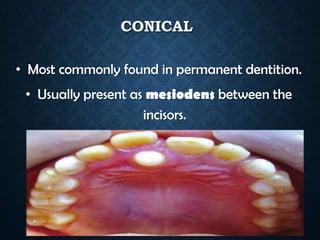
CONICAL
• Most commonly found in permanent dentition.
• Usually present as mesiodens between the
incisors.
TUBERCULATE
• Commonly located on palatal side of
central incisors.
• Possess more than 1 tubercle or cusp.
• Associated with delayed eruption of incisors.
SUPPLEMENTAL
• Duplication of teeth in normal series &
found at the end of a tooth series.
• Most commonly found in permanent
maxillary lateral incisors.
ALTERATIONS IN SIZE OF
TEETH
Alteration in tooth size originate during
the Bell stage or proliferation stage of
tooth development.
MICRODONTIA
• Teeth that are smaller than normal.
• Most commonly affects maxillary lateral
incisors or maxillary third molars.
• Occur in a condition known as pituitary
dwarfism.
• Can cause spacing in primary and
permanent dentition.
MACRODONTIA
• Teeth that are larger than normal
• Hemifacial hypertrophy
• Can cause crowding in primary n
permanent dentition
ALTERATIONS IN
SHAPE OF TEETH
•Abnormalities in shape can originate
during the morphodifferentiation stage
of tooth development and are
manifested as alterations in crown and
root form.
FUSION
GEMINATION
CONCRESCENCE
DENS INVAGINATUS(DENS IN DENTE)
DENS EVAGINATUS
TALON CUSP
TAURODONTISM
DILACERATION
HYPERCEMENTOSIS
FUSION
Union of 2 normally separated tooth germs.
Must involve the dentin.
Cause :some physical force or pressure
produces contact of tooth germs.
Early contact: 2 teeth may be completely
united.
Late contact: union of roots only.
GEMINATION
Incomplete attempt of a tooth germ to
divide into two.
Tooth has two crowns or a large crown
partially separated.
Single (common) root and root canal.
Etiology of this condition is unknown
CONCRESCENCE
Fusion occurring after root formation has
been completed.
Teeth united by their cementum.
Mostly association with the maxillary
second and third molars.
Difficulty in tooth extraction.
DENS INVAGINATUS
Invagination in the surface of tooth crown
before calcification has occurred.
Also called tooth within a tooth.
Can cause development and spread of
dental caries.
Maxillary lateral incisor is the most
frequently affected tooth.
DENS EVAGINATUS
Tubercle or cusp located in the center of
the occlusal surface.
Affect predominantly premolar and molar
teeth.
Tubercle wears off relatively quickly
causing early exposure of the accessory
pulp horn that extends into the tubercle.
TALON CUSP
Accessory cusp located on the lingual
surface of maxillary or mandibular teeth
Pattern resembling an eagle's talon.
Maxillary central or lateral incisor are often
involved
TAURODONTISM
 Crowns of normal size and shape but have large
rectangular bodies.
 Pulp chamber is dramatically increased in its
apico-occlusal heights.
 Apically displaced furcations.
 Short roots and pulp canals.
 Involves molar tooth.
 Seen in association with amelogenesis imperfecta.
 Not recognizable clinically but on a radiograph.
DILACERATION
Abnormal bend in the root of a tooth.
Result of trauma to a developing tooth.
Difficulties during extraction or root canal
therapy.
HYPERCEMENTOSIS
Excessive build-up of cementum around
tooth
Evident on a radiograph
Affects vital teeth
Exact cause not known
Mostly seen in periapical inflammation,
tooth repair and teeth that are not in
occlusion
ALTERATIONS IN STRUCUTRE
OF TEETH
AMELOGENESIS IMPERFECTA
DENTINOGENESIS IMPERFECTA
DENTIN DYSPLASIA
ODONTODYSPLASIA
AMELOGENESIS IMPERFECTA
• Disturbance in enamel development
•Normal dentin & root
•Etiology: alteration of genes involved in the
process of formation & maturation of the
enamel.
•Three general types
• Defects in matrix formation
HYPOPLASTI
C
• Defects of matrix structure
and of mineral deposition.
HYPOCALCIFI
ED
• Alterations in enamel rod
and rod sheath structures.HYPOMATURE
DENTINOGENESIS IMPERFECTA
A hereditary abnormality in the formation of
dentin.
Teeth varies from gray to brownish violet to
yellowish brown color.
Crown fractures easily because of abnormal DEJ.
Pulp chambers and root canals may be partially
or completely obliterated.
Radiographically, the teeth exhibit thin, short
roots.
DENTIN DYSPLASIA
Rare disturbance of dentin formation.
Normal enamel but atypical dentin with
abnormal pulp morphology.
It is subdivided into two types:
TYPE 1
RADICULAR
TYPE 2
CORONAL
TYPE 1 (RADICULAR)
 Normal color & shape in both dentition.
 Exfoliate with little or no trauma.
Short or abnormal roots.
Pulp chambers & canals are usually
obliterated.
20 % of teeth with type I disease have
apical radiolucencies.
TYPE 2 (CORONAL)
Primary dentition appears as in D.I., but
permanent dentition is normal.
 Obliteration of the pulp chamber in
deciduous dentition.
Abnormally large pulp chamber in
permanent dentition.
 Roots are normal in shape & proportion
ODONTODYSPLASIA
• Hypoplastic & hypocalcified dentin & enamel
•central incisors > lateral incisors >canines
(maxillary)
•Delayed eruption.
•Ghostlike appearance in image.
•Marked reduction in amount of dentin.
•Thin enamel , less dense as usual.
Dentl anomaly
Dentl anomaly

Dentl anomaly

  • 1.
    DENTAL ANOMALIES UNDER THEGUIDANCE OF: DR.M.K.JINDAL PRESENTED BY: BUSHRA FARHAN BDS 2010 BATCH
  • 2.
  • 3.
    ALTERATIONS IN NUMBER OFTEETH Alteration in tooth number occur usually during initiation or dental lamina stage of dental development The alteration may produce extra or missing teeth
  • 4.
  • 5.
    ANODONTIA •Congenital absence ofteeth because of failure of development of tooth germs. •Total anodontia is rare. •Partial anodontia (hypodontia) is more common.
  • 7.
    SUPERNUMERARY TEETH  Supernumeraryteeth are additional number of teeth, over and above the usual number for the dentition  Mostly seen in a. Gardner's syndrome, b. Cleidocranial dysostosis syndrome c. Cleft palate (or cleft lip)
  • 8.
  • 9.
    CONICAL • Most commonlyfound in permanent dentition. • Usually present as mesiodens between the incisors.
  • 10.
    TUBERCULATE • Commonly locatedon palatal side of central incisors. • Possess more than 1 tubercle or cusp. • Associated with delayed eruption of incisors.
  • 11.
    SUPPLEMENTAL • Duplication ofteeth in normal series & found at the end of a tooth series. • Most commonly found in permanent maxillary lateral incisors.
  • 12.
    ALTERATIONS IN SIZEOF TEETH Alteration in tooth size originate during the Bell stage or proliferation stage of tooth development.
  • 14.
    MICRODONTIA • Teeth thatare smaller than normal. • Most commonly affects maxillary lateral incisors or maxillary third molars. • Occur in a condition known as pituitary dwarfism. • Can cause spacing in primary and permanent dentition.
  • 16.
    MACRODONTIA • Teeth thatare larger than normal • Hemifacial hypertrophy • Can cause crowding in primary n permanent dentition
  • 17.
    ALTERATIONS IN SHAPE OFTEETH •Abnormalities in shape can originate during the morphodifferentiation stage of tooth development and are manifested as alterations in crown and root form.
  • 18.
    FUSION GEMINATION CONCRESCENCE DENS INVAGINATUS(DENS INDENTE) DENS EVAGINATUS TALON CUSP TAURODONTISM DILACERATION HYPERCEMENTOSIS
  • 19.
    FUSION Union of 2normally separated tooth germs. Must involve the dentin. Cause :some physical force or pressure produces contact of tooth germs. Early contact: 2 teeth may be completely united. Late contact: union of roots only.
  • 21.
    GEMINATION Incomplete attempt ofa tooth germ to divide into two. Tooth has two crowns or a large crown partially separated. Single (common) root and root canal. Etiology of this condition is unknown
  • 24.
    CONCRESCENCE Fusion occurring afterroot formation has been completed. Teeth united by their cementum. Mostly association with the maxillary second and third molars. Difficulty in tooth extraction.
  • 26.
    DENS INVAGINATUS Invagination inthe surface of tooth crown before calcification has occurred. Also called tooth within a tooth. Can cause development and spread of dental caries. Maxillary lateral incisor is the most frequently affected tooth.
  • 28.
    DENS EVAGINATUS Tubercle orcusp located in the center of the occlusal surface. Affect predominantly premolar and molar teeth. Tubercle wears off relatively quickly causing early exposure of the accessory pulp horn that extends into the tubercle.
  • 31.
    TALON CUSP Accessory cusplocated on the lingual surface of maxillary or mandibular teeth Pattern resembling an eagle's talon. Maxillary central or lateral incisor are often involved
  • 33.
    TAURODONTISM  Crowns ofnormal size and shape but have large rectangular bodies.  Pulp chamber is dramatically increased in its apico-occlusal heights.  Apically displaced furcations.  Short roots and pulp canals.  Involves molar tooth.  Seen in association with amelogenesis imperfecta.  Not recognizable clinically but on a radiograph.
  • 35.
    DILACERATION Abnormal bend inthe root of a tooth. Result of trauma to a developing tooth. Difficulties during extraction or root canal therapy.
  • 37.
    HYPERCEMENTOSIS Excessive build-up ofcementum around tooth Evident on a radiograph Affects vital teeth Exact cause not known Mostly seen in periapical inflammation, tooth repair and teeth that are not in occlusion
  • 39.
    ALTERATIONS IN STRUCUTRE OFTEETH AMELOGENESIS IMPERFECTA DENTINOGENESIS IMPERFECTA DENTIN DYSPLASIA ODONTODYSPLASIA
  • 40.
    AMELOGENESIS IMPERFECTA • Disturbancein enamel development •Normal dentin & root •Etiology: alteration of genes involved in the process of formation & maturation of the enamel. •Three general types
  • 42.
    • Defects inmatrix formation HYPOPLASTI C • Defects of matrix structure and of mineral deposition. HYPOCALCIFI ED • Alterations in enamel rod and rod sheath structures.HYPOMATURE
  • 43.
    DENTINOGENESIS IMPERFECTA A hereditaryabnormality in the formation of dentin. Teeth varies from gray to brownish violet to yellowish brown color. Crown fractures easily because of abnormal DEJ. Pulp chambers and root canals may be partially or completely obliterated. Radiographically, the teeth exhibit thin, short roots.
  • 45.
    DENTIN DYSPLASIA Rare disturbanceof dentin formation. Normal enamel but atypical dentin with abnormal pulp morphology. It is subdivided into two types: TYPE 1 RADICULAR TYPE 2 CORONAL
  • 46.
    TYPE 1 (RADICULAR) Normal color & shape in both dentition.  Exfoliate with little or no trauma. Short or abnormal roots. Pulp chambers & canals are usually obliterated. 20 % of teeth with type I disease have apical radiolucencies.
  • 48.
    TYPE 2 (CORONAL) Primarydentition appears as in D.I., but permanent dentition is normal.  Obliteration of the pulp chamber in deciduous dentition. Abnormally large pulp chamber in permanent dentition.  Roots are normal in shape & proportion
  • 50.
    ODONTODYSPLASIA • Hypoplastic &hypocalcified dentin & enamel •central incisors > lateral incisors >canines (maxillary) •Delayed eruption. •Ghostlike appearance in image. •Marked reduction in amount of dentin. •Thin enamel , less dense as usual.