.
Heat transfer from the work piece to the die surfaces causes
thermal gradients in the work piece.
The cooler areas at the die surfaces undergoes less plastic flow
than in the hotter core areas, so that plastic flow is not uniform.
This is termed die chilling.
Die chilling can be reduced by heating the dies nearer to the
actual forging temperature. Die chilling can be eliminated
entirely by heating the dies to essentially the same temperature
as the work piece. The former is called hot die forging; the latter
isothermal forging.
Isothermal forging represents a possible alternative to produce
near net and net shape forgings.
The basic principle of isothermal forging consists of a plastic
forming process during which die and work piece temperatures
are identical or very similar.
The most important resulting advantage is the possibility to
produce forgings with very thin sections.
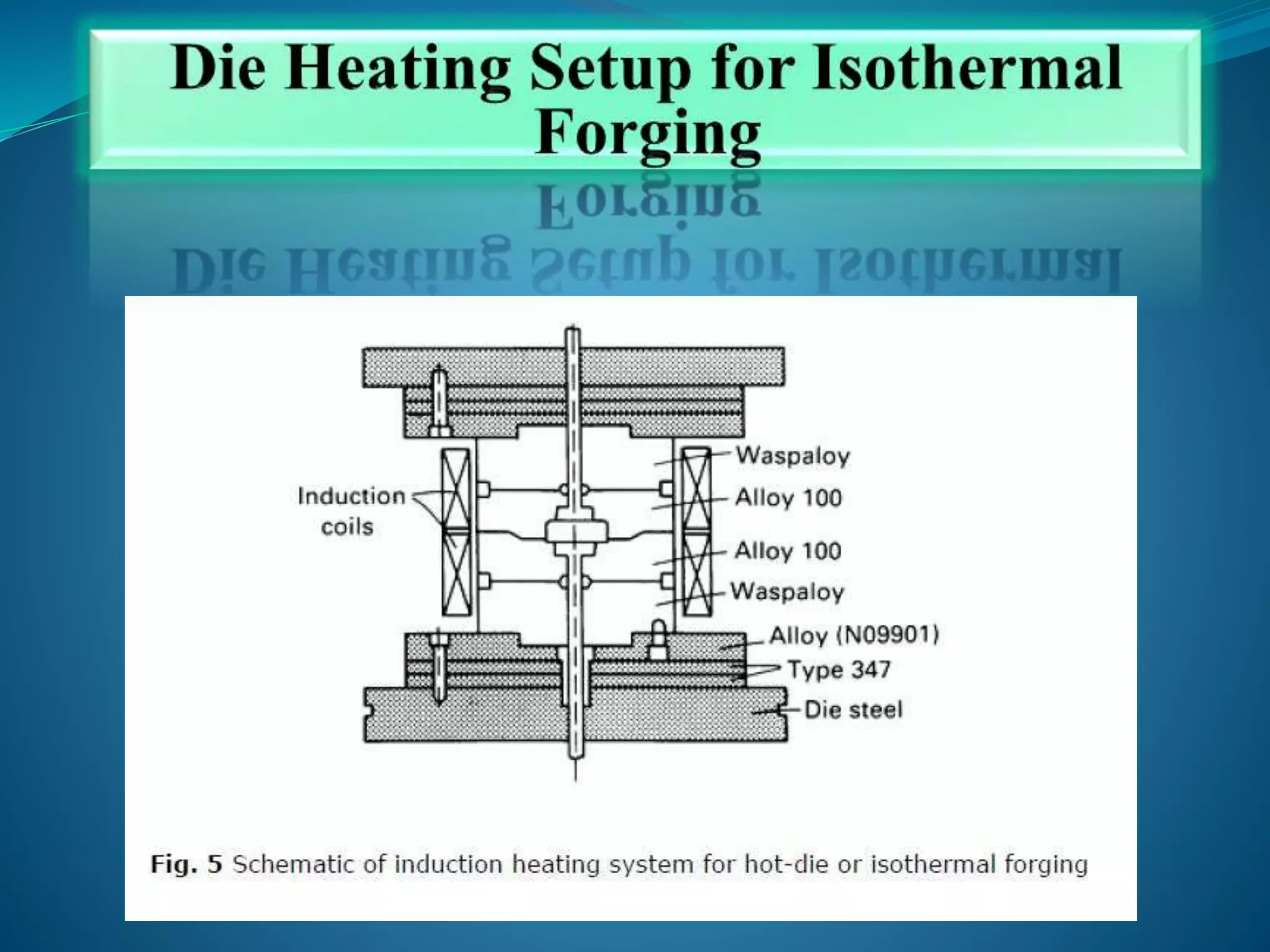
The die temperatures are maintained at these high levels through
continuous heating of the dies during the forge operation. This is
done by using-
induction heating,
gas-fired infrared heating,
resistance heating, and so on.
The heating arrangement is combined with the press so that heat
can be provided to the dies during the forging operation.
Alloys forged using these processes include titanium alloys, such
as
Ti-6Al-4V, Ti-6Al-2Sn-4Zr-2Mo, and
Ti-10V-2Fe-3Al and
super alloys, such as Alloy 100, Alloy 95, Alloy 718 (UNS07718)
Forging parameters –
Forging temperature, strain rate, preform microstructure, forging pressure,
and dwell time are all important factors .
Die Temperature –
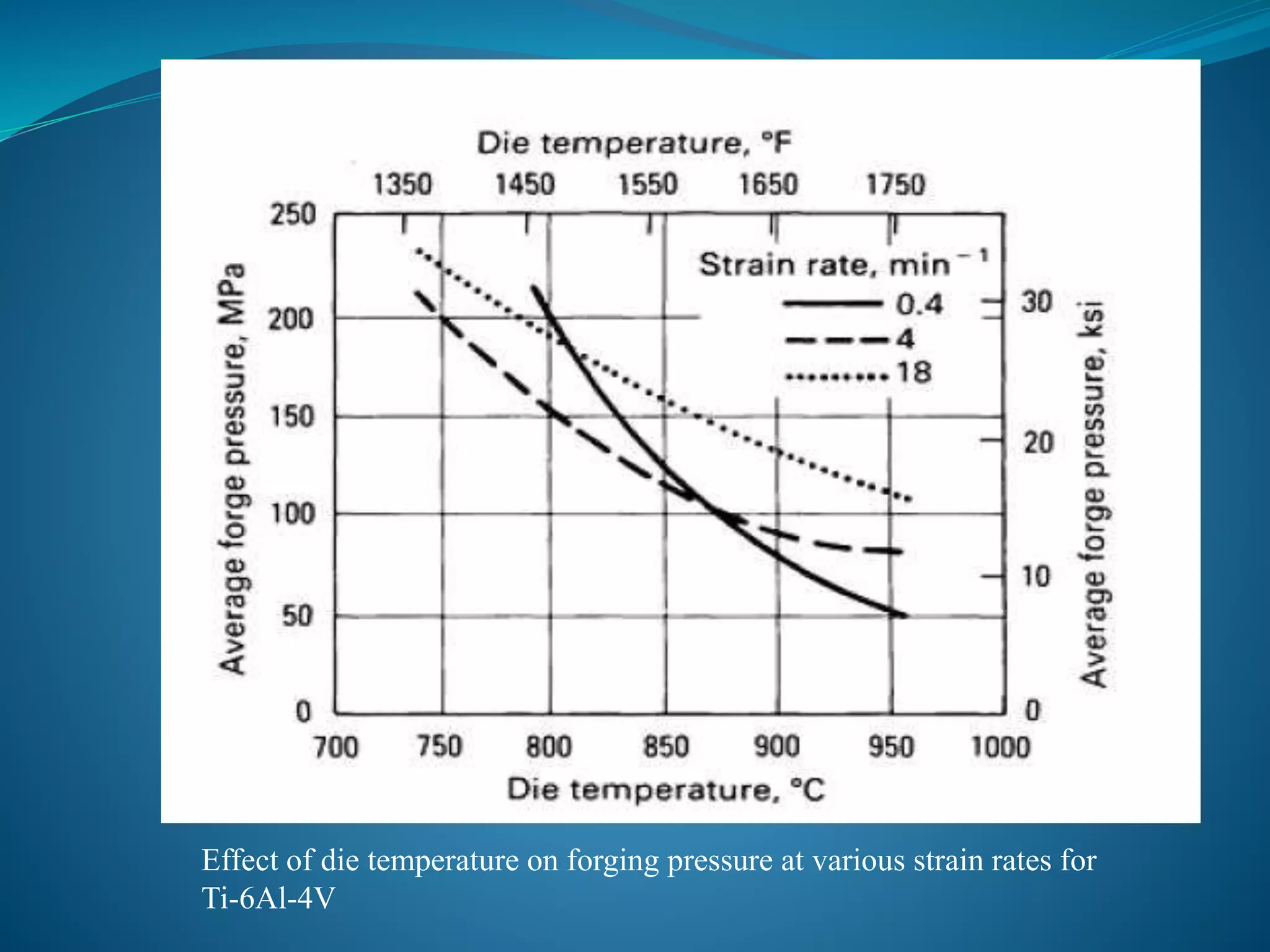
A decrease in die temperature of around 200°C may result in doubling the
forging pressure and may affect the shape capability available.
Effect of die temperature on forging pressure at various strain rates for
Ti-6Al-4V
Lubrication –
The lubrication/coating systems must provide proper lubrication and
must act as a good parting agent for the easy removal of the forging from
the dies.
They also have to protect the forging surface in order to maintain
acceptable surface finish for the forgings and must not build up in the
dies.
For die temperatures to 650 °C (1200 °F), graphite lubricants are
acceptable, but for higher die temperatures, glass frits with proper
additives or boron-nitride coatings find wider use.
Generally die material used for isothermal forging are:-
•Ni base super alloy.
•Mo base super alloy.
The total cost basis of producing a part has a major impact on the
selection of the hot-die or the isothermal forging process for a given part.
The initial cost of these processes is high because of the expensive die
materials, such as TZM and Alloy 100, which can sometimes cost in
excess of ten times the conventional die materials, and because of the
high cost of machining the dies.
The setup cost during forging for these processes may also be higher than
that for conventional forging because of the need for die stack, die
heating and atmospheric chamber.
•Reduced material cost.
•Less machining since it is a near net shape process.
•Product uniformity i.e. same microstructure throughout the cross section.
•Uniform mechanical properties.
•Low draft and fillet radius is required.
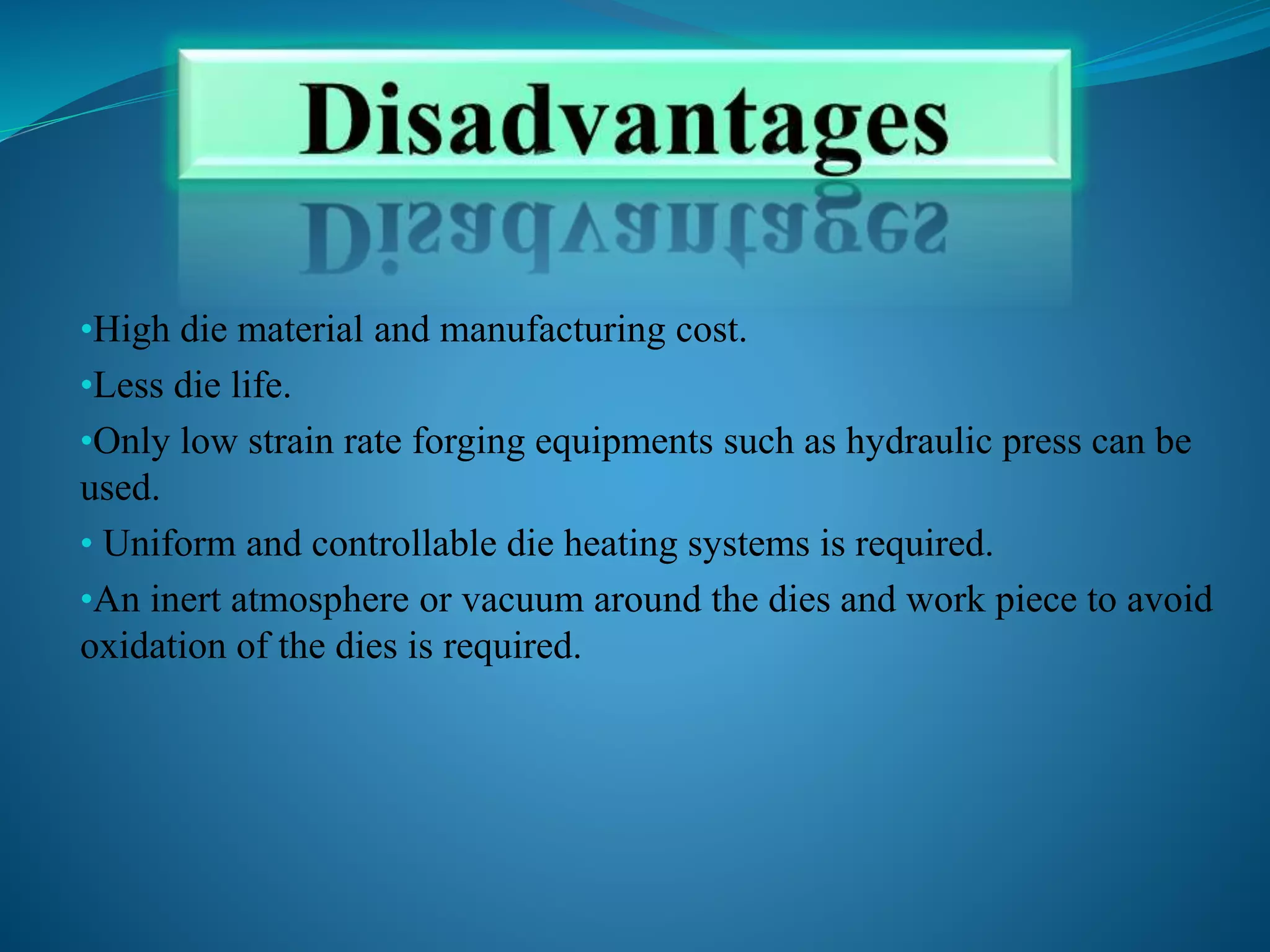
•High die material and manufacturing cost.
•Less die life.
•Only low strain rate forging equipments such as hydraulic press can be
used.
• Uniform and controllable die heating systems is required.
•An inert atmosphere or vacuum around the dies and work piece to avoid
oxidation of the dies is required.
•Automobile industry.
•Medical applications such as medical implants for dental, hip
joints, kidney valves etc.
•Sports equipments.
•Marine applications.
•Aircrafts .
In general Isothermal forging process is very costly, but it is
very suitable for costly material which is difficult to forged
conventionally
In costly material waste of material is very less, so suitable
process to getting near net shape component.
ISOTHERMAL FORGING

ISOTHERMAL FORGING

  • 1.
  • 2.
    Heat transfer fromthe work piece to the die surfaces causes thermal gradients in the work piece. The cooler areas at the die surfaces undergoes less plastic flow than in the hotter core areas, so that plastic flow is not uniform. This is termed die chilling. Die chilling can be reduced by heating the dies nearer to the actual forging temperature. Die chilling can be eliminated entirely by heating the dies to essentially the same temperature as the work piece. The former is called hot die forging; the latter isothermal forging.
  • 3.
    Isothermal forging representsa possible alternative to produce near net and net shape forgings. The basic principle of isothermal forging consists of a plastic forming process during which die and work piece temperatures are identical or very similar. The most important resulting advantage is the possibility to produce forgings with very thin sections.
  • 4.
    The die temperaturesare maintained at these high levels through continuous heating of the dies during the forge operation. This is done by using- induction heating, gas-fired infrared heating, resistance heating, and so on. The heating arrangement is combined with the press so that heat can be provided to the dies during the forging operation.
  • 6.
    Alloys forged usingthese processes include titanium alloys, such as Ti-6Al-4V, Ti-6Al-2Sn-4Zr-2Mo, and Ti-10V-2Fe-3Al and super alloys, such as Alloy 100, Alloy 95, Alloy 718 (UNS07718)
  • 7.
    Forging parameters – Forgingtemperature, strain rate, preform microstructure, forging pressure, and dwell time are all important factors . Die Temperature – A decrease in die temperature of around 200°C may result in doubling the forging pressure and may affect the shape capability available.
  • 8.
    Effect of dietemperature on forging pressure at various strain rates for Ti-6Al-4V
  • 9.
    Lubrication – The lubrication/coatingsystems must provide proper lubrication and must act as a good parting agent for the easy removal of the forging from the dies. They also have to protect the forging surface in order to maintain acceptable surface finish for the forgings and must not build up in the dies. For die temperatures to 650 °C (1200 °F), graphite lubricants are acceptable, but for higher die temperatures, glass frits with proper additives or boron-nitride coatings find wider use.
  • 10.
    Generally die materialused for isothermal forging are:- •Ni base super alloy. •Mo base super alloy.
  • 11.
    The total costbasis of producing a part has a major impact on the selection of the hot-die or the isothermal forging process for a given part. The initial cost of these processes is high because of the expensive die materials, such as TZM and Alloy 100, which can sometimes cost in excess of ten times the conventional die materials, and because of the high cost of machining the dies. The setup cost during forging for these processes may also be higher than that for conventional forging because of the need for die stack, die heating and atmospheric chamber.
  • 12.
    •Reduced material cost. •Lessmachining since it is a near net shape process. •Product uniformity i.e. same microstructure throughout the cross section. •Uniform mechanical properties. •Low draft and fillet radius is required.
  • 13.
    •High die materialand manufacturing cost. •Less die life. •Only low strain rate forging equipments such as hydraulic press can be used. • Uniform and controllable die heating systems is required. •An inert atmosphere or vacuum around the dies and work piece to avoid oxidation of the dies is required.
  • 14.
    •Automobile industry. •Medical applicationssuch as medical implants for dental, hip joints, kidney valves etc. •Sports equipments. •Marine applications. •Aircrafts .
  • 15.
    In general Isothermalforging process is very costly, but it is very suitable for costly material which is difficult to forged conventionally In costly material waste of material is very less, so suitable process to getting near net shape component.