MENTAL HEALTH
SUBJECT MATTER
What is Mental Health?
• How you feel about yourself
• How happy you are
• How much you believe you can overcome challenges in your life
• Whether you feel able to interact with other people
• A mental disorder, also called a mental illness or psychiatric disorder, is a diagnosis,
most often by a psychiatrist, of a behavioural or mental pattern that may cause
suffering or a poor ability to function in life.
• Such features may be persistent relapsing and remitting or occur as a single
episode. Many disorders have been described, with signs and symptoms that vary
widely between specific disorders.
Symptoms
• Most mental health symptoms have traditionally been divided into groups either
‘neurotic’ or ‘psychotic’ symptoms.
• Neurotic = Symptoms which can be regarded as severe forms of common
emotional experiences such as depression, anxiety or panic. Conditions formerly
referred to as ‘neuroses’ are now more frequently called ‘common mental health
problems’
• Less common are ‘psychotic’ symptoms, which interfere with a person’s perception
of reality, and may include hallucinations such as seeing, hearing, smelling or
feeling what no one else can. Mental health problems affect the way you think,
feel and behave.
• ¼ of the population experience some kind of mental health problems in any one
year.
Different types of Mental Health Issues
• Anxiety
• Attention Deficit Hyperactivity Disorder (ADHD)
• Bipolar Disorder
• Depression
• Obsessive Compulsive Disorder (OCD)
• Post – Traumatic Stress Disorder (PTSD)
• Schizophrenia
• Borderline Personality Disorder (BPD)
Anxiety
• Anxiety is a really common emotion. It can make you feel tired, upset, worried,
shaky and light – headed.
• It can also cause panic attacks.
• If you have a panic attack, you get a sudden rush of fear that makes you feel like
your heart is beating really fast.
Attention Deficit Hyperactivity
Disorder (ADHD)
• Someone with ADHD has a lot of energy and might find it hard to concentrate on
something for a long time.
• They also find it difficult to control their behaviour.
• ADHD affects 1 in 100 young people.
• More common in boys than girls.
Swimmer Michael Phelps racked up 14
gold medals at the Athens and Beijing
Olympics. But swimming isn't just a
winning sport for Phelps; it's a way for him
to cope with his ADHD.
Phelps' mom Debbie described her son's
exhibition of classic ADHD symptoms: not
sitting still or being able to focus. However,
he channelled that into swimming, and with
"continuous praise and positive
reinforcement" Phelps had the
encouragement he needed to score the
golds.
Bipolar Disorder
• Bipolar disorder also known as manic depression is an illness which leads to
somebody changing from really hyper or manic to feeling very low and
depressed.
• Affects 1 in 100 people but is rare in young people.
Depression
• Depression affects 80,000 children and young people in the UK.
It can start because of:
• Stress
• Bullying
• Drug problems
• Sexual Abuse
• Death of someone
• Worries about sexuality etc.
Obsessive Compulsive Disorder (OCD)
• OCD leads to people getting anxious.
• Affects 1 in 50 people.
• Can affect someone's everyday life and relationships.
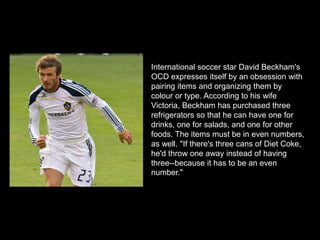
International soccer star David Beckham's
OCD expresses itself by an obsession with
pairing items and organizing them by
colour or type. According to his wife
Victoria, Beckham has purchased three
refrigerators so that he can have one for
drinks, one for salads, and one for other
foods. The items must be in even numbers,
as well. "If there's three cans of Diet Coke,
he'd throw one away instead of having
three--because it has to be an even
number."
Post – Traumatic Stress Disorder
(PTSD)
• It can start when someone experiences a really distressing event.
• Can cause flashbacks, problems sleeping and nightmares.
• Affects 1 in 3 people who have experienced a stressful event.
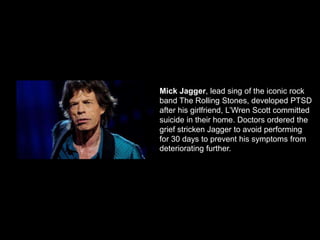
Mick Jagger, lead sing of the iconic rock
band The Rolling Stones, developed PTSD
after his girlfriend, L’Wren Scott committed
suicide in their home. Doctors ordered the
grief stricken Jagger to avoid performing
for 30 days to prevent his symptoms from
deteriorating further.
Schizophrenia
• Schizophrenia makes it hard for people to tell what is real and what is not.
• Does not mean that someone with this disorder is violent.
• to think that schizophrenia means you have two personalities.
• Affect 1% of people.
Alan Alda's Mother had Schizophrenia
"My mother didn't try to stab my father until I was
six," actor and author Alan Alda writes at the
beginning of his autobiography. The child of a well-
known actor, Alda (born Alphonso D'Abruzzo) spent
his early years on the road with a burlesque troupe.
The time spent on the stage wings, watching his
father perform, made a profound impact on the
youngster, igniting a desire to entertain others that
has stayed with him his entire life. Just as profound
was his mother's losing battle with mental illness;
Alda spent much of his adult life attempting to
reconcile his resentment of her outbursts and
unmanageable behavior coupled with her unbridled
enthusiasm for life and encouragement.
Borderline Personality Disorder (BPD)
• Personality disorders are a type of mental health problem where your attitudes,
belief and behaviours cause your longstanding problems in your life.
Symptoms:
• Feel very worried about what people abandoning you, do anything to stop that
happening.
• Very intense emotions.
• Don’t have a strong sense of who you are.
• Find it hard to make and keep stable relationships.
• Act impulsively.
• Suicidal thoughts, or self – harming behaviours.
• Feel empty and lonely
• Struggle to control anger
Causes:
• Difficult childhood or teenage experiences
• Genetic factors
• Personality in general
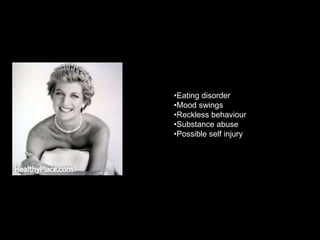
•Eating disorder
•Mood swings
•Reckless behaviour
•Substance abuse
•Possible self injury
Think / Feel Behave as a result
• Lonely
• Overwhelmed by the strength of
emotions
• That they are a bad person
• A child in an adult world
• Changing jobs, hobbies, goals,
ambitions or studies
• Self – harm / attempted suicide
• Keep very busy
• Over spending / Binge eating
Difficult feelings / behaviour towards yourself
Difficult feelings / behaviour towards others
Think / Feel Behave as a result
• Friends / partners will leave you
• No one understands you
• The world is a scary place
• Lashing out when angry
• Struggling to trust people
• Ending relationships with friends or
partners because you think you might
leave you.

Subject matter mental disorders

  • 1.
  • 2.
    What is MentalHealth? • How you feel about yourself • How happy you are • How much you believe you can overcome challenges in your life • Whether you feel able to interact with other people • A mental disorder, also called a mental illness or psychiatric disorder, is a diagnosis, most often by a psychiatrist, of a behavioural or mental pattern that may cause suffering or a poor ability to function in life. • Such features may be persistent relapsing and remitting or occur as a single episode. Many disorders have been described, with signs and symptoms that vary widely between specific disorders.
  • 3.
    Symptoms • Most mentalhealth symptoms have traditionally been divided into groups either ‘neurotic’ or ‘psychotic’ symptoms. • Neurotic = Symptoms which can be regarded as severe forms of common emotional experiences such as depression, anxiety or panic. Conditions formerly referred to as ‘neuroses’ are now more frequently called ‘common mental health problems’ • Less common are ‘psychotic’ symptoms, which interfere with a person’s perception of reality, and may include hallucinations such as seeing, hearing, smelling or feeling what no one else can. Mental health problems affect the way you think, feel and behave. • ¼ of the population experience some kind of mental health problems in any one year.
  • 4.
    Different types ofMental Health Issues • Anxiety • Attention Deficit Hyperactivity Disorder (ADHD) • Bipolar Disorder • Depression • Obsessive Compulsive Disorder (OCD) • Post – Traumatic Stress Disorder (PTSD) • Schizophrenia • Borderline Personality Disorder (BPD)
  • 5.
    Anxiety • Anxiety isa really common emotion. It can make you feel tired, upset, worried, shaky and light – headed. • It can also cause panic attacks. • If you have a panic attack, you get a sudden rush of fear that makes you feel like your heart is beating really fast.
  • 7.
    Attention Deficit Hyperactivity Disorder(ADHD) • Someone with ADHD has a lot of energy and might find it hard to concentrate on something for a long time. • They also find it difficult to control their behaviour. • ADHD affects 1 in 100 young people. • More common in boys than girls.
  • 8.
    Swimmer Michael Phelpsracked up 14 gold medals at the Athens and Beijing Olympics. But swimming isn't just a winning sport for Phelps; it's a way for him to cope with his ADHD. Phelps' mom Debbie described her son's exhibition of classic ADHD symptoms: not sitting still or being able to focus. However, he channelled that into swimming, and with "continuous praise and positive reinforcement" Phelps had the encouragement he needed to score the golds.
  • 9.
    Bipolar Disorder • Bipolardisorder also known as manic depression is an illness which leads to somebody changing from really hyper or manic to feeling very low and depressed. • Affects 1 in 100 people but is rare in young people.
  • 11.
    Depression • Depression affects80,000 children and young people in the UK. It can start because of: • Stress • Bullying • Drug problems • Sexual Abuse • Death of someone • Worries about sexuality etc.
  • 13.
    Obsessive Compulsive Disorder(OCD) • OCD leads to people getting anxious. • Affects 1 in 50 people. • Can affect someone's everyday life and relationships.
  • 14.
    International soccer starDavid Beckham's OCD expresses itself by an obsession with pairing items and organizing them by colour or type. According to his wife Victoria, Beckham has purchased three refrigerators so that he can have one for drinks, one for salads, and one for other foods. The items must be in even numbers, as well. "If there's three cans of Diet Coke, he'd throw one away instead of having three--because it has to be an even number."
  • 15.
    Post – TraumaticStress Disorder (PTSD) • It can start when someone experiences a really distressing event. • Can cause flashbacks, problems sleeping and nightmares. • Affects 1 in 3 people who have experienced a stressful event.
  • 16.
    Mick Jagger, leadsing of the iconic rock band The Rolling Stones, developed PTSD after his girlfriend, L’Wren Scott committed suicide in their home. Doctors ordered the grief stricken Jagger to avoid performing for 30 days to prevent his symptoms from deteriorating further.
  • 17.
    Schizophrenia • Schizophrenia makesit hard for people to tell what is real and what is not. • Does not mean that someone with this disorder is violent. • to think that schizophrenia means you have two personalities. • Affect 1% of people.
  • 18.
    Alan Alda's Motherhad Schizophrenia "My mother didn't try to stab my father until I was six," actor and author Alan Alda writes at the beginning of his autobiography. The child of a well- known actor, Alda (born Alphonso D'Abruzzo) spent his early years on the road with a burlesque troupe. The time spent on the stage wings, watching his father perform, made a profound impact on the youngster, igniting a desire to entertain others that has stayed with him his entire life. Just as profound was his mother's losing battle with mental illness; Alda spent much of his adult life attempting to reconcile his resentment of her outbursts and unmanageable behavior coupled with her unbridled enthusiasm for life and encouragement.
  • 19.
    Borderline Personality Disorder(BPD) • Personality disorders are a type of mental health problem where your attitudes, belief and behaviours cause your longstanding problems in your life. Symptoms: • Feel very worried about what people abandoning you, do anything to stop that happening. • Very intense emotions. • Don’t have a strong sense of who you are. • Find it hard to make and keep stable relationships. • Act impulsively. • Suicidal thoughts, or self – harming behaviours. • Feel empty and lonely • Struggle to control anger Causes: • Difficult childhood or teenage experiences • Genetic factors • Personality in general
  • 20.
    •Eating disorder •Mood swings •Recklessbehaviour •Substance abuse •Possible self injury
  • 21.
    Think / FeelBehave as a result • Lonely • Overwhelmed by the strength of emotions • That they are a bad person • A child in an adult world • Changing jobs, hobbies, goals, ambitions or studies • Self – harm / attempted suicide • Keep very busy • Over spending / Binge eating Difficult feelings / behaviour towards yourself Difficult feelings / behaviour towards others Think / Feel Behave as a result • Friends / partners will leave you • No one understands you • The world is a scary place • Lashing out when angry • Struggling to trust people • Ending relationships with friends or partners because you think you might leave you.