I
RESOURCE SCHEDULING IN CONSTRUCTION PROJECT
USING MSP
By
ID NO: 17CM811: KAPTAN SAGAR R
Dr. Jayeshkumar R. Pitroda
Associate Professor
PG Coordinator
Construction Engineering and Management
Civil Engineering Department
BVM Engineering College
Vallabh Vidyanagar, Gujarat
A Seminar (CM602) Submitted to
Birla Vishvakarma Mahavidyalaya (Engineering College), An Autonomous
Institution affiliated to Gujarat Technological University in Partial Fulfillment of the
Requirements for The Master of Technology (Civil Engineering) Specialization in
Construction Engineering and Management
May, 2019
BIRLA VISHVAKARMA MAHAVIDYALAYA
(ENGINEERING COLLEGE)
AN AUTONOMOUS INSTITUTION
Vallabh Vidyanagar – 388120
GUJARAT, INDIA
II
CERTIFICATE
This is to certify that work embodied in this Seminar (CM602) entitled “Resource Scheduling in
Construction Project Using MSP” was carried out by ID NO: 17CM811: Kaptan Sagar
Rajeshkumar, at Birla Vishvakarma Mahavidyalaya (Engineering College) An Autonomous
Institution for partial fulfillment of Master of Technology (Civil Engineering) with Specialization
in Construction Engineering and Management degree to be awarded by Gujarat
Technological University. This work has been carried out under our supervision meets the
requirement of Gujarat Technological University.
Date:
Place:
(Dr. Jayeshkumar R. Pitroda)
Head, Civil Engineering
(Dr. L. B. Zala)
Principal
(Dr. I. N. Patel)
BIRLA VISHVAKARMA MAHAVIDYALAY
(ENGINEERING COLLEGE)
AN AUTONOMOUS INSTITUTION
Vallabh Vidyanagar – 388120
GUJARAT, INDIA
III
ACKNOWLEDGEMENT
I express sincere and whole hearted thanks to Dr. C. L. Patel, Chairman
C.V.M., Er. V. M. Patel, Hon. Jt. Secretary C.V.M., Prof. (Dr.)I. N. Patel, Principal,
Birla Vishvakarma Mahavidyalaya Engineering College, Vallabh Vidyanagar,
Prof.(Dr.) L. B. Zala, Head and Professor of Civil Engineering Department, Birla
Vishvakarma Mahavidyalaya Engineering College and Dr. Jayeshkumar Pitroda,
Associate Professor, PG Coordinator of M.Tech. Construction Engineering and
Management Department, Birla Vishvakarma Mahavidyalaya Engineering College
(An Autonomous Institution), Vallabh Vidyanagar for providing me an opportunity to
undertake this topic for my study.
I express a deep sense of gratitude to Dr. Jayeshkumar Pitroda, Assosiate
Professor, PG Coordinator of M.Tech. Construction Engineering and Management
Department, Birla Vishvakarma Mahavidyalaya Engineering College, Vallabh
Vidyanagar for his extreme constructive support, constant encouragement, guidance
and challenging my efforts in the right direction.
I would like to thank my family and friends for allowing me to realize my own
potential. All the support they have provided me over the years was the greatest gift
anyone has ever given me.
Kaptan Sagar Rajeshkumar
Enrollment No.: 170080714006
ID No: 17CM811
M.Tech Construction Engineering and Management
IV
TABLE OF CONTENTS
Title Page I
Certificate II
Acknowledgement III
Table of Contents IV
List of Figures VI
Abstract VII
Chapter 1 Introduction 1
1.1 General 2
1.2 Project Management 3
1.3 Importance of Project Management 3
1.4 About Microsoft Project 3
1.5 Advantages of Using Microsoft Project 4
1.6 Disadvantages of Microsoft Project 5
1.7 Objective of study 6
1.8 Need of Study 6
1.9 Organization of the Seminar 6
Chapter 2 Review of Literature 8
2.1 Introduction 9
2.2
Reviews on Papers of Resource Scheduling in
Construction Project Using MSP.
9
2.3 Major Findings of Literature Review 13
Chapter 3 Resource scheduling 14
3.1 General 15
3.2 Benefits of Resource Scheduling 16
Chapter 4 Case Study 18
4.1 Introduction 19
4.2 Project schedule planning tools 20
4.3 Milestone Chart 21
4.4 Task List 21
4.5 Gantt Chart (Bar Chart) 22
4.6 Network Diagram 23
V
Chapter 5 Conclusion and Future Scope 25
5.1 Conclusions 26
References 27
Appendix A List of Abbreviations 30
VI
List of Figures
Figure No. Figure Name Page No.
Figure 4.1 Flowchart of methodology 20
Figure 4.2 Milestone Chart 21
Figure 4.3 Gantt Chart 22
Figure 4.4 Network Diagram 23
VII
RESOURCE SCHEDULING IN CONSTRUCTION PROJECT
USING MSP
Submitted By
KAPTAN SAGAR R.
(170080714006)
Guided By
DR. JAYESHKUMAR R. PITRODA
Assosiatet Professor
Civil Engineering Department
BVM Engineering College
VallabhVidyanagar, Gujarat
ABSTRACT
Every one of us is a manager of projects of our own life. From a house wife to an
employee to financial analyst, from banker to doctor, from engineer to administrator,
from a teacher to a student, we all work on different tasks with deadlines. Regardless
of our occupation, norms, or location in an organization, we all work on tasks that are
eclectic and involve people who do not usually work together. The project may have a
simple goals that does not require many people or a great deal of money or it may be
quite complex, calling for diverse skills and plethora of resources. But the bottom line
is that every one of us manages projects. Owing to this the purpose of dealing with the
project should not be only execution but effective and efficient execution of project is
essential which is needed to be highlighted. Construction Firms in India, Construct the
Projects in a Traditional ways, this sometimes proves Uneconomical & Tedious too.
Traditional way also proves to be Time Consuming and Confusing. The presented
work will provide them an Opportunity to clearly observe the difference between the
Microsoft Project (MSP) and the Traditional Planning Techniques which speeds up
Construction and also make the Project Cost Effective with Proper Planning. For
finding out various aspects that proves efficient planning & execution of the project,
disparate methodologies adopted and to find out remedial measures, international
journal papers were referred. Methodology adopted includes defining of problem
statement, insinuating the objectives from the data collected in two part viz. Primary
data and secondary, analyzing the data and finally coming to the conclusion.
CHAPTER 1: INTRODUCTION
B.V.M. Engineering College / Gujarat Technological University
(An Autonomous Institution) 1
CHAPTER: 1
INTRODUCTION
CHAPTER 1: INTRODUCTION
B.V.M. Engineering College / Gujarat Technological University
(An Autonomous Institution) 2
1.1 General
Project is a onetime activity with defined objectives which has to be finished
in a certain period of time using limited number of resources. The project
management comprises the computation of the early and the late start schedule, slack
times of the activities and the allocation of the available resources over time to the
execution of the activities. The project management techniques such as CPM/PERT
has been widely used for scheduling. CPM provides minimum time required for
completion of project and gives an advanced warning about future problems.
Some variables affect completion of construction projects such as activity
durations, early start time, late start time, early completion time, late completion time
and budget of project. The constraints such as weather, traffic, and the limited
availability of resources such as skilled workers, machines, equipment, etc., cause
increase in duration and cost of project. Therefore, new critical sequences will get
developed and float calculated using CPM techniques will lose its significance.
Schedules that neglect material constraints may affect the control of projects. Thus for
successful completion of project resource scheduling is very important task. Resource
scheduling is the futuristic planning of activities that is limited by the available
resources. Resource scheduling includes resource allocation to various activities and
resource leveling. Resource leveling is a technique which is used to analyze
unbalanced use of resources (usually people or equipment) over time, and resolves
over-allocations or conflicts among different resources.
In large scale project preparing accurate and workable schedules with
consideration of resources is very difficult task, for this use of project management
software’s like MSP, Primavera can be advantageous. Resource conflict or over
allocation can be resolved in Microsoft Project 2013 by delaying activities, splitting
certain task or updating task automatically. When project levels resources,
assignments are distributed and rescheduled.
CHAPTER 1: INTRODUCTION
B.V.M. Engineering College / Gujarat Technological University
(An Autonomous Institution) 3
1.2 Project Management
Project Management is the Application of knowledge, skills and Techniques to
project activities to meet project requirements. It is a strategic ability to do something
successfully for organizations, enabling them to patch the project results to
Organizational goals and thus, better compete in their markets. It can be also defined
as the process and activity of planning, organizing, inspiring, and controlling
resources, procedures and protocols to achieve specific goals in scientific or daily
problems. A project is a temporary aim designed to produce a special product, service
or result with a defined starting and end (usually time-constrained, and often
constrained by funding or deliverables), undertaken to meet eccentric goals and
objectives, typically to bring about beneficial change or added value. The temporary
nature of projects stands in contrast with business as usual (or operations), which are
recurring, permanent, or semi-permanent functional activities to produce products or
services. In implementation, the management of these two systems is often quite
distinct, and as such requires the development of divergent technical skills and
management strategies. It has always been practiced casually, but began to evolve as a
prime profession in the mid-20th century.
1.3 Importance of Project Management
Project gets started at the right way but as it proceeds further, gets off the track.
Owing to this it’s important to manage the activities in the right way, thus project
management plays a vital role in arranging the critical activities of the project which
is called as task to function in the appropriate way. Project Management aid the
project in better efficiency to deliver services.
1.4 About Microsoft Project
Microsoft Project is a project management software program developed and sold by
Microsoft, which is designed to assist a project manager in developing a plan,
assigning resources to tasks, tracking progress, managing the budget, and analyzing
workloads. Project creates budgets based on assignment work and resource cost. As
resources are assigned to the task and the program calculates the cost equal to the
CHAPTER 1: INTRODUCTION
B.V.M. Engineering College / Gujarat Technological University
(An Autonomous Institution) 4
work times the rate, which rolls up to the task level and then to any summary tasks
level and finally to the project level. Resource definitions (Labour, equipment and
materials) can be shared between projects using a shared resource pond. Each
resource can have its individual calendar, which defines what days and time is
resource present. Resource rates are used to calculate resource assignment costs. Each
resource can be assigned to multiple tasks in multiple projects and each task can be
assigned numerous resources. The execution of the scheduled task work based on the
resource availability as defined in the resource calendars. All resources can be defined
in Work, Material and Cost. Therefore it cannot estimate how many finished products
can be obtained with a given amount of raw materials. This makes Microsoft Project
unsuitable for solving problems of available materials constrained production.
1.5 Advantages of Using Microsoft Project
 Maturity: Microsoft Project is a very mature Project Management tool. MS
Project was first released in 1984 and over the next 26 years, Microsoft has
listened to the increasing number of Project Managers adopting this tool, and
added/enhanced a lot of features that are now vital for managing projects.
Almost any chart the Project Manager can think of is now available in MS
Project. (At the time of writing this article, the current version is MS Project
2007).
 Support and Reliability: Contrary to the myriad of the other Project
Management tools available on the market, Microsoft Project is developed by
the largest and most reputable software company in the world, which offers
reliable support of this product. Additionally, the success of MS Project has
spurred the growth of third party support and training services offered for this
product.
 Easy Integration with other Microsoft Products: MS Project offers
integration with other MS Products that are highly popular, such as MS Word,
MS Excel, and MS Outlook.
 Desktop Application: MS Project is a desktop application, which means the
Project Manager can work on the project schedule even if there is no Internet
connection.
CHAPTER 1: INTRODUCTION
B.V.M. Engineering College / Gujarat Technological University
(An Autonomous Institution) 5
1.6 Disadvantages of Microsoft Project
 Steep Learning Curve: MS Project is software that needs some considerable
training and experience to get knows how to use it. This is a significant
setback for the product as there are lots of Project Managers out there who are
not technical, and may experience a hard time trying to learn MS Project.
 Generic Focus: MS Project does not focus on any particular industry (though
some say it’s slightly more inclined to Software Project Management), this
results in Project Managers using a tool that is not tailored to their needs.
 No collaboration: This is a major drawback in MS Project because of the
importance of communication in Project Management. Online collaboration
nowadays is indispensable for easy and accessible updates by the team
members/the Project Manager/the stakeholders on the project. The complete
absence of real collaboration in MS Project makes it outdated by the standards
of today’s connected world. To make things worse, MS Project does not even
offer integration with third party collaboration tools, which leaves Project
Managers with no choice then to use a separate collaboration platform to ease
the communication flow on the project. This adds an unecessary overhead to
the workload of the Project Manager.
 Desktop, Offline Application: Although this one was mentioned as an
advantage, it is also a huge disadvantage. Using a desktop application means
that the project data file (usually the one with the .mpp extension) is stored
locally. This leaves the ever-busy Project Manager with the responsibility of
backing up this file always (not doing so may risk losing all the project plan in
the blink of an eye in case the Project Manager’s PC fails). Additionally, quite
often multiple people (e.g. the Project Manager, some team members, and
some stakeholders) will have different copies of the MS Project file which are
not in sync, leading to inconsistency issues (MS Excel has also the same issue
when used as a Project Management tool). The Project Manager will be forced
to email the project file to everyone involved every time a change is made.
 Compatibility Issues: MS Project files are saved in a proprietary format,
meaning they won’t run on any other PC unless that PC has also (usually the
same or a later version of) MS Project installed. This makes the life of the
Project Manager harder as he has to make sure that everyone (including the
CHAPTER 1: INTRODUCTION
B.V.M. Engineering College / Gujarat Technological University
(An Autonomous Institution) 6
stakeholders, the client, and the team members) receiving a copy of the .mpp
has to have MS Project installed on his PC. An alternative way is to send the
Project Plan as an image or a pdf file, but of course, both of these options are
not as good as sending the real project plan.
1.7 Objectives of the Study
This research project focuses on Resource Scheduling in Construction Project Using
MSP. The main objectives of this study are:
1. To determine exactly what resources the project requires, and make these
resources available for when they are needed.
2. To utilize the available resources effectively.
3. To develop resource scheduling using Microsoft Project 2013
4. To reduce the cost of the project.
5. To minimize the duration of the project.
1.8 Need of Study
Construct the project in traditional way, sometimes proves uneconomical &
Tedious too. Traditional ways sometimes also proves to be time consuming and
confusing. Microsoft project speeds up the construction and also make the project cost
effective.
1.9 Organization of the Thesis
This study consists of five chapters as follows:
Chapter Two: Review of Literature
This chapter covers the literature review as a part of the thesis. It includes the
detailed literature review carried out on Resource Scheduling in Construction Project
Using MSP.
Chapter Three: Resource Scheduling
This chapter contains information about the resource scheduling in
construction and its benefits.
CHAPTER 1: INTRODUCTION
B.V.M. Engineering College / Gujarat Technological University
(An Autonomous Institution) 7
Chapter Four: Case Study
This chapter includes case study on Resource Scheduling in Construction
Project Using MSP.
Chapter Five: Conclusions and Future Scope
This chapter states various conclusions and future scope from the conducted
research.
CHAPTER 2: REVIEW OF LITERATURE
B.V.M. Engineering College / Gujarat Technological University
(An Autonomous Institution) 8
CHAPTER: 2
REVIEW
OF
LITERATURE
CHAPTER 2: REVIEW OF LITERATURE
B.V.M. Engineering College / Gujarat Technological University
(An Autonomous Institution) 9
2.1 Introduction:
This chapter documents existing literature on Resource Scheduling in
Construction Project Using MSP. Literature published in various national,
international and other online and local journals; national, international and other
conferences; various reports; master and Ph.D. dissertations; books; the various
standards published by various authorities; etc. have been studied and their small
important contents have been stated here.
The literature review is Resource Scheduling in Construction Project Using
MSP related papers. Then, major findings have been stated, describing the most
important findings of this literature review stating use of MSP in construction project
for resource scheduling. This chapter therefore provides an extensive background to
enhance understanding of the subject by looking at it in context and in content as well
as put the entire research in an appropriate theoretical context.
2.2 Reviews on Papers of Resource Scheduling in Construction Project Using
MSP.
Following are the critical literature reviews on the papers of Resource
Scheduling in Construction Project Using MSP.
Maruthi S (2015) carried out studies in two phases at first phase the project schedule
and resource allocated done using MSP software and at second phase, optimization
has been carried out by modifying the man power requirement for various tasks to
remove any sudden variations in demand of manpower. And concluded manpower
resource has been optimized by modifying the particular activities duration and by
modifying predecessors without affecting the project duration. [1]
Rhuta Joshi et al. (2015) analyzed man power resource constrained project using
Microsoft Project 2013 by resource leveling and compares the time cost in residential
building. It helps to resolve resource conflicts and also useful in minimizing the
project duration within limited availability of resources to make the project profitable.
they concluded that without proper resource scheduling the project gets delayed and
they can be leveled to reduce project duration and cost. [4]
CHAPTER 2: REVIEW OF LITERATURE
B.V.M. Engineering College / Gujarat Technological University
(An Autonomous Institution) 10
B.S.K. Reddy et al. (2015) done resource optimization exercises on two on-going
projects in Dubai, UAE. they individually leveled and then combined option with
aggregated and then levelled clearly indicates reduction in demand of resources by
5.65% in later option, which could be best considered for economy . they concluded
Resource levelling at project job site and forwarding demand leads a possible sharing
of resources among projects. Ismail Abdul Rahman identified commonly used
techniques and software of time management together with their effectiveness level in
large construction projects. Data was collected from the construction organization that
deals with huge projects. Relative Importance Index calculation was employed to
assess the level of effectiveness for time management techniques and software
adopted in the construction project. Minh Shrestha, hinted that the main function of a
software is help, and develop the quality of output with less effort than manual ways.
A project has disparate requirements and the aim of the adopted software is to fulfill
those requirements effectively in terms of time and cost. In addition, the issues of
scheduling, tracking and physical element must be considered while adopting the
project management software. [12]
Abhishek Sharma et al. (2015) Many project suffers time and cost overruns due to
improper planning, scheduling and completing works that results in numerous issues
like delay in providing facilities, development, cutback in quality of construction and
making the project more expensive. A little consideration shows that the time required
to complete the project is inversely comparative to the supply of manpower. As the
manpower is increased, the completion time of the project is decreased and on the
other hand if the manpower is decreased, the completion time of the project is
increased. A comparison between the baseline duration and cost to actual duration and
cost of manpower of project is also determined using project management software
tool Microsoft Project. The schedule report is examined and causes for delay are
analyzed. This delay is due to inadequate manpower, contractor not starting the
multitasking activities at site, shortage of shuttering material and the work executed
by the activity in haphazard manner at site. [6]
CHAPTER 2: REVIEW OF LITERATURE
B.V.M. Engineering College / Gujarat Technological University
(An Autonomous Institution) 11
P M Walel et al. (2015) studied the skills and techniques to project activities to meet
project requirements. It is a planned ability to do something successfully for
organizations, enabling them to patch the project results to Organizational goals and
thus, superior battle in their markets. the process and activity of planning, organizing
exciting and controlling resources, procedures and protocols to achieve complete
goals in scientific or daily problems. that help to overcome the problems faced
outstanding to traditional way of Planning and Management. It helps for the optimum
and effective organization of activities which helps to give the vision to complete the
project in planned duration and within the market. [3]
E. Suresh kumar et al. (2015) studied scheduling using MSP Software is a
development which involves estimation, sequencing the activities, resources
allocation and timing. The construction scheduling is to complete the project in time
and equal the resources with the allocated time. EV Analysis is a standard method of
measuring a project’s progress at any given point of time, forecasting its completion
date, final cost and analysis difference in the schedule and budget of the project.
Scheduling using MSP Software gives good controlling. [2]
Raj saran et al. (2015) analyzed planning and scheduling is very significant in
construction projects because of the increasing complexities in this field. Construction
Planning is the necessary predecessor to Scheduling and includes major work tasks,
determining universal series, construction methods and conveying tasks. Improper
planning can lead to most important delays in the project work. Projects nowadays
huge amount of paperwork, which makes the management very bulky. These
problems can be solved using a project planning software which helps to give a
structured move toward to planning. In this study, a case of a two storey research lab
has been taken to demonstrate how proper planning and scheduling is done using
Primavera software. [5]
Umesh Y Polekar et al. (2015) analyzed proper planning and scheduling is very
essential in construction projects for sinking and scheming delays of the project.
Extensive amounts of time, money, resources are wasted each year in a construction
industry due to improper planning and scheduling. With globalization the construction
CHAPTER 2: REVIEW OF LITERATURE
B.V.M. Engineering College / Gujarat Technological University
(An Autonomous Institution) 12
projects have become infinite and complex. Planning of such projects requires huge
amount of paperwork, which can be reduced with the help of project planning
software. These study are to plan, schedule, and track a residential project with help
of primavera software, study the results generated, it is possible to propose which
method is suitable for the chosen residential project. [9]
Veena H.C et al. (2015) analyzed resource management is one of the most vital
aspects of construction project management in today’s economy since the
construction industry is resource exhaustive and the costs of construction resources
have gradually, risen over the last several decades. These techniques help to reduce
project duration use of unlimited availability of resources for completion of a project.
Through it is observed that resources are limited in real project situation. It has been
observed that the project delays occur due to inadequate supply of resources. In large
scale projects, preparing a correct and workable plan is very difficult. Project
management software like MS Project and Primavera project planner are used in
construction industry. The main aim of this study is to analyze the schedule control
techniques by constraints and activity types is done using primavera software for an
apartment building. [10]
J. Jayalakshmi (2014) compared time performance of the conventional method of
construction for high- rise residential and Industrial Building System (IBS) method by
overall construction period. The scheduling was developed using Primavera project
planning software. The positive changes include creating a healthy working
environment among those involved directly in the construction industry. The major
players in the are architects, engineers, town planner, developer, contractor and the
supplier or manufacturer have to play their roles in enhancing their working system,
management and administration to enable the modernization in the industry. [11]
Sushant pradhan et al. (2014) Every construction industry expression a stiff struggle
in every section of project, be it technique, equipment, methodology or management.
The goals are been created and the level is getting higher. Construction Industries
involve themselves in frequent projects and also aim for higher yield as financial
benefit is the ground certainty. The task becomes tougher when one indulges to
CHAPTER 2: REVIEW OF LITERATURE
B.V.M. Engineering College / Gujarat Technological University
(An Autonomous Institution) 13
maintain customer satisfaction i.e. quality and duration at the same time. Rarely have
the companies failed to attend the assure. Companies in the past have faced a lot of
problems particularly when it comes to multiple projects. The data are stuffed, the
cost has been overrun, the duration is extended and the resources have been over-
allocated. Thus, resulting in inappropriate project management. [8]
T. Subramani et al. (2014) compared time performance of the conventional method
of construction for high- rise residential and Industrial Building System method by
originate level measures of industry norms for overall construction period using
scheduling simulation modeling. The positive changes include creating a healthy
working environment among those involved directly in the construction industry..
Improved Customer Satisfaction Whenever you get a project done on time and under
budget, the client walks away happy. And a happy client is one you’ll see over. Smart
project management provides the tools that enable this client/manager bond to
continue. Services The same strategies that allowed you to successfully complete one
project will serve you many times over and also reduced risk and cost of schedule
swamped. It helps easily plan and manage project activities, It optimizes management
of all resources, It gives clear visibility of what’s going on in the project, It allows
quick and easy forecasting of WBS’s, activities or projects. [7]
Castor (2008) in his studies he compares software’s MSP, primavera and open
workbench for resource leveling in two real time project as a case study and the result
shows primavera gives most theoretically unlimited number of criteria as priority
rules and he suggest project management software’s to incorporate more efficient
methods for resource constraints. [14]
2.3 Major Findings from the Literature Review
1. It helps to resolve resource conflicts.
2. It is also useful in minimizing the project duration within limited
availability of resources to make the project profitable.
3. Without proper resource scheduling the project gets delayed
4. The use of modern techniques in projects leads to on time completion of the
project.
CHAPTER 3: RESOURCE SCHEDULING
B.V.M. Engineering College / Gujarat Technological University
(An Autonomous Institution) 14
CHAPTER: 3
RESOURCE
SCHEDULING
CHAPTER 3: RESOURCE SCHEDULING
B.V.M. Engineering College / Gujarat Technological University
(An Autonomous Institution) 15
3.1 Resource scheduling
Resource scheduling is a collection of techniques used to analyze the resources
required to deliver the work and when they will be required. The goals of resource
scheduling are to ensure:
 efficient and effective utilization;
 confidence that the schedule is realistic;
 Early identification of resource capacity bottlenecks and conflicts.
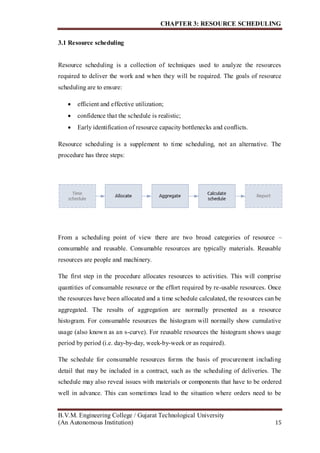
Resource scheduling is a supplement to time scheduling, not an alternative. The
procedure has three steps:
From a scheduling point of view there are two broad categories of resource –
consumable and reusable. Consumable resources are typically materials. Reusable
resources are people and machinery.
The first step in the procedure allocates resources to activities. This will comprise
quantities of consumable resource or the effort required by re-usable resources. Once
the resources have been allocated and a time schedule calculated, the resources can be
aggregated. The results of aggregation are normally presented as a resource
histogram. For consumable resources the histogram will normally show cumulative
usage (also known as an s-curve). For reusable resources the histogram shows usage
period by period (i.e. day-by-day, week-by-week or as required).
The schedule for consumable resources forms the basis of procurement including
detail that may be included in a contract, such as the scheduling of deliveries. The
schedule may also reveal issues with materials or components that have to be ordered
well in advance. This can sometimes lead to the situation where orders need to be
CHAPTER 3: RESOURCE SCHEDULING
B.V.M. Engineering College / Gujarat Technological University
(An Autonomous Institution) 16
placed before the work is fully authorized (see the ‘pre-authorization work’ activity in
the definition process).
Reusable resources are rarely, if ever, limitless and the schedule needs to be reviewed
to take all limitations into account. There are two approaches to resource limited
scheduling that reconciles resource limits and time constraints: resource smoothing
(or time limited resource scheduling) and resource leveling (or resource limited
scheduling).
Resource smoothing reschedules activities while retaining the finish date calculated
by critical path analysis. This results in a resource histogram where the peaks and
troughs are ‘smoothed out’ but not eliminated. A smoothed schedule is useful where it
is possible and practical to procure additional resources for periods of time.
Resource leveling ensures that resource demand never exceeds availability. This
usually results in an increase in the time taken to complete the work and is more
appropriate when there are strict limits on the available resources.
3.2 Benefits of Resource Scheduling
Resource scheduling can help a manager and their higher-ups determine whether a
project is feasible under the planned conditions, timeframe, or budget. If a project
can’t be done under given conditions, a particular schedule, or for a particular price
point, then a project manager must get creative or persuade upper management to
loosen its purse strings or extend the calendar for a project to reach completion. Here
are some of the benefits of resource scheduling.
 Provides Data about Utilization, Hiring, Job and Role Descriptions:
Companies spend many hours articulating job descriptions and then recruiting
the right talent for necessary roles. Project management data can help gather
vital information that informs hiring and how employees spend their time.
 Allows Project Management to Drive Business Information Trends:
Project management provides key information about the time and budget
required for a business to do its work.
CHAPTER 3: RESOURCE SCHEDULING
B.V.M. Engineering College / Gujarat Technological University
(An Autonomous Institution) 17
 Allows for Projects to Start Faster and with More Confidence: Companies
with competent project management infrastructure and a history of project
management protocols can make better assumptions about their odds of
success given past experience.
 Allows for Accurate Staffing Modeling: Seeing how many hours different
resources spend on different types of projects gives recruiters and managers a
clear picture of how staff spend their time.
 Better Planning Means Better Employee Morale: Resource scheduling that
is realistic and carefully executed keeps employees busy and challenged but in
an environment where, despite some pressure, they’re more likely to thrive
than experience stress. Resource scheduling turns the risk inherent in any
project into a more calculated risk with better odds.
 Improved Forecasting: Past planning leads future forecasting. As project
managers cycle on and off of teams, an archived or cloud-based resource
scheduling mechanism makes past project successes repeatable and
sustainable.
 Resource Scheduling Is Heavily Correlated to Budgeting: Whether
managing a budget or not, resource scheduling lets project managers
determine with great specificity what resources are necessary when and for
how long. In an environment where a subcontractor is hired to contribute to a
project or billable hours are involved, specific predetermination of hours is
important to still come in on budget.
 Determines Feasibility of Projects: Every business has project ideas, but
they’re not all feasible. If resources are unavailable or too preoccupied with
higher-priority projects, that’s a sign that a new project doesn’t have legs or
that outside resources may be required to pull it off.
 Maximizes Productivity: Resource scheduling can create a precise depiction
of how employees and contractors spend time on a project, and it can also
show variations in productivity between different resources.
CHAPTER 3: CASE STUDY
B.V.M. Engineering College / Gujarat Technological University (An Autonomous
Institution) 18
CHAPTER: 4
CASE STUDY
CHAPTER 3: CASE STUDY
B.V.M. Engineering College / Gujarat Technological University (An Autonomous
Institution) 19
4.1 Case Study:
A) IVRCL PVT LTD, PUNE
Company executed the works of building like residential and commercial complex in
Pune. IVRCL is an organization formed with the aim of handling large Civil
Engineering. Projects with quality construction and time bound completion of work.
IVRCL is trusted for quality and is acknowledged for an unshakable commitment to
excellence in every aspect of construction.
B) Intellectual Building System PVT. LTD
IBuild is committed to redefine the construction industry in India. They work with a
singular aim to help construction companies grow faster in terms of efficiency, quality
and business expanse. Build’s Precast systems are ideal for repeatable, cellular
structures like large hotels, residential apartments, low-cost housing structures, tiny
industrial parks etc. The systems simplify design, are quick to erect and easy to finish.
iBuild endeavors to liberate construction companies from the limitations of
conventional methodology to propagate a sustainable transformation. Company
provides variety of products like hollow core slabs, restricted column and beams,
precast staircase and landings and accessory elements.
COMPANY A (For questionnaire survey)
1) Why specifically you chose conventional method over prefabrication for
construction?
2) What is the slab cycle duration at your site?
3) What is the labour requirement at your site and extent of dependability on labour?
4) Any Special type of Formwork is used at your site?
5) What type of wall masonry is used at your site?
COMPANY B (For questionnaire survey)
1) What are the benefits of Prefabrication over conventional method of construction?
2) What is the economical reach of prefabricated components considering the
transportation cost?
3) What is the minimum slab cycle that can be achieved using prefab method?
CHAPTER 3: CASE STUDY
B.V.M. Engineering College / Gujarat Technological University (An Autonomous
Institution) 20
4) Why prefabrication is not adopted in small projects?
5) What is the labour requirement for prefabrication method of construction?
6) What is the labour requirement for prefabrication method of construction?
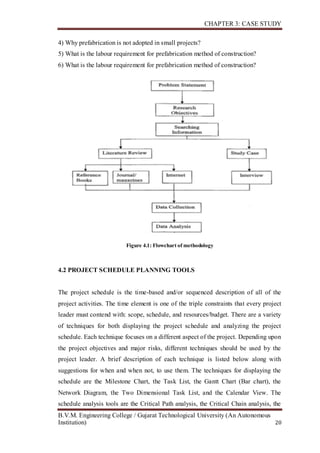
Figure 4.1: Flowchart of methodology
4.2 PROJECT SCHEDULE PLANNING TOOLS
The project schedule is the time-based and/or sequenced description of all of the
project activities. The time element is one of the triple constraints that every project
leader must contend with: scope, schedule, and resources/budget. There are a variety
of techniques for both displaying the project schedule and analyzing the project
schedule. Each technique focuses on a different aspect of the project. Depending upon
the project objectives and major risks, different techniques should be used by the
project leader. A brief description of each technique is listed below along with
suggestions for when and when not, to use them. The techniques for displaying the
schedule are the Milestone Chart, the Task List, the Gantt Chart (Bar chart), the
Network Diagram, the Two Dimensional Task List, and the Calendar View. The
schedule analysis tools are the Critical Path analysis, the Critical Chain analysis, the
CHAPTER 3: CASE STUDY
B.V.M. Engineering College / Gujarat Technological University (An Autonomous
Institution) 21
PERT analysis, the Resource Leveling analysis, and a variety of Schedule
Acceleration Techniques.
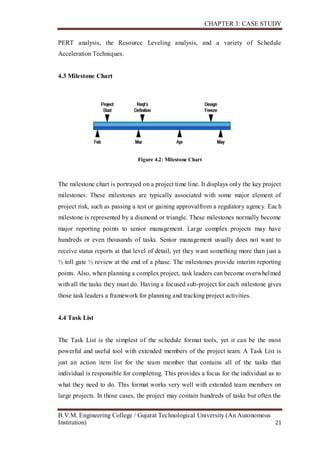
4.3 Milestone Chart
Figure 4.2: Milestone Chart
The milestone chart is portrayed on a project time line. It displays only the key project
milestones. These milestones are typically associated with some major element of
project risk, such as passing a test or gaining approvalfrom a regulatory agency. Each
milestone is represented by a diamond or triangle. These milestones normally become
major reporting points to senior management. Large complex projects may have
hundreds or even thousands of tasks. Senior management usually does not want to
receive status reports at that level of detail, yet they want something more than just a
½ toll gate ½ review at the end of a phase. The milestones provide interim reporting
points. Also, when planning a complex project, task leaders can become overwhelmed
with all the tasks they must do. Having a focused sub-project for each milestone gives
those task leaders a framework for planning and tracking project activities.
4.4 Task List
The Task List is the simplest of the schedule format tools, yet it can be the most
powerful and useful tool with extended members of the project team. A Task List is
just an action item list for the team member that contains all of the tasks that
individual is responsible for completing. This provides a focus for the individual as to
what they need to do. This format works very well with extended team members on
large projects. In those cases, the project may contain hundreds of tasks but often the
CHAPTER 3: CASE STUDY
B.V.M. Engineering College / Gujarat Technological University (An Autonomous
Institution) 22
extended team member is only involved in a small number of those tasks. The
extended team member can review their task list and understand what they must do on
the project without going through the hundreds of tasks, searching for those requiring
their effort. If the team has many extended team members with limited involvement in
the total project, this technique usually is the best method for communicating and
tracking scheduling of the work from those extended team members.
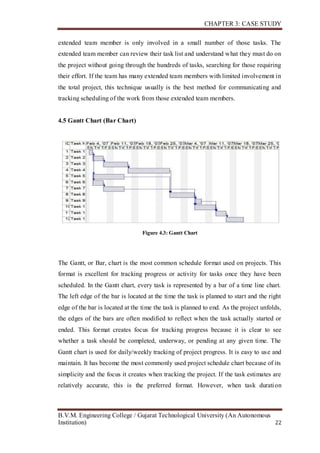
4.5 Gantt Chart (Bar Chart)
Figure 4.3: Gantt Chart
The Gantt, or Bar, chart is the most common schedule format used on projects. This
format is excellent for tracking progress or activity for tasks once they have been
scheduled. In the Gantt chart, every task is represented by a bar of a time line chart.
The left edge of the bar is located at the time the task is planned to start and the right
edge of the bar is located at the time the task is planned to end. As the project unfolds,
the edges of the bars are often modified to reflect when the task actually started or
ended. This format creates focus for tracking progress because it is clear to see
whether a task should be completed, underway, or pending at any given time. The
Gantt chart is used for daily/weekly tracking of project progress. It is easy to use and
maintain. It has become the most commonly used project schedule chart because of its
simplicity and the focus it creates when tracking the project. If the task estimates are
relatively accurate, this is the preferred format. However, when task duration
CHAPTER 3: CASE STUDY
B.V.M. Engineering College / Gujarat Technological University (An Autonomous
Institution) 23
estimates are not accurate - either due to uncertainty in the amount of work or
uncertainty in the resource availability.
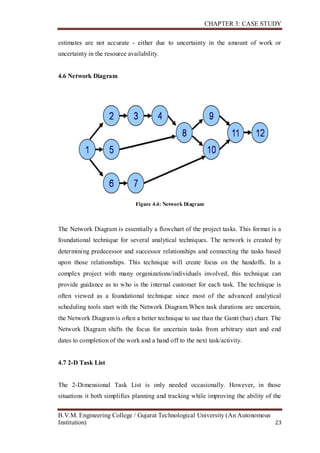
4.6 Network Diagram
Figure 4.4: Network Diagram
The Network Diagram is essentially a flowchart of the project tasks. This format is a
foundational technique for several analytical techniques. The network is created by
determining predecessor and successor relationships and connecting the tasks based
upon those relationships. This technique will create focus on the handoffs. In a
complex project with many organizations/individuals involved, this technique can
provide guidance as to who is the internal customer for each task. The technique is
often viewed as a foundational technique since most of the advanced analytical
scheduling tools start with the Network Diagram.When task durations are uncertain,
the Network Diagram is often a better technique to use than the Gantt (bar) chart. The
Network Diagram shifts the focus for uncertain tasks from arbitrary start and end
dates to completion of the work and a hand off to the next task/activity.
4.7 2-D Task List
The 2-Dimensional Task List is only needed occasionally. However, in those
situations it both simplifies planning and tracking while improving the ability of the
CHAPTER 3: CASE STUDY
B.V.M. Engineering College / Gujarat Technological University (An Autonomous
Institution) 24
project manager to manage many of the project tasks effectively. This technique is
used for scheduling and tracking a large quantity, or batch, of items through the same
set of project tasks or activities. The 2-D task list is a matrix with the vertical side
being a list of the items in the batch and the horizontal being the set of tasks. The
planned date for task completion of each item through the set of tasks is set in the
corresponding box of the matrix. As a task is completed, normally the background
color of the cell in the matrix is changed so that it shows completion. This change in
color allows the project manager to quickly see when one item in the batch starts to
fall behind or when many items in the batch become bottlenecked at one step in the
set of tasks. When I use this approach, I will place a summary task on the project-
level Gantt Chart or Network Diagram that represents the activity within the 2-D Task
List. Through the use of the matrix, hundreds of tasks can be tracked efficiently
without burdening one of the other techniques with redundant activities.
CHAPTER 5: CONCLUSIONS AND FUTURE SCOPE
B.V.M. Engineering College / Gujarat Technological University
(An Autonomous Institution) 25
CHAPTER: 5
CONCLUSIONS
AND
FUTURE SCOPE
CHAPTER 5: CONCLUSIONS AND FUTURE SCOPE
B.V.M. Engineering College / Gujarat Technological University
(An Autonomous Institution) 26
5.1 Conclusions:
The main goals of this survey have been achieved. The total cost and total duration for
the double storey residential building have been determined for both prefab and
conventional construction. And also we had known about the advantages and
disadvantages of both prefabrication and conventional construction by the survey
conducted in similar companies. The comparison showed there is enormous cost
difference between the methods, which the prefab is very high when compared to
conventional on this type of individual houses.

 The prefab construction for individual double storey residential building cost
is 13% more than the conventional construction. This is main drawback for
prefab construction which is not economical to construct in this case.
 At the same time the prefab construction is easy to work and reduces the
project duration, is reduced by 63 days when compared to the conventional.
It’s the main advantages for prefab construction and also it helps when there is
labor shortage.
 As a result of survey we had known that the prefab construction have more
advantages and procurement in industrialized, heavy infrastructures. But in
individual houses there are lot of constraints and lack of knowledge its get
struggling to implement in our country.
 At this stage conventional construction is economical and comfortable when
compared to the prefabrication construction.
REFERENCES
B.V.M. Engineering College / Gujarat Technological University
(An Autonomous Institution) 27
REFERENCES
REFERENCES
B.V.M. Engineering College / Gujarat Technological University
(An Autonomous Institution) 28
1. Rhuta Joshi, Prof. V. Z. Patil “Resource Scheduling of Construction Project”:
Case Study 4.438 Volume 4 Issue 5, May 2015.
2. E. Suresh kumar, S .Krishnamoorthi “Scheduling and Financial Analysis of a
High Rise Building” ISSN: 2278-1684 Volume 12, Issue 6 Ver. I (Nov. - Dec.
2015).
3. P M Wale1, N D. Jain, N R Godhani2, S R Beniwal, “Planning and
Scheduling of Project using Microsoft Project” Volume 12, Issue 3 Ver. III
(May. - Jun. 2015).
4. Rhuta Joshi, Prof. V. Z. Patil “Resource Scheduling of Construction Project:
Case Study": 2319-7064 Volume 4 Issue 5, May 2015.
5. Raj saran, Neel fondekar, Yash matalia,” planning and scheduling of a two
storey building Using primavera p6”, 26th IRF International Conference, 12th
June, 2016, Bengaluru, India, ISBN:978-93-86083-38-8
6. Abhishek sharma,and K.K.pathak “Manpower Planning, Scheduling and
Tracking of a Construction Project Using Microsoft Project Software”,
chitkara publication, December 17, 2015
7. T.Subramani, K.Chinnadurai, “Construction Management And Scheduling Of
Residential Building Using Primavera” ISSN 2319 – 4847 Volume 4, Issue 5,
May 2015.
8. Sushant Pradhan, Rajendra .S, Vijay.K “ planning, scheduling and resource
optimisation of multiple projects usingoracle primavera p6”ISSN: 2321-
7308,Volume: 05 Issue: 06 | Jun-2016.
9. Rohit.R.Salgu,Umesh.Y.Polekar, Planning, Scheduling and Tracking of a
residential Project using Primavera SoftwareISSN: 2321-7782.
10. Veena H C, Vijay K “Schedule Control of an Apartment Building using
Primavera Techniques” ISSN: 2278-0181, Vol. 5 Issue 06, June-2016.
11. T. Subramani, A. Sarkunam2 J. Jayalakshmi “Planning and Scheduling of
High Rise Building Using Primavera ISSN : 2248-9622 Vol. 4, Issue 6.
12. Khaled El-Rayes and Dho Heon - Optimizing Resource Leveling in
Construction Projects, Journal of Construction Engineering and Management
© ASCE, Vol. 135, No. 11, November 1, 2009.
13. Jonathan Jingsheng Shi, and Daniel W. Halpin, Enterprise Resource Planning
for Construction Business management, Journal ofConstruction Engineering
and Management © ASCE, Vol. 129, No. 2, April 1, 2003.
REFERENCES
B.V.M. Engineering College / Gujarat Technological University
(An Autonomous Institution) 29
14. Prof. A. Ray Chaudhuri, B. Sivakonda Reddy, Prof. A. Ray Chaudhuri,
“Resource Management in Construction Projects – a case study” Engineering
Science and Technology: An International Journal (ESTIJ), ISSN: 2250-3498,
Vol.2, No. 4, August 2012 PN (660 – 665).
15. RamyaSmruthi N.,(2016) “Study On Time And Resource Management In
Construction Project Using MS Project” International Journal Of Advanced
Scientific Technologies In Engineering And Management
Science(IJASTEMS) ISSN 2454-356X, Vol 2, Issue 10, pp 50-55.
16. https://www.praxisframework.org/en/knowledge/resource-scheduling
17. https://www.apm.org.uk/body-of-knowledge/delivery/schedule-
management/resource-scheduling/
18. https://www.visual-planning.com/en/resources/blog/325-five-benefits-of-
resource-scheduling-2
19. https://www.smartsheet.com/resource-scheduling-loading-leveling
APPENDIX A: LIST OF ABBREVIATION
B.V.M. Engineering College / Gujarat Technological University
(An Autonomous Institution) 30
APPENDIX – A
LIST OF
ABREVIATIONS
APPENDIX A: LIST OF ABBREVIATION
B.V.M. Engineering College / Gujarat Technological University
(An Autonomous Institution) 31
List of Abbreviations
MSP Microsoft Project
CPM Critical Path Method
PERT Program Evaluation Review Technique

Resource scheduling in Construction Project Using Microsoft Project

  • 1.
    I RESOURCE SCHEDULING INCONSTRUCTION PROJECT USING MSP By ID NO: 17CM811: KAPTAN SAGAR R Dr. Jayeshkumar R. Pitroda Associate Professor PG Coordinator Construction Engineering and Management Civil Engineering Department BVM Engineering College Vallabh Vidyanagar, Gujarat A Seminar (CM602) Submitted to Birla Vishvakarma Mahavidyalaya (Engineering College), An Autonomous Institution affiliated to Gujarat Technological University in Partial Fulfillment of the Requirements for The Master of Technology (Civil Engineering) Specialization in Construction Engineering and Management May, 2019 BIRLA VISHVAKARMA MAHAVIDYALAYA (ENGINEERING COLLEGE) AN AUTONOMOUS INSTITUTION Vallabh Vidyanagar – 388120 GUJARAT, INDIA
  • 2.
    II CERTIFICATE This is tocertify that work embodied in this Seminar (CM602) entitled “Resource Scheduling in Construction Project Using MSP” was carried out by ID NO: 17CM811: Kaptan Sagar Rajeshkumar, at Birla Vishvakarma Mahavidyalaya (Engineering College) An Autonomous Institution for partial fulfillment of Master of Technology (Civil Engineering) with Specialization in Construction Engineering and Management degree to be awarded by Gujarat Technological University. This work has been carried out under our supervision meets the requirement of Gujarat Technological University. Date: Place: (Dr. Jayeshkumar R. Pitroda) Head, Civil Engineering (Dr. L. B. Zala) Principal (Dr. I. N. Patel) BIRLA VISHVAKARMA MAHAVIDYALAY (ENGINEERING COLLEGE) AN AUTONOMOUS INSTITUTION Vallabh Vidyanagar – 388120 GUJARAT, INDIA
  • 3.
    III ACKNOWLEDGEMENT I express sincereand whole hearted thanks to Dr. C. L. Patel, Chairman C.V.M., Er. V. M. Patel, Hon. Jt. Secretary C.V.M., Prof. (Dr.)I. N. Patel, Principal, Birla Vishvakarma Mahavidyalaya Engineering College, Vallabh Vidyanagar, Prof.(Dr.) L. B. Zala, Head and Professor of Civil Engineering Department, Birla Vishvakarma Mahavidyalaya Engineering College and Dr. Jayeshkumar Pitroda, Associate Professor, PG Coordinator of M.Tech. Construction Engineering and Management Department, Birla Vishvakarma Mahavidyalaya Engineering College (An Autonomous Institution), Vallabh Vidyanagar for providing me an opportunity to undertake this topic for my study. I express a deep sense of gratitude to Dr. Jayeshkumar Pitroda, Assosiate Professor, PG Coordinator of M.Tech. Construction Engineering and Management Department, Birla Vishvakarma Mahavidyalaya Engineering College, Vallabh Vidyanagar for his extreme constructive support, constant encouragement, guidance and challenging my efforts in the right direction. I would like to thank my family and friends for allowing me to realize my own potential. All the support they have provided me over the years was the greatest gift anyone has ever given me. Kaptan Sagar Rajeshkumar Enrollment No.: 170080714006 ID No: 17CM811 M.Tech Construction Engineering and Management
  • 4.
    IV TABLE OF CONTENTS TitlePage I Certificate II Acknowledgement III Table of Contents IV List of Figures VI Abstract VII Chapter 1 Introduction 1 1.1 General 2 1.2 Project Management 3 1.3 Importance of Project Management 3 1.4 About Microsoft Project 3 1.5 Advantages of Using Microsoft Project 4 1.6 Disadvantages of Microsoft Project 5 1.7 Objective of study 6 1.8 Need of Study 6 1.9 Organization of the Seminar 6 Chapter 2 Review of Literature 8 2.1 Introduction 9 2.2 Reviews on Papers of Resource Scheduling in Construction Project Using MSP. 9 2.3 Major Findings of Literature Review 13 Chapter 3 Resource scheduling 14 3.1 General 15 3.2 Benefits of Resource Scheduling 16 Chapter 4 Case Study 18 4.1 Introduction 19 4.2 Project schedule planning tools 20 4.3 Milestone Chart 21 4.4 Task List 21 4.5 Gantt Chart (Bar Chart) 22 4.6 Network Diagram 23
  • 5.
    V Chapter 5 Conclusionand Future Scope 25 5.1 Conclusions 26 References 27 Appendix A List of Abbreviations 30
  • 6.
    VI List of Figures FigureNo. Figure Name Page No. Figure 4.1 Flowchart of methodology 20 Figure 4.2 Milestone Chart 21 Figure 4.3 Gantt Chart 22 Figure 4.4 Network Diagram 23
  • 7.
    VII RESOURCE SCHEDULING INCONSTRUCTION PROJECT USING MSP Submitted By KAPTAN SAGAR R. (170080714006) Guided By DR. JAYESHKUMAR R. PITRODA Assosiatet Professor Civil Engineering Department BVM Engineering College VallabhVidyanagar, Gujarat ABSTRACT Every one of us is a manager of projects of our own life. From a house wife to an employee to financial analyst, from banker to doctor, from engineer to administrator, from a teacher to a student, we all work on different tasks with deadlines. Regardless of our occupation, norms, or location in an organization, we all work on tasks that are eclectic and involve people who do not usually work together. The project may have a simple goals that does not require many people or a great deal of money or it may be quite complex, calling for diverse skills and plethora of resources. But the bottom line is that every one of us manages projects. Owing to this the purpose of dealing with the project should not be only execution but effective and efficient execution of project is essential which is needed to be highlighted. Construction Firms in India, Construct the Projects in a Traditional ways, this sometimes proves Uneconomical & Tedious too. Traditional way also proves to be Time Consuming and Confusing. The presented work will provide them an Opportunity to clearly observe the difference between the Microsoft Project (MSP) and the Traditional Planning Techniques which speeds up Construction and also make the Project Cost Effective with Proper Planning. For finding out various aspects that proves efficient planning & execution of the project, disparate methodologies adopted and to find out remedial measures, international journal papers were referred. Methodology adopted includes defining of problem statement, insinuating the objectives from the data collected in two part viz. Primary data and secondary, analyzing the data and finally coming to the conclusion.
  • 8.
    CHAPTER 1: INTRODUCTION B.V.M.Engineering College / Gujarat Technological University (An Autonomous Institution) 1 CHAPTER: 1 INTRODUCTION
  • 9.
    CHAPTER 1: INTRODUCTION B.V.M.Engineering College / Gujarat Technological University (An Autonomous Institution) 2 1.1 General Project is a onetime activity with defined objectives which has to be finished in a certain period of time using limited number of resources. The project management comprises the computation of the early and the late start schedule, slack times of the activities and the allocation of the available resources over time to the execution of the activities. The project management techniques such as CPM/PERT has been widely used for scheduling. CPM provides minimum time required for completion of project and gives an advanced warning about future problems. Some variables affect completion of construction projects such as activity durations, early start time, late start time, early completion time, late completion time and budget of project. The constraints such as weather, traffic, and the limited availability of resources such as skilled workers, machines, equipment, etc., cause increase in duration and cost of project. Therefore, new critical sequences will get developed and float calculated using CPM techniques will lose its significance. Schedules that neglect material constraints may affect the control of projects. Thus for successful completion of project resource scheduling is very important task. Resource scheduling is the futuristic planning of activities that is limited by the available resources. Resource scheduling includes resource allocation to various activities and resource leveling. Resource leveling is a technique which is used to analyze unbalanced use of resources (usually people or equipment) over time, and resolves over-allocations or conflicts among different resources. In large scale project preparing accurate and workable schedules with consideration of resources is very difficult task, for this use of project management software’s like MSP, Primavera can be advantageous. Resource conflict or over allocation can be resolved in Microsoft Project 2013 by delaying activities, splitting certain task or updating task automatically. When project levels resources, assignments are distributed and rescheduled.
  • 10.
    CHAPTER 1: INTRODUCTION B.V.M.Engineering College / Gujarat Technological University (An Autonomous Institution) 3 1.2 Project Management Project Management is the Application of knowledge, skills and Techniques to project activities to meet project requirements. It is a strategic ability to do something successfully for organizations, enabling them to patch the project results to Organizational goals and thus, better compete in their markets. It can be also defined as the process and activity of planning, organizing, inspiring, and controlling resources, procedures and protocols to achieve specific goals in scientific or daily problems. A project is a temporary aim designed to produce a special product, service or result with a defined starting and end (usually time-constrained, and often constrained by funding or deliverables), undertaken to meet eccentric goals and objectives, typically to bring about beneficial change or added value. The temporary nature of projects stands in contrast with business as usual (or operations), which are recurring, permanent, or semi-permanent functional activities to produce products or services. In implementation, the management of these two systems is often quite distinct, and as such requires the development of divergent technical skills and management strategies. It has always been practiced casually, but began to evolve as a prime profession in the mid-20th century. 1.3 Importance of Project Management Project gets started at the right way but as it proceeds further, gets off the track. Owing to this it’s important to manage the activities in the right way, thus project management plays a vital role in arranging the critical activities of the project which is called as task to function in the appropriate way. Project Management aid the project in better efficiency to deliver services. 1.4 About Microsoft Project Microsoft Project is a project management software program developed and sold by Microsoft, which is designed to assist a project manager in developing a plan, assigning resources to tasks, tracking progress, managing the budget, and analyzing workloads. Project creates budgets based on assignment work and resource cost. As resources are assigned to the task and the program calculates the cost equal to the
  • 11.
    CHAPTER 1: INTRODUCTION B.V.M.Engineering College / Gujarat Technological University (An Autonomous Institution) 4 work times the rate, which rolls up to the task level and then to any summary tasks level and finally to the project level. Resource definitions (Labour, equipment and materials) can be shared between projects using a shared resource pond. Each resource can have its individual calendar, which defines what days and time is resource present. Resource rates are used to calculate resource assignment costs. Each resource can be assigned to multiple tasks in multiple projects and each task can be assigned numerous resources. The execution of the scheduled task work based on the resource availability as defined in the resource calendars. All resources can be defined in Work, Material and Cost. Therefore it cannot estimate how many finished products can be obtained with a given amount of raw materials. This makes Microsoft Project unsuitable for solving problems of available materials constrained production. 1.5 Advantages of Using Microsoft Project  Maturity: Microsoft Project is a very mature Project Management tool. MS Project was first released in 1984 and over the next 26 years, Microsoft has listened to the increasing number of Project Managers adopting this tool, and added/enhanced a lot of features that are now vital for managing projects. Almost any chart the Project Manager can think of is now available in MS Project. (At the time of writing this article, the current version is MS Project 2007).  Support and Reliability: Contrary to the myriad of the other Project Management tools available on the market, Microsoft Project is developed by the largest and most reputable software company in the world, which offers reliable support of this product. Additionally, the success of MS Project has spurred the growth of third party support and training services offered for this product.  Easy Integration with other Microsoft Products: MS Project offers integration with other MS Products that are highly popular, such as MS Word, MS Excel, and MS Outlook.  Desktop Application: MS Project is a desktop application, which means the Project Manager can work on the project schedule even if there is no Internet connection.
  • 12.
    CHAPTER 1: INTRODUCTION B.V.M.Engineering College / Gujarat Technological University (An Autonomous Institution) 5 1.6 Disadvantages of Microsoft Project  Steep Learning Curve: MS Project is software that needs some considerable training and experience to get knows how to use it. This is a significant setback for the product as there are lots of Project Managers out there who are not technical, and may experience a hard time trying to learn MS Project.  Generic Focus: MS Project does not focus on any particular industry (though some say it’s slightly more inclined to Software Project Management), this results in Project Managers using a tool that is not tailored to their needs.  No collaboration: This is a major drawback in MS Project because of the importance of communication in Project Management. Online collaboration nowadays is indispensable for easy and accessible updates by the team members/the Project Manager/the stakeholders on the project. The complete absence of real collaboration in MS Project makes it outdated by the standards of today’s connected world. To make things worse, MS Project does not even offer integration with third party collaboration tools, which leaves Project Managers with no choice then to use a separate collaboration platform to ease the communication flow on the project. This adds an unecessary overhead to the workload of the Project Manager.  Desktop, Offline Application: Although this one was mentioned as an advantage, it is also a huge disadvantage. Using a desktop application means that the project data file (usually the one with the .mpp extension) is stored locally. This leaves the ever-busy Project Manager with the responsibility of backing up this file always (not doing so may risk losing all the project plan in the blink of an eye in case the Project Manager’s PC fails). Additionally, quite often multiple people (e.g. the Project Manager, some team members, and some stakeholders) will have different copies of the MS Project file which are not in sync, leading to inconsistency issues (MS Excel has also the same issue when used as a Project Management tool). The Project Manager will be forced to email the project file to everyone involved every time a change is made.  Compatibility Issues: MS Project files are saved in a proprietary format, meaning they won’t run on any other PC unless that PC has also (usually the same or a later version of) MS Project installed. This makes the life of the Project Manager harder as he has to make sure that everyone (including the
  • 13.
    CHAPTER 1: INTRODUCTION B.V.M.Engineering College / Gujarat Technological University (An Autonomous Institution) 6 stakeholders, the client, and the team members) receiving a copy of the .mpp has to have MS Project installed on his PC. An alternative way is to send the Project Plan as an image or a pdf file, but of course, both of these options are not as good as sending the real project plan. 1.7 Objectives of the Study This research project focuses on Resource Scheduling in Construction Project Using MSP. The main objectives of this study are: 1. To determine exactly what resources the project requires, and make these resources available for when they are needed. 2. To utilize the available resources effectively. 3. To develop resource scheduling using Microsoft Project 2013 4. To reduce the cost of the project. 5. To minimize the duration of the project. 1.8 Need of Study Construct the project in traditional way, sometimes proves uneconomical & Tedious too. Traditional ways sometimes also proves to be time consuming and confusing. Microsoft project speeds up the construction and also make the project cost effective. 1.9 Organization of the Thesis This study consists of five chapters as follows: Chapter Two: Review of Literature This chapter covers the literature review as a part of the thesis. It includes the detailed literature review carried out on Resource Scheduling in Construction Project Using MSP. Chapter Three: Resource Scheduling This chapter contains information about the resource scheduling in construction and its benefits.
  • 14.
    CHAPTER 1: INTRODUCTION B.V.M.Engineering College / Gujarat Technological University (An Autonomous Institution) 7 Chapter Four: Case Study This chapter includes case study on Resource Scheduling in Construction Project Using MSP. Chapter Five: Conclusions and Future Scope This chapter states various conclusions and future scope from the conducted research.
  • 15.
    CHAPTER 2: REVIEWOF LITERATURE B.V.M. Engineering College / Gujarat Technological University (An Autonomous Institution) 8 CHAPTER: 2 REVIEW OF LITERATURE
  • 16.
    CHAPTER 2: REVIEWOF LITERATURE B.V.M. Engineering College / Gujarat Technological University (An Autonomous Institution) 9 2.1 Introduction: This chapter documents existing literature on Resource Scheduling in Construction Project Using MSP. Literature published in various national, international and other online and local journals; national, international and other conferences; various reports; master and Ph.D. dissertations; books; the various standards published by various authorities; etc. have been studied and their small important contents have been stated here. The literature review is Resource Scheduling in Construction Project Using MSP related papers. Then, major findings have been stated, describing the most important findings of this literature review stating use of MSP in construction project for resource scheduling. This chapter therefore provides an extensive background to enhance understanding of the subject by looking at it in context and in content as well as put the entire research in an appropriate theoretical context. 2.2 Reviews on Papers of Resource Scheduling in Construction Project Using MSP. Following are the critical literature reviews on the papers of Resource Scheduling in Construction Project Using MSP. Maruthi S (2015) carried out studies in two phases at first phase the project schedule and resource allocated done using MSP software and at second phase, optimization has been carried out by modifying the man power requirement for various tasks to remove any sudden variations in demand of manpower. And concluded manpower resource has been optimized by modifying the particular activities duration and by modifying predecessors without affecting the project duration. [1] Rhuta Joshi et al. (2015) analyzed man power resource constrained project using Microsoft Project 2013 by resource leveling and compares the time cost in residential building. It helps to resolve resource conflicts and also useful in minimizing the project duration within limited availability of resources to make the project profitable. they concluded that without proper resource scheduling the project gets delayed and they can be leveled to reduce project duration and cost. [4]
  • 17.
    CHAPTER 2: REVIEWOF LITERATURE B.V.M. Engineering College / Gujarat Technological University (An Autonomous Institution) 10 B.S.K. Reddy et al. (2015) done resource optimization exercises on two on-going projects in Dubai, UAE. they individually leveled and then combined option with aggregated and then levelled clearly indicates reduction in demand of resources by 5.65% in later option, which could be best considered for economy . they concluded Resource levelling at project job site and forwarding demand leads a possible sharing of resources among projects. Ismail Abdul Rahman identified commonly used techniques and software of time management together with their effectiveness level in large construction projects. Data was collected from the construction organization that deals with huge projects. Relative Importance Index calculation was employed to assess the level of effectiveness for time management techniques and software adopted in the construction project. Minh Shrestha, hinted that the main function of a software is help, and develop the quality of output with less effort than manual ways. A project has disparate requirements and the aim of the adopted software is to fulfill those requirements effectively in terms of time and cost. In addition, the issues of scheduling, tracking and physical element must be considered while adopting the project management software. [12] Abhishek Sharma et al. (2015) Many project suffers time and cost overruns due to improper planning, scheduling and completing works that results in numerous issues like delay in providing facilities, development, cutback in quality of construction and making the project more expensive. A little consideration shows that the time required to complete the project is inversely comparative to the supply of manpower. As the manpower is increased, the completion time of the project is decreased and on the other hand if the manpower is decreased, the completion time of the project is increased. A comparison between the baseline duration and cost to actual duration and cost of manpower of project is also determined using project management software tool Microsoft Project. The schedule report is examined and causes for delay are analyzed. This delay is due to inadequate manpower, contractor not starting the multitasking activities at site, shortage of shuttering material and the work executed by the activity in haphazard manner at site. [6]
  • 18.
    CHAPTER 2: REVIEWOF LITERATURE B.V.M. Engineering College / Gujarat Technological University (An Autonomous Institution) 11 P M Walel et al. (2015) studied the skills and techniques to project activities to meet project requirements. It is a planned ability to do something successfully for organizations, enabling them to patch the project results to Organizational goals and thus, superior battle in their markets. the process and activity of planning, organizing exciting and controlling resources, procedures and protocols to achieve complete goals in scientific or daily problems. that help to overcome the problems faced outstanding to traditional way of Planning and Management. It helps for the optimum and effective organization of activities which helps to give the vision to complete the project in planned duration and within the market. [3] E. Suresh kumar et al. (2015) studied scheduling using MSP Software is a development which involves estimation, sequencing the activities, resources allocation and timing. The construction scheduling is to complete the project in time and equal the resources with the allocated time. EV Analysis is a standard method of measuring a project’s progress at any given point of time, forecasting its completion date, final cost and analysis difference in the schedule and budget of the project. Scheduling using MSP Software gives good controlling. [2] Raj saran et al. (2015) analyzed planning and scheduling is very significant in construction projects because of the increasing complexities in this field. Construction Planning is the necessary predecessor to Scheduling and includes major work tasks, determining universal series, construction methods and conveying tasks. Improper planning can lead to most important delays in the project work. Projects nowadays huge amount of paperwork, which makes the management very bulky. These problems can be solved using a project planning software which helps to give a structured move toward to planning. In this study, a case of a two storey research lab has been taken to demonstrate how proper planning and scheduling is done using Primavera software. [5] Umesh Y Polekar et al. (2015) analyzed proper planning and scheduling is very essential in construction projects for sinking and scheming delays of the project. Extensive amounts of time, money, resources are wasted each year in a construction industry due to improper planning and scheduling. With globalization the construction
  • 19.
    CHAPTER 2: REVIEWOF LITERATURE B.V.M. Engineering College / Gujarat Technological University (An Autonomous Institution) 12 projects have become infinite and complex. Planning of such projects requires huge amount of paperwork, which can be reduced with the help of project planning software. These study are to plan, schedule, and track a residential project with help of primavera software, study the results generated, it is possible to propose which method is suitable for the chosen residential project. [9] Veena H.C et al. (2015) analyzed resource management is one of the most vital aspects of construction project management in today’s economy since the construction industry is resource exhaustive and the costs of construction resources have gradually, risen over the last several decades. These techniques help to reduce project duration use of unlimited availability of resources for completion of a project. Through it is observed that resources are limited in real project situation. It has been observed that the project delays occur due to inadequate supply of resources. In large scale projects, preparing a correct and workable plan is very difficult. Project management software like MS Project and Primavera project planner are used in construction industry. The main aim of this study is to analyze the schedule control techniques by constraints and activity types is done using primavera software for an apartment building. [10] J. Jayalakshmi (2014) compared time performance of the conventional method of construction for high- rise residential and Industrial Building System (IBS) method by overall construction period. The scheduling was developed using Primavera project planning software. The positive changes include creating a healthy working environment among those involved directly in the construction industry. The major players in the are architects, engineers, town planner, developer, contractor and the supplier or manufacturer have to play their roles in enhancing their working system, management and administration to enable the modernization in the industry. [11] Sushant pradhan et al. (2014) Every construction industry expression a stiff struggle in every section of project, be it technique, equipment, methodology or management. The goals are been created and the level is getting higher. Construction Industries involve themselves in frequent projects and also aim for higher yield as financial benefit is the ground certainty. The task becomes tougher when one indulges to
  • 20.
    CHAPTER 2: REVIEWOF LITERATURE B.V.M. Engineering College / Gujarat Technological University (An Autonomous Institution) 13 maintain customer satisfaction i.e. quality and duration at the same time. Rarely have the companies failed to attend the assure. Companies in the past have faced a lot of problems particularly when it comes to multiple projects. The data are stuffed, the cost has been overrun, the duration is extended and the resources have been over- allocated. Thus, resulting in inappropriate project management. [8] T. Subramani et al. (2014) compared time performance of the conventional method of construction for high- rise residential and Industrial Building System method by originate level measures of industry norms for overall construction period using scheduling simulation modeling. The positive changes include creating a healthy working environment among those involved directly in the construction industry.. Improved Customer Satisfaction Whenever you get a project done on time and under budget, the client walks away happy. And a happy client is one you’ll see over. Smart project management provides the tools that enable this client/manager bond to continue. Services The same strategies that allowed you to successfully complete one project will serve you many times over and also reduced risk and cost of schedule swamped. It helps easily plan and manage project activities, It optimizes management of all resources, It gives clear visibility of what’s going on in the project, It allows quick and easy forecasting of WBS’s, activities or projects. [7] Castor (2008) in his studies he compares software’s MSP, primavera and open workbench for resource leveling in two real time project as a case study and the result shows primavera gives most theoretically unlimited number of criteria as priority rules and he suggest project management software’s to incorporate more efficient methods for resource constraints. [14] 2.3 Major Findings from the Literature Review 1. It helps to resolve resource conflicts. 2. It is also useful in minimizing the project duration within limited availability of resources to make the project profitable. 3. Without proper resource scheduling the project gets delayed 4. The use of modern techniques in projects leads to on time completion of the project.
  • 21.
    CHAPTER 3: RESOURCESCHEDULING B.V.M. Engineering College / Gujarat Technological University (An Autonomous Institution) 14 CHAPTER: 3 RESOURCE SCHEDULING
  • 22.
    CHAPTER 3: RESOURCESCHEDULING B.V.M. Engineering College / Gujarat Technological University (An Autonomous Institution) 15 3.1 Resource scheduling Resource scheduling is a collection of techniques used to analyze the resources required to deliver the work and when they will be required. The goals of resource scheduling are to ensure:  efficient and effective utilization;  confidence that the schedule is realistic;  Early identification of resource capacity bottlenecks and conflicts. Resource scheduling is a supplement to time scheduling, not an alternative. The procedure has three steps: From a scheduling point of view there are two broad categories of resource – consumable and reusable. Consumable resources are typically materials. Reusable resources are people and machinery. The first step in the procedure allocates resources to activities. This will comprise quantities of consumable resource or the effort required by re-usable resources. Once the resources have been allocated and a time schedule calculated, the resources can be aggregated. The results of aggregation are normally presented as a resource histogram. For consumable resources the histogram will normally show cumulative usage (also known as an s-curve). For reusable resources the histogram shows usage period by period (i.e. day-by-day, week-by-week or as required). The schedule for consumable resources forms the basis of procurement including detail that may be included in a contract, such as the scheduling of deliveries. The schedule may also reveal issues with materials or components that have to be ordered well in advance. This can sometimes lead to the situation where orders need to be
  • 23.
    CHAPTER 3: RESOURCESCHEDULING B.V.M. Engineering College / Gujarat Technological University (An Autonomous Institution) 16 placed before the work is fully authorized (see the ‘pre-authorization work’ activity in the definition process). Reusable resources are rarely, if ever, limitless and the schedule needs to be reviewed to take all limitations into account. There are two approaches to resource limited scheduling that reconciles resource limits and time constraints: resource smoothing (or time limited resource scheduling) and resource leveling (or resource limited scheduling). Resource smoothing reschedules activities while retaining the finish date calculated by critical path analysis. This results in a resource histogram where the peaks and troughs are ‘smoothed out’ but not eliminated. A smoothed schedule is useful where it is possible and practical to procure additional resources for periods of time. Resource leveling ensures that resource demand never exceeds availability. This usually results in an increase in the time taken to complete the work and is more appropriate when there are strict limits on the available resources. 3.2 Benefits of Resource Scheduling Resource scheduling can help a manager and their higher-ups determine whether a project is feasible under the planned conditions, timeframe, or budget. If a project can’t be done under given conditions, a particular schedule, or for a particular price point, then a project manager must get creative or persuade upper management to loosen its purse strings or extend the calendar for a project to reach completion. Here are some of the benefits of resource scheduling.  Provides Data about Utilization, Hiring, Job and Role Descriptions: Companies spend many hours articulating job descriptions and then recruiting the right talent for necessary roles. Project management data can help gather vital information that informs hiring and how employees spend their time.  Allows Project Management to Drive Business Information Trends: Project management provides key information about the time and budget required for a business to do its work.
  • 24.
    CHAPTER 3: RESOURCESCHEDULING B.V.M. Engineering College / Gujarat Technological University (An Autonomous Institution) 17  Allows for Projects to Start Faster and with More Confidence: Companies with competent project management infrastructure and a history of project management protocols can make better assumptions about their odds of success given past experience.  Allows for Accurate Staffing Modeling: Seeing how many hours different resources spend on different types of projects gives recruiters and managers a clear picture of how staff spend their time.  Better Planning Means Better Employee Morale: Resource scheduling that is realistic and carefully executed keeps employees busy and challenged but in an environment where, despite some pressure, they’re more likely to thrive than experience stress. Resource scheduling turns the risk inherent in any project into a more calculated risk with better odds.  Improved Forecasting: Past planning leads future forecasting. As project managers cycle on and off of teams, an archived or cloud-based resource scheduling mechanism makes past project successes repeatable and sustainable.  Resource Scheduling Is Heavily Correlated to Budgeting: Whether managing a budget or not, resource scheduling lets project managers determine with great specificity what resources are necessary when and for how long. In an environment where a subcontractor is hired to contribute to a project or billable hours are involved, specific predetermination of hours is important to still come in on budget.  Determines Feasibility of Projects: Every business has project ideas, but they’re not all feasible. If resources are unavailable or too preoccupied with higher-priority projects, that’s a sign that a new project doesn’t have legs or that outside resources may be required to pull it off.  Maximizes Productivity: Resource scheduling can create a precise depiction of how employees and contractors spend time on a project, and it can also show variations in productivity between different resources.
  • 25.
    CHAPTER 3: CASESTUDY B.V.M. Engineering College / Gujarat Technological University (An Autonomous Institution) 18 CHAPTER: 4 CASE STUDY
  • 26.
    CHAPTER 3: CASESTUDY B.V.M. Engineering College / Gujarat Technological University (An Autonomous Institution) 19 4.1 Case Study: A) IVRCL PVT LTD, PUNE Company executed the works of building like residential and commercial complex in Pune. IVRCL is an organization formed with the aim of handling large Civil Engineering. Projects with quality construction and time bound completion of work. IVRCL is trusted for quality and is acknowledged for an unshakable commitment to excellence in every aspect of construction. B) Intellectual Building System PVT. LTD IBuild is committed to redefine the construction industry in India. They work with a singular aim to help construction companies grow faster in terms of efficiency, quality and business expanse. Build’s Precast systems are ideal for repeatable, cellular structures like large hotels, residential apartments, low-cost housing structures, tiny industrial parks etc. The systems simplify design, are quick to erect and easy to finish. iBuild endeavors to liberate construction companies from the limitations of conventional methodology to propagate a sustainable transformation. Company provides variety of products like hollow core slabs, restricted column and beams, precast staircase and landings and accessory elements. COMPANY A (For questionnaire survey) 1) Why specifically you chose conventional method over prefabrication for construction? 2) What is the slab cycle duration at your site? 3) What is the labour requirement at your site and extent of dependability on labour? 4) Any Special type of Formwork is used at your site? 5) What type of wall masonry is used at your site? COMPANY B (For questionnaire survey) 1) What are the benefits of Prefabrication over conventional method of construction? 2) What is the economical reach of prefabricated components considering the transportation cost? 3) What is the minimum slab cycle that can be achieved using prefab method?
  • 27.
    CHAPTER 3: CASESTUDY B.V.M. Engineering College / Gujarat Technological University (An Autonomous Institution) 20 4) Why prefabrication is not adopted in small projects? 5) What is the labour requirement for prefabrication method of construction? 6) What is the labour requirement for prefabrication method of construction? Figure 4.1: Flowchart of methodology 4.2 PROJECT SCHEDULE PLANNING TOOLS The project schedule is the time-based and/or sequenced description of all of the project activities. The time element is one of the triple constraints that every project leader must contend with: scope, schedule, and resources/budget. There are a variety of techniques for both displaying the project schedule and analyzing the project schedule. Each technique focuses on a different aspect of the project. Depending upon the project objectives and major risks, different techniques should be used by the project leader. A brief description of each technique is listed below along with suggestions for when and when not, to use them. The techniques for displaying the schedule are the Milestone Chart, the Task List, the Gantt Chart (Bar chart), the Network Diagram, the Two Dimensional Task List, and the Calendar View. The schedule analysis tools are the Critical Path analysis, the Critical Chain analysis, the
  • 28.
    CHAPTER 3: CASESTUDY B.V.M. Engineering College / Gujarat Technological University (An Autonomous Institution) 21 PERT analysis, the Resource Leveling analysis, and a variety of Schedule Acceleration Techniques. 4.3 Milestone Chart Figure 4.2: Milestone Chart The milestone chart is portrayed on a project time line. It displays only the key project milestones. These milestones are typically associated with some major element of project risk, such as passing a test or gaining approvalfrom a regulatory agency. Each milestone is represented by a diamond or triangle. These milestones normally become major reporting points to senior management. Large complex projects may have hundreds or even thousands of tasks. Senior management usually does not want to receive status reports at that level of detail, yet they want something more than just a ½ toll gate ½ review at the end of a phase. The milestones provide interim reporting points. Also, when planning a complex project, task leaders can become overwhelmed with all the tasks they must do. Having a focused sub-project for each milestone gives those task leaders a framework for planning and tracking project activities. 4.4 Task List The Task List is the simplest of the schedule format tools, yet it can be the most powerful and useful tool with extended members of the project team. A Task List is just an action item list for the team member that contains all of the tasks that individual is responsible for completing. This provides a focus for the individual as to what they need to do. This format works very well with extended team members on large projects. In those cases, the project may contain hundreds of tasks but often the
  • 29.
    CHAPTER 3: CASESTUDY B.V.M. Engineering College / Gujarat Technological University (An Autonomous Institution) 22 extended team member is only involved in a small number of those tasks. The extended team member can review their task list and understand what they must do on the project without going through the hundreds of tasks, searching for those requiring their effort. If the team has many extended team members with limited involvement in the total project, this technique usually is the best method for communicating and tracking scheduling of the work from those extended team members. 4.5 Gantt Chart (Bar Chart) Figure 4.3: Gantt Chart The Gantt, or Bar, chart is the most common schedule format used on projects. This format is excellent for tracking progress or activity for tasks once they have been scheduled. In the Gantt chart, every task is represented by a bar of a time line chart. The left edge of the bar is located at the time the task is planned to start and the right edge of the bar is located at the time the task is planned to end. As the project unfolds, the edges of the bars are often modified to reflect when the task actually started or ended. This format creates focus for tracking progress because it is clear to see whether a task should be completed, underway, or pending at any given time. The Gantt chart is used for daily/weekly tracking of project progress. It is easy to use and maintain. It has become the most commonly used project schedule chart because of its simplicity and the focus it creates when tracking the project. If the task estimates are relatively accurate, this is the preferred format. However, when task duration
  • 30.
    CHAPTER 3: CASESTUDY B.V.M. Engineering College / Gujarat Technological University (An Autonomous Institution) 23 estimates are not accurate - either due to uncertainty in the amount of work or uncertainty in the resource availability. 4.6 Network Diagram Figure 4.4: Network Diagram The Network Diagram is essentially a flowchart of the project tasks. This format is a foundational technique for several analytical techniques. The network is created by determining predecessor and successor relationships and connecting the tasks based upon those relationships. This technique will create focus on the handoffs. In a complex project with many organizations/individuals involved, this technique can provide guidance as to who is the internal customer for each task. The technique is often viewed as a foundational technique since most of the advanced analytical scheduling tools start with the Network Diagram.When task durations are uncertain, the Network Diagram is often a better technique to use than the Gantt (bar) chart. The Network Diagram shifts the focus for uncertain tasks from arbitrary start and end dates to completion of the work and a hand off to the next task/activity. 4.7 2-D Task List The 2-Dimensional Task List is only needed occasionally. However, in those situations it both simplifies planning and tracking while improving the ability of the
  • 31.
    CHAPTER 3: CASESTUDY B.V.M. Engineering College / Gujarat Technological University (An Autonomous Institution) 24 project manager to manage many of the project tasks effectively. This technique is used for scheduling and tracking a large quantity, or batch, of items through the same set of project tasks or activities. The 2-D task list is a matrix with the vertical side being a list of the items in the batch and the horizontal being the set of tasks. The planned date for task completion of each item through the set of tasks is set in the corresponding box of the matrix. As a task is completed, normally the background color of the cell in the matrix is changed so that it shows completion. This change in color allows the project manager to quickly see when one item in the batch starts to fall behind or when many items in the batch become bottlenecked at one step in the set of tasks. When I use this approach, I will place a summary task on the project- level Gantt Chart or Network Diagram that represents the activity within the 2-D Task List. Through the use of the matrix, hundreds of tasks can be tracked efficiently without burdening one of the other techniques with redundant activities.
  • 32.
    CHAPTER 5: CONCLUSIONSAND FUTURE SCOPE B.V.M. Engineering College / Gujarat Technological University (An Autonomous Institution) 25 CHAPTER: 5 CONCLUSIONS AND FUTURE SCOPE
  • 33.
    CHAPTER 5: CONCLUSIONSAND FUTURE SCOPE B.V.M. Engineering College / Gujarat Technological University (An Autonomous Institution) 26 5.1 Conclusions: The main goals of this survey have been achieved. The total cost and total duration for the double storey residential building have been determined for both prefab and conventional construction. And also we had known about the advantages and disadvantages of both prefabrication and conventional construction by the survey conducted in similar companies. The comparison showed there is enormous cost difference between the methods, which the prefab is very high when compared to conventional on this type of individual houses.   The prefab construction for individual double storey residential building cost is 13% more than the conventional construction. This is main drawback for prefab construction which is not economical to construct in this case.  At the same time the prefab construction is easy to work and reduces the project duration, is reduced by 63 days when compared to the conventional. It’s the main advantages for prefab construction and also it helps when there is labor shortage.  As a result of survey we had known that the prefab construction have more advantages and procurement in industrialized, heavy infrastructures. But in individual houses there are lot of constraints and lack of knowledge its get struggling to implement in our country.  At this stage conventional construction is economical and comfortable when compared to the prefabrication construction.
  • 34.
    REFERENCES B.V.M. Engineering College/ Gujarat Technological University (An Autonomous Institution) 27 REFERENCES
  • 35.
    REFERENCES B.V.M. Engineering College/ Gujarat Technological University (An Autonomous Institution) 28 1. Rhuta Joshi, Prof. V. Z. Patil “Resource Scheduling of Construction Project”: Case Study 4.438 Volume 4 Issue 5, May 2015. 2. E. Suresh kumar, S .Krishnamoorthi “Scheduling and Financial Analysis of a High Rise Building” ISSN: 2278-1684 Volume 12, Issue 6 Ver. I (Nov. - Dec. 2015). 3. P M Wale1, N D. Jain, N R Godhani2, S R Beniwal, “Planning and Scheduling of Project using Microsoft Project” Volume 12, Issue 3 Ver. III (May. - Jun. 2015). 4. Rhuta Joshi, Prof. V. Z. Patil “Resource Scheduling of Construction Project: Case Study": 2319-7064 Volume 4 Issue 5, May 2015. 5. Raj saran, Neel fondekar, Yash matalia,” planning and scheduling of a two storey building Using primavera p6”, 26th IRF International Conference, 12th June, 2016, Bengaluru, India, ISBN:978-93-86083-38-8 6. Abhishek sharma,and K.K.pathak “Manpower Planning, Scheduling and Tracking of a Construction Project Using Microsoft Project Software”, chitkara publication, December 17, 2015 7. T.Subramani, K.Chinnadurai, “Construction Management And Scheduling Of Residential Building Using Primavera” ISSN 2319 – 4847 Volume 4, Issue 5, May 2015. 8. Sushant Pradhan, Rajendra .S, Vijay.K “ planning, scheduling and resource optimisation of multiple projects usingoracle primavera p6”ISSN: 2321- 7308,Volume: 05 Issue: 06 | Jun-2016. 9. Rohit.R.Salgu,Umesh.Y.Polekar, Planning, Scheduling and Tracking of a residential Project using Primavera SoftwareISSN: 2321-7782. 10. Veena H C, Vijay K “Schedule Control of an Apartment Building using Primavera Techniques” ISSN: 2278-0181, Vol. 5 Issue 06, June-2016. 11. T. Subramani, A. Sarkunam2 J. Jayalakshmi “Planning and Scheduling of High Rise Building Using Primavera ISSN : 2248-9622 Vol. 4, Issue 6. 12. Khaled El-Rayes and Dho Heon - Optimizing Resource Leveling in Construction Projects, Journal of Construction Engineering and Management © ASCE, Vol. 135, No. 11, November 1, 2009. 13. Jonathan Jingsheng Shi, and Daniel W. Halpin, Enterprise Resource Planning for Construction Business management, Journal ofConstruction Engineering and Management © ASCE, Vol. 129, No. 2, April 1, 2003.
  • 36.
    REFERENCES B.V.M. Engineering College/ Gujarat Technological University (An Autonomous Institution) 29 14. Prof. A. Ray Chaudhuri, B. Sivakonda Reddy, Prof. A. Ray Chaudhuri, “Resource Management in Construction Projects – a case study” Engineering Science and Technology: An International Journal (ESTIJ), ISSN: 2250-3498, Vol.2, No. 4, August 2012 PN (660 – 665). 15. RamyaSmruthi N.,(2016) “Study On Time And Resource Management In Construction Project Using MS Project” International Journal Of Advanced Scientific Technologies In Engineering And Management Science(IJASTEMS) ISSN 2454-356X, Vol 2, Issue 10, pp 50-55. 16. https://www.praxisframework.org/en/knowledge/resource-scheduling 17. https://www.apm.org.uk/body-of-knowledge/delivery/schedule- management/resource-scheduling/ 18. https://www.visual-planning.com/en/resources/blog/325-five-benefits-of- resource-scheduling-2 19. https://www.smartsheet.com/resource-scheduling-loading-leveling
  • 37.
    APPENDIX A: LISTOF ABBREVIATION B.V.M. Engineering College / Gujarat Technological University (An Autonomous Institution) 30 APPENDIX – A LIST OF ABREVIATIONS
  • 38.
    APPENDIX A: LISTOF ABBREVIATION B.V.M. Engineering College / Gujarat Technological University (An Autonomous Institution) 31 List of Abbreviations MSP Microsoft Project CPM Critical Path Method PERT Program Evaluation Review Technique