SOIL TTESTING
Karthik V
Assistant Professor
KPRIET
INTRODUCTION:
• Soil is an essential construction material for Civil Engineers.
• Hence, the accurate measurement of soil properties is very important in the design
and execution of a civil engineering project.
• Soil is used as
• (i) construction material (Example: roadways, railways, earthen embankments, earthen dams),
• (ii) Supporting material (Example: Foundations) and
• (iii) Surrounding material (Example: Underground pipelines, tunnels).
• Based on the type of soil and nature of the project a detailed test programme is
planned.
NEED FOR SOIL TESTING :
• Soil testing is an essential part of a Civil engineering project, the failure of a project
due to improper/ inadequate soil testing is very expensive and sometimes
irreparable.
• Hence, understanding the properties of soil and its consideration in the design are
important.
The three important aspects in soil testing
program are:
• Identification of appropriate soil test.
• Accurate measurement of soil properties.
• Analysis of test data and interpretation of properties for the design of
structure
IDENTIFICATION OF TESTS
• Identification of appropriate tests is the most important aspect in the soil
testing programme.
• The required tests for a given project depend on
• 1. The nature of the project.
• 2. The nature of the soil.
Nature of project:
The important civil engineering projects where soil properties considered are:
• 1. Earthen embankment to store water
• 2. Road construction
• 3. Foundation
• 4. Filling behind a retaining wall
Nature of soil :
• Soil testing not only depends on the type of the project as explained above but
also on the type of the soil.
• Shear parameters of clay soils are measured by performing either unconfined
compression tests or Vane shear test or Direct shear test or Triaxial shear test.
• . The compactness of cohesive soils is measured in terms of OMC conditions (by
performing compaction test) and the same is represented in terms of relative
density (by conducting minimum and maximum density tests) in case of sandy
soils.
CLASSIFICATION OF TESTS
INTRODUCTION
• There are a number of tests available to measure the engineering
properties of soils in laboratory and field.
• The tests to be performed depend on the type of soil and the
nature of project.
LABORATORY TESTS
• The samples are either collected in an undisturbed state, in the form of core
samples, or in a disturbed state, in the form of loose soils collected in bags.
• The laboratory tests, classified for the purpose for which the soil is being used are
as follows:
• 1. Classification tests
• 2. Test to obtain physical properties of soil
• 3. Shear tests
• 4. Compressibility tests
• 5. Other specific tests
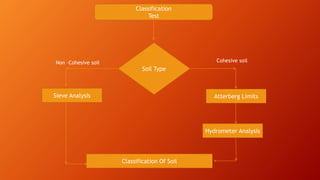
Classification
Test
Soil Type
Sieve Analysis
Hydrometer Analysis
Atterberg Limits
Classification Of Soil
Non –Cohesive soil Cohesive soil
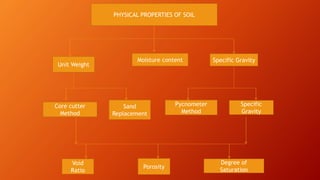
PHYSICAL PROPERTIES OF SOIL
Unit Weight
Specific GravityMoisture content
Specific
Gravity
Pycnometer
Method
Sand
Replacement
Core cutter
Method
Degree of
SaturationPorosity
Void
Ratio
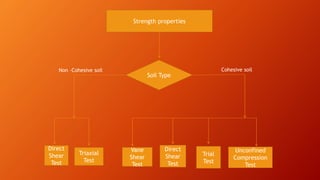
Strength properties
Direct
Shear
Test
Vane
Shear
Test
Trial
Test
Triaxial
Test
Unconfined
Compression
Test
Direct
Shear
Test
Soil Type
Non –Cohesive soil Cohesive soil
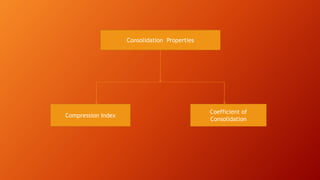
Consolidation Properties
Coefficient of
Consolidation
Compression Index
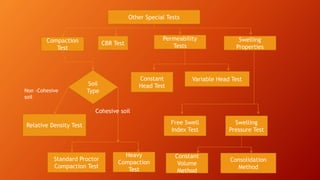
Other Special Tests
Compaction
Test
CBR Test
Permeability
Tests
Swelling
Properties
Soil
Type
Relative Density Test
Standard Proctor
Compaction Test
Heavy
Compaction
Test
Constant
Volume
Method
Consolidation
Method
Free Swell
Index Test
Swelling
Pressure Test
Variable Head TestConstant
Head Test
Cohesive soil
Non -Cohesive
soil
FIELD TESTS
• A reasonably good undisturbed soil sample can be collected from clay layer.
• If the soil at the site is non-cohesive, it is difficult to obtain a good undisturbed
soil sample.
Hence the field tests are broadly classified as:
• 1. Field tests for foundations
• 2. Field tests for pavement design
Field tests for foundation design
The following tests are useful in measuring the strength of soil in the field to
estimate the bearing capacity of soils for foundation design.
• 1. Standard penetration test. (SPT)
• 2. Dynamic cone penetration tests (DCPT)
• 3. Static cone penetration test
• 4. Field vane shear test
• 5. Plate load test (PLT)
Field tests for pavement design
The Commonly used field tests to obtain soil parameters required for designs of
pavements are
• 1. Field CBR
• 2. Plate load test Field
• CBR test gives the CBR valves of soil in the field conditions. The CBR valves are
useful in the design of flexible pavement.

Soil testing

  • 1.
  • 2.
    INTRODUCTION: • Soil isan essential construction material for Civil Engineers. • Hence, the accurate measurement of soil properties is very important in the design and execution of a civil engineering project. • Soil is used as • (i) construction material (Example: roadways, railways, earthen embankments, earthen dams), • (ii) Supporting material (Example: Foundations) and • (iii) Surrounding material (Example: Underground pipelines, tunnels). • Based on the type of soil and nature of the project a detailed test programme is planned.
  • 3.
    NEED FOR SOILTESTING : • Soil testing is an essential part of a Civil engineering project, the failure of a project due to improper/ inadequate soil testing is very expensive and sometimes irreparable. • Hence, understanding the properties of soil and its consideration in the design are important.
  • 4.
    The three importantaspects in soil testing program are: • Identification of appropriate soil test. • Accurate measurement of soil properties. • Analysis of test data and interpretation of properties for the design of structure
  • 5.
    IDENTIFICATION OF TESTS •Identification of appropriate tests is the most important aspect in the soil testing programme. • The required tests for a given project depend on • 1. The nature of the project. • 2. The nature of the soil.
  • 6.
    Nature of project: Theimportant civil engineering projects where soil properties considered are: • 1. Earthen embankment to store water • 2. Road construction • 3. Foundation • 4. Filling behind a retaining wall
  • 7.
    Nature of soil: • Soil testing not only depends on the type of the project as explained above but also on the type of the soil. • Shear parameters of clay soils are measured by performing either unconfined compression tests or Vane shear test or Direct shear test or Triaxial shear test. • . The compactness of cohesive soils is measured in terms of OMC conditions (by performing compaction test) and the same is represented in terms of relative density (by conducting minimum and maximum density tests) in case of sandy soils.
  • 8.
    CLASSIFICATION OF TESTS INTRODUCTION •There are a number of tests available to measure the engineering properties of soils in laboratory and field. • The tests to be performed depend on the type of soil and the nature of project.
  • 9.
    LABORATORY TESTS • Thesamples are either collected in an undisturbed state, in the form of core samples, or in a disturbed state, in the form of loose soils collected in bags. • The laboratory tests, classified for the purpose for which the soil is being used are as follows: • 1. Classification tests • 2. Test to obtain physical properties of soil • 3. Shear tests • 4. Compressibility tests • 5. Other specific tests
  • 10.
    Classification Test Soil Type Sieve Analysis HydrometerAnalysis Atterberg Limits Classification Of Soil Non –Cohesive soil Cohesive soil
  • 11.
    PHYSICAL PROPERTIES OFSOIL Unit Weight Specific GravityMoisture content Specific Gravity Pycnometer Method Sand Replacement Core cutter Method Degree of SaturationPorosity Void Ratio
  • 12.
  • 13.
  • 14.
    Other Special Tests Compaction Test CBRTest Permeability Tests Swelling Properties Soil Type Relative Density Test Standard Proctor Compaction Test Heavy Compaction Test Constant Volume Method Consolidation Method Free Swell Index Test Swelling Pressure Test Variable Head TestConstant Head Test Cohesive soil Non -Cohesive soil
  • 15.
    FIELD TESTS • Areasonably good undisturbed soil sample can be collected from clay layer. • If the soil at the site is non-cohesive, it is difficult to obtain a good undisturbed soil sample. Hence the field tests are broadly classified as: • 1. Field tests for foundations • 2. Field tests for pavement design
  • 16.
    Field tests forfoundation design The following tests are useful in measuring the strength of soil in the field to estimate the bearing capacity of soils for foundation design. • 1. Standard penetration test. (SPT) • 2. Dynamic cone penetration tests (DCPT) • 3. Static cone penetration test • 4. Field vane shear test • 5. Plate load test (PLT)
  • 17.
    Field tests forpavement design The Commonly used field tests to obtain soil parameters required for designs of pavements are • 1. Field CBR • 2. Plate load test Field • CBR test gives the CBR valves of soil in the field conditions. The CBR valves are useful in the design of flexible pavement.