What is Rhetoric
Objectives 
 Explain the history of rhetoric 
 Define rhetoric in speaking(speech) 
 Discuss the type of rhetorical devices in writing
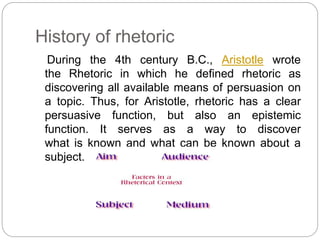
History of rhetoric 
During the 4th century B.C., Aristotle wrote 
the Rhetoric in which he defined rhetoric as 
discovering all available means of persuasion on 
a topic. Thus, for Aristotle, rhetoric has a clear 
persuasive function, but also an epistemic 
function. It serves as a way to discover 
what is known and what can be known about a 
subject.
Rhetoric in speech 
 In rhetoric, a formal address delivered to an 
audience. 
 It is an oration or oral presentation. 
 Classical rhetoric recognized three main type or 
genres of speech which are deliberative, judicial, 
and epideictic. 
 There are 3 major parts to every speech which 
are introduction, body, and, conclusion.
Type of Rhetorical devices in writing 
1) Alliteration (repetition of initial sound) 
The initial consonant sound is usually repeated 
in two neighboring words (sometimes also in 
words next to each other). Alliteration draws 
attention to the phrase and is often used for 
emphasis. 
2) Allusion (indirect reference to a person, 
event or piece of literature) 
Allusion is used to explain or clarify a complex 
problem. Note that allusion works best if you 
keep it short and refer to something the 
reader/audience is familiar with. For example: 
famous people, history, and the bible.
Type of Rhetorical devices in writing 
3) Anaphora (successive clauses or 
sentences start with the same word(s) 
The same word or phrase is used to begin 
successive clauses or sentences. Thus, the 
reader’s/listener’s attention is drawn directly to 
the message of the sentence. 
4) Antithesis (contrasting relationship between 
two ideas) 
Antithesis emphasis the contrast between two 
ideas. The structure of the phrases/clauses is 
usually similar in order to draw the reader’s/ 
listener’s attention directly to the contrast.
Type of Rhetorical devices in writing 
5) Hyperbole (deliberate exaggeration) 
used sparingly, hyperbole effectively draws the 
attention to a massage that you want to 
emphasize. 
6) Metaphor (figurative expression) 
metaphor compares two different things in a 
figurative sense. Unlike in a simile (A is like B), 
“LIKE” is not used in metaphor (A is B).
Type of Rhetorical devices in writing 
7) Metonymy (figurative expression, closely 
associated with the subject) 
metonymy (unlike metaphor) uses figurative 
expressions that are closely associated with the 
subject in terms of place, time or background. 
8) Personification (attribution of human 
characteristics to animals, inanimate objects or 
abstractions) 
animals, inanimate objects or abstractions are 
represented as having human characteristics 
(behavior, feelings, character.) personification can 
make a narration more interesting and lively.
Type of Rhetorical devices in writing 
9) Simile (direct comparison) 
two things are compared directly by using “like” 
(A is like B) 
other possibilities are for example: 
- A is (not) like B 
- A is more/less than B 
- A is as … as B 
- A is similar to B 
- A is …, so is B 
- A does …, so does B
Type of Rhetorical devices in writing 
10) Understatement (weaken or soften a 
statement) 
A statement is deliberately weakened to sound 
ironical or softened to sound more polite. 
note that understatement is a common feature 
of the English language (especially British 
English) used in everyday life situations.
Conclusion 
 We employ rhetoric whether we are conscious of it or 
not, but becoming conscious of how rhetoric works 
can transform speaking, reading and writing, making 
us more successful and able communicators and 
more discerning audiences. 
 It is more important to recognize how figures of 
speech or rhetorical devices affect readers and be 
able to use them effectively to persuade and 
communicate than it is to identify them. 
 Rhetoric speeches are intended to get listener to 
accept a particular point of view, and then motivate 
them into action. The art of giving a persuasive 
speech is as much about using languages effectively 
as it is about communicating a convincing argument.
References 
 Roskelly, H. What Do Students Need to Know About 
Rhetoric? Greensboro, North Carolina: University of 
North Carolina. 
http://apcentral.collegeboard.com/apc/members/repos 
itory/ap06_englang_roskelly_50098.pdf 
 Keefer, A. How to Write a Rhetoric Speech. Demand 
Media. http://classroom.synonym.com/write-rhetoric-speech- 
4533.html 
 http://examples.yourdictionary.com/examples-of-rhetorical- 
devices.html 
 http://www.let.rug.nl/usa/documents/1951-/martin-luther- 
kings-i-have-a-dream-speech-august-28- 
1963.php 
 http://estylistics.blogspot.com/2012/06/oxymoron-antithesis- 
irony-stylistic.html

STYLISTICS: What is rhetoric

  • 1.
  • 2.
    Objectives  Explainthe history of rhetoric  Define rhetoric in speaking(speech)  Discuss the type of rhetorical devices in writing
  • 3.
    History of rhetoric During the 4th century B.C., Aristotle wrote the Rhetoric in which he defined rhetoric as discovering all available means of persuasion on a topic. Thus, for Aristotle, rhetoric has a clear persuasive function, but also an epistemic function. It serves as a way to discover what is known and what can be known about a subject.
  • 4.
    Rhetoric in speech  In rhetoric, a formal address delivered to an audience.  It is an oration or oral presentation.  Classical rhetoric recognized three main type or genres of speech which are deliberative, judicial, and epideictic.  There are 3 major parts to every speech which are introduction, body, and, conclusion.
  • 5.
    Type of Rhetoricaldevices in writing 1) Alliteration (repetition of initial sound) The initial consonant sound is usually repeated in two neighboring words (sometimes also in words next to each other). Alliteration draws attention to the phrase and is often used for emphasis. 2) Allusion (indirect reference to a person, event or piece of literature) Allusion is used to explain or clarify a complex problem. Note that allusion works best if you keep it short and refer to something the reader/audience is familiar with. For example: famous people, history, and the bible.
  • 6.
    Type of Rhetoricaldevices in writing 3) Anaphora (successive clauses or sentences start with the same word(s) The same word or phrase is used to begin successive clauses or sentences. Thus, the reader’s/listener’s attention is drawn directly to the message of the sentence. 4) Antithesis (contrasting relationship between two ideas) Antithesis emphasis the contrast between two ideas. The structure of the phrases/clauses is usually similar in order to draw the reader’s/ listener’s attention directly to the contrast.
  • 7.
    Type of Rhetoricaldevices in writing 5) Hyperbole (deliberate exaggeration) used sparingly, hyperbole effectively draws the attention to a massage that you want to emphasize. 6) Metaphor (figurative expression) metaphor compares two different things in a figurative sense. Unlike in a simile (A is like B), “LIKE” is not used in metaphor (A is B).
  • 8.
    Type of Rhetoricaldevices in writing 7) Metonymy (figurative expression, closely associated with the subject) metonymy (unlike metaphor) uses figurative expressions that are closely associated with the subject in terms of place, time or background. 8) Personification (attribution of human characteristics to animals, inanimate objects or abstractions) animals, inanimate objects or abstractions are represented as having human characteristics (behavior, feelings, character.) personification can make a narration more interesting and lively.
  • 9.
    Type of Rhetoricaldevices in writing 9) Simile (direct comparison) two things are compared directly by using “like” (A is like B) other possibilities are for example: - A is (not) like B - A is more/less than B - A is as … as B - A is similar to B - A is …, so is B - A does …, so does B
  • 10.
    Type of Rhetoricaldevices in writing 10) Understatement (weaken or soften a statement) A statement is deliberately weakened to sound ironical or softened to sound more polite. note that understatement is a common feature of the English language (especially British English) used in everyday life situations.
  • 11.
    Conclusion  Weemploy rhetoric whether we are conscious of it or not, but becoming conscious of how rhetoric works can transform speaking, reading and writing, making us more successful and able communicators and more discerning audiences.  It is more important to recognize how figures of speech or rhetorical devices affect readers and be able to use them effectively to persuade and communicate than it is to identify them.  Rhetoric speeches are intended to get listener to accept a particular point of view, and then motivate them into action. The art of giving a persuasive speech is as much about using languages effectively as it is about communicating a convincing argument.
  • 12.
    References  Roskelly,H. What Do Students Need to Know About Rhetoric? Greensboro, North Carolina: University of North Carolina. http://apcentral.collegeboard.com/apc/members/repos itory/ap06_englang_roskelly_50098.pdf  Keefer, A. How to Write a Rhetoric Speech. Demand Media. http://classroom.synonym.com/write-rhetoric-speech- 4533.html  http://examples.yourdictionary.com/examples-of-rhetorical- devices.html  http://www.let.rug.nl/usa/documents/1951-/martin-luther- kings-i-have-a-dream-speech-august-28- 1963.php  http://estylistics.blogspot.com/2012/06/oxymoron-antithesis- irony-stylistic.html