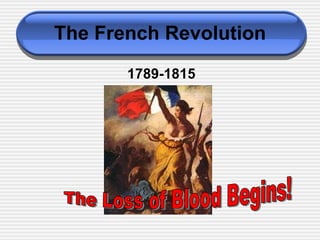
The French Revolution 1789-1815 The Loss of Blood Begins!
French Revolution  10.2.3 You will learn How the ideas of the Enlightenment led to Revolutions in America and France.  Learning Objective Students will list the causes of the French Revolution.
Warm Up #1:  Ch 3 Section 1 French Society Divided Which group made up the 1 st  Estate? (p.108) Which group made up the 2 nd  Estate?(p.108) Which group made up the 3 rd  Estate? (p.108) Which two Estates did not have to pay taxes? (p.108-109) Who targeted and criticized the Church during the Enlightenment? (.109) Which estate did the  bourgeoisie  belong to? (p.109) What was the  bourgeoisie? (p.109) What groups were a part of the bourgeoisie? (p.109)
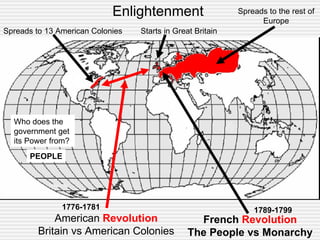
Spreads to the rest of Europe Spreads to 13 American Colonies Enlightenment Starts in Great Britain American  Revolution Britain vs American Colonies French  Revolution The People vs Monarchy Who does the  government get  its Power from?  PEOPLE 1776-1781 1789-1799
France American Revolution French Revolution Britain The French helped the American Colonists win the American  Revolution. But the Americans did not help the French during  The French Revolution
France
France
Paving the way! Just as the Scientific Revolution paved the way for the  Enlightenment … … Enlightenment ideas paved the way for the French Revolution. Revolution
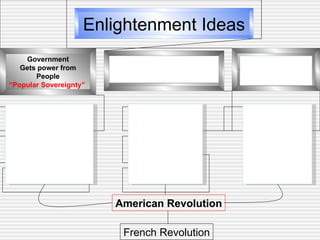
American Revolution French Revolution Enlightenment Ideas Government Gets power from People “ Popular Sovereignty”  People have natural Rights Life, Liberty, Property People have the right to Overthrow a govt. who does  Not protect their rights Speech Separation of Powers Elections Legislative, Executive Judicial Checks and Balances religion press Democracy Republic
Causes of the French Revolution Inequalities among classes: Third Estate ready to revolt! Soaring National debt = deficit spending   Enlightenment Ideas : *Natural Rights  and equality! Louis XVI  failed economic reform Locke: Natural Rights=life liberty and property. Voltaire:Battled corruption,injustice and inequality. American Revolution Formation of the National Assembly Storming  the  Bastille Soaring  Food Prices: Bread riots Bad Harvest Hunger  and Poverty Causes of the French Revolution Tennis Court Oath   Estates-General
The French Revolution Section 1: On the Eve of Revolution French Society Divided Before the French Revolution, France operated under a social system in which there were three classes of people. The highest was made up of the clergy, the next was composed of the nobility and the lowest was for everyone else. Members of this lowest class, called the Third Estate, paid all of the taxes.
 
The Third Estate *They paid all of the taxes
French Society 1 st  Estate  Clergy 2 nd  Estate:  Nobles Third Estate:  Everyone else Atlantic  Ocean Mediterranean Sea Spain Great  Britain English Channel France 1700s Paris Versailles Seine R. Pyrenees Mts.  Alps
Estates (Social Classes) in France Third Estate
Europe What is the significance/importance of this cartoon? It shows how the king, 1 st  Estate, and the 2 nd  Estate abused, used and depended on  the 3 rd  Estate
Direct Causes of the  French Revolution Causes 1.  Inequalities  between the1st, 2nd, 3rd estates or three social classes.  2. Monarchy  Deficit Spending France suffered from soaring debt during the lavish reigns of Louis XIV, Louis XV, and Louis XVI. Finally, Louis XVI was forced to summon the Estates-General in hopes of ending the debt crisis. 3. Hunger and Poverty   Bad Harvests =  majority  of people were broke and hungry  >>>>  Leads to Bread Riots and nobles’ fear of taxes. 4.  R eform fails!  Estates-General dead-locked and can not agree on issue of voting.
Indirect Causes of  the French Revolution Enlightenment ideas of  John Locke:   *It is the elected  government's responsibility to protect the peoples natural rights  and if it does not fill this obligation or violates the peoples natural rights, then the people have the right to overthrow that government. American Revolution ideas of  liberty  and  equality. *( U.S. Constitution was signed 2 yrs before, in 1787)
No more divine right! *Many members of the  Third Estate  were inspired by Enlightenment ideas. a) They wanted representation in government. b) They no longer believed monarchs had “divine right” = belief that their ruler’s power comes from God! c) They were inspired by the American Revolution “ The Enlightenment of the Third Estate”
The French Monarchy: 1775 - 1793 Louis XVI & Marie Antoinette
King Louis XVI This king was spoiled and weak. He led France deeply into debt through his severe  deficit spending   =(spending more $dinero$ than you have). He had to call on the  Estates- General  to help fix some problems, but his reforms failed.
Last time it was called into session was 1614! King Louis XVI calls the Estates-General
Estates-General The King told the Estates General to make a list of all their problems * 3 rd  Estates  main problem is representation . Largest group with only one vote in the Estates General 3 rd  estate wanted each person’s vote to count   The 1st and 2nd estates did note want to hear what the 3rd estate had to say or compromise on voting fairly.  To protest the unfair voting the Third Estate tells the king to “get lost” and they make their own government calling themselves the  National Assembly.
Estates General King Louis XVI called all three Estates together to vote on how to fix the issues France was facing.
France’s Population France’s Estates  Representatives First estate: clergy Second estate: nobles Third Estate: everyone else 1 vote 1 vote 1 vote 1% 2% 97%
Estates - General Estates-General Made up of the 3 Estates Unfair for 3 rd  Estate Because the 1 st  and 2 nd  Estates out vote the 3 rd   1 vote 1 vote 1 vote First estate: clergy Second estate: nobles Third Estate: everyone else
The Estates-General Fails! The Estates-General could not agree on a fair way to vote, so members of the Third Estate finally declared themselves as the new  National Assembly,  the new government of France that would represent the majority of the people.  They were joined by some reform-minded clergy and nobles as well. Tennis Court Oath =  Then they met at a near by indoor tennis court and they swore never to separate until they created a constitution.
Tennis Court Oath I promise to…
“ The Tennis Court Oath” The National Assembly promised never to give up, until they had created a lasting Constitution!
Storming the Bastille   July 14, 1789 *The Third Estate acted on a rumor that the king was planning a military coup against the National Assembly. *The Third Estate attacks the Bastille, because it has gunpowder and weapons they need to fight the Revolution.
The Bastille
The Great Fear:  Peasant Revolt (July 20, 1789) *Rumors that the King and the nobles were sending their military to attack peasants, pillage their land and put down the revolt.
The French Revolution Unfolds Inflamed by  famine  (starvation) and fear peasants unleashed their fury on the nobles who were trying to regain power. Factions  or dissenting groups (people with different ideas) fought for control of the government. The Declaration of Rights of Man  was issued by the new National Assembly.
“ The Third Estate Awakens” They proclaimed themselves the  “National Assembly”  of France.
Marie Antoinette Although people were starving and the country was broke, the royal family showed off their wealth and continued to spend money.  Queen  Marie Antoinette  : lived a life of great pleasure and extravagance. *The angry women marched on to the King and Queen’s palace in Versailles, Paris, demanding “Bread!”
Bread was a main part of the French diet!
Bread riots People were hungry; the country was broke. Marie Antoinette said, “let them eat cake!” This picture is from an all-woman bread riot.
What is the significance/importance of this cartoon? It shows how the other European rulers  feared the spread of the French Revolution Catherine of Russian, the Pope, King Leopold, and King George III The Revolution is portrayed as the Bubonic Plague (diseased Rats) with the main killing machine, (guillotine) as the tail Guillotine French  Rats “ The French Plague” *Textbook p.118 Monarchs from other European countries
List the rights that French men gained as a result of the Declaration of the Rights of Man?  (115) Life, liberty, property  How did the Constitution of 1791 change the monarchy?  (117) It went from an absolute monarchy to a limited monarchy    (Constitutional Monarchy) What new powers did the Legislative Assembly have?  (117) Collect taxes, and declare war or peace What did King Louis try to do in June 1791?  (118) He tried to escape in disguise, but was caught and sent back to Paris. He was now hated more than ever. He became a traitor.
Declaration of the Rights of Man and Citizen  (1789) The National Assembly created their own  Declaration of the Rights of Man and Citizen   modeled after TJ’s “ Declaration of Independence”.
Declaration of the Rights of Man and the Citizen: “ Liberty, Equality, Fraternity”   The slogan/motto of the French Revolution 1789
Declaration of the Rights of Man
Articles: 1.   Men are born and remain free and equal in rights . Social distinctions may be founded only upon the general good. 2.  The aim of all political association is the preservation of the  natural rights of man .  These rights are liberty, property, security, and resistance to oppression. 3.  The principle of all  sovereignty  resides essentially in the nation. No body nor individual may exercise any authority which does not proceed directly from the nation. 4.   Liberty   consists in the freedom to do everything which injures no one else; hence the exercise of the natural rights of each man has no limits except those which assure to the other members of the society the enjoyment of the same rights. These limits can only be determined by law.
 
8.  The  law shall provide for such punishments only as are strictly and obviously necessary , and no one shall suffer punishment except it be legally inflicted in virtue of a law passed and promulgated before the commission of the offense. 9.  As  all persons are held innocent until they shall have been declared guilty , if arrest shall be deemed indispensable, all harshness not essential to the securing of the prisoner's person shall be severely repressed by law. 10.   No one shall be disquieted on account of his opinions, including his religious views , provided their manifestation does not disturb the public order established by law. 11.  The  free communication of ideas and opinions  is one of the most precious of the rights of man. Every citizen may, accordingly,  speak, write, and print with freedom , but shall be responsible for such abuses of this freedom as shall be defined by law.
 
 
Constitution of 1791 The National Assembly fulfills the promise Tennis Court Oath. The new  Legislative Assembly  is created to make laws, collect taxes and decide on issues of war and peace. The new French Constitution of 1791 makes many  reforms  or changes to the way the government operates.
Political Declared all males were equal before the law Limited the power of the monarchy Established the Legislative Assembly to make laws and collect taxes Granted all tax-paying male citizens the right to elect members of the Legislative Assembly Social and Economic  Abolished special privileges of the nobility Announced an end to Feudalism Taxes will be levied on ability to pay them Reforms made by the National Assembly Reforms   are changes made to fix laws and the way a gov’t system operates.
Religious Declared freedom of religion Took over and sold church lands Placed the French Catholic Church under the power of the state Clergy was to be elected and received government salaries
National Assembly Now France has Three Branches of Government
Louis XVI “Accepts” the Constitution  & the National Assembly. 1791
Warm Up  What type of government did the san-cullotes demand by 1791?  (119) Republic How did the Legislative Assembly try to spread the revolution in 1792?  (119) They declared war on Prussia, Austria and Britain.
Political  Factions  = groups with different ideas. 1791: The Legislative Assembly, split into three general groups. Radicals Moderates Conservatives (Liberals) “Right wing” “Left wing”
Political Extremes The extreme  radicals  were the  sans-culotte . The extreme  conservatives  were the  émigrés . The  sans-culotte  push the revolution into the  radical phase, they demanded a republic - No Monarchy! Monarchs,  Clergy and Nobles
The Legislative Assembly eventually gave up the idea of forming a limited monarchy and was forced to turn control  over to the radicals;  the new governing body called itself the  National Convention . Radicals create the  National Convention Radicals that want  to Abolish the Monarchy! Want to create a Republic!
Sept. 1792 : France becomes a Republic! The  National Convention  abolished the monarchy and declared France a republic. France is a republic! The King and Queen were executed!
Robespierre  won the power struggle; attempts were made to destroy all traces of the monarchy and nobility. That led to the  Reign of Terror . 1793 - 1794 “ Radical” Radicals killed over 17,000 with the guillotine! Reign of Terror
End of the Reign of Terror “ Revolutions devour their own children.” July 28, 1794: Robespierre himself became a victim of the  guillotine  = execution device; a large blade slides down a track from above chopping the head off the body.
The Directory Many of the victims of the Reign of Terror were fellow radicals who had fallen out of favor with Robespierre and the radical Jacobins. The National Convention arrested Robespierre and his allies, convicted them of treason, and executed them. A group of  moderate  minded men seized power and ruled from 1795 to 1799 under a new government called the  Directory. The Directory sought a middle way between the  Ancien Regime  and radical revolution but had little success. In Nov 1799, Napoleon Bonaparte staged a  coup d’etat  and seized power.
1795:  The Directory * Moderate  leaders drafted a new Constitution, which set up a new government the  Directory  and a two house legislature. All power was put into the hands of the Directory.
A New General Though corrupt, the Directory did provide France with a period of order. They also found the right general to command France’s armies: Napoleon Bonaparte
Napoleon (1769-1821) Napoleon was an officer under King Louis XVI and had become a general at age 24. He then led the French army in many successful battles
More power! But that wasn’t enough – Napoleon wanted MORE power. 1804: With the support of the French voters, Napoleon made himself emperor.
Napoleon (1769-1821) In 1799, he returned to France and joined the Directory, but when Austria, Russia, and Britain formed a coalition to attack France and end the Revolution, Napoleon staged a  coup  (to overthrow the government) He overthrew the Directory, imposed a new constitution, and named himself first consul *In 1802, he became consul for life and in 1804 crowned himself emperor.
Napoleon’s Coronation
France under Napoleon Brought stability to France Napoleonic Code =  established the Civil Code of laws which further stabilized France Confirmed many of the moderate revolutionary policies of the National Assembly but removed many measures passed by the more radical Convention. Affirmed the political and legal equality of all adult men Made peace with the Catholic Church Through the Concordat with the pope in 1801 France would retain freedom of religion Established a merit-based society in which individuals qualified for education and employment because of talent rather than birth or social standing
Napoleon as Authoritarian Limited free speech and used  censorship  of newspapers Established a  secret police  force and detained thousands of political opponents Manipulated public opinion through systematic  propaganda Surrounded himself with loyal military officers Set his family above and apart from the French people Joseph Fouche, head of Napoleon’s secret police
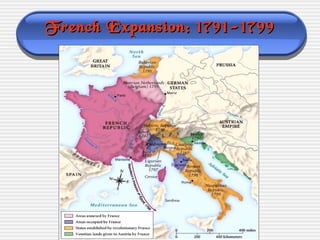
French Expansion: 1791-1799
End of Napoleon’s Empire In 1812, Napoleon decided to invade Russia, believing that the Russians were siding with the British. Napoleon and his “ Grand Army ” of 600,000 soldiers captured Moscow, but the Russians refused to surrender. Instead, Russians used the  Scorched-Earth Policy=  burned their cities, leaving Napoleon without food, supplies or shelter. Napoleon was forced to retreat Defeated by  “General Winter” Only 30,000 soldiers made it back to France
End of Napoleon's Empire The defeat in Russia sparked a  coalition  (combined effort) of British, Austrian, Prussian, and Russian armies to converge on France Forced Napoleon to  abdicate  (to give up) his throne in April 1814 He was then exiled to Elba island in the Mediterranean Sea, but he escaped and fought one last battle in attempts to regain his power. Waterloo  was Napoleon’s last battle where he lost to British and Prussian armies in Waterloo, Belgium. He was then exiled for life to another island further away in the South Atlantic Ocean (St. Helena)
End of Napoleon’s Empire An episode from the retreat from Russia,  by Nicolas-Toussaint Charlet
 
His “Waterloo” 1815: Napoleon was defeated at Waterloo.
End of Napoleon’s Empire The coalition restored the French monarchy and exiled Napoleon to the island of Elba, near Corsica In March 1815, Napoleon escaped, returned to France, and reconstituted his army This time the British defeated him at Waterloo and banished Napoleon to the remote island of St. Helena in the south Atlantic He died in 1821
Effects of the French Revolution Both the King and Queen were beheaded! The French Monarchy was no more. In addition to the Royal family, 17,000 people were executed with the guillotine.
Effects of the French Rev. The Enlightenment ideals and the American and French Revolutions also influenced: The Saint Domingue slave revolt  Simon Bolivar  in South America  The abolition movement  The Declaration of the Rights of Woman and the Female Citizen Elizabeth Cady Stanton and women’s rights movements
= Paris 3 Estates = Versailles Oct. 5, 1789: Paris Women march to Versailles to protest the high cost of bread Reign of Terror Guillotine, which was use on King Louis XVI and Marie Antoinette 1 st  Estate: clergy 2 nd  Estate: nobles 3 rd  Estate: everyone else Taxes and high costs of bread causes poverty and hunger, then riots  1789 People of Paris storm the Bastille French  Revolution
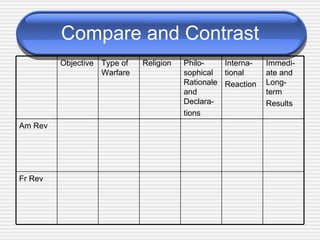
Compare and Contrast Fr Rev Am Rev Immedi-ate and Long-term Results Interna-tional Reaction Philo-sophical Rationale and Declara- tions Religion Type of Warfare Objective
In 18 th  Century French society, which estate had to pay taxes? First Second Third fourth Name the king and queen of France during this time. King John and Queen Mary King Louis 16 and Marie Antoinette King William and Queen Marie Define  bourgeoisie. The  clergy was a part of what estate? The nobility was a part of what estate? Pop Quiz #4  French Estates
The ideas of which movement caused people challenge the Church and the Monarchy? Glorious Revolution Enlightenment Industrial Revolution American Revolution Give an example of deficit spending? The Third Estate created their own government called what? A. The Third Convention  B. National Assembly C. Estates-General Why did the Third Estate attack the Bastille? Which estate took the Tennis Court Oath and what was it?
Which of the following was  not  a cause of the French Revolution? Economic depression (bad harvest, high cost of food, unemployment National Debt (due to wars and royalty costs) King Louis’ assassination (By the Third Estate)  Enlightenment (new ideas: people have rights)
Why was voting in the Estates General unfair for the 3 rd  Estate? They weren’t allowed to vote They were only allowed one vote Because only the doctors and lawyers could vote Because the 1st and 2nd estate had more votes
What did the National assembly promise to do in the  Tennis Court Oath? To abolish the monarchy and set up a republic To never separate and create a constitution To declare war on Great Britain To guillotine King Louis XVI
Why was the attack on the Bastille an important event? It showed the people’s power It showed the Revolution had begun It showed that the people wanted to be independent from the king. All of the above
What caused the king to call the Estates General? Enlightenment ideas New Laws Problem with national debt, and taxes American-Revolution
Before French Revolution France 2. Name and Describe the social classes 1. Name the type of  Government = Monarchy 1st Estate 2nd Estate 3rd Estate
1789 France “ We  promise  to  never separate and to  create a Constitution” August: National Assembly votes to end Special privileges and  Declaration Of Rights Of Man And Citizen 3. This action caused the beginning of the Revolution 4. Who attacked this building and why? Explain what is happening National  Assembly The Bastille Tennis Court Oath
1790 Constitution  of  1791 Limited  Monarchy 1791 N.A. Takes control  Legislative Assembly Make laws Collect taxes Decide on War
1792 Radicals  take control of the  Legislative Assembly And set up a  Republic Prussia,  Britain,  and  Austria VS France That’s why were gonna kill’em,  in the big nine-three  Ya down with  King Louis? Hell no, not me Male suffrage
1793 King Louis &  Maria Antoinette are  Guillotined Monarchy is Abolished Reign of Terror 17,000 executed Committee of Public Safety Robespierre Live by the guillotine, die by the guillotine 1794
1795 - 1797 Constitution  Of 1795 5 Man  Directory (Weak) Émigrés Return Gain power in Legislative Assembly Napoleon
1800 - 1804 Constitution  Of 1795 5 Man  Directory (Weak) Émigrés Return Gain power in Legislative Assembly Napoleon
Estates   (Social Classes) 1 st  Estate 2 nd  Estate 3 rd  Estate Paid all of the  Taxes Paid No Taxes Paid No Taxes Bourgeoisie King Louis XVI and his Queen Marie Antoinette Loved to spend money$$$
Sans-culottes
King Louis XVI Marie Antoinette Robespierre Napoleon
 
 
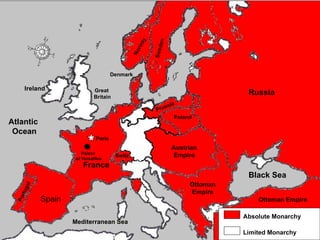
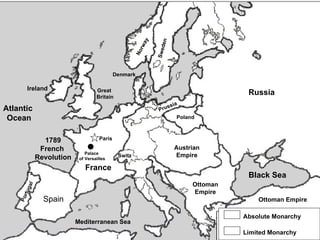
Atlantic  Ocean Mediterranean Sea Black Sea France Absolute Monarchy Limited Monarchy Great  Britain Ireland Austrian Empire Prussia Spain Portugal Norway Sweden Russia Ottoman Empire Denmark Poland Switz Ottoman Empire Paris Palace of Versailles 1789 French  Revolution
Absolute Monarchy Limited Monarchy Atlantic  Ocean Mediterranean Sea France Great  Britain Ireland Austrian Empire Prussia Spain Portugal Norway Sweden Ottoman Empire Denmark Poland Switz Black Sea Russia Ottoman Empire Paris Palace of Versailles 1789 French  Revolution
Absolute Monarchy Limited Monarchy Atlantic  Ocean Mediterranean Sea France Great  Britain Ireland Austrian Empire Prussia Spain Portugal Norway Sweden Ottoman Empire Denmark Poland Switz Black Sea Russia Ottoman Empire Paris Palace of Versailles
Absolute Monarchy Limited Monarchy Black Sea Russia Ottoman Empire Atlantic  Ocean Mediterranean Sea France Great  Britain Ireland Austrian Empire Prussia Spain Portugal Norway Sweden Ottoman Empire Denmark Poland Switz Paris Palace of Versailles
Benchmark Review 1. All citizens of Athens had the right to vote in the assembly. What is this an example of ? Republic Militarism monarchy democracy
Benchmark Review 2. Judaism, Islam, and Christianity share a belief in  The teachings of Lao Tzu Monotheism and ethical conduct reincarnation A prohibition on the consumption of pork
Benchmark Review 3. Who believed that in an ideal society the government should be controlled by a class of philosopher kings? Plato Lao Tzu Thomas Aquinas Muhammad
Benchmark Review 4. Which of the following is a concept from Athens that is central to Western political thought today Individuals should fight against nature Individual achievement, dignity, and worth are of great importance Individual recognition impedes societal progress Individuals play and insignificant role
Benchmark Review 5. Which of the following governments does not involve rule by a group? Democracy Aristocracy Oligarchy Monarchy
Benchmark Review 6. What was the international effect of the ratification of the US Constitution? It abolished slavery It caused all nations to establish state religions It made the idea governing though a single written constitution popular. It ended the monarchy in England
Benchmark Review 7. What document from the American Revolution is the most imitated and most used in other national constitutions? The Articles of Confederation The Declaration of Independence The US Bill of Rights The Federalist Papers
Benchmark Review 8. What legacy has the US Constitution had in most foreign countries? It provided a model for the establishment of a government by written law. It provided a model of separation of Church and State It provides a model for the separation of powers. It helped to abolish monarchy and dictatorship in virtually all the nations of the world
Benchmark Review 9. When a country’s constitution requires the branches of government to remain independent of each other, its is adhering to the constitutional principle of ? Popular sovereignty Direct democracy Federalism Separation of powers
Benchmark Review 10. The ideas of John Locke and Rousseau influenced Simon Bolivar in his commitment to Maintain  the peaceful rule of the Spanish  Fight for democratic revolution in Latin America Negotiate a social contract between Spain and Latin America Urge the Venezuelan govt. to separate into 3 branches
Benchmark Review Cont. 11. Solons helped to spread… Only ideas of the philosphes  Only the ideas of political scientists Enlightenment ideas The geocentric theory
Benchmark Review 12. The philosophes used reason to address Abusive rulers  Social issues British taxes All of the above
Benchmark Review 13. The English philosopher John Locke argued that life, liberty and property are.. Social rights guaranteed by the ruling class  Natural rights that should be protected by government Political rights to be granted as determined by law Economic rights earned in a capitalistic system
Benchmark Review 14. What is the significant of the Magna Carta? It approved money for wars in France  It allowed the monarch to abolish Paliament It limited the power of the pope It asserted that the monarch must obey the law
Benchmark Review 15. The term “unalienable rights” in the Declaration of Independence refers to rights that… Immigrants do not possess  A government grants its people A government cannot take away
Benchmark Review 16. In English history, the Magna Carta, the Petition of Right, and the Bill of Rights all reinforced the concept of… Universal suffrage  Religious toleration a laissez-faire economy A limited monarchy
Benchmark Review 17. Both, the United States Declaration of Independence and French Declaration of the Rights of Man emphasized the idea that governments must Operate on a system of checks and balances  Guarantee economic prosperity Protect the rights of people Support established religious beliefs
Benchmark Review 18.   The success of the formation of the US govt after the American Revolution served as an example to the peoples of Europe that  It was possible to set up a govt. based upon Enlightenment ideas  The social distinctions between the nobility and peasants was invalid and unnecessary  Building a nation on the concept of economic prosperity can be successful All of the above
Benchmark Review 19. Unlike the French Revolution, the American Revolution produced … Women’s suffrage  Short term military rule A lasting constitution Strategic alliances
Benchmark Review 20. The principles of the America  Revolutionand the French Revolution are similar in many ways…Which of the following best summarizes their similarities Both supported equal rights for women Both favored representative govt. Both retained certain hereditary rights for aristocrats Both limited voting rights to an economic elite

French revolution

  • 1.
    The French Revolution1789-1815 The Loss of Blood Begins!
  • 2.
    French Revolution 10.2.3 You will learn How the ideas of the Enlightenment led to Revolutions in America and France. Learning Objective Students will list the causes of the French Revolution.
  • 3.
    Warm Up #1: Ch 3 Section 1 French Society Divided Which group made up the 1 st Estate? (p.108) Which group made up the 2 nd Estate?(p.108) Which group made up the 3 rd Estate? (p.108) Which two Estates did not have to pay taxes? (p.108-109) Who targeted and criticized the Church during the Enlightenment? (.109) Which estate did the bourgeoisie belong to? (p.109) What was the bourgeoisie? (p.109) What groups were a part of the bourgeoisie? (p.109)
  • 4.
    Spreads to therest of Europe Spreads to 13 American Colonies Enlightenment Starts in Great Britain American Revolution Britain vs American Colonies French Revolution The People vs Monarchy Who does the government get its Power from? PEOPLE 1776-1781 1789-1799
  • 5.
    France American RevolutionFrench Revolution Britain The French helped the American Colonists win the American Revolution. But the Americans did not help the French during The French Revolution
  • 6.
  • 7.
  • 8.
    Paving the way!Just as the Scientific Revolution paved the way for the Enlightenment … … Enlightenment ideas paved the way for the French Revolution. Revolution
  • 9.
    American Revolution FrenchRevolution Enlightenment Ideas Government Gets power from People “ Popular Sovereignty” People have natural Rights Life, Liberty, Property People have the right to Overthrow a govt. who does Not protect their rights Speech Separation of Powers Elections Legislative, Executive Judicial Checks and Balances religion press Democracy Republic
  • 10.
    Causes of theFrench Revolution Inequalities among classes: Third Estate ready to revolt! Soaring National debt = deficit spending Enlightenment Ideas : *Natural Rights and equality! Louis XVI failed economic reform Locke: Natural Rights=life liberty and property. Voltaire:Battled corruption,injustice and inequality. American Revolution Formation of the National Assembly Storming the Bastille Soaring Food Prices: Bread riots Bad Harvest Hunger and Poverty Causes of the French Revolution Tennis Court Oath Estates-General
  • 11.
    The French RevolutionSection 1: On the Eve of Revolution French Society Divided Before the French Revolution, France operated under a social system in which there were three classes of people. The highest was made up of the clergy, the next was composed of the nobility and the lowest was for everyone else. Members of this lowest class, called the Third Estate, paid all of the taxes.
  • 12.
  • 13.
    The Third Estate*They paid all of the taxes
  • 14.
    French Society 1st Estate Clergy 2 nd Estate: Nobles Third Estate: Everyone else Atlantic Ocean Mediterranean Sea Spain Great Britain English Channel France 1700s Paris Versailles Seine R. Pyrenees Mts. Alps
  • 15.
    Estates (Social Classes)in France Third Estate
  • 16.
    Europe What isthe significance/importance of this cartoon? It shows how the king, 1 st Estate, and the 2 nd Estate abused, used and depended on the 3 rd Estate
  • 17.
    Direct Causes ofthe French Revolution Causes 1. Inequalities between the1st, 2nd, 3rd estates or three social classes. 2. Monarchy Deficit Spending France suffered from soaring debt during the lavish reigns of Louis XIV, Louis XV, and Louis XVI. Finally, Louis XVI was forced to summon the Estates-General in hopes of ending the debt crisis. 3. Hunger and Poverty Bad Harvests = majority of people were broke and hungry >>>> Leads to Bread Riots and nobles’ fear of taxes. 4. R eform fails! Estates-General dead-locked and can not agree on issue of voting.
  • 18.
    Indirect Causes of the French Revolution Enlightenment ideas of John Locke: *It is the elected government's responsibility to protect the peoples natural rights and if it does not fill this obligation or violates the peoples natural rights, then the people have the right to overthrow that government. American Revolution ideas of liberty and equality. *( U.S. Constitution was signed 2 yrs before, in 1787)
  • 19.
    No more divineright! *Many members of the Third Estate were inspired by Enlightenment ideas. a) They wanted representation in government. b) They no longer believed monarchs had “divine right” = belief that their ruler’s power comes from God! c) They were inspired by the American Revolution “ The Enlightenment of the Third Estate”
  • 20.
    The French Monarchy:1775 - 1793 Louis XVI & Marie Antoinette
  • 21.
    King Louis XVIThis king was spoiled and weak. He led France deeply into debt through his severe deficit spending =(spending more $dinero$ than you have). He had to call on the Estates- General to help fix some problems, but his reforms failed.
  • 22.
    Last time itwas called into session was 1614! King Louis XVI calls the Estates-General
  • 23.
    Estates-General The Kingtold the Estates General to make a list of all their problems * 3 rd Estates main problem is representation . Largest group with only one vote in the Estates General 3 rd estate wanted each person’s vote to count The 1st and 2nd estates did note want to hear what the 3rd estate had to say or compromise on voting fairly. To protest the unfair voting the Third Estate tells the king to “get lost” and they make their own government calling themselves the National Assembly.
  • 24.
    Estates General KingLouis XVI called all three Estates together to vote on how to fix the issues France was facing.
  • 25.
    France’s Population France’sEstates Representatives First estate: clergy Second estate: nobles Third Estate: everyone else 1 vote 1 vote 1 vote 1% 2% 97%
  • 26.
    Estates - GeneralEstates-General Made up of the 3 Estates Unfair for 3 rd Estate Because the 1 st and 2 nd Estates out vote the 3 rd 1 vote 1 vote 1 vote First estate: clergy Second estate: nobles Third Estate: everyone else
  • 27.
    The Estates-General Fails!The Estates-General could not agree on a fair way to vote, so members of the Third Estate finally declared themselves as the new National Assembly, the new government of France that would represent the majority of the people. They were joined by some reform-minded clergy and nobles as well. Tennis Court Oath = Then they met at a near by indoor tennis court and they swore never to separate until they created a constitution.
  • 28.
    Tennis Court OathI promise to…
  • 29.
    “ The TennisCourt Oath” The National Assembly promised never to give up, until they had created a lasting Constitution!
  • 30.
    Storming the Bastille July 14, 1789 *The Third Estate acted on a rumor that the king was planning a military coup against the National Assembly. *The Third Estate attacks the Bastille, because it has gunpowder and weapons they need to fight the Revolution.
  • 31.
  • 32.
    The Great Fear: Peasant Revolt (July 20, 1789) *Rumors that the King and the nobles were sending their military to attack peasants, pillage their land and put down the revolt.
  • 33.
    The French RevolutionUnfolds Inflamed by famine (starvation) and fear peasants unleashed their fury on the nobles who were trying to regain power. Factions or dissenting groups (people with different ideas) fought for control of the government. The Declaration of Rights of Man was issued by the new National Assembly.
  • 34.
    “ The ThirdEstate Awakens” They proclaimed themselves the “National Assembly” of France.
  • 35.
    Marie Antoinette Althoughpeople were starving and the country was broke, the royal family showed off their wealth and continued to spend money. Queen Marie Antoinette : lived a life of great pleasure and extravagance. *The angry women marched on to the King and Queen’s palace in Versailles, Paris, demanding “Bread!”
  • 36.
    Bread was amain part of the French diet!
  • 37.
    Bread riots Peoplewere hungry; the country was broke. Marie Antoinette said, “let them eat cake!” This picture is from an all-woman bread riot.
  • 38.
    What is thesignificance/importance of this cartoon? It shows how the other European rulers feared the spread of the French Revolution Catherine of Russian, the Pope, King Leopold, and King George III The Revolution is portrayed as the Bubonic Plague (diseased Rats) with the main killing machine, (guillotine) as the tail Guillotine French Rats “ The French Plague” *Textbook p.118 Monarchs from other European countries
  • 39.
    List the rightsthat French men gained as a result of the Declaration of the Rights of Man? (115) Life, liberty, property How did the Constitution of 1791 change the monarchy? (117) It went from an absolute monarchy to a limited monarchy (Constitutional Monarchy) What new powers did the Legislative Assembly have? (117) Collect taxes, and declare war or peace What did King Louis try to do in June 1791? (118) He tried to escape in disguise, but was caught and sent back to Paris. He was now hated more than ever. He became a traitor.
  • 40.
    Declaration of theRights of Man and Citizen (1789) The National Assembly created their own Declaration of the Rights of Man and Citizen modeled after TJ’s “ Declaration of Independence”.
  • 41.
    Declaration of theRights of Man and the Citizen: “ Liberty, Equality, Fraternity” The slogan/motto of the French Revolution 1789
  • 42.
    Declaration of theRights of Man
  • 43.
    Articles: 1. Men are born and remain free and equal in rights . Social distinctions may be founded only upon the general good. 2. The aim of all political association is the preservation of the natural rights of man . These rights are liberty, property, security, and resistance to oppression. 3. The principle of all sovereignty resides essentially in the nation. No body nor individual may exercise any authority which does not proceed directly from the nation. 4. Liberty consists in the freedom to do everything which injures no one else; hence the exercise of the natural rights of each man has no limits except those which assure to the other members of the society the enjoyment of the same rights. These limits can only be determined by law.
  • 44.
  • 45.
    8. The law shall provide for such punishments only as are strictly and obviously necessary , and no one shall suffer punishment except it be legally inflicted in virtue of a law passed and promulgated before the commission of the offense. 9. As all persons are held innocent until they shall have been declared guilty , if arrest shall be deemed indispensable, all harshness not essential to the securing of the prisoner's person shall be severely repressed by law. 10. No one shall be disquieted on account of his opinions, including his religious views , provided their manifestation does not disturb the public order established by law. 11. The free communication of ideas and opinions is one of the most precious of the rights of man. Every citizen may, accordingly, speak, write, and print with freedom , but shall be responsible for such abuses of this freedom as shall be defined by law.
  • 46.
  • 47.
  • 48.
    Constitution of 1791The National Assembly fulfills the promise Tennis Court Oath. The new Legislative Assembly is created to make laws, collect taxes and decide on issues of war and peace. The new French Constitution of 1791 makes many reforms or changes to the way the government operates.
  • 49.
    Political Declared allmales were equal before the law Limited the power of the monarchy Established the Legislative Assembly to make laws and collect taxes Granted all tax-paying male citizens the right to elect members of the Legislative Assembly Social and Economic Abolished special privileges of the nobility Announced an end to Feudalism Taxes will be levied on ability to pay them Reforms made by the National Assembly Reforms are changes made to fix laws and the way a gov’t system operates.
  • 50.
    Religious Declared freedomof religion Took over and sold church lands Placed the French Catholic Church under the power of the state Clergy was to be elected and received government salaries
  • 51.
    National Assembly NowFrance has Three Branches of Government
  • 52.
    Louis XVI “Accepts”the Constitution & the National Assembly. 1791
  • 53.
    Warm Up What type of government did the san-cullotes demand by 1791? (119) Republic How did the Legislative Assembly try to spread the revolution in 1792? (119) They declared war on Prussia, Austria and Britain.
  • 54.
    Political Factions = groups with different ideas. 1791: The Legislative Assembly, split into three general groups. Radicals Moderates Conservatives (Liberals) “Right wing” “Left wing”
  • 55.
    Political Extremes Theextreme radicals were the sans-culotte . The extreme conservatives were the émigrés . The sans-culotte push the revolution into the radical phase, they demanded a republic - No Monarchy! Monarchs, Clergy and Nobles
  • 56.
    The Legislative Assemblyeventually gave up the idea of forming a limited monarchy and was forced to turn control over to the radicals; the new governing body called itself the National Convention . Radicals create the National Convention Radicals that want to Abolish the Monarchy! Want to create a Republic!
  • 57.
    Sept. 1792 :France becomes a Republic! The National Convention abolished the monarchy and declared France a republic. France is a republic! The King and Queen were executed!
  • 58.
    Robespierre wonthe power struggle; attempts were made to destroy all traces of the monarchy and nobility. That led to the Reign of Terror . 1793 - 1794 “ Radical” Radicals killed over 17,000 with the guillotine! Reign of Terror
  • 59.
    End of theReign of Terror “ Revolutions devour their own children.” July 28, 1794: Robespierre himself became a victim of the guillotine = execution device; a large blade slides down a track from above chopping the head off the body.
  • 60.
    The Directory Manyof the victims of the Reign of Terror were fellow radicals who had fallen out of favor with Robespierre and the radical Jacobins. The National Convention arrested Robespierre and his allies, convicted them of treason, and executed them. A group of moderate minded men seized power and ruled from 1795 to 1799 under a new government called the Directory. The Directory sought a middle way between the Ancien Regime and radical revolution but had little success. In Nov 1799, Napoleon Bonaparte staged a coup d’etat and seized power.
  • 61.
    1795: TheDirectory * Moderate leaders drafted a new Constitution, which set up a new government the Directory and a two house legislature. All power was put into the hands of the Directory.
  • 62.
    A New GeneralThough corrupt, the Directory did provide France with a period of order. They also found the right general to command France’s armies: Napoleon Bonaparte
  • 63.
    Napoleon (1769-1821) Napoleonwas an officer under King Louis XVI and had become a general at age 24. He then led the French army in many successful battles
  • 64.
    More power! Butthat wasn’t enough – Napoleon wanted MORE power. 1804: With the support of the French voters, Napoleon made himself emperor.
  • 65.
    Napoleon (1769-1821) In1799, he returned to France and joined the Directory, but when Austria, Russia, and Britain formed a coalition to attack France and end the Revolution, Napoleon staged a coup (to overthrow the government) He overthrew the Directory, imposed a new constitution, and named himself first consul *In 1802, he became consul for life and in 1804 crowned himself emperor.
  • 66.
  • 67.
    France under NapoleonBrought stability to France Napoleonic Code = established the Civil Code of laws which further stabilized France Confirmed many of the moderate revolutionary policies of the National Assembly but removed many measures passed by the more radical Convention. Affirmed the political and legal equality of all adult men Made peace with the Catholic Church Through the Concordat with the pope in 1801 France would retain freedom of religion Established a merit-based society in which individuals qualified for education and employment because of talent rather than birth or social standing
  • 68.
    Napoleon as AuthoritarianLimited free speech and used censorship of newspapers Established a secret police force and detained thousands of political opponents Manipulated public opinion through systematic propaganda Surrounded himself with loyal military officers Set his family above and apart from the French people Joseph Fouche, head of Napoleon’s secret police
  • 69.
  • 70.
    End of Napoleon’sEmpire In 1812, Napoleon decided to invade Russia, believing that the Russians were siding with the British. Napoleon and his “ Grand Army ” of 600,000 soldiers captured Moscow, but the Russians refused to surrender. Instead, Russians used the Scorched-Earth Policy= burned their cities, leaving Napoleon without food, supplies or shelter. Napoleon was forced to retreat Defeated by “General Winter” Only 30,000 soldiers made it back to France
  • 71.
    End of Napoleon'sEmpire The defeat in Russia sparked a coalition (combined effort) of British, Austrian, Prussian, and Russian armies to converge on France Forced Napoleon to abdicate (to give up) his throne in April 1814 He was then exiled to Elba island in the Mediterranean Sea, but he escaped and fought one last battle in attempts to regain his power. Waterloo was Napoleon’s last battle where he lost to British and Prussian armies in Waterloo, Belgium. He was then exiled for life to another island further away in the South Atlantic Ocean (St. Helena)
  • 72.
    End of Napoleon’sEmpire An episode from the retreat from Russia, by Nicolas-Toussaint Charlet
  • 73.
  • 74.
    His “Waterloo” 1815:Napoleon was defeated at Waterloo.
  • 75.
    End of Napoleon’sEmpire The coalition restored the French monarchy and exiled Napoleon to the island of Elba, near Corsica In March 1815, Napoleon escaped, returned to France, and reconstituted his army This time the British defeated him at Waterloo and banished Napoleon to the remote island of St. Helena in the south Atlantic He died in 1821
  • 76.
    Effects of theFrench Revolution Both the King and Queen were beheaded! The French Monarchy was no more. In addition to the Royal family, 17,000 people were executed with the guillotine.
  • 77.
    Effects of theFrench Rev. The Enlightenment ideals and the American and French Revolutions also influenced: The Saint Domingue slave revolt Simon Bolivar in South America The abolition movement The Declaration of the Rights of Woman and the Female Citizen Elizabeth Cady Stanton and women’s rights movements
  • 78.
    = Paris 3Estates = Versailles Oct. 5, 1789: Paris Women march to Versailles to protest the high cost of bread Reign of Terror Guillotine, which was use on King Louis XVI and Marie Antoinette 1 st Estate: clergy 2 nd Estate: nobles 3 rd Estate: everyone else Taxes and high costs of bread causes poverty and hunger, then riots 1789 People of Paris storm the Bastille French Revolution
  • 79.
    Compare and ContrastFr Rev Am Rev Immedi-ate and Long-term Results Interna-tional Reaction Philo-sophical Rationale and Declara- tions Religion Type of Warfare Objective
  • 80.
    In 18 th Century French society, which estate had to pay taxes? First Second Third fourth Name the king and queen of France during this time. King John and Queen Mary King Louis 16 and Marie Antoinette King William and Queen Marie Define bourgeoisie. The clergy was a part of what estate? The nobility was a part of what estate? Pop Quiz #4 French Estates
  • 81.
    The ideas ofwhich movement caused people challenge the Church and the Monarchy? Glorious Revolution Enlightenment Industrial Revolution American Revolution Give an example of deficit spending? The Third Estate created their own government called what? A. The Third Convention B. National Assembly C. Estates-General Why did the Third Estate attack the Bastille? Which estate took the Tennis Court Oath and what was it?
  • 82.
    Which of thefollowing was not a cause of the French Revolution? Economic depression (bad harvest, high cost of food, unemployment National Debt (due to wars and royalty costs) King Louis’ assassination (By the Third Estate) Enlightenment (new ideas: people have rights)
  • 83.
    Why was votingin the Estates General unfair for the 3 rd Estate? They weren’t allowed to vote They were only allowed one vote Because only the doctors and lawyers could vote Because the 1st and 2nd estate had more votes
  • 84.
    What did theNational assembly promise to do in the Tennis Court Oath? To abolish the monarchy and set up a republic To never separate and create a constitution To declare war on Great Britain To guillotine King Louis XVI
  • 85.
    Why was theattack on the Bastille an important event? It showed the people’s power It showed the Revolution had begun It showed that the people wanted to be independent from the king. All of the above
  • 86.
    What caused theking to call the Estates General? Enlightenment ideas New Laws Problem with national debt, and taxes American-Revolution
  • 87.
    Before French RevolutionFrance 2. Name and Describe the social classes 1. Name the type of Government = Monarchy 1st Estate 2nd Estate 3rd Estate
  • 88.
    1789 France “We promise to never separate and to create a Constitution” August: National Assembly votes to end Special privileges and Declaration Of Rights Of Man And Citizen 3. This action caused the beginning of the Revolution 4. Who attacked this building and why? Explain what is happening National Assembly The Bastille Tennis Court Oath
  • 89.
    1790 Constitution of 1791 Limited Monarchy 1791 N.A. Takes control Legislative Assembly Make laws Collect taxes Decide on War
  • 90.
    1792 Radicals take control of the Legislative Assembly And set up a Republic Prussia, Britain, and Austria VS France That’s why were gonna kill’em, in the big nine-three Ya down with King Louis? Hell no, not me Male suffrage
  • 91.
    1793 King Louis& Maria Antoinette are Guillotined Monarchy is Abolished Reign of Terror 17,000 executed Committee of Public Safety Robespierre Live by the guillotine, die by the guillotine 1794
  • 92.
    1795 - 1797Constitution Of 1795 5 Man Directory (Weak) Émigrés Return Gain power in Legislative Assembly Napoleon
  • 93.
    1800 - 1804Constitution Of 1795 5 Man Directory (Weak) Émigrés Return Gain power in Legislative Assembly Napoleon
  • 94.
    Estates (Social Classes) 1 st Estate 2 nd Estate 3 rd Estate Paid all of the Taxes Paid No Taxes Paid No Taxes Bourgeoisie King Louis XVI and his Queen Marie Antoinette Loved to spend money$$$
  • 95.
  • 96.
    King Louis XVIMarie Antoinette Robespierre Napoleon
  • 97.
  • 98.
  • 99.
    Atlantic OceanMediterranean Sea Black Sea France Absolute Monarchy Limited Monarchy Great Britain Ireland Austrian Empire Prussia Spain Portugal Norway Sweden Russia Ottoman Empire Denmark Poland Switz Ottoman Empire Paris Palace of Versailles 1789 French Revolution
  • 100.
    Absolute Monarchy LimitedMonarchy Atlantic Ocean Mediterranean Sea France Great Britain Ireland Austrian Empire Prussia Spain Portugal Norway Sweden Ottoman Empire Denmark Poland Switz Black Sea Russia Ottoman Empire Paris Palace of Versailles 1789 French Revolution
  • 101.
    Absolute Monarchy LimitedMonarchy Atlantic Ocean Mediterranean Sea France Great Britain Ireland Austrian Empire Prussia Spain Portugal Norway Sweden Ottoman Empire Denmark Poland Switz Black Sea Russia Ottoman Empire Paris Palace of Versailles
  • 102.
    Absolute Monarchy LimitedMonarchy Black Sea Russia Ottoman Empire Atlantic Ocean Mediterranean Sea France Great Britain Ireland Austrian Empire Prussia Spain Portugal Norway Sweden Ottoman Empire Denmark Poland Switz Paris Palace of Versailles
  • 103.
    Benchmark Review 1.All citizens of Athens had the right to vote in the assembly. What is this an example of ? Republic Militarism monarchy democracy
  • 104.
    Benchmark Review 2.Judaism, Islam, and Christianity share a belief in The teachings of Lao Tzu Monotheism and ethical conduct reincarnation A prohibition on the consumption of pork
  • 105.
    Benchmark Review 3.Who believed that in an ideal society the government should be controlled by a class of philosopher kings? Plato Lao Tzu Thomas Aquinas Muhammad
  • 106.
    Benchmark Review 4.Which of the following is a concept from Athens that is central to Western political thought today Individuals should fight against nature Individual achievement, dignity, and worth are of great importance Individual recognition impedes societal progress Individuals play and insignificant role
  • 107.
    Benchmark Review 5.Which of the following governments does not involve rule by a group? Democracy Aristocracy Oligarchy Monarchy
  • 108.
    Benchmark Review 6.What was the international effect of the ratification of the US Constitution? It abolished slavery It caused all nations to establish state religions It made the idea governing though a single written constitution popular. It ended the monarchy in England
  • 109.
    Benchmark Review 7.What document from the American Revolution is the most imitated and most used in other national constitutions? The Articles of Confederation The Declaration of Independence The US Bill of Rights The Federalist Papers
  • 110.
    Benchmark Review 8.What legacy has the US Constitution had in most foreign countries? It provided a model for the establishment of a government by written law. It provided a model of separation of Church and State It provides a model for the separation of powers. It helped to abolish monarchy and dictatorship in virtually all the nations of the world
  • 111.
    Benchmark Review 9.When a country’s constitution requires the branches of government to remain independent of each other, its is adhering to the constitutional principle of ? Popular sovereignty Direct democracy Federalism Separation of powers
  • 112.
    Benchmark Review 10.The ideas of John Locke and Rousseau influenced Simon Bolivar in his commitment to Maintain the peaceful rule of the Spanish Fight for democratic revolution in Latin America Negotiate a social contract between Spain and Latin America Urge the Venezuelan govt. to separate into 3 branches
  • 113.
    Benchmark Review Cont.11. Solons helped to spread… Only ideas of the philosphes Only the ideas of political scientists Enlightenment ideas The geocentric theory
  • 114.
    Benchmark Review 12.The philosophes used reason to address Abusive rulers Social issues British taxes All of the above
  • 115.
    Benchmark Review 13.The English philosopher John Locke argued that life, liberty and property are.. Social rights guaranteed by the ruling class Natural rights that should be protected by government Political rights to be granted as determined by law Economic rights earned in a capitalistic system
  • 116.
    Benchmark Review 14.What is the significant of the Magna Carta? It approved money for wars in France It allowed the monarch to abolish Paliament It limited the power of the pope It asserted that the monarch must obey the law
  • 117.
    Benchmark Review 15.The term “unalienable rights” in the Declaration of Independence refers to rights that… Immigrants do not possess A government grants its people A government cannot take away
  • 118.
    Benchmark Review 16.In English history, the Magna Carta, the Petition of Right, and the Bill of Rights all reinforced the concept of… Universal suffrage Religious toleration a laissez-faire economy A limited monarchy
  • 119.
    Benchmark Review 17.Both, the United States Declaration of Independence and French Declaration of the Rights of Man emphasized the idea that governments must Operate on a system of checks and balances Guarantee economic prosperity Protect the rights of people Support established religious beliefs
  • 120.
    Benchmark Review 18. The success of the formation of the US govt after the American Revolution served as an example to the peoples of Europe that It was possible to set up a govt. based upon Enlightenment ideas The social distinctions between the nobility and peasants was invalid and unnecessary Building a nation on the concept of economic prosperity can be successful All of the above
  • 121.
    Benchmark Review 19.Unlike the French Revolution, the American Revolution produced … Women’s suffrage Short term military rule A lasting constitution Strategic alliances
  • 122.
    Benchmark Review 20.The principles of the America Revolutionand the French Revolution are similar in many ways…Which of the following best summarizes their similarities Both supported equal rights for women Both favored representative govt. Both retained certain hereditary rights for aristocrats Both limited voting rights to an economic elite

Editor's Notes

  • #12 Notes: Listen to the Witness History audio. Then read aloud the main idea for each subheading in this section and show the related visuals. After listening to the Witness History audio, ask, “What is the difference between a ‘revolt’ and a ‘revolution’?” (revolt: uprising, rebellion; revolution: overthrow of government or social system) When showing Color Transparency 110, use the lesson suggested in the transparency book to guide discussion.