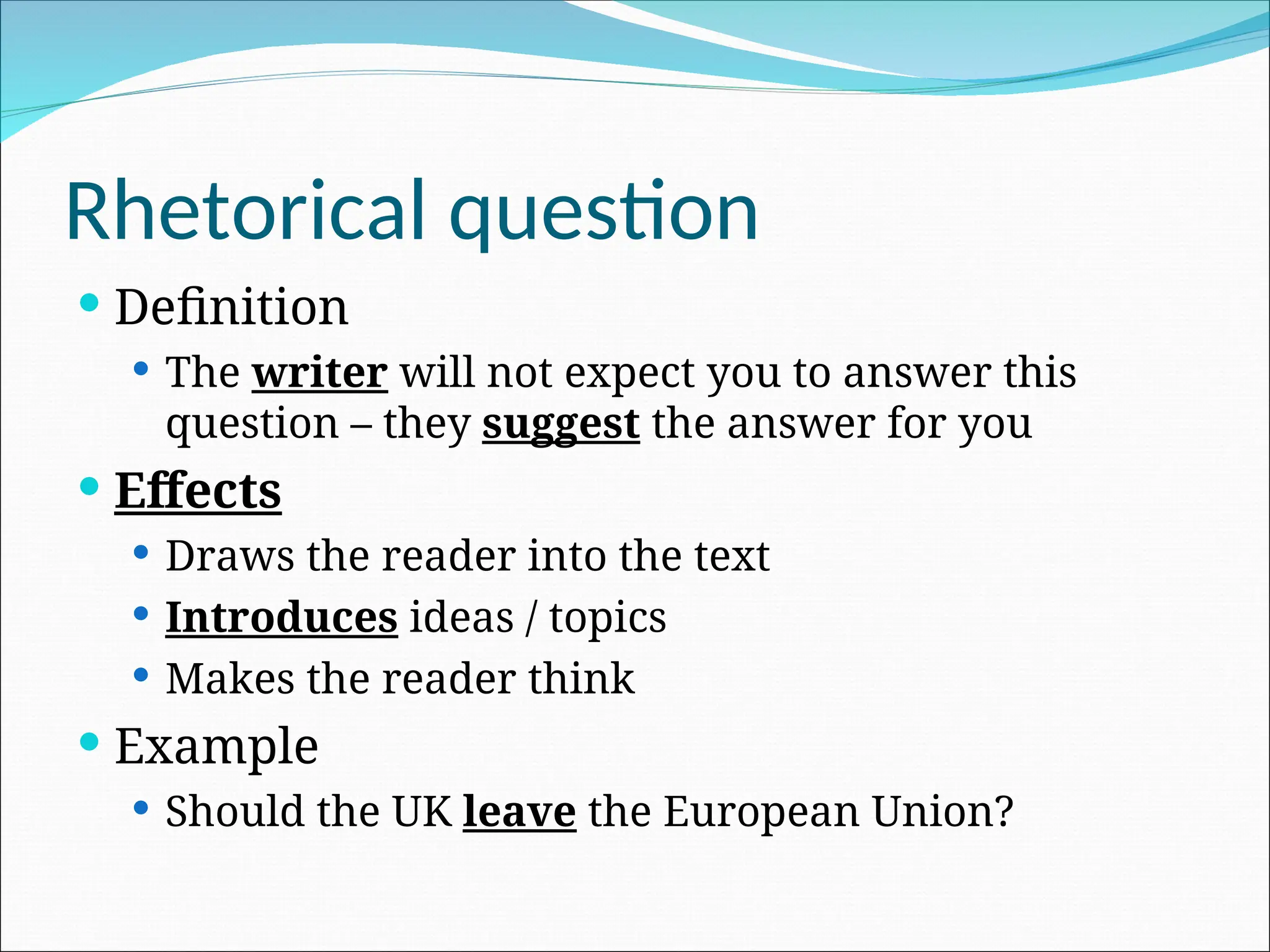
Rhetorical question
Definition
The writer will not expect you to answer this
question – they suggest the answer for you
Effects
Draws the reader into the text
Introduces ideas / topics
Makes the reader think
Example
Should the UK leave the European Union?
4.
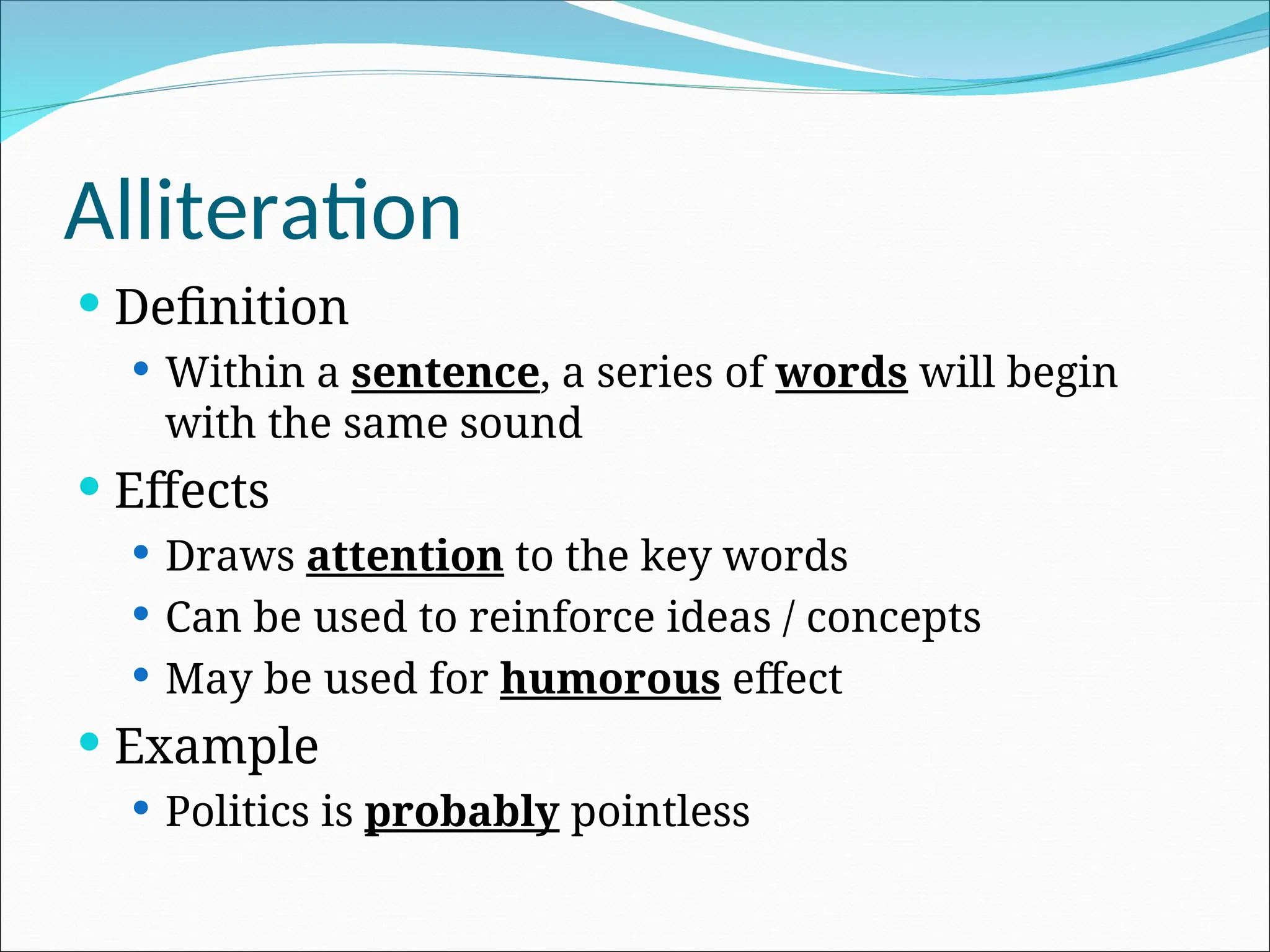
Alliteration
Definition
Withina sentence, a series of words will begin
with the same sound
Effects
Draws attention to the key words
Can be used to reinforce ideas / concepts
May be used for humorous effect
Example
Politics is probably pointless
5.
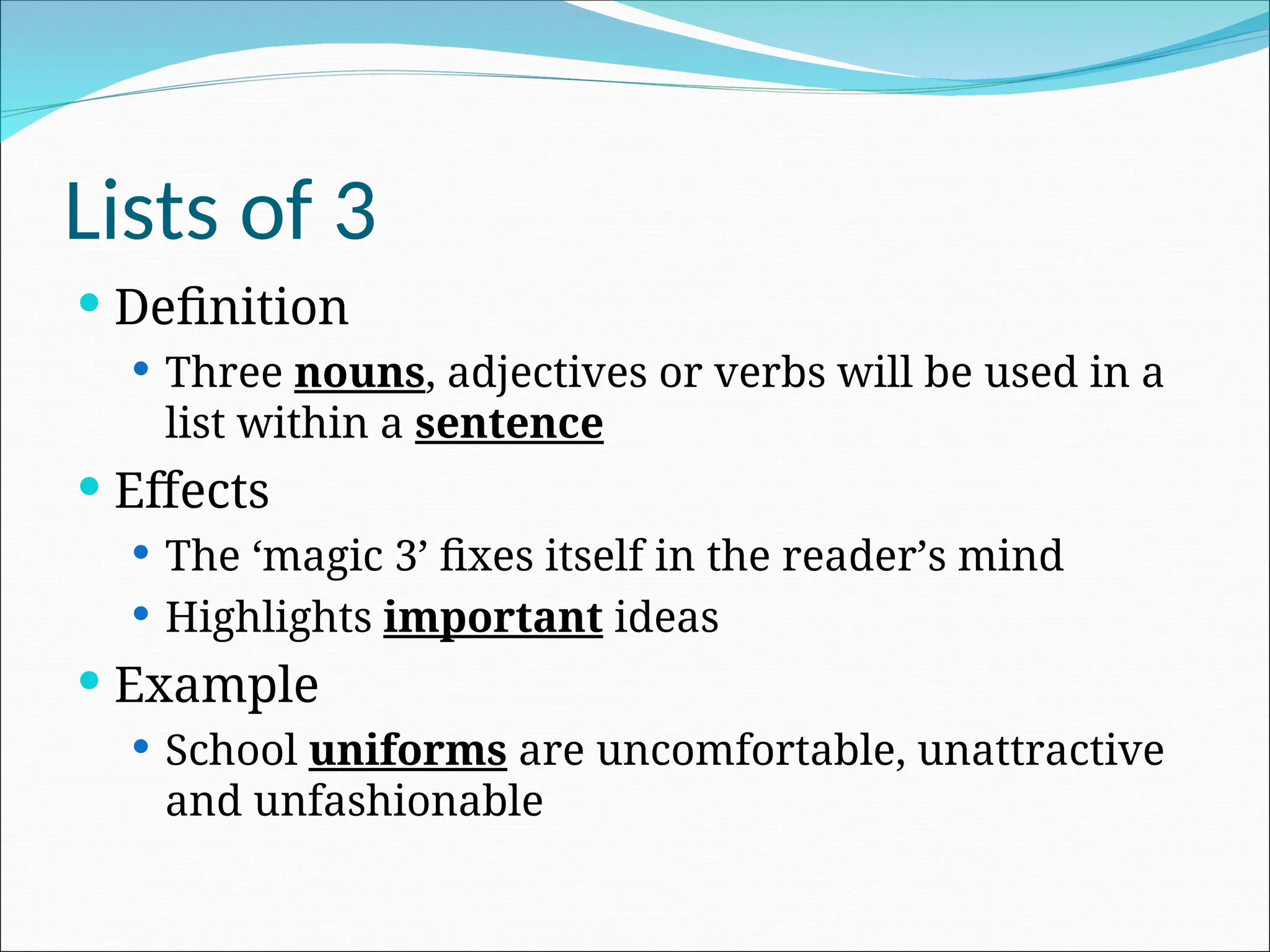
Lists of 3
Definition
Three nouns, adjectives or verbs will be used in a
list within a sentence
Effects
The ‘magic 3’ fixes itself in the reader’s mind
Highlights important ideas
Example
School uniforms are uncomfortable, unattractive
and unfashionable
6.
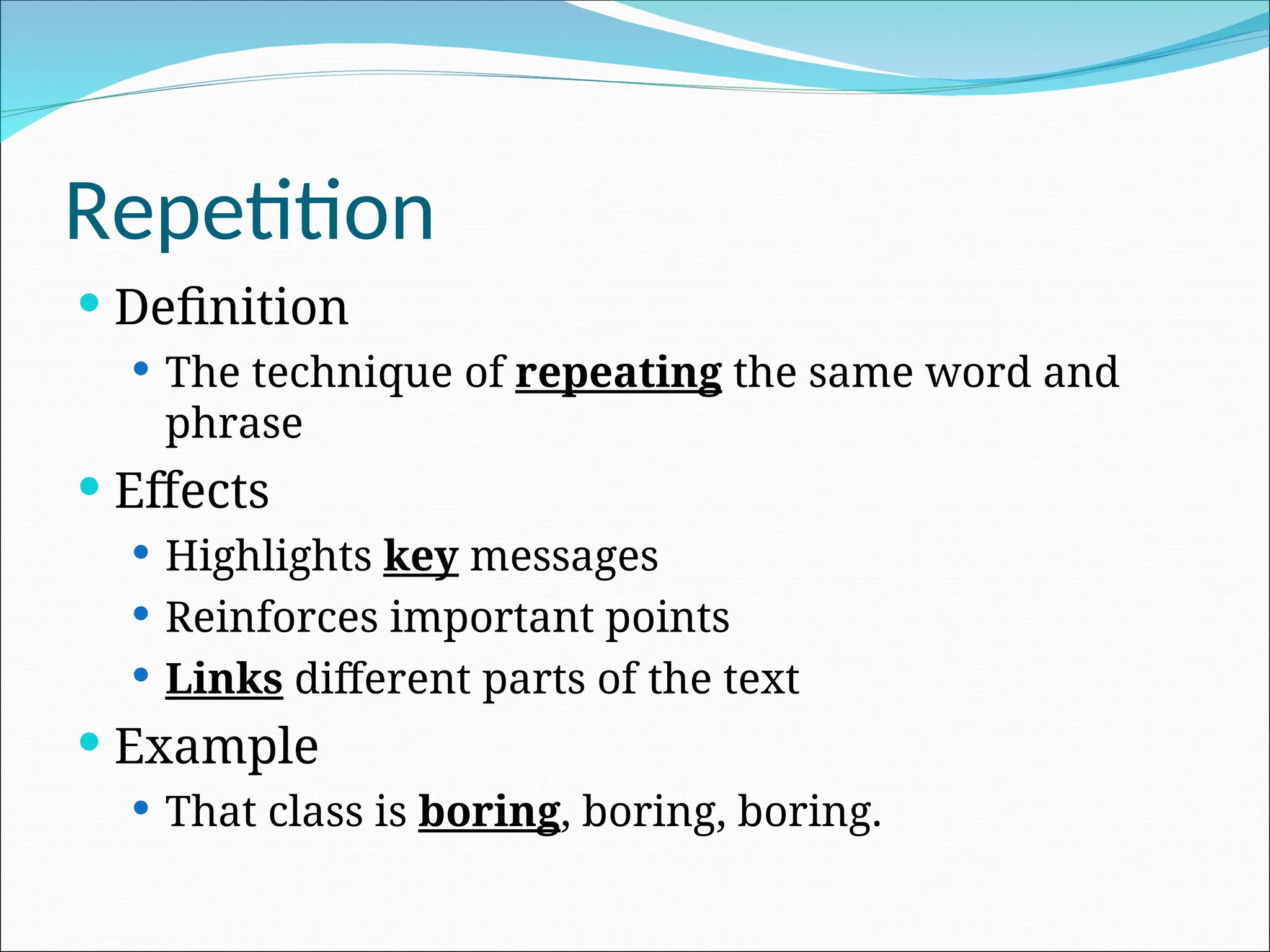
Repetition
Definition
Thetechnique of repeating the same word and
phrase
Effects
Highlights key messages
Reinforces important points
Links different parts of the text
Example
That class is boring, boring, boring.
7.
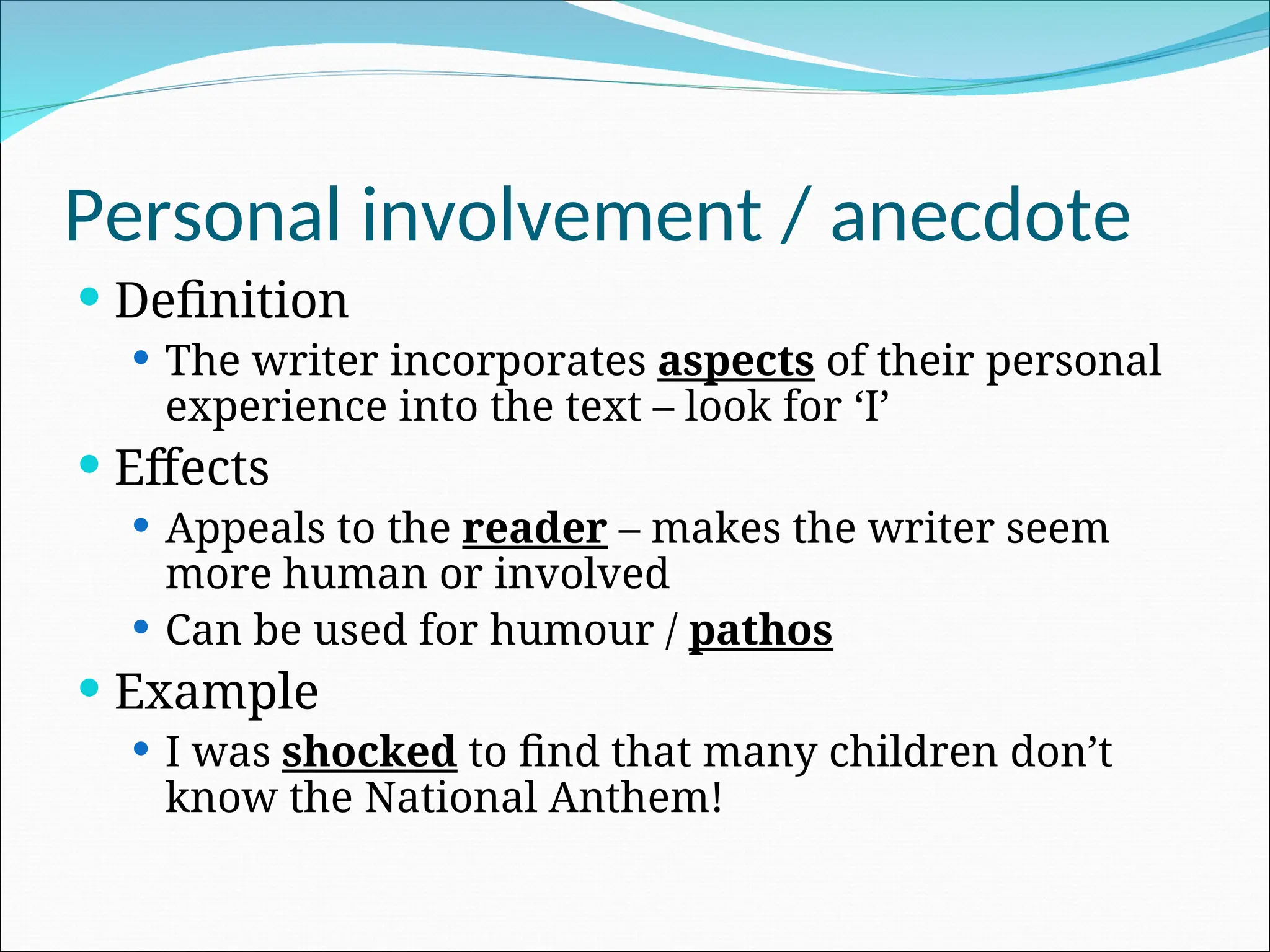
Personal involvement /anecdote
Definition
The writer incorporates aspects of their personal
experience into the text – look for ‘I’
Effects
Appeals to the reader – makes the writer seem
more human or involved
Can be used for humour / pathos
Example
I was shocked to find that many children don’t
know the National Anthem!
8.
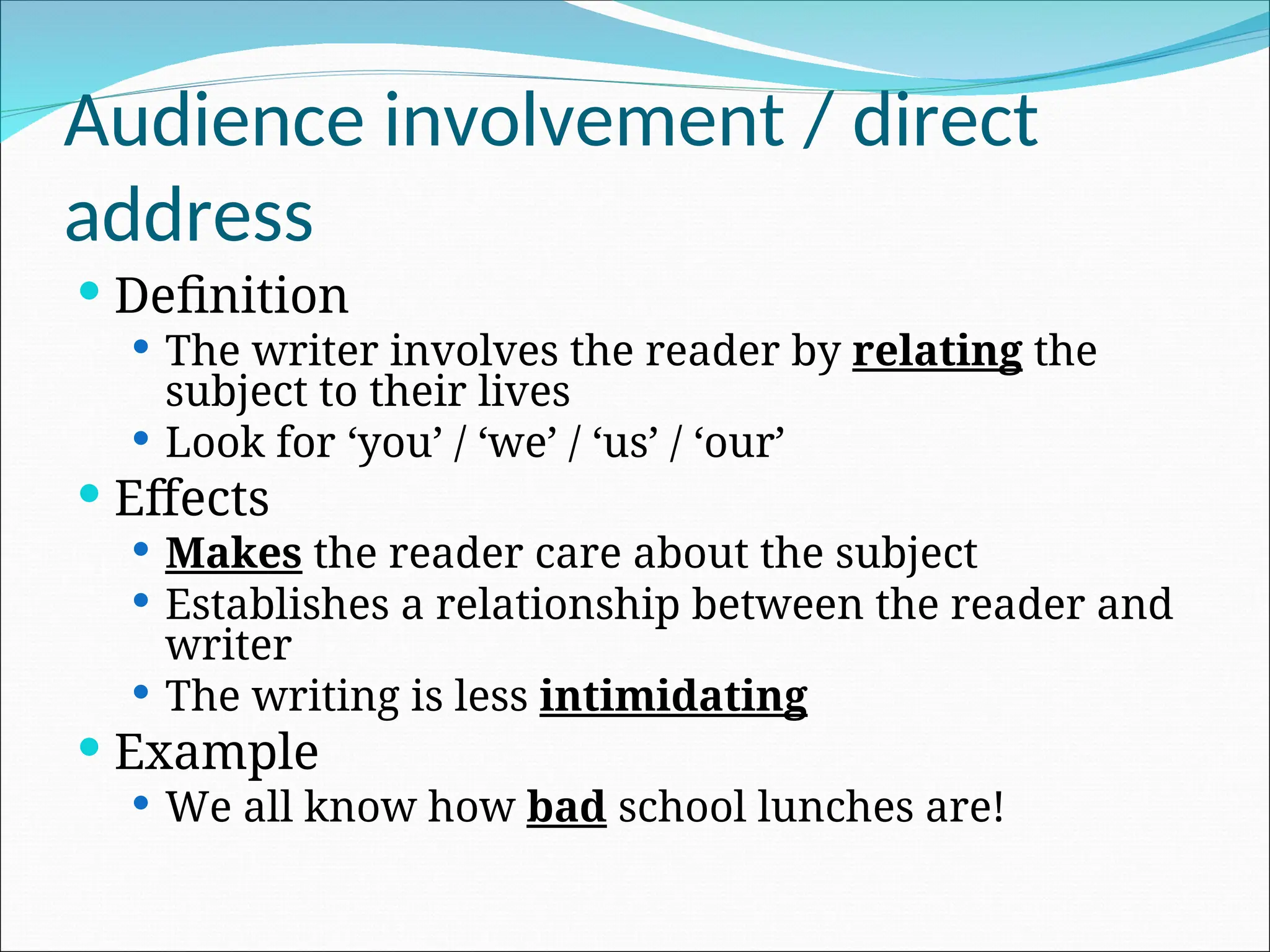
Audience involvement /direct
address
Definition
The writer involves the reader by relating the
subject to their lives
Look for ‘you’ / ‘we’ / ‘us’ / ‘our’
Effects
Makes the reader care about the subject
Establishes a relationship between the reader and
writer
The writing is less intimidating
Example
We all know how bad school lunches are!
9.
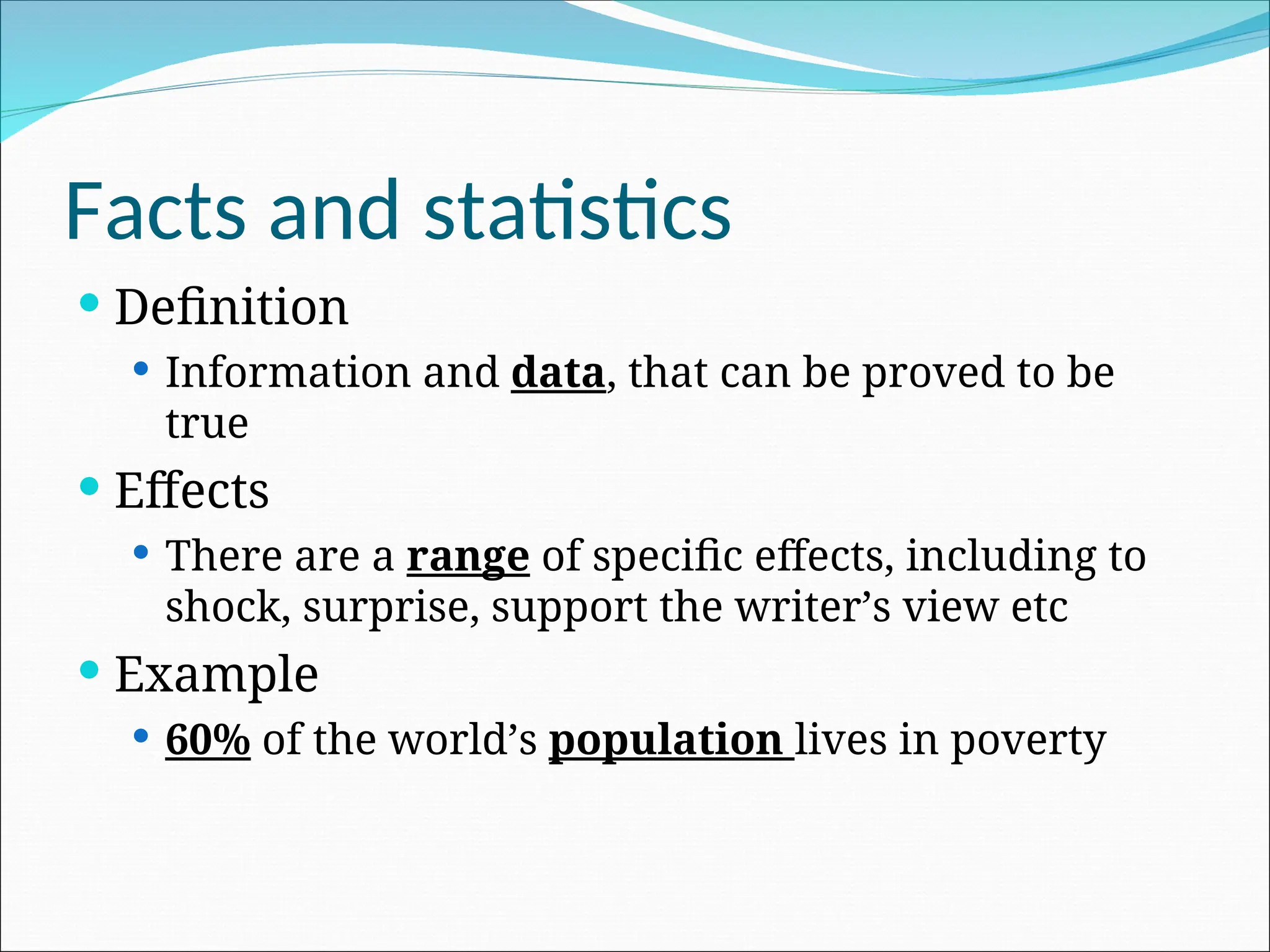
Facts and statistics
Definition
Information and data, that can be proved to be
true
Effects
There are a range of specific effects, including to
shock, surprise, support the writer’s view etc
Example
60% of the world’s population lives in poverty
10.
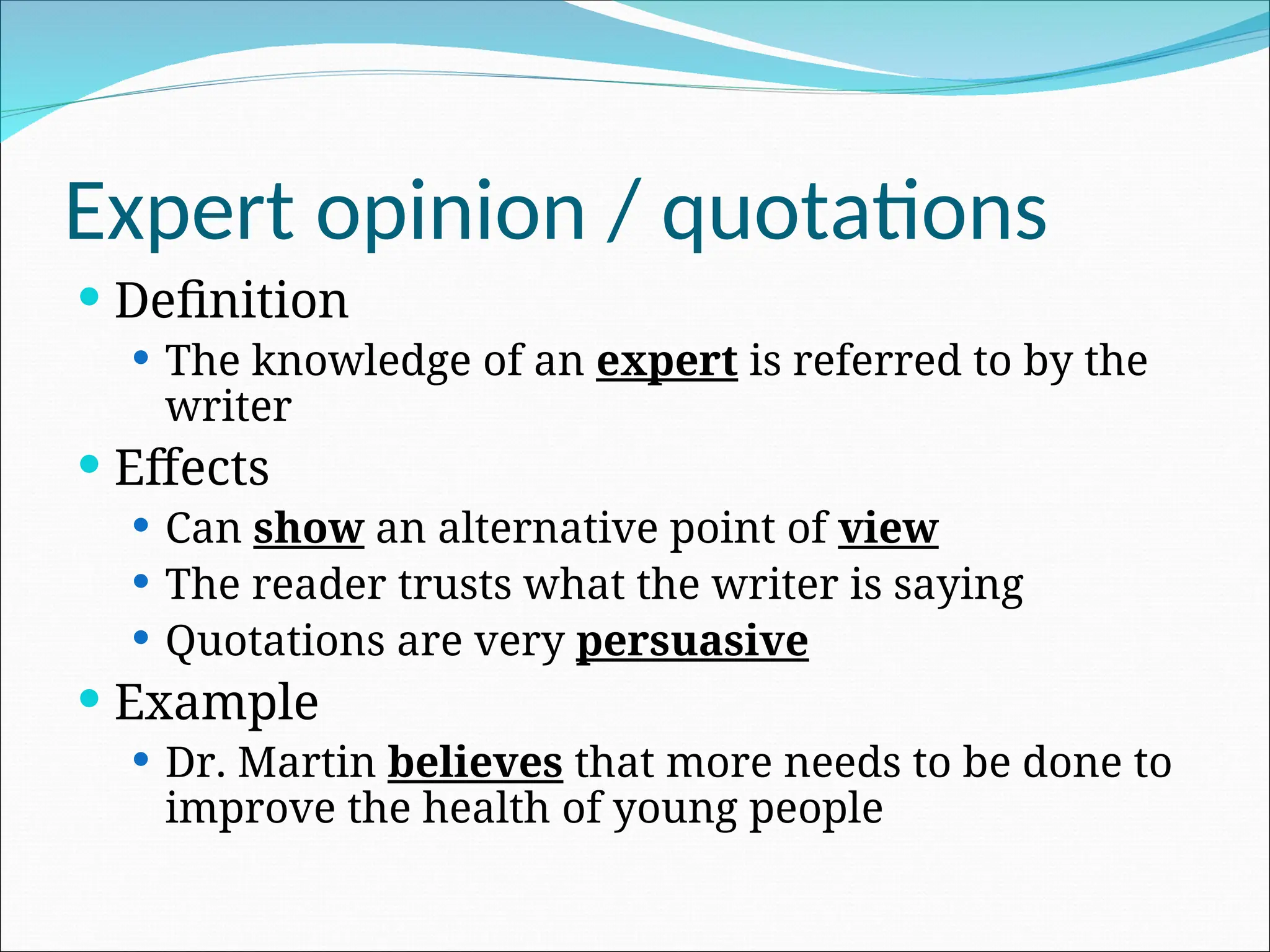
Expert opinion /quotations
Definition
The knowledge of an expert is referred to by the
writer
Effects
Can show an alternative point of view
The reader trusts what the writer is saying
Quotations are very persuasive
Example
Dr. Martin believes that more needs to be done to
improve the health of young people
11.
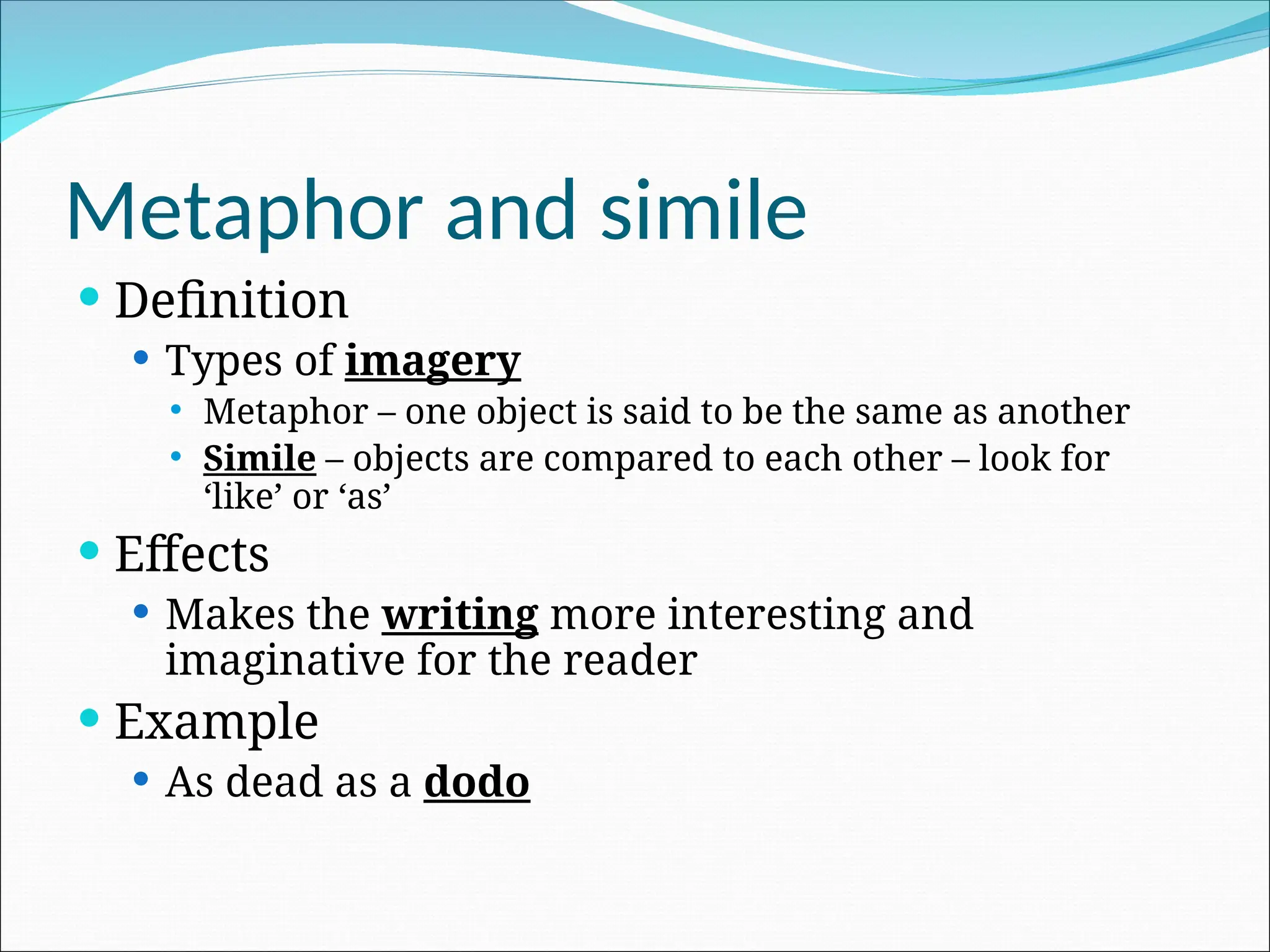
Metaphor and simile
Definition
Types of imagery
Metaphor – one object is said to be the same as another
Simile – objects are compared to each other – look for
‘like’ or ‘as’
Effects
Makes the writing more interesting and
imaginative for the reader
Example
As dead as a dodo
12.
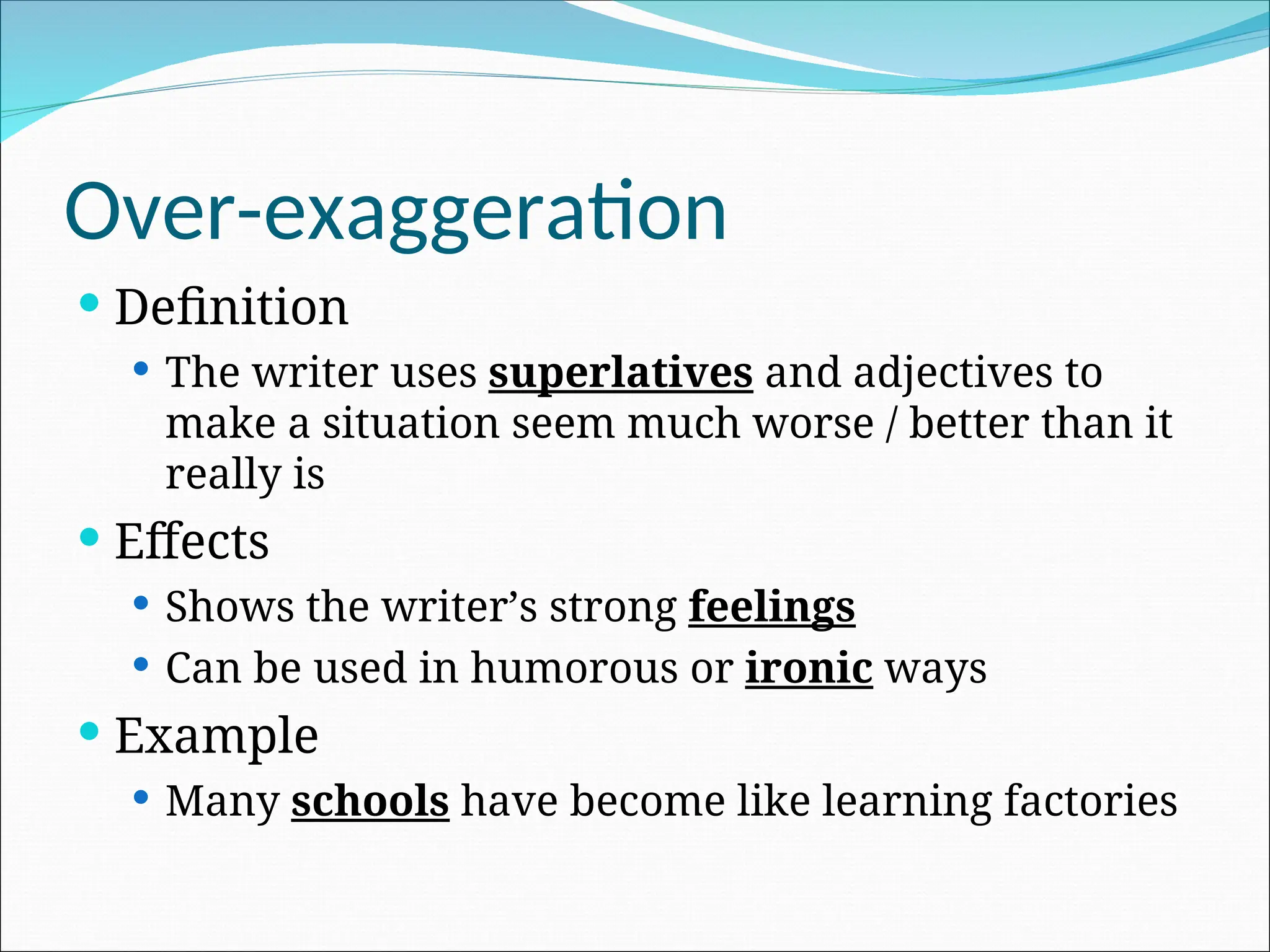
Over-exaggeration
Definition
Thewriter uses superlatives and adjectives to
make a situation seem much worse / better than it
really is
Effects
Shows the writer’s strong feelings
Can be used in humorous or ironic ways
Example
Many schools have become like learning factories
13.
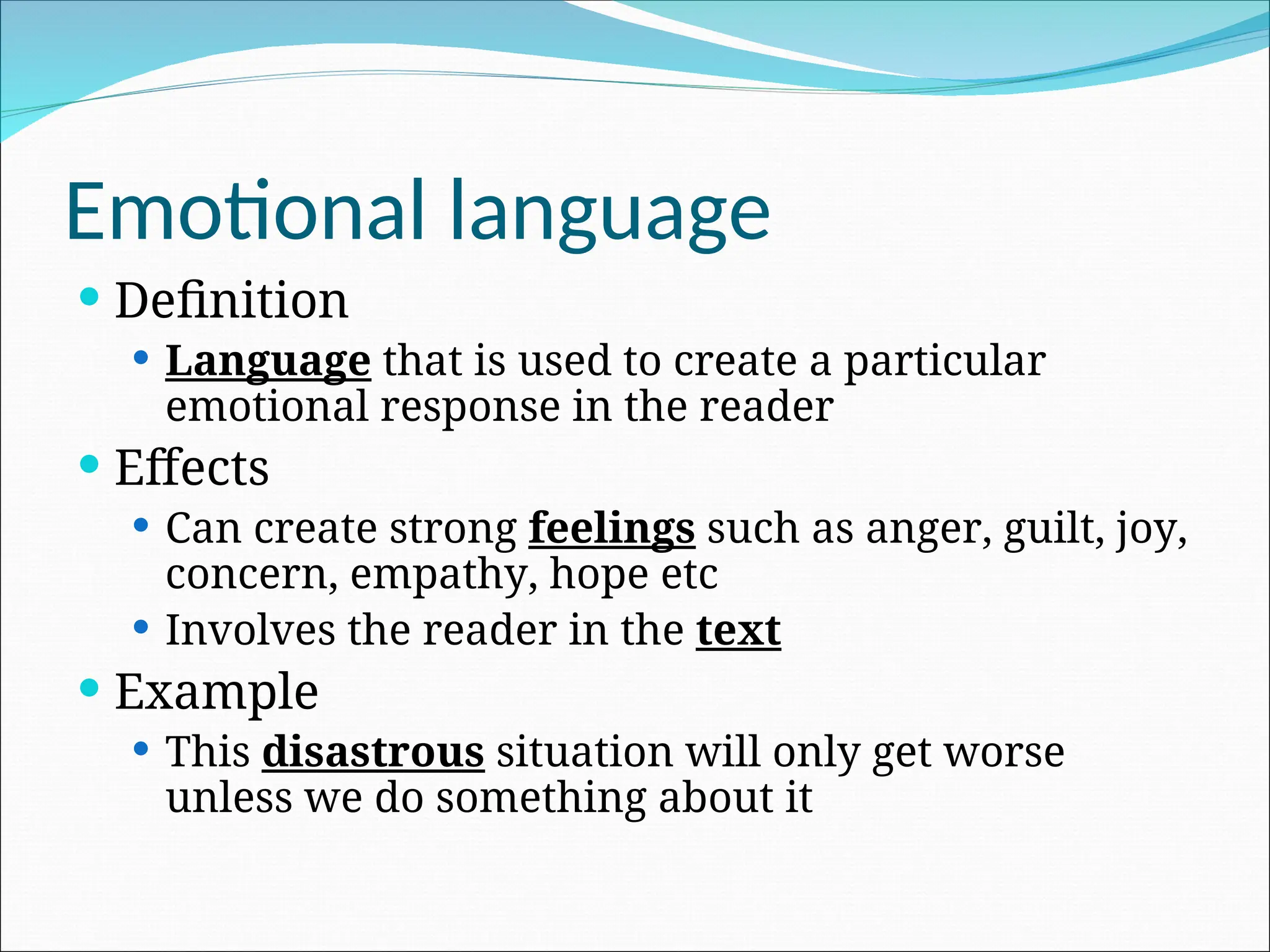
Emotional language
Definition
Language that is used to create a particular
emotional response in the reader
Effects
Can create strong feelings such as anger, guilt, joy,
concern, empathy, hope etc
Involves the reader in the text
Example
This disastrous situation will only get worse
unless we do something about it
14.
Irony / Sarcasm
Definition
Ideas are presented in a way that seems opposite
to what is really meant
Effects
Creates humour
Can over-exaggerate a situation
Engages the reader on a personal level
Example
“What a lovely day” when it is pouring with rain
15.
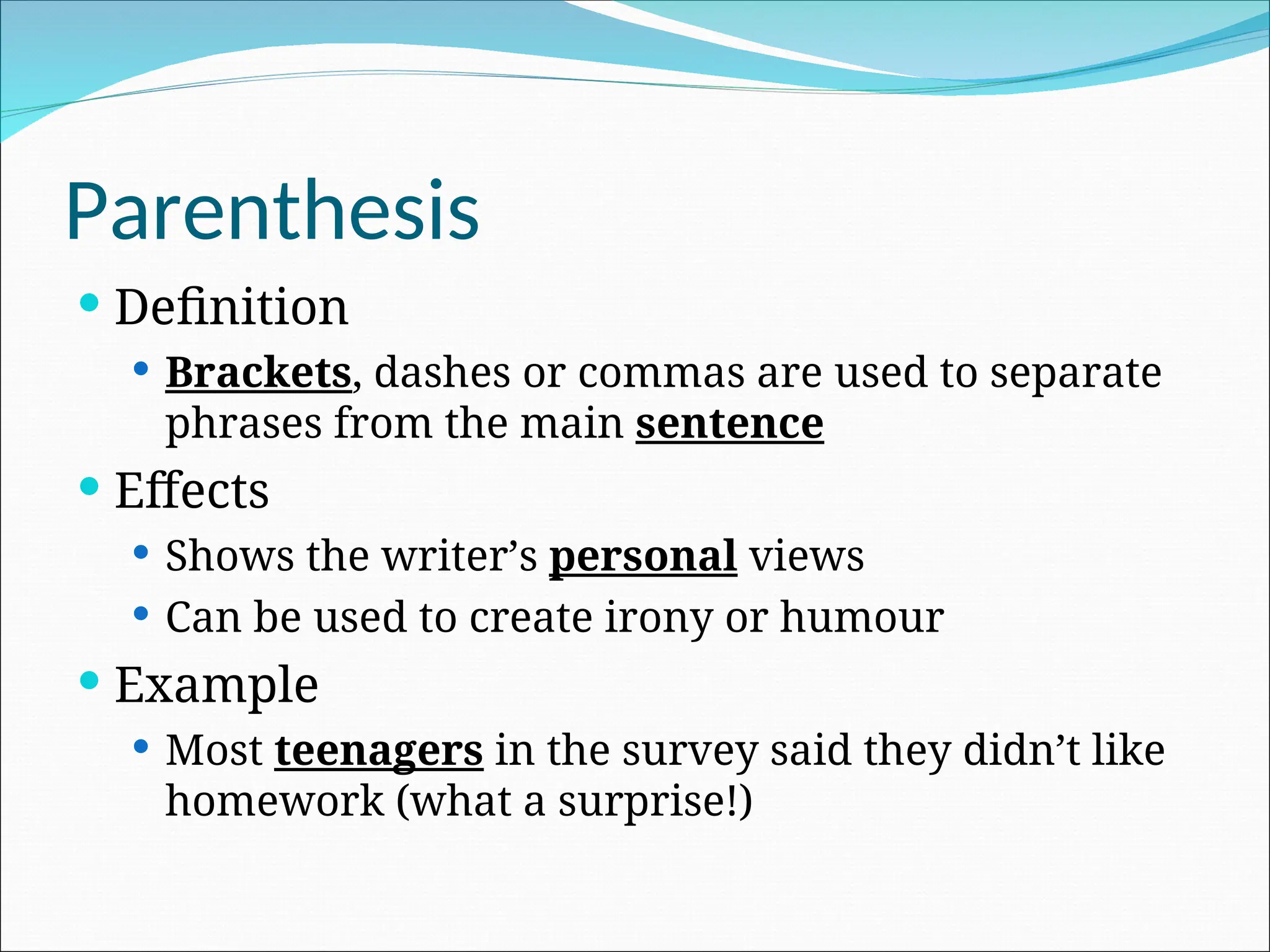
Parenthesis
Definition
Brackets,dashes or commas are used to separate
phrases from the main sentence
Effects
Shows the writer’s personal views
Can be used to create irony or humour
Example
Most teenagers in the survey said they didn’t like
homework (what a surprise!)
16.
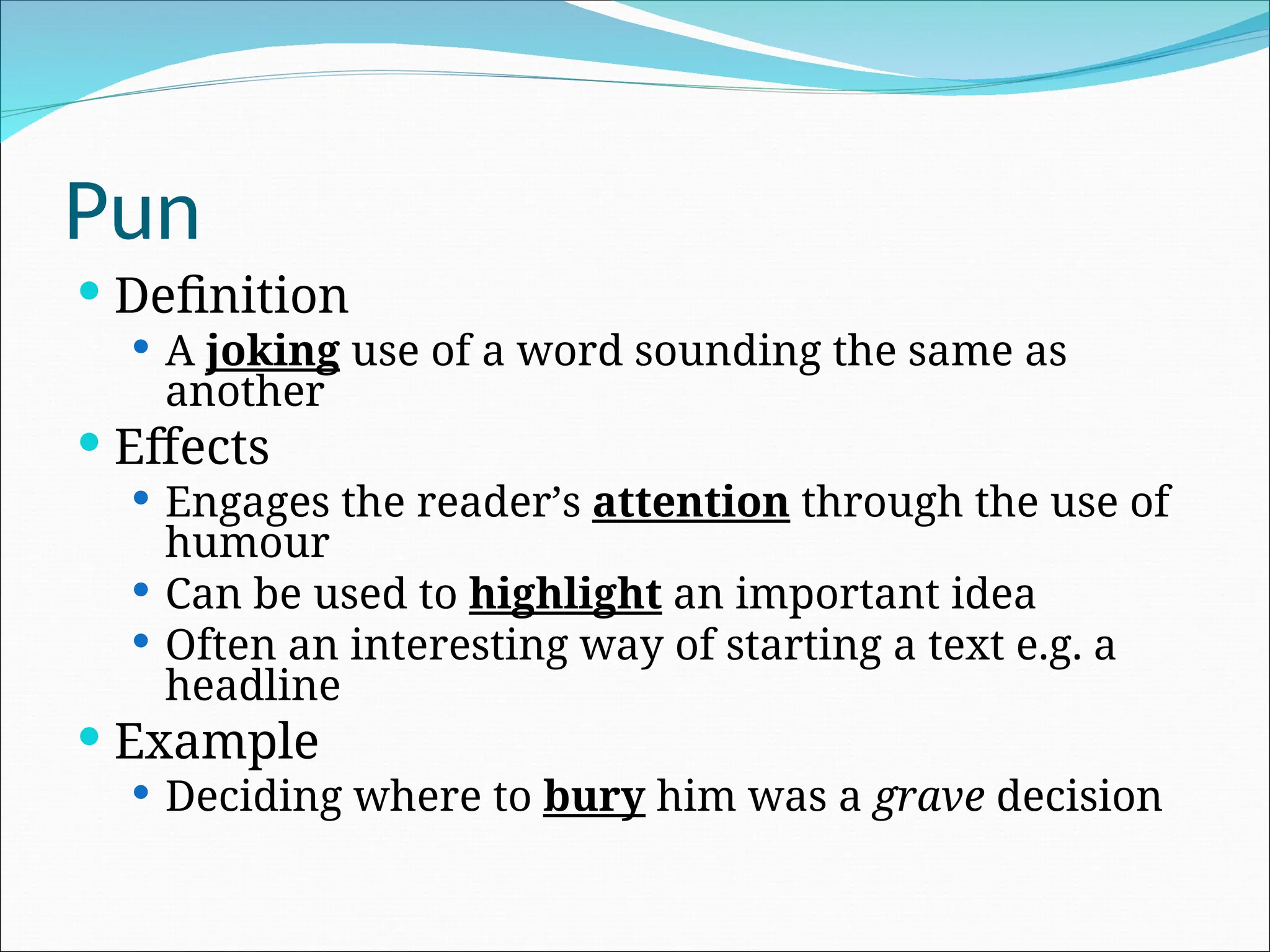
Pun
Definition
Ajoking use of a word sounding the same as
another
Effects
Engages the reader’s attention through the use of
humour
Can be used to highlight an important idea
Often an interesting way of starting a text e.g. a
headline
Example
Deciding where to bury him was a grave decision
17.
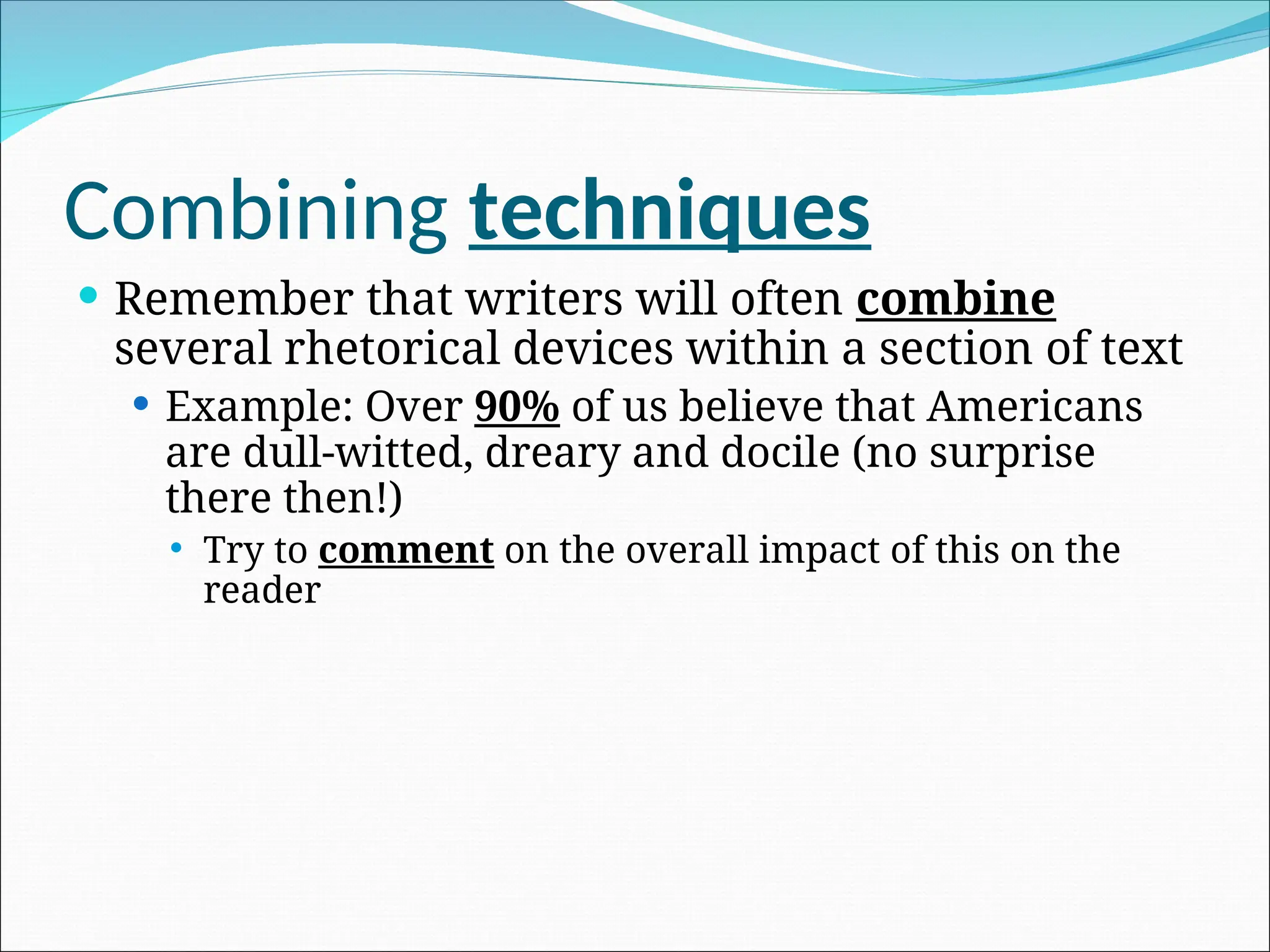
Combining techniques
Rememberthat writers will often combine
several rhetorical devices within a section of text
Example: Over 90% of us believe that Americans
are dull-witted, dreary and docile (no surprise
there then!)
Try to comment on the overall impact of this on the
reader
18.
Important advice
Useyour reading time efficiently. If you
know you have to write about the language in
one of the texts, highlight key examples as
you read it
You do not have to write about every device
– it is better to evaluate three or four good
examples than to simply ‘spot’ lots of them
20.
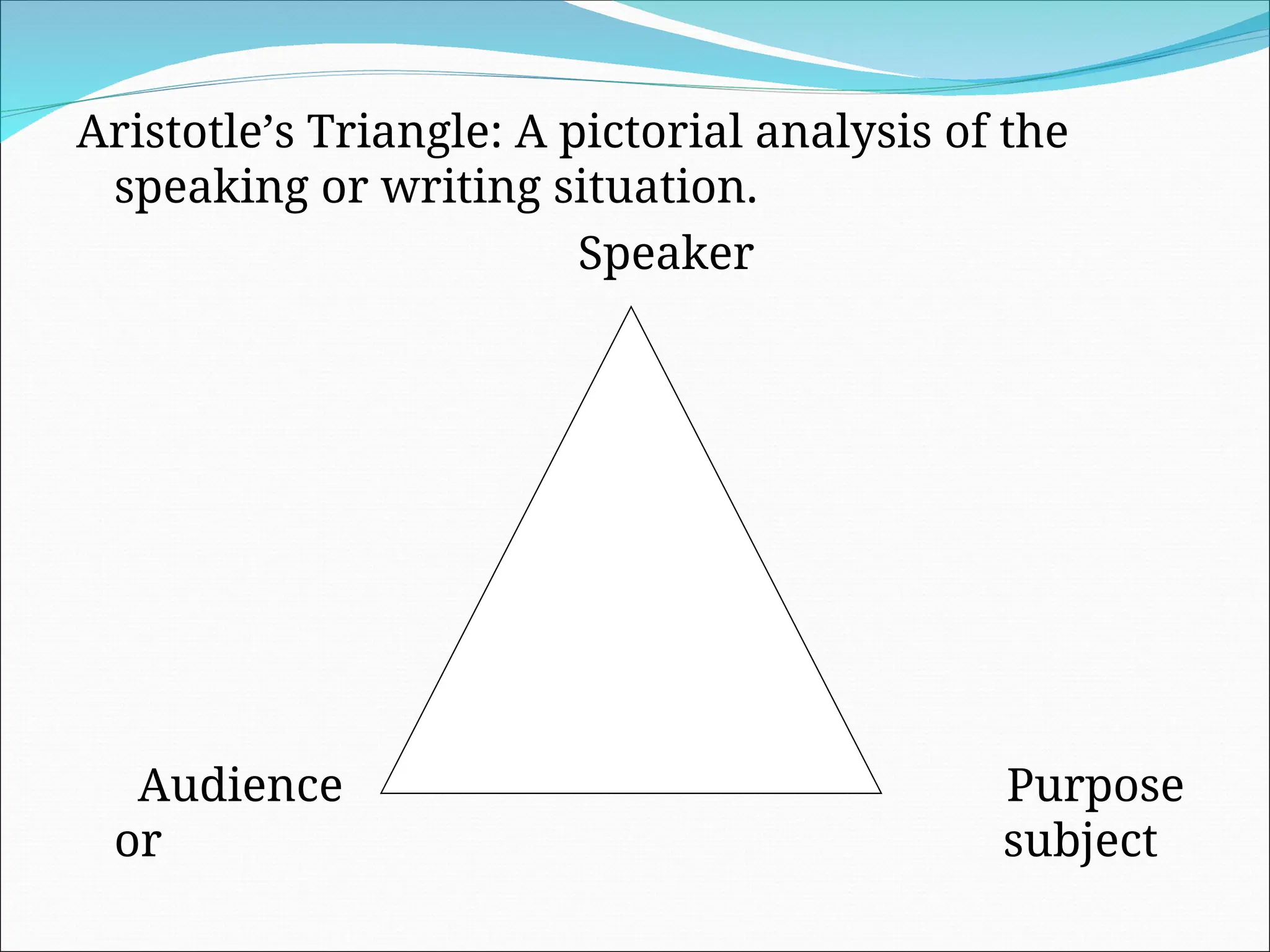
Aristotle’s Triangle: Apictorial analysis of the
speaking or writing situation.
Speaker
Audience Purpose
or subject
21.
Rhetoric
Rhetoric isa fancy word for using persuasive
techniques in writing or speaking.
Basically: using language effectively or persuasively
In rhetoric, a rhetorical device is a technique that an
author or speaker uses to convey to the listener or
reader a meaning with the goal of persuading him or
her towards considering a topic from a different
perspective.
Examples:
Irony
Metaphor
List of 3
Repetition
22.
In order fora speaker or writer to speak or
write, he or she MUST consider both the
audience and purpose.
For example: If you are talking to an elementary
school class, your topic, diction, and tone will be
different than if you were speaking to a high school
class.
Another example: When you talk to your friends,
your topic, diction, and tone are different than
when you talk to your parents or teachers.
23.
The speakeruses different approaches to
influence the audience’s attitude toward the
subject. These are the three ways you can appeal
to an audience.
24.
Logos (logic)
Logosrefers to any attempt to appeal to the
intellect. Everyday arguments rely heavily on ethos
and pathos, but academic arguments rely more on
logos.
Use clear and reasonable ideas with proof (any
statistic)
Effect of appeal: Evokes a cognitive, rational response
For example:
Nine out of ten dentists prefer Crest toothpaste.
If you have a good education, you are more likely to find a
good job.
25.
Ethos (ethical orcredibility)
Related to the English word “ethics” and refers to the
trustworthiness of the speaker/writer. Effective persuasive
strategy because when we believe that the speaker does not
intend to do us harm, we will more likely listen.
The person must be qualified to give this speech.
You must be credible and knowledgeable about the content
about the speech or piece of writing
Effect of appeal: Demonstrates author's reliability,
competence, and respect for the audience's ideas and values
For example:
If you walk in to your calculus class, and I am the teacher, I have
no ethos in that class.
A high school football player gives speech about the time and
discipline required to be a successful football player.
If you are sick, you are not going to go to your mechanic for help.
26.
Pathos (Emotions)
Pathosis related to the words pathetic, sympathy
and empathy. Whenever you accept a claim based
on how it makes you feel without fully analyzing the
rationale behind the claim, you are acting on pathos.
As the writer or speaker, you try to appeal to their
emotions
You may want them to feel sympathy or joy
Effect of appeal: Evokes a personal, emotional
response
For example:
The commercials about the starving children or dogs use
pathos to appeal to your emotions hoping to persuade you
to believe in their purpose.





![Reading Techniques [Autosaved].pptxReading Techniques [Autosaved].pptx](https://cdn.slidesharecdn.com/ss_thumbnails/readingtechniquesautosaved-251211193055-b8821f9d-thumbnail.jpg?width=640&height=640&fit=bounds)


