Stylistics
About this template
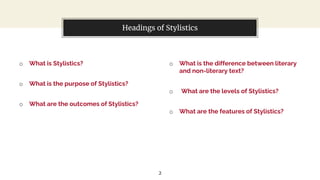
Headings of Stylistics
o What is Stylistics?
o What is the purpose of Stylistics?
o What are the outcomes of Stylistics?
o What is the difference between literary
and non-literary text?
o What are the levels of Stylistics?
o What are the features of Stylistics?
2
1233
I AM IFRA NAZIR
I am here because I love to give presentations.
My topic of Presentation is Stylistics
3
1.
What is Stylistics?
Let’s start with the first set of slides
4
“
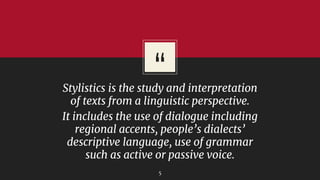
Stylistics is the study and interpretation
of texts from a linguistic perspective.
It includes the use of dialogue including
regional accents, people’s dialects’
descriptive language, use of grammar
such as active or passive voice.
5
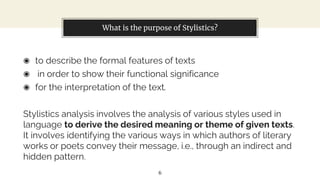
What is the purpose of Stylistics?
◉ to describe the formal features of texts
◉ in order to show their functional significance
◉ for the interpretation of the text.
Stylistics analysis involves the analysis of various styles used in
language to derive the desired meaning or theme of given texts.
It involves identifying the various ways in which authors of literary
works or poets convey their message, i.e., through an indirect and
hidden pattern.
6
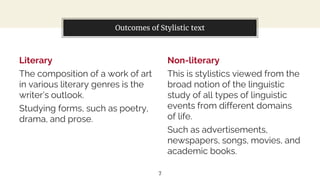
Literary
The composition of a work of art
in various literary genres is the
writer’s outlook.
Studying forms, such as poetry,
drama, and prose.
You can also split your content
Non-literary
This is stylistics viewed from the
broad notion of the linguistic
study of all types of linguistic
events from different domains
of life.
Such as advertisements,
newspapers, songs, movies, and
academic books.
Outcomes of Stylistic text
7
In two or three columns
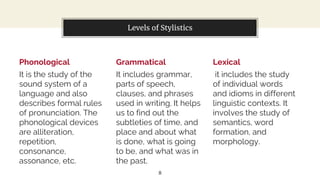
Phonological
It is the study of the
sound system of a
language and also
describes formal rules
of pronunciation. The
phonological devices
are alliteration,
repetition,
consonance,
assonance, etc.
Grammatical
It includes grammar,
parts of speech,
clauses, and phrases
used in writing. It helps
us to find out the
subtleties of time, and
place and about what
is done, what is going
to be, and what was in
the past.
Lexical
it includes the study
of individual words
and idioms in different
linguistic contexts. It
involves the study of
semantics, word
formation, and
morphology.
Levels of Stylistics
8
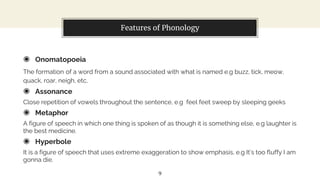
Features of Phonology
◉ Onomatopoeia
The formation of a word from a sound associated with what is named e.g buzz, tick, meow,
quack, roar, neigh, etc.
◉ Assonance
Close repetition of vowels throughout the sentence, e.g feel feet sweep by sleeping geeks
◉ Metaphor
A figure of speech in which one thing is spoken of as though it is something else, e.g laughter is
the best medicine.
◉ Hyperbole
It is a figure of speech that uses extreme exaggeration to show emphasis, e.g It’s too fluffy I am
gonna die.
9
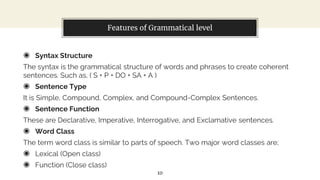
Features of Grammatical level
◉ Syntax Structure
The syntax is the grammatical structure of words and phrases to create coherent
sentences. Such as, ( S + P + DO + SA + A )
◉ Sentence Type
It is Simple, Compound, Complex, and Compound-Complex Sentences.
◉ Sentence Function
These are Declarative, Imperative, Interrogative, and Exclamative sentences.
◉ Word Class
The term word class is similar to parts of speech. Two major word classes are;
◉ Lexical (Open class)
◉ Function (Close class)
10
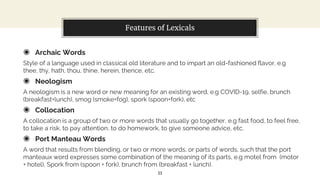
Features of Lexicals
◉ Archaic Words
Style of a language used in classical old literature and to impart an old-fashioned flavor, e.g
thee, thy, hath, thou, thine, herein, thence, etc.
◉ Neologism
A neologism is a new word or new meaning for an existing word, e.g COVID-19, selfie, brunch
(breakfast+lunch), smog (smoke+fog), spork (spoon+fork), etc
◉ Collocation
A collocation is a group of two or more words that usually go together, e.g fast food, to feel free,
to take a risk, to pay attention, to do homework, to give someone advice, etc.
◉ Port Manteau Words
A word that results from blending, or two or more words, or parts of words, such that the port
manteaux word expresses some combination of the meaning of its parts, e.g motel from (motor
+ hotel), Spork from (spoon + fork), brunch from (breakfast + lunch).
11
Thanks!
ANY QUESTIONS?
12

Stylistics and its Levels.pptx

  • 1.
  • 2.
    About this template Headingsof Stylistics o What is Stylistics? o What is the purpose of Stylistics? o What are the outcomes of Stylistics? o What is the difference between literary and non-literary text? o What are the levels of Stylistics? o What are the features of Stylistics? 2
  • 3.
    1233 I AM IFRANAZIR I am here because I love to give presentations. My topic of Presentation is Stylistics 3
  • 4.
    1. What is Stylistics? Let’sstart with the first set of slides 4
  • 5.
    “ Stylistics is thestudy and interpretation of texts from a linguistic perspective. It includes the use of dialogue including regional accents, people’s dialects’ descriptive language, use of grammar such as active or passive voice. 5
  • 6.
    What is thepurpose of Stylistics? ◉ to describe the formal features of texts ◉ in order to show their functional significance ◉ for the interpretation of the text. Stylistics analysis involves the analysis of various styles used in language to derive the desired meaning or theme of given texts. It involves identifying the various ways in which authors of literary works or poets convey their message, i.e., through an indirect and hidden pattern. 6
  • 7.
    Literary The composition ofa work of art in various literary genres is the writer’s outlook. Studying forms, such as poetry, drama, and prose. You can also split your content Non-literary This is stylistics viewed from the broad notion of the linguistic study of all types of linguistic events from different domains of life. Such as advertisements, newspapers, songs, movies, and academic books. Outcomes of Stylistic text 7
  • 8.
    In two orthree columns Phonological It is the study of the sound system of a language and also describes formal rules of pronunciation. The phonological devices are alliteration, repetition, consonance, assonance, etc. Grammatical It includes grammar, parts of speech, clauses, and phrases used in writing. It helps us to find out the subtleties of time, and place and about what is done, what is going to be, and what was in the past. Lexical it includes the study of individual words and idioms in different linguistic contexts. It involves the study of semantics, word formation, and morphology. Levels of Stylistics 8
  • 9.
    Features of Phonology ◉Onomatopoeia The formation of a word from a sound associated with what is named e.g buzz, tick, meow, quack, roar, neigh, etc. ◉ Assonance Close repetition of vowels throughout the sentence, e.g feel feet sweep by sleeping geeks ◉ Metaphor A figure of speech in which one thing is spoken of as though it is something else, e.g laughter is the best medicine. ◉ Hyperbole It is a figure of speech that uses extreme exaggeration to show emphasis, e.g It’s too fluffy I am gonna die. 9
  • 10.
    Features of Grammaticallevel ◉ Syntax Structure The syntax is the grammatical structure of words and phrases to create coherent sentences. Such as, ( S + P + DO + SA + A ) ◉ Sentence Type It is Simple, Compound, Complex, and Compound-Complex Sentences. ◉ Sentence Function These are Declarative, Imperative, Interrogative, and Exclamative sentences. ◉ Word Class The term word class is similar to parts of speech. Two major word classes are; ◉ Lexical (Open class) ◉ Function (Close class) 10
  • 11.
    Features of Lexicals ◉Archaic Words Style of a language used in classical old literature and to impart an old-fashioned flavor, e.g thee, thy, hath, thou, thine, herein, thence, etc. ◉ Neologism A neologism is a new word or new meaning for an existing word, e.g COVID-19, selfie, brunch (breakfast+lunch), smog (smoke+fog), spork (spoon+fork), etc ◉ Collocation A collocation is a group of two or more words that usually go together, e.g fast food, to feel free, to take a risk, to pay attention, to do homework, to give someone advice, etc. ◉ Port Manteau Words A word that results from blending, or two or more words, or parts of words, such that the port manteaux word expresses some combination of the meaning of its parts, e.g motel from (motor + hotel), Spork from (spoon + fork), brunch from (breakfast + lunch). 11
  • 12.