Stylistics & Practical Criticism  Objectives: *To understand the differences between stylistics and practical criticism *To be able to use stylistics and practical criticism to develop our understanding of the Pre-Release texts.
Literary Approaches:  Practical Criticism The analysis of the literary devices used in a text.  The literary text is seen as a self-sufficient work of art.  Rhyme Scheme Figurative Language (similes / metaphors / imagery / alliteration / personification) Enjambment Pathetic Fallacy  Etc …
Linguistic Approach: Stylistics The analysis of the language used in a text to help the reader arrive at an objective view.  Sentence structure (clauses / verbs / noun phrases etc ..) Connotations / Denotations Active / Passive grammatical structures phonology Etc …
Why is stylistics a useful approach? Stylistics allows you to make detailed comparisons about ALL the texts – both literary and non-literary. As you are stating what is used (linguistically) it allows you to be more objective (unbiased). BE CAREFUL – stylistic analysis will not give you all the answers.
Why is practical criticism a useful approach? Practical Criticism allows you to make detailed comparisons about literary texts it identifies how a text conforms or deviates from the typical features of that genre. The careful study of form and style and an analysis of techniques enables the reader to reveal the fine moral perceptions embedded in a text. BE CAREFUL – practical criticism is limited – it only considers the words on the page.
Stylistic or Practical? Look at the list of words on the next two slides.  Divide them into two categories (S) for Stylistic and (PC) for Practical Criticism.  Two have been done for you! Do you know what they mean?  Colour code your list: Red = No Idea Amber = I think I have some idea Green = I know what this means.
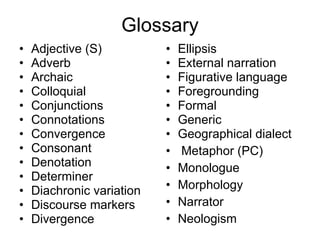
Glossary Adjective (S)  Adverb  Archaic Colloquial  Conjunctions  Connotations Convergence  Consonant  Denotation Determiner  Diachronic variation  Discourse markers  Divergence  Ellipsis  External narration  Figurative language  Foregrounding  Formal  Generic  Geographical dialect Metaphor (PC) Monologue Morphology Narrator Neologism
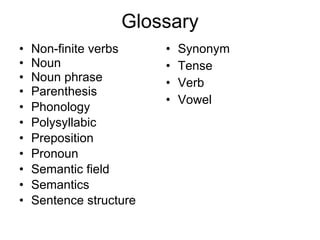
Glossary Non-finite verbs Noun  Noun phrase  Parenthesis Phonology  Polysyllabic  Preposition  Pronoun  Semantic field Semantics  Sentence structure Synonym Tense  Verb  Vowel
Task Read Activity 10. *How do they differ? *Where do they overlap?
Semantic Fields  Objectives: *To develop our understanding of semantic fields  *To be able to use  semantic fields when analysing texts.
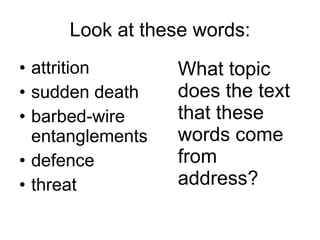
Look at these words: attrition sudden death barbed-wire entanglements defence threat What topic does the text that these words come from address?
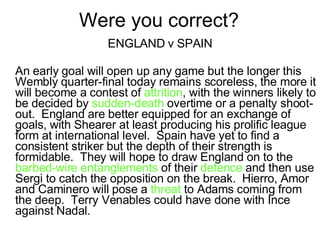
Were you correct? ENGLAND v SPAIN An early goal will open up any game but the longer this Wembly quarter-final today remains scoreless, the more it will become a contest of  attrition , with the winners likely to be decided by  sudden-death  overtime or a penalty shoot-out.  England are better equipped for an exchange of goals, with Shearer at least producing his prolific league form at international level.  Spain have yet to find a consistent striker but the depth of their strength is formidable.  They will hope to draw England on to the  barbed-wire entanglements  of their  defence  and then use Sergi to catch the opposition on the break.  Hierro, Amor and Caminero will pose a  threat  to Adams coming from the deep.  Terry Venables could have done with Ince against Nadal.
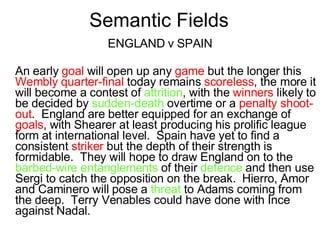
Semantic Fields The reporter has used two semantic fields within the report The words highlighted in green most people would assume to be from the semantic field of war The second semantic field are words one would associate with football reports – what words would form that semantic field?
Semantic Fields ENGLAND v SPAIN An early  goal  will open up any  game  but the longer this  Wembly quarter-final  today remains  scoreless , the more it will become a contest of  attrition , with the  winners  likely to be decided by  sudden-death  overtime or a  penalty shoot-out .  England are better equipped for an exchange of  goals , with Shearer at least producing his prolific league form at international level.  Spain have yet to find a consistent  striker  but the depth of their strength is formidable.  They will hope to draw England on to the  barbed-wire entanglements  of their  defence  and then use Sergi to catch the opposition on the break.  Hierro, Amor and Caminero will pose a  threat  to Adams coming from the deep.  Terry Venables could have done with Ince against Nadal.
How does the writer’s use of the war semantic field code the text? What does it tell us about the role football plays in today's society?
Semantic Fields  PRE-RELEASE Look at each of the pre-release texts you have been given. Make a note of words / phrases within each text that are in the same semantic field. You may find you have more than one semantic field per text – write a list of words / phrases that belong to each semantic field. How many of the texts share semantic fields?
Glossary Adjective – a word added to a noun to qualify it. Adverb – a word add to a verb to modify it’s meaning. Archaic – referring to language features that are no longer in use. Colloquial  - local dialect / slang Conjunctions – a word that connects sentences, clauses and words. Connotations - the implied meanings / associations of a word.  Convergence – a tendency to behave the same as people with whom one has contact.
Glossary  Consonant – a speech sound other than a vowel. Denotation – the surface meaning of the word. Determiner – a limiting adjective or modifying word (any, my) Diachronic variation – variation in the language that changes over time. Discourse markers – words and phrases that signal the structure and organisation of the text. Divergence – a tendency to behave differently from people with whom one has contact.
Glossary Ellipsis – an abbreviation in which a word or words are left out and implied. External narration – where the teller of the story is an external character. Figurative language (non-literal) Foregrounding – bringing something to our attention. Formal – proper. Generic – referring to the whole group. Geographical dialect – evidence from what is said / written of speaker’s regional origins.
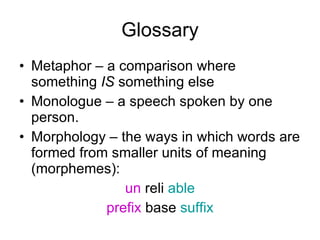
Glossary Metaphor – a comparison where something  IS  something else Monologue – a speech spoken by one person. Morphology – the ways in which words are formed from smaller units of meaning (morphemes): un  reli  able prefix  base  suffix
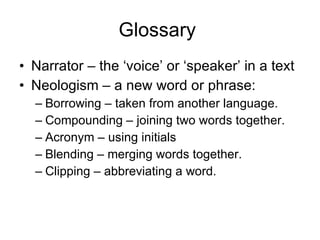
Glossary  Narrator – the ‘voice’ or ‘speaker’ in a text Neologism – a new word or phrase: Borrowing – taken from another language. Compounding – joining two words together. Acronym – using initials Blending – merging words together. Clipping – abbreviating a word.
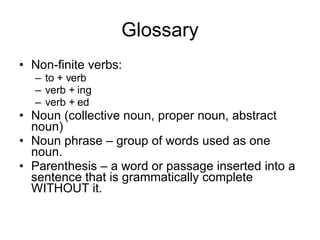
Glossary Non-finite verbs: to + verb verb + ing verb + ed Noun (collective noun, proper noun, abstract noun) Noun phrase – group of words used as one noun. Parenthesis – a word or passage inserted into a sentence that is grammatically complete WITHOUT it.
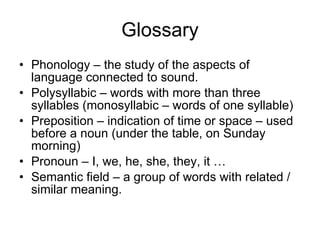
Glossary Phonology – the study of the aspects of language connected to sound. Polysyllabic – words with more than three syllables (monosyllabic – words of one syllable) Preposition – indication of time or space – used before a noun (under the table, on Sunday morning) Pronoun – I, we, he, she, they, it …  Semantic field – a group of words with related / similar meaning.
Glossary Semantics – the study of words and their meanings. Sentence structure: Single – a sentence with only one verb group Compound – sentences / clauses linked simply (and, but) Complex – sentences where subordinate clauses are bound together by more complex connectives and punctuation Minor – fragment of a sentence Declarative – a statement (most common sentence) Imperative – a command Interrogative – a question.
Glossary Synonym – a word that has the same meaning as another. Tense – past /  present / future Verb – a ‘doing’ word  Vowel – a e i o u

A2 English Literature & Language - Practical & Stylistics

  • 1.
    Stylistics & PracticalCriticism Objectives: *To understand the differences between stylistics and practical criticism *To be able to use stylistics and practical criticism to develop our understanding of the Pre-Release texts.
  • 2.
    Literary Approaches: Practical Criticism The analysis of the literary devices used in a text. The literary text is seen as a self-sufficient work of art. Rhyme Scheme Figurative Language (similes / metaphors / imagery / alliteration / personification) Enjambment Pathetic Fallacy Etc …
  • 3.
    Linguistic Approach: StylisticsThe analysis of the language used in a text to help the reader arrive at an objective view. Sentence structure (clauses / verbs / noun phrases etc ..) Connotations / Denotations Active / Passive grammatical structures phonology Etc …
  • 4.
    Why is stylisticsa useful approach? Stylistics allows you to make detailed comparisons about ALL the texts – both literary and non-literary. As you are stating what is used (linguistically) it allows you to be more objective (unbiased). BE CAREFUL – stylistic analysis will not give you all the answers.
  • 5.
    Why is practicalcriticism a useful approach? Practical Criticism allows you to make detailed comparisons about literary texts it identifies how a text conforms or deviates from the typical features of that genre. The careful study of form and style and an analysis of techniques enables the reader to reveal the fine moral perceptions embedded in a text. BE CAREFUL – practical criticism is limited – it only considers the words on the page.
  • 6.
    Stylistic or Practical?Look at the list of words on the next two slides. Divide them into two categories (S) for Stylistic and (PC) for Practical Criticism. Two have been done for you! Do you know what they mean? Colour code your list: Red = No Idea Amber = I think I have some idea Green = I know what this means.
  • 7.
    Glossary Adjective (S) Adverb Archaic Colloquial Conjunctions Connotations Convergence Consonant Denotation Determiner Diachronic variation Discourse markers Divergence Ellipsis External narration Figurative language Foregrounding Formal Generic Geographical dialect Metaphor (PC) Monologue Morphology Narrator Neologism
  • 8.
    Glossary Non-finite verbsNoun Noun phrase Parenthesis Phonology Polysyllabic Preposition Pronoun Semantic field Semantics Sentence structure Synonym Tense Verb Vowel
  • 9.
    Task Read Activity10. *How do they differ? *Where do they overlap?
  • 10.
    Semantic Fields Objectives: *To develop our understanding of semantic fields *To be able to use semantic fields when analysing texts.
  • 11.
    Look at thesewords: attrition sudden death barbed-wire entanglements defence threat What topic does the text that these words come from address?
  • 12.
    Were you correct?ENGLAND v SPAIN An early goal will open up any game but the longer this Wembly quarter-final today remains scoreless, the more it will become a contest of attrition , with the winners likely to be decided by sudden-death overtime or a penalty shoot-out. England are better equipped for an exchange of goals, with Shearer at least producing his prolific league form at international level. Spain have yet to find a consistent striker but the depth of their strength is formidable. They will hope to draw England on to the barbed-wire entanglements of their defence and then use Sergi to catch the opposition on the break. Hierro, Amor and Caminero will pose a threat to Adams coming from the deep. Terry Venables could have done with Ince against Nadal.
  • 13.
    Semantic Fields Thereporter has used two semantic fields within the report The words highlighted in green most people would assume to be from the semantic field of war The second semantic field are words one would associate with football reports – what words would form that semantic field?
  • 14.
    Semantic Fields ENGLANDv SPAIN An early goal will open up any game but the longer this Wembly quarter-final today remains scoreless , the more it will become a contest of attrition , with the winners likely to be decided by sudden-death overtime or a penalty shoot-out . England are better equipped for an exchange of goals , with Shearer at least producing his prolific league form at international level. Spain have yet to find a consistent striker but the depth of their strength is formidable. They will hope to draw England on to the barbed-wire entanglements of their defence and then use Sergi to catch the opposition on the break. Hierro, Amor and Caminero will pose a threat to Adams coming from the deep. Terry Venables could have done with Ince against Nadal.
  • 15.
    How does thewriter’s use of the war semantic field code the text? What does it tell us about the role football plays in today's society?
  • 16.
    Semantic Fields PRE-RELEASE Look at each of the pre-release texts you have been given. Make a note of words / phrases within each text that are in the same semantic field. You may find you have more than one semantic field per text – write a list of words / phrases that belong to each semantic field. How many of the texts share semantic fields?
  • 17.
    Glossary Adjective –a word added to a noun to qualify it. Adverb – a word add to a verb to modify it’s meaning. Archaic – referring to language features that are no longer in use. Colloquial - local dialect / slang Conjunctions – a word that connects sentences, clauses and words. Connotations - the implied meanings / associations of a word. Convergence – a tendency to behave the same as people with whom one has contact.
  • 18.
    Glossary Consonant– a speech sound other than a vowel. Denotation – the surface meaning of the word. Determiner – a limiting adjective or modifying word (any, my) Diachronic variation – variation in the language that changes over time. Discourse markers – words and phrases that signal the structure and organisation of the text. Divergence – a tendency to behave differently from people with whom one has contact.
  • 19.
    Glossary Ellipsis –an abbreviation in which a word or words are left out and implied. External narration – where the teller of the story is an external character. Figurative language (non-literal) Foregrounding – bringing something to our attention. Formal – proper. Generic – referring to the whole group. Geographical dialect – evidence from what is said / written of speaker’s regional origins.
  • 20.
    Glossary Metaphor –a comparison where something IS something else Monologue – a speech spoken by one person. Morphology – the ways in which words are formed from smaller units of meaning (morphemes): un reli able prefix base suffix
  • 21.
    Glossary Narrator– the ‘voice’ or ‘speaker’ in a text Neologism – a new word or phrase: Borrowing – taken from another language. Compounding – joining two words together. Acronym – using initials Blending – merging words together. Clipping – abbreviating a word.
  • 22.
    Glossary Non-finite verbs:to + verb verb + ing verb + ed Noun (collective noun, proper noun, abstract noun) Noun phrase – group of words used as one noun. Parenthesis – a word or passage inserted into a sentence that is grammatically complete WITHOUT it.
  • 23.
    Glossary Phonology –the study of the aspects of language connected to sound. Polysyllabic – words with more than three syllables (monosyllabic – words of one syllable) Preposition – indication of time or space – used before a noun (under the table, on Sunday morning) Pronoun – I, we, he, she, they, it … Semantic field – a group of words with related / similar meaning.
  • 24.
    Glossary Semantics –the study of words and their meanings. Sentence structure: Single – a sentence with only one verb group Compound – sentences / clauses linked simply (and, but) Complex – sentences where subordinate clauses are bound together by more complex connectives and punctuation Minor – fragment of a sentence Declarative – a statement (most common sentence) Imperative – a command Interrogative – a question.
  • 25.
    Glossary Synonym –a word that has the same meaning as another. Tense – past / present / future Verb – a ‘doing’ word Vowel – a e i o u