Guess the
Word…
Guess the word by filling in the
missing letters
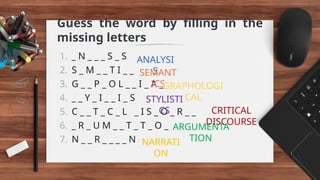
1. _ N _ _ _ S _ S
2. S _ M _ _ T I _ _
3. G _ _ P _ O L _ _ I _ A _
4. _ _ Y _ I _ _ I _ S
5. C _ _ T _ C _ L _ I S _ O _ R _ _
6. _ R _ U M _ _ T _ T _ O _
7. N _ _ R _ _ _ _ N
ANALYSI
S
SEMANT
ICS
GRAPHOLOGI
CAL
STYLISTI
CS CRITICAL
DISCOURSE
ARGUMENTA
TION
NARRATI
ON
Guess the word by filling in the
missing letters
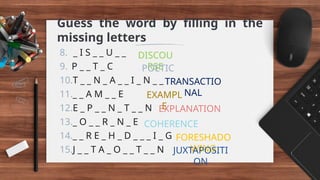
8. _ I S _ _ U _ _
9. P _ _ T _ C
10.T _ _ N _ A _ _ I _ N _ _
11._ _ A M _ _ E
12.E _ P _ _ N _ T _ _ N
13._ O _ _ R _ N _ E
14._ _ R E _ H _ D _ _ _ I _ G
15.J _ _ T A _ O _ _ T _ _ N
DISCOU
RSE
POETIC
TRANSACTIO
NAL
EXAMPL
E
EXPLANATION
COHERENCE
FORESHADO
WING
JUXTAPOSITI
ON
Analysis in
Stylistics
and
Discourse
Stylistics
What is
Stylistics
?
Stylistics
Stylistics, according to Cambridge University
Press, is interested in style both in spoken and
written language. It is underpinned by the idea that
whenever we use language to talk or write, we are
always – consciously and unconsciously – making
choices about the words we use (lexical choices) and
the order in which we use them (syntactic structure).
These choices form a particular style and changing
the choices changes the style. This is what stylistics
explores: how authors create effects through their
linguistic styles and how readers interpret those
effects. Stylistics is, thus, simply defined as the
(linguistic) study of style, which is the way in which
What are
the
different
dimensio
ns of
styles?
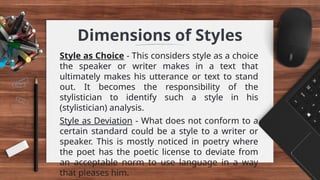
Dimensions of Styles
Style as Choice - This considers style as a choice
the speaker or writer makes in a text that
ultimately makes his utterance or text to stand
out. It becomes the responsibility of the
stylistician to identify such a style in his
(stylistician) analysis.
Style as Deviation - What does not conform to a
certain standard could be a style to a writer or
speaker. This is mostly noticed in poetry where
the poet has the poetic license to deviate from
an acceptable norm to use language in a way
that pleases him.
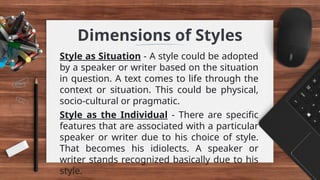
Dimensions of Styles
Style as Situation - A style could be adopted
by a speaker or writer based on the situation
in question. A text comes to life through the
context or situation. This could be physical,
socio-cultural or pragmatic.
Style as the Individual - There are specific
features that are associated with a particular
speaker or writer due to his choice of style.
That becomes his idiolects. A speaker or
writer stands recognized basically due to his
style.
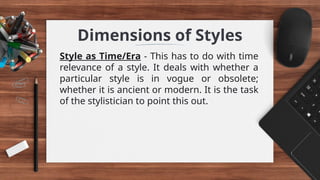
Dimensions of Styles
Style as Time/Era - This has to do with time
relevance of a style. It deals with whether a
particular style is in vogue or obsolete;
whether it is ancient or modern. It is the task
of the stylistician to point this out.
What are
the
elements
of style?
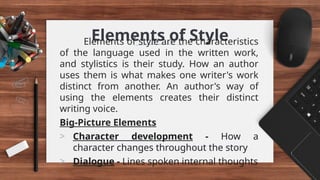
Elements of Style
Elements of style are the characteristics
of the language used in the written work,
and stylistics is their study. How an author
uses them is what makes one writer's work
distinct from another. An author's way of
using the elements creates their distinct
writing voice.
Big-Picture Elements
> Character development - How a
character changes throughout the story
> Dialogue - Lines spoken internal thoughts
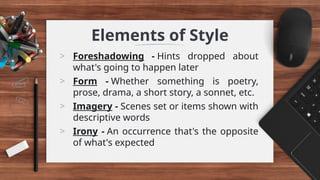
Elements of Style
> Foreshadowing - Hints dropped about
what's going to happen later
> Form - Whether something is poetry,
prose, drama, a short story, a sonnet, etc.
> Imagery - Scenes set or items shown with
descriptive words
> Irony - An occurrence that's the opposite
of what's expected
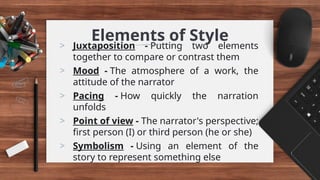
Elements of Style
> Juxtaposition - Putting two elements
together to compare or contrast them
> Mood - The atmosphere of a work, the
attitude of the narrator
> Pacing - How quickly the narration
unfolds
> Point of view - The narrator's perspective;
first person (I) or third person (he or she)
> Symbolism - Using an element of the
story to represent something else
Elements of Style
> Structure - How a story is told (beginning,
action, climax, denouement) or how a
piece is organized (introduction, main
body, conclusion vs. reverse-pyramid
journalistic style)
> Theme - A message delivered by or
shown in a work; its central topic or big
idea
> Tone - The writer's attitude toward the
subject or manner with choosing
vocabulary and presenting information,
such as informal or formal
Elements of Style
Line-by-Line Elements
> Alliteration - Close repetition of
consonants, used for effect
> Assonance - Close repetition of vowels,
used for effect
> Colloquialisms - Informal words, such as
slang and regional terms
> Diction - The correctness of the overall
grammar (big picture) or how characters
speak, such as with an accent or with poor
grammar
Elements of Style
> Jargon - Terms specific to a certain field
> Metaphor - A means to compare two
elements (Can also be big-picture if an
entire story or scene is laid out to show a
parallel with something else)
> Repetition - Using the same words or
phrases in a short amount of time for
emphasis
> Rhyme - When the same sounds appear
in two or more words
Elements of Style
> Rhythm - having a musicality to the
writing such as by using stressed and
unstressed syllables in a line of poetry or
sentence variety or repetition in a
paragraph
> Sentence variety - Variation in the
structure and length of consecutive
sentences
> Syntax - The arrangement of words in a
sentence
What is a
stylistici
an?
Stylistician
According to Burke (2014), stylistician is
a person who with his/her detailed knowledge
of the workings of morphology, phonology,
lexis, syntax, semantics, and various discourse
and pragmatic models, goes in search of
language-based evidence in order to support
or indeed challenge the subjective
interpretations and evaluations of various
critics and cultural commentators.
Stylistician
Burke paints stylisticians, then, as a kind
of Sherlock Holmes character who has
expertise in grammar and rhetoric and a love
of literature and other creative texts, picking
apart the details on how they operate piece by
piece—observing style as it informs meaning,
as it informs comprehension.
What are
the
subdiscipl
ines of
stylistics?
Subdisciplines of
Stylistics
> Literary stylistics - Studying forms, such
as poetry, drama, and prose
> Interpretive stylistics - How the linguistic
elements work to create meaningful art
> Evaluative stylistics - How an author's
style works—or doesn't—in the work
Subdisciplines of
Stylistics
> Corpus stylistics - Studying the frequency
of various elements in a text, such as to
determine the authenticity of a manuscript
> Discourse stylistics - How language in use
creates meaning, such as studying
parallelism, assonance, alliteration, and
rhyme
Subdisciplines of
Stylistics
> Feminist stylistics - Commonalities
among women's writing, how writing is
engendered, and how women's writing is
read differently than men’s
> Computational stylistics - Using
computers to analyze a text and determine
a writer's style
> Cognitive stylistics - The study of what
happens in the mind when it encounters
language
Stylistic
Analysis
What is
stylistic
analysis?
Stylistic Analysis
According to Baroudi (2020), stylistic
analysis is the analysis of various language styles
to extract the meaning or message contained in
texts. It requires critical analysis of texts to
recognize the various styles used. Once a person
identifies the styles, there arises the need for a
good understanding of the styles in order to
derive the meaning or the interpretation of the
hidden meaning. The skill and understanding are
mostly needed when dealing with literary works or
poems. This is because poets are very unlikely to
pass a message in a factual manner. Unlike
historians, they pass their message or information
in an indirect and hidden way.
What are
the
stylistic
features
of
stylistic
analysis?
Stylistic Features
Graphological Features
This concerns the physical appearance
of a text. The primary focus here is
foregrounding. That is an act of bringing to
fore, certain words to give them prominence.
This can be identified by looking at words in
italics, capital letters, bold letters, words that
are underlined, and so on. The use of
punctuation marks can equally create
stylistic effects. It is the task of the stylistician
to explore and give description of these
Stylistic Features
Syntactic Features
The focus here is on sentence types
and the effect they create in a text. A text
may contain a combination of simple,
complex, compound and compound complex
sentences or just simple sentences. Aspects
of ellipsis, parataxis, hypotaxis, right and left-
branching sentences are equally considered
significant here (Ogunsiji 11). For example, a
dislocation in syntax of a text could mean the
dislocation in human thoughts.
Stylistic Features
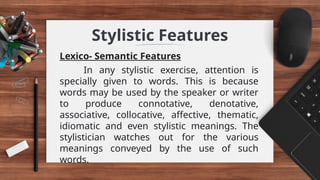
Lexico- Semantic Features
In any stylistic exercise, attention is
specially given to words. This is because
words may be used by the speaker or writer
to produce connotative, denotative,
associative, collocative, affective, thematic,
idiomatic and even stylistic meanings. The
stylistician watches out for the various
meanings conveyed by the use of such
words.
Discourse
What is
discourse
?
Discourse
According to StudySmarter (n.d.),
discourse is the verbal or written exchange of
ideas. Any unit of connected speech or
writing that is longer than a sentence and
that has a coherent meaning and a clear
purpose is referred to as discourse.
An example of discourse is when you
discuss something with your friends in
person or over a chat platform. Discourse
can also be when someone expresses their
ideas on a particular subject in a formal and
orderly way, either verbally or in writing.
What are
the basic
concept
of
discourse
?
Basic Concepts of
Discourse
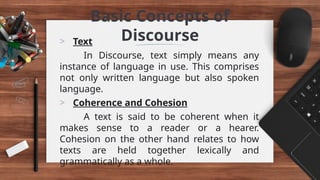
> Text
In Discourse, text simply means any
instance of language in use. This comprises
not only written language but also spoken
language.
> Coherence and Cohesion
A text is said to be coherent when it
makes sense to a reader or a hearer.
Cohesion on the other hand relates to how
texts are held together lexically and
grammatically as a whole.
Basic Concepts of
Discourse
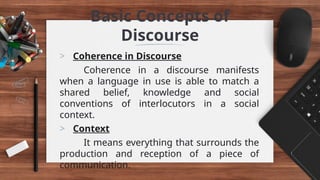
> Coherence in Discourse
Coherence in a discourse manifests
when a language in use is able to match a
shared belief, knowledge and social
conventions of interlocutors in a social
context.
> Context
It means everything that surrounds the
production and reception of a piece of
communication.
What are
the four
types of
discourse
?
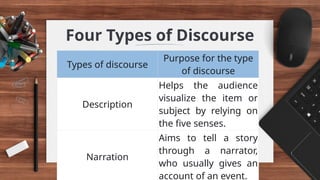
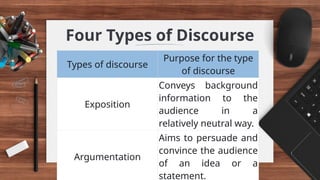
Four Types of Discourse
Types of discourse
Purpose for the type
of discourse
Description
Helps the audience
visualize the item or
subject by relying on
the five senses.
Narration
Aims to tell a story
through a narrator,
who usually gives an
account of an event.
Four Types of Discourse
Types of discourse
Purpose for the type
of discourse
Exposition
Conveys background
information to the
audience in a
relatively neutral way.
Argumentation
Aims to persuade and
convince the audience
of an idea or a
statement.
What is
discourse
analysis?
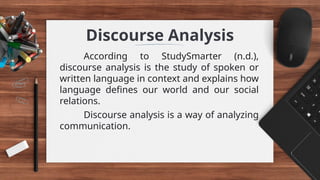
Discourse Analysis
According to StudySmarter (n.d.),
discourse analysis is the study of spoken or
written language in context and explains how
language defines our world and our social
relations.
Discourse analysis is a way of analyzing
communication.
What is
critical
discourse
analysis?
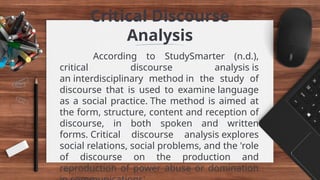
Critical Discourse
Analysis
According to StudySmarter (n.d.),
critical discourse analysis is
an interdisciplinary method in the study of
discourse that is used to examine language
as a social practice. The method is aimed at
the form, structure, content and reception of
discourse, in both spoken and written
forms. Critical discourse analysis explores
social relations, social problems, and the 'role
of discourse on the production and
reproduction of power abuse or domination
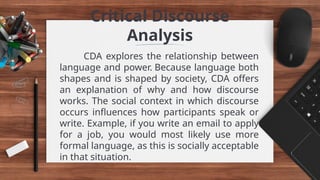
Critical Discourse
Analysis
CDA explores the relationship between
language and power. Because language both
shapes and is shaped by society, CDA offers
an explanation of why and how discourse
works. The social context in which discourse
occurs influences how participants speak or
write. Example, if you write an email to apply
for a job, you would most likely use more
formal language, as this is socially acceptable
in that situation.
Critical Discourse
Analysis
At the same time, the way in which
people speak ultimately influences the social
context. Example, if you are meeting your
new boss and you have prepared for a formal
conversation, but all of your other colleagues
are chatting with your boss in a more casual
manner, you would do the same as everyone
else, in this way changing what is expected.
By examining these social influences, critical
discourse analysis explores social structures
and issues even further.
Critical Discourse
Analysis
Critical discourse
analysis is problem or issue-oriented: it must
successfully study relevant social problems in
language and communication, such as
racism, sexism, and other social inequalities
in conversation. The method allows us to
look into the sociopolitical context - power
structures and the abuse of power in society.
What are
the 3
categorie
s of
literary
discourse
?
Categories of Literary
Discourse
Poetic Discourse
Poetic discourse is a type of literary
communication in which special intensity is
given to a text through
distinctive diction (such as rhyme), rhythm,
style, and imagination. It
incorporates different poetic devices to
emphasize the poet's expression of feelings,
thoughts, ideas or description of events and
places. Poetic discourse is most common
in poetry but it is also frequently used by
Categories of Literary
Discourse
Expressive Discourse
Expressive discourse refers to literary
writing that is creative but not
fictional. This writing aims to generate ideas
and to reflect the author's emotions, usually
without presenting any facts or arguments.
Expressive discourse includes diaries,
letters, memoirs, and blog posts.
Categories of Literary
Discourse
Transactional Discourse
Transactional discourse is
an instructional approach that is used
to encourage action. It presents a non-
ambiguous plan that is clear to the reader
and is usually written in an active voice.
Transactional discourse is common
in advertising, instruction manuals,
guidelines, privacy policies, and business
correspondence.
Analysis
What is
analysis?
Analysis
According to Course Hero (n.d.),
analysis is a way of understanding a subject
by using each of these elements, expressing
an opinion (making assertions), supporting
that opinion (including examples), justifying
that opinion (explaining the examples), and
showing why the opinion matters (extending
the significance).
What are
the
compone
nts of
analysis?
Components of Analysis
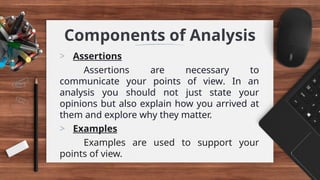
> Assertions
Assertions are necessary to
communicate your points of view. In an
analysis you should not just state your
opinions but also explain how you arrived at
them and explore why they matter.
> Examples
Examples are used to support your
points of view.
Components of Analysis
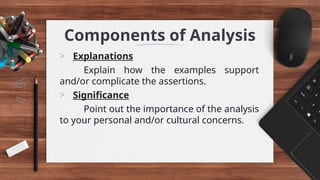
> Explanations
Explain how the examples support
and/or complicate the assertions.
> Significance
Point out the importance of the analysis
to your personal and/or cultural concerns.
Thank You!
Announcem
ent
There will be a
quiz tomorrow
about our lesson
today. Please be
prepared. Thank
you.

Analysis in Stylistics and Discourse.pptx

  • 2.
  • 3.
    Guess the wordby filling in the missing letters 1. _ N _ _ _ S _ S 2. S _ M _ _ T I _ _ 3. G _ _ P _ O L _ _ I _ A _ 4. _ _ Y _ I _ _ I _ S 5. C _ _ T _ C _ L _ I S _ O _ R _ _ 6. _ R _ U M _ _ T _ T _ O _ 7. N _ _ R _ _ _ _ N ANALYSI S SEMANT ICS GRAPHOLOGI CAL STYLISTI CS CRITICAL DISCOURSE ARGUMENTA TION NARRATI ON
  • 4.
    Guess the wordby filling in the missing letters 8. _ I S _ _ U _ _ 9. P _ _ T _ C 10.T _ _ N _ A _ _ I _ N _ _ 11._ _ A M _ _ E 12.E _ P _ _ N _ T _ _ N 13._ O _ _ R _ N _ E 14._ _ R E _ H _ D _ _ _ I _ G 15.J _ _ T A _ O _ _ T _ _ N DISCOU RSE POETIC TRANSACTIO NAL EXAMPL E EXPLANATION COHERENCE FORESHADO WING JUXTAPOSITI ON
  • 5.
  • 6.
  • 7.
  • 8.
    Stylistics Stylistics, according toCambridge University Press, is interested in style both in spoken and written language. It is underpinned by the idea that whenever we use language to talk or write, we are always – consciously and unconsciously – making choices about the words we use (lexical choices) and the order in which we use them (syntactic structure). These choices form a particular style and changing the choices changes the style. This is what stylistics explores: how authors create effects through their linguistic styles and how readers interpret those effects. Stylistics is, thus, simply defined as the (linguistic) study of style, which is the way in which
  • 9.
  • 10.
    Dimensions of Styles Styleas Choice - This considers style as a choice the speaker or writer makes in a text that ultimately makes his utterance or text to stand out. It becomes the responsibility of the stylistician to identify such a style in his (stylistician) analysis. Style as Deviation - What does not conform to a certain standard could be a style to a writer or speaker. This is mostly noticed in poetry where the poet has the poetic license to deviate from an acceptable norm to use language in a way that pleases him.
  • 11.
    Dimensions of Styles Styleas Situation - A style could be adopted by a speaker or writer based on the situation in question. A text comes to life through the context or situation. This could be physical, socio-cultural or pragmatic. Style as the Individual - There are specific features that are associated with a particular speaker or writer due to his choice of style. That becomes his idiolects. A speaker or writer stands recognized basically due to his style.
  • 12.
    Dimensions of Styles Styleas Time/Era - This has to do with time relevance of a style. It deals with whether a particular style is in vogue or obsolete; whether it is ancient or modern. It is the task of the stylistician to point this out.
  • 13.
  • 14.
    Elements of Style Elementsof style are the characteristics of the language used in the written work, and stylistics is their study. How an author uses them is what makes one writer's work distinct from another. An author's way of using the elements creates their distinct writing voice. Big-Picture Elements > Character development - How a character changes throughout the story > Dialogue - Lines spoken internal thoughts
  • 15.
    Elements of Style >Foreshadowing - Hints dropped about what's going to happen later > Form - Whether something is poetry, prose, drama, a short story, a sonnet, etc. > Imagery - Scenes set or items shown with descriptive words > Irony - An occurrence that's the opposite of what's expected
  • 16.
    Elements of Style >Juxtaposition - Putting two elements together to compare or contrast them > Mood - The atmosphere of a work, the attitude of the narrator > Pacing - How quickly the narration unfolds > Point of view - The narrator's perspective; first person (I) or third person (he or she) > Symbolism - Using an element of the story to represent something else
  • 17.
    Elements of Style >Structure - How a story is told (beginning, action, climax, denouement) or how a piece is organized (introduction, main body, conclusion vs. reverse-pyramid journalistic style) > Theme - A message delivered by or shown in a work; its central topic or big idea > Tone - The writer's attitude toward the subject or manner with choosing vocabulary and presenting information, such as informal or formal
  • 18.
    Elements of Style Line-by-LineElements > Alliteration - Close repetition of consonants, used for effect > Assonance - Close repetition of vowels, used for effect > Colloquialisms - Informal words, such as slang and regional terms > Diction - The correctness of the overall grammar (big picture) or how characters speak, such as with an accent or with poor grammar
  • 19.
    Elements of Style >Jargon - Terms specific to a certain field > Metaphor - A means to compare two elements (Can also be big-picture if an entire story or scene is laid out to show a parallel with something else) > Repetition - Using the same words or phrases in a short amount of time for emphasis > Rhyme - When the same sounds appear in two or more words
  • 20.
    Elements of Style >Rhythm - having a musicality to the writing such as by using stressed and unstressed syllables in a line of poetry or sentence variety or repetition in a paragraph > Sentence variety - Variation in the structure and length of consecutive sentences > Syntax - The arrangement of words in a sentence
  • 21.
  • 22.
    Stylistician According to Burke(2014), stylistician is a person who with his/her detailed knowledge of the workings of morphology, phonology, lexis, syntax, semantics, and various discourse and pragmatic models, goes in search of language-based evidence in order to support or indeed challenge the subjective interpretations and evaluations of various critics and cultural commentators.
  • 23.
    Stylistician Burke paints stylisticians,then, as a kind of Sherlock Holmes character who has expertise in grammar and rhetoric and a love of literature and other creative texts, picking apart the details on how they operate piece by piece—observing style as it informs meaning, as it informs comprehension.
  • 24.
  • 25.
    Subdisciplines of Stylistics > Literarystylistics - Studying forms, such as poetry, drama, and prose > Interpretive stylistics - How the linguistic elements work to create meaningful art > Evaluative stylistics - How an author's style works—or doesn't—in the work
  • 26.
    Subdisciplines of Stylistics > Corpusstylistics - Studying the frequency of various elements in a text, such as to determine the authenticity of a manuscript > Discourse stylistics - How language in use creates meaning, such as studying parallelism, assonance, alliteration, and rhyme
  • 27.
    Subdisciplines of Stylistics > Feministstylistics - Commonalities among women's writing, how writing is engendered, and how women's writing is read differently than men’s > Computational stylistics - Using computers to analyze a text and determine a writer's style > Cognitive stylistics - The study of what happens in the mind when it encounters language
  • 28.
  • 29.
  • 30.
    Stylistic Analysis According toBaroudi (2020), stylistic analysis is the analysis of various language styles to extract the meaning or message contained in texts. It requires critical analysis of texts to recognize the various styles used. Once a person identifies the styles, there arises the need for a good understanding of the styles in order to derive the meaning or the interpretation of the hidden meaning. The skill and understanding are mostly needed when dealing with literary works or poems. This is because poets are very unlikely to pass a message in a factual manner. Unlike historians, they pass their message or information in an indirect and hidden way.
  • 31.
  • 32.
    Stylistic Features Graphological Features Thisconcerns the physical appearance of a text. The primary focus here is foregrounding. That is an act of bringing to fore, certain words to give them prominence. This can be identified by looking at words in italics, capital letters, bold letters, words that are underlined, and so on. The use of punctuation marks can equally create stylistic effects. It is the task of the stylistician to explore and give description of these
  • 33.
    Stylistic Features Syntactic Features Thefocus here is on sentence types and the effect they create in a text. A text may contain a combination of simple, complex, compound and compound complex sentences or just simple sentences. Aspects of ellipsis, parataxis, hypotaxis, right and left- branching sentences are equally considered significant here (Ogunsiji 11). For example, a dislocation in syntax of a text could mean the dislocation in human thoughts.
  • 34.
    Stylistic Features Lexico- SemanticFeatures In any stylistic exercise, attention is specially given to words. This is because words may be used by the speaker or writer to produce connotative, denotative, associative, collocative, affective, thematic, idiomatic and even stylistic meanings. The stylistician watches out for the various meanings conveyed by the use of such words.
  • 35.
  • 36.
  • 37.
    Discourse According to StudySmarter(n.d.), discourse is the verbal or written exchange of ideas. Any unit of connected speech or writing that is longer than a sentence and that has a coherent meaning and a clear purpose is referred to as discourse. An example of discourse is when you discuss something with your friends in person or over a chat platform. Discourse can also be when someone expresses their ideas on a particular subject in a formal and orderly way, either verbally or in writing.
  • 38.
  • 39.
    Basic Concepts of Discourse >Text In Discourse, text simply means any instance of language in use. This comprises not only written language but also spoken language. > Coherence and Cohesion A text is said to be coherent when it makes sense to a reader or a hearer. Cohesion on the other hand relates to how texts are held together lexically and grammatically as a whole.
  • 40.
    Basic Concepts of Discourse >Coherence in Discourse Coherence in a discourse manifests when a language in use is able to match a shared belief, knowledge and social conventions of interlocutors in a social context. > Context It means everything that surrounds the production and reception of a piece of communication.
  • 41.
  • 42.
    Four Types ofDiscourse Types of discourse Purpose for the type of discourse Description Helps the audience visualize the item or subject by relying on the five senses. Narration Aims to tell a story through a narrator, who usually gives an account of an event.
  • 43.
    Four Types ofDiscourse Types of discourse Purpose for the type of discourse Exposition Conveys background information to the audience in a relatively neutral way. Argumentation Aims to persuade and convince the audience of an idea or a statement.
  • 44.
  • 45.
    Discourse Analysis According toStudySmarter (n.d.), discourse analysis is the study of spoken or written language in context and explains how language defines our world and our social relations. Discourse analysis is a way of analyzing communication.
  • 46.
  • 47.
    Critical Discourse Analysis According toStudySmarter (n.d.), critical discourse analysis is an interdisciplinary method in the study of discourse that is used to examine language as a social practice. The method is aimed at the form, structure, content and reception of discourse, in both spoken and written forms. Critical discourse analysis explores social relations, social problems, and the 'role of discourse on the production and reproduction of power abuse or domination
  • 48.
    Critical Discourse Analysis CDA exploresthe relationship between language and power. Because language both shapes and is shaped by society, CDA offers an explanation of why and how discourse works. The social context in which discourse occurs influences how participants speak or write. Example, if you write an email to apply for a job, you would most likely use more formal language, as this is socially acceptable in that situation.
  • 49.
    Critical Discourse Analysis At thesame time, the way in which people speak ultimately influences the social context. Example, if you are meeting your new boss and you have prepared for a formal conversation, but all of your other colleagues are chatting with your boss in a more casual manner, you would do the same as everyone else, in this way changing what is expected. By examining these social influences, critical discourse analysis explores social structures and issues even further.
  • 50.
    Critical Discourse Analysis Critical discourse analysisis problem or issue-oriented: it must successfully study relevant social problems in language and communication, such as racism, sexism, and other social inequalities in conversation. The method allows us to look into the sociopolitical context - power structures and the abuse of power in society.
  • 51.
    What are the 3 categorie sof literary discourse ?
  • 52.
    Categories of Literary Discourse PoeticDiscourse Poetic discourse is a type of literary communication in which special intensity is given to a text through distinctive diction (such as rhyme), rhythm, style, and imagination. It incorporates different poetic devices to emphasize the poet's expression of feelings, thoughts, ideas or description of events and places. Poetic discourse is most common in poetry but it is also frequently used by

  • 53.
    Categories of Literary Discourse ExpressiveDiscourse Expressive discourse refers to literary writing that is creative but not fictional. This writing aims to generate ideas and to reflect the author's emotions, usually without presenting any facts or arguments. Expressive discourse includes diaries, letters, memoirs, and blog posts.
  • 54.
    Categories of Literary Discourse TransactionalDiscourse Transactional discourse is an instructional approach that is used to encourage action. It presents a non- ambiguous plan that is clear to the reader and is usually written in an active voice. Transactional discourse is common in advertising, instruction manuals, guidelines, privacy policies, and business correspondence.

  • 55.
  • 56.
  • 57.
    Analysis According to CourseHero (n.d.), analysis is a way of understanding a subject by using each of these elements, expressing an opinion (making assertions), supporting that opinion (including examples), justifying that opinion (explaining the examples), and showing why the opinion matters (extending the significance).
  • 58.
  • 59.
    Components of Analysis >Assertions Assertions are necessary to communicate your points of view. In an analysis you should not just state your opinions but also explain how you arrived at them and explore why they matter. > Examples Examples are used to support your points of view.
  • 60.
    Components of Analysis >Explanations Explain how the examples support and/or complicate the assertions. > Significance Point out the importance of the analysis to your personal and/or cultural concerns.
  • 61.
  • 62.
    Announcem ent There will bea quiz tomorrow about our lesson today. Please be prepared. Thank you.