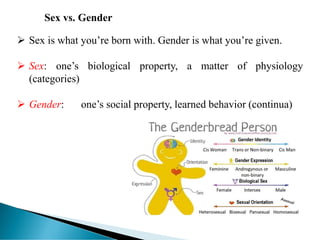
Sex iswhat you’re born with. Gender is what you’re given.
Sex: one’s biological property, a matter of physiology
(categories)
Gender: one’s social property, learned behavior (continua)
Sex vs. Gender
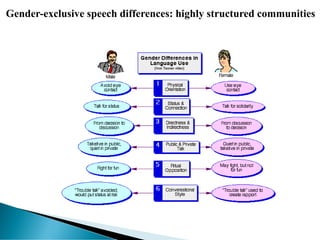
Gender-exclusive speech differences:highly structured communities
Women and men do not speak in exactly the same way as each
other in any community.
Amazonian Indians; men must marry outside their own tribe
so the men and women in the community speak different
languages
Gros Ventre North American Indian tribe; ‘bread’ is [kja'tsa]
for women and [dʒa'tsa] for men
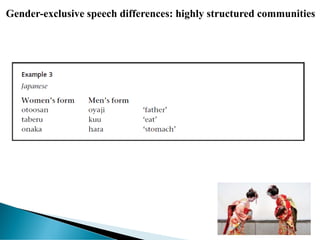
Traditional / conservative styles of Japanese where women
have to prefix nouns with o- , a marker of polite or formal style
Modern Japanese where such distinctions more related to
formality than to gender; ‘men’s’ forms casual, coarse, macho …
Gender-exclusive speech differences:highly structured communities
… ‘women’s’ forms used by everyone in public contexts.
Some languages signal the gender of the speaker in the pronoun
system.
In modern standard Japanese, these distinctions are more a matter
of degrees of formality or politeness than gender; so the ‘men’s’
forms are largely restricted to casual contexts and are considered
rather vulgar, while the ‘women’s’ forms are used by everyone in
public contexts.
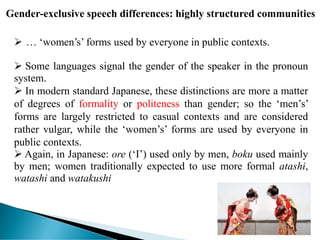
Again, in Japanese: ore (‘I’) used only by men, boku used mainly
by men; women traditionally expected to use more formal atashi,
watashi and watakushi
8.
Gender-exclusive speech differences:highly structured communities
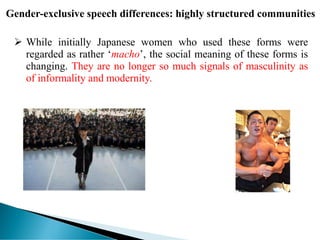
While initially Japanese women who used these forms were
regarded as rather ‘macho’, the social meaning of these forms is
changing. They are no longer so much signals of masculinity as
of informality and modernity.
9.
Gender-exclusive speech differences:highly structured communities
If a community is very hierarchical, for instance, and within each
level of the hierarchy men are more powerful than women, then
linguistic differences between the speech of women and men may
be just one dimension of more extensive differences reflecting the
social hierarchy as a whole.
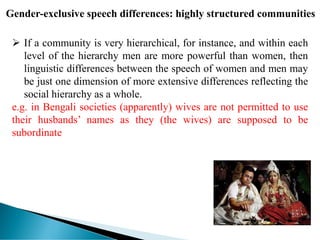
e.g. in Bengali societies (apparently) wives are not permitted to use
their husbands’ names as they (the wives) are supposed to be
subordinate
10.
Gender-exclusive speech differences:highly structured communities
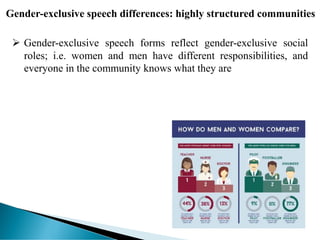
Gender-exclusive speech forms reflect gender-exclusive social
roles; i.e. women and men have different responsibilities, and
everyone in the community knows what they are
11.
in Westernurban communities where women’s and men’s social
roles overlap, the speech forms they use also overlap. In other
words, women and men do not use completely different forms.
They use different quantities or frequencies of the same forms.
Gender-preferential speech features: social dialect research
12.
Different quantitiesor frequencies of the same forms
Collected data (for English) shows that women use more –ing [ɪŋ]
and fewer -in’[ɪn] pronunciations
In Canada, the pronunciation of [l] in phrases such as il y a and il
fait differs between women and men
In Australia, some men and women pronounce the initial sound in
thing as [f], but men do it more than women
Gender-preferential speech features: social dialect research
13.
Though bothwomen and men use particular forms, one gender
shows a greater preference for them than the other.
In all these examples, women tend to use more of the standard
forms than men do, while men use more of the vernacular forms
than women do.
Gender-preferential speech features: social dialect research
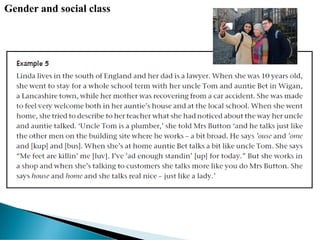
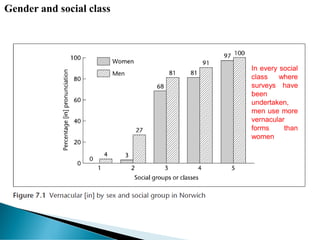
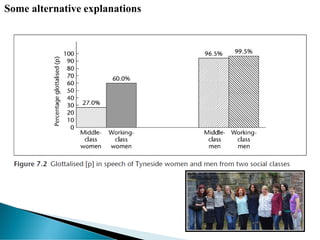
Gender and socialclass
In every social
class where
surveys have
been
undertaken,
men use more
vernacular
forms than
women
16.
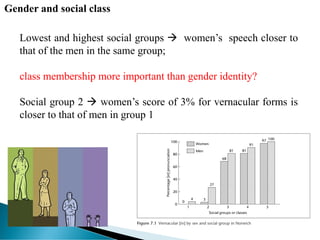
Gender and socialclass
Lowest and highest social groups women’s speech closer to
that of the men in the same group;
class membership more important than gender identity?
Social group 2 women’s score of 3% for vernacular forms is
closer to that of men in group 1
17.
Gender and socialclass
Across all social groups women generally use more standard
forms than men.
Standard forms are overtly prestigious
Vernacular forms are preferred by men, not admired overtly by
the society as a whole, and not cited as the ‘correct’ forms
Pattern found in all Western speech communities
Described by Trudgill (1983) as ‘the single most consistent
finding to emerge from sociolinguistic studies over the past 20
years’
Also evident from a very young age – young boys use more [ɪn],
more consonant cluster simplification [læs] for last, [təʊl] for
told, and are more likely to pronounce th [ð] as [d] in this, the and
then
18.
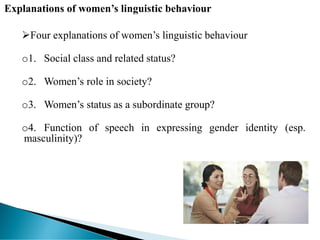
Explanations of women’slinguistic behaviour
Four explanations of women’s linguistic behaviour
o1. Social class and related status?
o2. Women’s role in society?
o3. Women’s status as a subordinate group?
o4. Function of speech in expressing gender identity (esp.
masculinity)?
19.
Explanations of women’slinguistic behaviour
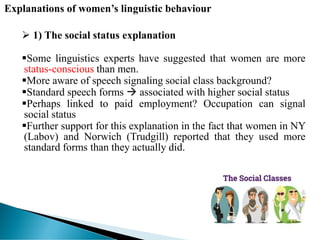
1) The social status explanation
Some linguistics experts have suggested that women are more
status-conscious than men.
More aware of speech signaling social class background?
Standard speech forms associated with higher social status
Perhaps linked to paid employment? Occupation can signal
social status
Further support for this explanation in the fact that women in NY
(Labov) and Norwich (Trudgill) reported that they used more
standard forms than they actually did.
20.
Explanations of women’slinguistic behaviour
2) The social status explanation
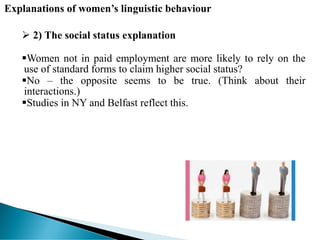
Women not in paid employment are more likely to rely on the
use of standard forms to claim higher social status?
No – the opposite seems to be true. (Think about their
interactions.)
Studies in NY and Belfast reflect this.
21.
Explanations of women’slinguistic behaviour
2) The social status explanation
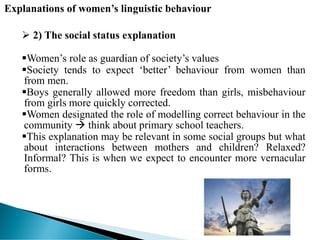
Women’s role as guardian of society’s values
Society tends to expect ‘better’ behaviour from women than
from men.
Boys generally allowed more freedom than girls, misbehaviour
from girls more quickly corrected.
Women designated the role of modelling correct behaviour in the
community think about primary school teachers.
This explanation may be relevant in some social groups but what
about interactions between mothers and children? Relaxed?
Informal? This is when we expect to encounter more vernacular
forms.
Explanations of women’slinguistic behaviour
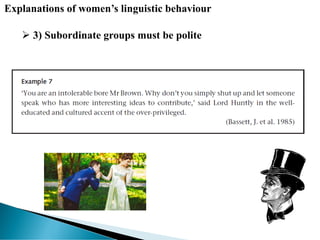
3) Subordinate groups must be polite
Not immediately apparent why polite speech should be equated
with standard speech. Perfectly possible to be polite using
Liverpudlian vernacular, as it is to be rude and insulting using RP.
Unsophisticated version women are subordinate and therefore
should be polite.
More sophisticated version women are protecting ‘face’ (their
own and others); this is when we start considering the more
subtle functions of speech
24.
Explanations of women’slinguistic behaviour
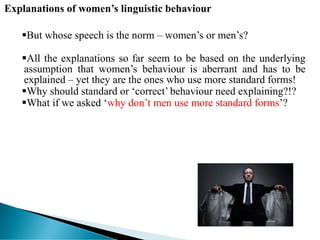
But whose speech is the norm – women’s or men’s?
All the explanations so far seem to be based on the underlying
assumption that women’s behaviour is aberrant and has to be
explained – yet they are the ones who use more standard forms!
Why should standard or ‘correct’ behaviour need explaining?!?
What if we asked ‘why don’t men use more standard forms’?
25.
Explanations of women’slinguistic behaviour
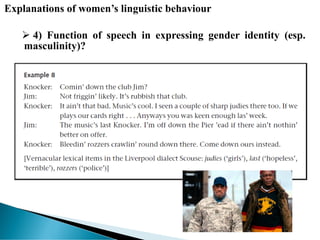
4) Function of speech in expressing gender identity (esp.
masculinity)?
26.
Explanations of women’slinguistic behaviour
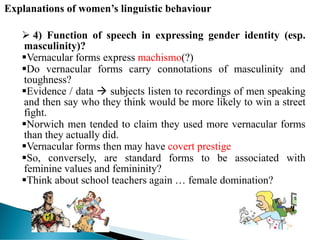
4) Function of speech in expressing gender identity (esp.
masculinity)?
Vernacular forms express machismo(?)
Do vernacular forms carry connotations of masculinity and
toughness?
Evidence / data subjects listen to recordings of men speaking
and then say who they think would be more likely to win a street
fight.
Norwich men tended to claim they used more vernacular forms
than they actually did.
Vernacular forms then may have covert prestige
So, conversely, are standard forms to be associated with
feminine values and femininity?
Think about school teachers again … female domination?
27.
Some alternative explanations
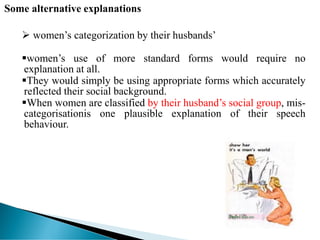
women’s categorization by their husbands’
women’s use of more standard forms would require no
explanation at all.
They would simply be using appropriate forms which accurately
reflected their social background.
When women are classified by their husband’s social group, mis-
categorisationis one plausible explanation of their speech
behaviour.
28.
Some alternative explanations
The influence of the interviewer and the context
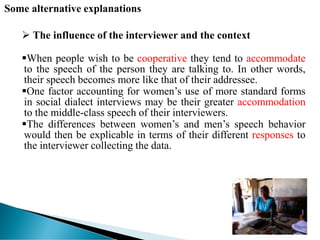
When people wish to be cooperative they tend to accommodate
to the speech of the person they are talking to. In other words,
their speech becomes more like that of their addressee.
One factor accounting for women’s use of more standard forms
in social dialect interviews may be their greater accommodation
to the middle-class speech of their interviewers.
The differences between women’s and men’s speech behavior
would then be explicable in terms of their different responses to
the interviewer collecting the data.
29.
Some alternative explanations
The influence of the interviewer and the context
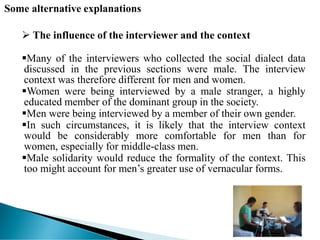
Many of the interviewers who collected the social dialect data
discussed in the previous sections were male. The interview
context was therefore different for men and women.
Women were being interviewed by a male stranger, a highly
educated member of the dominant group in the society.
Men were being interviewed by a member of their own gender.
In such circumstances, it is likely that the interview context
would be considerably more comfortable for men than for
women, especially for middle-class men.
Male solidarity would reduce the formality of the context. This
too might account for men’s greater use of vernacular forms.
30.
Some alternative explanations
The influence of the interviewer and the context
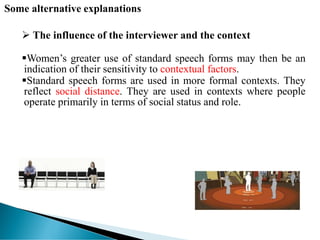
Women’s greater use of standard speech forms may then be an
indication of their sensitivity to contextual factors.
Standard speech forms are used in more formal contexts. They
reflect social distance. They are used in contexts where people
operate primarily in terms of social status and role.
31.
Some alternative explanations
The influence of the interviewer and the context
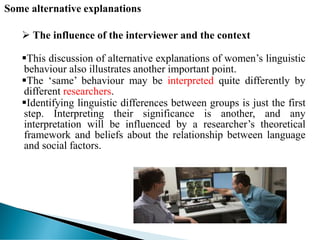
This discussion of alternative explanations of women’s linguistic
behaviour also illustrates another important point.
The ‘same’ behaviour may be interpreted quite differently by
different researchers.
Identifying linguistic differences between groups is just the first
step. Interpreting their significance is another, and any
interpretation will be influenced by a researcher’s theoretical
framework and beliefs about the relationship between language
and social factors.
32.
Some alternative explanations
The influence of the interviewer and the context
In some communities, a woman’s social status and her gender
interact to reinforce differential speech patterns between women
and men.
In others, different factors modify one another to produce more
complex patterns. But in a number of communities, for some
linguistic forms, gender identity seems to be a primary factor
accounting for speech variation.
The gender of the speaker can override social class differences,
for instance, in accounting for speech patterns.
In these communities, expressing masculine or feminine identity
seems to be very important.
Some alternative explanations
The influence of the interviewer and the context
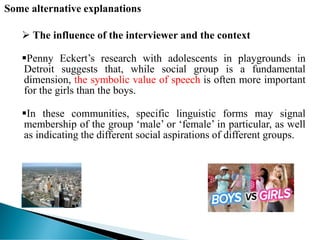
Penny Eckert’s research with adolescents in playgrounds in
Detroit suggests that, while social group is a fundamental
dimension, the symbolic value of speech is often more important
for the girls than the boys.
In these communities, specific linguistic forms may signal
membership of the group ‘male’ or ‘female’ in particular, as well
as indicating the different social aspirations of different groups.
35.
Some alternative explanations
The influence of the interviewer and the context
but there are exceptions….
A high frequency of vernacular forms may have a much wider
range of associations than the explanation which identifies them
with masculinity and toughness suggests.
To give just two contrasting examples, vernacular forms may
express conservative, non-urban values (where the standard is the
urban norm), or alternatively vernacular forms may reflect anti-
establishment attitudes (where the standard is the middle- class
adult norm).
38.
Age-graded features ofspeech
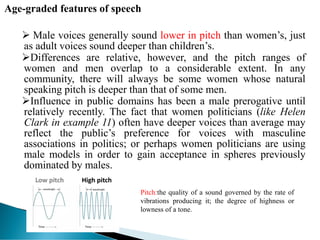
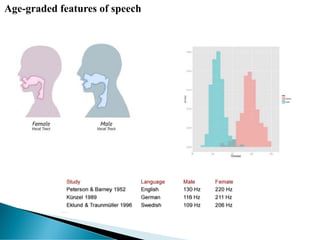
Male voices generally sound lower in pitch than women’s, just
as adult voices sound deeper than children’s.
Differences are relative, however, and the pitch ranges of
women and men overlap to a considerable extent. In any
community, there will always be some women whose natural
speaking pitch is deeper than that of some men.
Influence in public domains has been a male prerogative until
relatively recently. The fact that women politicians (like Helen
Clark in example 11) often have deeper voices than average may
reflect the public’s preference for voices with masculine
associations in politics; or perhaps women politicians are using
male models in order to gain acceptance in spheres previously
dominated by males.
Pitch:the quality of a sound governed by the rate of
vibrations producing it; the degree of highness or
lowness of a tone.
Age-graded features ofspeech
There are other features of people’s speech which vary at
different ages too.
Not only pitch, but vocabulary, pronunciation and grammar can
differentiate age groups.
There are patterns which are appropriate for 10-year-olds or
teenagers which disappear as they grow older.
These are age-graded patterns.
Between the ages of 10 and 15, and typically with
encouragement from their teachers and parents, middle-class
Glaswegians learn to substitute [t] for the vernacular glottal
stop variant in words like water and matter.
41.
Age-graded features ofspeech
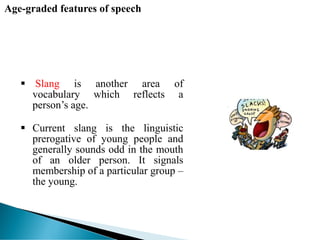
Slang is another area of
vocabulary which reflects a
person’s age.
Current slang is the linguistic
prerogative of young people and
generally sounds odd in the mouth
of an older person. It signals
membership of a particular group –
the young.
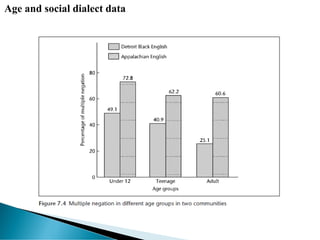
Age and socialdialect data
By their teenage years, most young people in English-speaking
communities have developed an awareness of the significance
of standard English variants, though they may not choose to
use them.
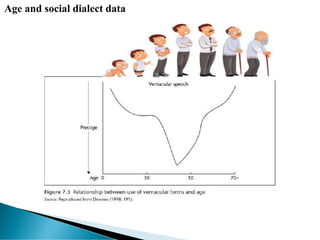
A common age-related pattern for stable vernacular forms,
such as the use of [in] for standard [iŋ], in walking, or [d] for
[ɵ] in then, or multiple negation, is represented by the curve in
figure 7.3 .
The graph suggests the relative frequency of vernacular forms
in different age groups. It indicates that they are high in
childhood and adolescence, and then steadily reduce as people
approach middle age when societal pressures to conform are
greatest.
Vernacular usage gradually increases again in old age as social
pressures reduce, with people moving out of the workforce and
into a more relaxed phase of their lives.
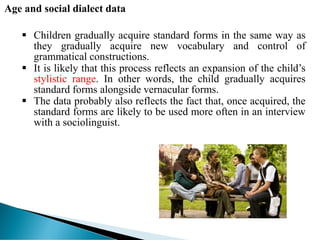
Age and socialdialect data
Children gradually acquire standard forms in the same way as
they gradually acquire new vocabulary and control of
grammatical constructions.
It is likely that this process reflects an expansion of the child’s
stylistic range. In other words, the child gradually acquires
standard forms alongside vernacular forms.
The data probably also reflects the fact that, once acquired, the
standard forms are likely to be used more often in an interview
with a sociolinguist.
46.
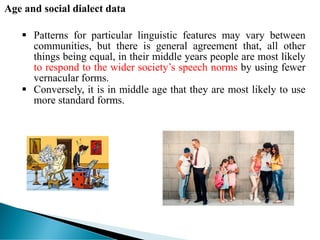
Age and socialdialect data
Patterns for particular linguistic features may vary between
communities, but there is general agreement that, all other
things being equal, in their middle years people are most likely
to respond to the wider society’s speech norms by using fewer
vernacular forms.
Conversely, it is in middle age that they are most likely to use
more standard forms.
47.
Age and socialdialect data
Patterns for particular linguistic features may vary between
communities, but there is general agreement that, all other
things being equal, in their middle years people are most likely
to respond to the wider society’s speech norms by using fewer
vernacular forms.
Conversely, it is in middle age that they are most likely to use
more standard forms.
Age and socialdialect data
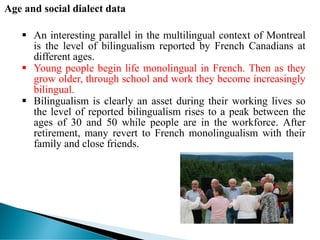
An interesting parallel in the multilingual context of Montreal
is the level of bilingualism reported by French Canadians at
different ages.
Young people begin life monolingual in French. Then as they
grow older, through school and work they become increasingly
bilingual.
Bilingualism is clearly an asset during their working lives so
the level of reported bilingualism rises to a peak between the
ages of 30 and 50 while people are in the workforce. After
retirement, many revert to French monolingualism with their
family and close friends.
50.
Age and socialdialect data
Bilingualism clearly functions as the equivalent of a linguistic
prestige form in a monolingual community, while the reversion
to French monolingualism parallels the greater use of
vernacular forms among older people illustrated in Figure 7.3
above.

![Gender-exclusive speech differences: highly structured communities
Women and men do not speak in exactly the same way as each
other in any community.
Amazonian Indians; men must marry outside their own tribe
so the men and women in the community speak different
languages
Gros Ventre North American Indian tribe; ‘bread’ is [kja'tsa]
for women and [dʒa'tsa] for men
Traditional / conservative styles of Japanese where women
have to prefix nouns with o- , a marker of polite or formal style
Modern Japanese where such distinctions more related to
formality than to gender; ‘men’s’ forms casual, coarse, macho …](https://image.slidesharecdn.com/presentation-07gender-and-age-250323221640-c2123286/85/presentation-07_gender-and-age-languagepdf-5-320.jpg)
![ Different quantities or frequencies of the same forms
Collected data (for English) shows that women use more –ing [ɪŋ]
and fewer -in’[ɪn] pronunciations
In Canada, the pronunciation of [l] in phrases such as il y a and il
fait differs between women and men
In Australia, some men and women pronounce the initial sound in
thing as [f], but men do it more than women
Gender-preferential speech features: social dialect research](https://image.slidesharecdn.com/presentation-07gender-and-age-250323221640-c2123286/85/presentation-07_gender-and-age-languagepdf-12-320.jpg)
![Gender and social class
Across all social groups women generally use more standard
forms than men.
Standard forms are overtly prestigious
Vernacular forms are preferred by men, not admired overtly by
the society as a whole, and not cited as the ‘correct’ forms
Pattern found in all Western speech communities
Described by Trudgill (1983) as ‘the single most consistent
finding to emerge from sociolinguistic studies over the past 20
years’
Also evident from a very young age – young boys use more [ɪn],
more consonant cluster simplification [læs] for last, [təʊl] for
told, and are more likely to pronounce th [ð] as [d] in this, the and
then](https://image.slidesharecdn.com/presentation-07gender-and-age-250323221640-c2123286/85/presentation-07_gender-and-age-languagepdf-17-320.jpg)

![Age-graded features of speech
There are other features of people’s speech which vary at
different ages too.
Not only pitch, but vocabulary, pronunciation and grammar can
differentiate age groups.
There are patterns which are appropriate for 10-year-olds or
teenagers which disappear as they grow older.
These are age-graded patterns.
Between the ages of 10 and 15, and typically with
encouragement from their teachers and parents, middle-class
Glaswegians learn to substitute [t] for the vernacular glottal
stop variant in words like water and matter.](https://image.slidesharecdn.com/presentation-07gender-and-age-250323221640-c2123286/85/presentation-07_gender-and-age-languagepdf-40-320.jpg)

![Age and social dialect data
By their teenage years, most young people in English-speaking
communities have developed an awareness of the significance
of standard English variants, though they may not choose to
use them.
A common age-related pattern for stable vernacular forms,
such as the use of [in] for standard [iŋ], in walking, or [d] for
[ɵ] in then, or multiple negation, is represented by the curve in
figure 7.3 .
The graph suggests the relative frequency of vernacular forms
in different age groups. It indicates that they are high in
childhood and adolescence, and then steadily reduce as people
approach middle age when societal pressures to conform are
greatest.
Vernacular usage gradually increases again in old age as social
pressures reduce, with people moving out of the workforce and
into a more relaxed phase of their lives.](https://image.slidesharecdn.com/presentation-07gender-and-age-250323221640-c2123286/85/presentation-07_gender-and-age-languagepdf-43-320.jpg)



![Chapter-07-4th-ed-Gender-Age[1].ppt and pdf](https://cdn.slidesharecdn.com/ss_thumbnails/chapter-07-4th-ed-genderage1-250721005132-eefebfbd-thumbnail.jpg?width=640&height=640&fit=bounds)


![He said she_saidwell[1]23](https://cdn.slidesharecdn.com/ss_thumbnails/hesaidshesaidwell123-110514191807-phpapp01-thumbnail.jpg?width=640&height=640&fit=bounds)


