LANGUAGE AND GENDER
Mustikaning Ayu Shaleha
161716251009
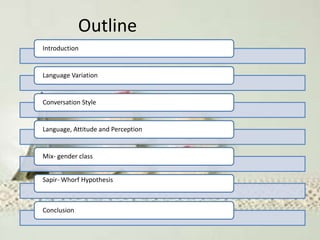
Outline
Introduction
Language Variation
Conversation Style
Language, Attitude and Perception
Mix- gender class
Sapir- Whorf Hypothesis
Conclusion
Introduction
 Women and men do not speak in exactly same way as each
other in any community. If men and women have different
language use, it means that they will learn or acquire language in
different ways (Holmes: 2001.151).
 Women spoke less forcefully than men, and men swore much
more than women. Men were also more blunt and to the point in
their speaking. (Wardaugh: 2006. 324).
Language Variation
Lakoff in Holmes (2001) women tend to (use):
 lexical hedges or filler (you know, well, you see)
 tag question (she’s very nice, isn’t she?)
 empty adjective (cute)
 precise in color terms (magenta, ivory, beige)
 intensifier such as just and so ( I like him so much)
 ‘hypercorrect’ in grammar (use standard form to
show social class)
 ‘superpolite’ form (indirect request)
 avoidance of strong swear words
 empathic stress ( it was a BRILIANT performance)
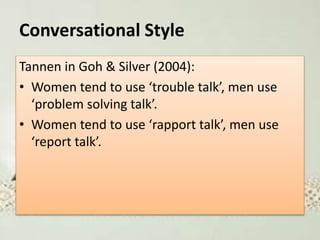
Conversational Style
Tannen in Goh & Silver (2004):
• Women tend to use ‘trouble talk’, men use
‘problem solving talk’.
• Women tend to use ‘rapport talk’, men use
‘report talk’.
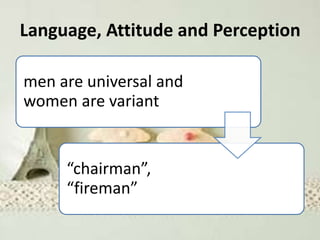
Language, Attitude and Perception
men are universal and
women are variant
“chairman”,
“fireman”
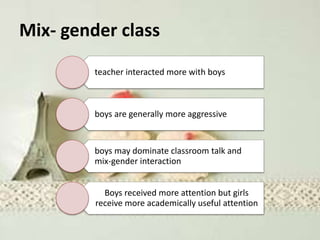
Mix- gender class
teacher interacted more with boys
boys are generally more aggressive
boys may dominate classroom talk and
mix-gender interaction
Boys received more attention but girls
receive more academically useful attention
Sapir- Whorf Hypothesis
We are only able to achieve full conceptual
thought through our use of language and that
the specific patterns in the language we use,
shape our thoughts in particular ways (Goh &
Silver:2004).
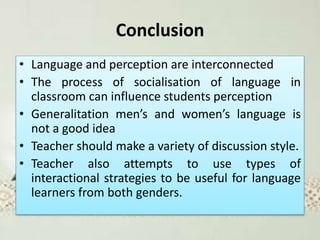
Conclusion
• Language and perception are interconnected
• The process of socialisation of language in
classroom can influence students perception
• Generalitation men’s and women’s language is
not a good idea
• Teacher should make a variety of discussion style.
• Teacher also attempts to use types of
interactional strategies to be useful for language
learners from both genders.
Reference
• Goh, Christine. C.M & Rita Elaine Silver. 2004.
Language Acquisition and Development. Singapore:
Longman
• Holmes, Janet. 2001. An Introduction to
Sociolinguistics: 2nd Edition. London: Longman
• Poynton, Cate. 1989. Language and Gender: Making
The Difference. London: Oxford University Press
• Pavlenko, Aneta & Ingrid Piller. 2008. Language
Education and Gender. Encyclopedia of Language and
Education 2nd Edition, Vol. 1
• Wardhaugh, Ronald.2006. An Introduction to
Sociolinguistics: 5th Edition. UK: Blackwell Publishing

Language and gender

  • 1.
    LANGUAGE AND GENDER MustikaningAyu Shaleha 161716251009
  • 2.
    Outline Introduction Language Variation Conversation Style Language,Attitude and Perception Mix- gender class Sapir- Whorf Hypothesis Conclusion
  • 3.
    Introduction  Women andmen do not speak in exactly same way as each other in any community. If men and women have different language use, it means that they will learn or acquire language in different ways (Holmes: 2001.151).  Women spoke less forcefully than men, and men swore much more than women. Men were also more blunt and to the point in their speaking. (Wardaugh: 2006. 324).
  • 4.
    Language Variation Lakoff inHolmes (2001) women tend to (use):  lexical hedges or filler (you know, well, you see)  tag question (she’s very nice, isn’t she?)  empty adjective (cute)  precise in color terms (magenta, ivory, beige)  intensifier such as just and so ( I like him so much)  ‘hypercorrect’ in grammar (use standard form to show social class)  ‘superpolite’ form (indirect request)  avoidance of strong swear words  empathic stress ( it was a BRILIANT performance)
  • 5.
    Conversational Style Tannen inGoh & Silver (2004): • Women tend to use ‘trouble talk’, men use ‘problem solving talk’. • Women tend to use ‘rapport talk’, men use ‘report talk’.
  • 6.
    Language, Attitude andPerception men are universal and women are variant “chairman”, “fireman”
  • 7.
    Mix- gender class teacherinteracted more with boys boys are generally more aggressive boys may dominate classroom talk and mix-gender interaction Boys received more attention but girls receive more academically useful attention
  • 8.
    Sapir- Whorf Hypothesis Weare only able to achieve full conceptual thought through our use of language and that the specific patterns in the language we use, shape our thoughts in particular ways (Goh & Silver:2004).
  • 9.
    Conclusion • Language andperception are interconnected • The process of socialisation of language in classroom can influence students perception • Generalitation men’s and women’s language is not a good idea • Teacher should make a variety of discussion style. • Teacher also attempts to use types of interactional strategies to be useful for language learners from both genders.
  • 10.
    Reference • Goh, Christine.C.M & Rita Elaine Silver. 2004. Language Acquisition and Development. Singapore: Longman • Holmes, Janet. 2001. An Introduction to Sociolinguistics: 2nd Edition. London: Longman • Poynton, Cate. 1989. Language and Gender: Making The Difference. London: Oxford University Press • Pavlenko, Aneta & Ingrid Piller. 2008. Language Education and Gender. Encyclopedia of Language and Education 2nd Edition, Vol. 1 • Wardhaugh, Ronald.2006. An Introduction to Sociolinguistics: 5th Edition. UK: Blackwell Publishing