Water control and diversion structures-check
gates, diversion, turnouts, siphon tubes
On farm structures for water conveyance
Structures to control erosion in irrigation channels:
• It is necessary to build irrigation channels on land slopes so steep that the water
will attain erosive velocities. Severe erosion will occur in earth channels if
structures to control the slope are not provided.
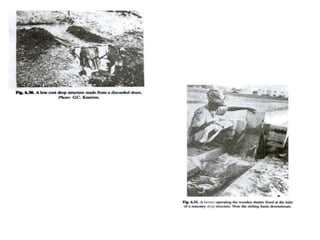
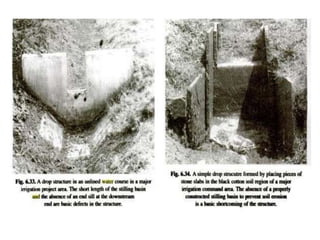
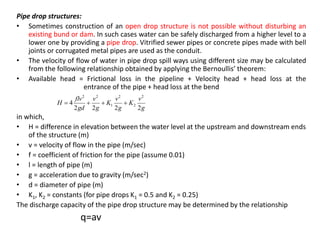
• Drop structures and chute drops are used to prevent erosion in field channels.
Drop structures:
• Drop structures are used to discharge water in a channel from a higher level to a
lower one. They may be open type drops or pipe drops.
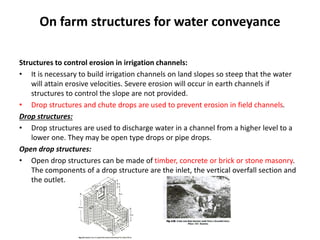
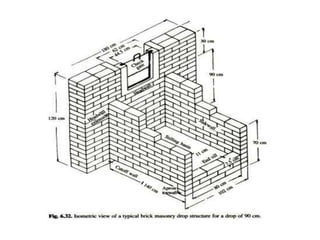
Open drop structures:
• Open drop structures can be made of timber, concrete or brick or stone masonry.
The components of a drop structure are the inlet, the vertical overfall section and
the outlet.
Pipe drop structures:
• Sometimes construction of an open drop structure is not possible without disturbing an
existing bund or dam. In such cases water can be safely discharged from a higher level to a
lower one by providing a pipe drop. Vitrified sewer pipes or concrete pipes made with bell
joints or corrugated metal pipes are used as the conduit.
• The velocity of flow of water in pipe drop spill ways using different size may be calculated
from the following relationship obtained by applying the Bernoullis’ theorem:
• Available head = Frictional loss in the pipeline + Velocity head + head loss at the
entrance of the pipe + head loss at the bend
in which,
• H = difference in elevation between the water level at the upstream and downstream ends
of the structure (m)
• v = velocity of flow in the pipe (m/sec)
• f = coefficient of friction for the pipe (assume 0.01)
• l = length of pipe (m)
• g = acceleration due to gravity (m/sec2)
• d = diameter of pipe (m)
• K1, K2 = constants (for pipe drops K1 = 0.5 and K2 = 0.25)
The discharge capacity of the pipe drop structure may be determined by the relationship
q=av
g
v
K
g
v
K
g
v
gd
flv
H
2
2
2
2
4
2
2
2
1
2
2




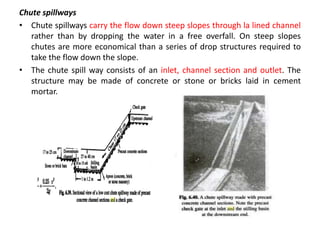
Chute spillways
• Chute spillways carry the flow down steep slopes through la lined channel
rather than by dropping the water in a free overfall. On steep slopes
chutes are more economical than a series of drop structures required to
take the flow down the slope.
• The chute spill way consists of an inlet, channel section and outlet. The
structure may be made of concrete or stone or bricks laid in cement
mortar.
Water control and diversion structure
• Water control and diversion structures are necessary to give easy and effective
control of irrigation water on the farm. Good control will reduce the labour required
to irrigate and check erosion and water loss. The structure include check gates,
portable check dams, diversion boxes, turnout boxes, siphons and pipe turnouts.
1. Check gates:
• Checks are placed in an irrigation channel to form an adjustable dam to control the
elevation of the water surface upstream. To apply water from channels into a field it
is often necessary to raise the water level. The water level in the channel should be
at least about 8 to 12 cm above the ground surface in order that siphon tubes or
pipe turn outs may be used efficiently. Check gates placed at intervals along the
channel keep a satisfactory water level for applying water to the field.
• A check structure consists of canvas, metal or masonry walls built across the channel
and provided with a suitable check gate or outlet device.
A check structure consists of canvas, metal or masonry walls built across the channel
and provided with a suitable check gate or outlet device.
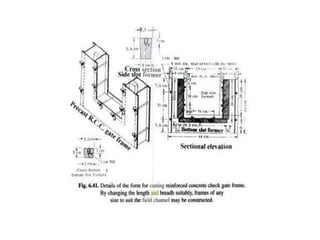
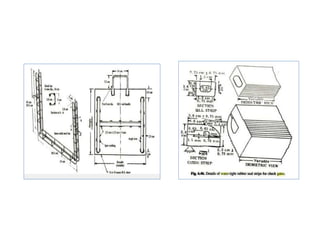
Precast check gates:
• Precast reinforced concrete check gates can be made in a form made of sheet metal
and provide with slot formers. A suitable concrete mix for check gates is 1: 2:3
(cement: sand: aggregate) made with minimum water consistent with the need to
compact the concrete thoroughly.
The gate:
• Plate steel gates or wooden boards may be used as stops for check gates. Wooden
boards inserted in the slots are usually leaky and the farmer usually shovels earth
around them to reduce leakage. Metal gates, together with specially designed
rubber seal strips, provide water tight gates.
Water tight seal for check gates:
• To obtain a water tight seal, specially designed rubber strips are used. Two types of
sealings are used- the guide strip, in which the vertical edge of the gate engages and
the still strip in which the bottom edge of the gate makes plane surface contact.
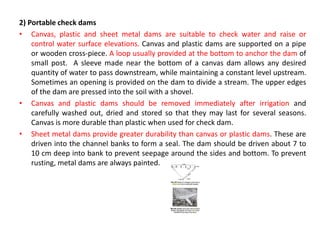
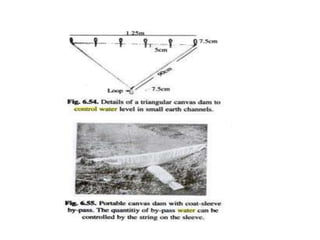
2) Portable check dams
• Canvas, plastic and sheet metal dams are suitable to check water and raise or
control water surface elevations. Canvas and plastic dams are supported on a pipe
or wooden cross-piece. A loop usually provided at the bottom to anchor the dam of
small post. A sleeve made near the bottom of a canvas dam allows any desired
quantity of water to pass downstream, while maintaining a constant level upstream.
Sometimes an opening is provided on the dam to divide a stream. The upper edges
of the dam are pressed into the soil with a shovel.
• Canvas and plastic dams should be removed immediately after irrigation and
carefully washed out, dried and stored so that they may last for several seasons.
Canvas is more durable than plastic when used for check dam.
• Sheet metal dams provide greater durability than canvas or plastic dams. These are
driven into the channel banks to form a seal. The dam should be driven about 7 to
10 cm deep into bank to prevent seepage around the sides and bottom. To prevent
rusting, metal dams are always painted.
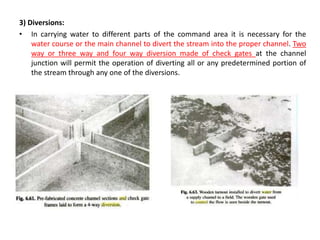
3) Diversions:
• In carrying water to different parts of the command area it is necessary for the
water course or the main channel to divert the stream into the proper channel. Two
way or three way and four way diversion made of check gates at the channel
junction will permit the operation of diverting all or any predetermined portion of
the stream through any one of the diversions.
4) Turnouts
• When water is to be taken from a lateral channel into a field distribution channel
or from a channel into a field, a turnout is used. Turnouts may be portable or built-
in. They are sometimes equipped with gates to control the flow of water. The most
common turnouts are box turnouts, spiles and siphon tubes.
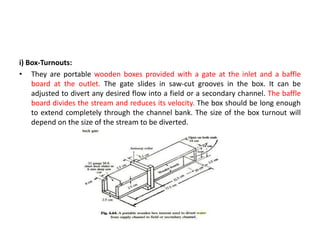
i) Box-Turnouts:
• They are portable wooden boxes provided with a gate at the inlet and a baffle
board at the outlet. The gate slides in saw-cut grooves in the box. It can be
adjusted to divert any desired flow into a field or a secondary channel. The baffle
board divides the stream and reduces its velocity. The box should be long enough
to extend completely through the channel bank. The size of the box turnout will
depend on the size of the stream to be diverted.
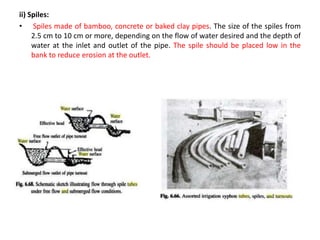
ii) Spiles:
• Spiles made of bamboo, concrete or baked clay pipes. The size of the spiles from
2.5 cm to 10 cm or more, depending on the flow of water desired and the depth of
water at the inlet and outlet of the pipe. The spile should be placed low in the
bank to reduce erosion at the outlet.
iii) Siphon tubes:
• Siphon tubes convey water over a channel bank into a field o furrow. They are made of plastic,
rubber or sheet metal (aluminum or mild steel) and are commercially available in different sizes,
usually ranging from 2.5 cm to 7.5 cm. each siphon tube is about one metre or more in length,
depending on the height of the channel bank above the field. In using a siphon tube, it is dipped
in water and filled completely. One end of the tube is then closed tightly with the palm of hand,
keeping the other end dipped in water, the closed end is taken out and released at the ground
surface.
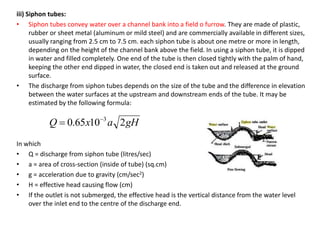
• The discharge from siphon tubes depends on the size of the tube and the difference in elevation
between the water surfaces at the upstream and downstream ends of the tube. It may be
estimated by the following formula:
In which
• Q = discharge from siphon tube (litres/sec)
• a = area of cross-section (inside of tube) (sq.cm)
• g = acceleration due to gravity (cm/sec2)
• H = effective head causing flow (cm)
• If the outlet is not submerged, the effective head is the vertical distance from the water level
over the inlet end to the centre of the discharge end.
gH
a
x
Q 2
10
65
.
0 3


Structures at channel crossings:
• It is often necessary to carry irrigation channels across roads, hillsides and natural
depressions or drainage ways. Siphons are used to carry irrigation channels across
natural farm obstructions. For the average farm job they are usually in the form of a
straight pipe or an inverted siphon.
• When the siphon is laid over a drainageway or depression it is often called flume.
• When it crosses a ridge, highway or bund it is called a culvert.
• Where the road surface lies too close to the field surface to permit using a culvert or
if the channel surface is higher than the road, an inverted siphon is constructed for
crossing the road.
• Siphons are made of concrete or vitrified clay pipes with suitable masonry structures
at the inlet and outlet. Flumes are made of elevated pipes or open channels
supported by pillars.
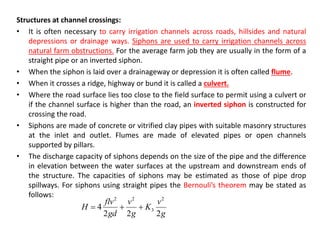
• The discharge capacity of siphons depends on the size of the pipe and the difference
in elevation between the water surfaces at the upstream and downstream ends of
the structure. The capacities of siphons may be estimated as those of pipe drop
spillways. For siphons using straight pipes the Bernouli’s theorem may be stated as
follows:
g
v
K
g
v
gd
flv
H
2
2
2
4
2
3
2
2



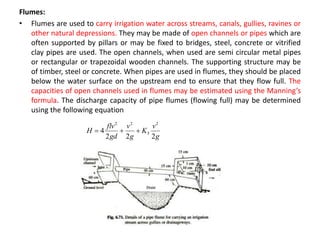
Flumes:
• Flumes are used to carry irrigation water across streams, canals, gullies, ravines or
other natural depressions. They may be made of open channels or pipes which are
often supported by pillars or may be fixed to bridges, steel, concrete or vitrified
clay pipes are used. The open channels, when used are semi circular metal pipes
or rectangular or trapezoidal wooden channels. The supporting structure may be
of timber, steel or concrete. When pipes are used in flumes, they should be placed
below the water surface on the upstream end to ensure that they flow full. The
capacities of open channels used in flumes may be estimated using the Manning’s
formula. The discharge capacity of pipe flumes (flowing full) may be determined
using the following equation
g
v
K
g
v
gd
flv
H
2
2
2
4
2
3
2
2



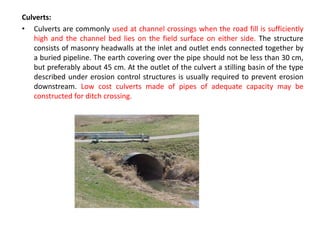
Culverts:
• Culverts are commonly used at channel crossings when the road fill is sufficiently
high and the channel bed lies on the field surface on either side. The structure
consists of masonry headwalls at the inlet and outlet ends connected together by
a buried pipeline. The earth covering over the pipe should not be less than 30 cm,
but preferably about 45 cm. At the outlet of the culvert a stilling basin of the type
described under erosion control structures is usually required to prevent erosion
downstream. Low cost culverts made of pipes of adequate capacity may be
constructed for ditch crossing.
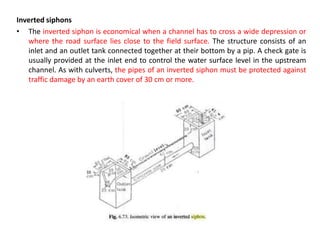
Inverted siphons
• The inverted siphon is economical when a channel has to cross a wide depression or
where the road surface lies close to the field surface. The structure consists of an
inlet and an outlet tank connected together at their bottom by a pip. A check gate is
usually provided at the inlet end to control the water surface level in the upstream
channel. As with culverts, the pipes of an inverted siphon must be protected against
traffic damage by an earth cover of 30 cm or more.

study\source\ppt\Water control and diversion structures.ppt

  • 1.
    Water control anddiversion structures-check gates, diversion, turnouts, siphon tubes
  • 2.
    On farm structuresfor water conveyance Structures to control erosion in irrigation channels: • It is necessary to build irrigation channels on land slopes so steep that the water will attain erosive velocities. Severe erosion will occur in earth channels if structures to control the slope are not provided. • Drop structures and chute drops are used to prevent erosion in field channels. Drop structures: • Drop structures are used to discharge water in a channel from a higher level to a lower one. They may be open type drops or pipe drops. Open drop structures: • Open drop structures can be made of timber, concrete or brick or stone masonry. The components of a drop structure are the inlet, the vertical overfall section and the outlet.
  • 6.
    Pipe drop structures: •Sometimes construction of an open drop structure is not possible without disturbing an existing bund or dam. In such cases water can be safely discharged from a higher level to a lower one by providing a pipe drop. Vitrified sewer pipes or concrete pipes made with bell joints or corrugated metal pipes are used as the conduit. • The velocity of flow of water in pipe drop spill ways using different size may be calculated from the following relationship obtained by applying the Bernoullis’ theorem: • Available head = Frictional loss in the pipeline + Velocity head + head loss at the entrance of the pipe + head loss at the bend in which, • H = difference in elevation between the water level at the upstream and downstream ends of the structure (m) • v = velocity of flow in the pipe (m/sec) • f = coefficient of friction for the pipe (assume 0.01) • l = length of pipe (m) • g = acceleration due to gravity (m/sec2) • d = diameter of pipe (m) • K1, K2 = constants (for pipe drops K1 = 0.5 and K2 = 0.25) The discharge capacity of the pipe drop structure may be determined by the relationship q=av g v K g v K g v gd flv H 2 2 2 2 4 2 2 2 1 2 2    
  • 8.
    Chute spillways • Chutespillways carry the flow down steep slopes through la lined channel rather than by dropping the water in a free overfall. On steep slopes chutes are more economical than a series of drop structures required to take the flow down the slope. • The chute spill way consists of an inlet, channel section and outlet. The structure may be made of concrete or stone or bricks laid in cement mortar.
  • 9.
    Water control anddiversion structure • Water control and diversion structures are necessary to give easy and effective control of irrigation water on the farm. Good control will reduce the labour required to irrigate and check erosion and water loss. The structure include check gates, portable check dams, diversion boxes, turnout boxes, siphons and pipe turnouts. 1. Check gates: • Checks are placed in an irrigation channel to form an adjustable dam to control the elevation of the water surface upstream. To apply water from channels into a field it is often necessary to raise the water level. The water level in the channel should be at least about 8 to 12 cm above the ground surface in order that siphon tubes or pipe turn outs may be used efficiently. Check gates placed at intervals along the channel keep a satisfactory water level for applying water to the field. • A check structure consists of canvas, metal or masonry walls built across the channel and provided with a suitable check gate or outlet device.
  • 11.
    A check structureconsists of canvas, metal or masonry walls built across the channel and provided with a suitable check gate or outlet device. Precast check gates: • Precast reinforced concrete check gates can be made in a form made of sheet metal and provide with slot formers. A suitable concrete mix for check gates is 1: 2:3 (cement: sand: aggregate) made with minimum water consistent with the need to compact the concrete thoroughly. The gate: • Plate steel gates or wooden boards may be used as stops for check gates. Wooden boards inserted in the slots are usually leaky and the farmer usually shovels earth around them to reduce leakage. Metal gates, together with specially designed rubber seal strips, provide water tight gates. Water tight seal for check gates: • To obtain a water tight seal, specially designed rubber strips are used. Two types of sealings are used- the guide strip, in which the vertical edge of the gate engages and the still strip in which the bottom edge of the gate makes plane surface contact.
  • 13.
    2) Portable checkdams • Canvas, plastic and sheet metal dams are suitable to check water and raise or control water surface elevations. Canvas and plastic dams are supported on a pipe or wooden cross-piece. A loop usually provided at the bottom to anchor the dam of small post. A sleeve made near the bottom of a canvas dam allows any desired quantity of water to pass downstream, while maintaining a constant level upstream. Sometimes an opening is provided on the dam to divide a stream. The upper edges of the dam are pressed into the soil with a shovel. • Canvas and plastic dams should be removed immediately after irrigation and carefully washed out, dried and stored so that they may last for several seasons. Canvas is more durable than plastic when used for check dam. • Sheet metal dams provide greater durability than canvas or plastic dams. These are driven into the channel banks to form a seal. The dam should be driven about 7 to 10 cm deep into bank to prevent seepage around the sides and bottom. To prevent rusting, metal dams are always painted.
  • 15.
    3) Diversions: • Incarrying water to different parts of the command area it is necessary for the water course or the main channel to divert the stream into the proper channel. Two way or three way and four way diversion made of check gates at the channel junction will permit the operation of diverting all or any predetermined portion of the stream through any one of the diversions.
  • 16.
    4) Turnouts • Whenwater is to be taken from a lateral channel into a field distribution channel or from a channel into a field, a turnout is used. Turnouts may be portable or built- in. They are sometimes equipped with gates to control the flow of water. The most common turnouts are box turnouts, spiles and siphon tubes.
  • 17.
    i) Box-Turnouts: • Theyare portable wooden boxes provided with a gate at the inlet and a baffle board at the outlet. The gate slides in saw-cut grooves in the box. It can be adjusted to divert any desired flow into a field or a secondary channel. The baffle board divides the stream and reduces its velocity. The box should be long enough to extend completely through the channel bank. The size of the box turnout will depend on the size of the stream to be diverted.
  • 18.
    ii) Spiles: • Spilesmade of bamboo, concrete or baked clay pipes. The size of the spiles from 2.5 cm to 10 cm or more, depending on the flow of water desired and the depth of water at the inlet and outlet of the pipe. The spile should be placed low in the bank to reduce erosion at the outlet.
  • 19.
    iii) Siphon tubes: •Siphon tubes convey water over a channel bank into a field o furrow. They are made of plastic, rubber or sheet metal (aluminum or mild steel) and are commercially available in different sizes, usually ranging from 2.5 cm to 7.5 cm. each siphon tube is about one metre or more in length, depending on the height of the channel bank above the field. In using a siphon tube, it is dipped in water and filled completely. One end of the tube is then closed tightly with the palm of hand, keeping the other end dipped in water, the closed end is taken out and released at the ground surface. • The discharge from siphon tubes depends on the size of the tube and the difference in elevation between the water surfaces at the upstream and downstream ends of the tube. It may be estimated by the following formula: In which • Q = discharge from siphon tube (litres/sec) • a = area of cross-section (inside of tube) (sq.cm) • g = acceleration due to gravity (cm/sec2) • H = effective head causing flow (cm) • If the outlet is not submerged, the effective head is the vertical distance from the water level over the inlet end to the centre of the discharge end. gH a x Q 2 10 65 . 0 3  
  • 20.
    Structures at channelcrossings: • It is often necessary to carry irrigation channels across roads, hillsides and natural depressions or drainage ways. Siphons are used to carry irrigation channels across natural farm obstructions. For the average farm job they are usually in the form of a straight pipe or an inverted siphon. • When the siphon is laid over a drainageway or depression it is often called flume. • When it crosses a ridge, highway or bund it is called a culvert. • Where the road surface lies too close to the field surface to permit using a culvert or if the channel surface is higher than the road, an inverted siphon is constructed for crossing the road. • Siphons are made of concrete or vitrified clay pipes with suitable masonry structures at the inlet and outlet. Flumes are made of elevated pipes or open channels supported by pillars. • The discharge capacity of siphons depends on the size of the pipe and the difference in elevation between the water surfaces at the upstream and downstream ends of the structure. The capacities of siphons may be estimated as those of pipe drop spillways. For siphons using straight pipes the Bernouli’s theorem may be stated as follows: g v K g v gd flv H 2 2 2 4 2 3 2 2   
  • 21.
    Flumes: • Flumes areused to carry irrigation water across streams, canals, gullies, ravines or other natural depressions. They may be made of open channels or pipes which are often supported by pillars or may be fixed to bridges, steel, concrete or vitrified clay pipes are used. The open channels, when used are semi circular metal pipes or rectangular or trapezoidal wooden channels. The supporting structure may be of timber, steel or concrete. When pipes are used in flumes, they should be placed below the water surface on the upstream end to ensure that they flow full. The capacities of open channels used in flumes may be estimated using the Manning’s formula. The discharge capacity of pipe flumes (flowing full) may be determined using the following equation g v K g v gd flv H 2 2 2 4 2 3 2 2   
  • 22.
    Culverts: • Culverts arecommonly used at channel crossings when the road fill is sufficiently high and the channel bed lies on the field surface on either side. The structure consists of masonry headwalls at the inlet and outlet ends connected together by a buried pipeline. The earth covering over the pipe should not be less than 30 cm, but preferably about 45 cm. At the outlet of the culvert a stilling basin of the type described under erosion control structures is usually required to prevent erosion downstream. Low cost culverts made of pipes of adequate capacity may be constructed for ditch crossing.
  • 23.
    Inverted siphons • Theinverted siphon is economical when a channel has to cross a wide depression or where the road surface lies close to the field surface. The structure consists of an inlet and an outlet tank connected together at their bottom by a pip. A check gate is usually provided at the inlet end to control the water surface level in the upstream channel. As with culverts, the pipes of an inverted siphon must be protected against traffic damage by an earth cover of 30 cm or more.