Description of flow pattern
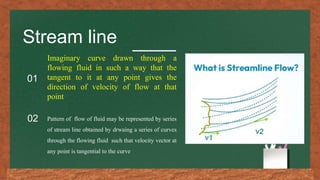
Stream line
01
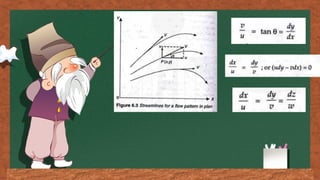
02 Pattern of flow of fluid may be represented by series
of stream line obtained by drwaing a series of curves
through the flowing fluid such that velocity vector at
any point is tangential to the curve
Imaginary curve drawn through a
flowing fluid in such a way that the
tangent to it at any point gives the
direction of velocity of flow at that
point
Stream
line
01
02
03
04
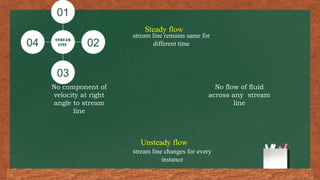
stream line remains same for
different time
Steady flow
stream line changes for every
instance
Unsteady flow
No component of
velocity at right
angle to stream
line
No flow of fluid
across any stream
line
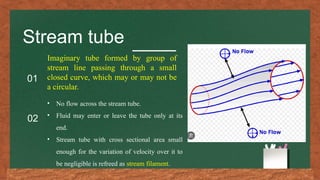
Stream tube
01
02
• No flow across the stream tube.
• Fluid may enter or leave the tube only at its
end.
• Stream tube with cross sectional area small
enough for the variation of velocity over it to
be negligible is refreed as stream filament.
Imaginary tube formed by group of
stream line passing through a small
closed curve, which may or may not be
a circular.
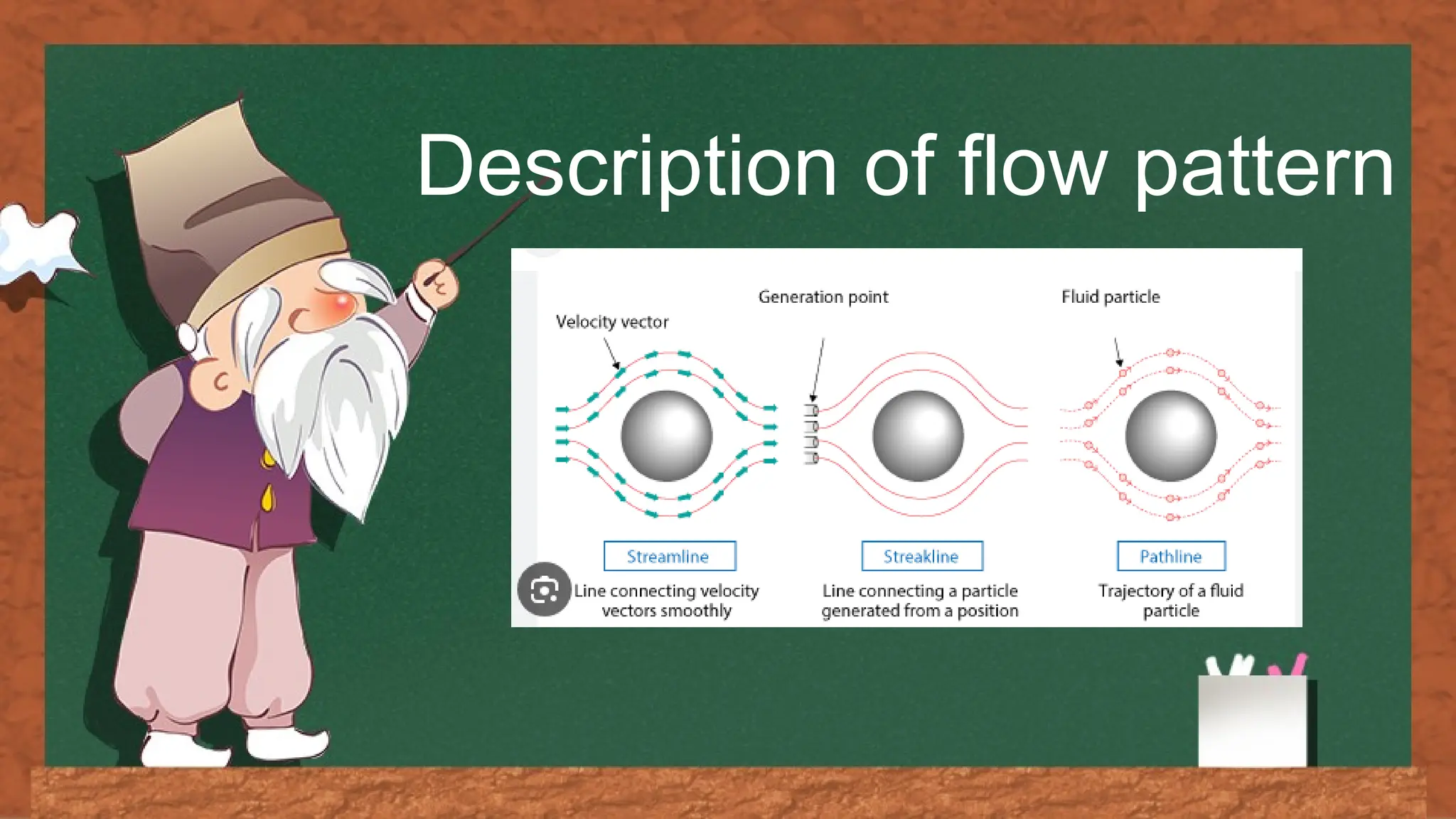
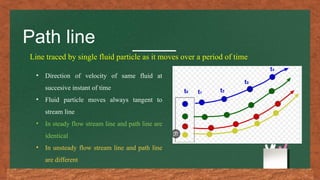
Path line
• Direction of velocity of same fluid at
succesive instant of time
• Fluid particle moves always tangent to
stream line
• In steady flow stream line and path line are
identical
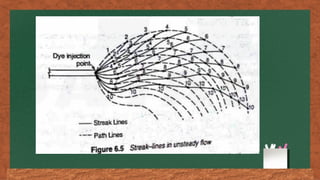
• In unsteady flow stream line and path line
are different
Line traced by single fluid particle as it moves over a period of time
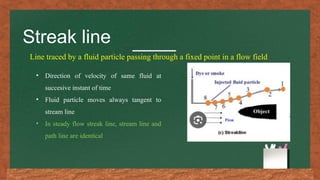
Streak line
• Direction of velocity of same fluid at
succesive instant of time
• Fluid particle moves always tangent to
stream line
• In steady flow streak line, stream line and
path line are identical
Line traced by a fluid particle passing through a fixed point in a flow field
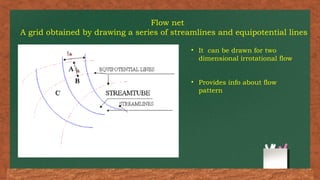
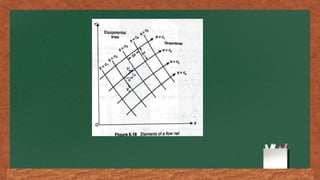
Flow net
A grid obtained by drawing a series of streamlines and equipotential lines
• It can be drawn for two
dimensional irrotational flow
• Provides info about flow
pattern
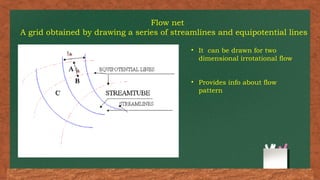
Flow net
A grid obtained by drawing a series of streamlines and equipotential lines
• It can be drawn for two
dimensional irrotational flow
• Provides info about flow
pattern
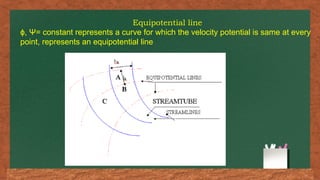
Equipotential line
, Ψ= constant represents a curve for which the velocity potential is same at every
ɸ
point, represents an equipotential line
Velocity potential
It is scalar function of space and time such that its negative derivation with respect
to any direction gives the fluid velocity in that direction.
= f(x,y,z,t) - unsteady flow
ɸ
= f(x,y,z,) - steady flow
ɸ
Velocity potential
exists only for
irrotational flow
Stream function
It is scalar function of space and time, such that its partial derivative with respect to
any direction gives the velocity component at right angle to this direction.
= f(x,y,t) - unsteady flow
ɸ
= f(x,y,) - steady flow
ɸ
Stream function
exists only if
flow satisfies
continuity
equation
Basic principles of
fluid flow
• Principle of conservation of mass
• Principle of conservation of energy
• Principle of conservation of momentum
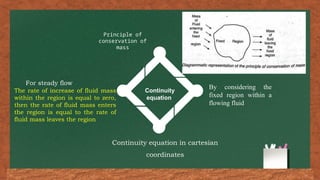
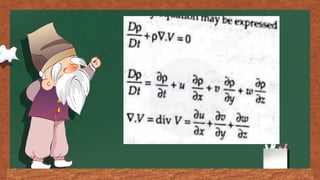
Continuity
equation
Principle of
conservation of
mass
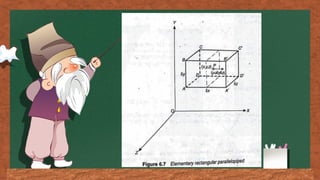
Continuity equation in cartesian
coordinates
For steady flow
By considering the
fixed region within a
flowing fluid
The rate of increase of fluid mass
within the region is equal to zero,
then the rate of fluid mass enters
the region is equal to the rate of
fluid mass leaves the region
01 02 03 04
Click here to add content
of the text the main idea
of this page,
Enter title
Click here to add content
of the text the main idea
of this page,
Enter title
Click here to add content
of the text the main idea
of this page,
Enter title
Click here to add content
of the text the main idea
of this page,
Enter title
Enter title Enter title Enter title Enter title
Click here to add content
of the text the main idea
of this page,
Click here to add content
of the text the main idea
of this page,
Click here to add content
of the text the main idea
of this page,
Click here to add content
of the text the main idea
of this page,

flow pattern OF A FLUID PARTICLES .pptx

  • 1.
  • 2.
    Stream line 01 02 Patternof flow of fluid may be represented by series of stream line obtained by drwaing a series of curves through the flowing fluid such that velocity vector at any point is tangential to the curve Imaginary curve drawn through a flowing fluid in such a way that the tangent to it at any point gives the direction of velocity of flow at that point
  • 4.
    Stream line 01 02 03 04 stream line remainssame for different time Steady flow stream line changes for every instance Unsteady flow No component of velocity at right angle to stream line No flow of fluid across any stream line
  • 5.
    Stream tube 01 02 • Noflow across the stream tube. • Fluid may enter or leave the tube only at its end. • Stream tube with cross sectional area small enough for the variation of velocity over it to be negligible is refreed as stream filament. Imaginary tube formed by group of stream line passing through a small closed curve, which may or may not be a circular.
  • 6.
    Path line • Directionof velocity of same fluid at succesive instant of time • Fluid particle moves always tangent to stream line • In steady flow stream line and path line are identical • In unsteady flow stream line and path line are different Line traced by single fluid particle as it moves over a period of time
  • 7.
    Streak line • Directionof velocity of same fluid at succesive instant of time • Fluid particle moves always tangent to stream line • In steady flow streak line, stream line and path line are identical Line traced by a fluid particle passing through a fixed point in a flow field
  • 9.
    Flow net A gridobtained by drawing a series of streamlines and equipotential lines • It can be drawn for two dimensional irrotational flow • Provides info about flow pattern
  • 10.
    Flow net A gridobtained by drawing a series of streamlines and equipotential lines • It can be drawn for two dimensional irrotational flow • Provides info about flow pattern
  • 12.
    Equipotential line , Ψ=constant represents a curve for which the velocity potential is same at every ɸ point, represents an equipotential line
  • 13.
    Velocity potential It isscalar function of space and time such that its negative derivation with respect to any direction gives the fluid velocity in that direction. = f(x,y,z,t) - unsteady flow ɸ = f(x,y,z,) - steady flow ɸ Velocity potential exists only for irrotational flow
  • 14.
    Stream function It isscalar function of space and time, such that its partial derivative with respect to any direction gives the velocity component at right angle to this direction. = f(x,y,t) - unsteady flow ɸ = f(x,y,) - steady flow ɸ Stream function exists only if flow satisfies continuity equation
  • 15.
    Basic principles of fluidflow • Principle of conservation of mass • Principle of conservation of energy • Principle of conservation of momentum
  • 16.
    Continuity equation Principle of conservation of mass Continuityequation in cartesian coordinates For steady flow By considering the fixed region within a flowing fluid The rate of increase of fluid mass within the region is equal to zero, then the rate of fluid mass enters the region is equal to the rate of fluid mass leaves the region
  • 20.
    01 02 0304 Click here to add content of the text the main idea of this page, Enter title Click here to add content of the text the main idea of this page, Enter title Click here to add content of the text the main idea of this page, Enter title Click here to add content of the text the main idea of this page, Enter title
  • 21.
    Enter title Entertitle Enter title Enter title Click here to add content of the text the main idea of this page, Click here to add content of the text the main idea of this page, Click here to add content of the text the main idea of this page, Click here to add content of the text the main idea of this page,