STUDY SKILLS
PAGES 66 - 85
APPLYING OWN STUDY SKILLS, STYLES AND
STRATEGIES
• Good study skills and strategies will help you to manage your
school work and prepare for assessments and exams.
• Study skills are techniques that you can learn and apply to all
your subjects.
• Study strategies refer to the way in which you put your study
skills to best use.
• This will depend on your study style, or the way in which you
study best.
HOW DOES LEARNING TAKE PLACE?
• Informal learning: Learning through watching and copying
other people’s behaviour. Informal learning is a lifelong
process.
• Formal learning: Planned, technical, professional and
academic learning that takes place in a structured
environment.
• Some examples of formal learning: Tests, assignments,
essays, studying, informal assessments, recall, exams, pair
work, group work, homework, experiments, formal
THE ROLE OF MEMORY IN FORMAL LEARNING
• There are two main types of memory:
• Short term memory – memory is stored in a part of
our brain for only a minute or so. The short-term
memory can store only a limited number of items at a
time.
• Long term memory – memories are stored in our
brains for a much longer period of time, from days to
a whole life-time.
DIFFERENT WAYS OF LEARNING
• One way of learning is to memorise information by rote
learning.
• Rote learning means to go over information again and again
until it is stored in your long-term memory so that you can
recall the information for tests and exams.
• Rote learning doesn’t mean you actually understand what you
are learning.
• Meaningful learning means you fully understand what you are
learning and can apply your knowledge in different ways.
Taking notes and reading for
meaning are two different
but very important ways of
learning.
VALUABLE
STUDY
SKILLS
TAKING NOTES
• Note taking is a study skill that will help you memorise new
information.
• Taking notes is useful at school to take down what your teachers
are saying and at home to check you understand what you have
learnt.
• The purpose of taking good notes is to help you organize the
information you are learning.
• Write your notes in a way that makes sense to you and helps you
to study and revise.
• When you take notes, make sure you use a logical approach. See
READING FOR MEANING
• Reading from a textbook or from notes helps you to
work out any parts of a subject that you don’t
understand.
• When we read for understanding, we dissect the text
paragraph by paragraph and sometimes, sentence by
sentence to understand the text.
• Read slowly and actively and think carefully about what
you are reading.
FOLLOW
THESE
STEPS
WHEN YOU
ARE
READING
FOR
MEANING:
Read the first sentence of any
text slowly.
If there’s something in the first
sentence that you don’t
understand, re-read it before
you continue.
If you understand what you have
read, go on to the next
sentence.
If you re-read a sentence and
you still don’t understand it, ask
someone to help you before you
go on. If there is no-one to help
you, make a note to ask
someone for help as soon as you
can.
Continue reading slowly and
carefully, noting anything else
that is unclear to you.
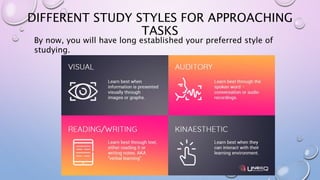
DIFFERENT STUDY STYLES FOR APPROACHING
TASKS
By now, you will have long established your preferred style of
studying.
STUDY
STRATEGI
ES TO
APPROAC
H A
SPECIFIC
TASK
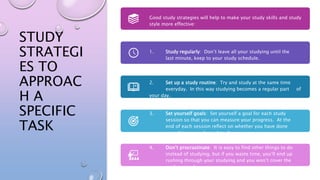
Good study strategies will help to make your study skills and study
style more effective:
1. Study regularly: Don’t leave all your studying until the
last minute, keep to your study schedule.
2. Set up a study routine: Try and study at the same time
everyday. In this way studying becomes a regular part of
your day.
3. Set yourself goals: Set yourself a goal for each study
session so that you can measure your progress. At the
end of each session reflect on whether you have done
everything you planned to do.
4. Don’t procrastinate: It is easy to find other things to do
instead of studying, but if you waste time, you’ll end up
rushing through your studying and you won’t cover the
work properly.
STUDY
STRATEGI
ES TO
APPROAC
H A
SPECIFIC
TASK
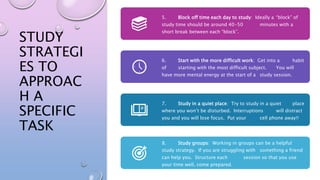
5. Block off time each day to study: Ideally a “block” of
study time should be around 40-50 minutes with a
short break between each “block”.
6. Start with the more difficult work: Get into a habit
of starting with the most difficult subject. You will
have more mental energy at the start of a study session.
7. Study in a quiet place: Try to study in a quiet place
where you won’t be disturbed. Interruptions will distract
you and you will lose focus. Put your cell phone away!!
8. Study groups: Working in groups can be a helpful
study strategy. If you are struggling with something a friend
can help you. Structure each session so that you use
your time well, come prepared.
EXAMINATION WRITING SKILLS AND PROCESS
OF ASSESSMENT
• Exams and assessments are part of every learner’s life.
• Exams and assessments help you to keep track of your development
throughout a school year and guide you in areas that need improvement.
• Look at exams and assessments as useful tools that will help you get
ahead.
• Exams are one way to assess whether or not you know the facts and
content of a particular subject and whether you can apply this
information to different questions and tasks.
• Exams also test whether you can think and apply your knowledge quickly
and under pressure.
• These are skills that are useful in many aspects of life.
BEFORE YOU START WRITING
• Listen carefully to all instructions that are given in the
exam room.
• Use your reading time effectively.
• Scan questions that you feel comfortable with and
answer those ones first.
• Make sure you know exactly how many questions you
must answer if you are given a choice and don’t waste
time doing more than is necessary.
UNDERSTAND THE QUESTIONS
• A really important skill that you need when writing
exams is to understand the question.
• Many learners answer questions incorrectly because they
misunderstand what they are asked to do.
• Exam questions contain clue words that tell you how to
approach the questions you are being asked.
• Words like: compare, evaluate, explain, describe; are
clue words.
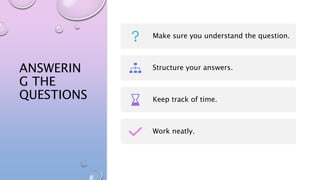
ANSWERIN
G THE
QUESTIONS
Make sure you understand the question.
Structure your answers.
Keep track of time.
Work neatly.
ASSESSMENT OF DIFFERENT SUBJECTS
• Assessment requirements differ for every subject,
and every subject has a different Programme of
Assessment.
• It is important that you are familiar with all
assessment requirements for each of your
subjects so that you can do as well as possible
when you complete the tasks.
THE
PROCESS
OF
ASSESSMEN
T
The intention behind assessment is to review what you have learnt
and to assess whether you need further assistance in a particular
area.
Assessments should be a clear and transparent process that involves
you and your teacher working together according to these steps:
1. Assessments must be planned so that learners know when
to expect it and what to expect.
2. The method of assessment must be clearly explained to
learners.
3. Assessments should be a fair process and must be
conducted in a safe environment.
4. Learners should always get feedback after assessments. This
can be in the form of a discussion or marks given.
TIME MANAGEMENT SKILLS & ANNUAL STUDY
PLAN
• At FET level, one of your most important priorities must
be attending school and focusing on your studies.
• The trick to balancing schoolwork and leisure activities is
managing your time efficiently.
• A good way to start managing your time efficiently is to
establish:
• What you do with your time.
• What do you have to achieve in an average day or week.
TIME-MANAGEMENT SKILLS
• School-based learning is a full-time job and you have to
keep your priorities in mind every day: your education
should come first.
• Part of your success at school is to manage your time
and making sure you have enough time to focus on your
studies.
• Most learners have busy lives with lots of different
interests.
DAY-TO-DAY PLANNING
• It is good to get into the habit of day-to-day planning so
that you can use this time effectively as possible. These
tips will help you to establish good time-management
skills:
• Every evening write down what you have to do the following
day. Include your routine activities as well as anything that is
specific to the next day.
• Highlight the most important things on the list that need your
attention.
PLANNING YOUR TIME IN THE SHORT TERM
• Short-term planning refers to priorities that you must be
aware of over a one-week or two-week period.
• Keep a copy of your short-term plan close to you all the time
so that you can refer to it regularly and check that you are on
track with everything.
• Prepare a new short-term plan every week or two.
• Review your plan weekly so that you can change your
schedule should anything unexpected crop up.
PLANNING YOUR TIME IN THE LONG TERM
• You can work towards your bigger goals by using a long-
term plan.
• One way to plan in the long term is to draw up an annual
study plan.
• ANNUAL STUDY PLAN:
• At the beginning of the year, identify the most important dates for
the year ahead, such as formal assessments, exams, family
commitments, school holidays as well as sport.
• Most school calendars will tell you when the school holidays are,
most teachers can give you test and exam dates well in advance.
• Create a year schedule that you can stick up and is big enough to add
details for different events.
• Identify how you are going to prepare for all the major tests and
exams.
• If you plan your year schedule carefully and include all relevant
GOAL SETTING SKILLS: PERSONAL
DEVELOPMENT GOALS REGARDING STUDY,
HEALTH AND FITNESS
• Do you have the answer to the question: What do I want to
do with my life?
• To get ahead and succeed in any area of your life you must
have goals.
• Having goals to work towards gives you a sense of direction
and helps you to focus.
• The exciting things about setting goals is that the most
important things will help you achieve your goals are:
• Your attitude
• The work you put into achieving them.
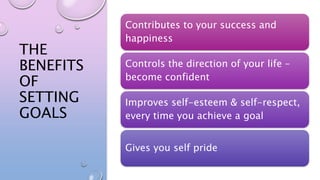
THE
BENEFITS
OF
SETTING
GOALS
Contributes to your success and
happiness
Controls the direction of your life –
become confident
Improves self-esteem & self-respect,
every time you achieve a goal
Gives you self pride
HOW TO SET GOALS FOR YOURSELF
Try to set yourself a
few different goals.
If you have too
many goals you may
not be able to
achieve any of them.
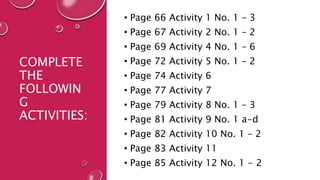
COMPLETE
THE
FOLLOWIN
G
ACTIVITIES:
• Page 66 Activity 1 No. 1 – 3
• Page 67 Activity 2 No. 1 – 2
• Page 69 Activity 4 No. 1 – 6
• Page 72 Activity 5 No. 1 – 2
• Page 74 Activity 6
• Page 77 Activity 7
• Page 79 Activity 8 No. 1 – 3
• Page 81 Activity 9 No. 1 a-d
• Page 82 Activity 10 No. 1 – 2
• Page 83 Activity 11
• Page 85 Activity 12 No. 1 - 2

5-Study-skills.pptx

  • 1.
  • 2.
    APPLYING OWN STUDYSKILLS, STYLES AND STRATEGIES • Good study skills and strategies will help you to manage your school work and prepare for assessments and exams. • Study skills are techniques that you can learn and apply to all your subjects. • Study strategies refer to the way in which you put your study skills to best use. • This will depend on your study style, or the way in which you study best.
  • 3.
    HOW DOES LEARNINGTAKE PLACE? • Informal learning: Learning through watching and copying other people’s behaviour. Informal learning is a lifelong process. • Formal learning: Planned, technical, professional and academic learning that takes place in a structured environment. • Some examples of formal learning: Tests, assignments, essays, studying, informal assessments, recall, exams, pair work, group work, homework, experiments, formal
  • 4.
    THE ROLE OFMEMORY IN FORMAL LEARNING • There are two main types of memory: • Short term memory – memory is stored in a part of our brain for only a minute or so. The short-term memory can store only a limited number of items at a time. • Long term memory – memories are stored in our brains for a much longer period of time, from days to a whole life-time.
  • 5.
    DIFFERENT WAYS OFLEARNING • One way of learning is to memorise information by rote learning. • Rote learning means to go over information again and again until it is stored in your long-term memory so that you can recall the information for tests and exams. • Rote learning doesn’t mean you actually understand what you are learning. • Meaningful learning means you fully understand what you are learning and can apply your knowledge in different ways.
  • 6.
    Taking notes andreading for meaning are two different but very important ways of learning. VALUABLE STUDY SKILLS
  • 7.
    TAKING NOTES • Notetaking is a study skill that will help you memorise new information. • Taking notes is useful at school to take down what your teachers are saying and at home to check you understand what you have learnt. • The purpose of taking good notes is to help you organize the information you are learning. • Write your notes in a way that makes sense to you and helps you to study and revise. • When you take notes, make sure you use a logical approach. See
  • 8.
    READING FOR MEANING •Reading from a textbook or from notes helps you to work out any parts of a subject that you don’t understand. • When we read for understanding, we dissect the text paragraph by paragraph and sometimes, sentence by sentence to understand the text. • Read slowly and actively and think carefully about what you are reading.
  • 9.
    FOLLOW THESE STEPS WHEN YOU ARE READING FOR MEANING: Read thefirst sentence of any text slowly. If there’s something in the first sentence that you don’t understand, re-read it before you continue. If you understand what you have read, go on to the next sentence. If you re-read a sentence and you still don’t understand it, ask someone to help you before you go on. If there is no-one to help you, make a note to ask someone for help as soon as you can. Continue reading slowly and carefully, noting anything else that is unclear to you.
  • 10.
    DIFFERENT STUDY STYLESFOR APPROACHING TASKS By now, you will have long established your preferred style of studying.
  • 11.
    STUDY STRATEGI ES TO APPROAC H A SPECIFIC TASK Goodstudy strategies will help to make your study skills and study style more effective: 1. Study regularly: Don’t leave all your studying until the last minute, keep to your study schedule. 2. Set up a study routine: Try and study at the same time everyday. In this way studying becomes a regular part of your day. 3. Set yourself goals: Set yourself a goal for each study session so that you can measure your progress. At the end of each session reflect on whether you have done everything you planned to do. 4. Don’t procrastinate: It is easy to find other things to do instead of studying, but if you waste time, you’ll end up rushing through your studying and you won’t cover the work properly.
  • 12.
    STUDY STRATEGI ES TO APPROAC H A SPECIFIC TASK 5.Block off time each day to study: Ideally a “block” of study time should be around 40-50 minutes with a short break between each “block”. 6. Start with the more difficult work: Get into a habit of starting with the most difficult subject. You will have more mental energy at the start of a study session. 7. Study in a quiet place: Try to study in a quiet place where you won’t be disturbed. Interruptions will distract you and you will lose focus. Put your cell phone away!! 8. Study groups: Working in groups can be a helpful study strategy. If you are struggling with something a friend can help you. Structure each session so that you use your time well, come prepared.
  • 13.
    EXAMINATION WRITING SKILLSAND PROCESS OF ASSESSMENT • Exams and assessments are part of every learner’s life. • Exams and assessments help you to keep track of your development throughout a school year and guide you in areas that need improvement. • Look at exams and assessments as useful tools that will help you get ahead. • Exams are one way to assess whether or not you know the facts and content of a particular subject and whether you can apply this information to different questions and tasks. • Exams also test whether you can think and apply your knowledge quickly and under pressure. • These are skills that are useful in many aspects of life.
  • 14.
    BEFORE YOU STARTWRITING • Listen carefully to all instructions that are given in the exam room. • Use your reading time effectively. • Scan questions that you feel comfortable with and answer those ones first. • Make sure you know exactly how many questions you must answer if you are given a choice and don’t waste time doing more than is necessary.
  • 15.
    UNDERSTAND THE QUESTIONS •A really important skill that you need when writing exams is to understand the question. • Many learners answer questions incorrectly because they misunderstand what they are asked to do. • Exam questions contain clue words that tell you how to approach the questions you are being asked. • Words like: compare, evaluate, explain, describe; are clue words.
  • 16.
    ANSWERIN G THE QUESTIONS Make sureyou understand the question. Structure your answers. Keep track of time. Work neatly.
  • 17.
    ASSESSMENT OF DIFFERENTSUBJECTS • Assessment requirements differ for every subject, and every subject has a different Programme of Assessment. • It is important that you are familiar with all assessment requirements for each of your subjects so that you can do as well as possible when you complete the tasks.
  • 18.
    THE PROCESS OF ASSESSMEN T The intention behindassessment is to review what you have learnt and to assess whether you need further assistance in a particular area. Assessments should be a clear and transparent process that involves you and your teacher working together according to these steps: 1. Assessments must be planned so that learners know when to expect it and what to expect. 2. The method of assessment must be clearly explained to learners. 3. Assessments should be a fair process and must be conducted in a safe environment. 4. Learners should always get feedback after assessments. This can be in the form of a discussion or marks given.
  • 19.
    TIME MANAGEMENT SKILLS& ANNUAL STUDY PLAN • At FET level, one of your most important priorities must be attending school and focusing on your studies. • The trick to balancing schoolwork and leisure activities is managing your time efficiently. • A good way to start managing your time efficiently is to establish: • What you do with your time. • What do you have to achieve in an average day or week.
  • 20.
    TIME-MANAGEMENT SKILLS • School-basedlearning is a full-time job and you have to keep your priorities in mind every day: your education should come first. • Part of your success at school is to manage your time and making sure you have enough time to focus on your studies. • Most learners have busy lives with lots of different interests.
  • 21.
    DAY-TO-DAY PLANNING • Itis good to get into the habit of day-to-day planning so that you can use this time effectively as possible. These tips will help you to establish good time-management skills: • Every evening write down what you have to do the following day. Include your routine activities as well as anything that is specific to the next day. • Highlight the most important things on the list that need your attention.
  • 22.
    PLANNING YOUR TIMEIN THE SHORT TERM • Short-term planning refers to priorities that you must be aware of over a one-week or two-week period. • Keep a copy of your short-term plan close to you all the time so that you can refer to it regularly and check that you are on track with everything. • Prepare a new short-term plan every week or two. • Review your plan weekly so that you can change your schedule should anything unexpected crop up.
  • 23.
    PLANNING YOUR TIMEIN THE LONG TERM • You can work towards your bigger goals by using a long- term plan. • One way to plan in the long term is to draw up an annual study plan. • ANNUAL STUDY PLAN: • At the beginning of the year, identify the most important dates for the year ahead, such as formal assessments, exams, family commitments, school holidays as well as sport. • Most school calendars will tell you when the school holidays are, most teachers can give you test and exam dates well in advance. • Create a year schedule that you can stick up and is big enough to add details for different events. • Identify how you are going to prepare for all the major tests and exams. • If you plan your year schedule carefully and include all relevant
  • 24.
    GOAL SETTING SKILLS:PERSONAL DEVELOPMENT GOALS REGARDING STUDY, HEALTH AND FITNESS • Do you have the answer to the question: What do I want to do with my life? • To get ahead and succeed in any area of your life you must have goals. • Having goals to work towards gives you a sense of direction and helps you to focus. • The exciting things about setting goals is that the most important things will help you achieve your goals are: • Your attitude • The work you put into achieving them.
  • 25.
    THE BENEFITS OF SETTING GOALS Contributes to yoursuccess and happiness Controls the direction of your life – become confident Improves self-esteem & self-respect, every time you achieve a goal Gives you self pride
  • 26.
    HOW TO SETGOALS FOR YOURSELF Try to set yourself a few different goals. If you have too many goals you may not be able to achieve any of them.
  • 27.
    COMPLETE THE FOLLOWIN G ACTIVITIES: • Page 66Activity 1 No. 1 – 3 • Page 67 Activity 2 No. 1 – 2 • Page 69 Activity 4 No. 1 – 6 • Page 72 Activity 5 No. 1 – 2 • Page 74 Activity 6 • Page 77 Activity 7 • Page 79 Activity 8 No. 1 – 3 • Page 81 Activity 9 No. 1 a-d • Page 82 Activity 10 No. 1 – 2 • Page 83 Activity 11 • Page 85 Activity 12 No. 1 - 2