Terminologies & deformities:
• Varus and valgus
• Hallux Valgus/Varus
• Coxa Vara/Coxa Vaiga
• Genu Varum/Valgum
• Cubitus Varus/Valgus
• Madelung Deformity
• Bunion
• Osteotomy
By Dhanulekha
Varus & valgus
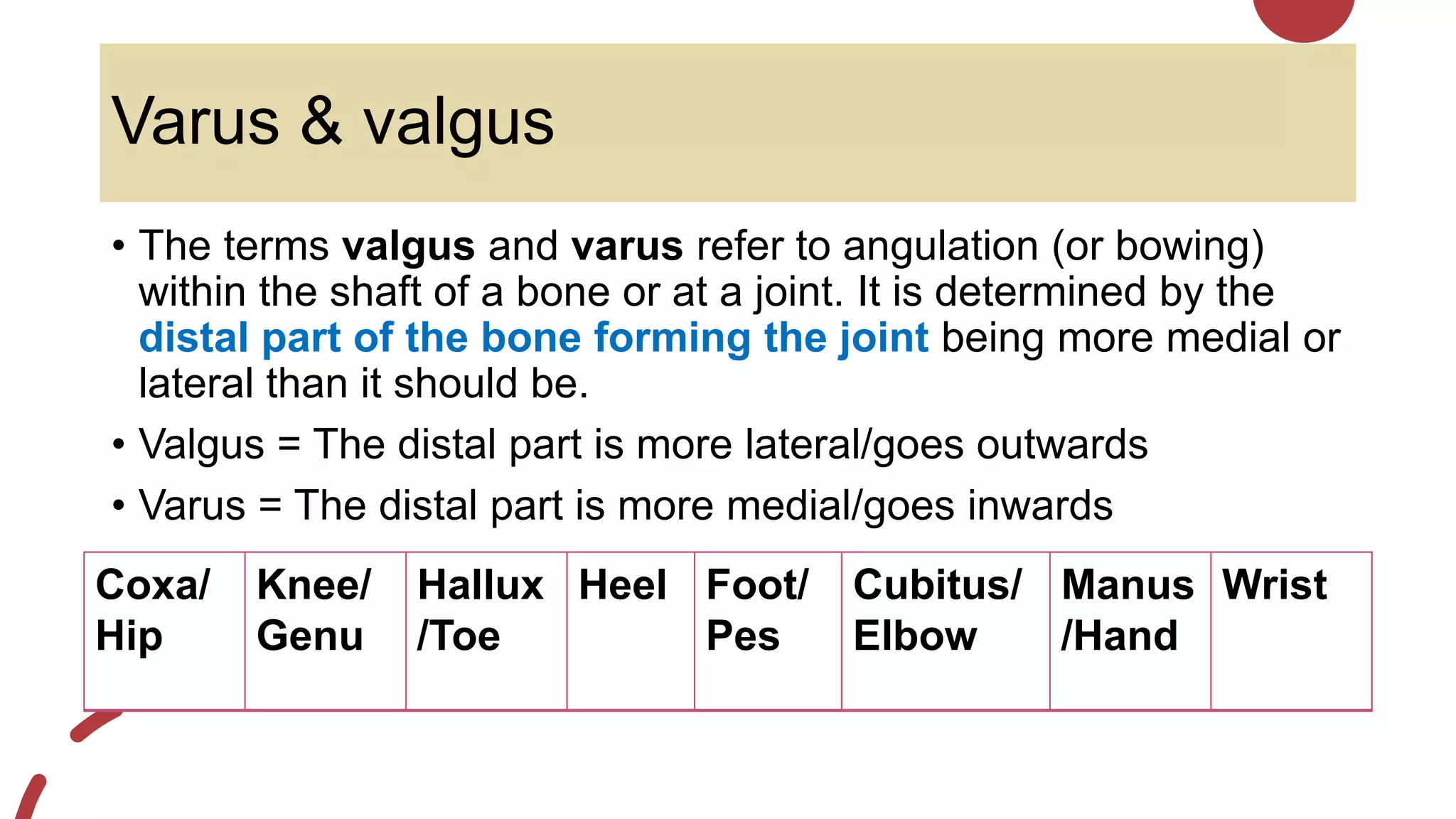
• The terms valgus and varus refer to angulation (or bowing)
within the shaft of a bone or at a joint. It is determined by the
distal part of the bone forming the joint being more medial or
lateral than it should be.
• Valgus = The distal part is more lateral/goes outwards
• Varus = The distal part is more medial/goes inwards
Coxa/
Hip
Knee/
Genu
Hallux
/Toe
Heel Foot/
Pes
Cubitus/
Elbow
Manus
/Hand
Wrist
Coxa/hip
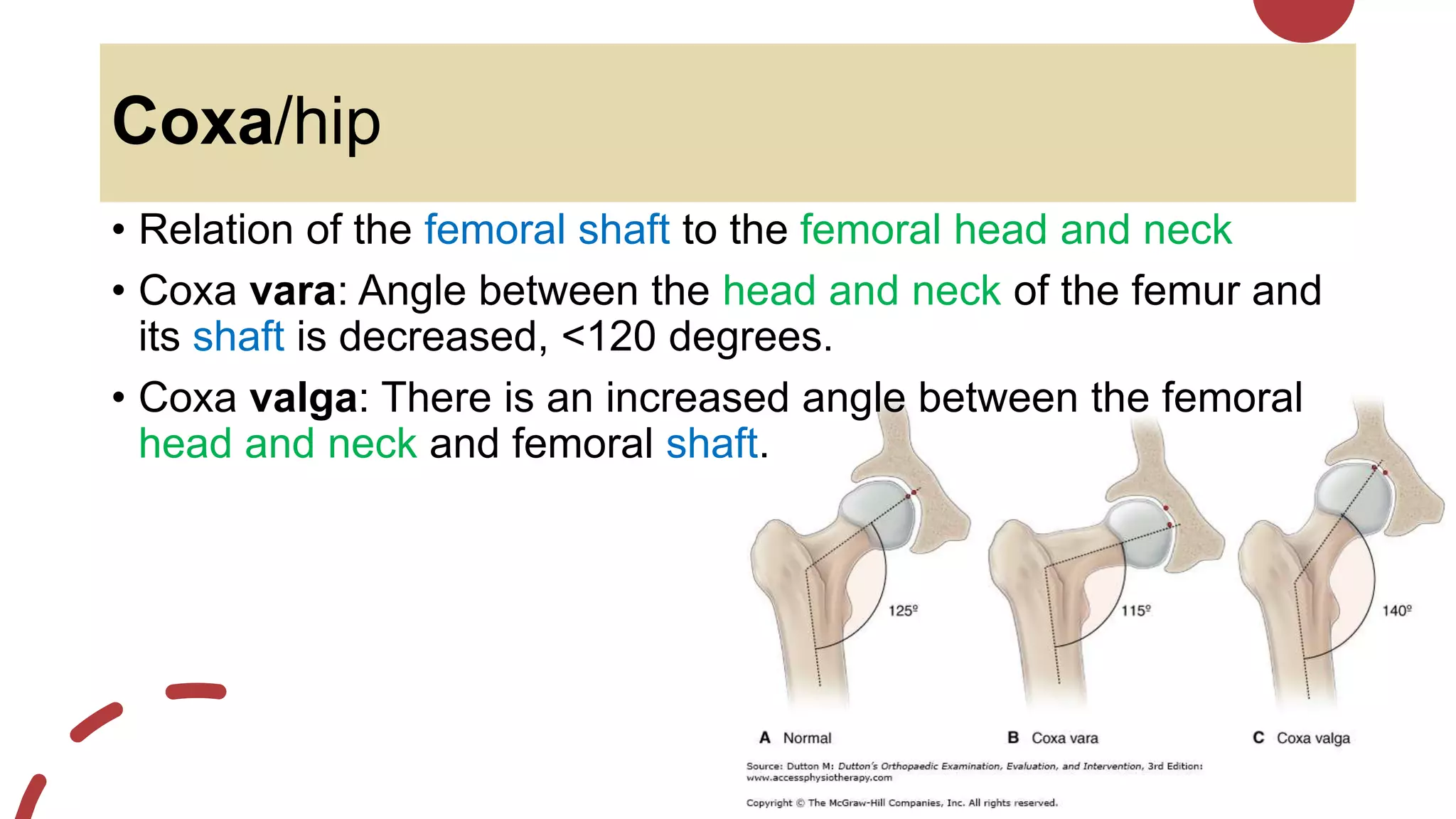
• Relation of the femoral shaft to the femoral head and neck
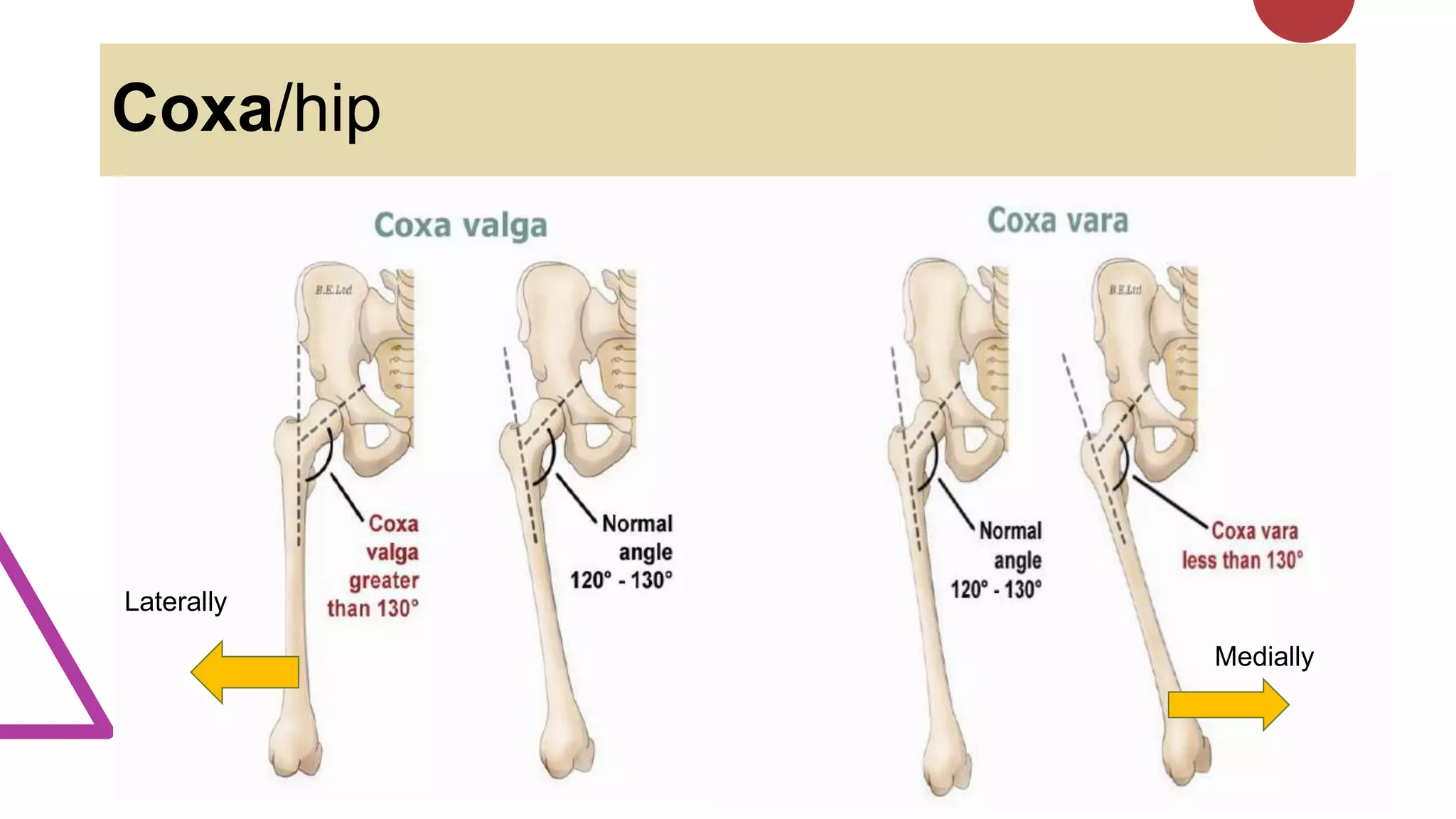
• Coxa vara: Angle between the head and neck of the femur and
its shaft is decreased, <120 degrees.
• Coxa valga: There is an increased angle between the femoral
head and neck and femoral shaft.
Coxa/hip
Laterally
Medially
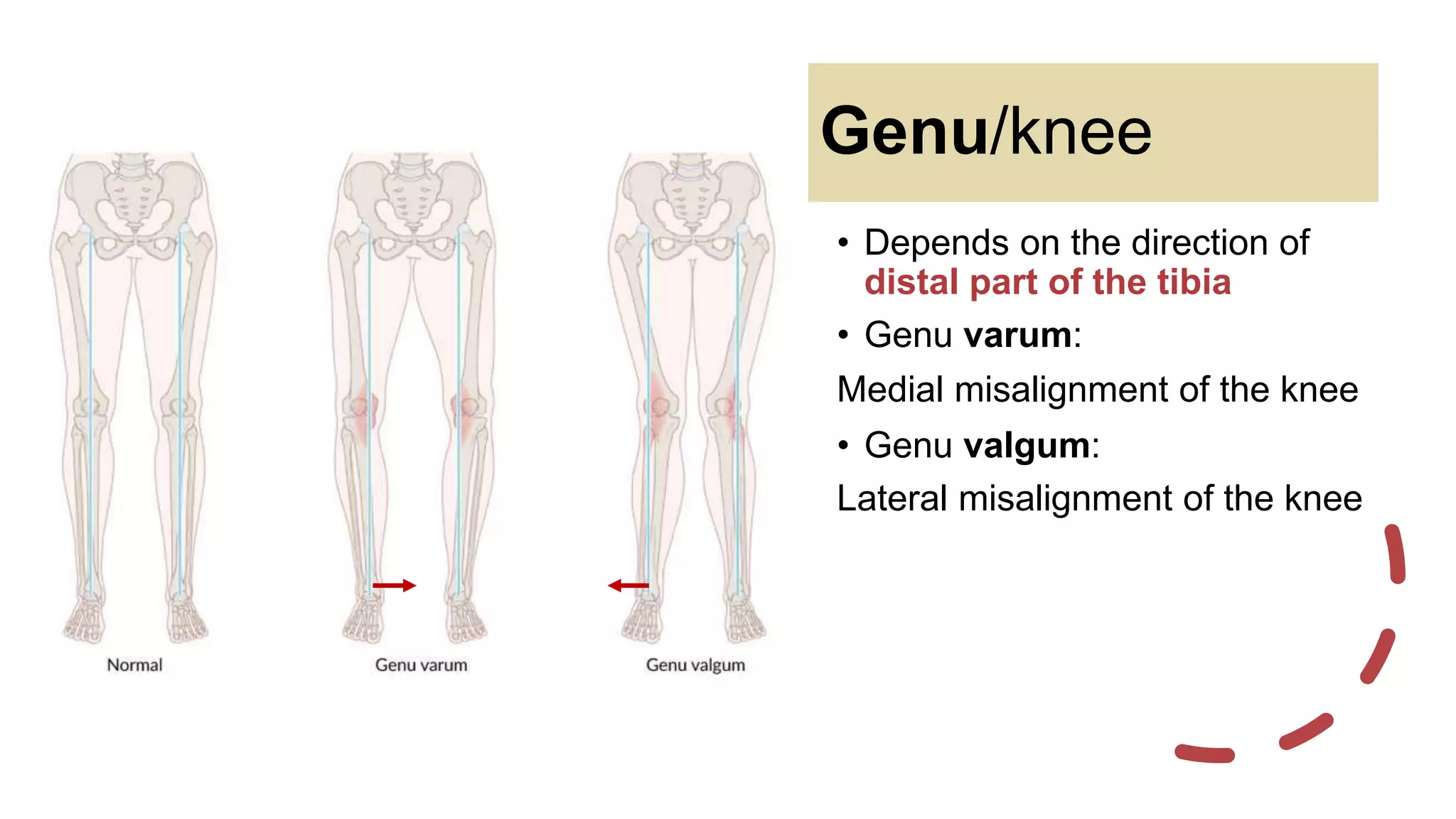
• Depends on the direction of
distal part of the tibia
• Genu varum:
Medial misalignment of the knee
• Genu valgum:
Lateral misalignment of the knee
Genu/knee
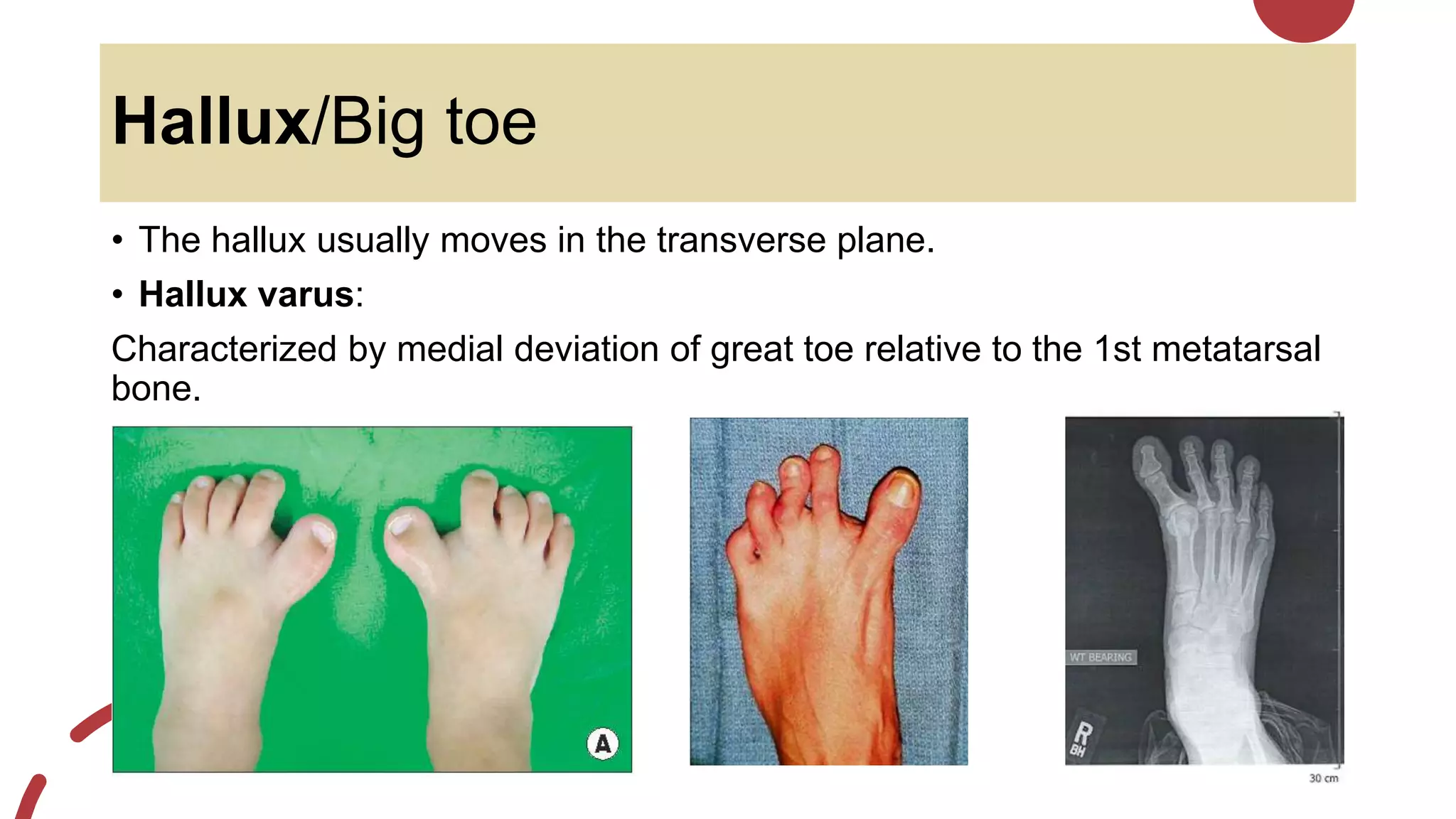
Hallux/Big toe
• The hallux usually moves in the transverse plane.
• Hallux varus:
Characterized by medial deviation of great toe relative to the 1st metatarsal
bone.
Hallux valgus / Bunion
• A bunion is a localized painful swelling at the
base of the big toe. The joint is enlarged (due to
new bone formation) and the toe is often
misaligned. It is frequently associated with
inflammation.
• It can be related to inflammation of the nearby
bursa (bursitis) or degenerative joint disease
(osteoarthritis)
• It is characterized by medial deviation of the
first metatarsal and lateral deviation rotation of
the hallux, with associated joint subluxation.
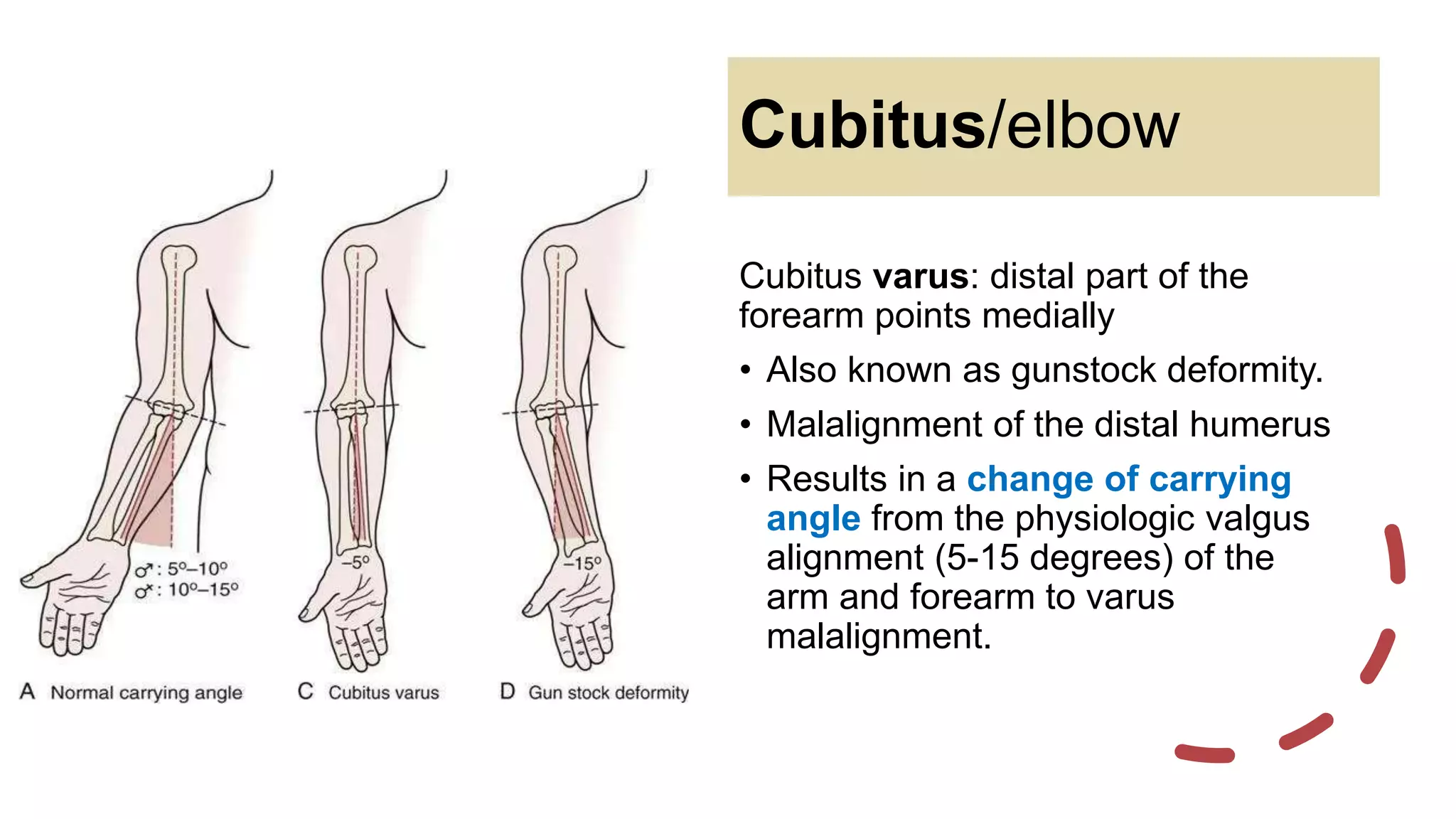
Cubitus/elbow
Cubitus varus: distal part of the
forearm points medially
• Also known as gunstock deformity.
• Malalignment of the distal humerus
• Results in a change of carrying
angle from the physiologic valgus
alignment (5-15 degrees) of the
arm and forearm to varus
malalignment.
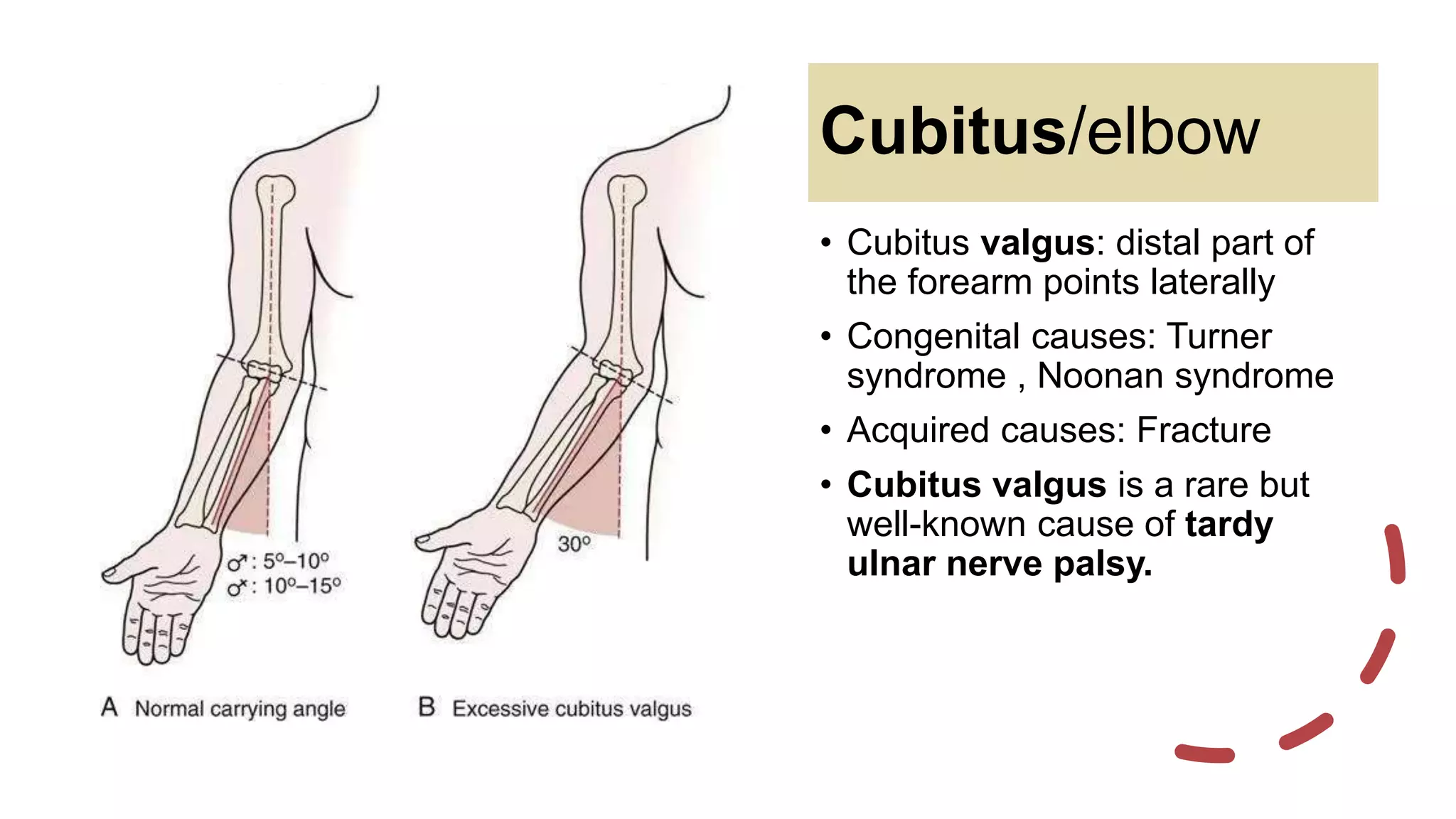
Cubitus/elbow
• Cubitus valgus: distal part of
the forearm points laterally
• Congenital causes: Turner
syndrome , Noonan syndrome
• Acquired causes: Fracture
• Cubitus valgus is a rare but
well-known cause of tardy
ulnar nerve palsy.
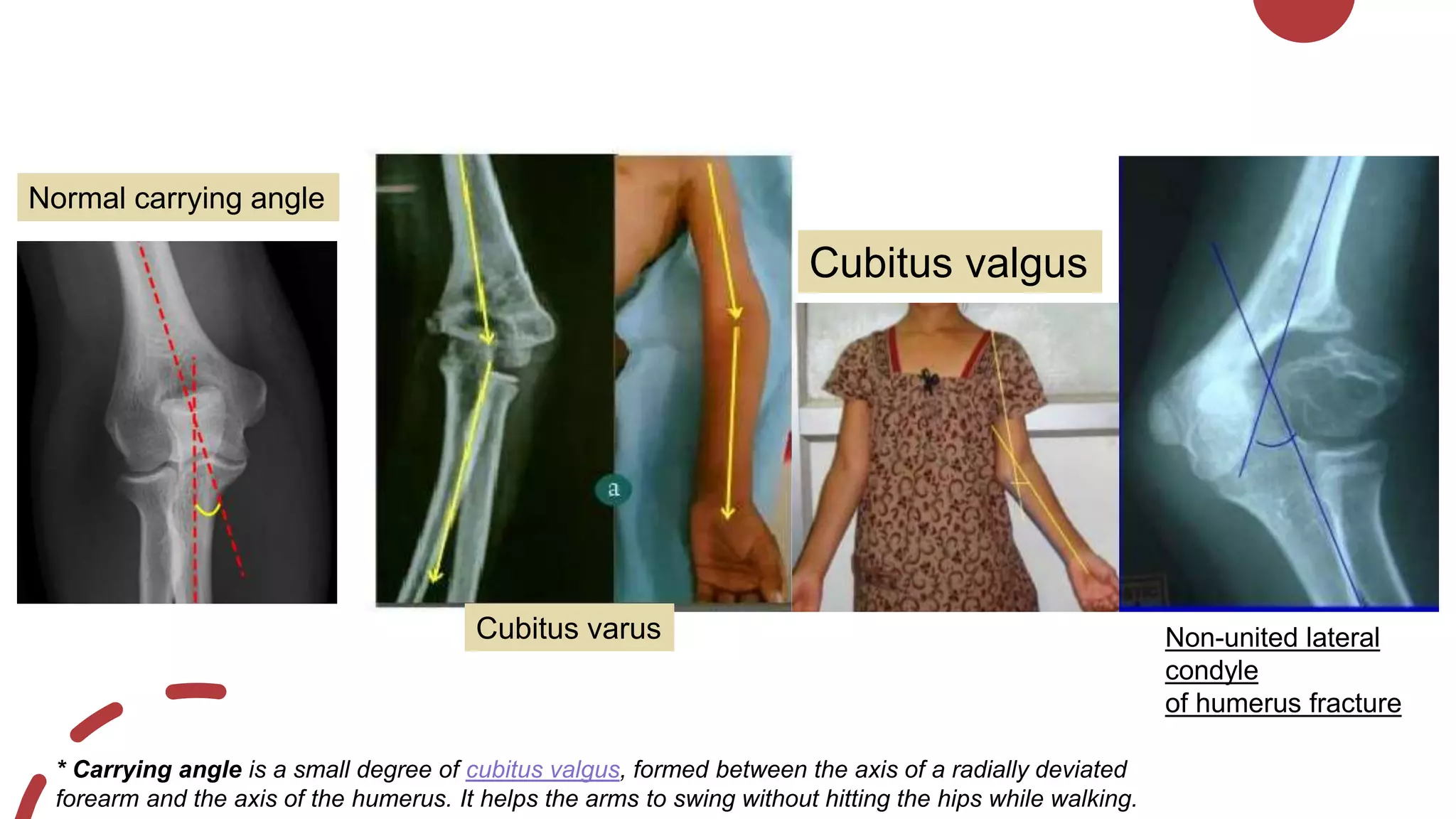
Cubitus varus
Cubitus valgus
Non-united lateral
condyle
of humerus fracture
Normal carrying angle
* Carrying angle is a small degree of cubitus valgus, formed between the axis of a radially deviated
forearm and the axis of the humerus. It helps the arms to swing without hitting the hips while walking.
Madelung Deformity
• It can be bilateral in 50-66% of patients.
• Rare congenital deformity and does not
usually manifest until 10-14 years.
• It may also be seen as an acquired
consequence of trauma to the growth plate,
e.g. Salter-Harris fracture (type V).
• Growth disturbance of volar-ulnar distal
radial physis
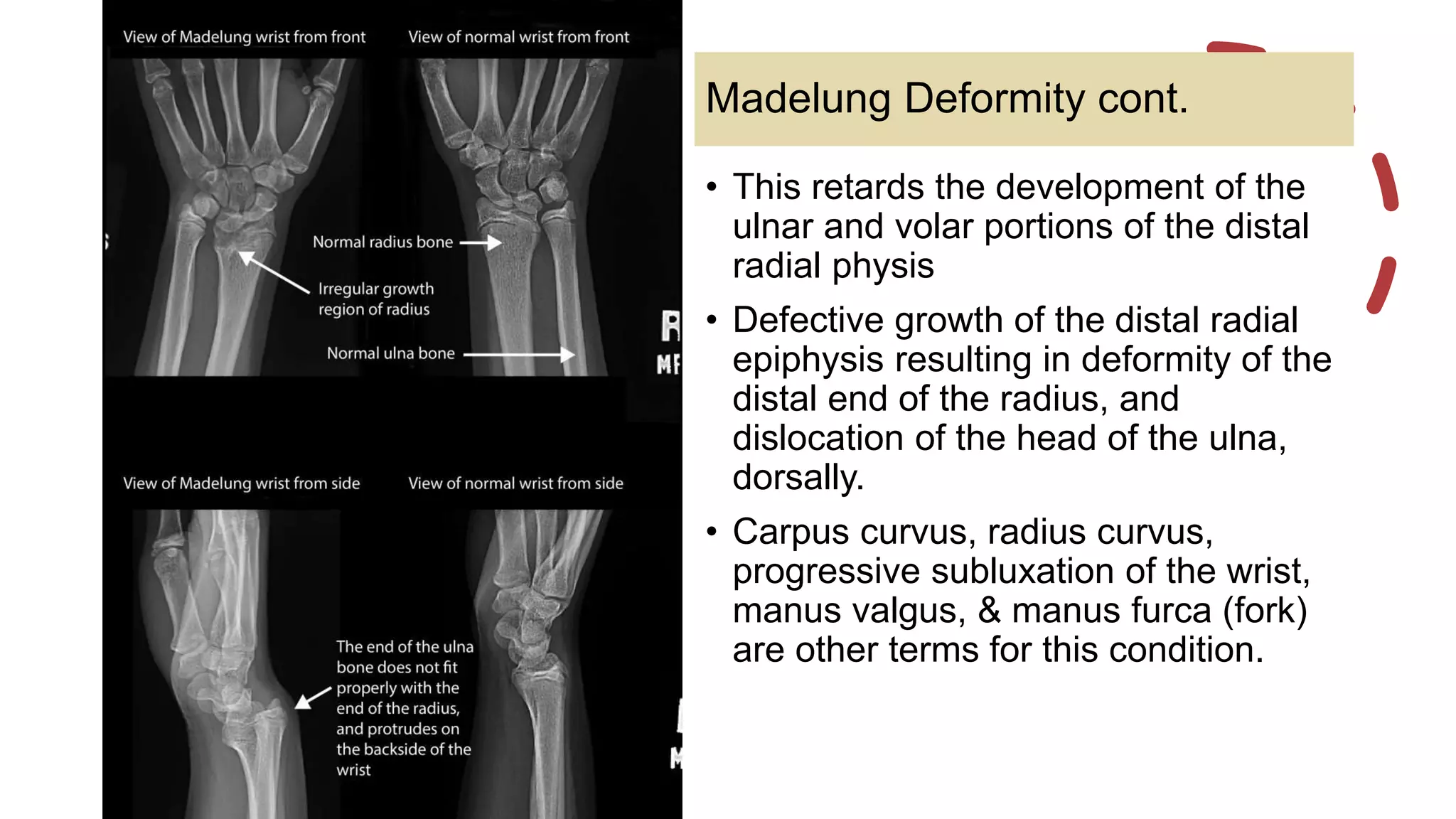
• This retards the development of the
ulnar and volar portions of the distal
radial physis
• Defective growth of the distal radial
epiphysis resulting in deformity of the
distal end of the radius, and
dislocation of the head of the ulna,
dorsally.
• Carpus curvus, radius curvus,
progressive subluxation of the wrist,
manus valgus, & manus furca (fork)
are other terms for this condition.
Madelung Deformity cont.
Osteotomy
• An osteotomy is a surgical operation whereby a bone is cut to
shorten or lengthen it or to change its alignment.
• It is sometimes performed to correct a hallux valgus, or to
straighten a bone that has healed crookedly following a fracture.
It is also used to correct a coxa vara, genu valgum, and genu
varum.
References
1) Maheshwari, J. and Mhaskar, V., 2015. Essential Orthopaedics. 5th ed. The Health Science
Publisher.
2) Jones, J., 2020. Coxa Valga | Radiology Reference Article | Radiopaedia.Org. [online]
Radiopaedia.org. Available at: https://radiopaedia.org/articles/coxa-valga
3) Lamberti, P., 2020. Madelung Deformity: Background, Anatomy, Pathophysiology. [online]
Emedicine.medscape.com. Available at: https://emedicine.medscape.com/article/1260002-
overview
4) Luijkx, T., 2020. Valgus Vs Varus | Radiology Reference Article | Radiopaedia.Org. [online]
Radiopaedia.org. Available at: https://radiopaedia.org/articles/valgus-vs-varus-1
Thank you

Student seminar valgus & varus

  • 1.
    Terminologies & deformities: •Varus and valgus • Hallux Valgus/Varus • Coxa Vara/Coxa Vaiga • Genu Varum/Valgum • Cubitus Varus/Valgus • Madelung Deformity • Bunion • Osteotomy By Dhanulekha
  • 2.
    Varus & valgus •The terms valgus and varus refer to angulation (or bowing) within the shaft of a bone or at a joint. It is determined by the distal part of the bone forming the joint being more medial or lateral than it should be. • Valgus = The distal part is more lateral/goes outwards • Varus = The distal part is more medial/goes inwards Coxa/ Hip Knee/ Genu Hallux /Toe Heel Foot/ Pes Cubitus/ Elbow Manus /Hand Wrist
  • 3.
    Coxa/hip • Relation ofthe femoral shaft to the femoral head and neck • Coxa vara: Angle between the head and neck of the femur and its shaft is decreased, <120 degrees. • Coxa valga: There is an increased angle between the femoral head and neck and femoral shaft.
  • 4.
  • 5.
    • Depends onthe direction of distal part of the tibia • Genu varum: Medial misalignment of the knee • Genu valgum: Lateral misalignment of the knee Genu/knee
  • 7.
    Hallux/Big toe • Thehallux usually moves in the transverse plane. • Hallux varus: Characterized by medial deviation of great toe relative to the 1st metatarsal bone.
  • 8.
    Hallux valgus /Bunion • A bunion is a localized painful swelling at the base of the big toe. The joint is enlarged (due to new bone formation) and the toe is often misaligned. It is frequently associated with inflammation. • It can be related to inflammation of the nearby bursa (bursitis) or degenerative joint disease (osteoarthritis) • It is characterized by medial deviation of the first metatarsal and lateral deviation rotation of the hallux, with associated joint subluxation.
  • 9.
    Cubitus/elbow Cubitus varus: distalpart of the forearm points medially • Also known as gunstock deformity. • Malalignment of the distal humerus • Results in a change of carrying angle from the physiologic valgus alignment (5-15 degrees) of the arm and forearm to varus malalignment.
  • 10.
    Cubitus/elbow • Cubitus valgus:distal part of the forearm points laterally • Congenital causes: Turner syndrome , Noonan syndrome • Acquired causes: Fracture • Cubitus valgus is a rare but well-known cause of tardy ulnar nerve palsy.
  • 11.
    Cubitus varus Cubitus valgus Non-unitedlateral condyle of humerus fracture Normal carrying angle * Carrying angle is a small degree of cubitus valgus, formed between the axis of a radially deviated forearm and the axis of the humerus. It helps the arms to swing without hitting the hips while walking.
  • 12.
    Madelung Deformity • Itcan be bilateral in 50-66% of patients. • Rare congenital deformity and does not usually manifest until 10-14 years. • It may also be seen as an acquired consequence of trauma to the growth plate, e.g. Salter-Harris fracture (type V). • Growth disturbance of volar-ulnar distal radial physis
  • 13.
    • This retardsthe development of the ulnar and volar portions of the distal radial physis • Defective growth of the distal radial epiphysis resulting in deformity of the distal end of the radius, and dislocation of the head of the ulna, dorsally. • Carpus curvus, radius curvus, progressive subluxation of the wrist, manus valgus, & manus furca (fork) are other terms for this condition. Madelung Deformity cont.
  • 14.
    Osteotomy • An osteotomyis a surgical operation whereby a bone is cut to shorten or lengthen it or to change its alignment. • It is sometimes performed to correct a hallux valgus, or to straighten a bone that has healed crookedly following a fracture. It is also used to correct a coxa vara, genu valgum, and genu varum.
  • 16.
    References 1) Maheshwari, J.and Mhaskar, V., 2015. Essential Orthopaedics. 5th ed. The Health Science Publisher. 2) Jones, J., 2020. Coxa Valga | Radiology Reference Article | Radiopaedia.Org. [online] Radiopaedia.org. Available at: https://radiopaedia.org/articles/coxa-valga 3) Lamberti, P., 2020. Madelung Deformity: Background, Anatomy, Pathophysiology. [online] Emedicine.medscape.com. Available at: https://emedicine.medscape.com/article/1260002- overview 4) Luijkx, T., 2020. Valgus Vs Varus | Radiology Reference Article | Radiopaedia.Org. [online] Radiopaedia.org. Available at: https://radiopaedia.org/articles/valgus-vs-varus-1 Thank you

Editor's Notes

  • #3 Valgus - A deformity in which the angulation of the part is away from the midline of the body. Varus - A deformity in which the angulation of the part is toward the midline of the body. The terms valgus and varus refer to angulation (or bowing) within the shaft of a bone or at a joint. It is determined by the distal part OF THE BONE FORMING THE JOINT being more medial or lateral than it should be. Whenever the distal part is more lateral, it is called valgus. Whenever the distal part is more medial, it is called varus. Therefore, when the apex of a joint points medially, the deformity, if any, would be called valgus, as the distal part points laterally. It is important to bear in mind that the most proximal part of a bone or joint is the reference point and that varus and valgus angles are relative to the angle in a normal situation, which need not be zero. 
  • #4 Reduced/Increases femoral neckshaft angle* Features: Coxa valga when the angle formed between the neck of the femur and its shaft is increased beyond >140º. Normal is between 125-135º in adults but can be 20-25º greater at birth and 10º greater in children. When the angle is <120º, this is considered coxa vara. Causes: Coxa vara: It can be congenital or acquired. The common mechanism in congenital cases is a failure of medial growth of the physeal plate Inflammatory: secondary to tuberculosis or other infection Secondary to other underlying bone diseases such as: osteogenesis imperfecta cretinism dyschondroplasia(s) Paget's disease osteoporosis (ii) Coxa valga - bilateral: 1) neuromuscular disorders, e.g. cerebral palsy, often have concurrent femoral anteversion 2) skeletal dysplasias, e.g. Turner syndrome, mucopolysaccharidoses - unilateral: 1)trauma causing growth plate arrest
  • #6 Causes of genu varum: Causes of genu valgum:
  • #7 The Q-angle is measured by extending a line through the center of the patella to the anterior superior iliac spine and another line from the tibial tubercle through the center of the patella. The intersection of these two lines is the Q-angle; the normal value for this angle is 13 to 18 degrees. (From Orthopaedic Physical Therapy Secrets (Third Edition), 2017, Pages 536-546 by T.R. Malone)
  • #8 Image from: DOI: 10.4055/cios.2014.6.2.216
  • #9 * Subluxation: Partial dislocation of a joint. A bunion (also referred to as hallux valgus) is often described as a bump on the side of the big toe. Bunions develop at the metatarsophalangeal joint (MTP). This condition is one of the most common foot problems in the adult population, with a prevalence of around 35% in those aged >65yrs and more common in women.
  • #10 More at: https://musculoskeletalkey.com/structure-and-function-of-the-elbow-and-forearm-complex/ Causes of cubitus varus: This deformity results due to malalignment of a supracondylar fracture. Varus alignment can result from collapse of the medial column from comminution. It can also result from an extension and internal rotation of the distal fractured fragment. This deformity is usually static and does not remodel over time.
  • #11 Turner syndrome is a chromosomal disorder in which a female is born with only one X chromosome. People with Turner syndrome experience a number of other symptoms, including short stature and delayed puberty. Treatment usually involves hormone replacement therapy. Noonan syndrome is another genetic disorder that results in delayed development. It’s usually caused by a genetic mutation, but sometimes doctors aren’t sure why it develops. While there’s no cure for Noonan syndrome, there are a number of treatments that can help minimize its effects. Cubitus valgus when present at birth, it can be an indication of Turner syndrome or Noonan syndrome. It can also be acquired through fracture or other trauma.
  • #12 Normal carrying angle is 5-15o away from the body .
  • #13 Definition obtained from Essential Orthopaedics 5th Edition. Volar: Pertaining to the palm or the sole Ulnar: The bone of the forearm on the side opposite to the thumb
  • #14 Normally, the radius and ulna bones connect with the bones of the hand to form the wrist joint.
  • #15 Osteotomy may be used to correct deformity, to change the shape of the bone, or to redirect load trajectories in a limb so as to influence joint function.