NAAC Criterion-III
Research, Innovations & Extension (120)
As per revised Manual for Affiliated/Constituent (UG, PG)Colleges that Updated on 04/02/2020)
Dr. Anil Vishnu Dusane
Sir Parashurambhau College, Pune
anildusane@gmail.com
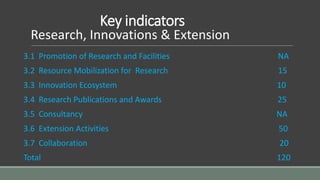
Key indicators
Research, Innovations & Extension
3.1 Promotion of Research and Facilities NA
3.2 Resource Mobilization for Research 15
3.3 Innovation Ecosystem 10
3.4 Research Publications and Awards 25
3.5 Consultancy NA
3.6 Extension Activities 50
3.7 Collaboration 20
Total 120
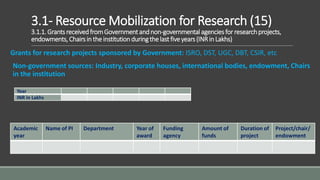
3.1- Resource Mobilization for Research (15)
3.1.1.GrantsreceivedfromGovernmentandnon-governmentalagenciesfor researchprojects,
endowments,Chairsin theinstitutionduringthelastfiveyears(INRinLakhs)
Grants for research projects sponsored by Government: ISRO, DST, UGC, DBT, CSIR, etc
Non-government sources: Industry, corporate houses, international bodies, endowment, Chairs
in the institution
Year
INR in Lakhs
Academic
year
Name of PI Department Year of
award
Funding
agency
Amount of
funds
Duration of
project
Project/chair/
endowment
Why research?
•Research plays an unique and irreplaceable role in the higher
education
•Tool for building knowledge
•Business success and economy of country
•Role in critical thinking and innovation
•Quality research is beneficial to student, society, industry,
region, nation and world.
•Research output is the vital indicator of quality education
Problems in Research activity
•Limited infrastructure
•Limited funding and time
•Lack of motivation and guidance
•Less focus on UG students research
• Lack of research ecosystem in most of educational
institutes
Efforts for Research Culture Development
•Good number of Major and minor research projects
•PhD research centres and Research guides
•Organization and active participation in National and
international seminars, conferences and symposiums
•Publication of Research papers in High impact factor
journals
•Research funding from Govt. and non-government
agencies
Efforts for Research Culture Development
•Filing of patents
•Awards and incentives for researchers
•MoUs with reputed research institute, Indian and foreign
Universities and industries
•Focus on UG students research
•Identification of thrust areas
•Sharing of resources, teamwork and interdisciplinary
approach
Research funding
•Funding agencies are Govt. or Non-govt. body providing monitory grants for scientific
research in the field of Science, Technology and Social Sciences.
•Research is a competitive process, in which potential research projects are evaluated
and only the most promising receive funding.
•Most of the research funding comes different departments of Government,
Universities and some specialized government agencies.
•Intuitions should try to receive funding from charitable foundations, industry, foreign
funding agencies along with government funding agencies.
•Institute should have special committee for obtaining funding from various funding
agencies.
Funding agencies
•University Grants Commission (UGC) https://ugc.ac.in
•All India Council for Technical Education (AICTE) https://www.aicte-india.org
•Council of Scientific and Industrial Research (CSIR) https://www.csir.res.in
•Department of Ayurveda, Yoga and Naturopathy, Unani, Siddha and Homeopathy (AYUSH)
https://www.nhp.gov.in/ayush_ms
•Department of Biotechnology (DBT) www.dbtindia.gov.in/schemes-programmes
•Department of Science and Technology (DST) https://dst.gov.in
•Technology Information, Forecasting and Assessment Council (TIFAC) https://tifac.org.in
•Indian Council of Medical Research (ICMR) https://www.icmr.nic.in
•Indian National science Academy (INSA) https://insa.nic.in
Funding agencies
•Atomic Energy Regulatory Board (AERB) https://www.aerb.gov.in
•Research in Nuclear Sciences (BRNS) https://brns.res.in
•Defence Research & Development Organisation (DRDO) https://www.drdo.gov.in
•Department of Atomic Energy dae.gov.in
•Department of Chemicals & Petrochemicals, Ministry of Chemicals & Fertilizers
https://chemicals.nic.in
•Department of Electronics and Information Technology meity.gov.in
•Indian Council of Agricultural Research (ICAR) https://www.icar.org.in
Funding agencies
•Ministry of Environment, forest and climate change moef.gov.in
•Ministry of Human Resource Development https://mhrd.gov.in
•Ministry of Non-conventional Energy Sources www.mnre.gov.in
•Ministry of Rural Development www.rural.nic.in
•Ministry of Science and Technology https://dst.gov.in
•Indian Council of Philosophical Research (ICPR) icpr.in
•Indian Renewable Energy Development Agency (IREDA) https://ireda.in
•India bioscience https://indiabioscience.org/grants
Funding from Indian Non-Governmental
Organisations & Trusts
Bombay Natural History Society https://www.bnhs.org
Indian Oil Corporation https://iocl.com/
INTACH www.intach.org
J.R.D. Tata Trust https://ngosindia.com/the-tata-trusts
Oil and Natural Gas Corporation https://www.ongcindia.com
Sri. Dorabji Tata Trust https://ngosindia.com/sir-dorabji-tata-trust
Sri. Ratan Tata Trust https://www.tatatrusts.org
Tata Energy Research Institute www.teriin.org
International funding organizations
European Commission (EC) https://ec.europa.eu/info/funding-tenders/funding-opportunities
ICEF (India - Canadian Environment Facility) https://www.allacronyms.com/ICEF
United Nations Food and Agricultural Organization (FAO) www.fao.org
UNESCO https://en.unesco.org
Foreign Governments & Governmental Organisations
•UK India Education and Research Initiative (UKIERI) Scholarship
AUSTRALIA: Department of Foreign Affairs and Trade
CANADA: Canadian High Commission in India
•DENMARK: Danish International Development Agency (DANIDA)
•GERMANY: Deutsche Gesellschaft für Technische Zusammenarbeit (GTZ)
JAPAN: Japanese Embassy in India
•NETHERLANDS: Royal Netherlands Embassy in India
NEW ZEALAND: New Zealand High Commission in India
What is endowment?
• Endowment refers to the amount of money a institute receives in donations.
• Endowment is used for a scholarships, upgrading facilities, hiring professors, and for
many other purposes.
•Endowments are often used by universities and non-profit organizations to fund their
ongoing operations.
•Chair is a position permanently paid from an endowment for a special purpose.
•NHRC (National Human Rights Commission) Chair on Human Rights
•ICICI Chair for Business Laws
•Mahatma Phule chair(SPPU)
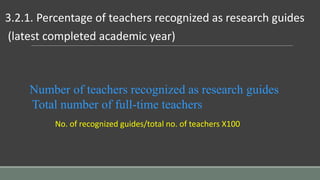
3.2.1. Percentage of teachers recognized as research guides
(latest completed academic year)
Number of teachers recognized as research guides
Total number of full-time teachers
No. of recognized guides/total no. of teachers X100
How to increase Number of Research guides?
•Motivation and incentives for the research guides
•Impart proper training to guides
•If possible provide flexibility in time schedules
•Provide sound research facilities
•Inculcate interdisciplinary research work and team
work
•Allocate funds for institute funded research projects
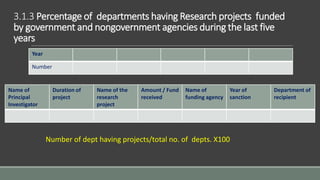
3.1.3 Percentage of departments having Research projects funded
by government and nongovernment agencies during the last five
years
Year
Number
Name of
Principal
Investigator
Duration of
project
Name of the
research
project
Amount / Fund
received
Name of
funding agency
Year of
sanction
Department of
recipient
Number of dept having projects/total no. of depts. X100
3.2.1 Institution has created an ecosystem for innovations and has initiatives
for creation and transfer of knowledge
Knowledge transfer practices
•Knowledge transfer between academia and industry is considered an important driver of innovation and economic
growth as it eases the commercialization of new scientific knowledge within firms.
•This requires bidirectional knowledge sharing to identify relevant problems, share and develop new insights, and
the transfer and implementation of knowledge or technology.
•Researchers benefit from the interaction with industry as well, as it can inspire new research directions and
provides additional funding.
• Collaboration between institute and industry for patenting, licensing, joint ventures and spin-offs.
•Encouragement for “high relational involvement of individuals and teams from academic and industries on specific
projects and produce common outputs”
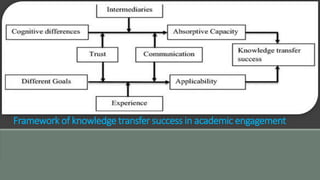
•To overcome the differences due to ambiguity and absorptive capacity.
•Try to meet the differences in knowledge background between the industry and the academics.
Framework of knowledge transfer success in academic engagement
3.2.1 Institution has created an ecosystem for innovations and has initiatives
for creation and transfer of knowledge
•Innovation Centre (IC)
•Business Incubation Centre(BIC)
•Intellectual Property Right (IPR) centre
•Industry-Institute-Interaction (III) Centre
•Well documented Research Policy of the institute
•Funding to students research projects and Products development
•Encouragement for filling the patents
•Transfer of knowledge to companies through Industry projects
•Proper share in Consultancy to industry and companies
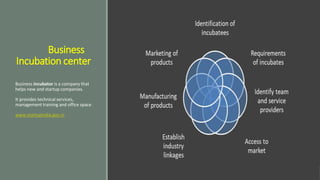
Business
Incubation center
Business incubator is a company that
helps new and startup companies.
It provides technical services,
management training and office space
www.startupindia.gov.in
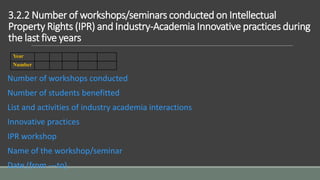
3.2.2 Number of workshops/seminars conducted on Intellectual
Property Rights (IPR) and Industry-Academia Innovative practices during
the last five years
Number of workshops conducted
Number of students benefitted
List and activities of industry academia interactions
Innovative practices
IPR workshop
Name of the workshop/seminar
Date (from ---to)
Year
Number
3.3- ResearchPublicationand Awards (25)
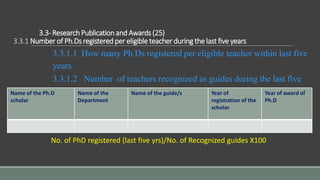
3.3.1 Number of Ph.Ds registeredper eligible teacher duringthe last five years
3.3.1.1 How many Ph.Ds registered per eligible teacher within last five
years
3.3.1.2 Number of teachers recognized as guides during the last five
yearsName of the Ph.D
scholar
Name of the
Department
Name of the guide/s Year of
registration of the
scholar
Year of award of
Ph.D
No. of PhD registered (last five yrs)/No. of Recognized guides X100
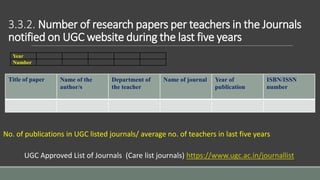
3.3.2. Number of research papers per teachers in the Journals
notified on UGC website during the last five years
Year
Number
Title of paper Name of the
author/s
Department of
the teacher
Name of journal Year of
publication
ISBN/ISSN
number
No. of publications in UGC listed journals/ average no. of teachers in last five years
UGC Approved List of Journals (Care list journals) https://www.ugc.ac.in/journallist
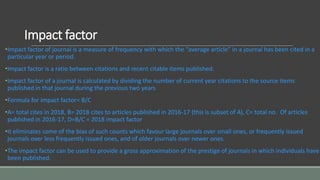
Impact factor
•Impact factor of journal is a measure of frequency with which the “average article” in a journal has been cited in a
particular year or period.
•Impact factor is a ratio between citations and recent citable items published.
•Impact factor of a journal is calculated by dividing the number of current year citations to the source items
published in that journal during the previous two years
•Formula for impact factor= B/C
•A= total cites in 2018, B= 2018 cites to articles published in 2016-17 (this is subset of A), C= total no. Of articles
published in 2016-17, D=B/C = 2018 impact factor
•It eliminates some of the bias of such counts which favour large journals over small ones, or frequently issued
journals over less frequently issued ones, and of older journals over newer ones.
•The impact factor can be used to provide a gross approximation of the prestige of journals in which individuals have
been published.
h-index and i10
•H- FACTOR: INDIVIDUAL; H = HIS/HER
•h-index: It is an author-level metric that attempts to measure both the
productivity and citation impact of publications of a scientist or
scholar. It is based on the set of the scientist's most cited papers .
•i10 index: It refers to the number of paper with 10 or more citations. It
is created by Google Scholar and used in Google's My Citations
feature. This very simple measure is only used by Google Scholar.
Google has provided an automatically-calculated h-index and i10-index
within Google Scholar profile. https://scholar.google.com
Scopus and ResearchGate
Scopus: It is the largest abstract and citation database of peer-
reviewed literature i.e. scientific journals, books and conference
proceedings. Delivering a comprehensive overview of the world's
research output in the fields of science, technology, medicine, social
sciences, and arts and humanities. Scopus features smart tools to
track, analyse and visualise research. https://www.scopus.com
•ResearchGate: It European commercial social networking site for
scientists and researchers to share papers, ask and answer questions,
and find collaborators. https://www.researchgate.net
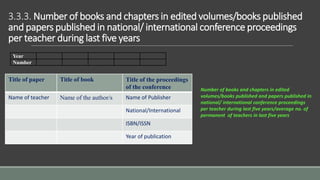
3.3.3. Number of books and chapters in edited volumes/books published
and papers published in national/ international conference proceedings
per teacher during last five years
Year
Number
Title of paper Title of book Title of the proceedings
of the conference
Name of teacher Name of the author/s Name of Publisher
National/International
ISBN/ISSN
Year of publication
Number of books and chapters in edited
volumes/books published and papers published in
national/ international conference proceedings
per teacher during last five years/average no. of
permanent of teachers in last five years
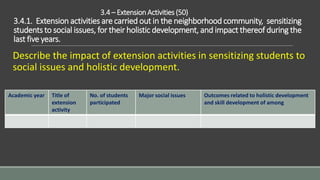
3.4 – ExtensionActivities (50)
3.4.1. Extension activities are carried out in the neighborhood community, sensitizing
students to social issues, for their holistic development, and impact thereof during the
last five years.
Describe the impact of extension activities in sensitizing students to
social issues and holistic development.
Academic year Title of
extension
activity
No. of students
participated
Major social issues Outcomes related to holistic development
and skill development of among
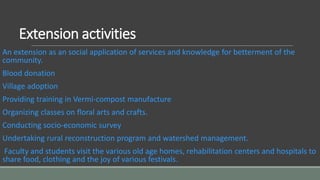
Extension activities
An extension as an social application of services and knowledge for betterment of the
community.
Blood donation
Village adoption
Providing training in Vermi-compost manufacture
Organizing classes on floral arts and crafts.
Conducting socio-economic survey
Undertaking rural reconstruction program and watershed management.
Faculty and students visit the various old age homes, rehabilitation centers and hospitals to
share food, clothing and the joy of various festivals.
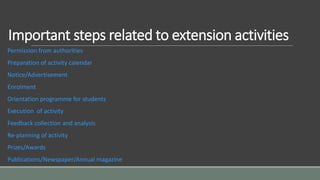
Important steps related to extension activities
Permission from authorities
Preparation of activity calendar
Notice/Advertisement
Enrolment
Orientation programme for students
Execution of activity
Feedback collection and analysis
Re-planning of activity
Prizes/Awards
Publications/Newspaper/Annual magazine
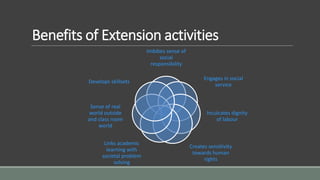
Benefits of Extension activities
Imbibes sense of
social
responsibility
Engages in social
service
Inculcates dignity
of labour
Creates sensitivity
towards human
rights
Links academic
learning with
societal problem
solving
Sense of real
world outside
and class room
world
Develops skillsets
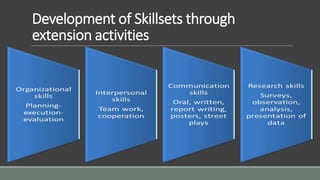
Development of Skillsets through
extension activities
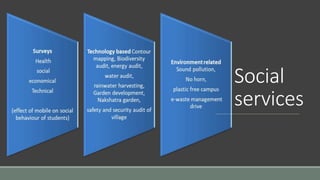
Social
services
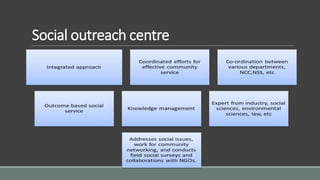
Social outreach centre
Technology based social work
PCB Making for rural women
Water Treatment Plant
Energy Audit in villages
Computer Literacy
Waste Management
Creation of GIS Database
Heritage Development Plan Template
Drip irrigation
Water Shed Management
Environmental Impact Assessment of River
NSS/NCC social services
Tree plantation programme
Organize rally and poster competition for Save Girl Child
Organize poster and essay competition on Save Water
Organize drawing competition on Save Earth
Blood donation camp in association with Armed Force Medical College
Swachh Bharat Abhiyan at college campus
Cashless awareness amongst society
Starts up India awareness programme for cadets
Proofs related to extension activity
Academic calendar
Minutes of IQAC/other meetings
Notice
Programme sheet
List of participants with signature
Certificate
At least two photos (geotagged)
Website report
News paper cuttings
You-tube clip
Other than college site (Govt.sites)
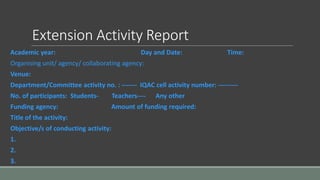
Extension Activity Report
Academic year: Day and Date: Time:
Organising unit/ agency/ collaborating agency:
Venue:
Department/Committee activity no. : ------- IQAC cell activity number: ---------
No. of participants: Students- Teachers---- Any other
Funding agency: Amount of funding required:
Title of the activity:
Objective/s of conducting activity:
1.
2.
3.
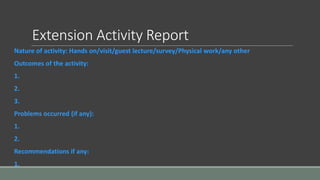
Extension Activity Report
Nature of activity: Hands on/visit/guest lecture/survey/Physical work/any other
Outcomes of the activity:
1.
2.
3.
Problems occurred (if any):
1.
2.
Recommendations if any:
1.
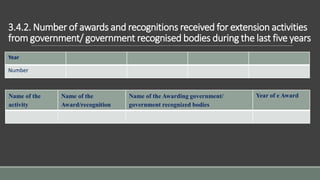
3.4.2. Number of awards and recognitions received for extension activities
from government/ government recognised bodies during the last five years
Year
Number
Name of the
activity
Name of the
Award/recognition
Name of the Awarding government/
government recognized bodies
Year of e Award
Year
Number
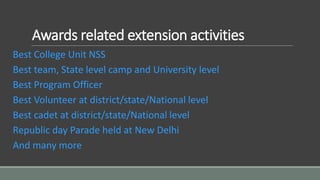
Awards related extension activities
Best College Unit NSS
Best team, State level camp and University level
Best Program Officer
Best Volunteer at district/state/National level
Best cadet at district/state/National level
Republic day Parade held at New Delhi
And many more
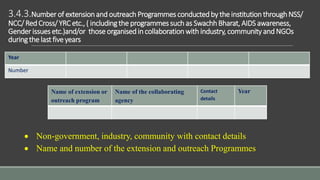
3.4.3.Number of extensionand outreach Programmes conductedby the institutionthroughNSS/
NCC/ Red Cross/ YRC etc., ( including the programmes such as SwachhBharat, AIDS awareness,
Gender issues etc.)and/or those organisedin collaborationwithindustry, community andNGOs
duringthe last fiveyears
Name of extension or
outreach program
Name of the collaborating
agency
Contact
details
Year
Year
Number
 Non-government, industry, community with contact details
 Name and number of the extension and outreach Programmes
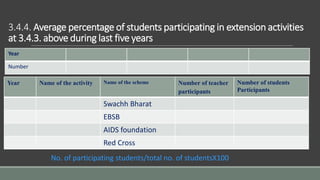
3.4.4. Average percentage of students participating in extension activities
at 3.4.3. above during last five years
Year Name of the activity Name of the scheme Number of teacher
participants
Number of students
Participants
Swachh Bharat
EBSB
AIDS foundation
Red Cross
Year
Number
No. of participating students/total no. of studentsX100
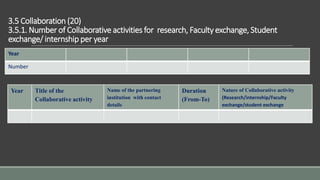
3.5 Collaboration (20)
3.5.1. Number of Collaborative activities for research, Faculty exchange, Student
exchange/ internship per year
Year Title of the
Collaborative activity
Name of the partnering
institution with contact
details
Duration
(From-To)
Nature of Collaborative activity
(Research/internship/Faculty
exchange/student exchange
Year
Number
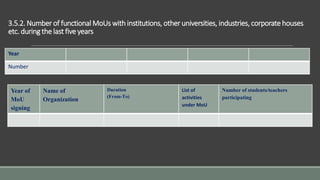
3.5.2. Number of functional MoUs with institutions, other universities, industries, corporate houses
etc. during the last five years
Year of
MoU
signing
Name of
Organization
Duration
(From-To)
List of
activities
under MoU
Number of students/teachers
participating
Year
Number
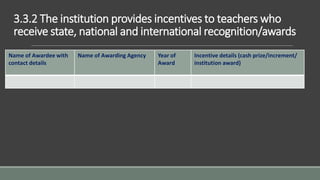
3.3.2 The institution provides incentives to teachers who
receive state, national and international recognition/awards
Name of Awardee with
contact details
Name of Awarding Agency Year of
Award
Incentive details (cash prize/increment/
institution award)
Thank you
Dr. Anil Dusane
anildusane@gmail.com

Naac Criterion-III

  • 1.
    NAAC Criterion-III Research, Innovations& Extension (120) As per revised Manual for Affiliated/Constituent (UG, PG)Colleges that Updated on 04/02/2020) Dr. Anil Vishnu Dusane Sir Parashurambhau College, Pune anildusane@gmail.com
  • 2.
    Key indicators Research, Innovations& Extension 3.1 Promotion of Research and Facilities NA 3.2 Resource Mobilization for Research 15 3.3 Innovation Ecosystem 10 3.4 Research Publications and Awards 25 3.5 Consultancy NA 3.6 Extension Activities 50 3.7 Collaboration 20 Total 120
  • 3.
    3.1- Resource Mobilizationfor Research (15) 3.1.1.GrantsreceivedfromGovernmentandnon-governmentalagenciesfor researchprojects, endowments,Chairsin theinstitutionduringthelastfiveyears(INRinLakhs) Grants for research projects sponsored by Government: ISRO, DST, UGC, DBT, CSIR, etc Non-government sources: Industry, corporate houses, international bodies, endowment, Chairs in the institution Year INR in Lakhs Academic year Name of PI Department Year of award Funding agency Amount of funds Duration of project Project/chair/ endowment
  • 4.
    Why research? •Research playsan unique and irreplaceable role in the higher education •Tool for building knowledge •Business success and economy of country •Role in critical thinking and innovation •Quality research is beneficial to student, society, industry, region, nation and world. •Research output is the vital indicator of quality education
  • 5.
    Problems in Researchactivity •Limited infrastructure •Limited funding and time •Lack of motivation and guidance •Less focus on UG students research • Lack of research ecosystem in most of educational institutes
  • 6.
    Efforts for ResearchCulture Development •Good number of Major and minor research projects •PhD research centres and Research guides •Organization and active participation in National and international seminars, conferences and symposiums •Publication of Research papers in High impact factor journals •Research funding from Govt. and non-government agencies
  • 7.
    Efforts for ResearchCulture Development •Filing of patents •Awards and incentives for researchers •MoUs with reputed research institute, Indian and foreign Universities and industries •Focus on UG students research •Identification of thrust areas •Sharing of resources, teamwork and interdisciplinary approach
  • 8.
    Research funding •Funding agenciesare Govt. or Non-govt. body providing monitory grants for scientific research in the field of Science, Technology and Social Sciences. •Research is a competitive process, in which potential research projects are evaluated and only the most promising receive funding. •Most of the research funding comes different departments of Government, Universities and some specialized government agencies. •Intuitions should try to receive funding from charitable foundations, industry, foreign funding agencies along with government funding agencies. •Institute should have special committee for obtaining funding from various funding agencies.
  • 9.
    Funding agencies •University GrantsCommission (UGC) https://ugc.ac.in •All India Council for Technical Education (AICTE) https://www.aicte-india.org •Council of Scientific and Industrial Research (CSIR) https://www.csir.res.in •Department of Ayurveda, Yoga and Naturopathy, Unani, Siddha and Homeopathy (AYUSH) https://www.nhp.gov.in/ayush_ms •Department of Biotechnology (DBT) www.dbtindia.gov.in/schemes-programmes •Department of Science and Technology (DST) https://dst.gov.in •Technology Information, Forecasting and Assessment Council (TIFAC) https://tifac.org.in •Indian Council of Medical Research (ICMR) https://www.icmr.nic.in •Indian National science Academy (INSA) https://insa.nic.in
  • 10.
    Funding agencies •Atomic EnergyRegulatory Board (AERB) https://www.aerb.gov.in •Research in Nuclear Sciences (BRNS) https://brns.res.in •Defence Research & Development Organisation (DRDO) https://www.drdo.gov.in •Department of Atomic Energy dae.gov.in •Department of Chemicals & Petrochemicals, Ministry of Chemicals & Fertilizers https://chemicals.nic.in •Department of Electronics and Information Technology meity.gov.in •Indian Council of Agricultural Research (ICAR) https://www.icar.org.in
  • 11.
    Funding agencies •Ministry ofEnvironment, forest and climate change moef.gov.in •Ministry of Human Resource Development https://mhrd.gov.in •Ministry of Non-conventional Energy Sources www.mnre.gov.in •Ministry of Rural Development www.rural.nic.in •Ministry of Science and Technology https://dst.gov.in •Indian Council of Philosophical Research (ICPR) icpr.in •Indian Renewable Energy Development Agency (IREDA) https://ireda.in •India bioscience https://indiabioscience.org/grants
  • 12.
    Funding from IndianNon-Governmental Organisations & Trusts Bombay Natural History Society https://www.bnhs.org Indian Oil Corporation https://iocl.com/ INTACH www.intach.org J.R.D. Tata Trust https://ngosindia.com/the-tata-trusts Oil and Natural Gas Corporation https://www.ongcindia.com Sri. Dorabji Tata Trust https://ngosindia.com/sir-dorabji-tata-trust Sri. Ratan Tata Trust https://www.tatatrusts.org Tata Energy Research Institute www.teriin.org
  • 13.
    International funding organizations EuropeanCommission (EC) https://ec.europa.eu/info/funding-tenders/funding-opportunities ICEF (India - Canadian Environment Facility) https://www.allacronyms.com/ICEF United Nations Food and Agricultural Organization (FAO) www.fao.org UNESCO https://en.unesco.org Foreign Governments & Governmental Organisations •UK India Education and Research Initiative (UKIERI) Scholarship AUSTRALIA: Department of Foreign Affairs and Trade CANADA: Canadian High Commission in India •DENMARK: Danish International Development Agency (DANIDA) •GERMANY: Deutsche Gesellschaft für Technische Zusammenarbeit (GTZ) JAPAN: Japanese Embassy in India •NETHERLANDS: Royal Netherlands Embassy in India NEW ZEALAND: New Zealand High Commission in India
  • 14.
    What is endowment? •Endowment refers to the amount of money a institute receives in donations. • Endowment is used for a scholarships, upgrading facilities, hiring professors, and for many other purposes. •Endowments are often used by universities and non-profit organizations to fund their ongoing operations. •Chair is a position permanently paid from an endowment for a special purpose. •NHRC (National Human Rights Commission) Chair on Human Rights •ICICI Chair for Business Laws •Mahatma Phule chair(SPPU)
  • 15.
    3.2.1. Percentage ofteachers recognized as research guides (latest completed academic year) Number of teachers recognized as research guides Total number of full-time teachers No. of recognized guides/total no. of teachers X100
  • 16.
    How to increaseNumber of Research guides? •Motivation and incentives for the research guides •Impart proper training to guides •If possible provide flexibility in time schedules •Provide sound research facilities •Inculcate interdisciplinary research work and team work •Allocate funds for institute funded research projects
  • 17.
    3.1.3 Percentage ofdepartments having Research projects funded by government and nongovernment agencies during the last five years Year Number Name of Principal Investigator Duration of project Name of the research project Amount / Fund received Name of funding agency Year of sanction Department of recipient Number of dept having projects/total no. of depts. X100
  • 18.
    3.2.1 Institution hascreated an ecosystem for innovations and has initiatives for creation and transfer of knowledge Knowledge transfer practices •Knowledge transfer between academia and industry is considered an important driver of innovation and economic growth as it eases the commercialization of new scientific knowledge within firms. •This requires bidirectional knowledge sharing to identify relevant problems, share and develop new insights, and the transfer and implementation of knowledge or technology. •Researchers benefit from the interaction with industry as well, as it can inspire new research directions and provides additional funding. • Collaboration between institute and industry for patenting, licensing, joint ventures and spin-offs. •Encouragement for “high relational involvement of individuals and teams from academic and industries on specific projects and produce common outputs” •To overcome the differences due to ambiguity and absorptive capacity. •Try to meet the differences in knowledge background between the industry and the academics.
  • 19.
    Framework of knowledgetransfer success in academic engagement
  • 20.
    3.2.1 Institution hascreated an ecosystem for innovations and has initiatives for creation and transfer of knowledge •Innovation Centre (IC) •Business Incubation Centre(BIC) •Intellectual Property Right (IPR) centre •Industry-Institute-Interaction (III) Centre •Well documented Research Policy of the institute •Funding to students research projects and Products development •Encouragement for filling the patents •Transfer of knowledge to companies through Industry projects •Proper share in Consultancy to industry and companies
  • 21.
    Business Incubation center Business incubatoris a company that helps new and startup companies. It provides technical services, management training and office space www.startupindia.gov.in
  • 22.
    3.2.2 Number ofworkshops/seminars conducted on Intellectual Property Rights (IPR) and Industry-Academia Innovative practices during the last five years Number of workshops conducted Number of students benefitted List and activities of industry academia interactions Innovative practices IPR workshop Name of the workshop/seminar Date (from ---to) Year Number
  • 23.
    3.3- ResearchPublicationand Awards(25) 3.3.1 Number of Ph.Ds registeredper eligible teacher duringthe last five years 3.3.1.1 How many Ph.Ds registered per eligible teacher within last five years 3.3.1.2 Number of teachers recognized as guides during the last five yearsName of the Ph.D scholar Name of the Department Name of the guide/s Year of registration of the scholar Year of award of Ph.D No. of PhD registered (last five yrs)/No. of Recognized guides X100
  • 24.
    3.3.2. Number ofresearch papers per teachers in the Journals notified on UGC website during the last five years Year Number Title of paper Name of the author/s Department of the teacher Name of journal Year of publication ISBN/ISSN number No. of publications in UGC listed journals/ average no. of teachers in last five years UGC Approved List of Journals (Care list journals) https://www.ugc.ac.in/journallist
  • 25.
    Impact factor •Impact factorof journal is a measure of frequency with which the “average article” in a journal has been cited in a particular year or period. •Impact factor is a ratio between citations and recent citable items published. •Impact factor of a journal is calculated by dividing the number of current year citations to the source items published in that journal during the previous two years •Formula for impact factor= B/C •A= total cites in 2018, B= 2018 cites to articles published in 2016-17 (this is subset of A), C= total no. Of articles published in 2016-17, D=B/C = 2018 impact factor •It eliminates some of the bias of such counts which favour large journals over small ones, or frequently issued journals over less frequently issued ones, and of older journals over newer ones. •The impact factor can be used to provide a gross approximation of the prestige of journals in which individuals have been published.
  • 26.
    h-index and i10 •H-FACTOR: INDIVIDUAL; H = HIS/HER •h-index: It is an author-level metric that attempts to measure both the productivity and citation impact of publications of a scientist or scholar. It is based on the set of the scientist's most cited papers . •i10 index: It refers to the number of paper with 10 or more citations. It is created by Google Scholar and used in Google's My Citations feature. This very simple measure is only used by Google Scholar. Google has provided an automatically-calculated h-index and i10-index within Google Scholar profile. https://scholar.google.com
  • 27.
    Scopus and ResearchGate Scopus:It is the largest abstract and citation database of peer- reviewed literature i.e. scientific journals, books and conference proceedings. Delivering a comprehensive overview of the world's research output in the fields of science, technology, medicine, social sciences, and arts and humanities. Scopus features smart tools to track, analyse and visualise research. https://www.scopus.com •ResearchGate: It European commercial social networking site for scientists and researchers to share papers, ask and answer questions, and find collaborators. https://www.researchgate.net
  • 28.
    3.3.3. Number ofbooks and chapters in edited volumes/books published and papers published in national/ international conference proceedings per teacher during last five years Year Number Title of paper Title of book Title of the proceedings of the conference Name of teacher Name of the author/s Name of Publisher National/International ISBN/ISSN Year of publication Number of books and chapters in edited volumes/books published and papers published in national/ international conference proceedings per teacher during last five years/average no. of permanent of teachers in last five years
  • 29.
    3.4 – ExtensionActivities(50) 3.4.1. Extension activities are carried out in the neighborhood community, sensitizing students to social issues, for their holistic development, and impact thereof during the last five years. Describe the impact of extension activities in sensitizing students to social issues and holistic development. Academic year Title of extension activity No. of students participated Major social issues Outcomes related to holistic development and skill development of among
  • 30.
    Extension activities An extensionas an social application of services and knowledge for betterment of the community. Blood donation Village adoption Providing training in Vermi-compost manufacture Organizing classes on floral arts and crafts. Conducting socio-economic survey Undertaking rural reconstruction program and watershed management. Faculty and students visit the various old age homes, rehabilitation centers and hospitals to share food, clothing and the joy of various festivals.
  • 31.
    Important steps relatedto extension activities Permission from authorities Preparation of activity calendar Notice/Advertisement Enrolment Orientation programme for students Execution of activity Feedback collection and analysis Re-planning of activity Prizes/Awards Publications/Newspaper/Annual magazine
  • 32.
    Benefits of Extensionactivities Imbibes sense of social responsibility Engages in social service Inculcates dignity of labour Creates sensitivity towards human rights Links academic learning with societal problem solving Sense of real world outside and class room world Develops skillsets
  • 33.
    Development of Skillsetsthrough extension activities
  • 34.
  • 35.
  • 36.
    Technology based socialwork PCB Making for rural women Water Treatment Plant Energy Audit in villages Computer Literacy Waste Management Creation of GIS Database Heritage Development Plan Template Drip irrigation Water Shed Management Environmental Impact Assessment of River
  • 37.
    NSS/NCC social services Treeplantation programme Organize rally and poster competition for Save Girl Child Organize poster and essay competition on Save Water Organize drawing competition on Save Earth Blood donation camp in association with Armed Force Medical College Swachh Bharat Abhiyan at college campus Cashless awareness amongst society Starts up India awareness programme for cadets
  • 38.
    Proofs related toextension activity Academic calendar Minutes of IQAC/other meetings Notice Programme sheet List of participants with signature Certificate At least two photos (geotagged) Website report News paper cuttings You-tube clip Other than college site (Govt.sites)
  • 39.
    Extension Activity Report Academicyear: Day and Date: Time: Organising unit/ agency/ collaborating agency: Venue: Department/Committee activity no. : ------- IQAC cell activity number: --------- No. of participants: Students- Teachers---- Any other Funding agency: Amount of funding required: Title of the activity: Objective/s of conducting activity: 1. 2. 3.
  • 40.
    Extension Activity Report Natureof activity: Hands on/visit/guest lecture/survey/Physical work/any other Outcomes of the activity: 1. 2. 3. Problems occurred (if any): 1. 2. Recommendations if any: 1.
  • 41.
    3.4.2. Number ofawards and recognitions received for extension activities from government/ government recognised bodies during the last five years Year Number Name of the activity Name of the Award/recognition Name of the Awarding government/ government recognized bodies Year of e Award Year Number
  • 42.
    Awards related extensionactivities Best College Unit NSS Best team, State level camp and University level Best Program Officer Best Volunteer at district/state/National level Best cadet at district/state/National level Republic day Parade held at New Delhi And many more
  • 43.
    3.4.3.Number of extensionandoutreach Programmes conductedby the institutionthroughNSS/ NCC/ Red Cross/ YRC etc., ( including the programmes such as SwachhBharat, AIDS awareness, Gender issues etc.)and/or those organisedin collaborationwithindustry, community andNGOs duringthe last fiveyears Name of extension or outreach program Name of the collaborating agency Contact details Year Year Number  Non-government, industry, community with contact details  Name and number of the extension and outreach Programmes
  • 44.
    3.4.4. Average percentageof students participating in extension activities at 3.4.3. above during last five years Year Name of the activity Name of the scheme Number of teacher participants Number of students Participants Swachh Bharat EBSB AIDS foundation Red Cross Year Number No. of participating students/total no. of studentsX100
  • 45.
    3.5 Collaboration (20) 3.5.1.Number of Collaborative activities for research, Faculty exchange, Student exchange/ internship per year Year Title of the Collaborative activity Name of the partnering institution with contact details Duration (From-To) Nature of Collaborative activity (Research/internship/Faculty exchange/student exchange Year Number
  • 46.
    3.5.2. Number offunctional MoUs with institutions, other universities, industries, corporate houses etc. during the last five years Year of MoU signing Name of Organization Duration (From-To) List of activities under MoU Number of students/teachers participating Year Number
  • 47.
    3.3.2 The institutionprovides incentives to teachers who receive state, national and international recognition/awards Name of Awardee with contact details Name of Awarding Agency Year of Award Incentive details (cash prize/increment/ institution award)
  • 48.
    Thank you Dr. AnilDusane anildusane@gmail.com