S.Ganeshan
Dept of Physics
Vivekananda College
Tiruvedakam West
Madurai
Astrophysics
The Birth and Death of Stars
What are Stars?
 Stars are large balls of hot gas.
 They look small because they are a long way
away, but in fact many are bigger and brighter
than the Sun.
 The heat of the star is made in the centre by
nuclear fusion reactions.
 There are lots of different colours and sizes of
star.
What is a Star?
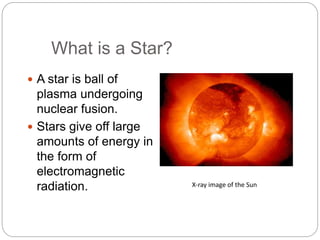
 A star is ball of
plasma undergoing
nuclear fusion.
 Stars give off large
amounts of energy in
the form of
electromagnetic
radiation. X-ray image of the Sun
How are stars made?
 Stars are made (or “born”) in giant
clouds of dust and gas.
 Sometimes part of the cloud shrinks
because of gravity.
 As it shrinks it becomes hotter and
when it is hot enough, nuclear
reactions can start in the centre…..
 … and A Star is Born!
Watching stars being born
The Bubble Nebula
Here you can see the
old dust and gas being
blown away by the
heat of the new star.
What happens next?
 Once nuclear fusion is producing heat in the
centre of the new star, this heats stops the rest of
the star collapsing.
 The star then stays almost exactly the same for a
long time (about 10 billion years for a star like the
Sun).
 The balance between gravity trying to make the
star shrink and heat holding it up is called
Thermodynamic Equilibrium.
The life of a star
 During its “life” a star will not change very much.
 However, different stars are different colour, size
and brightness.
 The bigger a star, the hotter and brighter it is. Hot
stars are Blue. Smaller stars are less bright,
cooler and Red.
 Because they are so hot, the bigger stars actually
have shorter lives than the small, cool ones.
The Birth of Solar Systems
A solar system
The disk condenses and dissipates
Collapse of
and
interstellar
cloud
Formation of a protostar and disk
The Birthplace of StarsThe space between the stars is not completely empty. Thin clouds of hydrogen and
helium, seeded with the “dust” from dying stars, form in interstellar space.
Hot Stars make their Nurseries glow
The Orion Region Infrared
Optical
Dark
Clouds
gather
The Sword of Orion
The nearest great stellar nursery to us is the great Orion molecular cloud which is about 1000
light years away, and manufacturing thousands of stars. This is probably how the typical star is
made.
Hubble Space Telescope
They look like little windsocks
The blast from the luminous stars is eating away at the little guys
A whole cluster of new stars is born before us
Orion in the near infrared
Disks in Orion
Hundreds of young stars, often with disks, have been seen.
The Young Star is Very Active
The magnetic flux is
hundreds of times
stronger than the Sun,
and huge starspots are
seen. The star itself is 3
times bigger.
The stage is set for planet formation
How does a star “die”?
 Eventually, the hydrogen (the “fuel” for the
nuclear fusion) in the centre of the star will run
out.
• No new heat is made and
gravity will take over and the
centre of the star will shrink.
• This makes the very outside of
the star “float up” and cool
down, making the star look
much bigger and redder - a
Red Giant star. Antares – a Red Giant
Within about 10 million
years, the birth-cloud is
shredded, and the disks
are dissipated.
The process of starbirth
has ended.
Collapsing
cloud
A new star
Red
Giant
Massive
stars
White Dwarf and
Planetary Nebula
Supernova
Remnant and
Neutron Star
Sun-like
stars
Nebula – Birth of Star
 Stars are formed in a
Nebula.
 A Nebula is a very large
cloud of gas and dust in
space.
Protostars
 Gravity makes dense
region of gas more
compact
 Soon take on a
definite shape and
are called protostars.
White Dwarfs
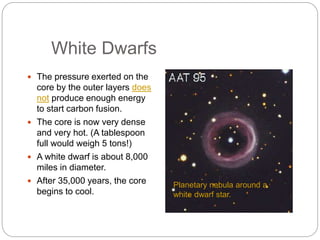
 The pressure exerted on the
core by the outer layers does
not produce enough energy
to start carbon fusion.
 The core is now very dense
and very hot. (A tablespoon
full would weigh 5 tons!)
 A white dwarf is about 8,000
miles in diameter.
 After 35,000 years, the core
begins to cool.
Planetary nebula around a
white dwarf star.
Black Dwarfs
 As the white dwarf cools, the light it gives off will fade
through the visible light spectrum, blue to red to back
(no light).
 A black dwarf will continue to generate gravity and low
energy transmissions (radio waves).
The Hertzsprung-Russell Diagram
4/23/2020
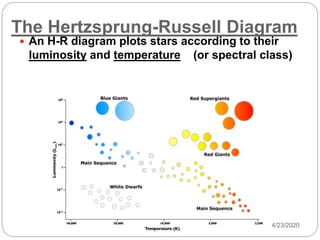
 An H-R diagram plots stars according to their
luminosity and temperature (or spectral class)
Supernova
 When a Supergiant fuses all
of the Carbon into Iron, there
is no more fuel left to
consume.
 The Core of the supergiant
will then collapse in less than
a second, causing a massive
explosion called a supernova.
 In a supernova, a massive
shockwave is produced that
blows away the outer layers
of the star.
 Supernova shine brighter
then whole galaxies for a few
years.Gas ejected from a supernova explosion
Black Holes
 If the mass of the surviving core is greater than 3
solar masses, then a black hole forms.
 A black hole is a core so dense and massive that it
will generate so much gravity that not even light can
escape it.
Energy Source for Stars
 A really good question is `how do stars produce
all that luminous energy’
 The answer should also naturally explain the
main-sequence and the mass-luminosity relation.
 Let’s start with the Sun. Requirements are:
(1) L=4x1033 ergs/sec
(2) for ~4.5 billions years
 The erg is a unit of energy equal to 10−7 joules.
Astrophysics

Astrophysics

  • 1.
    S.Ganeshan Dept of Physics VivekanandaCollege Tiruvedakam West Madurai Astrophysics
  • 2.
    The Birth andDeath of Stars What are Stars?  Stars are large balls of hot gas.  They look small because they are a long way away, but in fact many are bigger and brighter than the Sun.  The heat of the star is made in the centre by nuclear fusion reactions.  There are lots of different colours and sizes of star.
  • 3.
    What is aStar?  A star is ball of plasma undergoing nuclear fusion.  Stars give off large amounts of energy in the form of electromagnetic radiation. X-ray image of the Sun
  • 4.
    How are starsmade?  Stars are made (or “born”) in giant clouds of dust and gas.  Sometimes part of the cloud shrinks because of gravity.  As it shrinks it becomes hotter and when it is hot enough, nuclear reactions can start in the centre…..  … and A Star is Born!
  • 5.
    Watching stars beingborn The Bubble Nebula Here you can see the old dust and gas being blown away by the heat of the new star.
  • 6.
    What happens next? Once nuclear fusion is producing heat in the centre of the new star, this heats stops the rest of the star collapsing.  The star then stays almost exactly the same for a long time (about 10 billion years for a star like the Sun).  The balance between gravity trying to make the star shrink and heat holding it up is called Thermodynamic Equilibrium.
  • 7.
    The life ofa star  During its “life” a star will not change very much.  However, different stars are different colour, size and brightness.  The bigger a star, the hotter and brighter it is. Hot stars are Blue. Smaller stars are less bright, cooler and Red.  Because they are so hot, the bigger stars actually have shorter lives than the small, cool ones.
  • 8.
    The Birth ofSolar Systems A solar system The disk condenses and dissipates Collapse of and interstellar cloud Formation of a protostar and disk
  • 9.
    The Birthplace ofStarsThe space between the stars is not completely empty. Thin clouds of hydrogen and helium, seeded with the “dust” from dying stars, form in interstellar space.
  • 10.
    Hot Stars maketheir Nurseries glow The Orion Region Infrared Optical
  • 11.
  • 12.
    The Sword ofOrion The nearest great stellar nursery to us is the great Orion molecular cloud which is about 1000 light years away, and manufacturing thousands of stars. This is probably how the typical star is made.
  • 13.
  • 14.
    They look likelittle windsocks The blast from the luminous stars is eating away at the little guys
  • 15.
    A whole clusterof new stars is born before us Orion in the near infrared Disks in Orion Hundreds of young stars, often with disks, have been seen.
  • 16.
    The Young Staris Very Active The magnetic flux is hundreds of times stronger than the Sun, and huge starspots are seen. The star itself is 3 times bigger.
  • 17.
    The stage isset for planet formation
  • 18.
    How does astar “die”?  Eventually, the hydrogen (the “fuel” for the nuclear fusion) in the centre of the star will run out. • No new heat is made and gravity will take over and the centre of the star will shrink. • This makes the very outside of the star “float up” and cool down, making the star look much bigger and redder - a Red Giant star. Antares – a Red Giant
  • 19.
    Within about 10million years, the birth-cloud is shredded, and the disks are dissipated. The process of starbirth has ended.
  • 20.
    Collapsing cloud A new star Red Giant Massive stars WhiteDwarf and Planetary Nebula Supernova Remnant and Neutron Star Sun-like stars
  • 22.
    Nebula – Birthof Star  Stars are formed in a Nebula.  A Nebula is a very large cloud of gas and dust in space.
  • 23.
    Protostars  Gravity makesdense region of gas more compact  Soon take on a definite shape and are called protostars.
  • 24.
    White Dwarfs  Thepressure exerted on the core by the outer layers does not produce enough energy to start carbon fusion.  The core is now very dense and very hot. (A tablespoon full would weigh 5 tons!)  A white dwarf is about 8,000 miles in diameter.  After 35,000 years, the core begins to cool. Planetary nebula around a white dwarf star.
  • 25.
    Black Dwarfs  Asthe white dwarf cools, the light it gives off will fade through the visible light spectrum, blue to red to back (no light).  A black dwarf will continue to generate gravity and low energy transmissions (radio waves).
  • 26.
    The Hertzsprung-Russell Diagram 4/23/2020 An H-R diagram plots stars according to their luminosity and temperature (or spectral class)
  • 27.
    Supernova  When aSupergiant fuses all of the Carbon into Iron, there is no more fuel left to consume.  The Core of the supergiant will then collapse in less than a second, causing a massive explosion called a supernova.  In a supernova, a massive shockwave is produced that blows away the outer layers of the star.  Supernova shine brighter then whole galaxies for a few years.Gas ejected from a supernova explosion
  • 28.
    Black Holes  Ifthe mass of the surviving core is greater than 3 solar masses, then a black hole forms.  A black hole is a core so dense and massive that it will generate so much gravity that not even light can escape it.
  • 29.
    Energy Source forStars  A really good question is `how do stars produce all that luminous energy’  The answer should also naturally explain the main-sequence and the mass-luminosity relation.  Let’s start with the Sun. Requirements are: (1) L=4x1033 ergs/sec (2) for ~4.5 billions years
  • 30.
     The ergis a unit of energy equal to 10−7 joules.