Jaspreet Kaur
Practical 3
PowerPoint Presentation
Structure of Atom
On the basis of Rutherford Experiment
What is atom?
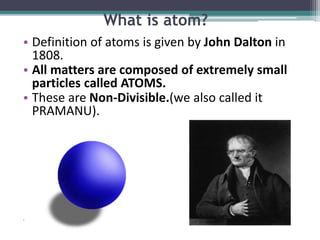
• Definition of atoms is given by John Dalton in
1808.
• All matters are composed of extremely small
particles called ATOMS.
• These are Non-Divisible.(we also called it
PRAMANU).
.
https://www.youtube.com/watch?v=jZO6W-DEVLk
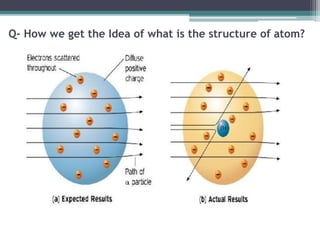
Q- How we get the Idea of what is the structure of atom?
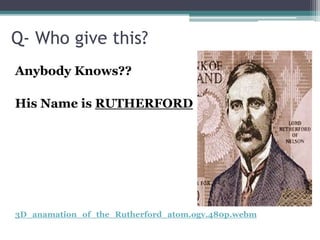
Q- Who give this?
Anybody Knows??
His Name is RUTHERFORD
3D_anamation_of_the_Rutherford_atom.ogv.480p.webm
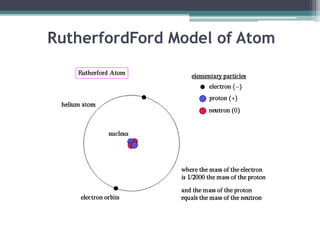
RutherfordFord Model of Atom
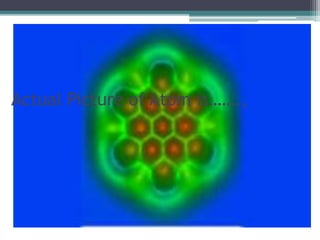
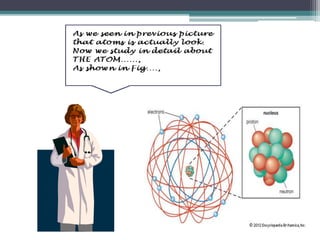
Actual Picture of Atom is…….,
Construction or Setup..,
• Ernest Rutherford was interested in knowing how the Electrons are arranged within an
atom. Rutherford designed an experiment for this. In this experiment, fast moving alpha
particles were made to fall on a thin gold foil.
• He selected a gold foil because he wanted as thin a layer as possible. This gold foil was
about 1000 atoms thick.
• Alpha particle are doubly charged helium ions. Since they have a mass of 4u, the fast
moving alpha particles have a considerable amount of energy.
• It was expected that alpha particles would be deflected by the sub atomic particles in the
gold atoms. Since the alpha particles were much heavier than the protons, he did not
expected to see large deflections.
• But the alpha particle scattering experiment gave totally unexpected results.
• The following observations were made:
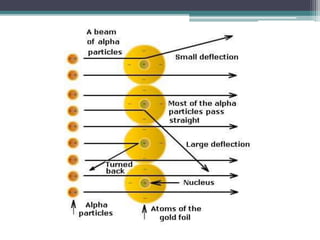
1. Most of the fast moving alpha particles passed straight through the gold foil.
2. Some of the alpha particles were deflected by the foil by small angles.
3. Surprisingly one out of every 12000 particles appeared to rebound.
https://www.youtube.com/watch?v=XLaeFUKd2Y4
Description of Experiment……,
• Rutherford gives following explanation while observing the behavior of atom..,
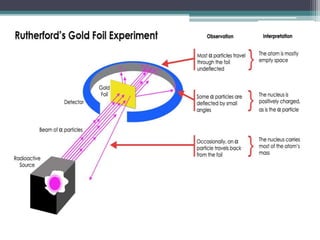
1. Most of the space inside the atom is empty because most of the alpha particle passed
through gold foil without getting deflected.
2. Very few particles were deflected from their path, indicating that the positive charge of the
atom occupies very little space.
3. A very small fraction of alpha particle were deflected by 180 degree , and indicating that all
positive charge and mass of the gold atom were concentrated in a very small volume within
the atom.
Calculation from experiment..,
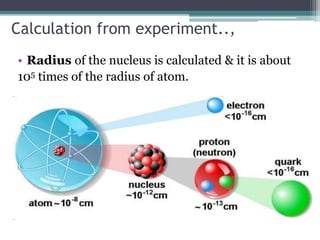
• Radius of the nucleus is calculated & it is about
105 times of the radius of atom.
Features of this experiment…,
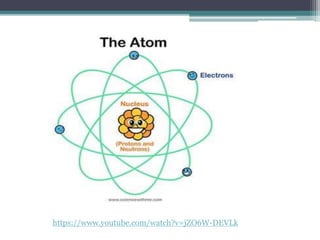
1. There is a positively charged centre in an atom
called the NUCLEUS. Nearly all the mass of an
atom resides in the NUCLEUS.
2. The electrons revolve around the nucleus in
circular path.
3. The size of the NUCLEUS is very small as
compared to the size of the ATOM.
https://www.youtube.com/watch?v=XBqHkraf8iE
Similarities of Thomson’s & Rutherford model of ATOM
They both show a positive charge as containing the majority
of the atom's mass. The Rutherford model presents a
nucleus wherein the positive charge and majority of mass
are contained. Electrons orbit the central charge like
planets do around a sun. The nucleus contains most of the
mass, but occupies little space. The Plum Pudding model
shows electrons orbiting in circles in the atom, which is
composed of the large positive charge.
Comparison of Thomson’s & Rutherford model of ATOM.
Thomson Model
• J.J. Thomson's model of the atom was
where positively charged particles and
negatively charged particles were spread
evenly. (Plum pudding model)
• The plum pudding model could not
however why atoms absorbed and
emitted spectral lines. The real
deathblow to the plum pudding model
came from experiments showing that
atoms have a nuclei.
Rutherford Model
• Rutherford then found out that the atom
was actually composed of a very small
and dense nucleus, with electrons
making up most of the atom's volume.
(Gold foil experiment) The atom was
found to be mostly empty space.
• The much lighter electrons, he assumed,
lay well outside the nucleus. To the shock
and amazement of everyone, the atoms
of which planets, people, pianos and
everything else are made consisted
almost entirely of empty space.
Conclusion of thoughts of Rutherford and Thomson
• Thompson had discovered about electrons which were tiny particles (with light) that had
negative charges, surrounded by a soup of positive to balance the negative charges of the
electrons. The electrons were thought to be positioned throughout the atom, but with many
structures possible for positioning multiple electrons. It is important to note that this was before
the discovery of the atomic nucleus.
• On the other hand, In the Rutherford model, the atom is made up of a central charge (this is the
modern atomic nucleus (though Rutherford did not use the term "nucleus" in his paper)
surrounded by a cloud of orbiting electrons.
So basically the same thing except that Thompson's didn't have a nucleus and Rutherford's did.
Also, Thompson's had electrons surrounding the the positive charge, while Rutherford has thm
in rings around the nucleus.
 topic Rutherford.docx
Over all We Learn ……,
Let’s Revise it…..,
https://www.youtube.com/watch?v=kHaR2rsFNhg

Structure of atom jaspreet

  • 1.
    Jaspreet Kaur Practical 3 PowerPointPresentation Structure of Atom On the basis of Rutherford Experiment
  • 3.
    What is atom? •Definition of atoms is given by John Dalton in 1808. • All matters are composed of extremely small particles called ATOMS. • These are Non-Divisible.(we also called it PRAMANU). .
  • 4.
  • 5.
    Q- How weget the Idea of what is the structure of atom?
  • 6.
    Q- Who givethis? Anybody Knows?? His Name is RUTHERFORD 3D_anamation_of_the_Rutherford_atom.ogv.480p.webm
  • 7.
  • 8.
    Actual Picture ofAtom is…….,
  • 11.
    Construction or Setup.., •Ernest Rutherford was interested in knowing how the Electrons are arranged within an atom. Rutherford designed an experiment for this. In this experiment, fast moving alpha particles were made to fall on a thin gold foil. • He selected a gold foil because he wanted as thin a layer as possible. This gold foil was about 1000 atoms thick. • Alpha particle are doubly charged helium ions. Since they have a mass of 4u, the fast moving alpha particles have a considerable amount of energy. • It was expected that alpha particles would be deflected by the sub atomic particles in the gold atoms. Since the alpha particles were much heavier than the protons, he did not expected to see large deflections. • But the alpha particle scattering experiment gave totally unexpected results. • The following observations were made: 1. Most of the fast moving alpha particles passed straight through the gold foil. 2. Some of the alpha particles were deflected by the foil by small angles. 3. Surprisingly one out of every 12000 particles appeared to rebound. https://www.youtube.com/watch?v=XLaeFUKd2Y4
  • 12.
    Description of Experiment……, •Rutherford gives following explanation while observing the behavior of atom.., 1. Most of the space inside the atom is empty because most of the alpha particle passed through gold foil without getting deflected. 2. Very few particles were deflected from their path, indicating that the positive charge of the atom occupies very little space. 3. A very small fraction of alpha particle were deflected by 180 degree , and indicating that all positive charge and mass of the gold atom were concentrated in a very small volume within the atom.
  • 14.
    Calculation from experiment.., •Radius of the nucleus is calculated & it is about 105 times of the radius of atom.
  • 15.
    Features of thisexperiment…, 1. There is a positively charged centre in an atom called the NUCLEUS. Nearly all the mass of an atom resides in the NUCLEUS. 2. The electrons revolve around the nucleus in circular path. 3. The size of the NUCLEUS is very small as compared to the size of the ATOM.
  • 16.
  • 17.
    Similarities of Thomson’s& Rutherford model of ATOM They both show a positive charge as containing the majority of the atom's mass. The Rutherford model presents a nucleus wherein the positive charge and majority of mass are contained. Electrons orbit the central charge like planets do around a sun. The nucleus contains most of the mass, but occupies little space. The Plum Pudding model shows electrons orbiting in circles in the atom, which is composed of the large positive charge.
  • 18.
    Comparison of Thomson’s& Rutherford model of ATOM. Thomson Model • J.J. Thomson's model of the atom was where positively charged particles and negatively charged particles were spread evenly. (Plum pudding model) • The plum pudding model could not however why atoms absorbed and emitted spectral lines. The real deathblow to the plum pudding model came from experiments showing that atoms have a nuclei. Rutherford Model • Rutherford then found out that the atom was actually composed of a very small and dense nucleus, with electrons making up most of the atom's volume. (Gold foil experiment) The atom was found to be mostly empty space. • The much lighter electrons, he assumed, lay well outside the nucleus. To the shock and amazement of everyone, the atoms of which planets, people, pianos and everything else are made consisted almost entirely of empty space.
  • 19.
    Conclusion of thoughtsof Rutherford and Thomson • Thompson had discovered about electrons which were tiny particles (with light) that had negative charges, surrounded by a soup of positive to balance the negative charges of the electrons. The electrons were thought to be positioned throughout the atom, but with many structures possible for positioning multiple electrons. It is important to note that this was before the discovery of the atomic nucleus. • On the other hand, In the Rutherford model, the atom is made up of a central charge (this is the modern atomic nucleus (though Rutherford did not use the term "nucleus" in his paper) surrounded by a cloud of orbiting electrons. So basically the same thing except that Thompson's didn't have a nucleus and Rutherford's did. Also, Thompson's had electrons surrounding the the positive charge, while Rutherford has thm in rings around the nucleus.  topic Rutherford.docx
  • 20.
    Over all WeLearn ……, Let’s Revise it….., https://www.youtube.com/watch?v=kHaR2rsFNhg