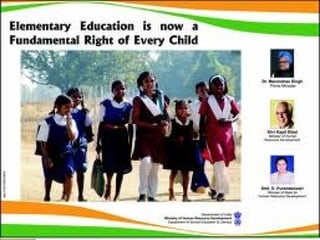
Right to Education(RTE)Right to Education(RTE)
11stst
April,2010April,2010
History of the ActHistory of the Act
December 2002
86th Amendment Act (2002) via Article 21A (Part III)
seeks to make free and compulsory education a
Fundamental Right for all children in the age group 6-14
years.
October 2003
A first draft of the legislation envisaged in the above Article,
viz., Free and Compulsory Education for Children Bill, 2003,
was prepared and posted on this website in October, 2003,
inviting comments and suggestions from the public at large.
2004
Subsequently, taking into account the suggestions received on
this draft, a revised draft of the Bill entitled Free and
Compulsory Education Bill, 2004, was prepared and posted
on the http://education.nic.in website.
History of the ActHistory of the Act
 June 2005
The CABE (Central Advisory Board of Education) committee drafted the
‘Right to Education’ Bill and submitted to the Ministry of HRD. MHRD
sent it to NAC where Mrs. Sonia Gandhi is the Chairperson. NAC sent
the Bill to PM for his observation.
 14th July 2006
The finance committee and planning commission rejected the Bill citing
the lack of funds and a Model bill was sent to states for the making
necessary arrangements. (Post-86th amendment, States had already cited
lack of funds at State level) Share of budget: 65:35 except NER 90:10 In
2010 share of financial assistant changed to 70:30 ration
 19th July 2006
Other organizations were invited for a Planning meeting to discuss the
impact of the Parliament action, initiate advocacy actions and set
directions on what needs to be done at the district and village levels.
History of the ActHistory of the Act
The bill was approved by the cabinet on 2 July
2009.
 Rajya Sabha passed the bill on 20 July 2009
 Lok Sabha on 4 August 2009.
 It received Presidential assent and was notified
as law on 3 Sept 2009 as The Children's Right to
Free and Compulsory Education Act.
 The law came into effect in the whole of India
except the state of Jammu and Kashmir from 1
April 2010, the first time in the history of India
Features of RTEFeatures of RTE
.. ..
 Free and compulsory Education
 Reservation of Seats
 Admission of Students
 No screening for admission
 Student Teacher Ratio
 Strict criteria of Teachers
 Physical Facilities
 Neighborhood Schools
 No board examination
 Certificate or Degree /
 Prohibition of proof age for admission
Challenges or Problems in Implementation ofChallenges or Problems in Implementation of
RTERTE
.. .. ..
Availability of teachers
Setting up of neighborhood schools
Laborers child
Financial Problem
Continuous Dropout in Govt. Institutions
Problem of implementation in Private Schools
Quality of Education
Implication of Right to EducationImplication of Right to Education
 RTE has been a part of the directive principles of the State Policy
under Article 45 of the Constitution, which is part of Chapter 4 of the
Constitution. And writes in Chapter 4 are not enforceable. For the
first time in the history of India we have made this right enforceable by
putting it in Chapter 3 of the Constitution as Article 21. This entitles
children to have the right to education enforced as a fundamental right.
 Education become fundamental right of all children’s
 Provide base for USE
 Proper use of RTE
 Increase accessibility of education
 Increase in enrolment
 State become responsible
 Development of physical facilities
 Helpful for weaker section and SC,ST category
.,.
 Equality

15918 right to education

  • 1.
    Right to Education(RTE)Rightto Education(RTE) 11stst April,2010April,2010
  • 4.
    History of theActHistory of the Act December 2002 86th Amendment Act (2002) via Article 21A (Part III) seeks to make free and compulsory education a Fundamental Right for all children in the age group 6-14 years. October 2003 A first draft of the legislation envisaged in the above Article, viz., Free and Compulsory Education for Children Bill, 2003, was prepared and posted on this website in October, 2003, inviting comments and suggestions from the public at large. 2004 Subsequently, taking into account the suggestions received on this draft, a revised draft of the Bill entitled Free and Compulsory Education Bill, 2004, was prepared and posted on the http://education.nic.in website.
  • 5.
    History of theActHistory of the Act  June 2005 The CABE (Central Advisory Board of Education) committee drafted the ‘Right to Education’ Bill and submitted to the Ministry of HRD. MHRD sent it to NAC where Mrs. Sonia Gandhi is the Chairperson. NAC sent the Bill to PM for his observation.  14th July 2006 The finance committee and planning commission rejected the Bill citing the lack of funds and a Model bill was sent to states for the making necessary arrangements. (Post-86th amendment, States had already cited lack of funds at State level) Share of budget: 65:35 except NER 90:10 In 2010 share of financial assistant changed to 70:30 ration  19th July 2006 Other organizations were invited for a Planning meeting to discuss the impact of the Parliament action, initiate advocacy actions and set directions on what needs to be done at the district and village levels.
  • 6.
    History of theActHistory of the Act The bill was approved by the cabinet on 2 July 2009.  Rajya Sabha passed the bill on 20 July 2009  Lok Sabha on 4 August 2009.  It received Presidential assent and was notified as law on 3 Sept 2009 as The Children's Right to Free and Compulsory Education Act.  The law came into effect in the whole of India except the state of Jammu and Kashmir from 1 April 2010, the first time in the history of India
  • 10.
    Features of RTEFeaturesof RTE .. ..  Free and compulsory Education  Reservation of Seats  Admission of Students  No screening for admission  Student Teacher Ratio  Strict criteria of Teachers  Physical Facilities  Neighborhood Schools  No board examination  Certificate or Degree /  Prohibition of proof age for admission
  • 11.
    Challenges or Problemsin Implementation ofChallenges or Problems in Implementation of RTERTE .. .. .. Availability of teachers Setting up of neighborhood schools Laborers child Financial Problem Continuous Dropout in Govt. Institutions Problem of implementation in Private Schools Quality of Education
  • 12.
    Implication of Rightto EducationImplication of Right to Education  RTE has been a part of the directive principles of the State Policy under Article 45 of the Constitution, which is part of Chapter 4 of the Constitution. And writes in Chapter 4 are not enforceable. For the first time in the history of India we have made this right enforceable by putting it in Chapter 3 of the Constitution as Article 21. This entitles children to have the right to education enforced as a fundamental right.  Education become fundamental right of all children’s  Provide base for USE  Proper use of RTE  Increase accessibility of education  Increase in enrolment  State become responsible  Development of physical facilities  Helpful for weaker section and SC,ST category .,.  Equality