 He is a British physicist and chemist and
known for his remarkable orbital theory
of the atom in his discovery of
Rutherford dispersion with his famous
gold foil experiment.
 He is also known as the “father of
nuclear physics”.
Purpose:
The purpose of the experiment is to test
the Plum-Pudding model of J.J.
Thomson
What did Rutherford do in the
experiment?
 Rutherford and his companions (Hans Geiger, a German
physicist and Ernest Marsden, an English physicist)
hammered a gold foil to a thin sheet approximately 8.6 x
10^(-6) centimetres thick.
 The experiment was performed in complete darkness in
order for the light of the alpha particles to be observed.
Hypothesis of the Experiment
If Thomson’s model is correct, high velocity of alpha
particles should pass through the foil in straight line
because:
1) The mass of the atom is spread out trough the atom .
2) Very little deflection of the beam of positively charged
particle will result from the repulsion of the positively-
charge material; and
3) Slight deflection due to collision with other atom.
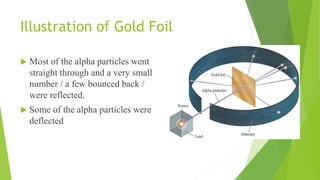
Illustration of Gold Foil
 Most of the alpha particles went
straight through and a very small
number / a few bounced back /
were reflected.
 Some of the alpha particles were
deflected
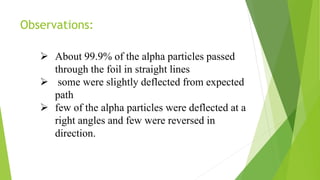
Observations:
 About 99.9% of the alpha particles passed
through the foil in straight lines
 some were slightly deflected from expected
path
 few of the alpha particles were deflected at a
right angles and few were reversed in
direction.
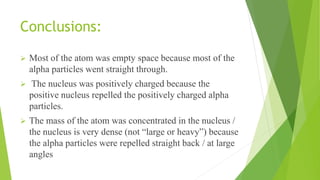
Conclusions:
 Most of the atom was empty space because most of the
alpha particles went straight through.
 The nucleus was positively charged because the
positive nucleus repelled the positively charged alpha
particles.
 The mass of the atom was concentrated in the nucleus /
the nucleus is very dense (not “large or heavy”) because
the alpha particles were repelled straight back / at large
angles
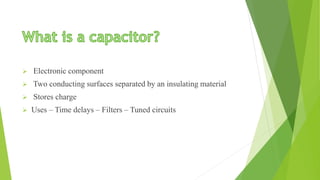
 Electronic component
 Two conducting surfaces separated by an insulating material
 Stores charge
 Uses – Time delays – Filters – Tuned circuits
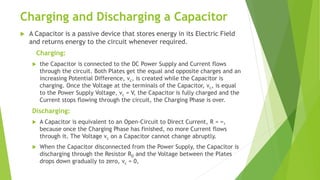
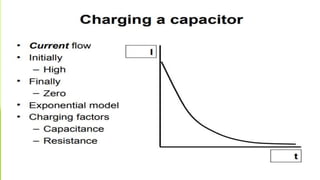
Charging and Discharging a Capacitor
 A Capacitor is a passive device that stores energy in its Electric Field
and returns energy to the circuit whenever required.
Charging:
 the Capacitor is connected to the DC Power Supply and Current flows
through the circuit. Both Plates get the equal and opposite charges and an
increasing Potential Difference, vc, is created while the Capacitor is
charging. Once the Voltage at the terminals of the Capacitor, vc, is equal
to the Power Supply Voltage, vc = V, the Capacitor is fully charged and the
Current stops flowing through the circuit, the Charging Phase is over.
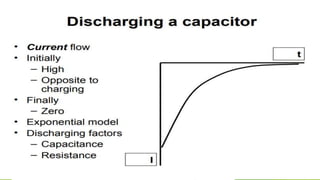
Discharging:
 A Capacitor is equivalent to an Open-Circuit to Direct Current, R = ∞,
because once the Charging Phase has finished, no more Current flows
through it. The Voltage vc on a Capacitor cannot change abruptly.
 When the Capacitor disconnected from the Power Supply, the Capacitor is
discharging through the Resistor RD and the Voltage between the Plates
drops down gradually to zero, vc = 0,
What are the differences between
conduction current , displacement
current and Convection currents?
Conducting current:
 A conduction current flows in a good conductor, e.g., a metal.
 It consists of free electrons which are the charge carriers.
 Strength is determined by the electrical conductivity of the material through
which the current flows
Displacement current:
 It is defined in terms of the rate of change of electric displacement field. The
units of displacement current are same as that of electric current density.
 Displacement current can exist in all materials, whether conducting or non-
conducting.
Displacement current:
 The electric field leads to some realignment of charges inside the material.
Electrons, though bound to the atoms, are displaced slightly opposite to the
direction of the electric field. The material thus gets polarized. If the electric field
is switched off, the electrons go back to their original configurations. If the
electric field changes direction repeatedly, the electrons move slightly to and fro
inside the material with the changing electric field. This slight movement of
electrons constitutes the displacement current.
Convection currents:
 Convection currents occur when there are significant differences in temperature
between two parts of a fluid. When this happens, hot fluids rise and cold fluids
sink. This causes movements or currents in the fluid.
 Convection can happen naturally or because of a moving device.
Convection currents:
 The fan is a device that produces the movement of the air
artificially. The air in this case is moving because of the
rotation of the fan. This is an example of "forced
convection". Natural convection happens because a fluid is
lighter if is hot and it is heavier if is cold, so if a fluid has a
hot part and a cold part, the hot part will naturally move
upward and the cold part naturally moves downward.
 For example, if the water in a pot is hotter near the bottom
because of the fire, it moves from the bottom to the surface.
At the same time the water near the surface is colder so it
moves to the bottom.
Thank You

Gold Foil Experiment Ernest RUtherford

  • 2.
     He isa British physicist and chemist and known for his remarkable orbital theory of the atom in his discovery of Rutherford dispersion with his famous gold foil experiment.  He is also known as the “father of nuclear physics”.
  • 3.
    Purpose: The purpose ofthe experiment is to test the Plum-Pudding model of J.J. Thomson
  • 4.
    What did Rutherforddo in the experiment?  Rutherford and his companions (Hans Geiger, a German physicist and Ernest Marsden, an English physicist) hammered a gold foil to a thin sheet approximately 8.6 x 10^(-6) centimetres thick.  The experiment was performed in complete darkness in order for the light of the alpha particles to be observed.
  • 5.
    Hypothesis of theExperiment If Thomson’s model is correct, high velocity of alpha particles should pass through the foil in straight line because: 1) The mass of the atom is spread out trough the atom . 2) Very little deflection of the beam of positively charged particle will result from the repulsion of the positively- charge material; and 3) Slight deflection due to collision with other atom.
  • 6.
    Illustration of GoldFoil  Most of the alpha particles went straight through and a very small number / a few bounced back / were reflected.  Some of the alpha particles were deflected
  • 7.
    Observations:  About 99.9%of the alpha particles passed through the foil in straight lines  some were slightly deflected from expected path  few of the alpha particles were deflected at a right angles and few were reversed in direction.
  • 8.
    Conclusions:  Most ofthe atom was empty space because most of the alpha particles went straight through.  The nucleus was positively charged because the positive nucleus repelled the positively charged alpha particles.  The mass of the atom was concentrated in the nucleus / the nucleus is very dense (not “large or heavy”) because the alpha particles were repelled straight back / at large angles
  • 9.
     Electronic component Two conducting surfaces separated by an insulating material  Stores charge  Uses – Time delays – Filters – Tuned circuits
  • 10.
    Charging and Discharginga Capacitor  A Capacitor is a passive device that stores energy in its Electric Field and returns energy to the circuit whenever required. Charging:  the Capacitor is connected to the DC Power Supply and Current flows through the circuit. Both Plates get the equal and opposite charges and an increasing Potential Difference, vc, is created while the Capacitor is charging. Once the Voltage at the terminals of the Capacitor, vc, is equal to the Power Supply Voltage, vc = V, the Capacitor is fully charged and the Current stops flowing through the circuit, the Charging Phase is over. Discharging:  A Capacitor is equivalent to an Open-Circuit to Direct Current, R = ∞, because once the Charging Phase has finished, no more Current flows through it. The Voltage vc on a Capacitor cannot change abruptly.  When the Capacitor disconnected from the Power Supply, the Capacitor is discharging through the Resistor RD and the Voltage between the Plates drops down gradually to zero, vc = 0,
  • 13.
    What are thedifferences between conduction current , displacement current and Convection currents? Conducting current:  A conduction current flows in a good conductor, e.g., a metal.  It consists of free electrons which are the charge carriers.  Strength is determined by the electrical conductivity of the material through which the current flows Displacement current:  It is defined in terms of the rate of change of electric displacement field. The units of displacement current are same as that of electric current density.  Displacement current can exist in all materials, whether conducting or non- conducting.
  • 14.
    Displacement current:  Theelectric field leads to some realignment of charges inside the material. Electrons, though bound to the atoms, are displaced slightly opposite to the direction of the electric field. The material thus gets polarized. If the electric field is switched off, the electrons go back to their original configurations. If the electric field changes direction repeatedly, the electrons move slightly to and fro inside the material with the changing electric field. This slight movement of electrons constitutes the displacement current. Convection currents:  Convection currents occur when there are significant differences in temperature between two parts of a fluid. When this happens, hot fluids rise and cold fluids sink. This causes movements or currents in the fluid.  Convection can happen naturally or because of a moving device.
  • 15.
    Convection currents:  Thefan is a device that produces the movement of the air artificially. The air in this case is moving because of the rotation of the fan. This is an example of "forced convection". Natural convection happens because a fluid is lighter if is hot and it is heavier if is cold, so if a fluid has a hot part and a cold part, the hot part will naturally move upward and the cold part naturally moves downward.  For example, if the water in a pot is hotter near the bottom because of the fire, it moves from the bottom to the surface. At the same time the water near the surface is colder so it moves to the bottom.
  • 16.